"Somebody grab that Black girl! She stole my wallet!"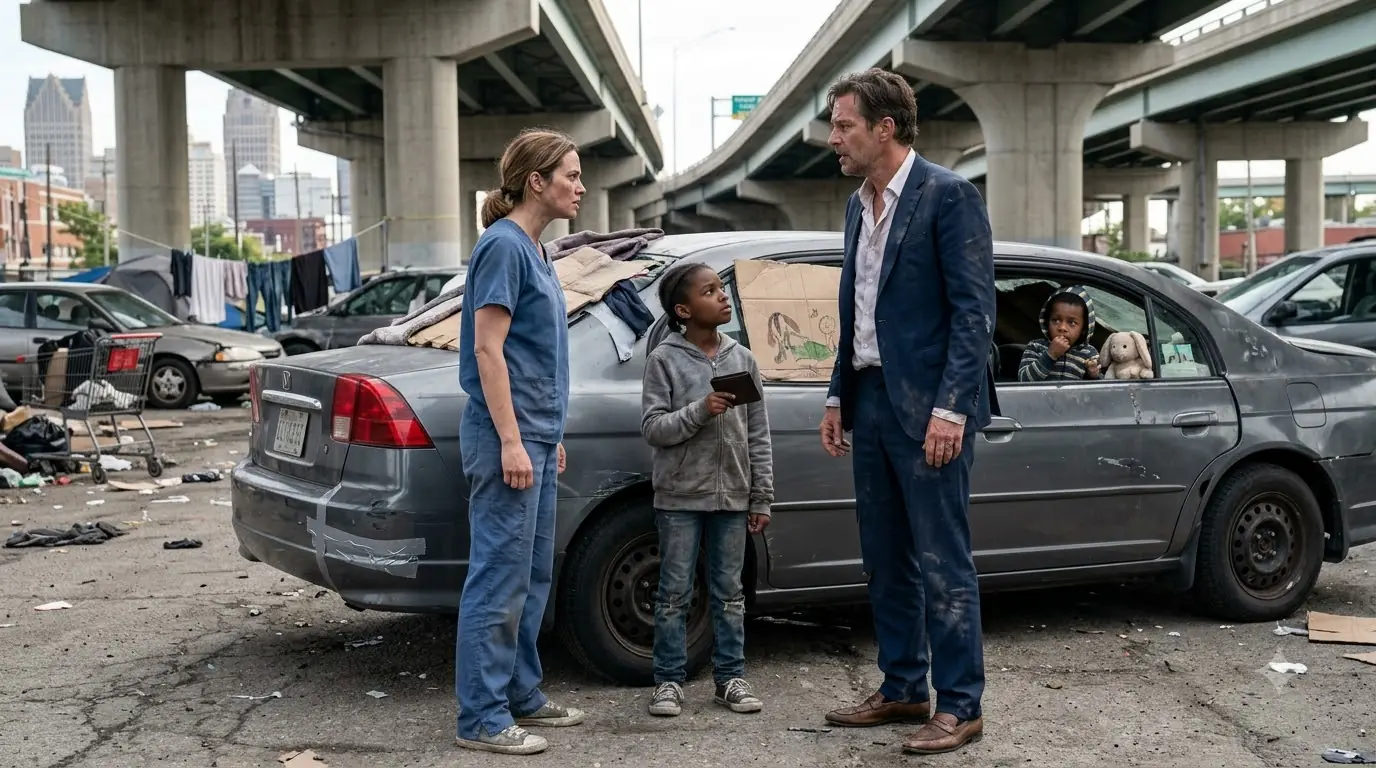
The billionaire's voice echoed across Michigan Avenue. Nobody moved. Nobody cared.
And the girl... she wasn't sprinting away. She was running slowly, glancing back, making sure he followed.
William Harrison jumped out of his Maybach and chased her himself: through crumbling streets, past houses marked with red X's, into a Detroit his money had destroyed. Her torn hoodie flapped behind her; her sneakers were worn through. Homeless for 2 weeks. But he didn't know that yet.
She wasn't fleeing; she was leading. Every time he got close, she slipped away, pulling him deeper into the ruins. The Black homeless girl who stole his wallet had a plan: a place she needed him to see, a place that would break his heart.
William's Italian loafers slapped against cracked pavement as he ran. This was insane. He was the CEO of a $2 billion company. He had a groundbreaking ceremony in 45 minutes; the mayor was waiting, the press was waiting, 300 VIPs were sipping champagne at a construction site, waiting to watch him turn a golden shovel. And here he was, chasing a 10-year-old girl through the worst part of Detroit.
His phone buzzed incessantly in his pocket: his assistant, the mayor's office, board members demanding to know why the CEO wasn't at his own ceremony. He ignored them all, because something about this girl made him keep running. The way she moved: not panicked, not desperate, calculated. Every turn seemed planned. Every glance back felt like an invitation rather than a check for pursuit.
Follow me, her eyes said. I dare you.
She ducked down an alley littered with broken glass and rotting garbage. William followed, his $3,000 suit jacket catching on a rusted fire escape. The gleaming towers of downtown had vanished behind him. Now he ran through a different Detroit: the one that didn't appear in development brochures or investor presentations, the Detroit that existed in the margins, in the shadows, in the spaces between progress and poverty.
Boarded windows everywhere. Sagging porches that looked like they might collapse at any moment. Houses marked with red X's—the brand of condemnation, the death sentence that preceded the wrecking ball.
Graffiti screamed from every wall: HARRISON = THIEVES 52 FAMILIES DISPLACED WHERE DO WE GO NOW? YOUR PROFIT = OUR PAIN
His name. His company. His project.
William's lungs burned, but he pushed harder. The girl was 30 feet ahead now, weaving through debris with the ease of someone who had walked these streets a thousand times.
"Wait!" he shouted. "I just want to talk!"
She didn't stop. But she didn't speed up, either. Just kept that same deliberate pace—fast enough to stay ahead, slow enough to ensure he followed.
They passed a demolition site where a house lay half-destroyed, its guts spilled across the yard like a body after surgery: furniture, photo albums, a child's bicycle crushed beneath a fallen beam, a pink backpack half-buried in rubble.
An elderly woman sat on the curb nearby, clutching a cardboard box to her chest. Inside the box, William glimpsed photographs yellowed with age, curling at the corners—a lifetime of memories reduced to a single container.
She looked up as William ran past, and her eyes went wide. "That's him," she said to no one. "That's the man whose name is on the paper. That's the one who took everything."
William didn't stop. Couldn't stop. The girl was getting away. But the woman's words burrowed into his skull like a splinter: The man whose name is on the paper. What paper? What had his name done here?
The girl turned another corner, disappearing around a crumbling brick wall. William followed and nearly collided with a chain-link fence that stretched across the alley. Dead end.
He spun around, searching frantically. There: a hole in the fence, edges worn smooth from repeated use. Someone had been coming through here regularly. He squeezed through, tearing his jacket on the wire, feeling the fabric give way like skin.
On the other side: an overpass. Interstate 94 roared overhead, a river of traffic carrying people to jobs and homes and lives that had nothing to do with the world beneath the concrete shadow.
And in that shadow, a community: three cars parked in a row, their windows covered with blankets and cardboard for privacy; a makeshift clothesline strung between two shopping carts, laundry flapping in the exhaust-tinged breeze; a man sitting in a lawn chair, reading a water-damaged paperback like this was the most normal thing in the world. Because for him, it was.
This wasn't a campground. This wasn't temporary. This was where people lived.
The girl had finally stopped. She stood next to a faded Honda Civic: paint peeling, bumper held together with duct tape, backseat converted into a makeshift bed visible through the dirty windows. She wasn't running anymore. She was waiting.
William approached slowly, gasping for breath, hands on his knees. His shirt was soaked with sweat. His shoes were ruined. His designer suit was torn and covered in dust. He looked nothing like the polished CEO who had stepped out of a Maybach 15 minutes ago.
"Why?" he panted. "Why did you—"
The car door opened, and a woman stepped out who looked at William Harrison like he was the devil himself. She was young, early 30s, but exhaustion had carved years into her face: dark circles shadowed bloodshot eyes; hair pulled back in a messy ponytail, strands escaping in every direction; nurse's scrubs wrinkled and stained, clearly slept in for days.
But her eyes—her eyes were fire.
"Zuri!" her voice cut through the noise of traffic overhead. "What did you do?"
"I brought him, Mama." The girl, Zuri, held up William's wallet. "I brought the man whose name stole our house."
The woman's face cycled through emotions like a slot machine: confusion, recognition, disbelief, and finally a rage so pure it seemed to radiate heat.
"You're William Harrison," she said. Not a question.
"I... yes."
"Your name is on the paper." She stepped forward, and William instinctively stepped back. "Your signature threw my family out of our home. Your company put my children in this car."
From inside the Honda, a small face appeared in the window: a boy, maybe 4 years old, thumb in his mouth, wide eyes watching everything. He coughed—a wet, rattling sound that spoke of cold nights and inadequate shelter.
"That's Isaiah," Zuri said quietly. "He's been sick since we lost the house. 2 weeks. Mama takes him to the clinic, but sleeping in a car isn't good for him."
William stared at the vehicle: the blankets piled in the backseat; the children's drawings taped to the inside of the windows—crayon houses and smiling stick figures, desperate attempts to make this metal box feel like home; a stuffed rabbit with one ear missing, propped against the window like a guardian.
His name had done this. His company. His project.