"Get your hands off that piano."
"I was only wiping it down," Tessa began.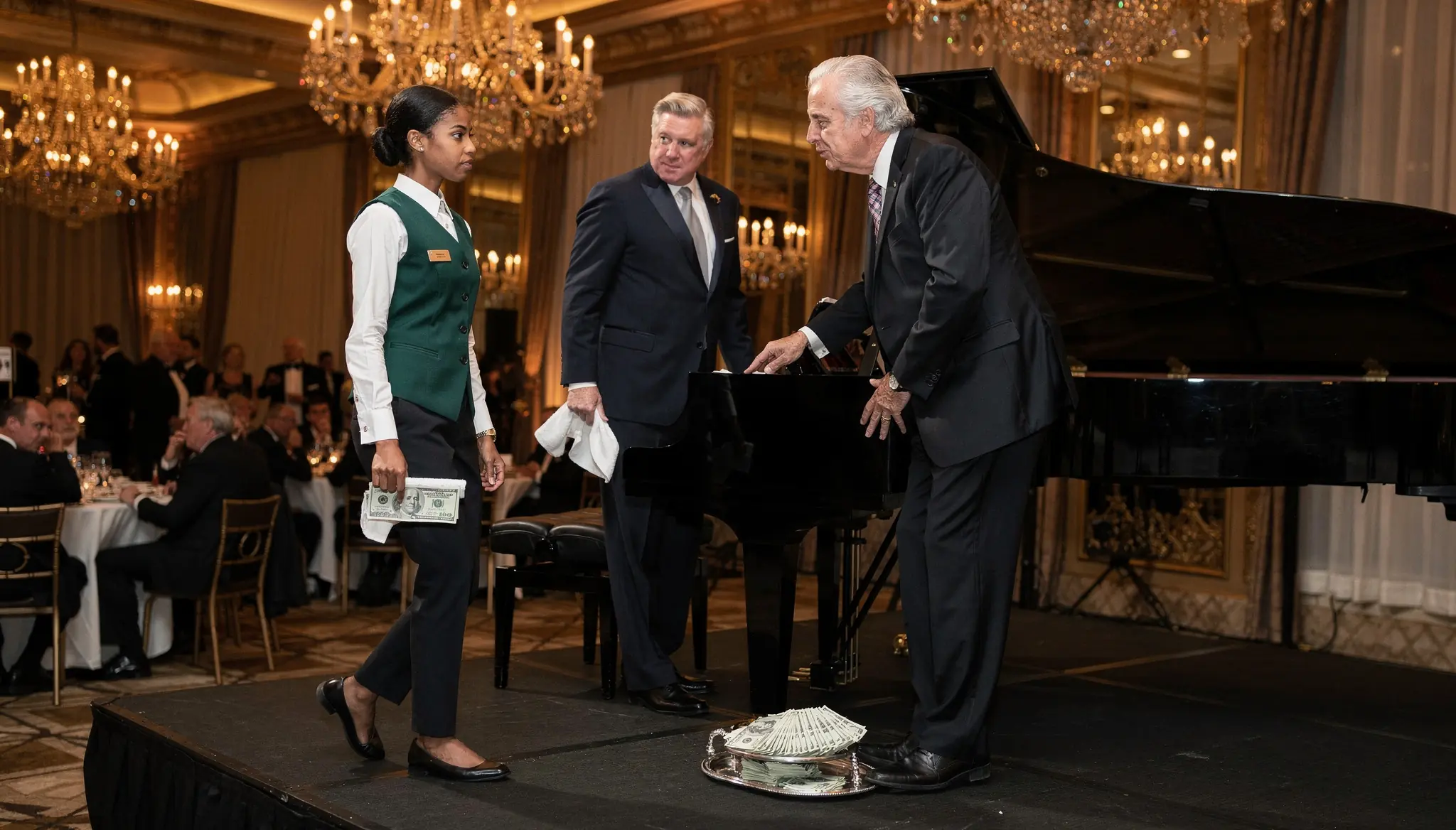
"Be quiet. Nobody asked you to speak." Grant Holloway ripped the cloth from her fingers as four hundred guests stared. "This costs more than every paycheck you will ever earn." He flicked one hand toward her uniform. "That uniform is the only reason someone like you belongs near my piano."
"Ridiculous," Tessa Powell said, looking him straight in the eye. Holloway grabbed the microphone with a smirk and pulled her toward the piano. "Play something right now. Ten thousand dollars says this woman cannot even find middle C." He leaned close. "Start your performance, the only thing you are good for, or I will fire you."
Phones rose. Laughter spread like wildfire. Tessa set down her tray, sat at the bench, and placed her fingers on the keys. What happened next plunged the entire party into deathly silence. Six hours before Grant Holloway dragged her onto that stage, Tessa Powell was standing in front of her bathroom mirror, pressing a damp cloth against the circles under her eyes.
The faucet dripped. The radiator clanked. Outside, Harlem was waking up. Garbage trucks groaned down Lenox Avenue while a dog barked three floors below. Her studio apartment barely fit a bed, a folding table, and a keyboard with 14 dead keys.
She kept it anyway. Some nights, after double shifts, she'd sit in the dark and let her fingers move across the silent keys, playing songs only she could hear. The neighbors never complained about noise. There was never any noise to complain about. Tessa was 28.
She hadn't touched a real piano in six years. At nineteen, she had been a third-year student at Juilliard on a full scholarship. The admissions panel had accepted her unanimously, the first time in four years they had done that for anyone. Her professors called her a once-in-a-decade talent. Dr. Evelyn Marsh, head of the piano faculty, once stopped a master class mid-session and told the room, "Listen to her phrasing. That is not technique. That is a conversation with a composer." Thirty students had turned to look at Tessa.
She'd stared at her hands, embarrassed. But somewhere deep inside, she'd felt it. The certainty that music was the one thing in her life that would never betray her. She'd been wrong about that. Her junior recital had been scheduled for November 15.
She had spent months preparing Chopin's Ballade No. 1 in G minor. "The piece that separates students from artists," her professor had said. She'd practiced until her fingers cramped, until the notes lived inside her bloodstream. She never played that recital. On October 3, her mother called.
Ruth Powell's voice was thin on the phone, the way paper sounds when it's about to tear. "Baby, I need you to come to the hospital. Do not rush, but come." Ruth Powell had cleaned offices in Midtown for 22 years, six days a week. She never complained about the hours, never complained about the pay. She never took a sick day, not once. Because sick days meant less money.
And less money meant Tessa might have to leave school. She only ever said one thing about work. "I clean their floors so you can play their stages." The diagnosis was pancreatic cancer, stage four. The doctors gave her five months. She lasted three.
Tessa remembered the last conversation. Ruth lying in the hospital bed, skin like parchment, fingers still warm. "Don't you dare quit that school," she had whispered. "Promise me." Tessa had promised. She'd lied.
She left Juilliard the week after the funeral. There was no real choice to make. Nadia was 12. Somebody had to be home when she got off the school bus. Somebody had to sign the permission slips and pack the lunches and make sure the electricity stayed on.
Somebody had to hold Nadia when she woke up crying at 2:00 in the morning asking where Mama went. The scholarship office called twice. Her adviser called three times. Dr. Marsh left a voicemail that Tessa still hadn't deleted. Six years later, it was still sitting in her phone like a ghost.
Crystal chandeliers hung from ceilings she wasn't allowed to look up at while working. Marble floors she was not allowed to walk across in her work shoes. She learned the rules fast. Don't make eye contact with VIPs unless they speak first. Don't linger at tables.
Don't exist louder than necessary. Six years passed like water through a cracked glass. Slow, steady, and impossible to hold. Nadia was 18 now, senior year at Harlem Renaissance High School. Smart, fierce.
She'd gotten into three colleges, Howard, Spelman, and NYU. All three cost money Tessa didn't have. The acceptance letters sat on the kitchen table, weighed down by a coffee mug, unopened. Every time Tessa looked at them, her chest tightened like someone was pulling a belt around her ribs. Tonight's gala was supposed to help.
The Holloway Foundation annual charity gala, black tie, five-course dinner, a live auction where rich people bid on things they didn't need to fund causes they'd forget by Monday. The servers received time-and-a-half plus a guaranteed tip pool. Her manager, Bradley Nash, had promised at least $300 extra per person. Three hundred dollars. That was Nadia's textbook deposit.
Tessa ironed her uniform at 5:30, black pants, white shirt, black vest. She pinned her name tag straight. Tessa, banquet staff. Then tied her hair back. In the mirror, she didn't look like someone who'd once made an auditorium full of musicians cry with Chopin.
She looked like someone who carried plates. The Langford's grand ballroom was already transformed when she arrived for the 6:00 briefing. White linens on 60 round tables, centerpieces of white roses and eucalyptus, a twenty-foot banner reading The Holloway Foundation Building Futures stretched across the back wall. The irony of that word, futures, landed on Tessa like a stone. And on the stage, under a single spotlight, sat a Steinway Model D concert grand piano.
Nine feet of polished ebony. The same model she'd played at her junior recital rehearsal. The same model that lived in her dreams and her nightmares. Tessa stopped when she saw it, just for a second. Her fingers tingled, a phantom reflex like a limb that had been amputated but still ached in the rain.
Bradley caught her staring. "Do not even think about it," he said, not unkindly. "That thing is worth two and a half million dollars. Holloway shipped it in from his penthouse for tonight. Nobody touches it except the performer."
"Who is performing?"
"Some concert pianist. Eleanor something." Bradley checked his clipboard. "Focus on section twelve. Those are the donor tables. Big money. Smile, pour from the right, and clear from the left. Whatever you do, do not spill on anyone worth more than this building." Tessa nodded. She'd done this a hundred times. She knew how to disappear, how to be furniture with a pulse. But as she walked to her section, she passed the piano one more time.
Close enough to smell the lacquer. Close enough to see her reflection warped in its polished surface, distorted, stretched. A version of herself she barely recognized. Her fingers twitched against her thigh. She kept walking.
Grant Holloway arrived at 7:15, 45 minutes late to his own gala. He didn't apologize. Men like Holloway didn't apologize. They arrived and the room adjusted. He came through the ballroom's east entrance flanked by two bodyguards in charcoal suits, a personal assistant clutching a tablet, and a woman half his age wearing a dress that cost more than Tessa's annual rent.
Behind them trailed three investors from his real estate group, Holloway Capital Partners. Each one laughing at something Grant had said in the elevator. The laughter was too loud, too eager. The kind of laughter people perform when they need something from the person telling the joke. Holloway was fifty-eight, tall, silver-haired, jaw like a shovel.
He wore a custom Tom Ford tuxedo with a pocket square folded into three precise peaks. The kind of detail that screamed, Someone else dressed me, and I paid them well. His watch alone, a Patek Philippe Nautilus, could have funded Nadia's entire college education. Four years, room and board included. He owned 32 commercial properties across Manhattan, Brooklyn, and Jersey City.
His net worth, according to Forbes, hovered around $4.6 billion. He'd built his empire buying up rent-stabilized buildings in black and Latino neighborhoods, gutting them, and flipping them into luxury condos. Entire communities displaced. Families who'd lived in the same apartment for three generations suddenly found eviction notices taped to their doors. Holloway Capital Partners called it urban revitalization.
The tenants called it something else. None of that was in the gala program, of course. Tonight, Grant Holloway was a philanthropist, a builder of futures. The banner behind the stage said so. He took his seat at the center of table one, the power table, closest to the stage.
His chair was slightly larger than the others. Nobody mentioned it. Everyone noticed. Within minutes, he was holding court, voice booming across the table, cutting through the string quartet playing Vivaldi in the corner. He told a story about a yacht trip in Monaco.
He told another about a senator who owed him a favor. The investors nodded. The woman beside him smiled on cue. Then he snapped his fingers at a passing server. Tessa was three tables away, pouring Bordeaux for a hedge fund manager's wife, when she heard it.
The snap. Sharp and dry, like a twig breaking. "You, come here." A server named Darnell Walker, twenty-three, new to the job and still learning which fork went where, walked over to table one. He was carrying a tray of crab cakes. "I asked for the lobster bites fifteen minutes ago," Holloway said without looking up from his phone.
"I am sorry, sir. I will check with the kitchen right away."
"Do not check. Just do it." Holloway waved him off like swatting a fly. Then to the table, loud enough for the neighboring tables to hear, "You would think that, for what I am paying this hotel, they would hire people who can follow a simple instruction." Darnell's jaw clenched. He turned and walked toward the kitchen without a word. Tessa watched him go. She'd seen that walk before.
The stiff spine, the controlled breath, the refusal to let anyone see the humiliation land. She'd done that walk herself more times than she could count. The evening continued. Holloway gave his keynote speech at 8:00. 12 minutes of rehearsed generosity.
He talked about opportunity. He talked about giving back. He talked about how his foundation had funded scholarships for underprivileged youth, how music education changed lives, how every child deserved a chance to shine. The audience applauded. Tessa stood at the edge of section 12 holding a water pitcher and felt something bitter rise in her throat.
She swallowed it down the way she always did. After the speech, Holloway returned to his table and ordered another scotch. His voice got louder. His gestures got wider. He leaned back in his chair like a man who owned the room.
Which technically, he did. He'd rented the entire ballroom for the evening. $80,000. A rounding error in his monthly budget. At 9:15, the concert pianist Bradley had mentioned, Eleanor Vance, still had not arrived.
Holloway checked his watch, whispered to his assistant. The assistant made a call, then shook her head. Holloway's face darkened. He didn't like waiting. He didn't like plans that didn't go his way, and more than anything, he didn't like looking like a man who couldn't deliver what he'd promised.
He scanned the room, irritation tightening his jaw. His eyes swept past the chandeliers, past the auction displays, past the servers moving silently between tables. And then his gaze landed on the piano. And then on the woman standing six feet from it, wiping down an empty table with a white cloth. A slow smile crept across Grant Holloway's face.
The kind of smile that never meant anything good. It started with a single note. Tessa was wiping down the table closest to the stage when her hip brushed the edge of the piano bench. She reached out to steady herself and her hand landed on the keys. One note.
A low E-flat rang out across the ballroom like a bell in an empty church. Conversation stopped. Heads turned. Tessa pulled her hand back as if the keys had burned her. She grabbed her cloth and stepped away, eyes down, heart hammering.
Too late. "Well, well, well." Holloway's voice hit the microphone before Tessa could make it three steps. He was already standing, scotch in one hand, mic in the other. That smile still carved into his face. "Ladies and gentlemen, it seems we have found our entertainment for the evening." A few guests chuckled.
Most just watched, the way people watch a car drifting toward a guardrail. Curious, uncomfortable, unwilling to look away. "You there." Holloway pointed at Tessa. "The one who just touched my piano. Come here." Tessa froze. Every instinct told her to keep walking, disappear into the kitchen, become invisible again.
"I said, come here. Do not make me ask twice." She turned. Four hundred faces stared back at her. The ballroom felt enormous, a cavern of white linen and candlelight and judgement. She could feel the heat of the spotlights on the stage. She could hear her own breathing.
She walked to the edge of the stage. Holloway looked down at her from the platform like a king addressing a peasant. "What is your name?"
"Tessa."
"Tessa." He repeated it slowly, tasting the word and finding it insufficient. "And what do you do here, Tessa?"
"I am banquet staff, sir."
"Banquet staff?" Holloway turned to the audience, eyebrows raised as if she'd said something hilarious. "Banquet staff just put careless hands on a two-and-a-half-million-dollar Steinway." He paused for effect. "Do you know where that piano has been played? Carnegie Hall, Lincoln Center, the Vienna Musikverein. And tonight, it was handled by a waitress." Laughter. Real laughter this time. The kind that comes from relief.
Relief that someone else is the target. Tessa's hands curled into fists at her sides. She said nothing. Holloway wasn't finished. He set down his scotch and stepped closer to the piano, running his fingers along its lid with exaggerated reverence.
"You know what? I had a performer lined up tonight. Apparently, she is stuck in traffic or dealing with something equally inconvenient." He spun back to Tessa. "So, how about you fill in?" A murmur rippled through the crowd. "Sit down." He pulled out the bench and patted it. "Play us something, anything. Twinkle, Twinkle, Little Star. Mary Had a Little Lamb. Whatever they taught you where you grew up. The Bronx? Harlem?"
"Harlem," Tessa said quietly.
"Harlem. Of course." Holloway grinned. "Tell you what. I will make it interesting." He reached into his jacket and pulled out his wallet. Slowly, deliberately, he counted out hundred-dollar bills. One, two, three, all the way to a hundred. $10,000.
He fanned them out on top of the piano like a deck of cards. "Ten thousand dollars says you cannot play a single real piece on this instrument. Not a pop song, not a hymn. A real classical piece, the kind this piano was built for." He leaned into the microphone. "And if you cannot, which we all know you cannot, you walk out of here tonight with no pay and no tips, and you never set foot in this building again." The room went quiet. Not the polite quiet of a speech, the sharp, breathless quiet of a crowd watching someone get cornered.
At table nine, a woman in a beaded gown whispered to her husband, This is awful. She didn't stand up. She didn't say it louder. She just whispered it and took another sip of wine. At table three, Darnell Walker stood frozen with a tray of champagne flutes, his knuckles white around the handles.
Bradley Nash, Tessa's manager, was by the service entrance. He stared at his shoes. Nobody moved. Nobody spoke. Nobody told Grant Holloway to stop.
Holloway spread his arms wide, basking. "What do you say, Tessa from Harlem? Do you want to earn ten thousand dollars the hard way?" He tilted his head, mock sympathy dripping from every syllable. "Or is this too much for you? Because I completely understand. Not everyone was built for this stage." Tessa stood at the foot of the platform. The spotlight above her was blinding.
She could feel the weight of four hundred stares pressing against her skin like hands. She could turn around, walk to the kitchen, clock out, take the bus home, sit in the dark with her dead keyboard and pretend tonight never happened. She could do what she'd been doing for six years. She could disappear. The silence stretched.
Holloway's smile widened. He was already tasting the punchline. The waitress who couldn't play. The humiliation that would become his favorite dinner party story for years. Tessa stared at the piano and somewhere beneath the fear, beneath the shame, beneath six years of silence, something shifted.
She heard her mother's voice. Not the frail voice from the hospital bed. The strong one. The one from Saturday mornings in their apartment when Ruth would sit beside her on the wobbly bench in front of their second-hand upright and say, "Play it again, baby. But this time, play it like you mean it." And then another voice, Dr. Marsh standing at the front of the master class, arms crossed, nodding slowly.
"That is not technique. That is a conversation with the composer." And then Nadia, 12 years old, standing in the doorway of Tessa's room the night she packed up her sheet music. "You are going to play again someday, right? Promise?" Tessa had said yes. Another promise. Another lie. She looked at Holloway.
He was leaning against the piano, arms folded, waiting for her to crumble. Behind him, four hundred people sat in their chairs like an audience at a trial, waiting for the verdict. She thought about the bus ride home, the dark apartment, the dead keyboard, the acceptance letters on the kitchen table that she couldn't afford to open. She thought about six years of pouring wine for people who never learned her name.
six years of don't make eye contact. six years of being furniture with the pulse. And she thought about the fact that the instrument sitting on that stage, that 9-ft Steinway Model D worth two and a half million dollars, was the same model she'd rehearsed on for her junior recital. The recital she never got to play. Her mother had cleaned floors so Tessa could play stages.
Tonight, there was a stage. Tessa climbed the three steps to the platform. Her shoes, flat black non-slip shoes issued by the hotel, made no sound on the polished wood. She didn't look at Holloway. She didn't look at the crowd.
She walked past the fanned-out hundred-dollar bills on the piano lid and sat down on the bench. She placed her fingers on the keys. Cool ivory. Familiar weight. Like shaking hands with someone she hadn't seen in years.
Holloway chuckled into the microphone. "Oh, this is going to be good." Tessa closed her eyes. "I will take that bet," she said. And then there was silence. The first note was almost nothing.
A whisper. A single G was pressed so softly that only the people in the first three rows heard it. It hung in the air like smoke, fragile, uncertain, ready to vanish. Holloway smirked. He turned to table one and mouthed, "Told you," he mouthed.
Then Tessa played the second note. And the third. And the fourth. The opening of Chopin's Ballade No. 1 in G minor unfolded from her fingers like a secret being told for the first time. Slow.
Tentative. The melody rose and fell in gentle waves. Each phrase reaching forward, then pulling back, as if the music itself wasn't sure it was allowed to exist. In the first 10 seconds, a few guests exchanged glances. Polite interest.
Mild surprise. The kind of reaction you give when something isn't as bad as you expected, but you're still waiting for the mistake. The mistake didn't come. Tessa's left hand found the bass line. A low, rolling murmur beneath the melody, steady as a heartbeat.
Her right hand began to climb. The phrases grew longer, fuller. The hesitation bled away, replaced by something that had no name. Something between memory and instinct, between grief and defiance. She wasn't reading sheet music.
She didn't need to. This piece lived inside her. It had lived inside her for six years, curled up in the dark like a sleeping animal, waiting to be woken. At the 30-second mark, the first modulation hit. The key shifted and the melody darkened.
Tessa's fingers pressed harder. The Steinway responded like it had been waiting for her. The hammers striking the strings with a resonance that filled every corner of the ballroom. The sound didn't just travel. It occupied.
It took up space the way a storm takes up sky. A woman at table seven set down her wine glass. She didn't pick it up again. At table 12, a retired music professor named Harold Bennett leaned forward in his chair. His wife touched his arm.
He didn't notice. His lips were moving silently, counting the time signature, tracking the voicing. After forty years of teaching music theory at Columbia, he knew what conservatory level playing sounded like. This wasn't conservatory level. This was beyond it.
At table five, a teenage girl, someone's granddaughter dragged to the gala against her will, lowered her phone from her Instagram feed and pointed it at the stage. She pressed record. Within twenty-four hours, that video would have eleven million views. But she didn't know that yet. She just knew she'd never heard anything like it.
Holloway's smirk was still there, but it had frozen. His eyes tracked Tessa's hands, moving now with a fluidity that shouldn't have been possible for someone who hadn't played in six years. Fast. Precise. The kind of speed that takes 10,000 hours to build and a lifetime to lose.
Except she hadn't lost it. The muscle memory had been sleeping, not dead. The moment her fingers touched the keys, it woke. Every hour she'd spent in practice room 4B at Juilliard, the late nights, the cramped fingers, the repetitions until the notes became reflex, came flooding back like water finding its old channel. The ballade entered its first dramatic passage, a cascade of sixteenth notes tumbling down the keyboard like water over rocks.
Tessa's wrists rolled, her fingers barely lifting between strikes, and the sound became a river. Not a gentle river. A river in spring, swollen and wild, tearing at its banks. People stopped eating. Forks rested on plates.
Napkins stayed in laps. The string quartet in the corner had put down their instruments and were watching, mouths slightly open. The first violinist, a woman who'd played with the New York Philharmonic for nine years, pressed her hand against her chest as if something inside it had come loose. A waiter carrying a tray of desserts stopped in the middle of the aisle between tables eight and nine.
He stood there, motionless, a crème brûlée slowly sliding toward the edge of the tray. He didn't notice. Nobody told him to move. Holloway shifted in his seat. He reached for his scotch.
His hand trembled. Just slightly. Just enough that his assistant noticed and looked away. The investors at his table had stopped paying attention to him entirely. Their chairs had turned inch by inch toward the stage.
Holloway was losing the room, and he could feel it leaving him the way heat leaves a body. Slowly at first. Then all at once. The ballad's middle section arrived, the lyrical heart of the piece where Chopin wrote a melody so achingly beautiful that pianists have described it as the sound of someone remembering a love they'll never see again. Tessa played it with her eyes closed.
Her body swayed. Her lips parted. For the first time in six years, she wasn't in a ballroom. She wasn't wearing a server's uniform. She wasn't anyone's waitress.
She was sitting in practice room 4B at Juilliard late at night, the hallway empty, playing for no one but herself and the ghost of her mother sitting beside her on the bench. Ruth's voice came to her, warm and steady. "Play it like you mean it, baby." She meant it. The melody soared. A single high note, an A-flat, rang out and held, sustained by the pedal, vibrating in the air like a wire pulled taut.
The chandeliers trembled. Someone at table four would later swear they saw the candle flames lean toward the stage. The waltz section bloomed, Chopin's hidden dance inside the Ballade, the three-four time signature lifting the melody off the ground. Tessa's touch became feather-light. The notes sparkled like light on moving water.
And then, without warning, the waltz fractured. The rhythm broke apart. Dissonance crept in. Chopin's genius, the way he wove beauty and destruction into the same phrase. Tessa leaned into the dissonance.
She didn't soften it. She let it scrape, let it ache, let it sound exactly like what it was. Something beautiful being torn apart by something it couldn't control. At table one, Holloway's date, the woman in the expensive dress, had stopped smiling. Her hand was over her mouth.
Her mascara was running. Then silence. Not a pause. Not a breath. A silence so absolute that four hundred people became aware of their own heartbeats.
The ballroom held still. No one coughed. No one shifted. No one breathed. Three seconds.
Four. Five. Holloway's smile was gone. His jaw was slack. The scotch sat untouched in his hand, the ice melting.
He looked like a man who had just realized the punchline of his own joke was him. Tessa opened her eyes. And then, she brought the storm. The Ballade's final section exploded from the piano like something that had been caged for years and had finally broken free. Tessa's hands became a blur.
Octave runs, crashing chords, arpeggios that spiraled upward and shattered at the top like waves against a cliff. The sound filled the ballroom the way thunder fills a valley. Not just heard, but felt in the chest, in the teeth, in the floor beneath their feet. Her left hand hammered bass notes that shook the water glasses on the nearest tables. Her right hand flew across the upper register pulling melodies out of the instrument that didn't sound like they could come from human fingers.
The Steinway sang and roared and wept all at once. And the woman playing it looked like she was fighting and surrendering at the same time. At table nine, the woman in the beaded gown, the one who had whispered, This is awful. during Holloway's humiliation, was crying. Tears ran down her cheeks and she made no move to wipe them.
At table one, one of Holloway's investors had pushed his chair back from the table as if the sound was a physical force. He stared at Holloway with an expression that wasn't admiration. It was something closer to disgust. The slow, dawning recognition that the man he'd been laughing with 20 minutes ago had just tried to destroy something sacred for sport. Darnell Walker stood by the kitchen entrance, champagne tray still in his hands, tears streaming silently down his face.
He didn't know why he was crying. He just knew he couldn't stop. Bradley Nash had come out from behind the service entrance. He was leaning against the wall, arms crossed, chin trembling. And at table two, the VIP table closest to the stage, a seventy-two-year-old woman with silver hair and sharp eyes sat perfectly still.
Eleanor Vance, the concert pianist who was supposed to perform tonight, the one stuck in traffic. She had arrived twelve minutes earlier, slipped in through the side door and taken her seat without a word. She hadn't announced herself. She hadn't interrupted. Because from the moment she heard the first eight bars, she knew.
She knew exactly what she was listening to. She recognized the Juilliard technique, the wrist position, the pedal control, the way Tessa voiced the inner melodies that most pianists buried under volume. She recognized the phrasing that Dr. Marsh had once described in a faculty meeting as "the most natural musicality I have encountered in thirty years of teaching." Eleanor Vance had played Chopin's Ballade No. 1 on six continents. She had performed it at the Royal Albert Hall, at the Sydney Opera House, at the Berliner Philharmonie.
She knew every note, every dynamic marking, every breath the piece demanded. And she knew, with the certainty of someone who had spent a lifetime listening, that the woman on that stage was playing it better than she ever had. The final passage arrived. Tessa's hands converged on the keyboard center, building a wall of sound that rose and rose and rose. And then, in the last four bars, collapsed into a single quiet chord.
G minor. The key it began in. The key it always returns to. The last note faded. Tessa's hands lifted from the keys and settled in her lap.
Silence. One second. Two seconds. Three. Then a chair scraped.
Eleanor Vance stood up. She raised her hands above her head and began to clap, slowly, deliberately. Each clap landing like a verdict. A second person stood, then a third, then 10, then 50, and then four hundred people were on their feet, and the ballroom erupted with a sound that was louder than anything the Steinway had produced. The sound of people who had just witnessed something they would never be able to explain to anyone who wasn't there.
The standing ovation lasted ninety seconds. Tessa sat on the bench, hands in her lap, tears running down her face. She didn't wipe them. She didn't move. She just sat there in the spotlight and let the sound wash over her like rain after a drought.
The applause was still thundering when Eleanor Vance walked to the stage. She didn't rush. She moved the way someone moves when they've spent fifty years commanding concert halls. Steady. Unhurried.
Every step deliberate. The crowd parted for her without being asked. People recognized her face from album covers, from PBS specials, from the cover of Time magazine's 100 most influential musicians issue eleven years ago. She climbed the three steps to the platform. Tessa was still sitting at the bench, tears drying on her cheeks, hands trembling in her lap.
She looked up and saw the silver-haired woman standing over her and didn't understand. Eleanor extended her hand. "Stand up, dear." Tessa stood. Her legs shook. Eleanor took both of Tessa's hands in hers and held them up.
Those hands, the ones Holloway had called greasy, the ones that had just made four hundred people forget where they were. "My name is Eleanor Vance," she said into the silence. "I was supposed to perform tonight. I arrived late." She paused, looked out at the audience. "I am grateful I was late, because if I had been on time, none of you would have heard what you just heard." She turned back to Tessa.
Her voice was quiet now, but the microphone caught every word. "I have heard thousands play that piece at the Royal Albert Hall, at the Vienna Musikverein, and at competitions where the best young pianists in the world fight for a single prize." She squeezed Tessa's hands. "Fewer than ten ever played it the way you just did." The ballroom erupted again. Not polite applause this time.
Something raw. Something that sounded like relief and rage and joy all tangled together. Tessa couldn't speak. Her chin trembled. She pressed her lips together and nodded.
One small nod. The kind you give when you're afraid that if you open your mouth, everything inside you will come pouring out. And then Four hundred faces turned toward Grant Holloway. He was still at table one, still in his oversized chair, but he didn't look like a king anymore. He looked like a man standing in a room where the oxygen had been replaced with something he couldn't breathe.
His face was white. Not pale. White. The color of paper. The color of surrender.
The investors at his table had shifted their chairs away from them. Not dramatically. Just enough. An inch. Two inches.
The kind of distance that says everything without saying a word. His assistant was staring at her tablet pretending to read something. His date was looking at the floor. The teenage girl at table five, the one who'd been recording, had turned her phone toward Holloway. The red dot was still blinking.
Someone at table eight said, loud enough for the room to hear, "You owe her ten thousand dollars, Grant." Nervous laughter. Then real laughter. the kind that has teeth. Holloway opened his mouth, closed it, opened it again. Nothing came out.
Tessa looked at him from the stage. She didn't glare. She didn't smirk. She didn't gloat. She just looked at him the way you look at something small, something that used to seem enormous but had suddenly shrunk to its actual size.
"You owe me ten thousand dollars, Mr. Holloway." Her voice was calm and level, without a tremor. "But keep it." She let the silence land. "Donate it to the music education program you described in your speech, the one about giving every child a chance." She tilted her head slightly. "Unless that was just talk." The room detonated. Applause, cheers, someone pounding a table.
The woman at table nine was on her feet, mascara ruined, clapping so hard her rings clinked together. Holloway sat frozen. His mouth twitched. He reached for his scotch, brought it to his lips, and set it back down without drinking. He had nothing left to say.
The $10,000 in hundred-dollar bills still sat fanned out on the piano lid, untouched. They looked obscene now, like props from a show that had been canceled mid-performance. Nobody picked them up. The gala ended at eleven. The guests filed out slowly, the way people leave a place where something important happened, reluctant, still carrying the weight of it.
Small clusters formed in the lobby. People talked in low voices. Some exchanged numbers. A few stood in silence, staring at nothing, still processing. Tessa was in the service corridor untying her apron when the door opened.
Eleanor Vance stood in the doorway. She'd taken off her heels and was holding them in one hand. Up close, she looked less like a legend and more like someone's grandmother. Tired eyes, reading glasses pushed up into her hair. A warmth in her face that the stage lights hadn't shown.
"Can we talk?" she said. They sat in the hotel's empty kitchen. Two chairs pulled up to a stainless steel prep counter. The fluorescent light buzzed overhead. It was the least glamorous room in the building.
And neither of them cared. "Where did you train?" Eleanor asked.
"Juilliard. Three years."
"You left before finishing?"
"Yes."
"Why?" Tessa told her all of it. Ruth, the cancer, Nadia at 12, the scholarship she couldn't keep. The voicemail from Dr. Marsh she'd never answered. The six years of carrying plates and pouring wine and pretending the music was dead when it was only sleeping. Eleanor listened without interrupting.
When Tessa finished, the old woman was quiet for a long time. She turned her reading glasses over in her hands slowly. Like she was weighing something. "I grew up in a town called Ridgewood, New Jersey," Eleanor said finally. "My mother cleaned houses for the families on the nice side of town. Four houses a day, six days a week. She had hands like sandpaper." She paused.
"One of the families she cleaned for had a baby grand in their living room, a Bösendorfer. They never played it. It was furniture to them, decoration." Tessa waited. "My mother made a deal with the wife. She would clean their house for free on Saturdays if they let me practice on that piano for two hours." Eleanor's voice was steady, but her eyes had gone somewhere far away. "Every Saturday for four years. That is where I learned Chopin, on someone else's piano in someone else's house, while my mother cleaned in the next room." The fluorescent light buzzed. Neither of them spoke for a moment.
"I am telling you this," Eleanor said, "because I need you to understand that I know exactly who you are. Not because I read your file, but because I was you." She reached into her purse and pulled out a business card, cream-colored, embossed, simple. Eleanor Vance, the Vance Academy of Music, Boston. Full scholarship, room and board, private mentorship with me personally. She set the card on the steel counter between them.
"Your sister is welcome, too. We have partnerships with three universities in Boston. We will find a way to cover her tuition." Tessa stared at the card. Her vision blurred. "I cannot," she began.
"You can, and you will." Eleanor's voice left no room for argument. "You lost six years. I will not let you lose another day." Tessa picked up the card. Her hands were shaking. She pressed it against her chest like it was something alive, something that might disappear if she didn't hold it close enough. "Thank you," she whispered.
It was the only thing she could say. It wasn't enough. Nothing would have been enough. Eleanor smiled, a real smile, the kind that cracked through decades of composure. "Do not thank me. Just play." Outside the hotel, the aftermath was already unfolding.
The teenage girl's video had hit Twitter at 10:47 p.m. By midnight, it had two million views. By morning, eleven million. The hashtag #PlaySomethingTessa trended at number one in the United States and number three worldwide. The footage showed everything. Holloway's insults, the counting of the bills, the smirk, and then Tessa sitting down and the music and the silence and the standing ovation.
The internet did what the internet does. It found Grant Holloway's name, his company, his foundation, his history. By Tuesday, three major sponsors had pulled their funding from the Holloway Foundation. By Thursday, two tenants' rights organizations had filed formal complaints against Holloway Capital Partners, citing the video as evidence of character in ongoing displacement lawsuits. Holloway released a statement through his publicist on Wednesday.
It called the incident a lighthearted moment taken out of context. Nobody believed it. The statement got ratioed so hard his PR team deleted it within four hours. Tessa didn't see any of it that night. She was on the A train heading back to Harlem, Eleanor's card still pressed against her chest.
She called Nadia from the subway platform. "I played again, Nadia." Silence on the other end. Then a sound, half laugh, half sob. "Mom would have heard it," Nadia said. Tessa closed her eyes.
The train was coming. She could feel it in the platform beneath her feet. A low rumble building the way music builds before it breaks through. "Yeah," she said. "She did." Two years later, Tessa Powell walked onto the stage at Carnegie Hall.
She wore a black gown. No name tag, no apron, no non-slip shoes. Her hair was down and it caught the light from the chandelier above the way her mother's used to catch the morning sun through the kitchen window on Lenox Avenue. Nadia sat in the third row. She was twenty now, a sophomore at Boston University on a full academic scholarship, the one Eleanor Vance had arranged with a single phone call.
Nadia was studying journalism. She wanted to tell stories about people who got overlooked. She said she'd learned that from her sister. Eleanor Vance sat beside her. Seventy-four now, retired from performing but still teaching, still showing up.
She'd told an interviewer the month before, "I have trained hundreds of pianists. Tessa Powell is the reason I kept teaching." The program that night listed Tessa's name alongside Chopin, Rachmaninoff, and Debussy. Below her name in small italic print, it read, "For Ruth." The hall held 2,800 seats. Every one was full. Tessa sat at the Steinway. Not a rented one this time, not someone else's showpiece, but the Carnegie Hall Steinway.
The one that had been played by Horowitz, by Rubinstein, by every giant whose fingers had shaped what classical music sounded like. She placed her hands on the keys, and she played. Not to prove anything, not to win a bet, not to answer an insult or survive a humiliation or earn $10,000 she'd never take. She played because her mother had cleaned floors so she could play stages.
She played because a twelve-year-old girl had once stood in a doorway and asked, "You are going to play again someday, right?" She played because a seventy-two-year-old woman had sat in an empty kitchen and said, "I was you." She played because music doesn't care about your uniform. It only cares about your hands. And somewhere in the sound, in the space between the notes, in the silence that holds them together, Ruth Powell was listening. Grant Holloway's name never appeared in the music section of any newspaper.
His gala was not repeated the following year. His foundation quietly dissolved. The last public record of his involvement in the arts was a court filing, a defamation suit he brought against the teenage girl who'd posted the video. He lost. Some stages are earned.
Some are stolen. And some, the ones that matter, are the ones you were always meant to stand on.