The car arrived without warning. No slow crawl, no polite deceleration. It cut through the night like a blade, tires hissing against wet asphalt, headlights sweeping across the glass front of Maison Dorée like a searchlight. The valets moved before it even stopped.
One reached for the door handle, another straightened his jacket, a third whispered something into his earpiece, and within seconds the quiet hum of a functioning restaurant shifted into something else. Something tighter, more alert. Elizabeth noticed it from across the room. She was carrying two plates of pan-seared duck to table nine when the energy changed.
It wasn't loud. It never was with this type of guest. It was the way the manager, Mr. Holloway, rose from behind the host stand like a man who had just remembered something urgent. The way the sommelier angled himself toward the entrance.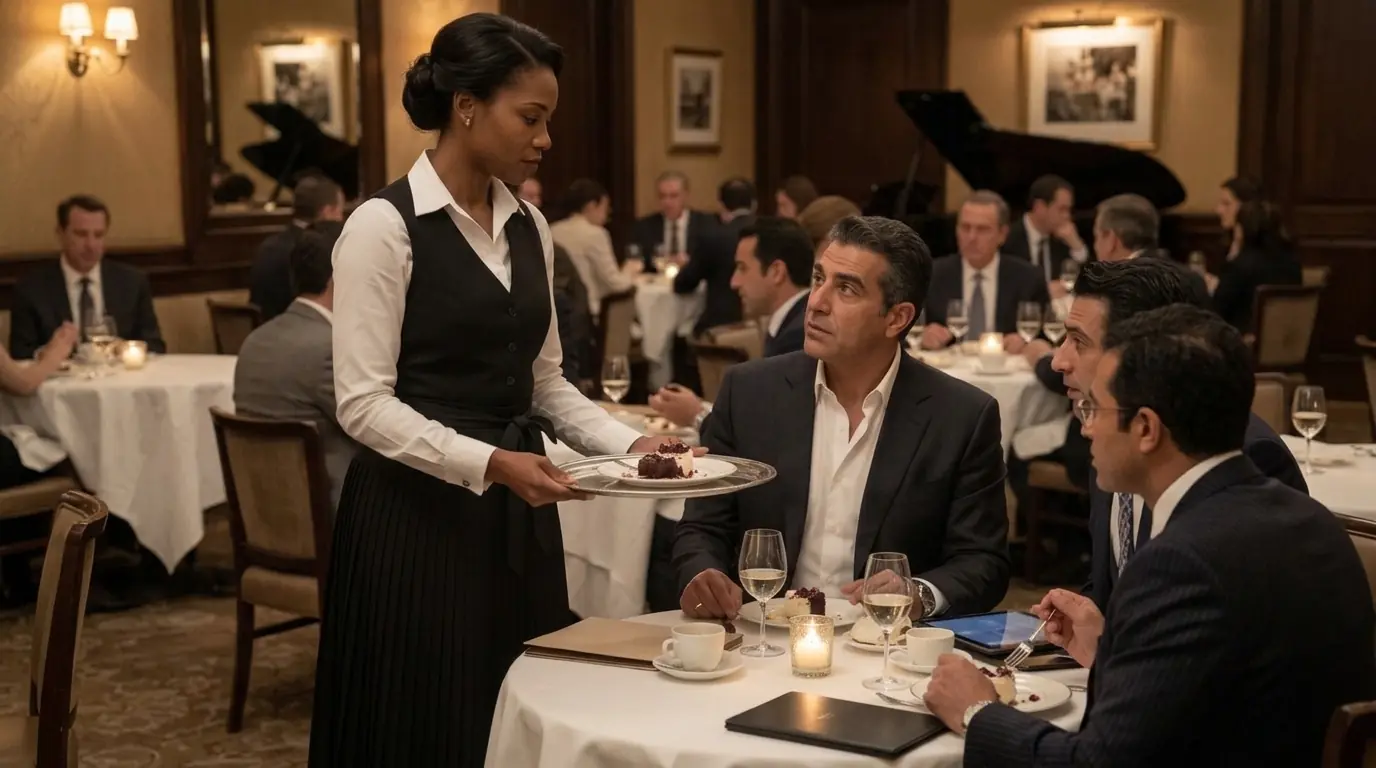
The way conversations at nearby tables dipped slightly, heads turning with practiced subtlety. She delivered the plates, smiled at the couple, refilled their water without being asked, and made her way back toward the service quarter. On her way, she glanced at the entrance. He walked in like the room owed him something.
Tall, broad-shouldered, late forties, maybe early fifties, with a jaw that seemed permanently set against the world. Two men trailed behind him, younger, quieter, carrying tablets and folders like armor. One, the billionaire himself, carried nothing. Men like him never did.
Everything around him moved so he wouldn't have to. Mr. Holloway reached him in four steps, extending a hand with a smile that Elizabeth had never seen him use before. Wide, eager, slightly desperate. Mr. Al Rashid, welcome back to Maison Dorée.
Your table is ready. Kareem Al Rashid looked at the outstretched hand for a beat too long before shaking it. Not rudely, precisely. The way someone shakes a hand when they have already decided the interaction doesn't matter.
It wasn't ready last time, Kareem said. His English was flawless, accented in a way that suggested several continents. I waited four minutes. That will not happen tonight, sir.
I assure you. Mr. Holloway said with great assurance. Kareem said nothing. Well, he simply walked toward the table, a corner booth near the window, already set with fresh linen and a candle that one of the junior staff had lit exactly six minutes ago per Holloway's instruction.
His two associates followed. One of them murmured something in Arabic as they sat and Kareem responded without looking up from the menu. Elizabeth was assigned their section. She found this out when Marcus, one of the other waiters, appeared at her elbow near the drink station and said in a voice barely above a breath, Holloway wants you on table four.
She looked at him. That's your table. I know. He picked up a tray and moved away quickly.
Elizabeth set down the cloth she was holding, adjusted her apron, and walked to table four. Kareem didn't look up when she arrived. He was reading the menu or appearing to read it, which wasn't quite the same thing. His associates had already settled into a quiet conversation in Arabic, leaning toward each other over folded hands.
Kareem looked up then. It was a brief look. The kind that takes inventory without interest. He glanced at her face, at her name tag, at her hands.
Then he looked back at the menu. Water. And the '09 Burgundy, if you still have it. We do.
I'll bring it right out. She turned to the associates. One of them ordered sparkling water. The other asked about a cocktail.
She answered clearly, smiled once, and walked back toward the bar. Behind her, before she had taken three steps, she heard Kareem speak again in Arabic, low and flat, to one of his men. They really hire anyone these days. Elizabeth did not pause.
She did not turn around. She reached the bar, placed the drink order with the bartender, and stood with her back straight and her hands still at her sides. She had understood every word. The first hour passed the way most hours passed at Maison Dorée, in controlled motion.
Elizabeth moved between tables with the economy of someone who had done this long enough to stop thinking about the mechanics. Water refilled before it reached the halfway mark. Plates cleared at the right moment. Never too early, never too late.
She noticed things. A woman at table seven whose smile had stopped reaching her eyes somewhere between the appetizer and the entrée. A man at table 12 who kept checking his phone and then looking guilty about it. But she filed these observations away quietly.
They weren't her business. Her business was the table. Kareem's table was different, not because he was difficult exactly. He wasn't shouting.
He wasn't snapping his fingers. He ordered with precision and ate without complaint. But there was something in the way he occupied the room. A deliberate heaviness as though his presence was a statement that everyone else was expected to receive and acknowledge.
When Elizabeth brought the burgundy, he held the glass to the light before tasting it. Not unusual for a man who knew wine. But when she moved to pour for the associates, No, he said in Arabic to the one on his left, She's pouring too fast. These people have no training.
She poured at exactly the rate she always poured. She thanked them and moved away. Later, when she brought the bread basket, she overheard him on a brief phone call. He had switched to Arabic entirely.
The conversation clipped and financial. Numbers, percentages, a name she didn't catch. Then a laugh, short and humorless, and a phrase she caught the edge of. Something about a deal being finalized.
Something about people not knowing what was coming until it had already happened. His associate leaned across the table after the call ended and said in Arabic, The staff here, do they speak anything other than English? Kareem glanced toward the room with mild disdain. Unlikely.
People in these positions rarely invest in themselves. Him. The associate nodded, satisfied. Elizabeth was at the next table setting down a dessert menu.
She did not look up. There was a woman who used to come into the diner where Elizabeth had worked years ago, before Maison Dorée, before the city, before everything. An older woman named Mrs. Christabel, who ordered black coffee and read the newspaper at the corner stool every Saturday morning. One day when Elizabeth was maybe 22, she had asked her why she never reacted when the cook was rude to her.
Mrs. Christabel had looked up over her reading glasses and said very simply, Because I already know who I am. What does his opinion add? Elizabeth had thought about that for a long time. She thought about it now, carrying a tray back to the service corridor.
The ambient noise of the restaurant folding around her like a curtain. The clink of cutlery, the murmur of wine loosened conversation. Somewhere near the kitchen, one of the junior staff had dropped something and the brief silence that followed was almost musical. Her co-worker Priya appeared beside her, refilling a water pitcher.
How's table four? she asked. Fine. Priya gave her a sideways look.
Marcus practically ran away from that section. He said the guy is He's a guest. Elizabeth interrupted, Same as the others. Priya shrugged and moved off.
Elizabeth set down her tray, checked her section, and went back to work. At forty-five minutes in, Kareem's mood shifted. It happened after a call he took outside. She saw him through the glass, standing near the valet stand, speaking with a sharpness that his indoor manner had carefully concealed.
When he returned to the table, and he sat down with the controlled energy of a man who had just received bad news and had decided the room around him would absorb the cost. He spoke to his associates in rapid Arabic. A contract issue. Something about a party that had backed out.
His voice was not loud, but it carried the specific weight of someone who expected the world to rearrange itself when he was inconvenienced. Then he looked toward the room at the other diners, at the softly lit interior, at the staff moving quietly between tables. And something in his expression settled into a kind of contempt that had nothing to do with the contract. Elizabeth arrived at the table to check on the entrées.
Is everything to your liking? she asked. Kareem looked at her plate, then at her. The lamb is overcooked.
She looked at the plate. He had eaten most of it. Ah, I'm sorry to hear that. I can have the kitchen prepare something else for you.
Don't bother. He waved a hand. It's the kind of mistake you'd expect. She nodded once.
Of course. Can I bring you anything else? He had already looked away. As she turned from the table, she heard him say to his associate in Arabic, deliberately, not lowered, not careful, People like these should remain invisible.
Elizabeth walked back to the service corridor. Her hand, just once, tightened around the edge of her tray. She had learned Arabic by accident. That was the honest answer, though it never sounded believable when she said it out loud.
People assumed languages were conquered, studied with textbooks, drilled with flashcards, earned through years of deliberate effort. And there had been effort, eventually. But the beginning was not effort. The beginning was survival.
She was nine years old when her father took the job. His name was Samuel Parker, and he was the kind of man who believed that dignity was something you carried inside you, not something in the world handed over. He had worked as an accountant in Accra, careful and precise, the type who triple-checked columns, not because he was afraid of mistakes, but because he respected the numbers. Uh, when the offer came, a position managing the financial records of a regional office for a large international firm operating out of the Gulf, he had sat with it for two weeks before saying yes.
They moved to Dubai when Elizabeth was nine and a half. The compound where they lived was a quiet, ordered place, other families, other fathers with briefcases, other children who spoke in a rotating mix of languages that shifted depending on who was standing next to you. Elizabeth had picked up Arabic the way children pick up everything, through repetition, through proximity, through the simple biological urgency of wanting to understand what the kids around her were saying, so she could decide whether to laugh or to run. By the time she was twelve, she was dreaming in it.
Her father had noticed. He would sit with her in the evenings sometimes, and after dinner going over documents he'd brought home, and she would read the Arabic headings to him, slowly at first, then with more confidence. He would correct her pronunciation with a gentleness that made her want to get it right, not because she feared disappointing him, but because she could see in his face that she was already something he hadn't expected, and she wanted to keep being that. Again, he would say softly, tapping a word on the page, and she would say it again, and get it right.
Then he would nod once with something in his eyes that she would only understand much later was pride held carefully so it wouldn't spill. She hadn't spoken Arabic in four years before tonight. Back on the floor, the dinner service was moving toward its second hour. Kareem had ordered dessert, a brief, almost reluctant concession to the menu, and his associates were quieter now.
The energy at the table having settled into something more transactional. Papers had appeared, the tablets were open, a conversation that had started in the restaurant was continuing in the way business conversations always continued. Never quite finished, never quite beginning, always orbiting the same center. Elizabeth refilled their water and left quickly.
At the service station, Marcus appeared beside her again. He had been watching the table from a distance all evening, she could tell, the way his eyes kept drifting there and then away. How are you doing over there? he asked, and the question had a layer to it.
Fine, she said. He keeps talking in Arabic. Yes. Marcus waited.
Elizabeth didn't offer anything else. He shifted his weight. She You know what he said earlier? I caught I I took two semesters in college.
I think he said something about Marcus. Elizabeth's voice was quiet but settled. I'm fine. He nodded slowly and moved away.
She watched him go, then turned back toward her section. The thing about staying silent when someone underestimated you was that it required a very specific kind of discipline. Not the cold discipline of suppressing anger, though there was that, too, occasionally. It was more like the discipline of a musician who could hear the wrong note and choose not to correct it immediately, who understood that the piece was still playing, that there was a better moment coming, and that interrupting now would cost more than waiting.
She had learned patience the same way she had learned Arabic, not all at once, through repetition. Be through necessity. It was Kareem's associate who pushed further at first. He was the younger of the two.
late thirties, a practiced ease about him that suggested someone who had spent years learning to mirror the confidence of powerful men. He leaned back in his chair after the dessert arrived and said in Arabic with the comfortable looseness of a man who believed himself unheard. I keep wondering, do you think any of them understands us? Kareem looked around the room briefly.
No, he said. These are not people who invest in themselves. Smart, though, to choose this restaurant. Smart is the wrong word.
Kareem lifted his coffee. They're trained. There's a difference. A dog can be trained.
The associate laughed. A short, private sound. Elizabeth was two tables away. By clearing plates from a couple who had just finished their meal, she kept her eyes on what she was doing.
Her movements didn't change. The plates went on to the tray in the same order they always did. What about her? The associate asked.
And Elizabeth understood from the tonal shift in his Arabic that he was gesturing in her direction. She seems like what she is, Kareem said. Unremarkable. A pause.
The associate said. And there was something almost playful in it now, the tone of a man amusing himself. Even if she understood us. Kareem completed the sentence without looking up from his coffee.
What could she possibly do? The table was quiet for a moment. Then the associate reached for his dessert fork and the conversation moved on. Much the way their conversations always moved on to the next thing, the next deal, the next room full of people who did not register.
Elizabeth set the last plate on her tray. She straightened, turned toward the service corridor, and then she stopped. Not visibly. She didn't freeze, but something inside her went very still, the way water goes still just before it changes state.
She had been here before in smaller ways. The customer who spoke about her to his companion as though she weren't standing there. The table that looked through her instead of at her. The hundred small moments across years of service where she had been reduced to a function rather than a person.
She had always let them pass. But there was something about the particular shape of those words. What could she possibly do? Spoken in a language he assumed was a wall between them.
Spoken with that specific comfortable certainty. The certainty of a man who had never once considered that the person in front of him might be more than what he decided he or she was. She thought of her father. She thought of the evenings at the kitchen table, his finger moving along the page, his voice saying again with infinite patience.
She thought of what had come after Dubai. What she had never spoken about in this restaurant or any restaurant, or any room where she was wearing an apron and carrying someone else's plates. She thought of all of it in the span of three seconds. Then she picked up her tray and walked back toward the table.
She set it down at the service station. She smoothed her apron once and approached table four. Kareem was speaking quietly. Another fragment of the endless business conversation.
And did not look up immediately. His associate noticed her first and fell silent. Then Kareem glanced up, the same brief inventory look he had given her at the beginning of the evening. Can I clear these for you?
Elizabeth asked, gesturing to the dessert plates. Yes. He said flatly, and returned to his associate. She began clearing, slowly, methodically, the way she always did.
And then she said, in Arabic, quiet, clear, and perfectly pronounced, We understand more than you think, sir. The silence that followed was not like other silences. It had a texture to it, the specific density of air in a room where something has shifted so suddenly that the people inside it haven't yet caught up. Kareem's associate went absolutely still, his fork suspended halfway to his plate.
The other associate looked up from his tablet with an expression that moved through confusion and arrived at something close to alarm. Kareem turned his head slowly. For the first time all evening, he was looking at her. Not the inventory look, not the dismissive glance.
He was actually looking at her, at her face, her eyes, the complete stillness of her posture, with the expression of a man who has just discovered that the ground he was standing on is not the ground he thought it was. She held his gaze. She did not smile. She did not look away.
Most of the candle on the table threw soft light across the white linen, and somewhere on the far side of the restaurant, a woman laughed at something her companion had said, and the sound floated across the room and dissolved. You speak Arabic. Kareem said. His voice had changed.
It was still controlled, but something underneath the control had shifted. A hairline fracture in the certainty. Elizabeth set the last plate on her tray. Fluently, she said in Arabic first, then in English.
I've understood everything you have said tonight. The table did not recover quickly. That was the thing about genuine shock. It didn't dissolve in seconds the way surprise did.
It settled. It changed the air pressure of a space and stayed there. Thick and rearranged while the people inside it tried to locate their footing. Kareem's younger associate set his fork down.
The sound of it touching the plate was very small and very loud at the same time. The other one closed his tablet slowly, the way people close things when they suddenly need their hands free to think. Kareem himself had not moved. He was still looking at Elizabeth with that fractured expression.
The one that hadn't quite decided yet what it wanted to become. She could see him processing it, running it back, the entire evening rewinding behind his eyes. Every sentence, every word he had let fall without care, um without consideration, without the basic human courtesy of assuming the person in front of him might be a full person. How long have you spoken it?
he said finally in Arabic. Since I was nine, Elizabeth said. She kept her voice even, not warm, not cold, level, the way you speak when you have decided that emotion is yours to keep and not his to receive. I lived in Dubai for six years.
My father worked there. Something moved across Kareem's face at the word father. It was brief, a flicker, there and gone like light off water. She noticed it.
She had been watching for it. Dubai. He repeated. Yes.
His associate shifted in his seat, the discomfort radiating off him in quiet waves. The other one was looking at the tablecloth. Neither of them spoke. This was no longer their conversation.
They understood that instinctively, in the way people understand when a room has contracted around two people and left everyone else outside it. Kareem set down his coffee cup. I owe you an apology. He said.
The words came out correctly shaped, the right syllables in the right order. But Elizabeth could hear what was underneath them. Not remorse, not yet. Something closer to damage control.
The reflex of a man who had spent decades making problems disappear before they could cost him anything. She looked at him for a moment. You owe me several. He was quiet after that.
Not the comfortable quiet of earlier in the evening, the quiet of a man at ease in his own authority, but a different kind, a compressed and quiet. The quiet of someone recalibrating in real time, trying to find the angle back to solid ground. Elizabeth did not help him find it. She stood at the edge of the table with her tray at her side, and she spoke carefully, the way she had learned to speak about things that mattered, not rushing, not performing, just saying the true thing in the order it needed to be said.
My father's name was Samuel Parker. She said. He managed financial records for a regional office in Dubai. He was there for six years.
He was precise, and he was honest, and he was very good at his job. Kareem had gone very still. In his fifth year, Elizabeth continued, there was an audit. Discrepancies in the accounts, not his accounts, not his numbers, but the investigation moved through the office the way those things do.
And somewhere in that process, my father was let go. No explanation, no severance. The visa was tied to the position, so we had three weeks to leave the country. Mhm, she paused.
Across the restaurant, the ambient noise continued. Cutlery, conversation, the low register of the pianist near the entrance, who had been playing soft standards for the last hour. None of it touched this corner of the room. He spent two years trying to rebuild after we came back, she continued.
He got sick in the third year. He died before the fourth. Kareem's jaw had tightened. He was not looking away from her.
Elizabeth gave him credit for that, at least. He was not a man who flinched from what he had caused, even if he had never thought to look for it before. The name of the firm, she said quietly, was Al Rashid International. The silence that followed was absolute.
The younger associate looked up sharply. The other one had stopped pretending to look at the tablecloth. And Kareem himself, who had walked into this restaurant two hours ago like a man the world arranged itself around, sat completely still. And for the first time all evening, he looked like what he actually was, a person sitting across from the consequence of a decision he had made and forgotten and never once returned to.
I don't he started. You don't remember, she said, not bitterly, just as a fact. I know. That's the part I had to make peace with a long time ago.
That we were a line in a report somewhere that the decision that changed everything for us took you probably four minutes. Kareem opened his mouth and closed it again. His associate the younger one whose discomfort had been building all evening into something that now looked almost like shame leaned slightly forward and said in Arabic Kareem, just the name. With a single quiet word that carried a meaning Elizabeth understood completely.
Say something real. Kareem looked at the table then at his hands then back at Elizabeth. I can't give you back what was lost, he said finally. His voice had changed again.
Stripped of its earlier precision, rougher at the edges. I know that. I'm not going to insult you by pretending otherwise. Good, she said.
But I would like He stopped, tried again. There are people who were affected by decisions from that period. Decisions I made or approved or didn't look at closely enough because I was looking at the number and not the person behind it. I have known this for some time and I have not done enough about it.
Elizabeth said nothing. She let him sit in that. I would like to do something, he said, if you would allow it. Um, she looked at him for a long moment.
In the face of a man who had just been shown clearly and without malice exactly who he was and what that had cost someone else. She thought about what she had imagined this moment looking like. She had thought there would be more heat in it. She had thought she would need to be louder.
She wasn't. I don't need your money, she said. My father didn't raise me to need it and I don't want it from you. Kareem nodded slowly.
What I needed, she continued, was for you to know. That's all. That the person you dismissed tonight, the person you dismissed all those years ago without ever learning his name, existed, was real, mattered. She picked up her tray.
Samuel Parker, she said one last time, clearly, precisely, with the way her father had taught her to pronounce words in a language that wasn't hers until it was. That was his name. Remember it. She turned and walked away.
She did not look back. She moved through the restaurant the way she always moved through it, with the quiet efficiency of someone who knew exactly where she was going. She passed table seven, where the woman's smile had finally reached her eyes again. She passed table 12, where the man had put his phone away.
She passed the pianist, who was playing something slow and deliberate, the notes falling into the room one at a time. She pushed through the service door and stood in the corridor for a moment, alone. The kitchen noise surrounded her. Orders called out, pans against burners, the controlled chaos of a professional kitchen at full pace.
She breathed in. She set her tray down on the counter, stood with her hands flat against the cool metal surface. She wasn't trembling. She had expected to be, but she wasn't.
She felt something she didn't have an immediate word for, a settled quality, like a door that had been left open for years finally closing gently. Not slammed, just eased shut by someone who had decided it was time. Her father had worked hard and been discarded and rebuilt and gotten sick and died without ever receiving an explanation or an acknowledgement or even the basic dignity of being remembered by the man whose decision had undone him. She had remembered for both of them.
Later, after the last table had cleared and the restaurant had dimmed into its closing routine, Elizabeth stood outside on the pavement, her jacket over her arm, the night air cool against her face. The street was quiet. A cab moved through the intersection at the end of the block. Somewhere above, a window was lit warm yellow against the dark.
She thought about her father at the kitchen table, his finger on the page, his voice patient and certain. Again. He would always say it again, and she had always gotten it right.