"Who let this janitor near my piano?" "I just wanted to play one song, sir." "Play? You hear that? The janitor wants to play. Look at those bleach-stained hands. Those are mop hands. Dirty hands. Don't touch my piano."
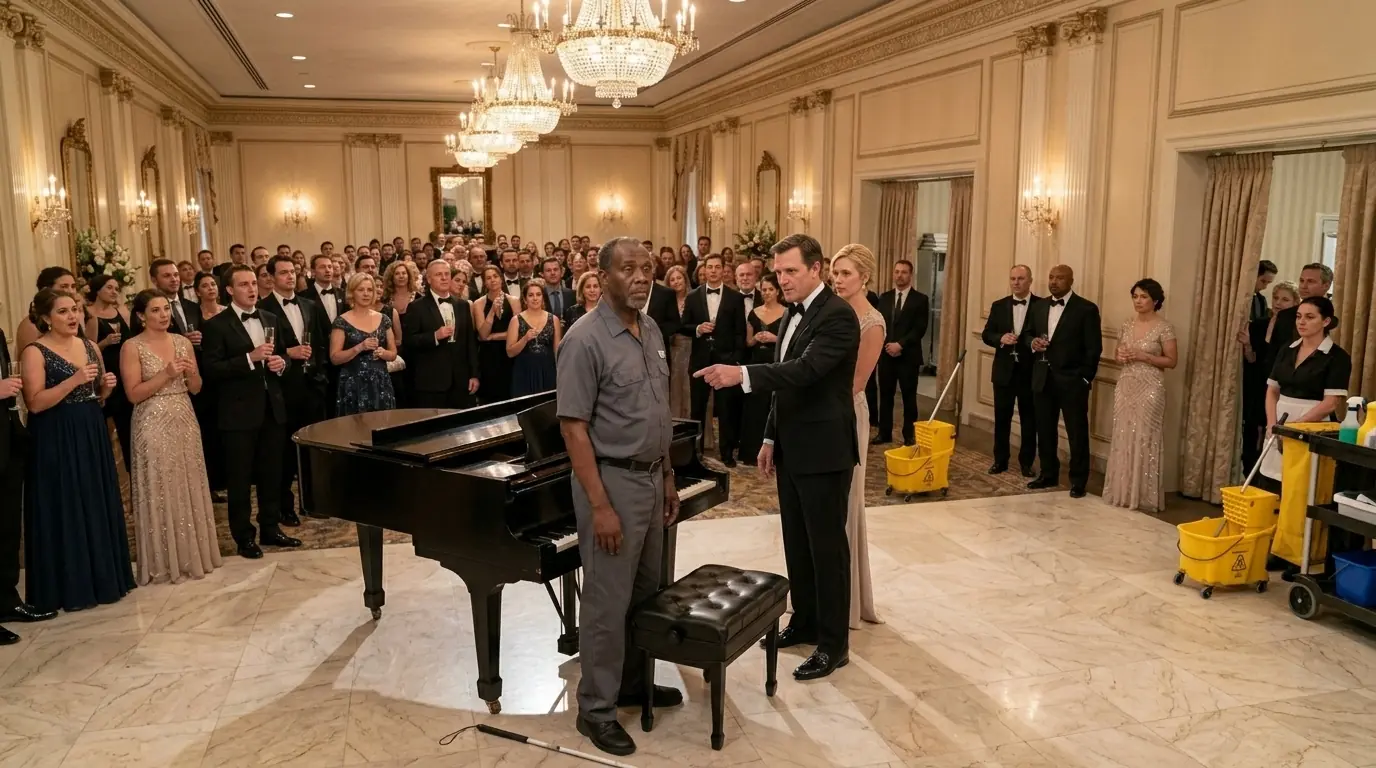
Gerald Whitmore paused, enjoying the laughter around him. "Fine. Play. Show us what a man like you can do with a Steinway. Give us a good laugh."
The janitor sat down. His fingers were shaking. But what no one in that room knew was that those hands had once made three American presidents rise to their feet. That morning, twelve hours before the shove, before the Steinway, before any of it, Preston Hayes woke up the same way he had woken up every day for the past six years: alone. It was 5:15 a.m. in Southeast Washington, D.C., inside a one-bedroom apartment on the third floor of a building where the elevator had not worked since last winter. The radiator clicked and hissed in a rhythm Preston knew by heart: two clicks, a long hiss, pause, repeat. It was the closest thing to music in his life these days.
Fourteen steps from bed to kitchen. He counted every one. His left hand trailed along the wall, fingertips reading the texture: smooth drywall, then the doorframe, then the peeling edge of wallpaper where the hallway turned. Fourteen steps. Same as yesterday. Same as the six years before that.
The coffee was instant, always instant. He kept it on the second shelf, right side, behind the salt. His fingers found the Braille label he had placed on the jar, a habit Eleanor had taught him when the darkness first started creeping in. Eleanor, his wife, had labeled every can, every bottle, every drawer in the apartment, as if she were building him a map for the life she knew she would not be part of much longer.
Cancer took her six years ago, quick and cruel. Four months from diagnosis to funeral. On the nightstand sat a framed photograph Preston had not seen in seventeen years. Yet every morning before coffee, before anything, he touched it.
His fingers traced the glass. He knew what was in that picture: a younger version of himself, eyes still bright, still seeing, shaking hands with a man in a dark suit. The background was blurred, but anyone who had been there would have recognized the East Room of the White House. Preston did not linger on it. He never did. He touched the frame, set it down, and started his day.
He ironed his janitor uniform by touch, every crease deliberate, collar flat, sleeves straight, name badge pinned exactly two inches below the left shoulder. Most people would have thrown on a wrinkled uniform for a job like his. Not Preston. Eleanor always said you could tell everything about a man by how he treated the things no one else would notice. So he ironed every single morning.
The bus ride to the Grand Meridian Hotel took forty minutes. Preston sat in the same seat, third row, left side, closest to the window he could no longer see through. He liked that seat because the vent above it blew warm air on cold mornings, and because the driver, a woman named Gloria, always said, "Morning, Mr. Hayes," when he got on and, "Have a good one, Mr. Hayes," when he got off. Two sentences. That was enough. Some days they were the only words anyone said to him.
The Grand Meridian was one of the most prestigious hotels in Washington, D.C. Presidents had stayed there. Foreign dignitaries, CEOs, senators, donors, and guests whose names appeared in newspapers had crossed its lobby. The building had Italian marble floors, hand-painted ceilings, and a chandelier that reportedly cost more than every apartment on Preston's block combined.
Preston had mopped that marble for nine years. Nine years of pushing a yellow bucket past guests who looked through him as if he were part of the wallpaper. Nine years of saying, "Excuse me," and receiving silence. Nine years of stepping aside so men in suits could pass without adjusting their stride.
He was not bitter about it. That was the thing. He simply did the work. He showed up, mopped, cleaned restrooms, emptied trash cans, and polished brass handles until they reflected a face he could not see.
His colleague, Darnell Cooper, was the closest thing Preston had to a friend. Darnell was thirty-four, built like a linebacker, with a voice like a preacher on Sunday morning. He had worked at the Grand Meridian for three years, and from day one he had taken it upon himself to carry Preston's supply cart to the service elevator every shift. "You don't have to do that, Darnell."
"I know I don't. I'm doing it anyway." That was their routine. Every shift. No negotiation.
Darnell was also the only person at the Grand Meridian who knew Preston could play piano. It had happened by accident about two years earlier. Darnell was pulling a late shift, walking past the staff break room at two in the morning, when he heard something that stopped him in the hallway. Music was coming from behind the closed door, soft but full, rich, like a sound that had no business coming from a room with plastic chairs and a broken vending machine. Darnell opened the door just a crack. Preston was sitting at the battered old upright piano someone had donated years earlier, his fingers moving across the keys like water finding its path through stone.
Darnell stood in that doorway for twenty minutes. He did not breathe. He did not move. When Preston finally stopped, Darnell quietly pulled the door shut and walked away.
The next morning, he asked Preston one question. "Who are you, man? For real?" Preston smiled, the kind of smile that answers nothing and says everything. "I'm the guy who mops the lobby, Darnell. Same as yesterday."
What Darnell did not know, what Preston had never told anyone at the hotel, was the full story. The scholarship to the Thornton Conservatory. The debut recital that earned a standing ovation from an audience of eight hundred. The invitation to play at a White House state dinner at age thirty-one, then again at thirty-five, then again at thirty-nine.
Three consecutive presidents had requested him by name. Then came the diagnosis: retinitis pigmentosa, degenerative and irreversible. The world closed in like a slow curtain. By forty-four, everything was dark and the invitations stopped. Not because he could not play. His fingers had not forgotten a single note. His ears heard more now than they ever had when his eyes worked.
But the industry, the agents, the promoters, the venues, they did not know what to do with a blind pianist who refused to be packaged as an inspiration story. Preston would not do the interviews. He would not do the "triumph over tragedy" television segments. He would not sit on a morning-show couch and let a host pat his hand and tell him how brave he was.