Malcolm Grant did not come to the Beaumont Conservatory to impress rich people. He came because eighteen teenagers from Bridgeport were standing behind the glass wall of the hotel's culinary theater, watching every move he made as if their own futures were on the cutting board. Most of them had never been inside a five-star hotel before. They wore borrowed black shirts, stiff name tags, and the nervous silence of kids who had been told too many times that rooms like this were not built for them. Malcolm knew that silence because he had grown up carrying it.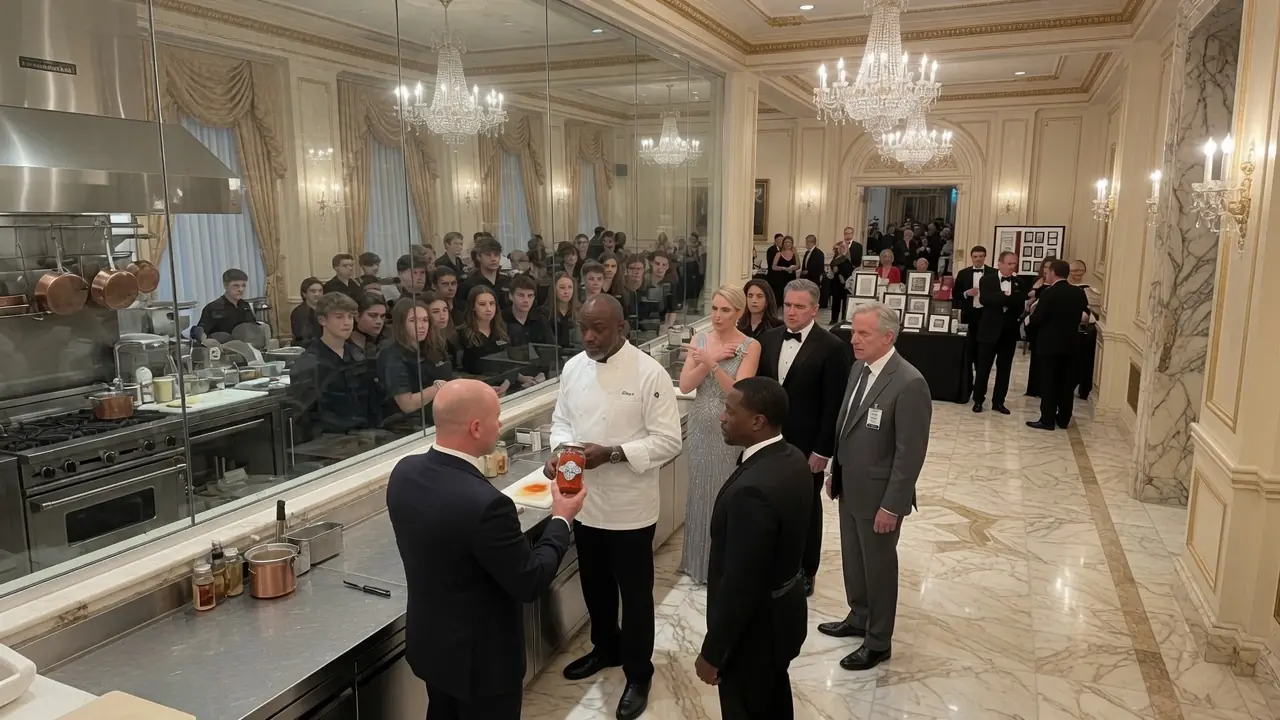
At forty-six, he was a tall Black man with calm eyes, close-cropped hair, and a short beard with gray beginning at the chin. He wore a clean white chef's coat with Grant stitched over the heart, black trousers, and polished shoes that had survived too many service entrances. Tonight was supposed to be a victory. The Ashford Foundation was hosting a high-profile charity dinner to announce a scholarship partnership with Malcolm's nonprofit, Second Chance Kitchen, a culinary training program for teenagers aging out of foster care, juvenile supervision, and neighborhoods where opportunity often arrived too late.
The room itself was designed for spectacle. The Beaumont Conservatory had a dining hall wrapped in glass, with a visible open kitchen in the center. Guests sipped champagne while watching chefs torch sugar, fold pasta, plate sauces, and pretend that witnessing labor made them generous. Malcolm stood at the central station, sharpening his knife.
Andre Bell, his assistant, leaned close and whispered, "Chef, one of those kids just asked if the spoon has to point north." Malcolm did not look up. "Tell him only if the donor has a compass." Andre laughed quietly, then went back to arranging herbs.
Across the kitchen, Tessa Caldwell, the event coordinator, hurried between stations with a tablet in one hand and panic in the other. "Malcolm," she said, stopping beside him. "Celeste Ashford just changed the order of the speeches again." "Let me guess," Malcolm said. "She speaks before the children."
Tessa exhaled. "She says it flows better." Malcolm said, "It always flows better when money talks first." Tessa gave him a look that said she agreed but could not afford to say so. Outside the glass wall, the guests had begun to arrive.
Judges, real estate developers, local news anchors, foundation board members, and people who knew exactly when to clap and when to look moved filled the room. Then the front doors opened, and Celeste Ashford entered as if the evening had been waiting for her. She was forty-three, beautiful in a polished, expensive way, with pale skin, blonde hair swept back into a sleek twist, and a silver dress that moved like water when she walked. Beside her was her husband, Preston Ashford, a billionaire real estate developer whose name appeared on hospitals, libraries, and lawsuits with equal frequency.
But nobody looked at Preston first. They looked at the diamond on Celeste's chest. It was not a necklace but a brooch pinned just below her left shoulder, shaped like a small frozen star. At the center sat the Ashford Aurora, a blue-white diamond insured for four million dollars.
The diamond was supposed to be the centerpiece of the evening's auction. Celeste paused beneath the chandelier, letting the cameras find the stone. "My husband believes charity should be quiet," she told a circle of donors. "I believe generosity should give people something to look at."
The group laughed politely. Malcolm glanced toward the teenagers behind the glass wall. Some were staring at the diamond as if it belonged to another planet. One girl, no more than sixteen, whispered to her friend, "Four million for a rock."
Malcolm heard it and kept cutting. Before he became a chef, Malcolm Grant had spent fifteen years as a federal agent in financial crimes. He had investigated insurance fraud, nonprofit theft, counterfeit art donations, forged appraisals, and wealthy people who used charity as camouflage. He left after a case involving a children's hospital fund had been quietly buried by men with better lawyers than morals.
Cooking had saved him. Feeding people gave him a way to build instead of chase. Second Chance Kitchen gave him a reason to stay out of the old life. But old instincts did not disappear; they waited.
Tonight, something was already wrong. Celeste kept touching the brooch, not admiring it but checking it, and that was different. Malcolm noticed a man standing near the donor display table. He wore a gray suit, had a narrow face and silver hair, an expensive watch, and no expression.
"Where?" she asked. "Near the auction display." She looked up, then frowned. "I don't know. He's not on my donor list."
"What about vendors?" Malcolm asked. "Only floral, lighting, security, catering, and appraisal." "Appraisal?" Tessa tapped the screen.
"An outside consultant named Graham Vale." Malcolm's knife paused for half a second. "Who hired him?" "Celeste's office." Malcolm resumed cutting.
That was the first thread. At 7:45, the first course went out: butternut squash soup with smoked paprika cream. It was simple, warm, and intentionally unfussy. Malcolm had designed the menu so the teenagers could understand every technique. Nothing on the plate existed just to show off.
Celeste did not like that. After the second course, she stepped into the culinary theater with a champagne flute in hand and a local reporter following her. "Chef Grant," she said loudly. "Come here a moment."
Malcolm wiped his hands and stepped forward. The cameras turned toward him. Celeste smiled for them. "Everyone, this is Malcolm Grant, the man behind tonight's food."
"His program works with young people who have had complicated paths," she continued. The word hung in the air. Complicated was a soft, acceptable way to say damaged. Malcolm kept his face still.
Celeste continued, "We believe in giving people second chances, provided they understand the responsibility that comes with being allowed into rooms like this." The reporter nodded as if wisdom had just been spoken. Malcolm looked through the glass wall at the students. A few lowered their eyes.
He stepped closer to the microphone. "Second chances are not permission slips," he said calmly. "They are investments, and the students here tonight are not lucky to be in this room." "This room is lucky to have them working in it."
Silence followed. Then Vivian Ashford, Preston's sister, began clapping. A few others joined. Celeste's smile stayed in place, but her eyes cooled.
That was the second thread. At 8:15, Malcolm saw Graham Vale slip behind the black curtain near the auction display. Celeste followed three minutes later. Malcolm did not chase them.
He had learned long ago that guilty people often made more mistakes when they believed nobody was watching. He sent Andre to rotate the sauce station, then moved toward the service corridor carrying an empty tray. Behind the curtain, Celeste's voice was low and sharp. "You said the appraisal would hold."
"It will hold if nobody examines the original tonight," Graham Vale answered. "The problem is the auction photographer asked for a close shot of the inscription." Celeste hissed, "Then make sure the close shot doesn't happen." Graham said, "There is still the matter of my final payment."
"You'll get it when the insurance claim clears," Celeste replied. Malcolm stopped before his shadow reached the curtain. Insurance claim. Then a busboy rounded the corner with a tray of glasses.
Malcolm turned away as if he had only been passing through, but Celeste saw him for just a glimpse. It was enough. Her expression changed, not to panic but calculation. She stepped from behind the curtain a moment later, smiling as if nothing in her life had ever gone wrong.
"Chef Grant," she said, "you seem to wander quite a bit for a man in charge of a kitchen." Malcolm gave a small nod. "Good chefs check their room." "And former criminals check exits," she said softly.
Malcolm looked at her. "I wouldn't know." Celeste's smile tightened. She had meant to cut him, but instead she had revealed what kind of knife she preferred.
At 8:40, the diamond disappeared. The lights above the auction display dimmed for the scholarship video. On screen, the teenagers appeared in their training kitchen, chopping onions, laughing, burning their first omelets, and trying again. The room softened.
Even Preston looked moved. Then Celeste screamed. The video stopped, and every head turned. Celeste stood beside the auction table, one hand pressed against her chest.
The brooch was gone. "My diamond," she cried. "The Aurora is gone." Security moved fast.
Doors were closed, staff were stopped, and guests were asked to remain calm, which instantly made them less calm. Brent Walker, head of event security, came into the culinary theater. "No one leaves the kitchen," he said. Malcolm set down his towel.
Celeste entered behind him, pale but perfectly composed beneath the performance. "I saw him near the auction table," she said, pointing at Malcolm. The room went silent. Andre stepped forward.
"Chef was in the kitchen," Andre said. Celeste ignored him. "He was behind the curtain earlier. I saw him, and he had access to all the service corridors."
Tessa looked horrified. "Mrs. Ashford, there are over fifty staff members here." Celeste's voice sharpened. "And only one of them has been watching my diamond all night." The teenagers behind the glass wall stared.
That hurt Malcolm more than the accusation. Brent turned to him. "Chef Grant, open your storage trunk." Malcolm's dry-goods trunk sat beneath the prep station.
It held sealed spices, specialty grains, tasting spoons, and backup knives. Every item had been logged when it arrived because the hotel required strict food-safety documentation for public events. Malcolm looked at Brent. "You need police before you search personal property."
Celeste snapped, "Personal property? My four-million-dollar diamond is missing." Preston stepped forward, his voice heavy with embarrassment and anger. "Open it, Chef." Malcolm looked at him.
"You're making a mistake," Malcolm said. Preston's face hardened. "Then prove it." Malcolm took the key from his pocket and opened the trunk.
Brent lifted out jars one by one: cumin, coriander, peppercorns, and smoked paprika. When he picked up the paprika jar, Malcolm saw it immediately. Wrong lid. His jar lids were matte black, but this one had a faint shine.
Brent unscrewed it. Inside, buried under red powder in a plastic sleeve, was the Ashford Aurora brooch. Gasps filled the room. Celeste covered her mouth.
The reporter lifted her camera. One of the teenagers whispered, "No way." Malcolm looked at the jar, then at Celeste. She had chosen a kitchen hiding place, and that was her mistake.
A person who had never worked in a kitchen thought spices were just containers. Malcolm knew every jar by weight, smell, and touch. Detective Raymond Holt arrived sixteen minutes later. He had the tired face of a man who had solved the case before reaching the room.
Celeste spoke first. She told him Malcolm had acted suspiciously all night. She told him he had been agitated after her speech. She told him the brooch had been found in his own locked trunk.
The story was clean, too clean. Holt turned to Malcolm. "Mr. Grant, do you have an explanation?" "Yes," Malcolm said. "Someone planted it."
Celeste laughed bitterly. "Of course." Holt asked, "Who had the key?" "I did," Malcolm answered. "That doesn't help you."
"No," Malcolm said, "but the kitchen log does." Holt frowned. "Kitchen log?" Malcolm pointed to the wall-mounted tablet beside the prep station.
"This hotel scans dry goods by station for allergen control." "Every sealed container is logged by weight, item number, and time," Malcolm continued. "My paprika jar was checked in at 3:42 p.m. It weighed nine ounces." "That jar on the counter is heavier."
Brent looked uncertain. Celeste said, "A thief could have added the brooch after check-in." Malcolm nodded. "Yes, but not without breaking the seal."
He reached into the trunk and lifted a small strip of blue tape from a side pocket. "These are tamper labels. I use them because half my students have probation officers, and the other half have people waiting to accuse them of something." "Every jar gets a seal number."
"Tessa photographed the trunk before service for the hotel record," Malcolm added. Tessa's eyes widened. "Yes," she said, opening her tablet. "I did."
She pulled up the photos. Malcolm's original paprika jar had seal number B91147. The jar on the counter had seal number B9417. Same digits, different order.
Detective Holt leaned closer. "That's not the same jar." "No," Malcolm said. "It's a copy made by someone who saw the label too quickly." Celeste's face tightened.
Holt turned toward her. "Mrs. Ashford?" "This is absurd," Celeste said. "He could have switched the seal himself." Malcolm said, "Then check the powder."
Everyone looked at him. "My smoked paprika is Spanish sweet and oil-rich," he continued. "That jar smells like commercial chili powder." "It was filled by someone who thought red powder was close enough."
Andre picked up the jar, smelled it, and made a face. "That is not Chef's paprika." Holt looked less certain now. Celeste's voice rose.
"A spice mistake does not change where my diamond was found," she said. "No," Malcolm replied, "but it changes who had time to plant it." He turned to Holt. "Check the service elevator footage between 8:18 and 8:32, not the ballroom cameras but the freight corridor."
"Whoever brought that jar into my station had to pass the dish return," Malcolm added. Celeste looked away only once, but Malcolm saw it. Holt ordered the footage pulled. While they waited, Malcolm requested one more thing.
"Keep the brooch in evidence," he said. "Do not let Mr. Vale near it." Preston looked up. "Graham Vale, the appraiser?" Malcolm turned to him.
"You should ask why your wife hired an outside appraiser for a diamond your family already had appraised," Malcolm said. Celeste snapped, "How dare you?" Malcolm did not raise his voice. "I heard you mention an insurance claim before the diamond disappeared."
The room went still. Preston stared at his wife. "What insurance claim?" Celeste pointed at Malcolm. "He was eavesdropping."
"Yes," Malcolm said. "And you were planning." Detective Holt stepped closer. "Mr. Grant, you sound very comfortable with investigative procedure." Malcolm looked at him.
"I used to be," he said. "Used to be what?" "A federal agent in financial crimes, insurance fraud, nonprofit fraud, and high-value asset cases." The room changed.
It did not become warm or friendly, just less certain that Malcolm was the easiest man to bury. Celeste blinked. For the first time that night, she looked afraid. Holt's officer returned with the freight-corridor footage on a tablet.
The video showed Sophie Miller, Celeste's young assistant, entering the kitchen corridor at 8:27 with a small paper bag from the hotel gift shop. She moved quickly, set the bag beneath Malcolm's station, and left. Sophie was brought in trembling. Celeste said immediately that she had been delivering napkins.
Malcolm looked at Sophie. "What did she tell you was in the bag?" Sophie's eyes filled. "She said it was a replacement spice jar. She said Chef Grant asked for it."
Andre shook his head. "No, he didn't." Sophie began crying. "Mrs. Ashford said if I didn't do it, she'd tell the foundation I stole donor envelopes last month."
"I didn't steal anything. I swear." Celeste's face hardened. "You stupid girl." That was when Vivian Ashford stood.
She had been quiet all evening, watching the story Celeste had tried to build collapse piece by piece. "Celeste," Vivian said, "sit down before you make yourself even uglier." Nobody laughed. Preston looked like a man watching his own name crack in public. Holt turned to Graham Vale, who had remained near the auction table.
"Mr. Vale, I need you to stay," Holt said. Graham smiled politely. "Of course." Malcolm said, "Search his appraisal case."
Graham's smile faded. Holt looked at Malcolm. "You have a reason?" "Yes," Malcolm said. "The brooch found in my paprika jar is probably real enough to fool a room but not enough to survive microscopic inspection."
"If Mrs. Ashford planned an insurance claim, the original had to leave before tonight," Malcolm continued. "Mr. Vale is the only outsider here hired specifically to handle the stone." Graham said, "This is outrageous." Malcolm looked at Preston.
"Call your family jeweler, not hers," Malcolm said. Vivian had already taken out her phone. Arthur Langley arrived from his shop twenty minutes later, irritated, elderly, and carrying a magnifier case like a surgeon carrying instruments. He examined the brooch found in the paprika jar.
Then he looked at Preston. "This is not the Aurora." Celeste grabbed Preston's arm. "Arthur is old. He's mistaken."
Arthur gave her a cold look. "I may be old, Mrs. Ashford, but the original stone has a natural feather inclusion near the lower facet." "This one has a laser-grown symmetry mark." "It is a replica."
Preston's voice dropped. "Where is my diamond?" Holt opened Graham Vale's appraisal case. Inside were certificates, gloves, measuring tools, and a velvet sleeve hidden beneath a false bottom. The sleeve was empty.
"He already moved it," Malcolm said. Holt's radio crackled. An officer at the service entrance reported that a courier had collected a sealed package from Graham Vale's car at 8:36 p.m., before Celeste screamed. The courier was stopped six blocks away.
Inside the package was a small hard case. Inside the hard case was the real Ashford Aurora. The room did not explode this time; it sank. Celeste sat slowly, as if her legs had forgotten their purpose.
Preston stepped away from her. Malcolm looked at Detective Holt. "She didn't frame me because I stole anything," he said. "She framed me because I heard too much."
Then he turned to Celeste. "You pledged the diamond for charity while already planning to move it." "You hired Graham Vale to switch the original, planned a theft to stop the auction, and expected insurance to cover the loss." "But when I overheard you, I became useful in two ways: a suspect and a warning."
Celeste's lips parted, but no words came. Malcolm continued. "You chose the kitchen because you thought nobody would understand our records." "You chose me because you thought the room would believe a Black chef with a program for troubled kids was easier to accuse than a billionaire's wife."
The teenagers behind the glass wall were silent. This time, they were not looking down. They were looking at Malcolm. Holt placed Celeste under arrest for insurance fraud, evidence tampering, false reporting, conspiracy, and obstruction.
Graham Vale was arrested beside her. As the cuffs closed around Celeste's wrists, the cameras that had come for charity finally captured something honest. Preston stood in front of Malcolm after the police took her away. "Chef Grant," he said, his voice rough, "I owe you an apology."
Malcolm removed his chef's coat and folded it over one arm. "You owe them one first," he said, nodding toward the students. Preston looked through the glass wall. The teenagers stared back.
"They watched you believe the worst about me because it was convenient," Malcolm said. "Some of them have lived their whole lives under that kind of convenience." Preston swallowed. "You're right."
"No," Malcolm said. "They need to hear you say it." So Preston Ashford, billionaire, donor, and public man, walked into the culinary theater and stood before eighteen teenagers in borrowed black shirts. "I was wrong," he said.
"I trusted status before evidence," Preston continued. "I let accusation move faster than truth." "And I am sorry." It was not enough, but it was a beginning.
Before Malcolm left, Tessa asked what he wanted done with his fee. "Pay the staff," he said. "All of them, including Sophie." Tessa blinked.
"She helped plant the jar," Tessa said. "She was threatened by someone with power," Malcolm replied. "That doesn't make it right, but it makes it different." "And your fee?"
"Put it into Second Chance Kitchen," Malcolm said. "Not under the Ashford name, but under the students' names." By midnight, the Beaumont Conservatory was nearly empty. The flowers were being removed.
The champagne had gone warm. The scholarship banner still hung above the glass kitchen. Malcolm found Andre packing knives into their case. Andre said, "Chef, do you ever miss being federal?"
Malcolm looked out at the dining room where money had tried to bend the truth and failed. "No," he said. "I miss what the badge was supposed to protect." Andre nodded slowly.
"What's that?" Andre asked. Malcolm zipped the knife case closed. "The person nobody wants to believe." When Malcolm walked outside, the teenagers were waiting near the bus.
The sixteen-year-old girl who had questioned the four-million-dollar diamond stepped forward. "Chef Grant?" "Yes?" "When she accused you, were you scared?"
Malcolm looked at her honestly. "Yes." "But you didn't look scared." "That's not the same thing."
She thought about that. Then she asked, "How did you know what to do?" Malcolm looked back at the hotel lights. "I remembered that the truth usually leaves small footprints."
"You just have to slow down enough to see them," he added. The girl nodded as if she had received a recipe. Maybe she had. At home, long after the news vans had arrived at the Beaumont and long after Celeste Ashford's perfect photographs had been replaced by booking footage, Malcolm made pancakes for his daughter, Naomi.
She sat at the counter in pajama pants, her hair wrapped in a scarf, watching him pour batter into the pan. "So," she said, "was the rich people's dinner weird?" Malcolm smiled. "Very."
"Did they like your food?" Naomi asked. He flipped a pancake. "They learned something more important." Naomi narrowed her eyes.
"That sounds like one of your life lessons," she said. "It is." "What was it?" Malcolm placed the pancake on her plate.
"That you don't wait until someone has power to treat them like they matter," he said. Naomi poured too much syrup and grinned. "That's actually a good one." By morning, the story had spread everywhere.
It was the story of the billionaire's wife, the fake charity theft, the Black chef accused in front of donors, and the former federal agent who used kitchen records, food seals, and patience to expose a four-million-dollar lie. But Malcolm did not watch the news. He returned to Second Chance Kitchen before noon. The students were already there, standing straighter than they had the night before.
On the whiteboard, someone had written, "Truth has a timer." Malcolm stared at it for a moment. Then he picked up a marker and added one more line beneath it. "So does a lie."
He turned to the class. "Today," he said, "we're learning knife skills." One student raised a hand. "Chef, after last night, shouldn't we learn investigation?"
Malcolm smiled. "In a kitchen, you learn both." For the first time in a long time, he felt certain he had not left justice behind. He had simply found a better room to teach it.