"Why is there a Black kid holding my mother's hand?"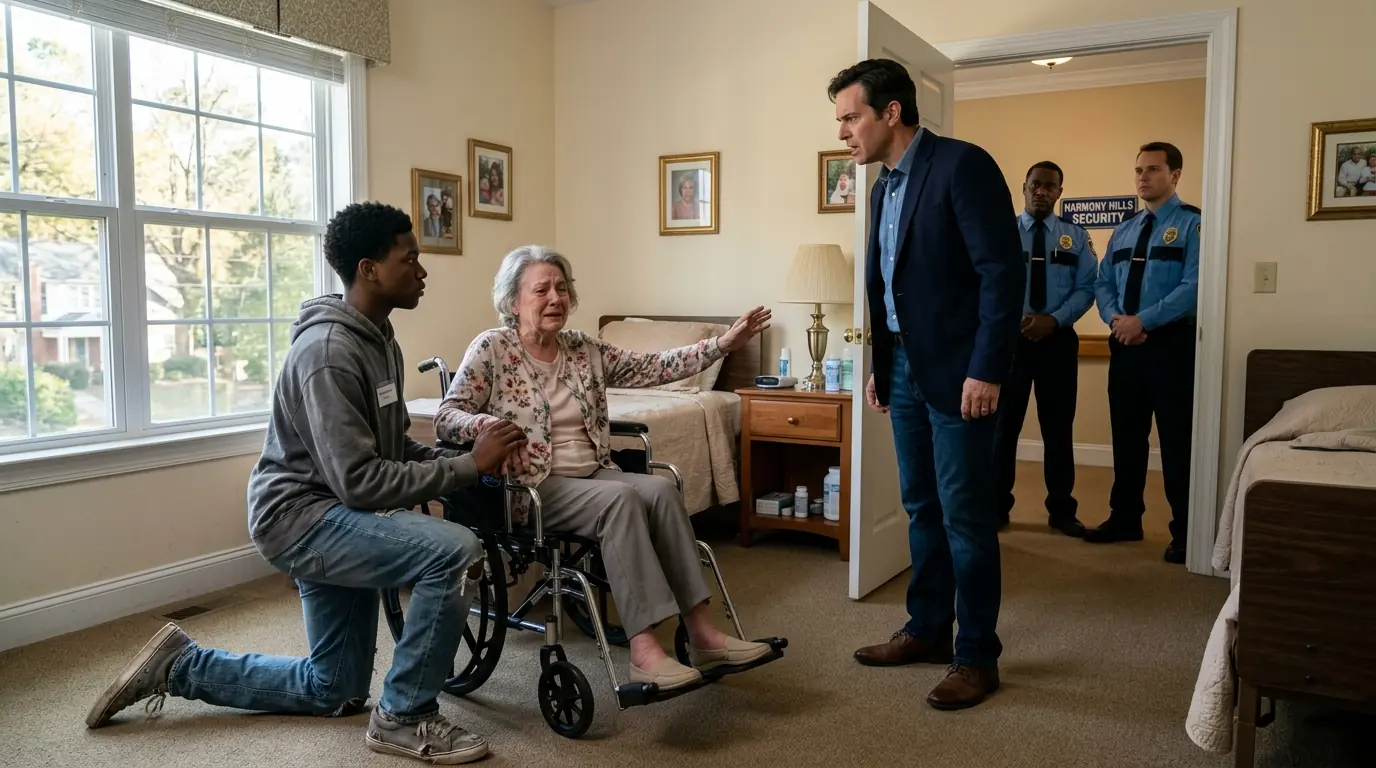
Carter Adams, billionaire, stands in the doorway. His elderly mother sits in her wheelchair, crying. A Black homeless teen kneels beside her, fingers intertwined with hers.
"Get away from her. Now."
The boy doesn't move. Seventeen. Raggedy hoodie. Holes in his shoes, but his grip stays gentle.
"Sir, please explain how you snuck in to scam a senile old woman." Carter's lip curls. "Security. Get this street trash out. You people are all the same."
"I'm not stealing anything."
"Then why is she crying?"
The old woman looks up, tears streaming, but her eyes sharp, lucid. "Carter, listen to him. Mom, listen."
The boy stands, looks Carter dead in the eyes. Three words. That's all he says. Three words. And Carter's knees buckle. His face drains white. His mouth opens, but nothing comes out. Three words just shattered a satisfying dollar empire.
What did he say?
Morning light cuts through floor-to-ceiling windows. The Buckhead estate sprawls across 3 acres of manicured silence: 12,000 square feet. A staff of four moves through the house like ghosts trained to be invisible, to anticipate needs before they're spoken.
Carter Adams stands in his home gym at 5:00 a.m. The treadmill hums beneath his feet. His breath is steady, controlled, like everything else in his life. CNBC plays on muted screens. Market reports scroll past. He doesn't watch them. He already knows what they'll say: Adams Development posted another record quarter. The Westside project alone displaced 23 families and generated $89 million in profit. He calls it urban renewal; others call it something else. Carter doesn't listen to others. He stopped listening years ago.
His phone buzzes. Harmony Hills Senior Living again. Third time this week. He ignores it. His mother can wait. She always waits.
Eleanor Adams is 78 years old. Early onset Alzheimer's, diagnosed 3 years ago. The decline accelerated 6 months back. Now she drifts between clarity and fog, between the present and some distant past Carter doesn't recognize. She calls for people who don't exist. Cries over photographs he's never seen. He visits once a week, 20 minutes, sometimes less. He tells himself, "It's enough."
There's something else. Something Carter hasn't told anyone. Not his board, not his lawyers, not even Victor. For 6 months, letters have arrived at his office. First Monday of every month, same envelope, same postmark: Atlanta, no return address, same single line inside: Ask your mother about Jamie.
Carter traced the postmark: dead end. He hired a handwriting analyst: inconclusive. He considered blackmail, but no demand ever came. Just that same sentence, month after month, patient as a heartbeat: Ask your mother about Jamie.
He doesn't know anyone named Jamie. Neither does his mother. At least that's what he tells himself.
His phone buzzes again. Not Harmony Hills this time. Victor Bennett, his CFO, his oldest friend. 30 years of partnership. They built Adams Development together. Brick by brick, deal by deal.
"Carter, quick question." Victor's voice is casual. Too casual. "Has anyone contacted you lately about older matters, family stuff?"
Carter pauses. The letters flash through his mind. The monthly envelopes, the single line. "No," he lies. "Why?"
"Just checking. Some journalist's been sniffing around. Rachel Morrison, Atlanta Chronicle. Probably nothing, but I wanted to make sure we're aligned."
"We're aligned."
Carter hangs up. He doesn't know why he lied to Victor. The instinct came before the thought. 30 years of trust, and something made him hold back.
That afternoon he drives to Harmony Hills. Obligation, not love. The facility smells of antiseptic and something older, something sweeter, something sad. The smell of time running out. Fluorescent lights hum overhead. The carpet muffles footsteps. Everything here is designed to muffle. Sound, pain, the slow fade of memory.
Eleanor sits in her chair by the window. She's having a bad day. Her eyes drift. Her words loop. She asks about breakfast three times in 5 minutes. Then something changes.
"Did you read the letters?" she asks suddenly. Her voice is sharp, clear.
Carter freezes. "What letters?"
"The letters, Carter. Did you read them? It's important."
"Mom, I don't know what your—"
Her clarity vanishes. She asks when Jamie is coming to visit. Carter assumes it's the dementia. A name from her childhood. Maybe a forgotten friend. He notices a gap on the wall. A photo frame missing for months. The nail still there. The dust outline visible. He never asked why it was removed. He never asked about anything.
20 minutes later, he leaves. At the door, a nurse stops him.
"Mr. Adams, your mother had an unauthorized visitor yesterday, a young man. He's been coming for months, apparently. We only just noticed the pattern."
Carter's jaw tightens. "Who is he?"
"We don't know. Security is reviewing the footage. He signs in under different names, but he comes every week. Same day, your mother calls the front desk asking to speak to Victor."
The name hits Carter like a slap. Victor. His mother calling for Victor. The letters asking about Jamie, an unauthorized visitor. Something is very wrong.
That night, Carter sleeps badly. He dreams of a photograph with two boys. One is him. The other has no face.
The next morning, his phone rings at 7:00 a.m. Harmony Hills.
"Mr. Adams, you need to come now. The visitor is back, and he refuses to leave."
Carter arrives at Harmony Hills in 14 minutes. What he finds in his mother's room will shatter everything he believes about his family.
Carter's Mercedes screeches into the parking lot. 8:52 a.m., 14 minutes from his estate. He doesn't remember the drive. His hands are shaking.
The receptionist's face is pale. "Mr. Adams, security is already—"
He pushes past her, down the hallway, past the nurse's station, past the medication cart with its plastic cups and measured doses. The fluorescent lights buzz overhead like insects. The administrator intercepts him outside room 114.
"Mr. Adams, we've called security. He refuses to leave. We didn't want to escalate without your—"
Carter doesn't stop. His mother's room is at the end of the hall. Door half-open. Morning light spills through the gap, catching dust motes, making them dance. He pushes the door open and stops.
Eleanor sits in her chair. She is crying. But these aren't the tears he knows. Not confusion, not fear, not the blank weeping of a mind losing its grip. These tears are different. There's something like joy in them, something like relief, like a prayer finally answered.