The Saturday before school picture day, Caleb Morgan walked into King’s Barbershop with fifteen dollars in his pocket and a promise in his heart.
The money had taken him almost a month to save.
He had carried grocery bags for Mrs. Bell from the second floor. He had helped Mr. Turner sweep the sidewalk outside the corner store. He had taken out trash for the older couple in apartment 1A, even when the bags smelled like onions and old coffee. His mother had added the last three dollars on Friday night after counting the rent money twice and sighing over the electric bill.
“You sure you want to spend it on a haircut?” she had asked.
Caleb had nodded fast.
“Yes, Ma.”
His mother, Nicole Morgan, had looked at him across the kitchen table with tired eyes and a soft smile. She worked long shifts at a hotel laundry room, and her hands were always dry from soap and hot water. Still, she kept Caleb’s shirts clean, his homework checked, and his dreams protected as much as she could.
“Picture day matters that much?” she asked.
Caleb touched the top of his head.
“My hair looks wild.”
“It does not look wild.”
“Ma.”
She laughed.
“All right. It has opinions.”
Caleb grinned.
He was eleven years old, Black, thin, and a little taller than most boys in his class. His skin was deep brown, his eyes were alert, and his face still had the softness of childhood, though worry sometimes made him look older. He did not ask for much. He had learned early that wanting things out loud could make his mother feel guilty.
But school picture day was different.
Last year, his hair had been uneven because Nicole had tried to trim it herself after watching a video on her phone. She had done her best. Caleb knew that. But the boys at school had laughed for three days.
This year, he wanted to look sharp.
Not rich.
Not fancy.
Just sharp.
King’s Barbershop sat between a small soul food takeout place and a laundromat on the south side of St. Louis. The front window had blue lettering, old photographs of haircuts taped inside, and a red barber pole that still spun even though the paint had faded. Inside, the shop smelled like hair cream, aftershave, coffee, floor cleaner, and the fried chicken drifting in from next door whenever someone opened the door.
Caleb loved the sound of the shop.
Clippers buzzing.
Men laughing.
Basketball talk.
Old soul music playing low from a radio behind the counter.
The barber chairs were black leather with silver arms. The mirrors had small scratches near the edges. The wall near the register held framed pictures of local baseball teams, church choirs, and men in suits from decades ago.
Mr. King, the owner, was a broad-shouldered man with gray in his beard and a towel always draped over one shoulder. He had cut hair in that neighborhood for thirty years and seemed to know everybody’s uncle, cousin, pastor, and business.
When Caleb stepped inside, Mr. King looked up from trimming a man’s beard.
“There he is,” Mr. King said. “Young Mr. Morgan.”
Caleb stood taller.
“Good morning.”
“Picture day coming?”
“Yes, sir.”
“I figured. You got that serious look. Boys only look that serious before pictures or trouble.”
The men in the shop laughed.
Caleb smiled but kept one hand in his pocket, touching the folded bills.
He had an appointment at ten.
He was early.
His mother had dropped him off before taking the bus to work. She had kissed his forehead on the sidewalk and told him to go straight home afterward.
“And don’t let Mr. King talk you into no grown-man sideburns,” she said.
Caleb had rolled his eyes.
“Ma.”
“I’m serious. I want my child back, not a tiny bank manager.”
Now he sat in the waiting chair near the window, looking at the haircut chart on the wall and imagining himself walking into school Monday with clean edges and a fresh fade.
That was when the old man came in.
The bell above the door rang softly.
A thin elderly man stepped inside, leaning on a polished wooden cane. He was Black, with warm brown skin, a narrow face, and a white mustache that curved neatly over his upper lip. He wore a dark brown suit even though it was Saturday, a cream shirt buttoned to the top, and a tan fedora held carefully in one hand. His shoes were old but shined so well they caught the light from the window.
The shop grew quieter when he entered, not because anyone was afraid of him, but because he carried himself like a man people had once stood up for.
Mr. King looked toward the door.
“Well, I’ll be,” he said. “Mr. Amos Whitaker.”
The old man smiled.
“Morning, Leonard.”
Mr. King wiped his hands on his towel and came around the chair.
“Been a long time.”
“Too long,” Mr. Whitaker said.
“You looking for a cut?”
“If you have room for an old man.”
“For you? Always.”
A younger barber near the back called out, “That the music teacher?”
Mr. King nodded.
“That is Mr. Whitaker, and you better put respect in your voice. Half this neighborhood learned scales from him.”
Mr. Whitaker laughed softly.
“Half this neighborhood refused to practice them.”
The men in the shop chuckled.
Caleb watched him carefully.
There was something about Mr. Whitaker’s hands. They were thin now, the knuckles raised, the fingers slightly bent, but he held them with grace, like they remembered music even when they were still.
Mr. King helped him into the empty barber chair closest to the window.
“What we doing today?” Mr. King asked.
“Clean me up,” Mr. Whitaker said. “Not too much. I still need to recognize myself.”
“You got somewhere special to be?”
The old man looked at himself in the mirror for a moment.
“My wife’s birthday.”
The shop quieted again.
Mr. King’s voice softened.
“Miss Evelyn?”
“Yes.”
“I didn’t know today was…”
“She would have been eighty-one.” Mr. Whitaker touched the brim of his hat resting on his lap. “I am taking flowers to the cemetery. Thought I should not visit looking like I wrestled a pillow and lost.”
Someone laughed gently.
Mr. King placed a cape around him.
“Then we’ll get you right.”
For twenty minutes, Caleb watched Mr. King work.
The clippers moved slowly around Mr. Whitaker’s head. Mr. King trimmed carefully, with the kind of respect people show when they know the person in front of them has lived a long life. The old man sat quietly, eyes half closed, sometimes tapping two fingers against the armrest in a rhythm only he could hear.
Caleb tapped along without realizing.
Mr. Whitaker noticed through the mirror.
“You hear that rhythm, young man?”
Caleb froze.
“Sir?”
“The one I was tapping.”
“Oh. Yes, sir.”
Mr. Whitaker smiled.
“You play anything?”
“No, sir.”
“Sing?”
Caleb looked down fast.
“No.”
That was not completely true.
He sang when he washed dishes, when he walked home alone, and sometimes when his mother was too tired to talk and soft music played from her phone. He liked singing, but he did not like people hearing him. Boys at school made fun of anything soft.
Mr. Whitaker’s eyes stayed on him in the mirror.
“Hmm,” he said.
Not accusing.
Just noticing.
When Mr. King finished, he brushed loose hair from Mr. Whitaker’s neck and turned the chair.
“There you go.”
Mr. Whitaker looked in the mirror.
For a moment, his face changed.
He looked younger.
Not in age, exactly.
In dignity.
“Yes,” he said softly. “That will do.”
Mr. King removed the cape.
“That’ll be fifteen.”
Mr. Whitaker reached inside his suit jacket and took out a worn leather wallet. He opened it.
Then he stopped.
His fingers moved through the wallet once.
Then again.
Then he checked another pocket.
The shop did not go silent all at once.
It happened slowly.
The laughter faded.
The clippers in the back kept buzzing, but everyone near the front seemed to become aware of the old man’s hands searching for money that was not there.
Mr. Whitaker’s face remained calm, but Caleb saw the embarrassment enter his eyes.
“I appear to have made a foolish mistake,” he said.
Mr. King waved one hand.
“Don’t worry about it.”
“No,” Mr. Whitaker said quickly. “I do worry about it. A man pays for work.”
“Amos, I know you.”
“I know you do.”
Mr. King leaned against the counter.
“Then you can bring it next time.”
Mr. Whitaker’s jaw tightened slightly.
Caleb understood before anyone said it.
Next time was not the same when you were old.
Next time might mean asking for kindness twice.
Next time might mean walking out with everyone knowing you could not pay.
Mr. Whitaker removed a small gold tie clip from his shirt.
“I can leave this.”
Mr. King frowned.
“Absolutely not.”
“It belonged to my father.”
“Then you definitely not leaving it.”
Mr. Whitaker looked down at the tie clip in his palm.
“I cannot go to Evelyn owing a debt.”
The sentence landed heavily in the shop.
Caleb felt his fingers close around the fifteen dollars in his pocket.
His haircut money.
His school picture money.
The money he had worked for.
The money his mother had helped him finish saving.
He looked at Mr. Whitaker’s clean haircut.
He looked at the old man’s cane.
He looked at the tie clip in his palm.
He thought about picture day.
He thought about the boys laughing last year.
He thought about his mother trying her best with kitchen scissors and a phone video.
Then Mr. Whitaker quietly placed the tie clip on the counter.
Caleb stood.
“I can pay.”
Every head near the front turned toward him.
Mr. King frowned. “Caleb.”
Caleb walked to the counter and pulled the folded bills from his pocket.
Three fives.
He placed them beside the tie clip.
“This covers it.”
Mr. Whitaker stared at him.
“Young man, no.”
“It’s okay.”
“It is not okay.”
“You need to see your wife,” Caleb said.
The old man’s face changed.
Caleb’s voice got smaller, but he kept going.
“And you shouldn’t have to leave your father’s tie clip for a haircut.”
Mr. King looked away for a second, his mouth pressed tight.
Mr. Whitaker slowly picked up the tie clip and held it in his hand.
“What is your name?” he asked.
“Caleb Morgan.”
“Caleb Morgan,” he repeated. “And what was this money for?”
Caleb hesitated.
“A haircut.”
The old man closed his eyes briefly.
“For picture day?”
Caleb nodded.
Mr. Whitaker shook his head.
“No. I cannot accept that.”
Mr. King cleared his throat.
“Amos, the boy made his choice.”
“He is a child.”
Mr. King looked at Caleb with something like pride.
“Children can still know when a man needs dignity more than they need a fade.”
Caleb looked down, embarrassed.
Mr. Whitaker reached for the bills, but not to take them. He held them out to Caleb.
“Please.”
Caleb did not touch them.
“My mother says giving only counts if you let go.”
Mr. Whitaker’s eyes grew shiny.
For a long moment, he said nothing.
Then he placed the money in Mr. King’s hand.
“Thank you,” he whispered.
Caleb shrugged because he did not know what else to do.
“It’s just a haircut.”
“No,” Mr. Whitaker said. “It is a boy seeing an old man before pride made him invisible.”
The shop stayed quiet.
Then Mr. King opened the register, put the money inside, and looked at Caleb.
“Sit down.”
Caleb blinked.
“What?”
“Sit in my chair.”
“I don’t have money.”
“I heard you the first time. Sit down.”
Caleb looked uncertain.
Mr. King pointed at the chair.
“Your mama will come for me if I let you go to picture day looking like your hair lost a debate.”
The men laughed, and the heaviness in the shop finally broke.
Caleb sat.
Mr. King cut his hair himself.
Not a rushed cut.
A clean, careful one.
When he finished, Caleb looked into the mirror and barely recognized himself.
Sharp edges.
Fresh fade.
Picture-day ready.
Mr. King removed the cape and leaned close.
“Don’t tell nobody I got soft,” he said.
Caleb smiled.
“Yes, sir.”
Mr. Whitaker stood slowly from the waiting chair where he had remained the whole time.
He placed his hat on his head, adjusted his tie clip, and came over to Caleb.
“You have a good ear,” he said.
Caleb frowned.
“For what?”
“Rhythm. And perhaps more.”
Caleb looked away.
Mr. Whitaker reached into his inside pocket and removed a small card. It was old-fashioned, cream-colored, with neat black letters.
Amos Whitaker
Piano & Voice Instruction
Former Director, St. Mark’s Youth Choir
A phone number was written at the bottom.
“I no longer teach many students,” Mr. Whitaker said. “But if your mother permits, I would like to hear you sing sometime.”
Caleb’s face went hot.
“I don’t sing.”
“Then come prove me wrong.”
Mr. King laughed from behind him.
“Boy, if Amos Whitaker says you sing, you probably sing.”
Caleb took the card because refusing felt rude.
That evening, his mother cried when she saw his haircut.
Not sad tears.
Not exactly happy tears either.
The complicated kind.
“You look handsome,” she said, touching the back of his head gently.
“Mr. King did it free.”
“He did?”
Caleb told her the whole story.
Nicole sat at the kitchen table while he spoke. When he finished, she picked up the business card and read it.
“Piano and voice instruction?”
“He thinks I can sing.”
“Can you?”
Caleb shrugged too fast.
His mother smiled slowly.
“Oh.”
“What?”
“You can.”
“I didn’t say that.”
“You didn’t have to.”
“I just sing sometimes.”
“When?”
“When I’m doing stuff.”
“What stuff?”
“Dishes.”
His mother leaned back.
“All this time, I got a dishwasher and a radio in one child?”
“Ma.”
She laughed, then grew serious.
“You want to go see him?”
Caleb looked at the card.
“I don’t know.”
“That was not a no.”
“He seems important.”
“He seems kind.”
“Important people can be kind?”
His mother’s face softened.
“Yes, baby. They just don’t always choose to be.”
A week later, Nicole took Caleb to Mr. Whitaker’s house.
It was a small brick home on a quiet street lined with old trees. The porch railing needed paint, but the steps were swept clean. A pot of yellow flowers sat near the door. Inside, the house smelled like lemon polish, old paper, and tea.
The living room held a piano.
Not a shiny grand piano like in movies.
An upright piano with dark wood, worn keys, and framed photographs on top. In one photo, a young Mr. Whitaker stood beside a smiling woman in a white dress. In another, a children’s choir stood on risers inside a church.
Mr. Whitaker welcomed them warmly.
“Ms. Morgan,” he said, bowing his head slightly. “Thank you for trusting me with your son’s time.”
Nicole looked him in the eye.
“I trust slowly.”
“As you should.”
That answer seemed to satisfy her.
Caleb sat stiffly on the piano bench while his mother took the chair near the wall.
Mr. Whitaker played a simple note.
“Match this.”
Caleb opened his mouth and made a sound so quiet it barely lived.
Mr. Whitaker did not laugh.
He simply said, “Again. Let the sound stand up.”
Caleb tried again.
Better.
Then again.
By the fourth time, the note filled the room.
Nicole’s eyes widened.
Caleb saw her reflection in the piano wood and immediately stopped.
Mr. Whitaker smiled.
“There he is.”
“I’m not good,” Caleb said quickly.
“No. You are untrained. That is a different problem and far more hopeful.”
For the next hour, Mr. Whitaker taught him how to breathe, how to stand, how to listen before singing, how to feel rhythm in his body, and how not to apologize for sound.
“Your voice is not a mistake,” he said. “Do not send it into the world like you are asking permission.”
Caleb did not know what to do with that sentence.
So he carried it home quietly.
Lessons began on Saturdays.
Nicole could not pay much. Mr. Whitaker refused regular payment.
“This is not charity,” he told her. “It is repayment of a debt I never intend to finish.”
Nicole did not like that.
“Debt makes people uneven,” she said.
Mr. Whitaker nodded.
“Then call it an exchange. Caleb helps me move things, carry groceries, sort old sheet music, and keep my piano bench from disappearing under papers. I teach him.”
Caleb liked that.
He did not want to feel like a charity case.
He wanted to feel useful.
So every Saturday, he arrived early. He dusted shelves. He carried grocery bags from the porch. He took trash to the curb. He watered the yellow flowers. Then he sang.
At first, he sang softly.
Then stronger.
Mr. Whitaker taught him old spirituals, jazz standards, church songs, and simple classical pieces. He taught him that music was not only about sounding pretty.
“Pretty is decoration,” he said. “Truth is the house.”
Caleb learned to read music slowly. He learned scales. He learned that breath mattered as much as sound. He learned that silence was part of music too.
Mr. Whitaker had many sayings.
“Do not chase the note. Prepare the breath, and the note will meet you.”
“Loud is not the same as strong.”
“Feeling without discipline becomes noise.”
“Discipline without feeling becomes furniture.”
Caleb wrote some of them in a notebook.
By thirteen, he was singing in the school choir.
By fourteen, he had his first solo at church.
His mother cried so hard that Mrs. Bell from the second floor had to hand her tissues.
By fifteen, Caleb began helping younger kids in the community center choir. He showed them how to stand, breathe, and not giggle through warmups.
He still visited Mr. Whitaker every Saturday.
But the old man was slowing down.
His hands stiffened. His breath grew shorter. Some days, he taught from his armchair instead of the piano bench. Caleb began making tea without being asked. He learned which medicine bottle went where, though Mr. Whitaker never allowed him to handle anything important without instruction.
The house grew quieter after each visit.
One Saturday, Caleb found Mr. Whitaker sitting in the living room with an old cassette recorder on the table.
It was silver and black, with large buttons and a tiny built-in microphone.
“What’s that?” Caleb asked.
“A machine from the ancient world.”
“I know it’s a cassette recorder.”
“Then why ask?”
“Because you put it on the piano like it matters.”
“It does.”
Mr. Whitaker pointed to the bench.
“Sit.”
Caleb sat.
“What are we doing?”
“Recording.”
“Why?”
“Because voices change. Because memory lies. Because one day you will need to hear where you began.”
Caleb shifted uncomfortably.
“I sound weird on recordings.”
“Everyone sounds strange when meeting themselves from outside.”
Mr. Whitaker pressed the red button.
The cassette wheels turned.
“State your name,” he said.
Caleb laughed.
“Why?”
“For the archive.”
“What archive?”
“My shoebox under the desk, currently underfunded but historically significant.”
Caleb shook his head, smiling.
“My name is Caleb Morgan.”
“Age?”
“Fifteen.”
“Date?”
“April 12.”
“Good. Now sing the piece from last week.”
Caleb sang.
At first, he was self-conscious. Then the room settled around him. The piano held the chords. Mr. Whitaker’s hand moved gently over the keys. Caleb’s voice rose, not perfect, not polished, but clear and honest.
When he finished, Mr. Whitaker let the final chord fade before stopping the tape.
“Again,” he said.
Caleb groaned.
“Again?”
“Greatness has never been built from one take.”
They recorded three songs that day.
Then Mr. Whitaker interviewed him.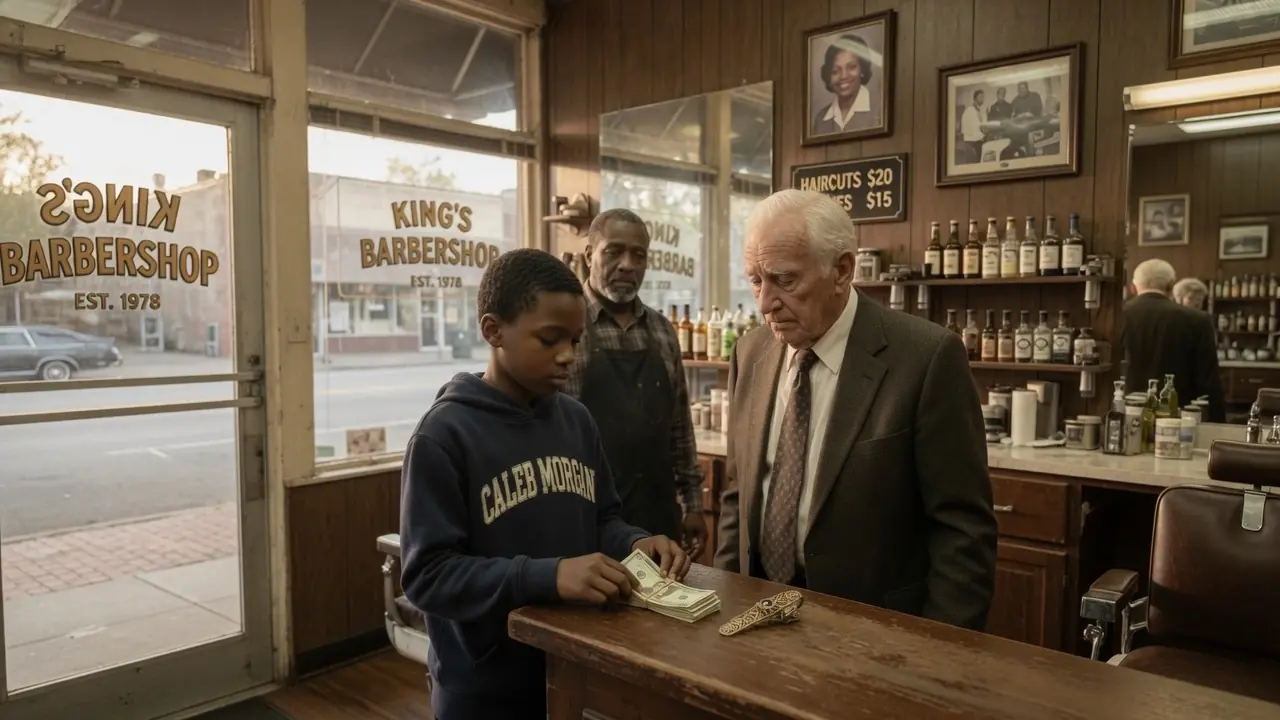
“What do you want music to do?”
Caleb frowned.
“I don’t know.”
“Answer anyway.”
“I want it to make people stop pretending they’re fine.”
Mr. Whitaker became very still.
Then he said, “That is a better answer than you realize.”
Caleb did not think much about the cassette afterward.
Life became busy.
School. Work. Choir. Helping his mother. Helping Mr. Whitaker. College brochures he was afraid to read too closely because the prices looked like phone numbers.
Mr. Whitaker pushed him to apply for a summer music program at a respected arts academy in Chicago. The program offered scholarships, but competition was fierce. Students from private schools applied. Students with professional recordings applied. Students who had been training since they were small applied.
Caleb almost refused.
“I’m not that kind of singer,” he said.
“What kind is that?”
“The kind who belongs there.”
Mr. Whitaker’s eyes sharpened.
“Belonging is not a personality trait. Sometimes it is a door you must open while your knees shake.”
Caleb sighed.
“You always say things that sound like they should be on walls.”
“Then stop resisting and write them down.”
Caleb applied.
He recorded an audition video at the community center with a borrowed microphone and a folding chair stacked on top of a table to hold the phone. It was not perfect, but it was good.
For three weeks, he checked his email too often.
Then the rejection came.
Not a full rejection, exactly.
Waitlist.
No scholarship funds available at this time.
Caleb stared at the message in the hallway after school until the words blurred.
He told his mother that night.
She tried to be encouraging.
“Waitlist means not no.”
“It means not yes.”
“It means they saw something.”
“Not enough.”
Mr. Whitaker responded differently.
When Caleb told him, the old man asked to see the email. He read it carefully.
Then he said, “Good.”
Caleb stared at him.
“Good?”
“Yes.”
“How is this good?”
“It means the door is not closed. It is merely being rude.”
Caleb almost laughed, but he was too disappointed.
Mr. Whitaker leaned back in his chair.
“We will send a supplemental package.”
“A what?”
“Additional material. A letter. Another recording. Evidence of growth.”
“Mr. Whitaker, they already decided.”
“They decided with incomplete information.”
Caleb shook his head.
“I can’t afford some professional recording.”
“I did not ask you to.”
The old man looked toward the desk.
“Open the bottom drawer.”
Caleb did.
Inside were folders, envelopes, old choir programs, and the silver cassette recorder. Beside it was a cassette labeled in Mr. Whitaker’s neat handwriting:
Caleb Morgan — April 12 — Voice, Interview, Piano
Caleb picked it up.
“You kept this?”
“Of course.”
“Why?”
“I told you. One day you would need to hear where you began.”
Over the next week, Mr. Whitaker worked like a man racing time but refusing to admit it.
He wrote a recommendation letter for Caleb.
Not a short polite one.
A long, detailed letter.
He described the barbershop. The haircut money. Caleb’s first hesitant note. His years of study. His discipline. His work helping younger children. His ability to hear rhythm. His respect for songs older than himself. His growth from fear into sound.
Caleb saw only part of it.
Mr. Whitaker covered the page with one hand.
“Some words are not for you until after they have done their work.”
They converted the cassette to a digital file at the public library with help from a young librarian who looked amused and impressed by Mr. Whitaker’s determination.
When Caleb heard his fifteen-year-old self sing, he cringed.
“I sound young.”
“You were young.”
“I’m still young.”
“Yes. But now you are young with better breath control.”
Mr. Whitaker included the recording, the new audition video, and his letter in the supplemental package.
Then they waited.
Two weeks passed.
Mr. Whitaker grew weaker.
He missed one Saturday lesson because of a doctor appointment. Then another because he was too tired. Caleb visited anyway, bringing groceries and reading emails aloud.
On a rainy Thursday in May, Caleb received a call from the arts academy.
He almost did not answer because he did not recognize the number.
“Is this Caleb Morgan?” a woman asked.
“Yes.”
“This is Dr. Elaine Porter from the Lakeside Summer Conservatory.”
Caleb sat down on the edge of his bed.
“Yes, ma’am?”
“I’m calling because we reviewed your supplemental materials.”
His heart pounded.
“Your original application placed you on our waitlist,” she continued. “But Mr. Whitaker’s letter and the additional recordings gave the committee a fuller picture of your development. We were particularly moved by the contrast between your early cassette recording and your current audition.”
Caleb could not speak.
“We would like to offer you admission with a full scholarship, including housing and meals.”
He closed his eyes.
“Mr. Morgan?”
“Yes,” he whispered. “I’m here.”
“Would you like to accept?”
He thought of his mother.
Mr. King.
The barbershop.
Mr. Whitaker’s piano.
The cassette wheels turning.
“Yes, ma’am,” he said. “I accept.”
Nicole screamed when he told her.
Then she cried.
Then she called Mrs. Bell, even though Mrs. Bell lived one floor above and would have heard her anyway.
Caleb ran to Mr. Whitaker’s house.
The old man was sitting in his armchair beside the piano, wearing a cardigan and looking smaller than he used to. But when Caleb burst through the door, waving the printed email, Mr. Whitaker’s eyes lit up.
“I got in,” Caleb said, breathless.
“With scholarship?”
“Full.”
Mr. Whitaker nodded once, as if the world had finally done what he instructed.
“Good.”
Caleb laughed.
“You always say good like you weren’t worried.”
“I was not worried.”
“That’s a lie.”
“It is a performance.”
Caleb handed him the email.
Mr. Whitaker read every line slowly.
Then he placed the paper on his lap and looked at Caleb.
“Do you understand what happened?”
“They liked the tape.”
“No.”
“The letter?”
“No.”
Caleb frowned.
“Then what?”
“They heard a story with evidence,” Mr. Whitaker said. “Talent matters. Work matters more. Character gives work direction. The cassette showed where you began. The new recording showed where practice carried you. The letter explained why you could be trusted with opportunity.”
Caleb sat down across from him.
“I wouldn’t have had any of it without you.”
Mr. Whitaker’s expression softened.
“And I would have gone to my wife’s grave ashamed over fifteen dollars if not for you.”
“That was years ago.”
“Yes,” the old man said. “That is how roots work.”
Caleb went to Chicago that summer.
He had never been away from home that long before. The dorm room felt strange. The schedule was demanding. The other students were talented in ways that scared him. Some had studied opera since childhood. Some played three instruments. Some spoke casually about private coaches, competitions, and tours.
For the first week, Caleb felt like a mistake wearing a name tag.
Then he remembered Mr. Whitaker’s words.
Belonging is not a personality trait.
He practiced.
He listened.
He asked questions.
He worked until his ribs hurt from breathing exercises and his legs ached from standing through rehearsals. Slowly, fear became focus. Focus became growth.
At the final concert, Nicole came by bus from St. Louis with Mr. King and Mrs. Bell. They sat in the audience together, proud enough to embarrass him from a distance.
Mr. Whitaker could not travel.
But Caleb carried the old man’s tie clip in his pocket.
Mr. Whitaker had given it to him before he left.
“Just for the concert,” he said.
“I can’t take this.”
“You are borrowing it.”
“What if I lose it?”
“Then I will haunt you with scales.”
Caleb sang that night like he was sending his voice all the way home.
Afterward, Dr. Porter found him backstage.
“You have unusual emotional honesty,” she said.
Caleb smiled.
“My teacher says truth is the house.”
“She is wise.”
“He,” Caleb said. “Mr. Whitaker.”
Dr. Porter nodded.
“Then Mr. Whitaker is wise.”
When Caleb returned to St. Louis, he went to Mr. Whitaker’s house before even taking his bag home.
The old man was in bed.
The room was dim, but the piano was still visible through the open doorway, waiting quietly.
Caleb sat beside him and told him everything.
The dorm.
The rehearsals.
The concert.
The compliments.
The mistakes.
The fear.
The tie clip in his pocket.
Mr. Whitaker listened with his eyes closed, smiling faintly.
When Caleb finished, the old man whispered, “Good.”
This time, Caleb did not laugh.
He took Mr. Whitaker’s hand.
“I brought it back,” he said, placing the tie clip on the bedside table.
Mr. Whitaker opened his eyes.
“Keep it.”
“No. You said borrow.”
“I have changed the arrangement.”
“I don’t want it like this.”
“Caleb.”
The old man’s voice was weak but firm.
“It belonged to my father. It kept me mindful of dignity. I want it to remind you of the same.”
Caleb’s eyes filled.
“I’m not ready.”
“Nobody is ready for gifts that matter.”
Mr. Whitaker passed away in early autumn, on a quiet morning after rain.
The funeral was held at St. Mark’s Church, where he had directed the youth choir for years. The sanctuary filled with former students, neighbors, church members, musicians, barbershop regulars, and children who had once learned scales from him and grown into adults who still remembered his corrections.
Mr. King stood in the back, wiping his eyes with a towel he had brought from the shop.
Nicole sat beside Caleb, holding his hand.
The choir sang one of Mr. Whitaker’s favorite songs.
Caleb could not sing with them.
Not that day.
His throat was too full.
After the service, Dr. Porter appeared unexpectedly. She had driven from Chicago after hearing the news from Caleb.
“He changed your life,” she said gently.
Caleb nodded.
“He changed my hearing.”
“That may be even bigger.”
Mr. Whitaker’s niece, a woman named Denise, handed Caleb an envelope after the burial.
“He left this for you.”
Caleb opened it that night at the kitchen table, with his mother sitting beside him.
Dear Caleb,
If you are reading this, I have gone somewhere beyond flat notes and late students.
Do not be dramatic about my passing. I was old, tired, and fortunate enough to hear your voice grow before I left. That is more than many teachers receive.
You once paid for my haircut when pride had cornered me in a barbershop. You were a child with picture day ahead of you, and still you saw an old man trying not to leave a piece of his father on a counter.
That day, you gave me dignity.
I gave you lessons.
Let us call it even, though we both know kindness does not keep accounts properly.
The cassette recorder and all recordings we made are yours. Keep them. Not because they are perfect, but because they are honest. One day, when applause gets loud or rejection gets louder, listen to where you began.
Also, enclosed is a list of people who owe me favors, musical and otherwise. Use it only when necessary. Do not become proud. Pride makes the throat tight.
Sing truthfully.
Teach someone younger.
Call your mother.
And remember: your voice is not a mistake. Do not send it into the world like you are asking permission.
Amos Whitaker
Inside the envelope was another folded sheet.
Names.
Phone numbers.
Notes.
Former students who had become choir directors, professors, studio owners, accompanists, and church musicians. Beside Dr. Porter’s name, Mr. Whitaker had written:
Already knows. Trusts the work. Do not waste her time.
Caleb laughed through tears.
Over the next years, he did what Mr. Whitaker told him.
He kept singing.
He worked hard in school.
He helped younger students at community choir rehearsals.
He called his mother more often than most college boys would admit.
He faced rejection too.
Auditions he did not win.
Scholarships he almost received.
Rooms where people underestimated him before he sang and praised him only after he proved himself.
Whenever rejection felt too heavy, he played the cassette recording.
The sound was rough.
A little hiss.
Piano slightly out of tune.
Mr. Whitaker’s voice in the background saying, “Again. Let the sound stand up.”
Then young Caleb singing, unsure but honest.
It reminded him that growth was real even when progress felt invisible.
At twenty-three, Caleb returned to King’s Barbershop during winter break. The shop looked almost the same. Same mirrors. Same smell of aftershave. Same old radio. Mr. King had more gray in his beard now, but his voice was unchanged.
“Young Mr. Morgan,” he said. “College singer now.”
Caleb smiled.
“Trying.”
“You still owe me for that free haircut.”
Caleb laughed.
“I thought Mr. Whitaker’s payment covered it.”
“Nah. That paid the shop. Your debt is emotional. Very expensive.”
Caleb sat in the chair.
Mr. King placed the cape around him.
“You want the picture-day cut?”
Caleb looked at himself in the mirror.
For a second, he saw the eleven-year-old boy with fifteen dollars in his pocket and fear of being laughed at.
Then he saw Mr. Whitaker in the chair near the window, touching his father’s tie clip.
“Yeah,” Caleb said softly. “Picture-day cut.”
Mr. King nodded like he understood.
While the clippers buzzed, a small boy came into the shop with his grandmother. He was Black, maybe ten, with nervous eyes and a school folder hugged to his chest. His hair needed a cut, but the grandmother asked Mr. King quietly if there was a cheaper price for children.
Mr. King’s face softened.
Before he could answer, Caleb reached into his wallet and placed a twenty on the counter.
“Put it on mine.”
The grandmother turned.
“Oh, no, baby, you don’t need to—”
Caleb smiled.
“I know.”
The boy stared at him.
“You famous?”
Mr. King snorted.
“Not yet.”
Caleb laughed.
“No. I just know picture day matters.”
The boy touched his folder.
“It’s tomorrow.”
“Then you better look sharp.”
The grandmother’s eyes filled.
“Thank you.”
Caleb looked toward the chair where Mr. Whitaker had once sat.
“You’re welcome.”
Years later, when Caleb became a music teacher, he kept three things in his classroom.
The cassette recorder.
The gold tie clip in a small frame.
And a photograph of Amos Whitaker seated at his piano, one hand lifted as if about to correct someone’s posture.
He did not name the room after anyone.
He did not need a sign.
Every student who entered learned Mr. Whitaker’s lessons.
Your voice is not a mistake.
Loud is not the same as strong.
Truth is the house.
Let the sound stand up.
Sometimes students came in ashamed of their voices. Too quiet. Too rough. Too churchy. Too untrained. Too different. Caleb heard all the ways children tried to apologize before making sound.
He never let them keep apologizing.
One afternoon, a boy named Jordan stayed after class.
He was twelve, Black, thin, and serious-eyed, with a voice he kept hidden behind shrugs.
“Mr. Morgan,” he said, “how do you know if you’re actually good?”
Caleb thought for a moment.
Then he pulled out the old cassette recorder.
“You don’t start by asking if you’re good,” he said. “You start by being honest enough to begin.”
He pressed play.
The room filled with hiss.
Then piano.
Then the voice of fifteen-year-old Caleb Morgan, uncertain but rising.
Jordan listened.
“That’s you?”
“That’s me.”
“You sound scared.”
“I was.”
“But you kept singing.”
Caleb smiled.
“Because somebody heard more in me than I heard in myself.”
Jordan looked at the cassette recorder.
“Can I record mine?”
Caleb picked up a blank digital recorder from his desk.
“Yes,” he said. “State your name.”
Jordan laughed nervously.
“Why?”
“For the archive.”
“What archive?”
Caleb looked at the photo of Mr. Whitaker.
Then at the boy in front of him.
“The one we’re starting now.”
Outside the classroom, students moved through the hallway, laughing, shouting, rushing toward buses and after-school practices. Life kept moving, loud and ordinary.
Inside, Jordan took a breath.
Not a perfect breath.
Not yet.
But a beginning.
“My name is Jordan Ellis,” he said.
Caleb nodded.
“Good. Now let the sound stand up.”
And as the boy began to sing, Caleb understood something he had been learning since the day he gave away his haircut money.
Kindness did not always come back as money.
It did not always come back as a building, a sign, or a grand reward.
Sometimes it came back as a lesson.
Sometimes as a cassette tape.
Sometimes as an old man’s letter.
Sometimes as a voice, once hidden, finding enough courage to fill a room.
And sometimes the return was simply this:
You became for someone else what someone once became for you.