"We're looking for refined young gentlemen, not street kids who'll dirty up our stage."
Vicki Harper didn't even look up from her laptop when she said it. Her manicured nails kept clicking across the keyboard with annoying precision. 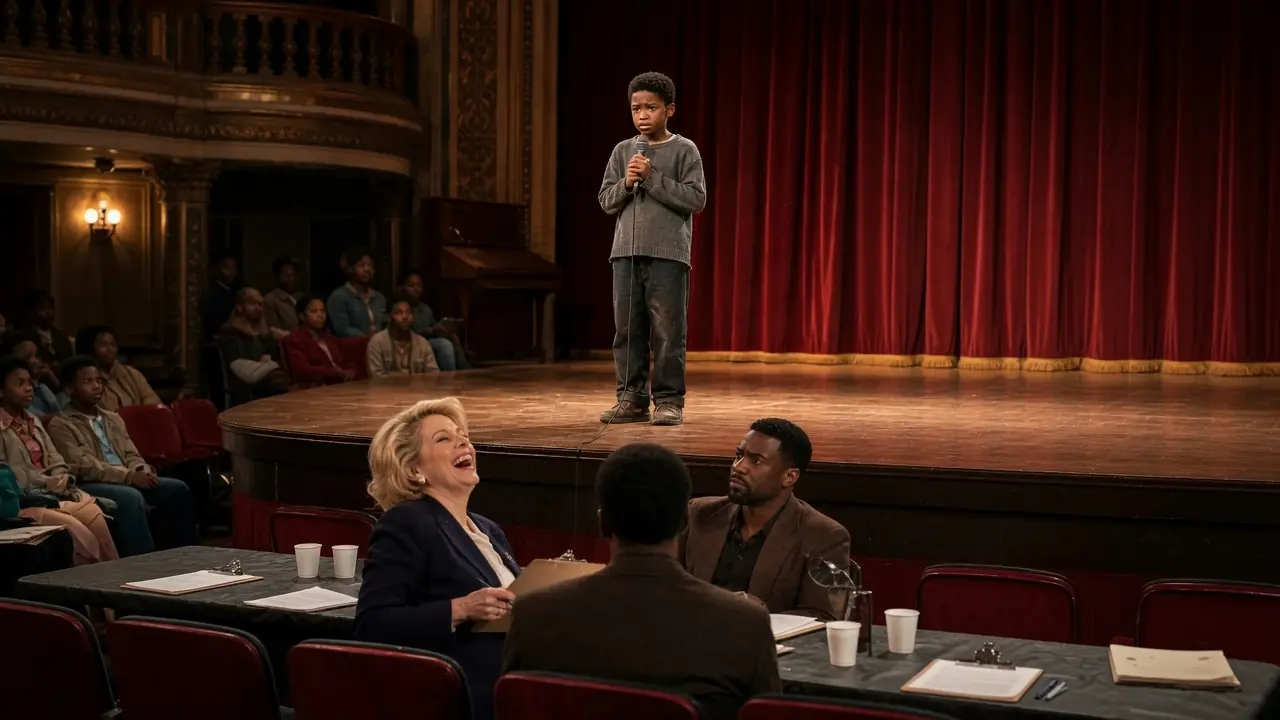
Henry stood on the other side of the registration desk, his worn hoodie still damp from the walk over. He had heard the words clearly, but his brain needed a second to process them—to confirm that yes, this woman had actually just said that to his face.
"I'm here to register for the talent competition," he said, keeping his voice steady.
Now Vicki looked up. Her eyes traveled from his face down to his mud-stained sneakers, lingering on every tear in his jeans, every frayed edge of his hoodie. When her gaze finally made it back to his face, her expression had settled into disgust. "How old are you?"
"Ten."
Vicki picked up the form Henry had placed on the desk with two fingers, holding it away from her body. Her eyes scanned the paper quickly, her lips pressing into a thin line. "Henry Brooks." She said his name like it was distasteful. "No phone number, no email address."
"We don't have a computer right now."
"I see." Vicki set the form down without smoothing it out. "Henry, let me be direct. This program is designed for children with proper training. Our participants have been taking voice lessons since they were five or six years old. They have coaches, stage experience." She leaned back in her chair, crossing her arms. "What do you have?"
Henry thought about the supply closet at the supermarket where his mom worked, how he'd go there after school and sing while she finished her shift. The acoustics were good, surrounded by all those cardboard boxes. He thought about practicing in the bathroom at home because the tiles made his voice sound fuller.
"I can sing," he said simply.
Vicki laughed. The sound bounced off the walls, sharp and cruel. "Oh, sweetheart, I'm sure you can. But this is different. This is the Community Arts Center. We have standards."
Henry's jaw clenched. He could feel heat crawling up his neck, his hands curling into fists at his sides. He had to remind himself why he was here. For Mom. For that number the doctor had written down: $68,000.
"I have the registration fee."
Vicki's smile sharpened. "The fee is $240, Henry. That's not pocket change."
"I know."
"And your mother approved this? Sending you out in the rain with that much money?" Vicki's eyebrow arched. "That seems irresponsible."
Something in Henry's chest tightened. "She's sick. She's in the hospital."
For a split second, something flickered across Vicki's face, but it vanished quickly. "I'm sorry to hear that," she said, though her tone suggested otherwise. "Content status doesn't change reality. This competition isn't for untrained children. Without proper preparation, you'd be setting yourself up for embarrassment."
"I won't fail."
"You don't know that."
"Yes, I do."
The absolute certainty in his voice made Vicki pause. Then, she picked up his registration form again, held it up to the light, and without warning, let it drop. The paper fluttered down and landed directly in the puddle of rainwater around Henry's feet.
Henry stared at his form lying in the dirty water. He watched the paper darken as it soaked up the puddle, watched his carefully written letters start to blur. Within seconds, it was ruined.
"Oops," Vicki said flatly, reaching for a tissue. "How clumsy of me."
Henry's vision went red at the edges. Every muscle tensed. He imagined flipping that desk, watching her laptop crash to the floor. His breathing came faster, his fingernails digging into his palms. But then he thought about Mom, about her thin hand in his, about the way she'd looked at him and said, *You're my strong boy.*
He crouched down slowly and picked up the soggy paper. Water dripped from it, running down his wrists. He pressed it against his hoodie, leaving wet marks across his chest.
Vicki was wiping her hands with the tissue now, cleaning each finger individually. "You know what I think, Henry? Save your money. Buy yourself some decent clothes. Or better yet, help your mother with her medical bills. I'm sure she needs it more than you need to chase some fantasy."
---
The door behind Vicki opened. A man walked in from the offices—tall and wearing an expensive leather jacket. He was scrolling through his phone. "Vicki, I need the participant list for Friday," he said without looking up. "The tech crew wants to know—"
He stopped mid-sentence. His thumb froze on his phone screen.
Henry had turned at the sound, and now the man was staring at him. His face had gone pale, his mouth slightly open. The phone slipped in his hand, and he caught it awkwardly. The man's dark eyes were locked on Henry's face. Not his dirty clothes, just his face. His eyes.
"Who is this?" the man asked, his voice rough.
Vicki straightened. "Mr. Harrington, this is just a walk-in. I was explaining that our program requires—"
"Cole Harrington," Henry interrupted. He recognized the name from the flyer. "You're the guest judge."
Cole seemed to shake himself. "Yeah, that's me." His voice was quiet now. Careful. "What's your name?"
"Henry Brooks."
Something passed across Cole's face when he heard the last name. His jaw tightened. "Brooks," he repeated slowly.
"Yes, sir."
A strange silence stretched between them. Vicki looked between them, completely confused. Henry just stood there with his ruined form against his chest, water dripping onto the floor.
Cole forced himself to focus. "What's going on here?"
"Nothing of concern," Vicki said quickly. "I was simply explaining our standards."
"She dropped my form in the water," Henry's voice came out stronger than expected. "And she said I would dirty up the stage."
Cole's expression changed. His eyebrows drew together. "You said what?"
"Mr. Harrington, I was maintaining our standards—"
"Did you say that to him?" Cole's voice dropped.
Vicki's mouth opened and closed. "The exact wording may have been—"
"Did you or didn't you?"
Vicki glanced at Henry, nervousness crossing her face. "I may have expressed concerns about proper preparation."
"Right." Cole looked at the wet floor, at Henry's soaked form, then back at Vicki. "What's the registration fee?"
"$240," Henry answered.
Cole's eyes came back to him. "You have that?"
Henry nodded. He bent down and picked up the shoebox by his feet. It was an old Nike box, its corners patched with duct tape. The cardboard was soft from being opened and closed hundreds of times.
"Henry, perhaps we should discuss—" Vicki started, but Henry was already lifting the lid.
He turned the box upside down over her desk. The money exploded out. Quarters bounced across the desk. Dollar bills scattered across her keyboard. Pennies hit the floor with sharp pings. Nickels spun before falling flat.
Vicki jerked back so fast her chair hit the wall. Her hands flew up in shock.
Henry started sorting immediately, smoothing each bill, stacking them in neat piles. His hands moved with practiced efficiency. A dollar here, five dollars there. Quarters went into a separate pile.
Cole moved closer. He wasn't watching the money; he was watching Henry's hands—the calluses on his palms, the dirt under his fingernails, the automatic precision.
After four minutes of rustling bills and clinking coins, Henry looked up. "$240. Not a penny short."
Vicki stared at the money. "Where did you get this?"
"I earned it."
"Mowing lawns, washing cars, whatever work I could find." Henry met her eyes. "Took me a year. A year of 5:00 a.m. Saturdays. A year of blistered hands. A year of dumping earnings into this box and watching the pile grow so slowly."
"You're ten years old," Vicki said weakly.
"Yes, ma'am."
Cole was staring at Henry with that same strange expression, like he was looking at a ghost. "You earned all of this yourself for a singing competition?"
Henry hesitated. He thought about his mom in that hospital bed. About stage three. About $68,000. He thought about the competition's grand prize: $75,000. It was the only number bigger than $68,000 that he could possibly reach.
"Yes, sir."
Vicki pulled a sanitizing wipe from her drawer, scrubbing each of her fingers. "Even with the fee paid, you need to understand what you're walking into. The other participants have been training since they were toddlers."
"Then he'll work harder," Cole's voice cut through. He picked up a blank form from the counter and handed it to Henry. "Fill this out. Clean copy."
Vicki's head snapped toward him. "Mr. Harrington, as program director, I—"
"I don't care." Cole's tone made Vicki go instantly silent. "This competition is open to any child who can pay the fee. That's what we advertised. Are you suggesting we exclude certain applicants based on their economic background?"
Vicki's face flushed deep red. "Of course not."
"Good. We're done here."
Vicki began collecting the money with her fingertips, dropping each piece into an envelope like they were contaminated. "Fine, he can register. But when he embarrasses himself, don't blame me."
Henry filled out the new form carefully. When he finished, he slid it across. Vicki stamped it hard. "Preliminary round is Friday at 6:00 p.m. Don't be late."
"I won't."
Henry picked up his empty shoebox and turned toward the door. His heart was hammering, but he kept his shoulders straight. He was almost to the door when Cole spoke.
"Henry."
He stopped and turned back. Cole stood with his hands in his pockets, and there was something in his expression like pain, like profound recognition.
"Good luck," Cole said quietly.
Henry nodded once, then pushed through the door into the rain. Behind him, he heard Vicki's sharp voice mutter, "That child is going to humiliate himself," and Cole's response, barely audible: "Maybe. Or maybe we're all about to be surprised."
---
The apartment smelled like bleach and something medicinal that Henry couldn't quite name. He had scrubbed the bathroom that morning before school, trying to get rid of the mildew that kept coming back no matter how many times he cleaned it.
The faucet in the kitchen was dripping again—that slow, steady drip that drove him crazy at night when he was trying to sleep. Henry stood on a chair now, wrench in hand, trying to tighten the connection under the sink. His arms ached from holding them up for so long, and his fingers kept slipping on the slick metal. He had watched a video at the library about fixing faucets, but the guy on the screen had made it look a lot easier than it actually was.
"Baby, you don't have to do that."
Henry looked over his shoulder. His mom, Diane, was standing in the doorway of her bedroom, one hand braced against the frame for support. She had lost more weight since her last hospital stay. Her cheekbones were sharp now, visible in a way that made Henry's stomach hurt. The scarf wrapped around her head was slipping, showing patches of scalp where her hair had fallen out from the treatments.
"I got it, Mom." Henry turned back to the faucet, giving the wrench another tight twist. "Just needs to be tighter."
"Henry James Brooks." Her voice was firmer now, carrying that specific edge mothers get when they're about to put their foot down. "Get down from there."
"Almost done." Henry sighed and climbed down from the chair. Water had dripped onto his shirt from where he'd been working. He wiped his hands on his jeans and looked at his mom—really looked at her. She was wearing the same pajamas she'd had on for three days. There were dark circles under her eyes that looked like deep bruises. "You should be resting," he said.
Diane moved slowly into the kitchen, each step careful and measured. She reached out and touched Henry's face, her palm cool against his cheek. "And you should be playing with your friends, being a kid."
Henry pulled away gently. "I don't have time for that, Mom."
"Baby, don't—"
"I'm fine. We're fine," Henry's voice came out sharper than he intended. He took a breath and tried again. "We're fine."
But they weren't fine. The stack of medical bills on the kitchen counter proved that. Henry had gone through them yesterday while his mom was sleeping, adding up all the numbers with shaking hands. The total kept growing. The latest one, the one that had arrived three days ago in the red envelope, was for the upcoming surgery—the one the doctor said she absolutely needed if she wanted to live.
$68,000.
The number sat in Henry's brain like a physical weight. He would lie awake at night and see it written on the ceiling in glowing numbers. $68,000. It might as well have been sixty-eight million.
"I talked to the hospital today," Diane said quietly. She was leaning against the counter now, as if standing was taking all her remaining energy. "They gave us twenty days to come up with at least half. If we can't..." She didn't finish the sentence.
Henry knew what happened if they couldn't. The surgery would be canceled. The cancer would keep growing. His mom would die. It was as simple as that.
"I'm going to win that competition," Henry said, his hands clenched tightly at his sides. "The prize is $75,000. That's enough. That's more than enough."
Diane's eyes filled with tears. "Henry, baby, please. You can't put this on yourself. You're ten years old."
"I'm the man of the house."
"No." Diane shook her head, tears spilling down her cheeks. "No, baby. You're my son. You're my child. This isn't your responsibility."
But it was. Henry knew it was because if he didn't do something—if he just sat around being a kid like his mom wanted—then she would die. And he couldn't let that happen. He wouldn't.
He thought about his father, the man his mom flatly refused to talk about. All Henry knew was that his dad had been a singer, that he had left before Henry was born, and that his mom's eyes went entirely dead whenever Henry asked about him. *He made his choice,* was all she would ever say. *We don't need him.*
But maybe they did need him. Maybe if his dad knew—no. Henry pushed the thought away. His father had left, choosing his career over his family, deciding that a baby would tie him down and keep him from being successful. Henry had overheard his mom talking to her sister on the phone once late at night when she thought he was asleep. He had heard the whole story: how his father had said he needed freedom to create, how he had walked out and never looked back.
So fine. They would do it without him.
Henry walked to his room, which was barely big enough for his twin mattress on the floor and the plastic crates that held his clothes. On the wall, he had taped up the competition flyer. The words were printed in bold letters: **YOUTH TALENT SHOWCASE - GRAND PRIZE $75,000 PLUS EXCLUSIVE TRAINING CONTRACT.** Beneath it, he had taped the hospital bill—the one with $68,000 in red numbers at the bottom.
Henry picked up a roll of athletic tape from his crate, the kind coaches used to wrap sprained ankles. He had found it in a dumpster behind the high school. He tore off a strip and wrapped it tightly around his wrist. Then, he took a black marker and wrote on the white tape in block letters: **PROTECT MOM.**
He stared at the words for a moment, then wrapped another strip around his other wrist, writing the exact same message. His hands didn't shake this time.
From the kitchen, he heard his mom crying—quiet sobs that she was trying to muffle. Henry closed his eyes and took a deep breath.
"I got this, Mom," he whispered to the empty room. "I got this."
---
That night, Henry lay on his mattress and stared at the ceiling. The faucet in the kitchen was dripping again; he hadn't fixed it right. Each drop echoed in the quiet apartment like a tiny hammer. Drip, drip, drip.
Twenty days. The surgery was scheduled for twenty days from now, which meant he had nineteen days to win the competition, collect the prize money, and pay the hospital. It was tight—really tight—but it was possible.
Henry rolled onto his side and looked at the words on his wrists. *Protect Mom.* The tape was already starting to peel at the edges, but the message remained clear.
His mom appeared in the doorway, a shadow backlit by the dim hallway light. "Baby? You awake?"
"Yeah."
She came in slowly and sat on the edge of his mattress. The springs creaked under her weight—what little weight she had left. She reached out and took his hand, her fingers tracing over the rough athletic tape on his wrist.
"What's this?" she asked softly.
"Just something I'm doing."
Diane's thumb rubbed across the letters. Henry watched her read them in the dim light. When she looked up, her eyes were wet again. "Oh, baby," her voice cracked. "You can't. You can't do this. This is too much weight for you."
"I'm doing it anyway."
"Henry—"
"Mom, stop." Henry sat up and looked at her directly. "I know you want me to be a kid. I know you want me to go play basketball or whatever, but I can't. Because if I don't do something, you're going to die. And I'm not going to let that happen. So, you can either help me or you can stay out of my way. But I'm not stopping."
The words came out harder than he meant them to—more grown-up, as if he were the parent and she were the child. Diane stared at him for a long moment. Then, she pulled him into a fierce hug, holding him so tight he could barely breathe, her body shaking with silent sobs.
"Okay," she whispered into his hair. "Okay, baby. But promise me something."
"What?"
"Promise me that after this—after the competition—you'll let yourself be ten again. Just for a little while."
Henry didn't answer. He couldn't promise that because even after the competition, even after the surgery, there would still be utility bills, still be rent, still be a hundred things that needed to be taken care of. But he held his mom, let her cry, and pretended that maybe, someday, he could be just a kid again.
In the kitchen, the faucet kept dripping. Drip, drip, drip—sounding exactly like a countdown.
---
The auditorium at the Community Arts Center was much bigger than Henry expected. Rows of red velvet seats stretched back into the darkness, and the heavy stage lights hung from the ceiling like mechanical spiders. The air smelled of dust, old wood, and the nervous sweat of fifty kids waiting backstage.
Henry stood in the wings, watching the other contestants. They all looked like they belonged here: designer clothes, professional haircuts, and parents hovering nearby with water bottles, vocal sprays, and words of encouragement.
A boy about Henry's age was warming up near the curtain, running through scales while his mom—dressed in a pantsuit that probably cost more than Henry's annual rent—made notes on a clipboard. The kid was good, really good. His voice was clear and controlled, hitting each note with absolute precision.
"That's Julian Harper," someone whispered next to Henry. "Vicki's son. He's been training since he was four."
Henry glanced over. A girl, maybe twelve years old, was standing there wearing a sparkly dress that caught the stage lights.
"He's going to win," the girl continued. "Everyone knows it. His mom basically runs this place."
"We'll see," Henry said quietly.
The girl looked him up and down, taking in his clean but worn jeans and his button-up shirt from Goodwill that didn't quite fit his shoulders right. "You're that kid. The one from the video."
Henry's stomach tightened. The video. He had forgotten about that. After he had registered, someone in the lobby had filmed the whole interaction with the shoebox and the money. It had gone viral online—five million views in two days. People in the comments were calling him 'Soulboy' and 'the kid who paid in quarters.'
"Yeah," he admitted.
"That was cool, what you did." The girl smiled. "I'm Sarah."
"Henry."
"I know." She nodded toward the stage. "You're up right after Julian. Good luck following that."
Julian was walking onto the stage now. The house lights dimmed, and a sharp spotlight hit him dead center. He looked confident and entirely comfortable, like he'd been born to stand in that exact spot.
Henry watched from the wings as Julian began to sing. It was a current pop ballad, something that had been all over the radio all summer. Julian's voice was technically flawless. Every run was clean, every note was perfectly on pitch, and his choreography was smooth and professional—the kind of performance that came from years of expensive, dedicated lessons.
The audience, mostly parents and competition staff, applauded loudly when he finished. From her seat in the judges' section, Vicki was beaming. She held up her scorecard: *8.8*. The other judges gave similar high scores, all except Cole Harrington, who sat at the end of the table, his expression unreadable. He held up an *8.5*.
"Next up," the announcer called into the microphone. "We have contestant number forty-five, Henry Brooks."
Henry felt his heart kick into overdrive. His palms were sweating instantly, and the tape around his wrists suddenly felt suffocatingly tight. He walked out onto the stage.
The spotlight was blinding. He couldn't see the audience at all, and he could barely make out the judges' table. All he could see was white light and the dark silhouettes of people watching him.
"Contestant forty-five," Vicki's voice came from somewhere in the darkness, her tone dripping with false sweetness. "A self-sponsored entry from the labor district. No accompaniment requested."
Henry heard the murmurs that rippled through the crowd. He saw Julian watching him from the wings, a slight smirk on his face.
Henry walked up to the microphone at center stage. His hand wrapped around the stand; the metal was ice-cold against his palm. He looked down and could just make out the words written on his wrist: *Protect Mom.*
The stage manager gave him a nod. The entire auditorium went dead silent.
Henry closed his eyes. He thought about his mom in that hospital bed, about how thin and fragile her hand had felt in his. He thought about that number, $68,000, and about the surgery she needed to live. He thought about the supply closet at the supermarket where he'd practiced, and about the bathroom tiles that made his voice sound bigger than it was.
He opened his mouth and began to sing.
---
The song was "A Change Is Gonna Come" by Sam Cooke. It was an old song, older than Henry by decades, but he had heard it on the radio once, and something about the melody had reached deep inside his chest and grabbed hold.
His voice came out a bit rough at first, tight with nervousness. But then, something shifted. He stopped thinking about the judges, the audience, and Julian Harper watching from the wings. He stopped thinking about being ten years old, poor, and terrified. He just sang.
His voice wasn't pretty and polished like Julian's. It was raw, rough around the edges, but it carried something that technical perfection could never teach. It had soul. It had pain. It held the literal weight of every hard thing Henry had ever lived through, packed tightly into every single note. The words poured out of him as if he had lived them himself—like he'd been born tired, carrying burdens far too heavy for shoulders his size.
When he hit the high notes, his face scrunched up, his eyebrows drawing together and his lips pulling tight—looking exactly like Cole Harrington did on his old album covers.
In the judges' section, Cole dropped his pen. It clattered against the table, and he didn't even notice. He was staring at Henry as if he were looking at a ghost. Henry's eyes were closed, but if they had been open, he would have seen people in the audience leaning forward in their seats. He would have seen Sarah backstage with her mouth hanging open. He would have seen Julian's smirk vanish completely.
The song built toward its emotional climax. Henry's voice cracked on one of the highest notes—not perfectly, not cleanly, but somehow that imperfection made it feel entirely real, entirely honest.
When the final note faded into the rafters, there was a moment of absolute silence.
Then, the auditorium exploded.
People were on their feet, physically jumping up. Henry opened his eyes, blinking against the bright spotlight, utterly confused by the thunderous sound of applause rolling through the hall. At the judges' table, Cole Harrington had his face buried in his hands, his shoulders shaking. The other judges were standing and clapping wildly. Even Julian, watching from backstage, was clapping, ignoring his mom who was actively tugging on his arm to make him stop.
Vicki sat frozen, her scorecard still blank in front of her.
"Scores, please," the announcer called out over the din.
The judges held up their cards one by one. *9.5.* *9.7.* *9.2.*
Then came Vicki. She held up her card with a tight, strained smile: *7.5*.
The audience immediately booed. Someone shouted, "Are you kidding me?"
"Lack of technical fundamentals," Vicki defended into her microphone, her face flushing red. "Raw talent simply isn't enough in a professional venue."
Finally, it was Cole's turn. He lowered his hands from his face, his eyes noticeably red. He picked up his scorecard, looked at Henry for a long moment, and held it up high.
*10.*
The audience roared. Henry's average score, even with Vicki's blatant attempt to drag it down, was the highest of the preliminary round by a wide margin.
As he walked off the stage, his legs felt like water. Julian was standing in the wings, and for a second, their eyes met. Julian opened his mouth as if to say something, then simply nodded in respect. Sarah grabbed Henry's arm as he passed. "Oh my god, Henry! That was—"
"I need some air," Henry managed to say, pushing through the heavy backstage door and into the alley behind the building.
The cool night air hit his face. His hands were shaking uncontrollably; his whole body was vibrating. He had done it. He was still in the running.
Behind him, the door clicked open. Henry turned, expecting Sarah or one of the staff members. It was Cole Harrington. The music producer stood in the doorway, the light from inside silhouetting his frame. He didn't say anything for a long moment, just looking at Henry with that same painful expression of recognition.
"That was..." Cole's voice was rough. He cleared his throat. "Where did you learn to sing like that?"
"I taught myself. Mostly watched videos at the library."
"Videos." Cole let out a short laugh, though there was no humor in it. "You taught yourself to sing like that from videos."
Henry didn't know how to respond, so he stayed quiet. Cole took a step forward into the alley.
"When you were singing... when you hit those high notes, you do this specific thing with your eyebrows. You scrunch them together tightly."
"Okay."
"I do the exact same thing," Cole said, his hands shoved deep into his pockets, looking intensely uncomfortable. "I've always done it, ever since I was a kid."
Henry felt a sudden, cold sensation settle deep in his stomach. "So?"
Cole stopped, shaking his head quickly. "Nothing. Never mind. You did good tonight, kid. Real good." He turned to go back inside.
"Mr. Harrington?"
Cole stopped and looked back over his shoulder.
"Why'd you give me a ten?"
Cole was quiet for a second. "Because that wasn't a performance. That was the absolute truth, and truth is always worth a ten."
He disappeared back inside, leaving Henry alone in the dark alley with his shaking hands and the distant sound of the crowd still echoing through the brick walls.
---
Henry's phone—the cheap, prepaid model his mom had gotten him strictly for emergencies—started buzzing violently at 6:00 a.m. the next morning. He had fallen asleep on his mattress still wearing his competition clothes, too exhausted to change. The buzzing wouldn't stop. He grabbed the device and squinted at the screen.
Notifications. Hundreds of them.
His mom's phone was buzzing too, out in the kitchen, vibrating loudly against the Formica counter. Henry sat up and opened the first link. It was a YouTube video titled: *Ten-Year-Old Contestant Brings Judges to Tears: Soulboy Henry Brooks.* The view count was already at 2.3 million and climbing by the second.
"Oh no," Henry whispered.
He clicked on it. Someone had filmed his entire performance from the audience on a phone. The quality was slightly shaky, but his voice came through crystal clear. The comment section was a runaway train:
> *This kid has more soul in his pinky than most professional singers out today.*
> *I'm literally crying at my desk at work. That judge who gave him a 7.5 needs to be investigated.*
> *Someone get this child a record deal immediately!*
Henry scrolled through more alerts. His performance had been shared across every major social media platform. People were officially calling him 'Soulboy.' Remixes and reaction videos were popping up by the minute.
His mom appeared in the doorway, her own phone clutched tightly in her hand. "Baby... are you seeing this?"
"Yeah."
"There's a..." Diane's voice was visibly shaking. "Baby, there's a fundraising campaign online for my surgery. Someone started it last night after the video went up."
Henry's head snapped up. "What?"
Diane showed him the screen. A campaign page read: *Help Soulboy Henry Save His Mom.* It featured a still shot of Henry from the stage, followed by a detailed description of his mom's diagnosis and the exact cost of the procedure. The goal was set at $68,000.
The current amount raised: $22,000.
"$22,000," Henry breathed. "In one night?"
His mom was crying, her hand pressed over her mouth. "People are so good, Henry... people are so kind."
But Henry's mind was already calculating. Twenty-two thousand was incredible—more money than they had ever seen in one place. But it still left forty-six thousand dollars to go, and the surgery deadline was in nineteen days. Even if the donations continued, there was no guarantee they would hit the mark in time. He still needed to win the competition; the $75,000 grand prize remained their most reliable shot.
---
By the time Henry got to school on Monday, everything had changed. Kids who had never spoken to him before were stopping him in the hallways. Teachers who had barely noticed his presence were suddenly patting him on the back. Even Principal Morrison called him into the office—not to hand out a detention, but to shake his hand and tell him how proud the entire school was of his talent.
It felt entirely wrong to Henry. These same kids had ignored him last week; these same teachers had looked right through him. Now they suddenly cared because he was famous on the internet.
During lunch, Henry sat alone in the far corner of the cafeteria, just as he always did. But this time, a steady stream of students kept walking over.
"Yo, Henry, can I get a selfie?"
"Henry, my mom is literally obsessed with your video. Can you sing something right now?"
Henry kept his head down, picking at his lunch tray. He just wanted them to leave him alone.
"Leave him alone," Julian Harper's voice suddenly cut through the chatter. "Can't you see he's trying to eat?"
The crowd dispersed slowly, muttering. Julian stood there holding his own lunch tray, looking deeply uncomfortable. "Can I sit?" he asked.
Henry shrugged. "Free country."
Julian sat down across from him. For a minute, neither of them said anything.
"Your performance was really good," Julian finally said, looking at his food. "I mean it. You're incredibly talented."
"Thanks."
"My mom is pissed," Julian gave a small, cynical laugh. "She's been on the phone all weekend calling her lawyer friends, trying to find a way to..." He stopped abruptly, as if realizing he had said too much.
Henry looked up sharply. "A way to what?"
"Nothing. Forget I said anything."
But Henry could see the anxiety written all over Julian's face—a mixture of guilt and worry that looked exactly like a warning.
"What's your mom planning, Julian?" Henry asked quietly.
Julian hesitated, looking around the cafeteria. Then, he leaned forward across the table, lowering his voice to a whisper. "Look, I'm not supposed to know this, okay? But I overheard her on the phone last night. She's digging into your background. She's trying to find any technicality she can use to disqualify you before the finals tonight."
Henry's stomach dropped instantly. "Disqualify me? For what?"
"I don't know. But knowing my mom, she'll find something. She always does." Julian stood up, picking up his tray. "Just be careful, Henry. Watch your back."
He walked away, leaving Henry sitting alone with a cold, sick feeling spreading through his chest.
---
The email arrived at 11:00 p.m. on the day of the finals.
Henry was in their small apartment, getting ready to leave for the auditorium. He had borrowed a suit jacket from the church's donation bin—it was slightly too big in the shoulders, but it was clean. His mom was in the bathroom, carefully tying her headscarf, trying to make herself look stronger than she felt.
Henry's phone buzzed. It was an official email from the competition office.
> **SUBJECT: URGENT - COMPETITION ELIGIBILITY ISSUE**
>
> *Dear Mr. Brooks,*
>
> *It has come to our attention that you may be in direct violation of the competition's strict eligibility requirements. Specifically, we have discovered a secondary YouTube channel registered under the name "Street Corner Singing" that has been verified as belonging to you.*
>
> *This channel contains numerous videos featuring copyrighted musical compositions performed without proper licensing documentation. Per Section 12.3 of the Community Arts Center Competition Bylaws, all participants must maintain strict compliance with intellectual property regulations. The public dissemination of copyrighted material without explicit licensing constitutes a violation of policy and grounds for immediate disqualification.*
>
> *To maintain your eligibility for tonight's finals, you must provide verifiable proof of licensing documentation for all material featured on said channel to the administrative office no later than 1:00 p.m. today. Failure to provide adequate documentation will result in permanent disqualification from the showcase.*
>
> *Sincerely,*
> *Vicki Harper*
> *Program Director*
Henry read the text three times, his hands shaking so hard he almost dropped the phone. He clicked the link she had attached. It was his old channel—the one he had started when he was eight years old, long before he knew anything about copyright, licensing, or legal guidelines. It was just a collection of videos of him singing covers of songs he liked, filmed entirely on his mom's old phone.
He had stopped posting to it over a year ago and had basically forgotten it even existed. There were maybe forty videos total.
"Mom," Henry's voice came out strangled. "Mom, we have a big problem."
Diane came out of the bathroom, adjusting her scarf. "What is it, baby?"
Henry handed her the phone. He watched the last bit of color drain from her face as her eyes moved across the text.
"Licensing documentation..." Diane's voice shook. "Baby, we don't have... we can't afford that."
"I know."
Obtaining retroactive licensing for forty commercial songs would cost thousands of dollars—money they absolutely did not possess. And even if they did, there was no administrative way to get it processed by 1:00 p.m. It was already 11:15 a.m.
Henry looked down at his wrists. The athletic tape was slightly dirty now, peeling at the edges, but the marker letters were still clear: **PROTECT MOM.**
"She can't do this," Henry said, his hands clenching into tight fists. "She can't just—"
But she could. And she had.
Diane pulled Henry into a tight hug. "It's okay, baby. It's okay. We'll figure something else out."
"It's not okay!" Henry pulled away, his eyes burning with hot tears. "That prize money, Mom... we need it. You need it."
"The fundraiser is at twenty-two thousand, Henry. That's a start."
"That's not even half!" Henry's voice rose as panic clawed at his throat. "We have nineteen days left. Nineteen days. And if we don't have the money, the hospital won't perform the surgery, and you'll..." He couldn't finish the sentence.
Diane cupped his face gently in her hands. "Henry James Brooks, you listen to me. You have already done more than any ten-year-old child should ever have to do. You've worked yourself to the bone for a year. You stood up on that stage and sang your heart out. You've been so brave. But I am not going to let you carry the weight of this timeline on your shoulders. You hear me? This is not your fault."
Henry's phone buzzed again with a new notification. It was a direct text message from an unknown number, but the sign-off was clear:
> *Henry, it's Cole Harrington. I saw the email Vicki sent. Meet me at the Arts Center administrative office right now. Don't quit.*
Henry showed the message to his mom.
"Go," she said, her voice turning firm. "Go see what he wants."
Henry grabbed his oversized church jacket and ran out into the midday sun.
---
Henry burst through the double doors of the Community Arts Center at 11:47 a.m. He was completely out of breath, his shirt soaked with sweat from running the entire way from the apartment.
The lobby was dead quiet, except for Cole Harrington, who was pacing back and forth in front of the empty registration desk like a caged animal. When he spotted Henry, he stopped instantly.
"Did you get the notice?" Cole asked.
"Yeah."
"Okay. Come with me."
Cole didn't wait for a formal discussion. He marched straight toward the secure corridor leading to the executive offices, and Henry followed closely behind. They walked down a long hallway Henry had never seen before, passing doors labeled *Board of Directors* and *Financial Operations*. At the very end of the hall was Vicki Harper's private office.
Cole didn't bother knocking. He turned the handle and walked straight in.
Vicki was sitting at her desk, speaking into her phone. When she saw them enter, her expression shifted rapidly from surprise to deep annoyance. "I'll call you right back," she muttered into the receiver and slammed it down.
"Mr. Harrington, this is highly inappropriate," Vicki began, straightening her posture.
"Inappropriate?" Cole let out a harsh laugh completely devoid of humor. "You want to talk about inappropriate, Vicki? Let's talk about how you're weaponizing copyright technicalities to exclude a ten-year-old child from a community competition."
Vicki leaned back in her chair. "I am simply enforcing the administrative guidelines established by the arts program—"
"Bullshit." The word came out flat and hard. "You deliberately waited until the morning of the finals to dig up an old, non-monetized channel and send that notice. You waited until there was no physical way for him to comply before the deadline. That's not enforcing rules, Vicki. That's targeted sabotage."
"Mr. Harrington, I understand you have a personal soft spot for this particular contestant, but the bylaws are explicit. All finalists must be in full legal compliance with—"
Cole slammed a thick manila folder down onto her desk. The sharp sound made both Vicki and Henry jump.
"You want to talk about compliance?" Cole flipped the folder open aggressively. "Let's talk about your son Julian's official submission video. The one he used for his primary application, where he performs a choreographed routine to a commercial remix of a Drake track. I had my team check the registration this morning. That specific remix is completely unlicensed. The producer who uploaded it doesn't hold the master rights, which means Julian performed copyrighted material without proper licensing in a commercial application. By your exact standards, your own son should be disqualified immediately."
Vicki's face went entirely white, then flushed a dark crimson. "That is completely different!"
"How? Explain to me exactly how that's different, Vicki." Cole leaned forward, placing both hands flat on her desk, pinning her with his gaze. "Actually, let me save you the trouble. It isn't. The only variable here is that Julian is your son, and Henry isn't."
"You're oversimplifying administrative policy—"
"Am I?" Cole pulled another document from the folder. "Because I also dug into the center's archives this morning. Three years ago, a formal complaint was filed against you by a family alleging discriminatory behavior based on economic status. You made specific comments about their background and tried to force them out of the program. The board buried it because your family brings in heavy donors." Cole looked at her hard. "How many other kids have you pushed out of this center, Vicki?"
Vicki stood up, her hands trembling with rage. "Get out of my office."
"No."
"I said get out!"
"I'm not going anywhere," Cole said, crossing his arms calmly. "Here is exactly how this is going to go. You are going to log into your system right now, withdraw the eligibility notice, and issue a formal reinstatement for Henry. And you're going to do it in the next five minutes."
"Or what?" Vicki's voice rose, sharp and defensive. "You'll go to the board? Please. Half of them are my personal friends."
"I don't need the board," Cole's voice dropped to a dangerous, quiet register. "I have my own legal representation, my publicist, and media contacts I've spent twenty years cultivating in this entertainment industry. You know what makes a viral news story, Vicki? *'Wealthy Arts Director Uses Legal Loopholes to Disqualify Ten-Year-Old Prodigy From Charity Talent Show.'* That will play beautifully on local networks, especially since the internet already loves Henry and thinks you're a monster."
Vicki's mouth opened, but no words came out.
"And then there's the civil litigation," Cole continued smoothly. "Selective enforcement of corporate rules, disparate impact, and economic discrimination. I have enough documentation right here to tie you up in court for years. And trust me, my lawyers are much better than yours."
"You're threatening my position."
"I'm explaining the metrics of your failure," Cole countered, straightening up. "You made this personal when you targeted a child's survival. So now it's personal, and you are going to lose."
Henry stood by the door, watching the interaction unfold. He had never seen an adult stand up for him like this—never seen someone with institutional power use it to shield him instead of pushing him down.
Vicki slowly sat back down in her chair. She tried to maintain her cold composure, but Henry could see her fingers trembling as she reached for her mouse.
"The guidelines state—" she attempted one last time.
"The guidelines also include a standard fair use provision," Cole interrupted flatly. "Which covers non-commercial, educational use of creative material. Henry's old channel was completely un-monetized; he was an eight-year-old learning how to modulate his voice. That is textbook fair use. Any first-year law student would throw your notice out of court."
Vicki's jaw clenched tightly. Finally, she clicked her mouse a few times, her eyes fixed on the monitor.
"The disqualification notice has been withdrawn," she said, her voice dripping with pure venom as she looked up at Cole. "Henry Brooks is officially reinstated as a finalist. But this administrative conversation is far from over."
"Yes, it is." Cole turned, placed a solid hand on Henry's shoulder, and steered him toward the exit. "Come on, kid. You've got a competition to win."
---
In the quiet hallway, Henry stopped and looked up at the music producer. "Why'd you do that, Mr. Harrington?"
Cole was silent for a moment. His hand was still resting on Henry's shoulder, and Henry could feel it trembling slightly.
"Because somebody should have done it for me," Cole said quietly. "A long time ago."
Before Henry could ask what that meant, Cole's phone began to ring. He pulled it out, looked at the screen, and his expression hardened into something Henry couldn't decipher.
"I have to take this, Henry," Cole said, his voice returning to its professional tone. "Go home. Rest your voice, eat something, and be back here at 5:30 p.m. sharp for soundcheck. Don't let what happened this morning mess with your head. You belong on that stage tonight. You understand me?"
Henry nodded. "Yes, sir."
Cole answered the call and walked quickly down the hall, his voice echoing off the walls. "Yeah, I'm here. What did the records show? Tell me."
Henry stood alone in the empty corridor for a moment. He looked down at his wrists. The tape was fraying significantly, but the marker text was still visible: *Protect Mom.* He had come so close to losing his chance because someone didn't think he belonged in their room. But he was still in the fight.
He walked out of the Community Arts Center and into the sunlight. His hands weren't shaking anymore. He had exactly five hours until the finals—five hours to prepare for the most important performance of his life.
---
The main auditorium was packed to absolute capacity. Every velvet seat was occupied, people were standing three-deep along the back walls, and professional television crews had set up cameras in the rear production bays. The video of Henry's preliminary round had spread so rapidly that local networks were covering the finals like a major breaking event.
Backstage was a blur of high-stress chaos. Finalists were running through vocal warm-ups, parents were adjusting elaborate costumes, and the stage crew was shouting technical cues over headsets.
Henry stood quietly in a far corner, away from the noise. He was wearing the church suit, but someone had taken it to a local tailor that afternoon and altered it completely free of charge after reading his story online. It fit him perfectly now, making him look older, more grounded.
His mom was right beside him. She had absolute insisted on attending despite her weakness. She sat in a small folding chair, her headscarf wrapped neatly, a genuine smile on her face.
"You look so handsome, baby," she said, reaching up to gently adjust his lapel. "Like a proper young gentleman."
"I feel like I'm going to be sick, Mom."
Diane laughed softly, her eyes warm. "That's completely normal. That just means you care about what you're doing."
Henry looked across the room. He saw Julian warming up with a vocal coach who kept checking an Apple Watch. He saw Sarah stretching near the curtain in her sparkly dress.
Then, the backstage security door opened, and a large group of people walked in who clearly didn't fit the typical high-society crowd of the Arts Center. It was Marcus from the local barbershop, Teresa the floor nurse from his mom's hospital unit, Big Mike from the corner grocery store, and a dozen other familiar faces from their neighborhood. They were all wearing matching white t-shirts with bold black text stamped across the front: **TEAM HENRY.**
"Surprise!" Marcus called out with a wide grin. "You really think we'd let you do this alone, little man?"
Henry felt his throat instantly tighten. His mom stood up carefully from her chair, and the neighbors immediately surrounded her with warm hugs and quiet words of support.
"We bought out a whole section out there," Teresa told Henry, pointing toward the curtain. "Front row, center. We're gonna be so loud they'll hear us down the block."
Big Mike clapped a heavy hand gently on Henry's shoulder. "You got this, son. Show them what real music sounds like."
The stage manager's voice barked over the backstage PA system: "Five minutes to showtime. Finalists, please line up in official performance order."
The room shifted instantly. Parents gave final kisses, and contestants began shaking out their nerves. Henry was scheduled to perform fifth out of the eight finalists. Julian was performing third.
The house lights dimmed, the crowd noise swelled to a massive roar, and the finals officially commenced.
Henry watched the first two performances from the wings. Both were technically exceptional—a twelve-year-old girl delivering a flawless classical piece, followed by a thirteen-year-old boy leading a complex jazz arrangement.
Then, it was Julian's turn.
Julian walked out onto the stage with absolute confidence, entirely untouched by nerves. The accompaniment began—a difficult contemporary ballad designed to showcase range and breath control. Julian's execution was mathematically perfect. Every single run was clean, every note hit the exact frequency required, and his stage movements were highly polished. It was a masterclass in classical training.
The audience responded with strong, polite applause when he finished—the kind of appreciation that comes from recognizing hard work, but not the kind that pulls people out of their seats by their souls.
Julian walked off the stage, sweat glistening on his forehead. As he passed Henry, their eyes met. "Good luck out there," Julian said quietly.
"Thanks," Henry replied.
The fourth performer delivered another solid, high-scoring routine. The judges were throwing out nines across the board. The competition was incredibly tight.
The stage manager tapped Henry's shoulder. "You're up, kid. Deep breaths."
His mom squeezed his hand one last time. "Sing it from the center, Henry. That's all that matters."
Henry walked out onto the stage. The intense spotlight hit him dead center, momentarily blinding him. As his eyes adjusted, the scope of the room materialized—the massive crowd, the rolling television cameras, the long judges' table where Vicki sat with her arms tightly crossed, and Cole Harrington sitting forward, his hands clasped tightly in front of him. In the very front row, the white shirts of **TEAM HENRY** gleamed under the stage lights.
"Contestant number forty-five," the announcer's voice boomed. "Henry Brooks, performing an original arrangement."
The entire auditorium fell dead silent. Henry stepped up to the microphone stand. There was no backing track, no band accompaniment—just him, the microphone, and the space. He looked down at the frayed tape on his wrist one last time: *Protect Mom.*
Then, he began to sing.
---
The song was "Stand Up," an old traditional gospel track his mom used to sing around the apartment when she still had the physical strength to clean. But Henry had rearranged it completely. He had turned it into a rhythm of resilience—a song about being small but standing completely immovable, about being counted out based on your zip code, your clothes, or the color of your skin, and about refusing to stay down.
His voice came out massive from the very first syllable. There was no hesitation, no wobbly pitch. This wasn't a performance for a scorecard; it was a visceral declaration.
He moved across the stage with raw, unchoreographed intent, commanding the physical space. He pointed directly toward the crowd when the lyrics spoke of unity; he fixed his gaze directly on Vicki's desk when the words touched on institutional oppression.
His voice cracked slightly on a sustained high note in the bridge—not cleanly, not perfectly—but the flaw only made the emotion feel raw and undeniable.
The audience was completely transfixed, suspended in the space. Henry could see his mom in the wings, tears streaming down her face. He saw Cole at the end of the table, both hands covering his mouth, staring up at the stage.
The arrangement built to its final crescendo. Henry poured every ounce of fear, exhaustion, and desperate hope he had carried over the last twelve months into the final vocal run. The sound filled every corner of the structure, echoing off the high ceiling.
The final note cut off cleanly, fading into absolute silence.
For three full seconds, nobody in the arena moved.
Then, the room exploded.
The entire audience surged to their feet in a massive wave of thundering applause. People were shouting, crying openly in the rows. Marcus and Big Mike were embracing, and Teresa had her hands pressed firmly over her heart. Even the television cameras were shaking slightly as the operators wiped their eyes.
Henry stood at the microphone, breathing heavily, blinking against the bright lights as the physical force of the ovation hit the stage.
In the wings, Julian was clapping wildly, ignoring his mother who was actively glaring at him.
The announcer had to wait nearly two minutes for the noise to subside enough to request the official tallies. One by one, the judges held up their scores: *9.8.* *9.9.* *9.7.*
Then came Vicki. She raised her card with a tight, wooden smile: *8.9*.
The front rows immediately erupted in loud boos. Someone threw a crumpled program toward the orchestra pit, forcing the stage manager to signal for order.
Finally, Cole Harrington stood up slowly. He wiped his face, picked up his scorecard, and held it high above his head.
*10.*
The arena went wild again. Henry's average baseline, even with Vicki's transparent attempt to suppress it, was the highest of the final round by an insurmountable margin.
---
The final three contestants delivered excellent routines, but the emotional ceiling of the room had already been set. When the final tallies were verified by the auditors, the announcer returned to center stage holding a folder.
"Ladies and gentlemen, we have our official results. In third place, with an average score of 9.2... Sarah Chen!"
Applause rippled through the hall as Sarah claimed her medal.
"In second place, with an average score of 9.3... Julian Harper!"
Julian walked out, shaking hands with the panel. He was smiling politely, though disappointment was visible in his eyes. Vicki looked as if she wanted to burn the building down.
"And the grand prize winner of the talent showcase, with an average final score of 9.66... Henry Brooks!"
The neighborhood crew immediately rushed the stage. Big Mike hoisted Henry onto his massive shoulders as the confetti cannons detonated, filling the air with silver foil under flashing lights. Someone handed Henry a massive, oversized cardboard check made out to the sum of **$75,000**.
Henry stared at the black ink numbers: *$75,000.* It was real. It was more than enough for the surgery, more than enough for the back rent, more than enough to stop counting pennies in a duct-taped shoebox.
His mom rushed through the crowd, pulling him down into a fierce hug, sobbing into his neck. "You did it, baby... you did it."
"We did it, Mom," Henry whispered back, the cardboard check crinkling between them. "We're going to be okay."
---
The post-show celebration wrapped up around 9:00 p.m. After dozens of interviews with local news crews and endless photographs, the auditorium began to empty out. Marcus and the neighborhood team said their goodbyes, promising to throw a proper block party the next day.
Henry and his mom were walking toward the stage exit, carrying the oversized check, when a voice called out from the shadows of the wings.
"Henry, wait please."
They both turned. Cole Harrington was standing near the production racks, his hands shoved deep into his pockets. He looked completely stripped of his usual music-executive bravado. He looked genuinely terrified.
"Can I..." Cole glanced tentatively at Diane. "Can I talk to you both for a brief minute? Please."
Diane's grip tightened noticeably on Henry's shoulder. "We're incredibly tired, Mr. Harrington. It's been a very long day."
"I know, I completely understand," Cole said, taking a step forward, his voice cracking slightly. "But this is... this is important. Please."
There was a desperate, raw quality to his tone that Henry recognized instantly—it was the same tone he had used when pleading with hospital administrators.
"Five minutes," Diane said quietly.
They followed Cole into a secure green room down the hall, filled with stacked folding chairs and equipment cases. Cole closed the door, stood against it for a moment, and took a long, stabilizing breath.
"I need to tell you something," Cole finally said, his eyes fixed on the floor. "Something I should have had the courage to say eleven years ago."
Diane went completely rigid. Henry could feel the immediate spike of tension radiating from his mom.
"Cole, don't do this," Diane's voice held a dangerous warning.
"Diane, please let me speak. He has a right to know."
"You don't hold any rights in this room!"
"I know I don't!" Cole's voice broke completely, tears gathering in his eyes. "I know I have zero claims here. But he deserves the truth. He deserves to know who his father is."
The words hung in the air like heavy smoke. Henry looked between the two adults. His mom's face had gone entirely bloodless; Cole looked as if he were about to collapse to his knees.
"What?" Henry's voice came out very small.
Cole knelt down slowly, bringing himself directly to Henry's eye level. His dark eyes—the exact same shape and shade as Henry's—were wet.
"Henry..." Cole said softly. "I'm your father."
For a second, Henry's brain simply locked up, refusing to process the data. The syllables didn't make sense. "No," Henry said automatically. "No, my dad is... my mom said he was just a singer who left before I was born."
"That's true," Cole finished, a tear cutting through the dust on his cheek. "She told you the exact truth. He was a singer who walked away. That was me."
Henry turned his head slowly to look at his mother. She was crying silently, her hand clamped firmly over her mouth.
"Mom?" Henry's voice trembled. "Is he... is this real?"
Diane nodded once, unable to find her voice.
Henry turned back to Cole, and suddenly the physical puzzle pieces locked into place—the uncanny physical resemblance he hadn't understood until now. The specific way they both scrunched their eyebrows when hitting high notes. The exact slant of their jawlines. The way they both tilted their heads slightly to the left when analyzing a melody.
"You're..." Henry couldn't finish the sentence.
"I am so incredibly sorry, Henry," Cole's voice broke completely. "I was twenty-three years old, stupid, selfish, and completely terrified. I convinced myself that having a child would destroy my career path, that it would tie me down. So I left. I abandoned your mother when she needed support the most, and I walked away from you before you were even born. I spent years telling myself that you were better off without a screw-up like me around. But I was wrong. I was so deeply wrong."
Henry's hands balled into tight fists, the athletic tape straining against his skin. "You left us."
"Yes."
"You left my mom when she was pregnant and had nothing."
"Yes."
"You didn't even try," Henry's voice began to rise, thick with years of accumulated absence. "You didn't even want to know if I was alive."
"Henry—"
"No!" Henry stepped back, breaking the proximity. "You don't get to show up now! You don't get to step in and play the father role just because I won a trophy and my name is on the news! That's not fair!"
"That's not why I'm here, Henry—"
"Then why now?" Henry was shouting now, the cardboard check shaking in his grip. "Why not when we were getting the eviction threats? Why not when Mom first got diagnosed? Why not when I was eight years old selling lemonade down the block just to help buy basic groceries? Where were you then?"
Cole flinched as if he had been physically struck across the face. "I didn't know, Henry... I swear to God, I had no idea about the illness or the poverty."
"You could have known!" Henry shot back, hot tears spilling down his cheeks. "You could have checked on her! You could have cared enough to look! But you didn't, because we weren't important enough to fit into your successful life."
"You are important to me—"
"Don't say that!" Henry's voice went freezing cold. "Don't tell me I'm important now, because it's eleven years too late."
Cole reached slowly into his leather jacket pocket and pulled out a folded slip of white paper. He held it out toward Henry with a trembling hand.
"This is an official administrative receipt," Cole said quietly. "From the municipal hospital's financial department. I settled your mother's primary surgery bill in full this morning. The entire $68,000. The procedure is fully cleared for next week, including the post-operative care units and long-term oncology cycles. Everything is paid."
Henry stared at the slip of paper but didn't reach out to touch it.
"The prize money..." Cole continued, his voice dropping to a whisper. "You keep every cent of that $75,000. Use it for a college trust, a secure house, whatever you need. But you don't need to hand it over to the billing department anymore. The medical emergency is resolved."
"Why?" Henry's voice was barely audible.
"Because..." Cole's breath hitched sharply. "Because I know I can't repair the last eleven years. I can't go back and stand in the rooms where you needed a father. I can't fix that fracture. But I can do this. I can make absolute sure you don't lose your mother. I can take that weight off your shoulders."
He set the paper down gently on the edge of a equipment case when Henry remained still.
"I'm not asking for your forgiveness," Cole said. "I don't deserve it. I'm not asking to move into your life or be called your dad. I know I haven't earned that title. I'm just... I'm just asking you to let me help you both. Please."
Henry looked at his mother. She was still standing against the wall, her arms wrapped tightly around herself, crying silently. He looked back at Cole—this wealthy, influential music producer who was apparently his biological father. The man who had chased his own validation while Henry grew up in tight rooms, wearing secondhand clothes, counting out wrinkled single-dollar bills from a duct-taped shoebox.
Henry thought about the hollow ache he had felt every time he saw other kids playing basketball with their fathers at the park. He thought about the endless double shifts that had literally broken his mother's health down to the bone.
"You paid the hospital," Henry said slowly.
"Yes."
"Thank you for that," Henry's voice cracked, but his gaze remained steady. "That's... that's a good thing. That saves my mom's life. But that doesn't make you my dad."
The final trace of hope in Cole's expression shattered completely.
"Henry..." Diane started softly.
"No, Mom. I'm sorry, but no." Henry looked Cole directly in the eyes. "Thank you for clearing the medical bill. Truly. But I don't need a father figure right now. I've survived fine without one for ten years, and I'll survive fine for ten more."
He walked over to the green room door and pulled it open.
"Henry, please," Cole whispered desperately.
Henry stopped at the threshold, keeping his back turned. "If you genuinely want to help us... then just don't make this harder than it already is. Don't try to simulate something you're not. Just let us walk out."
He stepped into the corridor, his mother following a moment later. Behind them, through the heavy door, they could hear the raw, broken sound of Cole sobbing in the empty room. Henry didn't look back.
---
The exterior parking lot was mostly deserted now, the asphalt bathed in the pale orange glow of the streetlights. Henry and his mom walked in complete silence toward the transit stop, their shoes clicking against the pavement. Henry carried the oversized cardboard check flat against his side like a surfboard. The hospital clearance receipt was tucked securely inside his mom's purse—proof that the medical baseline was safe.
But Henry didn't feel victorious. His chest felt constricted, and his hands were trembling again inside his pockets.
"Baby," Diane said softly as they approached the bench. "Do you want to discuss what happened?"
"No."
"He really settled the entire operational account, Henry," Diane continued gently. "The billing office called me this afternoon to confirm the transaction. The surgery, the recovery tracking, the medication blocks... it's completely cleared."
"I know. That's good, Mom. I'm glad."
"He's trying to—"
"I said I don't want to talk about it, Mom!" Henry's voice came out sharper than intended. He stopped, took a breath, and lowered his head. "Sorry. I just... I can't process it right now."
Diane nodded understandingly and went quiet. They sat down on the metal bench, propping the oversized check between them.
Henry stared at the bold numbers: *$75,000.* The money he had spent a year of blistered hands and early mornings working to compete for. The money that was supposed to be the literal shield that saved his mother's life. And now it didn't even matter for the surgery, because a stranger had simply stepped in at the final second and resolved it with a credit card.
Part of him felt an immense relief—his mother was going to live. But another, deeper part felt strangely cheated, as if his immense effort had been minimized.
"You know what the worst part is?" Henry whispered, his eyes burning.
"What, baby?"
"I wanted to be the one who saved you," Henry's voice cracked completely. "I wanted to be the one who fixed the problem. I wanted to... I wanted to be enough."
Diane immediately pulled him into a tight, warm embrace. "Oh, Henry... baby, you are enough. You have always been more than enough."
"But I didn't save you," he sobbed into her shoulder. "He did."
"No," Diane pulled back, holding his face firmly so he had to look at her. "You saved me long before tonight, Henry Brooks. You saved me every single morning you got up at 5:00 a.m. to work those odd jobs. You saved me every time you practiced your music until your throat was raw. You took care of this household when you should have been outside playing. You saved me with your love and your courage, baby. Cole just wrote a corporate check. But you... you gave me your entire heart."
Henry wiped his eyes quickly on his sleeve. "I don't want him to be my dad, Mom. I mean it. I don't care about the eyes or the eyebrows or the rest of it. He left us."
"Yes, he did."
"So why do I feel bad?" Henry looked at her, entirely confused. "Why do I feel sick inside for telling him to stay away?"
Diane sighed softly, her expression full of empathy. "Because you are a deeply good person, Henry. Because even when someone inflicts a wound on you, your instinct isn't to hurt them back. That isn't a sign of weakness, baby. That is true strength."
---
Headlights suddenly swept across the transit bay. It wasn't the city bus; it was Cole's luxury sedan. The vehicle pulled up to the curb a few feet away, and the engine cut out. Cole got out slowly, standing by the driver's door.
"I'll leave immediately if you tell me to," Cole called out across the pavement, his hands raised slightly. "I will. I just... I needed to say one final thing before you go."
Henry stood up from the bench, his posture defensive. "We already said everything inside, Mr. Harrington."
"I know exactly what I am to you," Cole interrupted, his voice carrying clearly through the night air. "I know I am not your father, and I know I don't hold the right to ask for that. But maybe... maybe I can be something else to you."
He walked closer, stopping a respectful ten feet away, keeping his distance clear.
"I can't alter the past," Cole said, his voice dropping. "But I can choose to show up now. Not as a dad—I threw that privilege away eleven years ago—but maybe as... I don't know, someone who protects your interests. Let me be your manager, your industry mentor, whatever you need to navigate this business."
"I don't need anything from you," Henry stated flatly.
"I know you don't," Cole agreed quietly. "But maybe... maybe I need something from you. Maybe I desperately need the opportunity to do something right for once. To be someone you can actually count on, even if it's strictly professional."
Henry stared at him—at this stranger who held his DNA but had never held his hand. This man who had built wealth while they struggled, who had written the check that saved his mom, but couldn't buy back a single day of his childhood.
"What exactly do you want from me?" Henry asked.
"Nothing. I want to give you an actual path," Cole took a stabilizing breath. "I work with development projects all the time in the industry. You have an extraordinary, generational talent, Henry. What you did on that stage tonight was pure truth. Let me help you develop it properly—professional vocal coaching, structural arrangement, protective management to keep the industry predators away from your contracts. Not because you're my son. Because you are a phenomenal artist who deserves a clean shot."
Cole paused, looking at them both. "Don't give me an answer tonight. Just think about the metrics. I'm leaving my professional card right here."
He walked forward slowly, placed a black business card on the bench next to Diane, and stepped back.
"If you want the guidance, call the office. If you choose never to see me again, that is completely your right. Either way, the hospital account is permanently settled. Either way, I'm staying in this city. I'm not running away again."
He turned and began walking back toward his vehicle.
"Wait," Henry heard himself say.
Cole stopped instantly, turning around. Henry walked forward across the asphalt until he was standing a few feet from the producer. He could see the flash of hope return to Cole's eyes.
"Thank you," Henry said clearly. "For saving my mom's life."
"You don't have to thank me, Henry—"
"I'm not finished," Henry cut him off, his voice firm and completely mature. He extended his right hand out between them. "Thank you for the medical settlement. Truly. But you're still not my father. You're Cole. Just Cole. Do you understand?"
Cole looked down at the young boy's outstretched hand. His lips trembled slightly, but he nodded. "I understand, Henry."
"Good. And if I ever choose to use your office for management, it will be because you're a professional executive, not because of family. We keep the lines straight."
"Understood."
Cole reached out and gripped Henry's hand, delivering a solid, formal handshake—the kind exchanged between two professional partners concluding an agreement, not a father and son.
"Thank you, Henry," Cole said, his voice thick with emotion. "For giving me at least that much consideration."
Henry nodded once, pulled his hand back, and walked back to the bench. Cole stood there for a few seconds under the streetlights, then quietly climbed into his vehicle and drove away into the dark.
Diane pulled Henry close against her side. "That was an incredibly grown-up decision, baby."
"I don't feel grown-up, Mom. I just feel tired."
"I know, baby."
The city transit bus finally pulled up to the curb, its brakes hissing. They climbed aboard, Henry carefully navigating the aisle with the large cardboard check. The driver looked up, recognized his face from the evening broadcast, and smiled, waving them past the fare box without taking their tickets.
As the bus pulled away from the Community Arts Center, Henry looked out the window. The building was completely dark now, the parking lot vacant under the streetlights. Tomorrow, the actual logistical work would begin—scheduling the procedure, setting up the financial trusts, mapping out the future. Maybe eventually he would call the number on that black card. But tonight, the emergency was over.
He leaned his head against his mother's shoulder and let his eyes slide shut.
"We did it, baby," Diane whispered, kissing the top of his head.
"Yeah," Henry murmured into the quiet hum of the engine. "We did."
And for the first time in his life, the physical weight on his shoulders felt just a little bit lighter.
---
One year later, the arena was an absolute sea of humanity.
Twenty thousand seats were packed to the rafters, the massive overhead lighting grids cast a brilliant blue hue across the floor, and the stadium sound system hummed with clean power. Henry stood in the dark wings backstage, looking through a small gap in the heavy velvet curtains at the crowd.
His hands should have been shaking. A year ago, they would have been vibrating with terror. But tonight, he felt entirely centered.
"Five minutes to cue, Henry," the stage manager said, walking past with a headset and a digital production roster.
Henry nodded. He was wearing a dark, custom-tailored suit—his own this time, altered precisely to fit his frame. His mom had taken him shopping the previous month using their baseline revenue. *You're a professional recording artist now,* she had told him firmly. *You need to represent that stature on the tour.*
*A professional artist.* Henry was still adapting to the reality of the phrase.
The past twelve months had been an absolute whirlwind. Following the viral explosion of the showcase broadcast, three major national record labels had flown executives out to offer contracts. Network morning shows had called for bookings, and national venues had offered placement. The options had been overwhelming.
That was when Henry had made the definitive decision. Cole's black business card had sat on their kitchen counter for exactly two weeks before Henry finally picked up the phone. The initial conference had been direct and entirely formal; Henry had established the professional boundaries on day one. *I require an experienced manager who knows the contract logistics of this industry to protect my masters,* Henry had told him. *Are you interested in representing the project on those terms?* Cole had accepted before Henry could even finish the sentence.
Their working relationship remained unique. Cole wasn't Henry's dad—Henry strictly avoided using the word—but Cole was exceptional at his job. He had successfully negotiated a major distribution deal that left Henry with one hundred percent creative autonomy over his arrangements. He had secured top-tier vocal coaches and completely shielded the family from the predatory elements of the commercial industry. Over time, they had developed a strong, reliable mutual respect.
"How are the metrics looking?" Cole's voice came from the shadows behind him.
Henry turned. Cole was dressed in his standard production uniform—clean jeans and a worn leather jacket. His hair was noticeably grayer at the temples now, but he looked genuinely happy.
"Good," Henry said, adjusting his cuffs. "Ready to go."
"Your mom is settled into the executive box with your aunt," Cole said, gesturing toward the upper tiers. "She looks phenomenal, Henry. Really healthy."
The surgery had been a complete success. The primary tumor had been removed cleanly, and Diane had completed her final post-operative clear cycles six months ago, officially entering full remission. She had regained her physical weight, her hair had grown back thick and beautiful, and she now managed the internal scheduling and corporate bookings for Henry's touring company. They had moved out of the Riverside complex into a quiet, single-story home with a secure yard—nothing ostentatious, as Henry had remained firm on avoiding wasteful luxury.
"Julian arrived about twenty minutes ago," Cole added with a smile. "He wanted me to relay his support before you went out."
Henry smiled. Julian had become a genuine friend over the year. Following the overhaul of the Arts Center's leadership, they had bonded over their shared navigation of the musical circuit. Julian had even delivered a sincere apology for his family's past behavior. Vicki Harper had been permanently removed from her directorship following an internal audit into demographic favoritism and policy violations. Julian seemed significantly happier now, entirely free from the intense pressure his mother used to place on his performance.
"Tell him I'll catch him in the lounge after the set," Henry said.
"Will do." Cole stepped forward, holding out a closed fist. Henry met it with his own, executing their standard pre-show ritual. "Remember the core rule, kid. You're not performing to earn their validation. You're performing your own truth."
Henry nodded firmly. "Got it, Cole."
The main arena lights suddenly cut out, plunging the stadium into darkness as a massive roar erupted from twenty thousand voices. The announcer's voice boomed through the stadium arrays:
"Ladies and gentlemen, please welcome to the stage... Henry Brooks!"
---
Henry walked out into the bright white beam of the follow-spot. The volume of the crowd was a physical vibration under his feet. He could see signs bearing his name flashing across the tiers. He walked directly to center stage, gripped the microphone stand, and waited.
The stadium instantly went dead silent, twenty thousand faces waiting in the space.
Henry looked out across the expanse. He thought about exactly where he had been a year and a half ago—standing at a damp registration desk, watching his soggy form float in a muddy puddle, counting out wrinkled single-dollar bills from a duct-taped shoebox while his mother grew weaker by the day. He thought about the rapid sequence that followed: the viral upload, the panel room showdown, meeting Cole, the hospital clearing, and the recovery tracking.
He looked down at his bare wrist. He no longer wore the white athletic tape—he didn't require the physical reminder anymore. But the message remained permanently engraved into his character: *Protect Mom.*
He had accomplished the mission. They had survived the drop.
Henry brought the microphone to his lips and signaled the technician. The arrangement was a new composition, one he had written himself alongside Cole's production team. It was a track about structural resilience—about taking a heavy hit, resetting your base, and standing completely tall against the wind. It was about carrying a massive voice inside a small frame.
His vocals filled the entire stadium arena, clean, massive, and entirely unbreakable. The crowd immediately began singing along with the chorus, thousands of phone lights illuminating the dark tiers like stars.
Henry closed his eyes, letting the melody completely take over his breathing. When he opened them during the bridge, he looked directly toward the executive box. His mom was standing right at the glass, her hands pressed over her heart, tears of pure happiness streaming down her face. Right behind her, Cole was watching the stage intently.
And Henry could see a profound, unmistakable pride written across the older man's features. It wasn't the traditional pride of a father who had raised a child, but it was the deep, authentic pride of a professional partner who had shown up when the stakes were absolute and helped build a sanctuary out of the wreckage.
The final vocal run soared up into the highest register of the arena, clear, sustained, and perfectly balanced. The note held, then cut cleanly into the baseline.
Twenty thousand people erupted in a deafening ovation. Henry stood at center stage, a genuine smile breaking across his face as he waved to the tiers. He looked at his mom, then at Cole, then out at the crowd, acknowledging every variable that had driven him to this floor.
The lights faded smoothly as he turned and walked off the stage into the wings. His mother was waiting right by the steps, pulling him into a massive, laughing embrace. "You were incredible, baby! Absolutely beautiful!"
Cole stepped up as they cleared the technical area. For a second, the two men simply looked at each other, acknowledging the trajectory. Then, Cole extended his hand.
Henry gripped it firmly, a solid, professional handshake between partners.
"Thank you," Henry said quietly. "For everything, Cole."
Cole smiled, his eyes slightly bright under the backstage work lights. "Thank you for letting me handle the music, Henry. Somehow... that's more than enough for me."
---
Six months later, Henry walked back through the glass double doors of the Community Arts Center for the first time since the night of the finals.
The lobby framework looked identical—the same red carpet texture, the same fluorescent lighting hum, the same central registration desk—but the internal atmosphere had shifted completely.
"You doing okay, baby?" his mom asked, resting a supportive hand on his shoulder.
"Yeah," Henry said, looking around the room. "Just strange being back here."
They were attending the opening day of the new youth talent cycle. Cole had suggested Henry appear as the primary guest speaker to address the new class of contestants regarding his operational journey. *It's crucial for them to analyze your timeline,* Cole had noted. *Show them that authentic substance can override privilege every single time.*
The lobby was humming with activity, crowded with young applicants and their families. Registration was being handled at the main desk, but Vicki Harper was long gone. The board had hired a new program director, a dedicated educator named Michelle Torres, who had systematically updated the center's entry metrics.
Michelle spotted Henry immediately and walked over with a warm smile. "Henry, thank you so much for volunteering your time today."
"No problem, ma'am."
"The children are completely ecstatic to meet you," Michelle said, gesturing toward the registration lines. "We have over fifty applicants registered this morning—the largest entry baseline this center has ever recorded. Your online documentation inspired a lot of working families to enter the program."
Henry looked across the lobby. He saw kids who looked exactly like he used to—wearing worn sneakers, oversized clothes from donation racks, carrying their application fees carefully in envelopes. But he also saw affluent applicants with private coaches and professional gear, all mixing together in the same queue without demographic separation or institutional bias. Every single child was getting a clean, fair shot at the mat.
"Things look different around here," Henry noted.
"That change is directly tied to your case, Henry," Michelle said seriously. "After the audit went public, the board executed a complete overhaul of corporate policy. Favoritism is entirely banned; our entry fees have a sliding scale now to ensure economic parity."
A young boy, maybe nine years old, approached Henry tentatively from the line, his fingers clutching a registration sheet. "Excuse me... are you Soulboy Henry Brooks?"
Henry knelt down smoothly until he was at eye level with the kid. "Yeah, I'm Henry. What's your name, man?"
"Marcus," the boy whispered, his eyes wide. "Marcus Williams. I watched your performance video like a hundred times on the library computer. You're the literal reason I asked my dad to sign this form today."
Henry smiled warmly. "Good to meet you, Marcus. You feeling the nerves?"
"Super nervous," Marcus admitted, looking down at his scuffed sneakers. "I don't have a designer suit like the kids from the academy, and my family couldn't afford private voice lessons. I just... I just practice in my room."
Henry tapped Marcus gently on the center of his chest. "Let me tell you the secret, Marcus. The single most important variable in this entire room is *why* you are stepping onto that mat. If you are singing because you genuinely love the music—because you have a message inside you that absolutely has to be heard—then none of the equipment matters. Not the clothes, not the lessons, none of it. It's entirely about the truth you carry right here."
Marcus looked up, his eyes clearing.
"I didn't have a single formal voice lesson before my primary round either," Henry added encouragingly. "I just had a reason that forced me to sing. You find your core reason, you focus on it, and you'll hold your ground perfectly. Trust me."
---
As Marcus walked back to his parents with his head held high, Henry noticed Julian standing near the side exit alongside his mother. When Julian caught his eye, he waved warmly. Henry walked over to greet them.
"Hey, Henry," Julian said, offering a quick handshake. "Didn't know you'd be in the building today."
"Guest speaking for the orientation," Henry said. "What about you?"
"Just helping Michelle set up the backstage equipment arrays," Julian explained, glancing briefly at his mother. "We're trying to volunteer with the mentorship program this semester."
Vicki Harper stood silently beside her son. She looked noticeably different than she had a year ago—the sharp, arrogant edge was gone, replaced by a quiet, subdued demeanor. When her eyes met Henry's, there was a visible look of genuine remorse in her expression.
"Henry," Vicki said softly, her voice entirely devoid of its old condescension. "If you don't mind... I would appreciate a brief moment to speak with you."
Diane gave Henry a supportive nod, and the two stepped away from the crowd toward the quiet corridor.
"I owe you an authentic apology," Vicki said, looking him directly in the face. "The way I treated your entry—the malicious language I used at that desk—was entirely unacceptable and cruel. I was so completely consumed by securing an insular victory for Julian that I sabotaged the exact purpose this foundation was built to serve: providing access to children who deserve a shot. I lost my directorship because of my actions, and I fully deserved that outcome. I'm not here to plead for your validation, Henry. I simply needed to state clearly that I recognize the damage I caused, and I am deeply sorry."
Henry took a slow, measured breath. He looked at the woman who had once thrown his survival plan into a dirty puddle.
"You made a very difficult year significantly harder for my family," Henry said honestly. "You made me doubt my baseline when I was already operating under extreme stress. It wasn't okay."
"I know."
"But the resistance also made me sharpen my discipline," Henry continued, his voice calm and entirely centered. "It forced me to fight harder for my mom. So... I'm not carrying the anger around anymore, Vicki. The situation is resolved."
Vicki's eyes welled with tears. "Thank you, Henry."
They rejoined the group near the entrance. Julian gave Henry a silent look of immense gratitude.
Michelle Torres clapped her hands to gather the room's attention. "All right, everyone! Let's file orderly into the main auditorium. Our reigning champion, Henry Brooks, is going to deliver a few words of advice to our new applicants before the preliminary rounds commence."
---
The crowd moved into the stadium rows. Henry walked backstage, accompanied by his mother and Cole. The physical layout of the stage was exactly the same as the night he had won—the same heavy tracking lights, the same central microphone stand. But the fear had entirely evaporated.
Henry walked out onto the stage. The fifty young contestants were seated in the front three rows, looking up at him with wide, expectant eyes. Some looked terrified; others looked eager.
"Hey, everyone," Henry said into the microphone, his voice echoing cleanly through the auditorium. "I'm Henry. Most of you probably know the outline of my story, but just to be clear: a year and a half ago, I was sitting exactly where you are sitting right now. I was ten years old, my family was facing eviction, and I was terrified out of my mind."
A few of the younger kids let out a soft laugh.
"I didn't have classical training. I didn't have an elite vocal coach. I didn't even have a suit that fit my shoulders properly. What I had was a definitive reason. My mom was incredibly sick in the hospital, and I needed to win the grand prize to secure her surgery."
He could see Marcus in the third row, leaning forward, listening intently.
"And I learned a lesson during that crisis," Henry continued, his tone carrying absolute conviction. "I learned that authentic talent isn't determined by the luxury of your lessons or the cost of your wardrobe. It is entirely about having something real to declare—something absolutely true. Tonight, when you step up to this microphone, some of you are going to deliver a mathematically perfect performance. Every note will hit the exact pitch, every run will be technically clean, and that is excellent work. But technical perfection isn't what the world remembers."
He paused, looking across the young faces.
"What people remember is honesty. What people remember is soul. My own winning performance had cracked notes and raw, uncontrolled emotion because I was singing from a place much deeper than textbook technique. So my advice to you tonight is simple: don't focus on being perfect. Focus on being entirely true to your message. Sing about something that matters to your core. Make the people in these seats feel your reality. That is the single metric that separates a good routine from a legendary one."
Marcus was nodding along dynamically from his seat.
"And remember this final rule," Henry concluded, looking at the entire group. "No matter what scores are held up tonight—whether you advance to the finals or get cut in the preliminaries—this day is just the baseline of your track. A single competition does not define your character, your talent, or your work ethic. You define that yourself through your discipline. Go out there, deliver your absolute truth, and know that you have already won a massive victory just by having the courage to step onto this stage."
The auditorium erupted in a warm, sincere ovation from the kids and parents alike. Henry waved, stepped back into the wings, and was immediately met by his mother's warm embrace. "That was beautifully said, baby."
Cole stood nearby, nodding in agreement. "You have a natural capacity for development management, Henry. We should look into adding community mentorship seminars to your off-tour schedule—visiting urban arts programs, speaking to development classes. You'd be exceptional at it."
"Maybe," Henry smiled. "Let's check the logistics."
They watched the preliminary rounds from the production side. Marcus Williams went fourth in the order. His routine was noticeably raw—his pitch wavered during the transition, and his nervous energy caused him to rush the primary tempo. But the raw substance of his voice was undeniable; he sang with absolute, authentic focus.
He didn't make the top three cut that afternoon, but when he walked off the stage, he was grinning from ear to ear.
"I did it, Henry!" Marcus said, running over to the wings. "I was shaking before the cue, but I held my ground!"
"You sure did, Marcus," Henry said, kneeling down to high-five him. "How'd the stage feel?"
"Amazing! Terrifying! I want to practice and get back out there as soon as possible!"
Henry laughed warmly. "Then you keep working those scales. Keep training hard. This is just day one."
---
Later that evening, after the event concluded, Henry and his family walked out to the central parking lot. They weren't heading toward the transit bench this time; they had a reliable vehicle of their own now.
Cole walked alongside them to the driver's side. "Are we tracking the studio sessions tomorrow morning, Henry?"
"Yeah," Henry said, leaning against the door frame. "We have the new track arrangements to review. I heard you brought in a new young artist from the district."
"Yeah, a kid from the east side," Cole smiled, his eyes warm. "Tremendous raw talent, completely untrained. Reminds me exactly of you. He needs protective management, and I told him he should analyze your track records."
"Good. He'll be in safe hands with your office." Henry looked at Cole—really looked at him. This man who held his biological history but had never been his dad. The man who had abandoned them in the dark, but had also written the check that saved his mother's life, managed his career with absolute integrity, and consistently showed up when it mattered.
"Thanks, Cole," Henry said quietly. "For the management. For showing up for the project."
"You don't ever have to thank me for that, Henry."
"I know," Henry replied, his tone firm but warm. "But I want to."
A brief, solid moment of complete understanding passed between the two men—not the traditional bond of a father and son, but a deep, unshakeable mutual respect born of surviving a crucible together.
Cole extended his hand. Henry gripped it firmly—a reliable, professional handshake.
"See you at the studio next week, Cole," Henry said.
"See you then, Henry."
Henry climbed into the passenger seat. His mom started the engine, shifted into gear, and they pulled out of the Arts Center lot. As they drove toward the main highway, Henry looked back through the rearview mirror one last time. Cole was standing under the pale orange streetlight, raising his hand in a silent wave. Henry waved back.
Then, he turned his eyes forward, focusing on the open road stretching out into the Texas night.
Behind them lay the poverty, the black mold rooms, the emergency rooms, and the fear. Ahead lay the structural stability, the health, the creative control, and the unwritten future.
His mom reached across the console and squeezed his hand firmly. "Proud of you, baby."
"Proud of us, Mom," Henry corrected gently.
She smiled, her eyes reflecting the dashboard lights. "Yeah. Proud of us."
They drove home together into the dark, leaving the illusions of the stage behind, carrying their true strength forward. Henry was fifteen now—still young, still learning, still balancing his growth. But he was no longer that terrified ten-year-old child counting quarters out of a duct-taped shoebox. He was Henry Brooks: professional artist, survivor, dedicated son.
He looked down at his bare wrist, where the athletic tape used to stretch. The marker letters were gone, but he could still feel their exact weight stamped permanently across his heart.
*Protect Mom.*
Mission accomplished.