Hey, mop boy. Move your ass. You're stinking up my lobby. Bradley Thornton shoved past Fletcher Davis, wrinkling his nose. Smells like a dumpster in here. That you, janitor?
Fletcher kept mopping, silent. Eyes down. Look at me when I'm talking to you, dog. Bradley snapped his fingers an inch from Fletcher's face. Craig Ellsworth strolled over, laughing.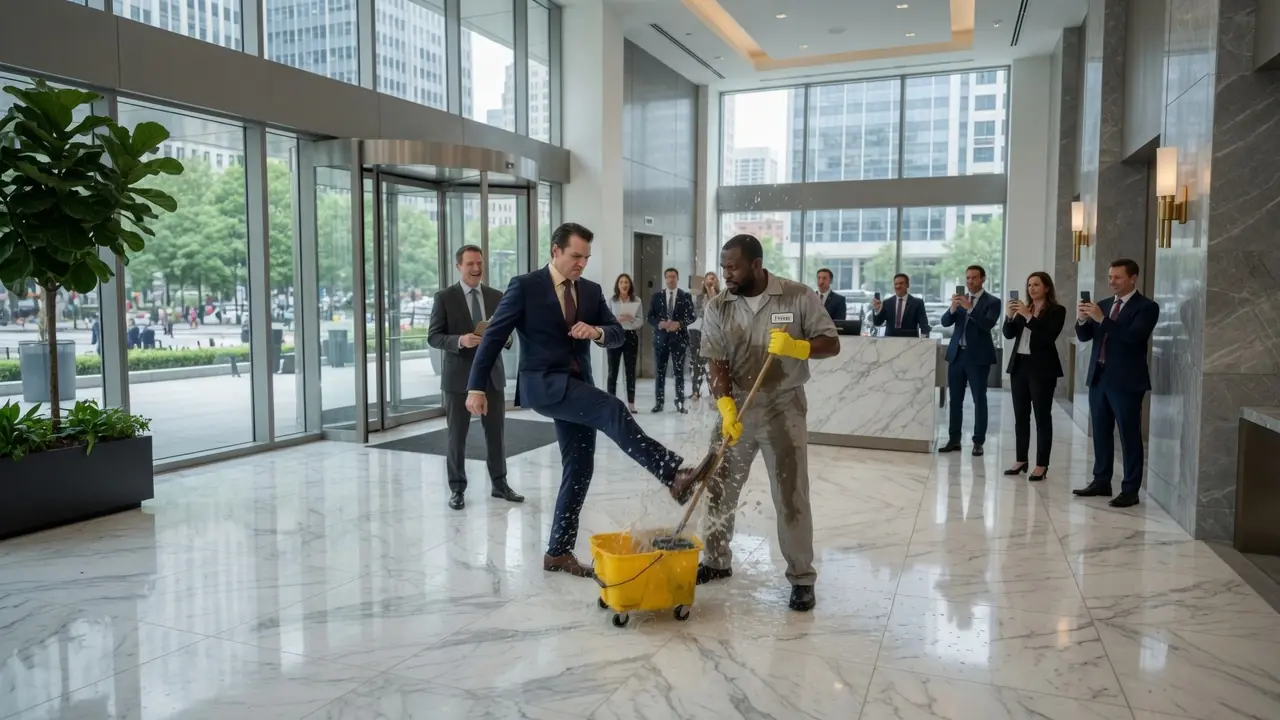
Where'd they dig this one up? Smells like he slept on the street. Probably did. Bradley kicked the mop bucket hard. Dirty water splashed across Fletcher's uniform.
Clean it up, trash. That's all you're good for. Fletcher's knuckles went white around the mop handle. His jaw locked. But he kept working. Not one word.
That man they just called trash, he's not who they think he is. Not even close. Nobody saw it coming. Let me take you back to where this all started, 3 weeks before that lobby scene.
Fletcher Davis was sitting in a corner office on the 42nd floor of Pinnacle Industries headquarters in downtown Atlanta. Floor-to-ceiling windows. The city skyline stretched out below him like he owned it. Because in many ways, he did.
14 billion dollars. That's what Pinnacle Industries was worth. Real estate, technology, infrastructure, logistics. Fletcher built it all from nothing. A kid from public housing in Savannah, Georgia, who earned an engineering scholarship, slept in his car for 2 years, and turned a one-room logistics startup into a Fortune 500 empire.
The wall behind his desk told the story. Magazine covers, Forbes, Bloomberg, Black Enterprise, awards from the Chamber of Commerce, the Urban League, three different governors. A framed photo of him shaking hands at the White House. But that morning, none of that mattered.
Because on his desk sat a report. 46 pages. Anonymous complaints from janitorial and maintenance staff across Pinnacle properties. Racial harassment, verbal abuse, wage theft, hostile working conditions. Some of these complaints were 3 years old.
Every single one had been buried by middle management. Not one had ever reached his office. Fletcher read every page. Twice. His coffee went cold.
His assistant knocked three times. He didn't answer. One name kept showing up. Pinnacle Tower. The company's flagship property in Atlanta's Buckhead district. 40 stories of glass and steel.
Home to tech firms, law offices, and Pinnacle's own regional operations. The crown jewel of his empire. And the man running it? Bradley Thornton. Regional property manager. 12 years on the job. Never once met the CEO face-to-face.
Fletcher closed the report. He picked up his phone and called one person. Raymond Cole, his chief legal counsel. Ray, I need you to do something for me. And I need you to keep it between us.
That same week, Fletcher walked into a small apartment across town. No driver, no security. Just him and a disguised consultant Raymond had hired. They built a simple identity. Fletch. No last name needed.
A janitor resume. Work history at two cleaning companies that didn't exist anymore. Nothing fancy, nothing traceable. Fletcher applied through a third-party cleaning contractor, not Pinnacle directly. See, that's the thing. Pinnacle Tower didn't even employ its own janitors.
They outsourced the entire custodial workforce to a contractor. Cheaper. No benefits. No HR protections. No accountability. The people who cleaned the building every single day weren't even considered Pinnacle employees.
Fletcher got hired in 2 days. No background check, no interview. They just needed a body with a mop. His first morning started at 5:45 a.m. Service entrance, side of the building.
No marble lobby, no glass doors. A gray metal door next to the loading dock. Paint peeling. A security camera with a cracked lens hanging above it. He carried a brown lunch bag.
Wore a gray uniform two sizes too big. A plastic name tag clipped to his chest. Fletch. The hallway inside smelled like bleach and wet concrete. Fluorescent lights buzzed overhead, one of them flickering in a rhythm that would drive you crazy by noon.
The break room was in the basement. No windows, no air conditioning. A vending machine that ate quarters. Plastic chairs with cracked seats. A microwave crusted with last week's leftovers.
Fletcher shook her hand. Fletch. First day. Denise showed him the ropes. Where the supply closets were.
Which elevators to use. Service only, never the main ones. Which floors to avoid before 9:00 a.m. How to refill soap dispensers without bothering the office tenants. Then she stopped.
Looked him straight in the eyes. Her voice dropped low. Listen to me. Keep your head down. Don't make eye contact with management.
And whatever Mr. Thornton says to you, whatever he calls you, just say, "Yes, sir." And keep moving. You understand? Fletcher stared at her. Does he talk to everybody like that? Denise didn't answer.
She just picked up her cleaning cart and pushed it toward the elevator. Over her shoulder, she said, "You'll find out soon enough." Fletcher stood alone in that basement break room. Fluorescent buzz overhead. The smell of bleach burning his nostrils.
A plastic name tag on his chest that said, "Fletch." This was his building. His company. His name on the deed, on the contracts, on every piece of letterhead in every office above him. And his own employees had been trained to be invisible.
Day three. Fletcher was on his knees scrubbing the baseboard in the 12th floor executive lounge. The carpet smelled like expensive perfume and old money. Soft jazz played from a hidden speaker. Floor-to-ceiling windows looked out over Buckhead.
Swimming pools on rooftops. German cars crawling through tree-lined streets. This was where the building's top tenants came to drink espresso and close deals. Fletcher heard the footsteps before he saw them. Leather soles on marble tile.
Click. Click. Click. The sound of someone who wanted you to know they were coming. Bradley Thornton walked in with two white office tenants. Mid-conversation. Laughing about a golf trip.
The smell of cologne hit Fletcher from 10 feet away. Sharp, heavy, suffocating. Bradley stopped mid-sentence. His eyes landed on Fletcher like he'd spotted a stain. The hell? They send you up here?
Bradley's voice filled the room. No warmth, no greeting, just teeth. I told them I don't want you people on this floor before noon. Fletcher kept scrubbing. I was told to finish this floor by 10:00, sir.
You were told? Bradley stepped closer. Close enough for Fletcher to see the veins in his neck. Who told you? Because I run this floor. I run this building. And I'm telling you, you don't belong up here.
One of the tenants shifted uncomfortably. The other, a man named Owen Hargrove, looked at Fletcher, then looked away. Said nothing. Bradley crouched down, eye level. His breath smelled like bourbon and breath mints.
He pointed one finger at Fletcher's chest. Let me explain something to you, janitor. The people on this floor pay more rent in 1 month than you'll see in your entire life. You think they want to look at you while they're having their morning coffee? You think they want to smell you?
Fletcher's grip tightened on the scrub brush. His knuckles ached. His pulse drummed in his temples. But his face stayed flat, perfectly still. I'll finish up and move to the next floor, sir.
Bradley stood up. Brushed off his pants like he'd touched something dirty. He turned to the two tenants with a grin. See what I deal with every single day? You give these people a job, a uniform, a paycheck, and they still can't figure out basic instructions.
He laughed, loud, theatrical. I swear, training a dog would be easier. The tenants gave half smiles, uncomfortable. Owen Hargrove stared at his coffee cup. His jaw was tight, but his mouth stayed shut.
Bradley walked out. His cologne lingered for a full minute after he left. The jazz kept playing. The espresso machine hummed. Fletcher stayed on his knees.
His hands were shaking. Not from fear, from something deeper. Something hot and heavy sitting right behind his ribs. He finished the baseboard, stood up, picked up his bucket, and walked to the service elevator without a word.
Day five. It got worse. Fletcher was restocking paper towels in the ground floor restroom when he heard yelling in the lobby. Not conversation, yelling. He stepped out.
Bradley Thornton was standing over a young black janitor named Terrence, early 20s, skinny, new on the job. The kid had knocked over a small bucket of cleaning solution near the reception desk. A minor spill, maybe half a gallon, already mostly wiped up. But Bradley was treating it like a crime scene. Are you stupid? Are you actually brain dead?
Bradley's voice bounced off the marble walls. Every word is designed to carry. Look at this mess. Look at it. A five-year-old could do your job better than you.
Terrence was frozen, hands at his sides, eyes wide. His bottom lip was trembling. Dozens of people were watching. Office workers, visitors, a delivery driver standing by the front desk. Nobody moved.
Nobody spoke. Bradley wasn't done. You know what you are? You're a liability. You're a walking disaster. I should have had you thrown out the first week.
He stepped closer, towering over Terrence. You're not worth minimum wage. You hear me? You're worthless. Terrence whispered something. Fletcher couldn't hear it.
What? Speak up. You got something to say? Bradley cupped his ear mockingly. No? That's what I thought. Because you got nothing.
You are nothing. The lobby was dead silent. 30, maybe 40 people watching a grown man destroy a kid in public. Not one person intervened. Bradley straightened his tie, smoothed his jacket, turned to Craig Ellsworth, who had appeared from nowhere with a clipboard.
Write him up. Third strike and he's out. Tell the contractor to send someone who actually has a brain cell. He walked away, shoes clicking, back straight, like nothing happened. Terrence stood there, alone, in the middle of a lobby full of people who pretended he didn't exist.
Fletcher followed him. He found Terrence in the basement break room, sitting on one of the cracked plastic chairs, elbows on his knees, hands covering his face. His shoulders were shaking. Fletcher sat down next to him, didn't say anything for a full minute, just sat. Finally, Terrence spoke.
His voice was raw. This happens every week, man. Every single week. To all of us. He picks one of us and just goes off in front of everybody.
He wiped his eyes with the back of his hand. But we can't say nothing. We're contracted. No HR, no union, no nothing. You complain, you get replaced. Simple as that.
Fletcher's chest was tight. Has anyone tried reporting it? Terrence laughed, a broken, hollow sound. Report to who? Craig? He's Bradley's boy.
Every complaint goes through him. And every complaint disappears. Denise walked in. She looked at Terrence. She didn't ask what happened.
She already knew. She handed him a bottle of water, squeezed his shoulder. Then she looked at Fletcher. Now you see it, she said quietly. Now you know.
Day eight. The mask slipped further. Fletcher was using his janitor access card to enter a supply closet on the 20th floor. Normal routine. Restock cleaning products, replace trash bags, move on.
The card beeped. Green light. Door clicked open. Hold it. Fletcher turned.
Craig Ellsworth was standing at the end of the hallway, arms folded, face hard. Let me see your badge. Fletcher unclipped his contractor badge and held it up. Craig walked over, took it, held it up to the light like it was counterfeit currency. This looks expired.
It's not, sir. It was issued two weeks ago. Craig pocketed the badge, just put it in his jacket like it belonged to him. I'll hold on to this. We've been having some inventory issues on this floor.
He said it loud, loud enough for three office workers in the hallway to hear. You know what I mean by inventory issues, right? Fletcher understood exactly what he meant. Craig pulled out his radio. I need two guards on 20, now. Got a contractor up here needs supervision.
Two minutes later, two security guards arrived. Craig pointed at Fletcher. Stay on him. Every room he enters, you enter. Every closet he opens, you watch. He doesn't leave this floor without checking out through me.
Fletcher spent the next four hours cleaning offices with an armed guard standing 10 feet behind him. Every room, every hallway, every bathroom. Office workers stared. A woman in a gray blazer clutched her laptop bag to her chest when Fletcher walked past. A man in a conference room locked his briefcase and watched Fletcher through the glass until he moved on.
The guard never spoke, just followed. Heavy boots on carpet, a constant shadow. Fletcher could feel it in his skin, that crawling, suffocating sensation of being watched, of being assumed guilty, of performing labor while your humanity gets peeled away layer by layer in real time. He kept working, emptied trash cans, wiped down desks, replaced soap dispensers, all while being escorted like a criminal. The body camera on his chest, disguised as a button, recorded everything.
Craig's words, the guard shadowing him. The woman clutching her bag. The man locking his briefcase. Every single second. When his shift ended, Fletcher walked to the service elevator.
The guard followed him all the way down. Watched him clock out. Watched him leave through the gray metal door by the loading dock. Fletcher stepped outside. The evening air hit his face.
Atlanta heat, car exhaust, the distant sound of traffic on Peachtree Road. He stood there for a long time. His hands were still. His face was calm. But inside, something was building.
Something that had no name yet. Just wait. Just pressure. Growing every single day.
Day 14. Fletcher arrived at work that morning and knew something was wrong. The basement hallway was too quiet. No one was talking. No music from the break room.
Just silence and the hum of fluorescent lights. Denise was standing by her locker, arms crossed, face like stone. They're doing a search, she said. Thornton's orders. Says property's gone missing from the upper floors.
What property? Doesn't matter. It's not about property. It's never about property. 20 minutes later, Craig Ellsworth walked into the basement locker room with two security guards.
One of them carried a black duffel bag. The other had latex gloves on. Like this was a crime scene. Craig didn't announce himself, didn't explain. He just pointed at the first locker in the row, a young black woman named Keisha, and said, "Open it."
Keisha's hands were trembling as she turned the combination. Craig reached past her before she even finished. He pulled the door open and started yanking things out. A winter coat, a pair of sneakers, a framed photo of her daughter. He dropped them on the concrete floor one by one, checked the shelf, checked the corners, tossed her lunch bag onto the pile.
Next, he moved down the line, every black and Latino worker, one by one. Open, search, dump, move on. Fletcher watched from the end of the row. His heart was slamming. He counted.
Craig searched 14 lockers. Every single one belonged to a person of color. The white maintenance workers, electricians, HVAC technicians, plumbers, stood on the other side of the room, untouched. Their lockers stayed closed. Nobody asked them to open anything.
Nobody even looked at them. Craig reached Fletcher's locker. "Open it." Fletcher turned the lock. Click. The door swung open.
Craig reached in, pulled out a spare uniform, a water bottle, then his hand found it. Fletcher's leather notebook. The one he'd been using to document every incident. Dates, times, names, quotes. Craig flipped it open.
His eyes scanned the pages. His brow furrowed. "What is this?" Fletcher's pulse spiked, but his voice stayed level. "Just personal notes, grocery lists, things like that."
Craig stared at him. 3 seconds. 5. Then he closed the notebook and slid it into his own jacket pocket. "I'll be holding onto this."
"That's my personal property, sir." "And this is my building." Craig smiled. A cold, thin smile that didn't reach his eyes. "You'll get it back when I decide you get it back. If I decide."
He turned to the guards. "We're done here. Pack it up." They walked out, left the basement looking like a ransacked apartment. Personal belongings scattered across the concrete floor. Family photos face down in puddles of dirty mop water.
A pair of reading glasses cracked under someone's boot. The staff stood in a line, silent. Some of them had tears running down their faces. Not from sadness, from the raw, burning humiliation of being treated like criminals in the place where they come to work every single day.
Denise bent down, picked up Keisha's photo, wiped it on her sleeve, handed it back without a word. Fletcher memorized everything. Every detail. Every face. The camera on his chest caught what his eyes couldn't hold.
4 days later, it got worse. Day 18. Denise found Fletcher in the stairwell during their 15-minute break. She was holding a paystub. Her hands were shaking.
And Denise's hands never shook. "Look at this." Fletcher took the stub, scanned the numbers, then scanned them again. "They docked you for 12 hours?" "Unauthorized breaks. That's what it says."
Denise's voice was steady, but her eyes were burning. "Fletch, I've been here 22 years. I have never taken an unauthorized break, not once." It wasn't just her. Fletcher spent the rest of the day quietly checking with other staff. Every single custodial worker had hours docked that pay period.
Different amounts, 4 hours here, 8 hours there. Terrence lost 16 hours, nearly half his paycheck. Fletcher ran the math in his head. 35 custodial workers, average 12 docked hours per period, twice a month, across an entire year, the total came to over $180,000 stolen from people who could barely afford rent.
And the docked hours lined up perfectly with Bradley Thornton's quarterly operational efficiency bonuses. Every dollar stolen from the workers below went straight into the pockets of the men above. Fletcher asked Denise the obvious question. "How do we report this?" She laughed. Not a real laugh, the kind that comes out when crying isn't an option.
"Report to who, baby? Craig signs off on the timesheets. Bradley approves the bonuses. The contractor doesn't care. They get paid either way. We're ghosts in this building. We don't exist on paper unless they want us to."
That same afternoon, things crossed a line that couldn't be uncrossed. Conference room on the ninth floor. Fletcher was stacking chairs after a meeting. The door opened. Bradley Thornton walked in, alone.
His tie was loosened. His face was flushed. The smell of whiskey hit Fletcher from across the room. Sharp, warm, unmistakable. Liquid lunch.
Bradley leaned against the doorframe. His eyes locked onto Fletcher. "You're the new one." Fletcher kept stacking. "Yes, sir."
"Put the chair down. Look at me." Fletcher set the chair down, turned, met Bradley's eyes. Bradley walked toward him, slow, deliberate. Each step was a statement. He stopped 6 inches from Fletcher's face, close enough for Fletcher to count the broken capillaries in his cheeks, close enough to smell the bourbon on his breath.
"You've been asking questions." Bradley's voice was low now, not loud like the lobby. This was different. This was private, intimate, dangerous. "Talking to the other janitors, checking paystubs. You think I don't hear things?"
Fletcher said nothing. Bradley poked his index finger into Fletcher's chest, hard, right above the sternum. "Let me make something real clear to you, boy." Another poke, harder. "I run this building. I decide who works here and who gets thrown out on the street.
You're a cockroach. You understand? A cockroach in my house. And I can step on you anytime I want." He shoved a metal folding chair toward Fletcher. It crashed into his shin. The sound of metal on bone echoed off the conference room walls.
Fletcher didn't flinch, didn't step back. His eyes stayed level. His breathing stayed even. But underneath his uniform, his chest was on fire where Bradley's finger had dug in. And his shin was throbbing.
A dull, hot pulse that would leave a bruise the size of a fist. Bradley stared at him, waiting for a reaction, wanting one. He didn't get it. Bradley snorted. "Pathetic."
He walked out. The door slammed behind him. Fletcher stood alone in the conference room, the overturned chair at his feet, the smell of whiskey still hanging in the air. His body camera recorded the whole thing. The finger in the chest, the shoved chair, every single word.
Then came day 22, the breaking point. It was 2:00 in the afternoon, 91° outside. In the basement, it felt worse. The air conditioning had been broken for 3 straight weeks. Multiple work orders filed. Everyone ignored.
Fletcher was hauling trash bags up the service stairwell when he heard the thud. A heavy, boneless sound, like a bag of sand dropping on concrete. He ran. Earl, a 62-year-old black janitor who'd been with the building for 15 years, was collapsed on the second floor landing, face down, arms limp. His gray uniform was soaked through with sweat.
His skin was burning hot to the touch. Fletcher dropped to his knees. "Earl! Earl, can you hear me?" Denise came running. She pressed her fingers to Earl's neck.
His pulse was there, fast, weak, thready. "Call medical," Fletcher said. "Now!" Denise radioed the front desk. 3 minutes later, Craig Ellsworth showed up. Not a paramedic, not a nurse, Craig, with his clipboard.
He looked down at Earl like he was looking at a stain on the carpet. "He's dehydrated. Give him water. He'll be fine." "He needs an ambulance," Fletcher said. "He's burning up. His pulse is weak. This could be heatstroke."
Craig's jaw tightened. He stepped toward Fletcher. Close. That same intimidation distance Bradley used. "You want to keep your job? Shut your mouth. We're not calling an ambulance for a guy who forgot to drink water. You know how much paperwork that is? How that looks for the building?"
Fletcher stared at him. 3 seconds. 5. 10. Then he pulled out his personal phone and dialed 911.
Craig's face went white. Then red. What the hell are you doing? Hang up. Hang up right now.
I need an ambulance at Pinnacle Tower, service stairwell, second floor landing. 62-year-old male, possible heatstroke. He's unresponsive. The paramedics arrived in 9 minutes. They confirmed severe heat exhaustion, borderline heatstroke.
Earl was loaded onto a stretcher. IV in his arm, oxygen mask on his face. Craig stood in the hallway watching the stretcher roll out. His fists were clenched. His radio crackled.
He didn't say a word to Fletcher. Didn't need to. His eyes said everything. You're done. Fletcher watched the ambulance pull away.
Red lights flashing against the glass lobby doors. The wail of the siren fading down Peachtree Road. He stepped into the stairwell alone. He pulled out his phone and made one call. Raymond Cole picked up on the first ring.
Ray it's time. Day 25. Fletcher walked through the gray metal service door one last time. Same uniform, same plastic name tag, same mop bucket waiting for him in the basement. But today the building felt different.
The lobby was buzzing. Workers were hanging Pinnacle Industries banners from the mezzanine railing. A podium was being set up near the reception desk. Audio technicians were testing a microphone. Someone had polished the marble floor twice.
Whispers spread through every floor like wildfire. The CEO is coming. The real CEO. Nobody's ever seen him. He's coming today.
Fletcher grabbed his mop and started working the lobby like any other morning. Head down, slow strokes, invisible. Bradley Thornton came barreling out of the elevator at 8:15 a.m. Looking like a man who hadn't slept. His shirt was wrinkled under his blazer.
His hair was freshly gelled, but his hands were shaking. He was barking orders at everyone within earshot. Move that table. Straighten those chairs. Get fresh flowers. Where the hell are the fresh flowers?
Then his eyes found Fletcher. He crossed the lobby in five steps. Got right in Fletcher's face. That familiar cologne. That familiar sneer.
What are you doing here? I told the crew no janitors on the main floor today. None. Zero. You understand me?
I was assigned to the lobby this morning, sir. I don't care what you were assigned. Bradley grabbed Fletcher's mop and threw it on the ground. The wooden handle clattered across the marble. Every head in the lobby turned.
The CEO of this company is walking through those doors in less than an hour. You think I'm going to let him see you smelling like bleach and floor wax? Looking like that? He grabbed Fletcher's shoulder and shoved him toward the service elevator. Hard.
Fletcher stumbled two steps. Get downstairs now. Take your bucket, take your stink, and disappear. I don't want a single one of you people visible when the boss gets here. Not one.
Craig Ellsworth appeared from behind the security desk grinning. You heard the man. Move it, janitor. Back to the basement where you belong. Fletcher looked at Bradley. Then at Craig.
Then at the service elevator. He pressed the button. The doors opened with a soft chime. He didn't get in. The doors closed.
Fletcher turned around. Slowly. He set his mop bucket against the wall. Straightened his uniform and walked back toward the center of the lobby. Bradley's face twisted.
Hey. Hey. I just told you to get downstairs. Are you deaf? Are you stupid? Get out of my lobby before I have you dragged out.
Fletcher stopped walking. He stood in the middle of the marble floor right in front of the podium. Feet planted, hands at his sides, still as stone. Before Bradley could say another word, the front doors opened. Raymond Cole walked in first.
Dark suit, silver tie, briefcase in hand. Behind him four attorneys three Pinnacle Industries board members in tailored suits and two uniformed police officers. They walked in a straight line across the lobby. Every one of them heading directly toward Fletcher. Bradley froze.
His mouth opened, but nothing came out. Raymond reached Fletcher. He opened his briefcase and pulled out a navy suit jacket. Italian wool. Custom tailored.
He held it open. Fletcher unclipped the plastic name tag from his chest. He looked at it for a moment. Fletch. Then set it gently on the podium.
He pulled off his gray janitor shirt. Underneath was a crisp white dress shirt. He slipped on the suit jacket, adjusted the cuffs. Raymond turned to face the lobby. Every person in that building had stopped moving.
Receptionists office workers security guards tenants all frozen. His voice carried across the marble like a bell. Ladies and gentlemen I'd like to introduce Fletcher Davis. Founder chairman and chief executive officer of Pinnacle Industries.
The silence that followed was absolute. Not a cough not a breath not a footstep. Bradley Thornton's face went through every color a human face can go through. White gray green. His mouth hung open.
His hands dropped to his sides. His knees buckled slightly like someone had kicked the back of his legs. Craig Ellsworth's radio slipped from his hand and hit the marble floor. The crack echoed through the lobby. He didn't pick it up. He couldn't move.
Denise Holloway was standing near the service hallway. Her hand went to her mouth. Tears spilled down her cheeks before she even understood what was happening. Terrence standing beside her grabbed the wall to steady himself. Owen Hargrove, the tenant who had watched Bradley humiliate Fletcher on the 12th floor and said nothing stood near the elevator bank.
His coffee cup was shaking in his hand. Fletcher stood at the podium. He didn't raise his voice. He didn't need to. Every word landed like a hammer on glass.
Mr. Thornton. Mr. Ellsworth. Bradley's lips moved. No sound came out. Fletcher reached into his jacket pocket and pulled out a small tablet.
He tapped the screen once. The lobby's large display monitors, the ones usually showing Pinnacle Industries stock tickers and promotional videos, flickered. Then the body camera footage began to play. Bradley's voice filled the lobby. Clean it up, trash. That's all you're good for.
Then Craig's voice. Smells like he slept on the street. Then Bradley again. In the conference room, finger in Fletcher's chest. You're a cockroach.
A cockroach in my house. Every person in that lobby watched. Every person heard. Fletcher let the footage play for a full 60 seconds. Then he paused it.
Looked directly at Bradley. You didn't know I was the CEO. Fine. But you knew these people were human beings. And you treated them like they were nothing.
The lobby was still. No one moved. No one breathed. The body camera footage was frozen on the display screens. Bradley's face mid sneer.
His finger pressed into Fletcher's chest. The image hung there like a verdict. Bradley Thornton was the first to break. His voice came out cracked. Thin.
A completely different man from the one who had kicked a mop bucket 30 minutes ago. Mr. Davis. Please. I This is You have to understand. I've given 12 years to this company. 12 years.
I've never missed a quarter. I've kept this building running. I've You've given 12 years to terrorizing people who couldn't fight back. Fletcher's voice was level. Quiet. But it cut through the lobby like a blade.
12 years of calling them trash dogs cockroaches. 12 years of stealing their wages. 12 years of making them afraid to come to work. Bradley's mouth kept moving, but the words had stopped making sense. His hands were trembling.
Sweat was beating along his hairline. The Rolex on his wrist, the one he'd flashed in Fletcher's face on day one, caught the overhead light as his arm shook. Please, I have a family. I have a mortgage. I'll change. I swear to God, I'll You had 35 families depending on their paychecks.
You stole from every single one of them. Fletcher turned to Raymond Cole and nodded once. Raymond stepped forward and addressed Bradley directly. Bradley Thornton, your employment with Pinnacle Industries is terminated effective immediately. Your access credentials are revoked.
Your severance is forfeited in full. A formal complaint has been filed with the Equal Employment Opportunity Commission and the United States Department of Labor. You will be hearing from both. Bradley's corporate ID was unclipped from his jacket by a security guard. The same guards he'd used to shadow Fletcher on the 20th floor.
The same guards he had sent to intimidate janitors in the basement. Now, they flanked him on both sides. They walked him toward the front doors. Every step echoed on the marble. The lobby was packed.
Receptionists, tenants, office workers, janitorial staff, and every single pair of eyes followed him. Bradley kept his head down. His Italian leather shoes, the $1,200 ones, squeaked on the freshly mopped floor. The glass doors opened. The Atlanta heat rushed in.
He stepped outside. The doors closed behind him. He didn't look back. No one called after him. While every eye was on Bradley's exit, Craig Ellsworth tried to disappear.
He moved along the far wall toward the service corridor, walking fast, head low, radio abandoned on the floor where he'd dropped it. He made it 15 ft. Mr. Ellsworth. Fletcher's voice stopped him cold. Craig turned around.
His face was gray. His lips were pressed into a thin line. The two uniformed officers stepped forward. Raymond Cole handed them a thick manila envelope. The dossier.
Documentation of every illegal locker search. Falsified timesheets spanning 18 months. Confiscation of personal property. The refusal to authorize emergency medical care for Earl. Every incident cataloged with dates, witness statements, and body camera timestamps.
One of the officers opened the envelope, scanned the first page, looked at Craig. Craig Ellsworth, you're under arrest. Charges include grand theft, civil rights violations under federal statute, assault, and filing false business records. You have the right to remain silent. Craig opened his mouth.
This is You can't I was following orders. Thornton told me to You have the right to an attorney. The handcuffs clicked around Craig's wrists. The sound was small. Just two metallic snaps.
But in that silent lobby, it sounded like a gunshot. Craig's protest started loud, then faded to nothing as the officers walked him toward the service exit. The same service exit where he had once stood with his arms crossed, telling Fletcher to get back to the basement where he belonged. The door closed behind him. Fletcher stood at the podium for a moment.
Then he stepped down and walked toward the service hallway. Toward his people. Denise was standing with the custodial staff. Terrence, Keisha, a dozen others. Some were crying.
Some were shaking. Some just stood there, mouths open, trying to process what they had just witnessed. Fletcher looked at each of them. He knew their names. Every single one.
He had mopped floors beside them. Eaten lunch in that broken-down basement breakroom with them. Watched them get humiliated and robbed and threatened. And stayed silent so this moment could happen. "Effective immediately," he said, "every custodial worker at every Pinnacle property is being converted from contract labor to full Pinnacle Industries employees.
Full benefits, union representation, and every dollar of back pay that was stolen from you will be returned with interest." Denise covered her face with both hands. Her shoulders shook. Terrence grabbed the wall and slid down to the floor, head in his hands. Fletcher walked to Denise.
He took her hand. "You told me to keep my head down. You told me to say, 'Yes, sir,' and keep moving." He squeezed her hand. "You showed me what courage looks like every single day. Thank you."
The story didn't end in that lobby. Not even close. What happened next was bigger than Bradley Thornton. Bigger than Craig Ellsworth. Bigger than Pinnacle Tower.
Within 48 hours of the reveal, Fletcher Davis ordered a full independent audit of every Pinnacle Industries property in the country. Not an internal review. Not a committee. He hired Wallace and Grant, one of the most respected labor rights auditing firms in the United States, and gave them unrestricted access to every payroll record, every HR complaint, every security log, every contractor agreement across all 23 properties. The results came back in 6 weeks.
They were worse than anyone expected. Pinnacle Tower was not an isolated case. Six other properties in Charlotte, Nashville, Houston, Jacksonville, Tampa, and Richmond had nearly identical patterns. Custodial and maintenance staff, overwhelmingly black and Latino, subjected to racial harassment from white management. Wages docked for fabricated infractions.
Complaints filed and buried. Workers intimidated into silence through threats of termination. The total wage theft across all seven properties over a 3-year period came to $2.4 million. Stolen from the people who cleaned the floors, emptied the trash, scrubbed the bathrooms, and kept the buildings running. People who earned $11, $12, $13 an hour and couldn't afford to lose a single one.
Fletcher held a company-wide all-hands meeting. Every employee, every property, live-streamed on internal channels. He stood at the podium in Atlanta headquarters, the same building where he'd once mopped floors in a gray uniform, and spoke for 42 minutes without notes. He didn't blame the system. He didn't hide behind corporate language.
He took it personally. "I built this company from nothing. From a one-room office and a used delivery van. I built it because I believe that work has dignity. That every person who shows up and gives their time deserves to be treated like a human being."
He paused. The room was silent. "I failed. I let this company grow so fast that I lost sight of the people holding it up. The people at the bottom. The people who were invisible. That ends today. Not tomorrow. Not next quarter. Today."
He announced three immediate changes. First, every third-party custodial contract across all Pinnacle properties was terminated. Every custodial worker would be rehired as a direct Pinnacle Industries employee with full health insurance, retirement benefits, paid leave, and union representation. Second, a new chief equity officer position was created, reporting directly to the CEO. Third, a worker advocacy division was established at every property with an independent hotline that bypassed local management entirely.
He offered the leadership of the worker advocacy division to Denise Holloway. She accepted. The woman who had spent 22 years being told to keep her head down was now in charge of making sure no one ever had to keep their head down again. Then, the media arrived. Stephanie Brennan, an investigative journalist at the Atlanta Journal-Constitution, had been tipped off by an anonymous source inside the company.
She broke the story on a Wednesday morning. The headline read, "Billionaire CEO goes undercover as janitor. Exposes racism and wage theft inside his own empire." By Thursday evening, the story had been picked up by CNN, MSNBC, The Washington Post, The New York Times, and every major digital outlet in the country. Fletcher's body camera footage, released with the full written consent of every staff member who appeared in it, was uploaded to YouTube. It hit 40 million views in 48 hours.
The footage was devastating. Bradley's voice calling Fletcher trash. Craig dumping personal belongings on a concrete floor. The locker search. The chest poke.
The chair shoved into Fletcher's shin. Craig refusing to call an ambulance for Earl. All of it captured in sharp, unedited, undeniable detail. Fletcher did one sit-down interview, just one. He chose Stephanie Brennan.
They sat in the basement break room at Pinnacle Tower. The same room with the cracked plastic chairs and the broken vending machine. Except now the room had fresh paint, working air conditioning, and a new table. Stephanie asked him why he did it. Why would a billionaire spend 30 days mopping floors and being called a cockroach?
Fletcher's answer was simple. I got a report on my desk that said my own employees were afraid to come to work. Afraid. In my building. Under my name.
I couldn't fix that from a corner office on the 42nd floor. I had to see it. I had to feel it. The public response was overwhelming. The hashtag Pinnacle Justice trended nationally for five straight days.
Labor rights organizations cited the case in congressional testimony. Three other Fortune 500 companies announced independent audits of their contractor practices within the same month. Bradley Thornton's name became public. Every outlet ran his photo. His LinkedIn profile was deleted within hours.
Former colleagues issued statements distancing themselves. No company would touch him. His $1,200 shoes and his Rolex couldn't buy him a single reference letter. And then came the trial. Three months after the lobby reveal, Craig Ellsworth stood trial in the United States District Court for the Northern District of Georgia.
Judge Patricia Wells presiding. The prosecution's case was airtight. Fletcher's body camera footage, payroll records showing systematic wage falsification across 18 consecutive months. Testimony from 14 current and former custodial workers. Bank records linking the docked wages to Bradley Thornton's bonus payouts with Craig Ellsworth's signature on every falsified timesheet.
And Owen Hargrove, the office tenant who had watched Bradley humiliate Fletcher on the 12th floor and said nothing, took the stand as a corroborating witness. Craig's defense attorney argued standard security protocols, reasonable workplace inspections, management discretion. The prosecution dismantled every argument. The locker searches targeted only employees of color. The confiscated property was never returned or logged.
The wage theft was systematic, intentional, and personally profitable. The refusal to authorize medical care for Earl was documented on camera and nearly cost a man his life. The jury deliberated for 4 hours. Guilty. On all counts.
Grand theft. Civil rights violations under federal law. Assault. Filing false business records. Judge Patricia Wells handed down the sentence.
Eight years in federal prison. $350,000 in restitution. A lifetime ban from holding any security, management, or supervisory position. Craig Ellsworth stood motionless as the sentence was read. His attorney put a hand on his shoulder.
Craig didn't react. He just stared at the table in front of him. The same empty stare he used to give janitors in the basement. Except now, it was his own future he was looking at. In the gallery, Denise Holloway sat in the second row.
Terrence beside her. Keisha beside him. Earl, recovered and using a cane, at the end of the row. Fletcher sat quietly in the back. No podium. No cameras.
Just a man watching justice land exactly where it was supposed to. Bradley Thornton faced a separate civil lawsuit filed by 35 former custodial workers. He fought it for 2 months, then settled. $4.2 million. His savings. His retirement fund. His reputation.
All of it gone. Every last cent distributed to the workers he had spent 12 years calling trash, dogs, and cockroaches. One year later, Pinnacle Industries was named one of the top 10 workplaces for hourly employees in the Southeastern United States. Staff retention among custodial workers hit 94%, the highest in the company's history.
Every single property had a worker advocacy office with a direct hotline to corporate headquarters. No middleman. No gatekeepers. No complaints lost in a drawer. Denise Holloway traveled the country.
The woman who once pushed a cleaning cart through the service elevator now stood in conference rooms in tailored blazers training property managers on respectful workplace practices. She spoke at labor rights conferences. She testified before Senate subcommittee on contractor abuse. When she walked into a room, people stood up. Not because she demanded it, but because she had earned it.
22 years of keeping her head down, followed by 1 year of making sure no one else ever had to. Terrence received a full academic scholarship through the Pinnacle Foundation. He enrolled in Georgia State University's business management program. On his first day of classes, he wore a new suit. Not expensive. Not flashy.
Just clean, pressed, and his. He told a reporter that the last time he wore a uniform with a name tag, a man called him worthless in front of 40 strangers. He said he never wanted to feel that small again. He said he was going to make sure nobody else did, either. Earl recovered fully.
It took 3 months of physical therapy and two follow-up hospital stays, but he came back. Not to work. He retired with a full pension, health insurance, and a benefits package that would have been unthinkable for a contract janitor 1 year earlier. On his last day, the custodial staff threw him a party in the basement break room. The same room that used to have no air conditioning, a broken vending machine, and cracked plastic chairs.
It now had fresh paint, comfortable furniture, a proper kitchen, and a brass plaque on the wall that read, "Every person who walks through these doors keeps this building standing." Earl cried when he saw the plaque. So did everyone else. Owen Hargrove, the office tenant who had watched Bradley humiliate Fletcher on the 12th floor and said nothing, quit his silence.
He became one of the most outspoken advocates for bystander intervention training in corporate settings. He partnered with three Atlanta nonprofits to develop a workplace program called "See something, say something, mean it." He told anyone who would listen that the worst thing he ever did was hold his coffee cup and look away. Fletcher Davis still visited Pinnacle Tower once a month. Not the corner office.
Not the executive lounge. The basement break room. He sat at the same table where he'd eaten lunch as Fletch. He brought food. He ate with the staff.
He asked about their families, their kids, their weekends. No cameras. No press releases. Just a man sitting with the people who had shown him the truth about his own company. And Bradley Thornton?
Last anyone heard, he was working a stock room job at a retail outlet in suburban Atlanta. A reporter tracked him down and asked for a comment. Bradley said four words. "I made some mistakes." No apology. No accountability.
No recognition of the 35 lives he had degraded for 12 years. The internet responded the way the internet responds. Nobody accepted it. Nobody forgave him. Craig Ellsworth was 18 months into his 8-year sentence at a federal correctional facility.
He filed one appeal. It was denied. His attorney stopped returning calls. Justice doesn't always move fast. But when it moves, it moves with weight.