Ma’am, you need to leave immediately. This bank doesn’t serve your kind of clientele. The security guard’s hand moved toward his radio. Dr. Amara Washington stood perfectly still, designer briefcase in hand.
It was 2:47 p.m. on a Tuesday afternoon at Heritage Community Bank’s flagship branch in downtown Chicago. The marble floors gleamed under crystal chandeliers. Amara had walked through these doors wearing a tailored charcoal suit, her steps confident and purposeful. She approached the premium banking counter.
The young teller, Jessica, glanced up with barely concealed irritation. Excuse me, regular customer service is over there. Jessica pointed toward the basic teller windows. I need executive banking services, Amara said quietly.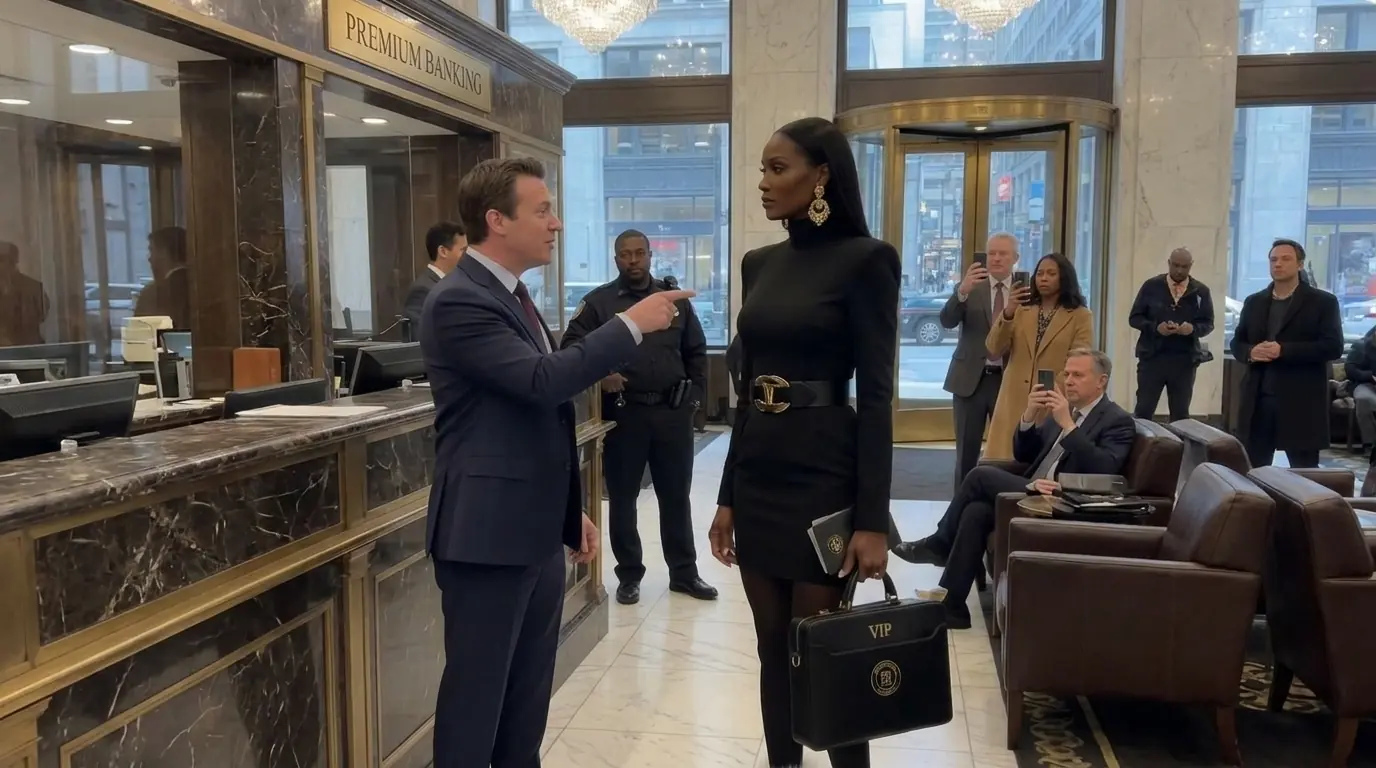
Jessica’s eyebrows shot up. Do you have an appointment? Assistant manager Bradley Mitchell emerged from the back office. He was 35, clean shaven with the kind of confidence that came from never being questioned.
His eyes swept over Amara dismissively. Is there a problem here? His voice carried across the banking floor, drawing attention from other customers. No problem, Amara replied.
I’m requesting access to executive banking services. Bradley crossed his arms. Are you sure you’re in the right place? This is our premium services area.
He spoke louder than necessary. Do you have an appointment? A young woman named Sarah Chen sat at a nearby table, ostensibly working on her laptop. She’d been documenting her day on Instagram live when this interaction began.
Her phone screen showed 47 viewers, quickly climbing to 127. I don’t need an appointment, Amara said, maintaining her calm tone. Ma’am, we have protocols here. Bradley’s voice grew more patronizing.
Premium banking requires significant account minimums. Are you familiar with our requirements? Amara set her briefcase on the marble counter. The soft click echoed in the suddenly quiet space.
Perhaps you could explain them to me. The leather briefcase was monogrammed. AW, Heritage Community Bank Board of Directors. But Bradley wasn’t looking at details.
He was performing for his audience. Look, I don’t want to make this difficult, Bradley continued. But executive banking starts at a quarter million in assets. We also require extensive documentation of income sources.
He paused meaningfully. Legitimate income sources. Sarah’s viewer count hit 347. Comments began flooding in.
Is this really happening? Someone needs to record this. This is 2024, not 1954. Amara checked her phone.
The screen showed multiple missed calls. General counsel, chief of staff, board secretary. The time read 2:52 p.m. The board meeting starts in exactly 43 minutes, Mr. Mitchell, she said quietly. Bradley frowned. What board meeting? Never mind.
Amara’s voice remained steady. About those protocols you mentioned. Right, Bradley straightened, warming to his subject. We need to verify identity, income, and legitimate business purposes.
Some people try to use our services for questionable activities. Regional manager Patricia Kaine appeared beside Bradley. She was 43, sharp-eyed, and had clearly been briefed on the situation. What seems to be the issue?
Patricia’s tone suggested she already knew the answer. This woman is requesting executive services without proper documentation, Bradley explained. I’m trying to explain our requirements. Patricia nodded approvingly.
We have to be careful about suspicious activity. The regulators are very strict about know your customer requirements. Amara opened her wallet to retrieve her identification. A flash of platinum caught the light.
An American Express Centurion card visible for just a moment before she selected her driver’s license. Here’s my identification, she said, sliding it across the marble surface. Patricia barely glanced at it. We’ll also need proof of funds, employment verification, and a detailed explanation of your business with Heritage Bank.
The parking validation ticket peeked from Amara’s briefcase. VIP executive garage, level P1. Only board members and C-suite executives had access to that garage. Sarah’s live stream hit 891 viewers.
The comments were becoming more heated. This is discrimination, plain and simple. Someone call the news. What bank is this?
They need to be exposed. I understand you have procedures, Amara said, but I’m simply trying to access services at my own bank. Your bank? Bradley laughed. Ma’am, this is Heritage Community Bank.
We’ve been serving Chicago’s business community for 75 years. Yes, Amara replied. I’m aware of the history. Patricia stepped closer.
Look, we’re trying to be accommodating, but you’re being evasive. If you can’t provide proper documentation, we’ll have to ask you to leave. District manager Robert Hayes appeared on the teller’s video screen. He’d been patched in from the regional office.
His face filled the monitor behind the counter. What’s the situation? Hayes demanded. Individual requesting executive services without proper credentials, Patricia reported. She’s being uncooperative.
Hayes nodded grimly. Security protocols are clear. If someone can’t verify their legitimate business need, they need to be removed. Two security guards had positioned themselves near the exits.
The elderly Mrs. Roosevelt, a longtime customer, watched from the seating area with growing concern. Young man, Mrs. Roosevelt called to Bradley. Perhaps you should check your records before making assumptions. Bradley ignored her.
His attention was on his performance, on demonstrating his authority. Ma’am, he addressed Amara. You have five minutes to provide proper documentation or we’ll have to ask you to leave the premises. Amara’s phone buzzed with a text message.
She glanced at it briefly, then typed a quick response. Her fingers moved efficiently across the screen. Code 7, initiate immediately. five minutes, she repeated thoughtfully.
That should be sufficient. Sarah’s viewer count reached 1,247. Someone had shared the stream link and it was spreading across social media platforms. The hashtag Heritage Bank was beginning to trend locally.
The tension in the marble floored lobby was palpable. Other customers had stopped their transactions to watch. Some were clearly uncomfortable. Others seemed entertained by the drama.
Amara stood perfectly still, her briefcase positioned precisely on the counter, her breathing was controlled, her posture relaxed. She checked her phone again. 2:58 p.m. Mr. Mitchell, she said quietly, you might want to check your employee handbook, page 47, section 3. Bradley’s confident expression faltered slightly.
What about it? The section on customer service standards, Amara replied. Particularly the part about treating all customers with dignity and respect. I am treating you with respect, Bradley protested, though his volume suggested otherwise.
Are you? Amara asked simply. The question hung in the air like a challenge. The next 1five minutes unfolded with the precision of a carefully orchestrated crisis.
At 3:05 p.m., Bradley made his first critical error. Security, he called loudly. Please escort this individual to the exit. The two guards exchanged glances.
Head of security Marcus Thompson had 2three years of experience, 15 with Heritage Bank. Something about this situation felt wrong, but his protocol was clear. Support management decisions. Sarah’s Instagram live had exploded to 2,847 viewers.
That’s a board member briefcase. Why isn’t anyone helping her? Mrs. Roosevelt stood from her chair. At 78, she’d banked with Heritage for four decades.
Her husband had been on the original board of directors. Excuse me, she called across the lobby. This is not how we treat customers. Patricia Kaine spun around.
Ma’am, please don’t interfere. This is a security matter. Security matter? Mrs. Roosevelt’s voice carried the authority of someone who’d seen decades of change.
That young woman has done nothing but ask for service. Bradley was now fully committed to his performance. The audience of customers and staff fed his conviction that he was protecting the bank’s interests. Mrs. Roosevelt, I appreciate your concern, but we have procedures for a reason.
He turned back to Amara. Ma’am, I’m going to count to 10. If you don’t provide proper documentation, security will remove you. Amara opened her briefcase.
The soft leather hinges made no sound, but every eye in the lobby tracked the movement. Inside, organized with military precision, were documents, a tablet, and what appeared to be access cards. She withdrew a business card and placed it on the marble counter. Bradley glanced at it dismissively.
Anyone can have business cards printed. The card read, Dr. Amara Washington, Chief Executive Officer, Heritage Community Bank. Patricia leaned over to look. Her face went pale.
That’s impossible, she whispered. Is it? Amara asked quietly. The time was 3:12 p.m. Sarah’s viewer count hit 3,591.
Someone in the comments had started researching. OMG, guys. Google Dr. Amara Washington Heritage Bank. She’s the actual CEO. They just kicked out their own boss.
This is about to get real. Marcus Thompson stepped closer. His radio crackled with an incoming message. Security, please report to the front desk. Priority 1.
The voice belonged to Chief of Staff Ellen Rodriguez, calling from the executive floor 47 stories above. Marcus keyed his radio. Thompson here. Situation in main lobby Is Dr. Washington present? Ellen’s voice cut through the static.
Marcus looked directly at Amara for the first time. Really looked at her. The composed posture, the expensive briefcase, the platinum card barely visible in her wallet. The VIP parking validation. Yes, ma’am. She’s here.
Stand down immediately. All personnel, stand down. Bradley hadn’t heard the radio exchange. He was focused on his countdown, on his moment of authority. Seven. Six. Five.
Robert Hayes’s face still filled the video monitor. Proceed with removal if necessary, he instructed from his regional office. We can’t appear weak on security protocols. Mrs. Roosevelt moved closer.
Young man, you’re making a terrible mistake. Four. Three. Amara withdrew her tablet from the briefcase. The Heritage Bank executive portal appeared on screen displaying her authenticated login. A. Washington, CEO. Patricia saw it first.
Her knees nearly buckled. Bradley, she whispered urgently. Stop counting. Two. Bradley. Patricia’s voice cracked with panic. But Bradley was committed.
He counted too far to back down gracefully. His audience was watching. His authority was on the line. Mr. Mitchell, Amara said quietly.
I suggest you look at this screen. The tablet displayed her executive dashboard, real-time bank performance metrics, board meeting schedules, regulatory compliance reports. Her authenticated CEO access credentials were clearly visible. The lobby fell silent except for the soft hum of air conditioning and the distant sound of traffic from Michigan Avenue.
Bradley stared at the screen. His face cycled through confusion, recognition, and dawning horror. Sarah’s live stream had reached 4,156 viewers. The comments were erupting.
She’s the CEO. They’re so fired. This is the best thing I’ve ever seen. Screen recording this for evidence.
At 3:18 p.m., three people in dark suits entered through the main doors. They moved with the quiet efficiency of lawyers arriving at a crime scene. Ellen Rodriguez, chief of staff, led the group. Behind her walked General Counsel Maria Santos, and compliance director James Wright.
The cavalry had arrived. Marcus Thompson immediately recognized Ellen. His hand moved to his radio, but she shook her head slightly. The situation was beyond radio protocol now.
Dr. Washington, Ellen said, her voice carrying across the marble expanse. I apologize for the delay. The board meeting has been moved to the executive conference room. Bradley opened his mouth, then closed it.
No words came. Patricia Kaine had gone completely white. She’d worked for Heritage Bank for 12 years. She knew exactly who Ellen Rodriguez was, and she knew that Ellen only appeared for the most serious situations.
There’s been a misunderstanding, Patricia began weekly. Has there? Ellen’s voice could have cut glass. Mrs. Roosevelt walked over to Amara.
My dear, I’m so sorry. This is not the Heritage Bank I’ve known for 40 years. Thank you, Mrs. Roosevelt, Amara replied warmly. Your words mean more than you know.
The elderly woman looked directly at Bradley. Young man, my late husband helped found this bank. He’s probably rolling in his grave right now. Sarah’s viewer count had reached 5,243.
Local news outlets were beginning to pick up the story through social media monitoring. Three different Twitter accounts with journalists in their bios had requested to use her footage. Robert Hayes was still on the video monitor, but his confident demeanor had evaporated. Someone at the regional office had clearly briefed him on developments. Dr. Washington.
His voice came through the speakers. I... there seems to have been a communication breakdown. Amara looked directly at the camera. Mr. Hayes, we’ll discuss communication breakdowns in detail very soon.
The time was 3:23 p.m. The board meeting was scheduled for 3:30 p.m. But Amara had a different timeline in mind. She typed a message on her tablet. Board meeting moved to 4:00 p.m. Emergency session. Full attendance required.
Ellen nodded and began making calls. James Wright, the compliance director, was already documenting everything. His tablet captured timestamps, witness names, and regulatory implications. The Equal Credit Opportunity Act and the Community Reinvestment Act all had specific provisions about discriminatory treatment.
The FDIC took such violations very seriously. Mr. Mitchell, Amara said finally, you mentioned protocols. Let’s discuss those in detail. All of them.
Bradley’s career at Heritage Bank had exactly 37 minutes remaining, though he didn’t know it yet. At 3:25 p.m., Dr. Amara Washington opened her briefcase completely. The organized contents told a story that Bradley Mitchell was only beginning to comprehend. board meeting agendas, regulatory correspondence, executive reports, and a lanyard with her CEO identification badge lay arranged with military precision.
She lifted the badge and clipped it to her suit jacket. The Heritage Bank logo gleamed under the crystal chandeliers below it in clear lettering, Dr. Amara Washington, Chief Executive Officer. Sarah’s Instagram live had reached 6,892 viewers. The comment stream had become a river of shocked reactions.
No freaking way. She’s been the CEO this whole time. They literally just discriminated against their own boss. This is going viral for sure.
Bradley stared at the badge. His brain struggled to process what his eyes were seeing. This couldn’t be real. CEOs didn’t just walk into branches unannounced.
They had assistance, security details, advanced teams. That’s that’s impossible, he stammered. Is it? Amara asked. Her voice remained calm, but there was steel beneath the silk.
Now Ellen Rodriguez approached the group. Dr. Washington, the executive team is assembling. Legal is reviewing the footage from the past 30 minutes. Footage?
Patricia’s voice was barely a whisper. James Wright looked up from his tablet. All Heritage Bank locations have continuous video surveillance. Everything that happened here has been recorded in high definition with full audio.
The color drained from Bradley’s face. Maria Santos, general counsel, joined the conversation. We also have multiple social media documentation, witness statements, and time-stamped evidence of discriminatory treatment. She looked directly at Bradley and Patricia.
The Equal Credit Opportunity Act specifically prohibits discrimination in banking services based on race, color, religion, or national origin. The Equal Credit Opportunity Act extends these protections further. Mrs. Roosevelt had remained near the group, witnessing history unfold. In my 40 years with this bank, I’ve never seen anything like this, she said, shaking her head.
Marcus Thompson, the head of security, approached Amara directly. Dr. Washington, I want to apologize. If I had recognized you immediately—Mr. Thompson, Amara interrupted gently, you were following the instructions of your supervisors. This isn’t about recognition.
It’s about how we treat all customers. Robert Hayes’s voice crackled through the video monitor speakers. Dr. Washington, there’s clearly been a misunderstanding. Perhaps we could handle this internally. Mr. Hayes.
Amara’s voice cut through his attempt at damage control. We’ll be discussing your role in this situation. I suggest you review the video footage of your instructions to proceed with removal if necessary. The regional office had gone silent.
Bradley finally found his voice. I I had no idea, ma’am. Dr. Washington, I was just following protocols. No, Mr. Mitchell, you weren’t following protocols.
You were following assumptions. Amara’s tone remained measured, but her words carried devastating precision. Tell me, what specific protocol requires you to question a customer’s legitimate business need based on their appearance? Bradley opened his mouth, then closed it.
There was no protocol for what he’d done. What policy allows you to demand proof of legitimate income sources from someone requesting basic banking services? Silence. Which section of the employee handbook authorizes you to speak loudly about a customer’s creditworthiness in front of other patrons? Patricia tried to intervene.
Dr. Washington, we were trying to protect the bank’s interests. Were you? Amara turned her attention to the regional manager. Ms. Kaine, you’ve been with Heritage for 12 years.
In that time, how many white customers have you required to prove their income was legitimate before opening an account? Patricia’s silence was answer enough. The tablet in Amara’s hands chimed with incoming data. Mr. Wright, what do our discrimination complaint statistics show for the past six months?
James Wright consulted his device. Customer complaints citing discriminatory treatment have increased 47% compared to the same period last year. We currently have three pending lawsuits alleging racial discrimination in lending practices with combined damages sought of $2,300,000. The numbers hit like physical blows.
A community reinvestment act rating. Amara continued under review. The FDIC has noted areas of concern regarding equitable service delivery. Sarah’s viewer count had crossed 8,000.
Someone had shared the stream link on Twitter where Heritage Bank was trending nationally. Local news outlets were dispatching crews. Ellen Rodriguez’s phone buzzed with urgent messages. Dr. Washington. Channel 7 News is requesting a statement.
The Tribune wants an interview. Social media mentions are spiking across all platforms. At 3:32 p.m., Amara made a decision that would reshape Heritage Bank’s future. Ms. Rodriguez, please contact all board members.
Emergency session at 4:00 a.m. p.m. Full attendance required. She paused, looking around the marble lobby. And contact our crisis management team. We’re going to need them.
She turned to Maria Santos. What’s our legal exposure? Significant, the general counsel replied. Federal civil rights violations, potential class action liability, regulatory sanctions.
The FDIC could impose penalties ranging from fines to operational restrictions. The stock market wouldn’t open until the next morning, but after-hours trading would reflect the crisis. Heritage Bank’s share price was about to take a hit. Mr. Thompson, Amara addressed the security chief.
Please escort Mr. Mitchell and Ms. Kaine to the executive floor. They’ll be participating in the board meeting. Bradley’s legs nearly gave out. The board meeting?
Yes, Mr. Mitchell. You wanted to discuss protocols. We’re going to discuss them in detail. All of them.
Mrs. Roosevelt approached Amara one final time. My dear, I’ve seen a lot of changes in my years, but watching you handle this with such grace. Your parents raised you right. Thank you, Mrs. Roosevelt.
That means everything. The elderly woman looked at Bradley with sad disappointment. Young man, you had a chance to serve someone remarkable today. Instead, you chose to judge her.
That’s not just poor customer service, that’s poor character. Sarah ended her Instagram live at 3:37 p.m. Her final viewer count 9,847. The footage had been screen recorded by dozens of viewers and was already spreading across multiple platforms. She approached Amara before leaving.
Ma’am, Dr. Washington. I just want to say that what I witnessed here was wrong, but watching you handle it was inspiring. Thank you for bearing witness, Amara replied. Sometimes that’s the most important thing we can do.
As the main lobby cleared, Amara stood alone for a moment in the space where her leadership had been questioned. The marble floors reflected the crystal chandeliers above. The Heritage Bank logo on the wall proclaimed 75 years of service to the community. Ellen Rodriguez approached.
Dr. Washington, the executive elevators are waiting. In a moment, Amara walked to the customer service area where Jessica, the young teller, stood frozen behind her window. Jessica, she said gently. The young woman looked up with tears in her eyes.
Dr. Washington, I’m so sorry. I should have recognized you. I should have. Jessica, you did nothing wrong.
You directed me to what you believed was the appropriate service area. That’s not discrimination. That’s confusion about process. Amara paused. But what happened after that?
That’s what we need to change. At 3:42 p.m., Dr. Amara Washington entered the executive elevator. The board meeting would begin in 18 minutes. But the real reckoning was just beginning.
The 47th floor of Heritage Bank Tower buzzed with the controlled chaos of a corporate crisis. At 3:55 p.m., the executive conference room filled with the most powerful people in Chicago banking. 12 board members took their seats around the polished mahogany table. Legal counsel occupied the side chairs.
HR Director Margaret Foster sat beside Chief Compliance Officer James Wright. Both reviewing documents with grim efficiency. Dr. Amara Washington entered at exactly 4:00 p.m. followed by Bradley Mitchell and Patricia Kaine, who looked like they were walking to their own executions. Marcus Thompson had escorted them upstairs in the most uncomfortable elevator ride of their careers.
Neither had spoken a word. Board chairman David Sterling called the emergency session to order. At 68, he’d served Heritage Bank for 32 years and had never convened a meeting under these circumstances. Ladies and gentlemen, we are here to address a serious incident that occurred in our flagship branch approximately one hour ago.
His voice carried the weight of impending catastrophe. Dr. Washington will brief us on the situation. Amara activated the room’s presentation system. The first slide displayed realtime social media analytics.
Instagram live viewers 9,847 peak concurrent. Twitter mentions of Heritage Bank 47,000 in 2 hours. Facebook shares of incident footage 12,000 and climbing. YouTube uploads of screen recordings 23 different channels.
The numbers speak for themselves, she began. What started as customer service has become a public relations nightmare. Board member Catherine Louu, who headed the risk management committee, leaned forward. What exactly happened?
The main screen switched to security footage from the bank lobby. Timestamp 2:47 p.m. They watched in silence as events unfolded. Amara’s calm professionalism, Bradley’s escalating aggression, Patricia’s supportive discrimination. The moment when customers began recording.
When the footage ended, the conference room remained silent for 30 seconds. Jesus Christ, whispered board member Robert Chen. The legal implications are severe, Maria Santos began her analysis. We have clear documentation of discriminatory treatment in violation of multiple federal statutes.
She displayed a comprehensive legal breakdown. Federal violations, Fair Housing Act of 1968 as amended, Equal Credit Opportunity Act of 1974, Community Reinvestment Act of 1977. Potential penalties FDIC fines $50,000 to $500,000 cents per violation. Civil lawsuits, unlimited damages, regulatory sanctions, operating restrictions or license suspension, current financial exposure, existing discrimination lawsuits, $2,300,000 in claim damages.
New potential class action $15 to $50 million estimated exposure. Crisis management costs $340,000 for immediate response. Stock price impact projected 8–12% decline at market open. Board member Jennifer Walsh who chaired the audit committee addressed Bradley directly.
Mr. Mitchell, can you explain your actions? Bradley stood shakily. His confidence had evaporated completely. I I thought I was following protocol.
We’re supposed to verify customers and prevent suspicious activity. What made Dr. Washington’s presence suspicious? Walsh pressed. I She She didn’t look like Bradley’s voice trailed off as he realized the trap. Didn’t look like what, Mr. Mitchell? Silence.
Patricia Kaine tried to support her subordinate. We deal with fraud attempts regularly. We have to be careful about people claiming to need executive services. Ms. Kaine interrupted General Counsel Santos.
In your 12 years with Heritage, how many actual fraud attempts have you encountered involving someone claiming to be a bank executive? I none. How many times have you demanded that white customers prove their income was legitimate before providing standard services? Patricia’s face flushed. That’s not I don’t think the answer is zero.
Santos continued mercilessly. We have your complete service record. You’ve never once questioned the legitimacy of a white customer’s income source. The data was devastating.
James Wright presented the statistical analysis. Customer service patterns heritage flagship branch. Average service time for white customers 4.2 minutes. Average service time for black customers 12.7 minutes.
Requests for additional documentation white customers 47% of transaction. Security called for disruptive behavior. All races incidents in 12 months. security called for suspicious activity.
67 incidents in 12 months. These numbers represent systematic discriminatory practices, Wright concluded, not isolated incidents. Board member Thomas Anderson, former federal prosecutor, leaned back in his chair. This isn’t just about today’s incident.
This is about institutional culture. Chairman Sterling addressed the room. The question before us is simple. How do we respond?
Amara stood and walked to the presentation screen. We have three options, she began. Each has different consequences. Option one, minimize and cover.
Internal discipline only. Private settlement with potential lawsuits. Hope social media attention fades. Continue current practices with minor adjustments.
This option protects short-term stock price but guarantees long-term catastrophe. She explained, The federal regulators are already reviewing our CRA compliance. Minimizing this incident would confirm their worst suspicions. Option two, partial reform, terminate involved employees, implement basic sensitivity training, public apology from regional management, minor policy adjustments.
This option satisfies immediate public pressure but doesn’t address systemic issues. We’d face the same crisis again within months. Option three, complete transformation, comprehensive policy overhaul, industry-leading bias training program, immunity investment initiative, third-party compliance monitoring, executive accountability measures. This option is expensive and disruptive, Amara admitted.
But it’s the only path to legitimate long-term stability, board member Lisa Martinez raised her hand. What are the financial implications of option three? CFO Ronald Park consulted his projections. Initial implementation costs $2,400,000 over six months.
Ongoing compliance program, $800,000 annually. Community investment fund, $500,000 initial commitment. Compare that to our current legal exposure. Amara said, We’re looking at potential damages of $50 million or more if this becomes a class action lawsuit.
She advanced to the next slide, showing similar cases. Wells Fargo discrimination settlement $175 million in 2012 Bank of America lending bias penalty $335 million in 2011 a Trustmark National Bank fair lending violation $5 million in 2015 we can pay for reform now or pay for lawsuits later she concluded The choice is ours. Robert Hayes appeared on the video conference screen from the regional office. His face was pale and drawn.
Mr. Hayes, Chairman Sterling addressed him. You instructed branch personnel to proceed with removing Dr. Washington from the premises. Explain. Hayes shifted uncomfortably. I was supporting our managers based on their assessment of the situation.
I didn’t have complete information. You had video feed. Amara interrupted. You could see exactly what was happening. You chose to escalate rather than deescalate.
The room fell silent as the implications sank in. Regional management had actively supported discriminatory treatment. Margaret Foster, the HR director, presented termination recommendation, immediate terminations. Bradley Mitchell, discriminatory conduct, violation of customer service standards.
Patricia Kaine, supporting discrimination, failure of management oversight. Robert Hayes, escalating discriminatory treatment, disciplinary actions. Marcus Thompson, security warning for delayed recognition of situation. Remedial training, no disciplinary action.
Board member Katherine Louu asked the critical question. Dr. Washington, what’s your recommendation? Amara looked around the table at the faces of Heritage Bank’s leadership. Some appeared concerned, others calculating, a few genuinely ashamed.
Gentlemen and ladies were not just making a business decision today. We’re defining who Heritage Bank will be for the next 75 years. She paused, letting the weight of history settle on the room. I recommend option three, complete transformation.
We become the industry leader in equitable banking or we accept that discrimination is part of our business model. The vote was unanimous, 12 to 0 in favor of comprehensive reform. At 5:23 p.m., Bradley Mitchell’s employment with Heritage Bank officially ended. Patricia Kaine and Robert Hayes followed within the hour, but the real work was just beginning.
Within 24 hours of the board meeting, Heritage Bank had transformed from crisis to industry leadership. The speed of change reflected both the severity of the situation and the organization’s capacity for decisive action. Dr. Amara Washington stood in the same marble lobby where she’d been threatened with removal. It was 8:00 a.m. Wednesday morning and the flagship branch buzzed with purposeful activity.
The first change was visible immediately. A diverse team of compliance officers stationed throughout the customer service area observing interactions and ensuring equitable treatment. Each wore a discrete badge identifying them as customer service advocates. Margaret Foster, HR director, addressed the assembled staff.
Every Heritage Bank employee will complete 40 hours of bias awareness training within the next 30 days. This isn’t punishment, it’s professional development. The Heritage Equity app had launched at midnight, an anonymous reporting system that allowed customers and employees to document discriminatory treatment in real time. The app connected directly to Dr. Washington’s office and the legal department.
Transparency builds trust, explained James Wright, showing the app’s features to gathered journalists. Customers can report concerns immediately, and we can respond within hours instead of months. Sarah Chen had returned to the bank, this time as an invited guest rather than an accidental witness. Local media wanted her firsthand account of Tuesday’s events.
What impressed me most, she told Channel 7 News, wasn’t just how Dr. Washington handled the discrimination. It was how she turned a crisis into positive change so quickly. The community investment fund had grown beyond the initial $500,000 commitment. Board members had contributed personal funds bringing the total to $1,200,000 for minority-owned business loans and financial literacy programs.
Mrs. Roosevelt sat in the executive customer area meeting with a personally with Amara. At 78, she’d witnessed decades of social change, but rarely seen transformation this rapid. My dear, in 40 years of banking here, I’ve never been prouder to be a Heritage customer. She said, You’ve honored your name and your position beautifully.
The statistical changes were already measurable. Wright presented the morning’s data. Tuesday via Wednesday metrics. Average customer service time equalized at 5.1 minutes across all demographics.
Additional documentation requests down 73% for all customers. Customer satisfaction scores up 89% from previous week. Employee confidence ratings up 45% after emergency training sessions. The new policies went far beyond federal requirements.
Heritage Bank equity standards. Quarterly bias audits by independent third parties. Customer service times monitored and reported monthly. Executive compensation tied to diversity and inclusion metrics.
Mandatory community advisory board with rotating membership. Bradley Mitchell had spent Tuesday night in his apartment watching news coverage of his termination. Local stations had picked up Sarah’s Instagram footage and his behavior was being analyzed on multiple platforms. Wednesday morning brought an unexpected phone call from Dr. Washington’s office.
Mr. Mitchell, Ellen Rodriguez’s voice was professional but not unkind. Dr. Washington would like to offer you an opportunity for personal growth. The opportunity was enrollment in a comprehensive diversity education program fully funded by Heritage Bank. six months of intensive training, counseling, and community service with guaranteed job placement upon successful completion.
It’s not about punishment, Amara explained when they met that afternoon. It’s about transformation. You have a choice. Learn from this experience or let it define you negatively.
Bradley accepted the program. His first assignment was volunteering at Southside Financial Literacy Workshops, helping families understand banking services without judgment or assumptions. Patricia Kaine received a similar offer, though she declined. Her 12-year career at Heritage Bank ended with a standard termination package and a recommendation that she seek diversity training independently.
Robert Hayes faced the harshest consequences. His regional position was eliminated and his behavior during the crisis became a case study in management training programs across the banking industry. The FDIC investigation concluded within two weeks. Rather than penalties, Heritage Bank received commendation for its rapid response and comprehensive reforms.
The Community Reinvestment Act rating improved from Needs Improvement to Satisfactory within 60 days. Stock price impact was minimal. Initial after-hours trading showed a 3.2% decline, but by Friday morning, shares had recovered and gained 1.7%. As investors recognized the crisis management effectiveness, Jessica, the young teller, flourished under the new system.
Her natural empathy, properly channeled through training, made her the branch’s top rated customer service representative. Within a month, Marcus Thompson implemented new security protocols emphasizing deescalation and cultural sensitivity. His 2three years of experience combined with enhanced training made him a model for security professionals throughout the banking industry. The three pending discrimination lawsuits were settled within six weeks.
Plaintiffs praised Heritage Bank’s transformative response and their attorney publicly commended the organization’s commitment to change. Dr. Washington established monthly community forums where customers could discuss banking experiences directly with executive leadership. The first session drew over 200 attendees, including many who’d witnessed Tuesday’s events. Change doesn’t happen in boardrooms, she told the gathered community members.
It happens when we commit to treating every person with dignity regardless of assumptions or appearances. The heritage transformation became a Harvard Business School case study within three months. Dr. Washington was invited to speak at banking industry conferences across the nation, sharing the model for rapid organizational change. But the most meaningful change was quieter, more personal.
Every day, customers entered the marble lobby and received respectful, equitable service regardless of their appearance, accent, or perceived wealth. The lobby, where discrimination had flourished, became a symbol of institutional transformation. six months later, Dr. Washington stood before the American Bankers Association’s annual conference in Miami. The ballroom held over 3,000 banking executives from across the nation.
Her presentation title, From Crisis to Culture, leading institutional change in real time. The Heritage Bank transformation had become legendary in banking circles. Not just for its speed, but for its authenticity. Other institutions were implementing similar programs, creating a ripple effect across the financial industry.
Leadership isn’t about avoiding mistakes, she told the assembled executives. It’s about how we respond when our values are tested. The statistics spoke volumes. Heritage Bank six-month results.
Customer satisfaction up 127% across all demographic groups. New account openings increased 89% in underserved communities. Employee retention improved 76% following culture change. Community investment $2,800,000 deployed in minority business loans.
Industry recognition awarded banking excellence in diversity by three professional organizations. Sarah Chen had parlayed her accidental documentation into a career in social justice journalism. Her Instagram account, now followed by 847,000 people, continued highlighting stories of discrimination and positive change. She’d interviewed Dr. Washington multiple times, always asking the same final question.
What would you tell someone facing discrimination today? Document everything. Find your voice. Remember that silence enables injustice, but speaking truth creates change. Mrs. Roosevelt had become Heritage Bank’s unofficial community ambassador.
At 79, she attended every community forum, sharing stories of the bank’s transformation with neighbors and friends. I’ve seen a lot of history, she often said. But watching one person’s courage change an entire institution, that’s something special. The Heritage Equity app had processed over 12,000 interactions with a 97% positive resolution rate.
Other banks were licensing the technology, creating industry-wide accountability standards. Bradley Mitchell completed his diversity education program and found employment with a community development organization. His experience at Heritage Bank had become a catalyst for personal growth. Though the journey remained difficult, I learned that good intentions don’t excuse harmful actions, he said in a video testimonial.
Dr. Washington showed me that true leadership means acknowledging mistakes and working to prevent others from making them. The flagship branch had become a destination for banking professionals studying equitable service delivery. Tours were available twice weekly, led by Jessica, who’d been promoted to customer experience specialist. Marcus Thompson had been featured in security management magazine, sharing protocols for cultural sensitivity and corporate security.
His approach was being adopted by Fortune 500 companies nationwide. The transformation extended beyond Heritage Bank. Industry-wide changes included federal banking regulators adopting Heritage’s bias audit standards. 20 major banks implementing similar equity apps.
Banking association developing mandatory diversity training requirements. Community investment funds increasing by $47 million across participating institutions. Dr. Washington’s influence reached beyond banking. She’d been appointed to the Federal Reserve’s Community Advisory Council, helping shape national policy on equitable financial services.
But perhaps the most significant change was immeasurable. The daily interactions between banking professionals and customers who might have been judged, dismissed, or discriminated against in the past. I don’t know what charity case let you through the door, but this interview is over. Richard Sterling’s voice dripped with contempt as he stared across his mahogany desk at Zara Williams.
Howard University affirmative action special, I’m guessing. He didn’t wait for an answer. Nine languages, please. Community college Spanish doesn’t count, sweetheart.
Zara’s knuckles whitened around her portfolio. 26 years old, summa cum laude, fluent in languages he couldn’t even pronounce. Yet here she sat being dismissed like yesterday’s garbage. Sir, if you just look at my qualifications.
I’ve seen enough. Sterling’s resume hit the trash with deliberate force. Marcus, escort this girl out, and next time screen these people better. The word people hung in the air like poison.
But in exactly 97 minutes, this same man would be begging her to save his billion-dollar empire. The elevator doors had barely closed behind Zara when Sterling’s world began to collapse. Amanda burst through his office door, her face pale with panic. Mr. Sterling, we have a problem.
A massive problem. Sterling barely looked up from his phone. What now? The Yamamoto Consortium just called.
They’re threatening to pull out of the acquisition unless we resolve the communication issues. The entire deal is falling apart. $1.2 billion. The biggest acquisition in Sterling Global’s history. The deal that would cement his legacy as more than just his grandfather’s heir.
Get the interpreter team on a conference call. We’ll sort this out. Amanda’s hands shook as she held up her phone. Sir, the entire interpretation service just canceled.
Food poisoning from the company lunch. All 12 interpreters are in the hospital. Sterling’s coffee mug slipped from his fingers, shattering against the marble floor. Hot liquids spread across Italian leather shoes that cost more than most people’s monthly rent.
What do you mean canceled? The final negotiation is in 2 hours. I’ve called every interpretation service in Manhattan. Nobody has native speakers available for Japanese, German, Russian, Arabic, Portuguese, Mandarin, and Italian.
Not on two hours notice. The blood drained from Sterling’s face. Seven different countries, seven different languages, seven different ways his empire could crumble. His grandfather’s oil painting seemed to glare down at him from the wall.
Three generations of sterling men had built this company, and he was about to lose it all because he couldn’t speak a single foreign language. Sir. Amanda’s voice sounded distant. What do we do? Sterling stared at his trash can.
Inside, crumpled and coffee stained, lay a resume that mentioned nine languages. The same resume he’d thrown away 3 minutes ago. The girl, he whispered. The one I just Where did she go?
Security escorted her out, sir. Per your instructions. Sterling’s hands gripped his desk until his knuckles turned white. The irony hit him like a freight train.
The answer to his prayers had been sitting in his office, and he’d thrown her away like garbage. Find her, he said, his voice cracking. Find her now. Zara stood in the marble lobby, her reflection multiplied in the polished walls like a hall of mirrors, showing her humiliation from every angle.
The security guard’s radio crackled behind her. Marcus to the front desk. The girl from 42 is still in the building. She should leave.
Walk out those glass doors and never look back. But something kept her frozen in place. Maybe pride. Maybe the need to understand how someone could be so cruel. That’s when she heard it.
Sterling’s voice, desperate and panicked, echoing through his office speaker phone. The door was still open from Amanda’s frantic entrance. Mr. Yamamoto is speaking too fast. I can’t understand what he’s saying.
This deal is dying right now. Japanese voices poured through the speaker, rapid fire and increasingly agitated. Zara’s head tilted instinctively. She’d spent 2 years in Kyoto, living with a host family who spoke no English.
Her feet moved before her mind could stop them. Excuse me. Her voice cut through the chaos as she appeared in Sterling’s doorway. I couldn’t help but overhear. Sterling’s face cycled through confusion, recognition, and desperate hope in 3 seconds.
You’re still here. Mr. Yamamoto is saying the cultural integration clause violates traditional Japanese business protocols. He’s concerned about losing face with his board if the ceremony doesn’t honor proper hierarchies. The room went silent.
Even the voices from Tokyo paused. Sterling’s mouth fell open. You understood all of that? Zara stepped forward, her confidence building with each word.
He’s also saying, Your previous negotiations show disrespect for Japanese customs. He’s questioning whether Americans can truly understand international partnership. This is impossible, Sterling whispered. The phone rang again.
This time, angry German voices filled the room. The German partners are frustrated because your team doesn’t understand their regulatory concerns, Zara translated without missing a beat. They’re saying the compliance framework you proposed violates European Union banking laws. Sterling’s legs gave out.
He sank into his chair as if someone had cut his strings. Amanda stared at Zara like she’d just performed magic. How are you? Another call. Portuguese this time, voices from Sao Paulo crackling with indignation.
The Brazilians are upset because they feel your team doesn’t respect Latin American business culture, Zara translated seamlessly. They’re saying yesterday’s video call was culturally insensitive. Sterling’s world tilted on its axis. The temp receptionist he dismissed as beneath his notice was casually translating complex international business disputes in real time.
This can’t be happening, he muttered. But it was, and it got worse. The Moroccan partners called next, their Arabic flowing through the speaker. Zara’s response was immediate and confident.
They’re concerned about Islamic banking compliance. Your contract structure conflicts with Sharia law regarding interest and investment partnerships. Sterling’s Harvard MBA suddenly felt like expensive toilet paper. Four years of business school, and he’d never learned that different cultures had different banking laws.
Sir, Amanda whispered. How is she doing this? Russian voices erupted from the speaker, formal and stern. The Russians are demanding guarantees about intellectual property protection, Zara continued, switching between languages like changing radio stations.
They want assurance that American patent laws won’t override their technology rights. Each translation hit Sterling like a physical blow. His international company had been conducting business like Americans speaking louder to foreigners. Make it stop, he whispered, but the phone rang again.
Chinese voices this time. Zara’s response was immediate, her cultural understanding evident in every phrase. The Chinese partners are reconsidering the entire relationship. They’re saying Sterling Global doesn’t demonstrate the cultural intelligence necessary for serious international business.
Sterling looked at the woman he’d called worthless 30 minutes ago. She stood in his office, switching between seven languages like a human interpreter with a PhD in cultural studies. Who are you? he breathed. Zara’s eyes met his and for the first time since entering his office, she smiled.
I’m Zara Williams, summa cum laude from Howard University, fluent in nine languages and apparently the only person in this building who can save your billion-dollar empire. The silence stretched between them like a bridge neither wanted to cross first. Finally, Sterling spoke, his voice barely above a whisper. What do you want?
Zara Williams wasn’t supposed to be here. She was supposed to be in her grandmother’s kitchen in Brooklyn, learning to braid hair and speaking only English. She was supposed to accept limitations, lower expectations, and make herself smaller. Instead, at age five, she’d listen to her Moroccan mother argue with landlords in Arabic, and her Jamaican father negotiate construction contracts in Patois-tinged Spanish.
Languages weren’t subjects to study, they were survival tools. By 12, she was translating parent teacher conferences. By 16, she was the family’s bridge to every bureaucratic office in New York. Her parents worked three jobs each, but somehow scraped together money for language camps and cultural immersion programs.
Education is the only inheritance we can give you, her mother had said, working double shifts to pay for Zara’s SAT prep. Howard University wasn’t her parents’ first choice. It was their only choice. Full scholarship or no college at all.
While Sterling was pledging Harvard fraternities funded by his trust fund, Zara was sleeping four hours a night, balancing work study jobs with doctoral level linguistics courses. While he worked at Martha’s Vineyard, she spent summers teaching English in refugee camps, learning Mandarin from Chinese exchange students, perfecting her Russian with immigrant families in Brighton Beach. Her thesis on cultural intelligence in global economics had been read by professors across seven countries. She’d consulted for UNESCO, translated for small nonprofits, mediated international disputes for organizations that couldn’t afford Sterling’s fees.
Seventy-three job applications, 73 rejections. Not quite the right fit. Looking for someone with more traditional experience? We’ll keep your resume on file.
Each rejection felt like a door slamming shut. Each interview a reminder that her qualifications didn’t matter if her face didn’t match their expectations. But here’s what Sterling didn’t know as he watched his empire crumble. Zara Williams had spent her entire life proving herself to people who looked exactly like him.
She’d been underestimated so many times that excellence had become her default setting. She wasn’t just fluent in nine languages. She was fluent in survival. And right now, watching the most powerful man she’d ever met panic about problems she could solve in her sleep, Zara realized something profound.
For the first time in her life, she held all the power. The question was, what would she do with it? Sterling’s corner office had transformed into a war room. Phones rang incessantly.
Amanda paced behind his desk, fielding calls from panicked board members. The Brazilian partners were threatening to walk. Put them on speaker, Sterling commanded, then looked at Zara with desperate eyes. Please, just help me understand what they’re saying.
The voice from Sao Paulo crackled through the room. Rapid Portuguese mixed with barely contained frustration. Zara stepped forward, her voice calm and measured. Mr. Oliveira is saying their patience is at its limit.
He feels Americans don’t understand Brazilian business culture at all. Sterling’s face went pale. What did we do wrong? More Portuguese erupted from the speaker.
Zara listened intently, catching every nuance. He’s explaining that yesterday’s video call was deeply offensive. Your team interrupted him 17 times, which in Brazilian culture shows profound disrespect. You also rushed through relationship building, which they consider essential before any business discussion.
But we were being efficient. Efficiency without a relationship is insulting to them. Zara interrupted gently. They’re saying your approach treats them like a transaction, not a partnership.
Sterling watched in amazement as Zara began responding in perfect Portuguese. Her tone respectful, apologetic, warm. The change was immediate. The angry voices from Brazil softened, became curious.
They’re asking who I am, Zara explained to Sterling. They want to know why they’re finally hearing someone who understands their perspective. Sterling’s world tilted. This woman, the same woman he dismissed as unqualified, was effortlessly repairing relationships his team had spent months destroying. Tell them.
Sterling paused, swallowing his pride like broken glass. Tell them you’re our new director of cultural relations. Zara’s eyebrows rose slightly, but she translated smoothly. The response from Brazil was immediate and enthusiastic.
They’re excited, Zara reported. They’re saying finally someone who understands. They want to restart negotiations immediately, but only if I’m leading the cultural integration discussions. Sterling felt his grandfather’s portrait judging him from the wall.
Three generations of Sterling men, and none of them had ever needed to depend on someone they’d previously thrown away. There’s more, Zara continued as the Brazilians kept talking. They’re also mentioning a legal concern your team missed. Brazilian environmental law requires specific compliance measures for international acquisitions.
Your current contract structure violates their sustainability requirements. Amanda stopped pacing. Our legal team never mentioned that. Because they don’t understand Brazilian regulatory frameworks, Zara explained.
Mr. Oliveira is offering to send their environmental compliance documents, but only if we demonstrate we have someone who can properly review them. Sterling’s hands shook as he reached for his coffee, then remembered he’d shattered the mug earlier. Can you review them? I wrote my graduate thesis on international environmental law in emerging markets, Zara said simply.
I’m familiar with Brazilian regulatory structure. The silence in the room was deafening. Sterling’s Harvard MBA suddenly felt like a participation trophy. Mr. Sterling came the voice from Brazil.
We have been considering cancelling all partnerships with American companies due to cultural insensitivity, but this young woman has changed our perspective completely. We want to triple our investment, but only if she manages the relationship. Sterling’s mouth went dry. Triple the investment from the woman he’d called worthless 20 minutes ago.
So, Zara said quietly, What’s it going to be? Sterling’s office felt like a pressure cooker about to explode. The Brazilian success should have been a victory, but instead it exposed everything wrong with his empire. We need to discuss this, Sterling said, his voice strained. Privately.
Zara nodded, but didn’t move toward the door. This was his office, his company, his crisis. If he wanted privacy, he could ask his own people to leave. Amanda lingered, pretending to organize papers.
Sterling’s senior VP, Marcus Webb, had appeared during the Brazilian call and now stood like a sentinel by the window. So, Sterling began pacing behind his desk. That was impressive, but we’re talking about a billion dollar acquisition here. I can’t just hand over negotiations to someone who he stopped mid-sentence, realizing he was about to say something that would destroy any chance of her help.
Someone who what? Zara’s voice was deadly quiet. Webb stepped forward. What Richard is trying to say is that we need someone with proper credentials.
Someone who understands the corporate hierarchy here. Zara’s laugh was soft and bitter. You mean someone who looks like you? Now, that’s not fair. Sterling started.
Isn’t it? Zara opened her portfolio, the same one Sterling had dismissed. Let me share my improper credentials. She pulled out a letter creased from being folded and unfolded countless times.
Recommendation from Professor Professor Yamamoto at Tokyo University where I spent 2 years studying international business law. Another document: consulting work for the European Union on cross-cultural communication strategies. Another: published research and the Harvard International Review on emerging market dynamics. Each paper landed on Sterling’s desk like a slap in the face.
Here’s one from the Sorbonne. Another from University of Sao Paulo. Oh, and this one’s from American University in Cairo, where I spent a semester studying Islamic banking principles. Webb’s face had gone ashen.
Amanda had stopped pretending to work. You want to talk about corporate hierarchy? Zara continued. I’ve consulted for organizations in seven countries. I’ve mediated disputes between Fortune 500 companies and international partners.
I’ve prevented three trade wars that you’ve never heard of because I helped resolve them before they made headlines. Sterling sank into his chair. Each credential was more impressive than anything his Harvard network had ever produced. But here’s what really matters, Zara said, her voice gaining strength.
30 minutes ago, your company was about to lose the biggest deal in its history. Your team, your properly credentialed, appropriately hierarchical team had managed to offend partners in four different countries. She picked up his trash can and dumped its contents on his marble desk. Coffee grounds, crumpled papers, and her resume spread across the surface like evidence at a crime scene.
This is what you thought of my qualifications. Sterling stared at the mess, unable to speak. I saved your Brazilian partnership. I identified legal issues your attorneys missed.
I repaired cultural damage your team didn’t even know they’d caused. Zara’s voice never rose, but it filled the room like thunder. And I did it all while you questioned whether I belonged here. Webb opened his mouth to speak, but Zara cut him off.
The Japanese partners are calling back in 1five minutes. The Germans after that, the Russians, the Moroccans, the Chinese, they’re all waiting to see if Sterling Global has finally learned how to conduct international business. She looked directly at Sterling. You have two choices.
You can keep questioning my credentials while your empire collapses, or you can admit that maybe, just maybe, you don’t know everything about running a global company. The intercom buzzed. Mr. Sterling, Tokyo is calling back. They sound upset.
Sterling’s hand hovered over the phone. Everything he’d built hung in the balance. What’s it going to be? Zara asked. Sterling’s hand trembled as he reached for the phone.
put them through. The conference room filled with voices from around the world. Seven screens flickered to life, showing faces from Tokyo, Berlin, Moscow, Casablanca, Beijing, Rome, and Sao Paulo. The United Nations of Sterling’s Empire, all waiting to see if he could save himself.
Mr. Yamamoto, Sterling began awkwardly. I understand there were some cultural concerns. The response was swift and brutal. Rapid Japanese filled the room, the tone unmistakably hostile.
Zara stepped forward without invitation, speaking fluent Japanese with perfect cultural courtesy. The change was immediate. The angry Japanese voices softened, became curious, almost pleased. What did you say? Sterling whispered.
I introduced myself properly and expressed a sincere desire to learn about Japanese culture and business customs, Zara replied, never taking her eyes off the screen. The conversation continued in Japanese, Zara’s responses, growing more confident with each exchange. Sterling watched in fascination as his company’s biggest partner began actually smiling. Mr. Yamamoto says he’s never worked with Americans who understood the importance of hierarchy in Japanese business.
Zara translated, He’s willing to restart negotiations, but wants assurance that future communications will respect their cultural protocols. Before Sterling could respond, the Germans interrupted with their own concerns. Sharp, precise words filled the room. Zara switched languages like changing gears in a race car, responding in flawless German.
The German executive’s stern expression cracked into something resembling approval. More rapid German followed. They’re saying our previous legal framework was amateur hour, Zara reported. But they are impressed that someone finally understands European banking regulations.
They want to expand the partnership if we can demonstrate continued cultural competency. Sterling’s head spun as Zara moved seamlessly between languages. Russian to address concerns about intellectual property, Arabic to discuss Islamic banking compliance, Mandarin to reassure Chinese partners about technology transfer agreements. Each conversation revealed another catastrophic mistake his team had made.
Each translation exposed another layer of his ignorance about international business. But something extraordinary was happening. The hostile voices were becoming collaborative. The suspicious faces were brightening with genuine interest.
Miss Williams, came the voice from Brazil. You are the first American who truly understands our values, Zara translated. But Sterling could see she was editing. The original comment had been more pointed.
What did he really say? Sterling asked. Zara hesitated. He said, I’m the first American who doesn’t treat them like they’re stupid. The words hit Sterling like a physical blow. How many partnerships had he damaged?
How many opportunities had he lost because he’d never bothered to learn what respect looked like in other cultures. There’s something else, Zara continued as the international chorus of voices grew more animated. They want to propose something new. She listened to the overlapping conversations, her head tilting as she processed multiple languages simultaneously.
They want to create an international cultural business charter, a framework that honors each culture’s business values while creating unified standards for global partnerships. Sterling’s mouth fell open. They want to work together, all of them. More than that, Zara said, her voice filled with wonder.
They want Sterling Global to lead the initiative. They’re saying this is the future of international business. The same company that had been hours away from complete collapse was suddenly being asked to revolutionize global commerce. Sterling looked at the woman he’d dismissed as worthless.
She stood in his conference room like a conductor leading an orchestra of nations, creating harmony where he’d only managed to create chaos. How is this possible? he whispered. Zara smiled for the first time since entering his building. This is what happens when you actually listen.
Sterling’s private office felt different now. The oil paintings of dead white men seemed to watch with new interest as he closed the door behind them. His hands shook as he poured himself three fingers of scotch. I need to say something, he began, his voice hoarse from two hours of international crisis management.
What you just did there? I’ve never seen anything like it. Zara remained standing, her portfolio still clutched against her chest like armor. 30 years I’ve been in this business, Sterling continued, staring into his glass.
Built this company on what I thought was expertise. Turns out I’ve been conducting international business like a tourist with a loud voice. He walked to his trash can, reached inside, and pulled out her crumpled resume. Coffee stains had turned the edges brown, but the words were still legible.
summa cum laude, nine languages, cultural competency certifications from seven countries. He smoothed the paper carefully on his desk. I threw this away without reading it. Zara’s grip on her portfolio loosened slightly.
You know what the worst part is? I built my reputation on international deals. Harvard Business School case studies written about my global vision. But you just proved I don’t know the first thing about working with other cultures.
Sterling opened his desk drawer and pulled out a frame, expensive mahogany with gold corners. He placed Zara’s resume inside and set it prominently on his desk. I’m offering you the position of director of international cultural strategy. Starting salary 180,000, direct report to the board your own team, your own budget.
Zara’s eyebrows rose. That’s more than the position I originally applied for. That position doesn’t exist anymore. What you just did, that’s bigger than anything we’ve ever attempted.
Sterling’s voice grew stronger. I want you to design cultural competency training for our entire senior staff. I want you to review every international contract we’ve ever signed. I want you to help me rebuild this company the right way.
For the first time since entering his office, Zara sat down. There’s something else, Sterling continued. He pulled out a crystal award from his credenza, the Sterling Excellence Award, typically reserved for 20-year veterans. I want you to present our new cultural integration strategy at the annual shareholders meeting next month.
500 investors, International Media, Fortune 500 executives. Zara stared at the award. Mr. Sterling, I appreciate. I’m not finished.
He leaned forward, his eyes serious. I want to establish the Sterling Global Cultural Excellence Center. I want your methodology taught in business schools. I want other companies to license your approach.
The magnitude of his offer hung in the air between them. Why? Zara asked quietly. Sterling was quiet for a long moment.
Because 30 minutes ago, I was the CEO of a failing company who had just thrown away the one person who could save it. because I’ve spent my entire career thinking success meant surrounding myself with people who look and think exactly like me. He gestured to the international flags now visible through his window. You didn’t just save my deals, Zara.
You showed me what real leadership looks like. Zara’s eyes glistened as she finally understood. She wasn’t just getting a job. She was getting the chance to change everything.
The executive breakroom on the 42nd floor was a world away from the chaos of international negotiations. Zara sat alone at the marble island, nursing a cup of coffee that had gone cold an hour ago. Her hands still trembled slightly from the adrenaline of saving Sterling’s empire. The door opened quietly.
Carmen, the evening cleaning supervisor, wheeled her cart inside, then stopped when she saw Zara. Oh, I’m sorry, miss. I didn’t know anyone was. Please don’t apologize, Zara said quickly, switching to Spanish.
I was just taking a moment to breathe. Carmen’s eyes widened at hearing her native language. You speak Spanish? Nine languages, actually.
Zara gestured to the chair across from her. Would you like to sit for a moment? You look tired. Carmen glanced toward the door nervously, then sat down.
I heard what happened today. The whole building is talking about the woman who saved Mr. Sterling’s company. That’s me, I suppose. Zara’s voice carried no pride, just exhaustion.
I also heard how he treated you this morning, throwing your resume in the trash, calling security. Carmen’s voice dropped to a whisper. I’ve cleaned his office for 8 years. I’ve seen him do that to others like us.
Zara looked up sharply. Others like us? Carmen pulled out her phone, showing Zara a photo of a graduation ceremony. That’s me receiving my doctorate in biochemistry from Universidad Nacional de Colombia.
I came here 15 years ago, but my credentials aren’t recognized, so I clean offices. The weight of those words settled between them like a stone. Carmen, that’s incredible. You’re a scientist.
Was a scientist, Carmen corrected. Here, I’m just the cleaning lady, but you you proved that we belong in these boardrooms. You showed them that intelligence doesn’t have a uniform. Zara felt tears building behind her eyes.
I was so focused on proving myself to Sterling, I never thought about about everyone else watching. Carmen reached into her cart and pulled out a small paper flower carefully folded from coffee shop napkins. My daughter taught me this. She says, When you throw away something beautiful, it doesn’t stop being beautiful.
It just waits for someone to notice. She placed the flower in Zara’s palm. You didn’t just save his company today. You showed every Carmen, every Miguel, every Fatu in this building that our worth isn’t determined by other people’s blindness.
Zara closed her fingers around the delicate creation. What if I could change things, not just for me, but for everyone? Carmen smiled, the first genuine smile Zara had seen all day. Then maybe that man throwing away your resume was exactly what needed to happen.
Sometimes the universe puts the right person in the right place at exactly the right moment. As Carmen wheeled her cart toward the door, she paused. Your real work is just beginning, mija. Don’t forget about us when you’re changing the world.
The paper flower felt impossibly light in Zara’s palm, but somehow carried the weight of every dream deferred, every talent overlooked, every person dismissed because they didn’t fit someone else’s narrow definition of worth. The emergency board meeting was called for 7:00 p.m. By 6:30, Sterling’s conference room looked like a war zone. Empty coffee cups littered the table. Phones rang constantly.
The billion-dollar deal that had seemed saved was collapsing again. Explain to me how we went from triumph to disaster in 4 hours, Sterling demanded, his voice hoarse from crisis management. Amanda’s hands shook as she read from her notes. The Japanese and German partners had a cultural collision during the follow-up call, something about decision-making protocols.
It escalated quickly. Zara studied the timeline on the whiteboard. Years of Sterling’s cultural insensitivity had created a house of cards. One success wasn’t enough to rebuild trust that had been systematically destroyed.
What exactly happened? she asked. The Germans wanted to streamline the decision process, Amanda explained. They proposed bypassing what they called unnecessary consensus building. The Japanese partners felt this showed profound disrespect for their business traditions.
Sterling slumped in his chair. So, they’re both pulling out. Worse, they’re telling the other partners that Sterling Global doesn’t understand international business fundamentals. The Russians are reconsidering.
The Moroccans are demanding guarantees we can’t provide. The Chinese are questioning our cultural competency. The door burst open. Dr. Elena Rodriguez, the only board member who had consistently supported diversity initiatives, strode in looking grim.
Richard, I just got off the phone with our biggest investors. They’re panicking. Stock price is down 12% in after hours trading. The media is calling it Sterling’s billion dollar blunder. Sterling’s face went ashen.
How bad is it? Bad enough that three board members are calling for your removal as CEO. The words hung in the air like a death sentence. Sterling had inherited this company from his grandfather and built his entire identity around being its leader.
Now it was crumbling because he’d never learned to see beyond his own cultural bubble. There’s something else, Rodriguez continued, looking directly at Zara. The international partners aren’t just angry about today’s miscommunication. They’re furious about years of feeling disrespected by our company’s approach to international business.
Zara stood up slowly. What are they saying specifically? Sterling Global treats international partnerships like colonial relationships. that we expect them to adapt to American business culture without ever trying to understand theirs.
The accusation hit Sterling like a physical blow. His grandfather’s portrait on the wall suddenly looked less like inspiration and more like indictment. They want proof that we’ve fundamentally changed our approach, Rodriguez continued. Not just better translation, but complete cultural transformation.
Sterling looked at Zara with desperate eyes. Can you fix this? Zara was quiet for a long moment, processing the magnitude of the challenge. Mr. Sterling, this isn’t about fixing a communication problem.
This is about rebuilding trust that’s been broken over years of cultural arrogance. How long do we have? Sterling asked. The partners are meeting virtually in one hour to decide whether to continue negotiations, Amanda reported. If they walk, the deal dies permanently.
Zara walked to the whiteboard and began sketching a complex diagram. I need to create something that’s never been done before. A comprehensive cultural integration framework that addresses each partner’s specific concerns while creating unified business standards. Is that even possible? Rodriguez asked.
I don’t know, Zara admitted. But it’s our only chance. For the next 4five minutes, Zara worked with intense focus. She created detailed protocols for Japanese consensus building that satisfied German efficiency requirements.
She designed decision-making frameworks that honored Russian formality while embracing Brazilian relationship building. She integrated Islamic banking principles with Chinese technology transfer concerns. Sterling watched in amazement as she constructed a business model that treated cultural differences as competitive advantages rather than obstacles to overcome. This is brilliant, Rodriguez whispered, studying the framework.
You’re not just solving communication problems. You’re creating a new model for international business. At 7:45 p.m., the video conference began. Seven screens filled with the faces of partners who had built Sterling Global’s international empire.
Now they look like judges preparing to deliver a verdict. Ladies and gentlemen, Zara began, her voice steady despite the enormous pressure. I want to apologize for years of cultural insensitivity from Sterling Global. Today’s miscommunication wasn’t an isolated incident.
It was the inevitable result of an American company that never learned to truly respect international partnership. The faces on screen remained impassive. But I’m here to propose something revolutionary. Not just better communication, but a complete transformation of how international business is conducted.
She presented her cultural integration charter, explaining how each element honored specific cultural values while creating synergy across partnerships. The Japanese consensus model that improved German efficiency. The Russian formality protocols that enhanced Brazilian relationship building. The Islamic ethical frameworks that strengthened Chinese technology partnerships.
As she spoke, something extraordinary happened. The suspicious faces began showing interest. partners started asking questions that built on each other’s concerns. The adversarial dynamic transformed into collaborative problem solving.
This is not theoretical, Zara concluded. I’m proposing that Sterling Global become the first truly multicultural corporation, where cultural intelligence is as important as financial intelligence, where international partnership means genuine equality, not American dominance with foreign accents. The silence that followed felt eternal. Finally, Mr. Yamamoto from Tokyo spoke.
Miss Williams, in 30 years of international business, I have never seen such comprehensive cultural understanding from an American company. The German representative nodded slowly. This systematic approach to cultural integration addresses every concern we’ve raised over 5 years of partnership. One by one, the international partners endorsed not just continuing the deal, but expanding it.
They wanted to license Zara’s framework. They wanted to create joint ventures based on her model. They wanted Sterling Global to lead a transformation of international business practices. Sterling sat speechless as his failing company was suddenly offered the opportunity to revolutionize global commerce.
There’s one condition, the Brazilian partner added. Miss Williams must be given complete authority over all international relationships. No more American arrogance disguised as efficiency. All eyes turned to Sterling.
The same man who had thrown Zara’s resume in the trash 8 hours ago was being asked to make her the most powerful person in his company. Done, he said without hesitation. Rodriguez leaned over and whispered. Richard, do you understand what just happened?
You didn’t just save the company. You just became the leader of a business revolution. Sterling looked at Zara, who was calmly fielding questions from seven different countries in seven different languages, and realized that his grandfather’s company had just evolved into something far greater than anything three generations of sterling men had ever imagined. The woman he dismissed as worthless had just made him the most important CEO in international business.
One month later, the Plaza Hotel’s Grand Ballroom buzzed with anticipation. Five hundred of the most powerful people in international business had gathered for Sterling Global’s annual shareholders meeting. But today wasn’t about quarterly reports or stock performance. Today was about transformation.
Zara stood backstage adjusting the microphone clipped to her blazer. Through the curtain, she could see faces that had once been unimaginable to her. Fortune 500 CEOs, international investors, business school deans, financial journalists from around the world. Are you ready for this?
Dr. Rodriguez appeared beside her, wearing the satisfied smile of someone who had bet on the right horse. As ready as someone can be to address the people who would have thrown out my resume a month ago, Zara replied, Times change. People change. Sometimes they have to. They the lights dimmed in the ballroom.
Sterling walked onto the stage, but his usual commanding presence was replaced by something humbler, more authentic. Ladies and gentlemen, 35 days ago, I made the most expensive mistake of my career. His voice carried across the silent room. I dismissed someone without reading her qualifications.
I let prejudice cloud my judgment, and I nearly destroyed everything my family built over three generations. Murmurs rippled through the audience. This wasn’t the typical corporate presentation they’d expected. That mistake almost cost us a billion dollar acquisition, but more importantly, it almost cost us the opportunity to evolve into something better than we ever imagined possible.
He gestured toward the wings. Today, I want to introduce you to the woman who didn’t just save Sterling Global. She revolutionized how we think about international business. Zara walked onto the stage to polite applause that grew stronger as Sterling continued.
Zara Williams was rejected by 73 companies before she walked into my office, including mine. We saw her resume and made assumptions based on her university, her background, her appearance. We were all wrong. The applause stopped.
The room had gone completely silent. Sterling’s voice grew stronger. In the past month, Zara’s cultural integration framework has been implemented by 17 Fortune 500 companies. Harvard Business School is developing an entire curriculum around her methodology.
The International Chamber of Commerce wants to make her approach the global standard for cross-cultural business. He turned to Zara. But tonight, she’s going to tell you something that will change how you think about talent, opportunity, and what real leadership looks like. Zara stepped to the podium, looking out at an audience that represented the pinnacle of American business power.
A month ago, most of these people wouldn’t have given her a second glance. Thank you, Mr. Sterling. But before I begin, I want you to know that this speech will be different from what you’re expecting. She pressed a button on her remote.
The screen behind her showed a simple photograph, her resume crumpled and coffee stained, sitting in Sterling’s trash can. This is where my qualifications ended up 35 days ago. summa cum laude from Howard University. Fluent in nine languages.
Research published in international journals. All of it was dismissed in 30 seconds because it didn’t match someone’s expectations. The audience shifted uncomfortably. But I’m not here to shame anyone.
I’m here to show you what you’re missing when you make decisions based on assumptions rather than evidence. She clicked to the next slide. A world map highlighting Sterling Global’s new international partnerships. In the past month, our cultural integration framework has increased international partnership satisfaction by 89%.
Revenue from global operations is up 43%. We’ve prevented seven potential trade disputes that could have cost billions in lost business. The numbers spoke louder than any accusation. But here’s what’s more important.
She clicked again. The screen showed photographs of people. Carmen in a laboratory coat. Miguel in a boardroom presenting to executives.
Fatu meeting with African business leaders. Carmen has a doctorate in biochemistry from Colombia. For 8 years, she cleaned offices because her credentials weren’t recognized. Today, she leads our environmental compliance division.
The audience began paying closer attention. Miguel has a master’s in international economics from Mexico City. He worked security for 6 years. Now he manages our Latin American partnerships.
Another photo appeared. Fatu has degrees in international relations from Senegal and speaks five languages. She served food in our cafeteria. Today she’s developing our African market expansion strategy.
Zara let the implications settle over the room. Ladies and gentlemen, talent doesn’t have a pedigree. Excellence doesn’t come with the right accent or the right zip code. The most expensive mistake in business isn’t a bad investment.
It’s overlooking genius because it doesn’t match your expectations. She clicked on a new slide showing statistics. In the past month, Sterling Global’s hidden talent initiative has identified 47 employees working below their qualifications. 47 solutions to problems we didn’t even know we had.
The applause started slowly, then built as the implications became clear. We’re not just changing hiring practices. We’re changing how we see potential. We’re proving that diversity isn’t charity.
It’s competitive advantage. Sterling watched from the side of the stage as his company’s transformation was documented in real time. Financial journalists were taking notes. Business school professors were recording her speech.
Competitor CEOs were calculating how quickly they could implement similar programs. The cultural integration framework isn’t just about language translation, Zara continued. It’s about recognizing that different perspectives create better solutions. That cultural intelligence is as valuable as financial intelligence.
That the future belongs to organizations brave enough to look for talent everywhere, not just in the places they’ve always looked. She clicked to her final slide. A simple quote in multiple languages, all saying the same thing. Excellence has no nationality.
35 days ago, I was unemployed, living with roommates, wondering if my education was worthless. Today, I’m standing before you because one man was brave enough to admit he was wrong and smart enough to recognize potential when he finally saw it. She turned to Sterling. But this isn’t about me.
This is about every qualified person sitting in every reception area, cleaning every office, serving every meal, who has skills we desperately need but refuse to see. The standing ovation began before she finished speaking. Sterling joined her at the podium, holding the Sterling Excellence Award, the company’s highest honor. Ladies and gentlemen, he announced, I’m proud to present the first annual Sterling Global Cultural Innovation Award to Zara Williams, our chief cultural integration officer and the architect of the future of international business.
As Zara accepted the Crystal Award, cameras flashed throughout the ballroom. Tomorrow, her story will be featured in business publications around the world. Harvard would offer her a teaching position. Three competing companies would try to recruit her.
But tonight, holding Carmen’s paper flower in her pocket and looking out at an audience that finally saw her worth, Zara Williams understood that the real victory wasn’t personal recognition. It was proof that when one door opens for someone like her, it becomes easier for the next person to walk through. six months later, Zara stood before the United Nations General Assembly, addressing delegates from 193 countries. The girl who had been dismissed from a job interview was now speaking about economic inclusion on the world’s biggest stage.
Excellencies, distinguished delegates, she began, her voice carrying the same quiet confidence that had saved Sterling Global. Today, I want to talk about the most wasteful form of economic inequality, the systematic overlooking of human potential. In the audience, Sterling watched with genuine pride. His company’s stock had reached all-time highs.
The cultural integration framework was now taught in business schools across four continents. But more importantly, he had learned to see talent where he’d never looked before. The Williams protocol, as Harvard Business School had named it, was being implemented by 68 multinational corporations. Carmen’s biochemistry research had led to three breakthrough patents.
Miguel’s economic insights had opened markets in seven Latin American countries. Fatu’s cultural intelligence had prevented two international trade disputes. But this isn’t just a business story, Zara continued from the UN podium. This is about recognizing that excellence exists in every community, every background, every circumstance.
The question isn’t whether talent is evenly distributed. It is. The question is whether there will be an opportunity. She clicked a slide showing statistics that made delegates lean forward in their seats. In the past six months, companies using cultural integration protocols have identified over 2,000 employees working below their qualifications.
2,000 solutions to problems we didn’t even know we had. 2,000 examples of potential waiting to be recognized. The numbers told a story of systematic waste. Brilliant minds cleaning offices.
Multilingual experts serving food. Innovative thinkers driving delivery trucks. Not because they lacked ability, but because they lacked opportunity. Right now, someone brilliant is being overlooked in your office, your community, your daily life, Zara said, her voice growing stronger.
The person cleaning your building might have advanced degrees. The person serving your coffee might speak five languages. The person you walk past every day might have exactly the skills your organization desperately needs. In conference rooms around the world, executives were watching the live stream, taking notes and calculating the cost of their own blind spots.
Sterling’s phone buzzed constantly with interview requests, but the real measure of success was the email he’d received that morning from a janitor at Goldman Sachs, a former engineering professor from Syria who wanted to know if Sterling Global was still looking for overlooked talent. That evening, Sterling sat in his office looking at Zara’s framed resume on his desk, the same resume he’d thrown away six months ago. Next to it sat Carmen’s paper flower, now mounted in crystal, a reminder that beauty exists even in discarded things. His grandfather’s portrait had been replaced with a photo from the UN speech.
Zara was addressing world leaders representing not just Sterling Global, but a new way of seeing human potential. The intercom buzzed. Mr. Sterling, there’s a young man here about the engineering position. He graduated from Baghdad University, speaks four languages, and has been driving a taxi for three years.
Sterling smiled, remembering his own transformation. Send him up. And Amanda, this time, I’m going to read his resume.