"Come on. Get up, rich boy. What are you going to do? Cry?"
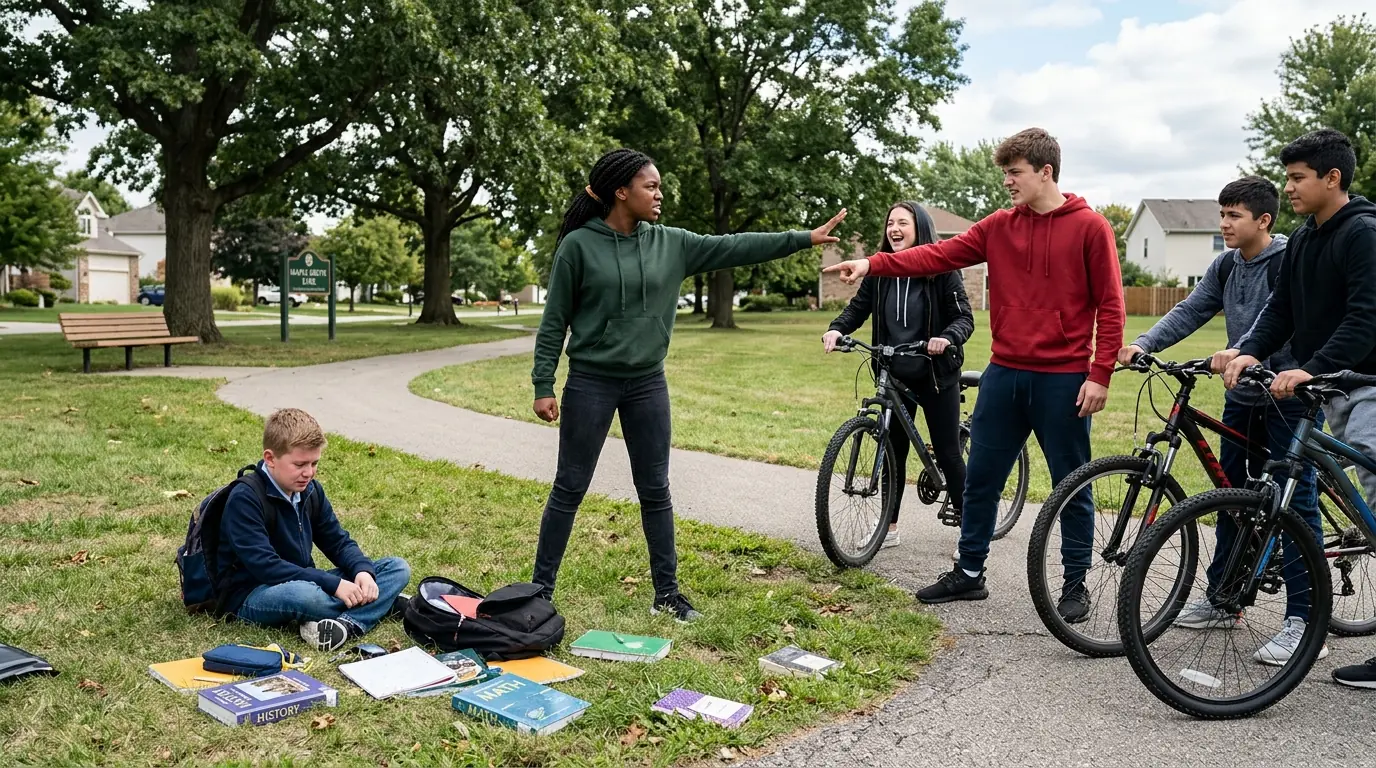
Five boys circled a ten-year-old in an empty park, shoved him off the bench, dumped his backpack, snatched his phone.
She didn't ask who he was. She didn't check if anyone was watching. She stepped in because a child needed help.
And the next morning, a black SUV pulled up outside her apartment, and three knocks changed everything.
---
To understand why Bria walked toward those boys instead of away, you need to know who she is and what she carries every single day.
Let's rewind to earlier that Friday.
Collier Heights, Atlanta. A two-bedroom apartment on the second floor of a faded brick building. The hallway smelled like Pine-Sol and cooking grease. The front door had two locks. One hadn't worked in over a year. Nobody had the money to fix it.
Bria's alarm went off at 5:45 a.m. She didn't hit snooze. She never did.
She shared a room with her nine-year-old brother, Caleb. Their beds were three feet apart, separated by a curtain on a clothesline stretched wall to wall. His sneakers sat by his bed—hand-me-downs, two sizes too big.
She made breakfast in a kitchen so small she could reach the stove, the sink, and the fridge without taking a single step. Oatmeal with brown sugar for Caleb, black coffee for her mother.
She set the coffee on the counter next to a mason jar half full of coins. A strip of masking tape read, "Bria's future" in her mother's handwriting. That jar had been there for three years. Some weeks it grew, most weeks it didn't.
Her mother, Denise, was already dressed when she came out. Scrubs for the morning shift at Grady Memorial Hospital cafeteria. 6:00 a.m. to 2:00 p.m. Then home to change and leave again for her second job cleaning offices in Buckhead. 4:00 p.m. to 9:00 p.m. Five days a week. Sometimes six.
She was thirty-eight years old but moved like a woman twenty years older.
She kissed Caleb on the forehead and looked at Bria. "Walk him into school. Don't let him skip breakfast again."
"I won't, Mama."
Denise grabbed her coffee, her keys, and a granola bar. She stopped at the door and looked back. The kind of look a mother gives when she wants to say something but doesn't have the time. Then she left.
There was a note on the fridge Bria had seen every morning for four months.
*Knee appointment canceled.*
Denise's right knee had been swelling for over a year. She needed an MRI. She needed a specialist. But she couldn't afford the copay. So she kept walking on it. Kept climbing stairs. Kept standing eight hours on a cafeteria line.
Bria never said anything about it. But she saw her mother wince every time she stood up from a chair. She saw the way Denise gripped the railing going down the stairs, knuckles tight, jaw set, and every time something tightened in her own chest like a fist closing around her heart.
---
She walked Caleb to school at 7:10. He held her hand at every crosswalk. She quizzed him on spelling words along the way.
"Adventure. A-D-V-E-N-T-U-R-E."
"Good. Use it in a sentence."
He thought for a second. "My sister is my biggest adventure."
She smiled. "That's not how you use that word, bug."
"Yes, it is."
At school, Bria was a senior graduating in the spring. Quiet but sharp. The kind of student who never raised her hand but always had the right answer when called on. Her biology teacher wrote on her last test—a 98—"Have you thought about AP?"
Bria folded the test into her backpack and never mentioned it to anyone.
She ate lunch alone most days. Not because she had no friends, but because she used the thirty minutes to finish homework so she'd have time to work after school.
Suds and Spin, a coin laundromat six blocks from home. Three afternoons a week, 3:30 to 6:30. She folded clothes, wiped machines, and helped older customers carry baskets to the door.
Her boss, Mr. Otis, was a kind man in his sixties who paid her $8.50 an hour in cash and never asked questions. Every dollar went into the jar.
After work, she picked up Caleb from the neighbor's apartment. Gloria Dunn, a woman in her fifties who ran a small hair salon out of her living room and watched Caleb for free because she'd known Denise for fifteen years.
They walked home together. Caleb showed her his latest sketch—a girl with braids and a cape flying over a city.
"That's you, Bree."
"I don't have a cape, Bug."
"You don't need one."
She didn't answer, but she held his hand a little tighter.
There was a folder on the kitchen counter at home. Inside was a letter from Spelman College. Bria had applied to their nursing program and been accepted conditionally, pending financial aid that hadn't come through.
The deadline was December 15th. Forty-two days away.
The coin jar wasn't even close.
She never talked about it. She never complained. She just worked, studied, walked her brother to school, made oatmeal, folded laundry, and kept going.
But some nights, after Caleb fell asleep and the apartment went quiet, she'd pull out the Spelman pamphlet from her nightstand. She'd unfold it carefully, the creases so soft from years of folding that the paper felt like cloth. She'd look at the photos—the green lawns, the brick buildings, the girls in white coats with stethoscopes.
Then she'd fold it back up, slide it under her pillow, and close her eyes.
---
That Friday afternoon, Bria clocked out at 6:30, picked up Caleb from Gloria's, and instead of the short way home, she walked through Langford Park.
Warm October evening, golden light, trees just starting to turn. The park was almost empty. Almost.
What Bria saw when she turned the corner past the basketball courts would make most people keep walking. She was eighteen. She was alone with her nine-year-old brother. And what was happening near the playground was none of her business.