"Don't get on that plane."
Annie's voice sliced through the steady rumble of jet engines and the clipped murmur of suited men discussing departure clearance.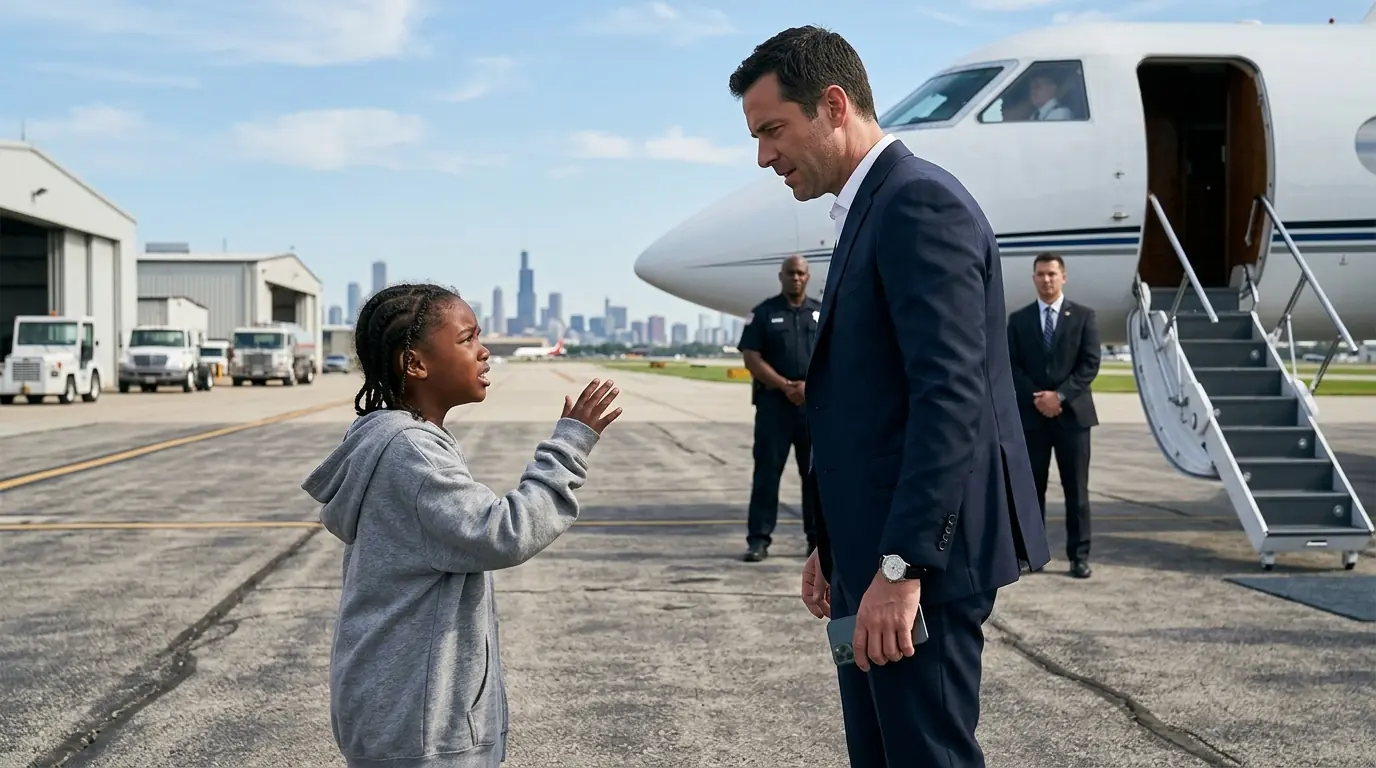
Michael Whitmore did not stop. At 40 years old, he had built a reputation on discipline. Time was leverage. Punctuality was power. He walked with the forward-leaning urgency of someone whose minutes were worth more than most people's annual salaries.
His phone was pressed to his ear. "Yes," he said calmly, eyes on the aircraft stairs ahead of him. "We'll be airborne shortly."
His assistant's voice came through tight and insistent from Washington. "Michael, the secretary moved the meeting up. If you're not in the air in the next 3 minutes, this becomes a scheduling issue with defense oversight. We cannot afford optics right now."
Whitmore checked his watch: 3:58 p.m. "I'm boarding," he replied.
Behind him, small footsteps pounded against concrete. "Sir, please!"
He ended the call and exhaled slowly, irritation flickering across his expression as he turned.
A little girl stood several yards away, braids slightly uneven, oversized sweatshirt sleeves covering half her hands. She looked no older than six. Security had already noticed her but had not intervened. She didn't look threatening—just misplaced.
"You can't be in this area," Whitmore said evenly. Not harsh, not warm, simply factual.
"Don't get on that plane," Annie repeated, breathless.
Whitmore gave the kind of polite nod adults reserve for children who believe they've discovered something important. "I appreciate that," he said, turning back toward the stairs. He placed one foot on the first metal step.
"They're going to activate it after 10 minutes!" she cried.
That made him pause—not because he believed her, but because of the word activate. His assistant's warning echoed in his mind: "Wheels up now."
He glanced over his shoulder. "What are you talking about?" he asked.
Annie's chest rose and fell rapidly. She pointed toward the aircraft. "The pilot," she said. "He was talking on the radio."
Whitmore's expression remained skeptical but attentive. He was a cybersecurity expert; he had spent half his career teaching executives not to dismiss anomalies outright. "What did he say?" he asked.
Annie swallowed, then spoke in Russian—clear, fluid, precise: "Когда самолет будет в воздухе 10 минут, активируем."
Whitmore's foot slowly came off the stair. The engines hummed steadily behind him.
She continued, eyes locked on his: "Пассажиров уже перевели. Он будет один." The passengers have already been moved. He will be alone.
Whitmore stared at her. "You speak Russian?" he asked in Russian.
Her face brightened with urgency. She answered in the same language: "Да." Yes.
"How?" he asked, switching back to English.
"I sit with my grandma at the cafe every day," she said quickly. "Lots of Russian pilots stop there. They talk. They think I don't understand. I listen."
It was plausible. Chicago's executive aviation corridor served international charter routes; Russian crews rotated through more often than most people realized. Whitmore studied her carefully. There was no hesitation in her grammar, no guessing.
"Say it again," he said quietly.
She repeated the first sentence in Russian without stumbling: "10 minutes in the air, we activate."
His gaze shifted slowly toward the cockpit. From this angle, he could see the captain's silhouette behind the tinted glass. The man appeared to be adjusting something near the console.
Whitmore's assistant called again. He declined the call. "Who else heard this?" he asked Annie.
"No one," she said. "I was near the maintenance hallway. He had your picture."
Whitmore's jaw tightened. "My picture?"
She nodded rapidly. "He took it out of his jacket, and they said if you survive, there's a second plan."
Second plan. That phrase settled heavily in his mind. He had learned long ago that real threats did not announce themselves dramatically; they embedded themselves in routine. He looked at the aircraft more carefully now. Something was off. There were fewer ground technicians around the rear service panel than normal. Standard departure protocol required visible clearance checks; today, the perimeter looked sparse.
He turned back to Annie. "Point to him," he said calmly.
She lifted her small hand and pointed directly toward the cockpit window. "There."
Whitmore switched back to Russian and raised his voice slightly: "Капитан, выйдите, пожалуйста." Captain, step out, please.
There was a delay—a subtle one, but noticeable. Whitmore felt the shift in the air around him. His security chief leaned closer: "Sir?"
Whitmore did not take his eyes off the aircraft. "When did you hear this?" he asked Annie.
"Just now. In the hallway."
The captain finally appeared at the top of the stairs. He looked composed—too composed.
Whitmore's instincts, sharpened by years of risk assessment, aligned with what the little girl had said: 10 minutes, activate, passengers moved, alone.
He stepped completely away from the stairway. "Hold departure," he said quietly to his security chief.
"Sir, we're cleared for—"
"Hold departure." The tone left no room for debate.
He crouched slightly so he was closer to Annie's height. "You're certain about the words?" he asked in Russian.
She nodded firmly: "Очень уверена." Very certain.
Whitmore stood. "Ground control," he ordered. "Lockdown on aircraft. No one boards. No one disembarks without clearance."
The engines continued to hum, but the rhythm of the moment had changed. His assistant's phone call buzzed again in his pocket. He ignored it. For the first time that afternoon, Michael Whitmore did not see a child out of place in a restricted zone; he saw the only person in the terminal who had been paying attention.
The engines had not yet powered down completely when Annie saw it. Not the device—she didn't know where that would be, not yet. She saw the movement: the co-pilot. He emerged from the side stair hatch instead of the main cockpit steps, moving quickly along the far edge of the fuselage, head slightly lowered, one hand gripping a small black flight bag too tightly.
Everyone else's attention was on the captain standing stiffly near Michael Whitmore—everyone except Annie.
Her small fingers tightened around Whitmore's hand. "He's leaving," she whispered urgently.
Whitmore's focus had been locked on the captain's face, measuring tone, posture, breath control. But Annie's voice cut through the analysis. "Who?" he asked without turning.
"The other one," she said, pointing. "The second pilot. He wasn't supposed to go that way."
Whitmore's gaze shifted. 30 yards away, the co-pilot was walking fast—too fast for someone whose aircraft was merely undergoing a precautionary review.
"Ruiz," Whitmore said calmly.
His head of security followed the direction of Annie's finger. "I see him."
The co-pilot broke into a quicker stride when he noticed security eyes on him. That was all Whitmore needed.