She was invisible to them: just the quiet Black girl who cleaned their bats, organized their gear, and swept their dugout without complaint.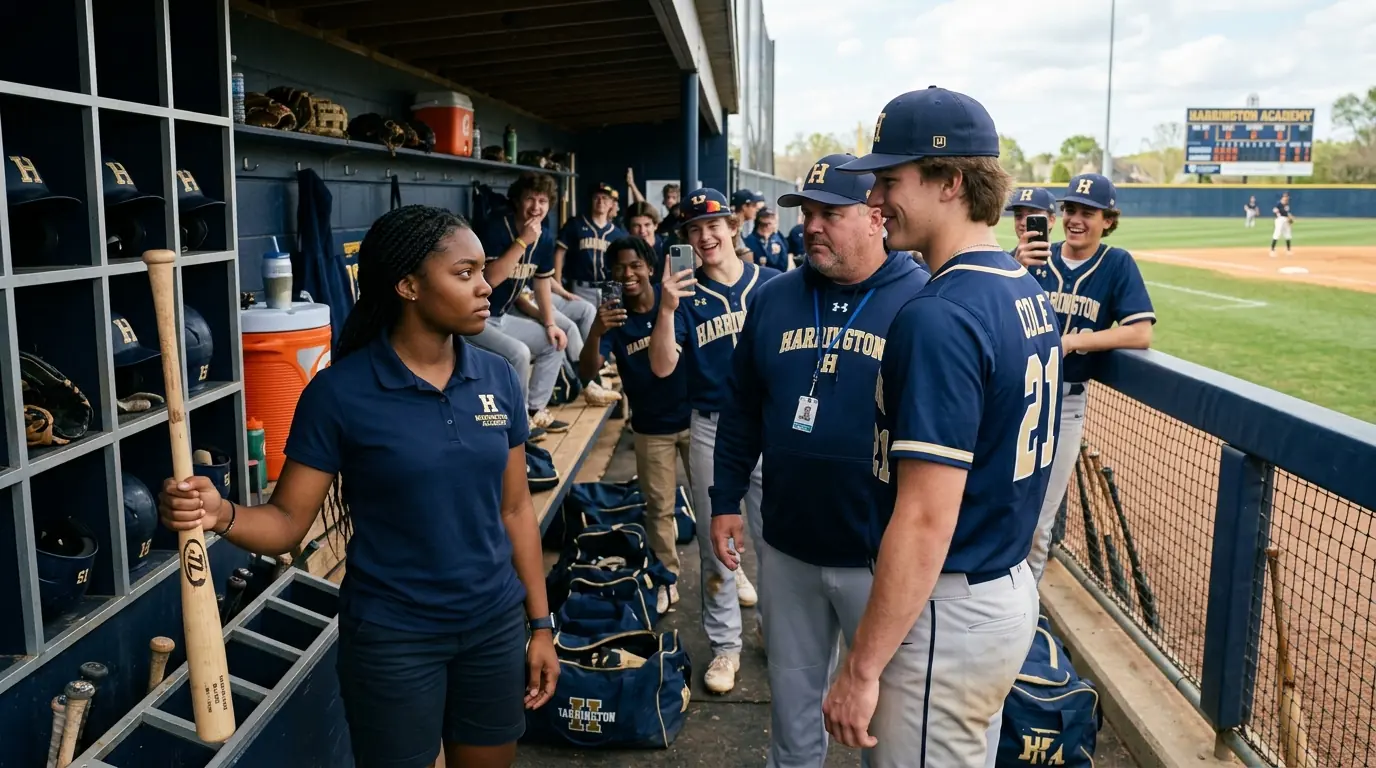
Aaliyah Brooks had spent three months being looked through by an entire baseball program—by the coaches, the scouts, the golden boys who never once wondered what she knew, or what she carried, or whose hands had taught her how to read a hitter before she was old enough to understand what reading a hitter meant.
But the moment she opened her mouth in that dugout—one quiet sentence, no raised voice, no anger—everything changed. They laughed, they recorded it, they waited for her to shrink.
And that was the last mistake Harrington Academy ever made.
The thing about Harrington Academy was that it didn't just produce baseball players. It produced a certain kind of baseball player: the kind with legacy behind their name, connections woven into the fabric of the sport, and a built-in sense that the field had always belonged to them.
Walk through those iron gates on any given afternoon and you'd see it immediately: the way the boys moved with that comfortable confidence, the way the coaches spoke to scouts and agents like old friends, the way everything about the place hummed with expectation and entitlement in equal measure.
Harrington's baseball program had been running for 41 years. In that time, it had sent seventeen players to the majors and produced two World Series winners. Its trophy cases stretched the entire length of the main corridor, and the school had repainted its team colors, navy and gold, on practically every surface that stood still long enough. The program wasn't just part of Harrington; it was Harrington in a way that mattered to the people who funded it, promoted it, and sent their sons to be shaped by it.
The field itself was something else: regulation dimensions, professional-grade turf, lighting rigs that made night practice look like afternoon. There were two batting cages behind the left-field fence, a fully equipped weight room beneath the main bleachers, and a clubhouse that most college programs would have envied. It was the kind of facility built by people who wanted results and who expected them without question.
What made Harrington work, or what made it appear to work, was also what made it difficult to breathe inside. The culture was old—not old in a wise or seasoned way, but old in the way that certain things harden over decades and stop being examined. There was a hierarchy that everyone understood without it ever being spoken aloud: players who came from money, from baseball families, from the right networks—they moved through that world easily. Everyone else carved out whatever space they could and tried not to draw the wrong kind of attention.
Aaliyah Brooks had been drawing the wrong kind of attention her whole life without meaning to. Not because she was loud, or difficult, or disruptive. If anything, she was the opposite. But she was a seventeen-year-old Black girl working part-time in the clubhouse of an elite, legacy-obsessed baseball program, and that alone made her visible in a way that she often wished she wasn't.
She'd started the job three months before the season began. Her mother had arranged it through a neighbor who did groundskeeping for the school: a quiet favor, a small income, something to help with the tightening of things at home since her father passed. Aaliyah had taken it without complaint.
The work was straightforward enough: she cleaned bats, organized equipment, kept the gear bags sorted and the shelves stocked. She swept the dugout before and after practice, laundered the training towels, and made sure the water coolers were filled and cold before the team arrived. She was good at making herself small. It was a skill she developed without noticing: the ability to move through a space without disrupting it, to complete the work and step back into the edges before anyone thought to look her way.
The players barely registered her presence most of the time. She was furniture, background, part of the clubhouse the same way the equipment racks were: useful when needed, invisible the rest of the time.
But invisibility for Aaliyah was never the same as absence. While she worked, she watched. Not obviously—she was careful about that—but consistently. She'd catch the tail end of a pitching session through the equipment room window and find herself breaking down the mechanics in her head before she even realized she was doing it. She'd clean along the dugout bench after practice and find herself studying the pitch charts that had been left out on the bench, her fingers tracing the spray patterns, her mind already calculating where the sequences had broken down and why.
Late some evenings, when the field was empty and the light was dropping low, she'd stand at the edge of the mound and go through the motions slowly—not with a ball, just with her arm, working through the mechanics like a meditation. She never asked anyone to watch. She never talked about it. It was just something she did, the way some people run through music in their heads or replay old conversations: a kind of private, constant practice that lived entirely inside of her.
In her locker at home, tucked beneath a stack of schoolbooks and an old photograph, there was a baseball glove: worn leather, the stitching repaired twice, the name "D.B." written inside the cuff in permanent marker. Her father's glove.
Darnell Brooks had given it to her on her ninth birthday with a seriousness that surprised her at the time—not as a toy or a keepsake, but as a tool handed over with instruction. He had taught her how to grip a seam, how to read a hitter's stance, how to think about the space between catcher and batter not as a distance, but as a conversation.
She hadn't known then what she understood now: that her father had been exceptional. Not just good, not just talented—exceptional in the way that certain players are exceptional, the ones who change the math of a game just by being in it. He had pitched semi-professionally for six years before something happened that Aaliyah only understood in pieces: a contract that fell through, a coach who closed doors, a version of the baseball world that decided a man like her father didn't fit the image they were selling.
He'd come home quieter every year after that. He'd stopped talking about pitching, then stopped watching it, then stopped mentioning it altogether. But he had never stopped teaching her.
She hadn't fully understood why until she was standing in this dugout cleaning someone else's equipment and watching someone else's players throw the pitches he had taught her in his backyard.
The afternoon the inciting incident happened was a Tuesday in late March. It started the way most Tuesdays did: with the team loose and loud after a light practice, leaning against the dugout rails and talking with the easy confidence of people who had never seriously doubted their place in any room.
Ethan Cole was holding court at the center of it, which was where Ethan Cole typically was. He was seventeen, recruited nationally, already being discussed in draft conversations that most players wouldn't enter until their senior year. He was tall, with a hitter's build: wide shoulders, strong forearms, the kind of physical presence that made scouts lean forward in their seats. He knew it, too. Not in an obnoxious way, exactly, but in the way that someone who has been told they're exceptional since childhood eventually stops having to be told. It just becomes the air they breathe.
"There's not a pitcher at this school that can touch me in a live situation," Ethan was saying, settling back against the rail with his arms crossed. "Ask Riley. Ask Whitmore. I've gone forty-two straight at-bats without a strikeout under real conditions."
"That's actually insane," said one of the outfielders, a tall kid named Preston Webb who worshiped Ethan the way younger brothers worship older ones. "Nobody can touch you, man. Nobody here."
"Nobody here," Ethan agreed, and a few players laughed.