"You're fired. Hand over your badge and get out."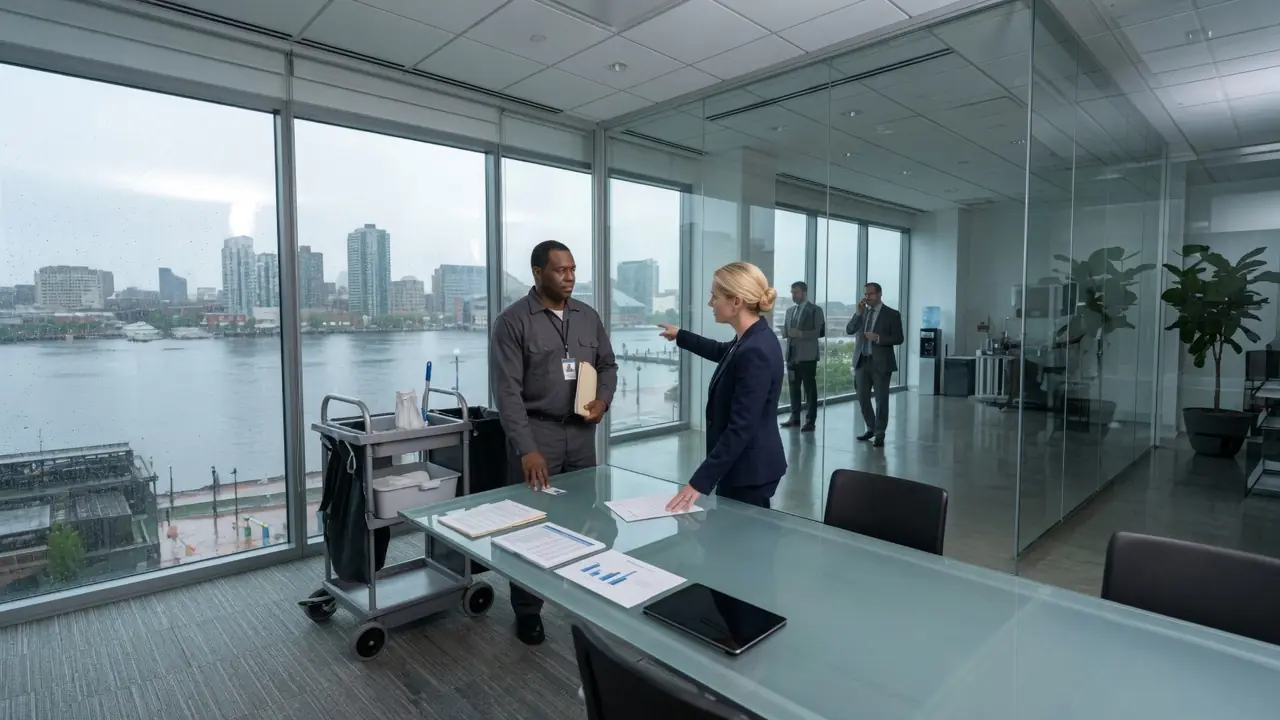
"Before I leave, check who owns this company. I control 40%."
Rain pressed against the glass walls of Bishop Vector Systems in thin gray sheets as Adrien Walker pushed a janitorial cart across the 48th floor. Baltimore was still waking below him, its harbor lights fading beneath a wet morning sky, but the tower had already begun performing importance. Engineers moved quickly between laboratories. Executives checked their reflections in darkened windows.
Assistants carried tablets, coffee, and the tense expressions of people preparing for visitors who mattered. No one looked at Adrien long enough to remember his face. They stepped around his cart without breaking conversation, as though the bucket, the mop, and the man guiding them were all part of the building's maintenance system. Adrien wore a plain charcoal uniform, work shoes softened by years of use, and a badge that identified him as a contractor.
Nothing about him asked for attention. That suited everyone. He reached the main elevator just as the doors opened. Before he could roll the cart inside, a facilities manager stepped in front of him.
The man's badge read Colin Mercer. His smile carried the tired impatience of someone who believed politeness should be reserved for equals. "Service elevator is around the corner," Colin said. Adrien glanced at the green light on his access badge.
"This one is approved for my floor." Colin looked at the cart, then at Adrien. His eyes paused half a second too long. "We have federal guests arriving. The lobby needs to look right." He lowered his voice as though offering friendly advice.
"Use the freight elevator today." Adrien did not argue. He looked once at Colin's name, then at the clock above the elevator. 6:42 a.m. He turned the cart toward the service corridor.
Behind him, a white technician hurried through the same doors carrying a metal toolbox large enough to block half the entrance. Colin held the elevator and nodded him inside without checking his badge. Adrien heard the doors close. His expression did not change, but something quiet settled behind his eyes.
Not surprise, recognition. He had learned long ago that unfairness rarely announced itself with a speech. More often, it appeared as a different door, an extra question, a rule that existed only when he arrived. On the other side of the glass wall, Tyler Grant was preparing the Aegis transport robot for a client demonstration scheduled that morning.
The machine stood twelve feet tall on a reinforced platform, its articulated arm folded against a steel frame. Nearly $10 million of sensors, processors, and precision engineering waited beneath the white laboratory lights. Tyler had been working most of the night. His collar sat crooked beneath his lab coat, and the skin beneath his eyes had taken on a faint blue shadow.
Douglas Vance had shortened the preparation schedule twice and removed the final calibration cycle altogether. "The client is not paying to watch us test," Douglas had said. "They are paying to watch it work." Tyler had nodded because people below Douglas often confused obedience with safety. Adrien began cleaning the corridor outside the lab.
Voices moved through the glass. Tyler called out numbers. Another engineer confirmed them. A cooling fan rose to a steady pitch.
Then Adrien heard something else beneath it. A faint, uneven vibration. Three pulses, a pause, then two. He stopped the mop.
Inside, no one reacted. The sound returned, sharper now, hidden beneath the conversation and the hum of machinery. Adrien looked through the glass. The Aegis arm began its startup sequence, but the shoulder joint rotated before the base had locked.
Tyler frowned at his monitor. The robot turned hard to the left. Its metal arm struck the support frame with a crack that silenced the room. Warning lights flashed red.
Tyler hit the emergency stop. Nothing happened. The motor kept pushing, grinding steel against steel. Adrien dropped the mop handle and entered the lab.
For a moment, no one moved. Adrien knelt beside the exposed controls. He found a positioning sensor seated several degrees off alignment. The heat-resistant connector beside it had burned along one edge.
On the diagnostic screen, two controllers showed calibration values that should have matched but did not. Tyler stood over him, breathing too quickly. "Maintenance will take hours," he said. Adrien reached into a compact pouch attached to his belt and removed an insulated driver and a pair of precision pliers.
Colin would have called the pouch suspicious. A trained engineer would have recognized organized tools. Adrien took a replacement connector from the labeled spare parts tray beside the platform, installed it, loosened the sensor bracket, reset its angle, then forced the two controllers into a clean handshake. His hands moved without hurry.
That was what unsettled Tyler most. Everyone else in the room looked afraid of the machine. Adrien looked as though he understood why it was afraid of itself. Seven minutes after the impact, the warning lights shifted from red to amber, then green.
Adrien restarted the diagnostic sequence at minimum power. The Aegis arm rose, rotated, and returned smoothly to its resting position. Tyler stared at the screen, then at the man kneeling beside the machine in a janitor's uniform. "Where did you learn to do that?" Adrien watched the diagnostic line settle into a steady pattern.
"The machine warned you," he said. "Everyone was just too busy to listen." He closed the panel, picked up his mop, and walked back into the corridor before anyone thought to thank him. Less than an hour later, the security recording reached Savannah Price's office. The CEO watched Adrien stop the robot, identify the fault, and restore a machine her engineering team had nearly lost.
She replayed the footage once, then again. Gratitude never reached her face. Her jaw tightened instead. She paused the video on Adrien standing inside the restricted lab, calm among the flashing red lights.
"Why was that man allowed into engineering?" she asked. 5 months earlier, Adrien Walker sat across from his mother in a quiet house overlooking the Chesapeake Bay. Rain traced the windows. The water beyond them lay flat and gray beneath the evening sky.
Dr. Lorraine Bishop had built her company from a rented workshop, a secondhand soldering station, and a habit of noticing what others missed. At 74, that alertness still lived in her eyes, though her hands moved more slowly now. A thin folder rested between them. "You said this was urgent." Lorraine pushed it toward him.
One page showed complaints from frontline employees closed without witness interviews. Another listed maintenance tickets downgraded days before quarterly reports reached the board. Several reviews used the same phrases for Black employees. Difficult to work with, too direct, not aligned with team culture.
The last page outlined Savannah Price's plan to cut support staff before Bishop Vector signed a major federal automation contract. Adrien read everything twice. Nothing looked dramatic alone. That was what bothered him.
No open insult, no written order telling managers to treat one group differently. Just small decisions, each easy to defend in isolation. Together, they formed something harder to excuse. "I don't know whether this begins with Savannah," Lorraine said, "or Douglas, or whether the company has learned to protect anyone with a title." Adrien closed the folder.
"And you want me to go inside pretending to be someone else?" "I want you to see what people do when they think no one important is watching." His expression tightened. He had spent years avoiding the family company because he refused to let inheritance define him. After leaving engineering leadership, he built a training program for adults moving into technical careers. Many had spent years being judged before anyone asked what they knew.
Turning that reality into an experiment felt wrong. "A disguise can become a trap," he said. "People may fail because we designed the test for them to fail." Lorraine leaned back. Fatigue crossed her face, quick but visible.
"Then don't judge anyone for failing to recognize you." Her voice softened. "Judge them only for what they choose to do with the person they believe you are." Adrien looked toward the bay. The silence between them carried years of disagreement. Lorraine had built an empire.
Adrien had spent half his life proving he could stand without it. "I don't need you to find out who is loyal to this family," she said. "I need to know whether this company still respects people who cannot help anyone get promoted." That sentence held him. Adrien reopened the folder and read the names.
Then he agreed under three conditions. No one would step in to protect him. No one would be punished merely for failing to recognize his identity. Every conclusion would rest on documented behavior, not instinct, rumor, or dislike.
Lorraine accepted. Independent counsel structured the placement, limited Adrien to information available to ordinary contractors, and barred him from accessing confidential records through his ownership status. A week later, Adrien applied through Harbor Services, a legitimate contractor supplying custodial staff to the tower. He used Walker, his father's last name, passed every background check, completed safety training, and requested the earliest shift.
By 4:30 a.m. each morning, he entered through the loading dock in a gray uniform with his badge clipped to his chest. In the first weeks, no one told him he did not belong. The words were rarely that honest. Instead, differences in access, scrutiny, and basic courtesy began to repeat.
Each moment was small enough to dismiss. repeated often enough, they became a system. Adrien understood that exclusion had grown more polished than he remembered. People seldom ordered him out of the building. They simply kept pointing him toward another door.
Over the next several weeks, Adrien learned that Bishop Vector Systems rarely announced its judgments aloud. They appeared in pauses, altered tones, and extra rules applied only to certain people. One morning, he entered through the loading dock carrying a tool pouch used for minor repairs on cleaning carts. The scanner flashed green.
The security guard still raised one hand. Open the bag. Adrien unzipped it on the counter. A minute later, a white contractor passed through with a similar pouch hanging from his shoulder.
The guard nodded without stopping him. "What triggered the additional inspection?" Adrien asked. The guard's mouth tightened. "Don't make this into something."
"I'm asking for the reason."
"You're making the situation tense." Adrien looked at the green light above the scanner. "Then record that my badge cleared and that you chose a second inspection." The guard wrote nothing. He waved Adrien through with the irritation of someone who believed a question was an accusation. Two floors above, Adrien was cleaning the glass outside a strategy meeting when a white systems engineer named Evan Cole interrupted Savannah.
"That deadline will force us to skip validation," Evan said. "We're creating risk to satisfy a calendar." Savannah studied him, then smiled. "I appreciate the assertiveness. That's the kind of ownership I want." 3 days later, a black quality technician named Denise Harper raised the same concern during an operations review.
She waited until Savannah finished, pointed to the missing validation cycle and asked for two more days. Savannah's expression cooled. "We need solutions, not resistance." Denise's next review described her as insufficiently collaborative. Adrien saw both exchanges from the hallway.
Same warning, same measured tone, different verdict. The pattern followed him into the executive offices. One afternoon, a senior director extended an empty coffee cup toward Adrien without looking at his badge. Adrien did not take it.
The director finally looked up. "I'm facilities," Adrien said. "Not catering." Embarrassment flickered across the man's face, but no apology followed. "You're headed that way anyway." He placed the cup on Adrien's cart and walked off.
Adrien left it untouched until the director returned and removed it himself. Renee Foster began seeing the same pattern in employee files. Difficult presence, uncomfortable energy, makes managers feel unsafe. Not a cultural fit.
The phrases appeared where facts should have been. No quoted words, no dates, no witnesses, no policy violations, only feelings turned into permanent records. Adrien's own file joined them after a shift supervisor complained that he questioned a last-minute reassignment. The supervisor wrote that Adrien had been uncooperative.
Renee was near the service desk when Adrien read the report. "What did I do?" he asked.
"It was the overall impression," the supervisor said.
"What action created that impression?"
"Your tone. The way you kept pushing." Adrien's voice remained level. "I asked why the assignment changed. I completed it anyway." The supervisor looked toward Renee.
She said nothing. Adrien turned back to him. "A feeling is not a behavior." The sentence stayed with Renee after he left. That evening, she reopened promotion denials from the previous two years.
Black employees had been described as too forceful for leadership. While white employees with similar feedback were praised for confidence and executive presence, she found the same imbalance in scheduling disputes, disciplinary notes, and performance reviews. None of it was loud enough to become a scandal alone. Together, it formed a language that could close doors without admitting why.
Renee printed several files and locked them in her desk. She still did not confront Savannah. Adrien noticed that silence, too. Then the robot incident happened.
Before Adrien was called upstairs, Savannah sent Renee a direct instruction. "Prepare a disciplinary file for unauthorized access and possible insubordination." No interview had taken place. No statement had been requested. The judgment had arrived before the facts.
Adrien entered the executive office wearing the same gray uniform he had worn beside the damaged robot. The room seemed designed to make anyone from the service floors feel misplaced. Pale stone covered the walls. A glass conference table reflected the Baltimore skyline.
Beyond the windows, rain blurred the harbor into streaks of steel and white. Savannah Price stood with her back to the room, one hand resting against the edge of her desk. She did not turn when Renee brought Adrien inside. Douglas Vance was already seated near the window, though this was supposed to be a personnel meeting.
His presence told Adrien the conclusion had arrived before he had. "Close the door," Savannah said. Renee did. Adrien remained standing until Savannah finally faced him.
Her expression was controlled, but the security footage had unsettled her. "Who authorized you to enter the engineering lab?" she asked. "No one."
"Why were you carrying electronic tools?"
"They are used for repairs on cleaning equipment."
"What other systems have you accessed?"
"None without a work order or an immediate safety concern." Savannah's eyes narrowed. "Do you understand the limits of your position here?" Adrien looked at her without lowering his gaze. "I understand the work listed on my assignment."
"That is not what I asked."
"Then ask what you mean." Douglas shifted in his chair. A faint smile crossed his face. The expression of a man pleased to see someone confirm the story he had already chosen. Savannah stepped closer to the table.
"You entered a restricted area and opened a machine worth nearly $10 million. You could have made the situation worse." "The emergency stop had failed," Adrien said. "The shoulder motor was still drawing power." If the locking pin had not been engaged, the arm could have torn through the support frame.
Savannah did not ask if he was correct. She turned to Renee. "Does his file list an engineering degree?" Renee opened the folder on her tablet.
"The contractor application only required custodial experience and building safety certification." Adrien saw the hesitation in her face. She knew the answer did not prove what Savannah wanted it to prove. "They did not ask what I knew outside the job they hired me to do," he said. Douglas leaned back.
"Convenient." Before Adrien could answer, Savannah called Tyler into the office. He arrived pale and stiff, his lab coat replaced by a dress shirt that still carried a faint crease from where his badge had hung. Savannah's voice softened as soon as she addressed him. "Tyler, did Mr. Walker pressure you or interfere after you asked him to stop?" Tyler looked at Adrien, then at Douglas.
Fear moved across his face so quickly he almost hit it. "He didn't threaten anyone," Tyler said. Savannah waited. Tyler swallowed. "But he walked in on his own. I didn't have time to stop him." It was not a lie. It was only the smallest piece of truth chosen because it protected him. Savannah nodded as if he had confirmed everything.
"You maintained control under difficult circumstances," she told him. Tyler's face tightened. Adrien had seen that expression before. Relief mixed with shame.
The private discomfort of receiving credit that belonged elsewhere. Savannah dismissed him. When the door closed, Adrien turned to Renee. "The report should state that I did not raise my voice, touch anyone, cause the original failure, or damage the machine. It should also state that the robot returned to service after my intervention." Douglas let out a quiet breath of disbelief. "You are in no position to dictate the report." "I am asking that it describe the event." Savannah folded her arms. "Your calm manner does not make the breach less serious." Adrien held her gaze. "Then write what I did. Do not write how you felt about me." The words landed without force, which made them harder to dismiss. Douglas leaned forward. "That is exactly the attitude we are discussing. Defiance disguised as precision." Renee looked down at her tablet.
Savannah could have ordered an independent technical review. She could have asked engineering to verify Adrien's explanation, compared it with the video, and corrected the record. For one brief second, the choice was visible in her face, then control won. She signed the final warning and slid it across the table.
Adrien read it, signed only to acknowledge receipt and placed the pen down carefully. As he stepped into the hallway, the door remained open by a few inches. Savannah's voice carried through the gap. "People like that always need to prove they are smarter than the room." Adrien paused.
The sentence did not surprise him. What stayed with him was how certain she sounded. Two weeks after the warning in Savannah's office, Bishop Vector Systems prepared to run its robotic network for federal clients and private partners. The demonstration had already been delayed once, and Douglas Vance had made it clear that no one would be rewarded for finding another reason to wait.
By 6:00 a.m. that morning, engineers moved between consoles, checking sequences they no longer had time to question. Adrien was cleaning the service corridor when the cooling system changed its rhythm. It should have run in long, steady cycles. Instead, the compressor started, stopped, then started again after only a few seconds.
He rested one hand on the cart and listened. Across from him, a public status screen displayed three alerts. rising temperature in the control room, sensor data falling out of synchronization, and voltage fluctuation along an auxiliary power branch. None looked severe alone. Together, they pointed toward the same place.
An overloaded power converter was starving the cooling system while feeding unstable current into the network controllers. If the robots were pushed to full load, the protection system could shut down the demonstration. Adrien submitted a maintenance ticket through the approved portal. Four minutes later, the status changed to closed.
The note read, "Outside custodial scope." He found Tyler in the preparation bay. "Check the control room temperature against the auxiliary voltage," Adrien said. Tyler opened the diagnostic panel. The temperature had climbed another 3°.
Voltage on the branch was drifting beyond tolerance. His face tightened. "You may be right."
"Then stop the run." Tyler looked toward the glass room where Savannah, Douglas, and several division heads were waiting. "She said there would be no more delays."
"A deadline does not cool a converter." Tyler lowered his voice. "You already have a final warning." Adrien studied him. Fear had made Tyler careful in all the wrong places.
He walked into the preparation area. Conversation stopped. Savannah stood beside the central console in a dark blue suit. Her expression changed when she saw the gray uniform.
"The system is not safe for a full-load run," Adrien said. Douglas gave a short laugh. Savannah's eyes hardened. "Are you claiming the authority to stop an executive-level demonstration?"
"I am reporting a risk. The decision remains yours." The calmness in his answer irritated her more than an argument would have. She turned to Tyler. "Do you agree with him?" Tyler looked at the data, then at Douglas. "The readings are elevated, but there isn't enough information to confirm a failure." Relief passed through Savannah's face. She looked back at Adrien.
"You are confusing access to this building with authority to judge how this company operates." Adrien placed a printed copy of the ticket on the console, then acknowledged that the warning was received. Savannah did not touch it. "I will not sign documents presented by a contractor already disciplined for crossing boundaries." "The data does not know my job title." Douglas stepped between them. "This conversation is over." Savannah ordered the team to proceed at reduced load, not because she accepted Adrien's warning, but because she wanted control of the compromise.
The robots began moving. For four minutes, the sequence held. Then the cooling alarm sounded. Two units stopped mid-route and the network shut itself down before damage occurred.
No machine was destroyed. No one was injured. Douglas called it a successful protective shutdown and argued that the converter could wait until the next scheduled maintenance window. Savannah accepted that explanation because it allowed her to treat Adrien's warning as exaggerated.
"The safeguards worked," she said. Adrien looked at the silent robots.
"After the condition I warned you about occurred." She turned away. That afternoon, Douglas recommended placing Adrien on the upcoming reduction list.
Savannah approved the request without asking to see the closed ticket. Adrien had given her two opportunities, one to examine the evidence, another to stop before the risk became visible. She refused both. Savannah approved the reduction plan on a Tuesday morning while rain pressed against the windows of the executive conference room.
Douglas called it a neutral performance-based streamlining of non-essential operations. The phrase sounded clean enough to survive a board presentation. On paper, it removed roughly 30% of custodial facilities and technical support positions. In practice, it cut deepest into the teams that noticed problems before executives ever saw them.
Renee Foster reviewed the list twice, then a third time with the employee evaluations open beside it. The pattern was impossible to ignore. Black employees appeared at a much higher rate than their share of the departments. Many had been selected because their files included words like attitude, difficult to manage, resistant, and poor cultural fit.
None of those phrases came with precise examples. Meanwhile, white employees with similar attendance, performance scores, and disciplinary histories were often described as developing, candid, or showing leadership potential. Renee carried the analysis into Savannah's office before the final approval meeting. Douglas was already there, standing beside a screen filled with projected savings.
"We need to pause this," Renee said. Savannah did not look pleased.
"For what reason?"
Renee placed the report on the table. "The criteria are not operating evenly. These labels are subjective, and they are removing Black employees at a much higher rate." Douglas folded his arms. "We are not cutting anyone because of race."
"Intent is not the only thing that matters," Renee said. Savannah's expression hardened. "This is a business decision. Do not turn a spreadsheet into a debate about race." Renee held her gaze. "The spreadsheet did not create the disparity. It only makes it harder for us to pretend the disparity is not there." Silence settled over the room. For one moment, Savannah could have stopped the process and ordered an independent review.
Instead, she picked up the pen and signed the approval. Adrien received his termination notice that afternoon. The letter cited unauthorized technical intervention and continued disruption after a formal warning. He read it without visible surprise, then asked Renee to show him the conduct that qualified as continued disruption.
She searched the attached reports. There was no threat, no refusal to work, no raised voice, no damaged property. The only documented acts involved requests to inspect safety warnings and record technical data accurately. "There is nothing specific here," Renee admitted quietly.
Adrien folded the letter once. "Then I would like to hear the decision from the person who signed it." Savannah agreed to meet because she believed the matter had already ended. Adrien entered her office carrying a thin folder and placed five documents on the desk. The maintenance ticket that had been closed within minutes, the control room temperature history, the voltage alerts, the original robot repair report, and the warning notice that described him as disruptive without naming a single disruptive act.
"You do not have to trust me," he said. "Check the data." Savannah looked at the folder but did not open it. Fatigue showed at the edges of her face. The delayed demonstration, the board pressure, and Adrien's refusal to become embarrassed had begun to feel connected in her mind.
Instead of examining that feeling, she blamed him for creating it. "Your problem is not ability," she said. "Your problem is that you do not understand your place in this organization." Adrien remained still. The sentence landed with more weight than she seemed to realize.
"I understand my place," he said. "I do not think you understand the value of the people who stand there." Douglas shifted behind her, but Savannah did not look away. She signed the termination confirmation in front of Adrien and pushed it across the desk. No one asked him to explain the three alerts again.
No one opened the technical report. By late afternoon, Adrien was clearing his locker in the service level. Tyler stood several feet away, watching him pack a spare uniform, work gloves, and the small tool pouch that had saved the Aegis unit. Shame tightened Tyler's face.
"I should have said something," he whispered. Adrien closed the locker. "You still can." Tyler looked toward the hallway where supervisors moved between offices. "It may be too late." Adrien picked up his bag.
"Do not thank me when there is nothing left to lose. Tell the truth while it can still cost you something." Tyler lowered his eyes. Adrien walked through the loading dock and left Bishop Vector Systems without revealing his name, his ownership, or the reason he had entered the company in the first place. Twelve days after Adrien Walker left Bishop Vector Systems, the control room overheated before sunrise.
The replacement contractor's transition team, which Douglas had brought on site weeks before the layoffs, reset the cooling system twice, assuming the fault came from an aging sensor. By midmorning, three transport robots began receiving delayed commands. One stopped 6 ft beyond its assigned station. Another froze with a loaded platform halfway through a secured corridor.
The third rotated in place until an engineer killed its power manually. Then the backup server disconnected to protect itself from unstable voltage. Hours of validation data had to be restored from an older copy. By noon, the federal client postponed its review of the $450 million contract.
Their notice gave Bishop Vector 10 days to present a credible recovery plan. When news of the delay reached investors, the company's shares fell nearly 5%. Savannah called an emergency meeting and demanded the name of the person responsible. The engineering directors exchanged exhausted looks.
"There is no single failure," one of them said. "Cooling, network timing, and power protection are handled by different teams. Then find where they connect," Savannah replied. Tyler sat near the end of the table with Adrien's closed maintenance ticket open on his laptop. temperature increase, sensor synchronization loss, voltage fluctuation.
Three departments had treated them as separate problems. Adrien had connected them before the demonstration began. Tyler pulled system logs from the previous month and traced every alert back to the overloaded converter Adrien had identified. The converter had not been replaced.
Its service request had been downgraded twice, then closed. Tyler opened the quarterly maintenance report and understood why. Closing the ticket had reduced projected expenses enough to improve the division's numbers. The crisis was not hidden in a complex codebase.
It had been hidden inside a clean spreadsheet. Across the building, Renee unlocked the drawer where she had stored the earlier personnel records. She carried two versions of the robot incident report into Savannah's office. The first described Adrien as calm and cooperative.
It credited him with securing the machine and preventing additional damage. The second called him confrontational and suggested his technical knowledge created a security concern. Douglas had requested the revised wording. Savannah's electronic approval appeared beneath it.
She stared at her own name. "He influenced the report," she said. Renee did not soften her answer. "He suggested the language. You approved it." For the first time, Savannah had no procedure to hide behind. Tyler entered before she could respond. His face had lost the nervous caution Adrien had seen in him. He placed the system logs beside Renee's reports.
"I caused the original robot failure," he said. Savannah looked up sharply. "What?" "I skipped the final calibration because we were behind schedule. Adrien stopped the machine. He repaired it. I stood there." His voice tightened, but he continued. "You praised me for staying calm. I was not calm. I was terrified. He was the only person in that lab who understood what was happening." Savannah's eyes moved toward Douglas, but Tyler did not let her turn the confession into someone else's fault. "I let the report stand because it protected me."
I knew he was being blamed for saving us. "Why are you telling me now?" she asked. Tyler looked at the silent monitors behind her, each filled with warnings Adrien had already named "Because the system rewarded my silence then. Now that same silence is destroying it." Renee placed the two reports side by side.
Together, she and Tyler assembled the maintenance history, video records, personnel notes, and approval trail. Renee also sent the contractor's ownership records to independent board counsel for an urgent conflict of interest review. No rumor, no dramatic accusation, only decisions preserved in the order they had been made. Savannah read Adrien's name at the top of the original report.
Until that moment, she had thought of him as a difficult contractor who happened to possess unusual skills. Now his precision looked less like defiance and more like foresight. She turned toward Renee. "Who is Adrien Walker?" she asked.
Before Renee could answer, the lobby called upstairs. Dr. Lorraine Bishop was asking for the executive floor. Lorraine Bishop entered the lobby alone, wearing a dark wool coat and carrying no briefcase. The young receptionist smiled politely and asked whom she was there to see.
Lorraine gave her name. Recognition arrived a second too late. By then, Lorraine had already crossed the marble floor toward the elevators. On the executive-level, she paused outside Savannah's office and heard her speaking to a board member.
"The reductions removed roles that did not create direct value," Savannah said. Lorraine stepped through the open door. "What kind of clothes does value have to wear before you recognize it?" Savannah rose so quickly that her chair rolled backward. "Dr. Bishop, I wasn't told you were coming."
"That is becoming a theme in this building." Lorraine looked at Renee, then at the report spread across Savannah's desk. "Call the board. All eleven members. Tonight."
The emergency meeting began at 7:00 p.m. Savannah stood at the head of the glass table and presented a recovery plan. Her plan was to replace the failed converter, bring in outside engineers, stabilize the network, and reassure the federal client. Her voice remained controlled, but the confidence beneath it had thinned. Lorraine let her finish.
Then she connected a laptop to the room's display. Before we discuss recovery, she said, "We need to understand what failed." The first video showed the Aegis incident. Tyler initiated the wrong sequence. The emergency stop failed.
Adrien entered, locked the arm, replaced the damaged connector, realigned the sensor, and restored the machine. He never raised his voice. He never threatened anyone. The official report barely mentioned him.
Lorraine paused the recording on Adrien kneeling beside the robot. "Did you watch this footage?" Savannah's fingers tightened around her pen. "Yes." "Then you did not lack evidence. You chose how to interpret it." No one moved. Lorraine opened the second file. Performance reviews appeared side by side. A white engineer who challenged a deadline had been praised for assertiveness.
A black technician who raised the same concern had been marked as uncooperative. Security records showed Adrien's valid badge being checked repeatedly while other contractors passed without delay. His disciplinary report called him confrontational but listed no threatening act, no refusal, no raised voice. Renee stood.
Her hands were steady, though shame had settled into her expression. "I saw the pattern," she said. "I challenged individual cases, but I did not force the company to face the whole system. I told myself I was protecting people quietly. Silence protected the pattern, too." Lorraine nodded once and moved to the third file. Adrien's maintenance tickets appeared on the screen. Heat, synchronization, voltage. Three signals from separate departments.
Together, they formed an exact map of the failure now threatening the company. Adrien had not secretly kept the entire corporation running. He had done something more ordinary and more important. He saw a risk, reported it through the correct channel, and waited for someone with authority to listen.
No one did. The fourth file prepared by independent board counsel from the contractor's ownership records contained the conflict of interest findings. Douglas Vance's face changed before Lorraine spoke. A private fund connected to his brother held a financial interest in the contractor chosen to replace the facilities division.
Douglas had pushed to close maintenance tickets, requested harsher language in Adrien's reports, and used the reduction plan to support a deal that benefited him. "That is misleading," Douglas said. "The relationship was indirect. The profit was not," Lorraine replied.
"The board voted to suspend him immediately and transfer the records to independent counsel," Lorraine said. Douglas left without looking at Savannah. For one brief moment, relief crossed her face. Lorraine saw it. "Douglas used your bias," she said.
"But he did not sign Adrien's warning. He did not reject Renee's request for an audit. He did not watch the evidence and choose to ignore it. You did." Savannah's relief disappeared.
Lorraine closed the financial file. "There is one final fact you were never given." She looked around the table. "Adrien Walker is my son."
"He holds 40% of this company's voting authority through the Bishop Family Trust, while I remain the trust's administrative trustee." The boardroom doors opened. Adrien entered in a dark suit, but the work shoes beneath it were the same pair that had crossed the service floors. Several directors began to rise.
Adrien motioned for them to remain seated. He did not take the chair at the head of the table. He chose the empty seat directly across from Savannah. She stared at him as though the uniform had been removed from her own memory rather than from his body.
Adrien had not changed. Only the amount of power she was willing to see had changed. Savannah kept her eyes on Adrien as the boardroom settled into a silence no title could control. "I did not know you were Dr. Bishop's son," Savannah said.
The sentence came out thinner than she intended. Adrien placed the disciplinary warning on the glass table between them. "You did not need to know." Savannah drew a careful breath. "I was responsible for protecting restricted systems, maintaining deadlines, and preserving the chain of command. I made decisions based on the information available." Adrien looked down at the report. "Then let us examine that information." He tapped the first paragraph. "Who did I threaten?" Savannah did not answer.
"What equipment did I damage?" Her eyes moved toward the paused image of the restored Aegis robot. "When did I raise my voice?" No one around the table shifted. Adrien continued without anger. Anger would have given Savannah somewhere easier to look.
"Why was Tyler's calmness praised while mine was described as unsettling? Why did a correct warning become evidence that I did not understand my place? Why did you ask whether Tyler felt safe, but never ask whether I had been treated fairly?" Savannah glanced toward the chair Douglas had occupied.
It now sat empty. For a moment she seemed tempted to place the weight of every decision there. Then she saw her signatures on the documents before her. Douglas had shaped the language, but she had approved it.
He had encouraged the suspicion, but she had chosen to trust it. He had benefited from the reduction plan, but she had rejected Renee's request for an audit. "I should resign," Savannah said. She rose halfway from her chair as if movement itself might restore dignity.
Adrien lifted one hand. "Sit down." His voice remained quiet, but she obeyed. "A resignation letter can end your employment," he said. "It does not answer the question." Savannah's face tightened.
The confidence she had worn through investor calls and board presentations had fallen away, leaving exhaustion and something closer to shame. Adrien leaned forward. "If I owned no shares, had no connection to the founder, and truly was only the man cleaning those floors, would you believe you had been wrong?" Savannah opened her mouth, then stopped. The honest answer cost more than any prepared apology. She looked at Renee, at Tyler, at the reports showing two standards operating inside the same company.
Finally, she said, "No. I probably would have believed I was protecting the organization." Adrien nodded slowly. There was no satisfaction in his face. Only sadness sharpened by confirmation. "That is the larger failure. You did not fail because you could not recognize me. You decided a man like me did not need to be seen completely." Lorraine lowered her eyes. Several directors shifted in their seats, but no one interrupted. The board's decisions followed.
Douglas was removed from office and referred for an independent investigation into conflicts of interest, altered records, and concealed operational risks. Savannah was suspended from executive authority for ten weeks. Her annual bonus was cancelled, and she lost the power to approve terminations without independent review. Renee would report directly to the board while the reduction plan underwent a full audit.
Tyler would provide a complete statement and work with the recovery team to repair the system he had helped place at risk. Savannah listened without protest. When the chair asked Adrien whether he wanted additional disciplinary measures, he said no. He did not ask Savannah to carry a mop or wear a service uniform for public humiliation.
Punishment built around degradation would only repeat the belief the company needed to unlearn. Instead, he proposed that she work inside three departments during her suspension. Facilities operations, customer complaints, and maintenance validation. The board approved the condition by formal vote.
She would follow real shifts, observe how decisions traveled downward, and document where employees lacked the authority to correct problems they could already see. Savannah looked at him. "You want me to understand the jobs I dismissed?" "No," Adrien said. "I want you to understand the people doing them." He closed the warning file.
"The purpose is not to make you feel lower. It is to teach you that no one in those departments stands below you." Savannah's eyes dropped to the paper bearing her signature. For the first time, she seemed to understand that the document recorded more than Adrien's dismissal. It preserved the moment she had mistaken hierarchy for judgment and control for leadership.
During the ten weeks that followed, Savannah Price did not enter the frontline departments as a visiting executive. No one prepared a welcome presentation. No manager cleared a schedule to impress her. She worked the assigned shifts, wore the required badge, and followed the same procedures as everyone else.
Meanwhile, within six days, the recovery team replaced the overloaded converter, restored the validation environment, and delivered a verified remediation plan. The federal client resumed its review under enhanced oversight rather than cancelling the $450 million contract. In facilities operations, she watched technicians repair aging equipment with tools that should have been replaced years earlier, then explain delays to supervisors who had never seen the machines they judged from spreadsheets. At the customer complaint center, she listened to employees apologize for errors they had no authority to correct.
They could document a billing mistake, identify the system that caused it, and speak to the customer absorbing the consequences, but they still needed approval from three levels above them to change a single record. In maintenance validation, Savannah saw safety warnings reduced in priority because the people submitting them lacked senior titles. The software did not reject the evidence. Managers did.
The hardest lesson arrived more quietly. Black employees described the calculations they made before ordinary conversations. How firmly to speak, how long to hold eye contact, whether a question might be labeled disagreement, whether silence would be mistaken for indifference. Savannah had once believed professionalism meant everyone entered the same room under the same rules.
Now she understood that some people spent energy proving they were safe before anyone considered whether they were right. The board did not restore her authority because she completed the ten weeks. Experience without change would have been another performance. Savannah had to rebuild the procedures she had once defended.
The first reform was called behavior before labels. Disciplinary reports could no longer rely on words such as confrontational, difficult, uncomfortable, or not a cultural fit unless the writer documented the exact statement, action, time, witness, and policy involved. The second reform created a frontline review process. Any safety or operational warning submitted by a contractor, custodian, technician, or support worker had to reach a qualified reviewer.
No ticket could be closed because the person who noticed the problem held the wrong title. The third reform established an independent appeal panel outside the employee's direct chain of command. Contractors and lower-paid workers finally had somewhere to challenge decisions made by the same managers who wrote the original reports. The independent audit reversed termination decisions based on unsupported labels, offered reinstatement to affected employees who wanted to return, and provided corrected severance to those who did not.
Renee Foster became chief people and ethics officer with direct access to the board. Tyler Grant accepted responsibility for the Aegis failure in a company-wide technical briefing. He named Adrien as the person who saved the machine and admitted that fear had kept him silent. Later, he was asked to lead a cross-department risk team, not because the company forgot his failure, but because he had learned what silence could cost.
Savannah returned as CEO on a six-month probationary term after the board completed its review. During that period, terminations required independent approval and quarterly ethics reports went directly to the board. Any repeat violation would trigger a new leadership vote. Following a formal board vote, Adrien became chairman and chose an office near the technical training center instead of the highest floor.
Lorraine formally stepped down as the trust's administrative trustee after seeing that the company no longer depended on a hidden heir, appearing at the right moment to force people to behave fairly. Ten months later, Bishop Vector prepared another major demonstration. The same white lights shone across the same glass corridor where Adrien had once pushed his cart. A new member of the custodial team stopped beside a power cabinet and listened.
There was a faint vibration inside, irregular and low. He mentioned it to an engineer rushing toward the laboratory. The engineer glanced at the clock, then at the uniform. His mouth opened with the beginning of a familiar dismissal.
Savannah was standing several feet away. She saw the calculation cross his face because she had once made it herself. "Stop the demonstration," she said. "We check the warning first." The custodian showed them where the sound was strongest.
The engineering team opened the cabinet and found a connector beginning to overheat. They replaced it before the system went under load. No alarm sounded. No equipment failed.
No one asked the custodian where he had learned to listen before they accepted what he had heard. Savannah entered his name in the incident report as the first person to identify the risk. Adrien watched from the far end of the corridor. He did not step forward and no one announced his presence.
This was not another secret test. It was simply how the company now worked. Lorraine stood beside him and watched the engineers include the custodian as they studied the wiring diagram. "Do you think the company has changed?" she asked.
Adrien considered the question before answering. "It is not perfect," he said. "But this time they stopped to listen."