The wind on the tarmac had teeth. It snapped at suit jackets. It tugged at scarves. It stole words right out of mouths and threw them into the engine noise that never fully died, even when the turbines were still. 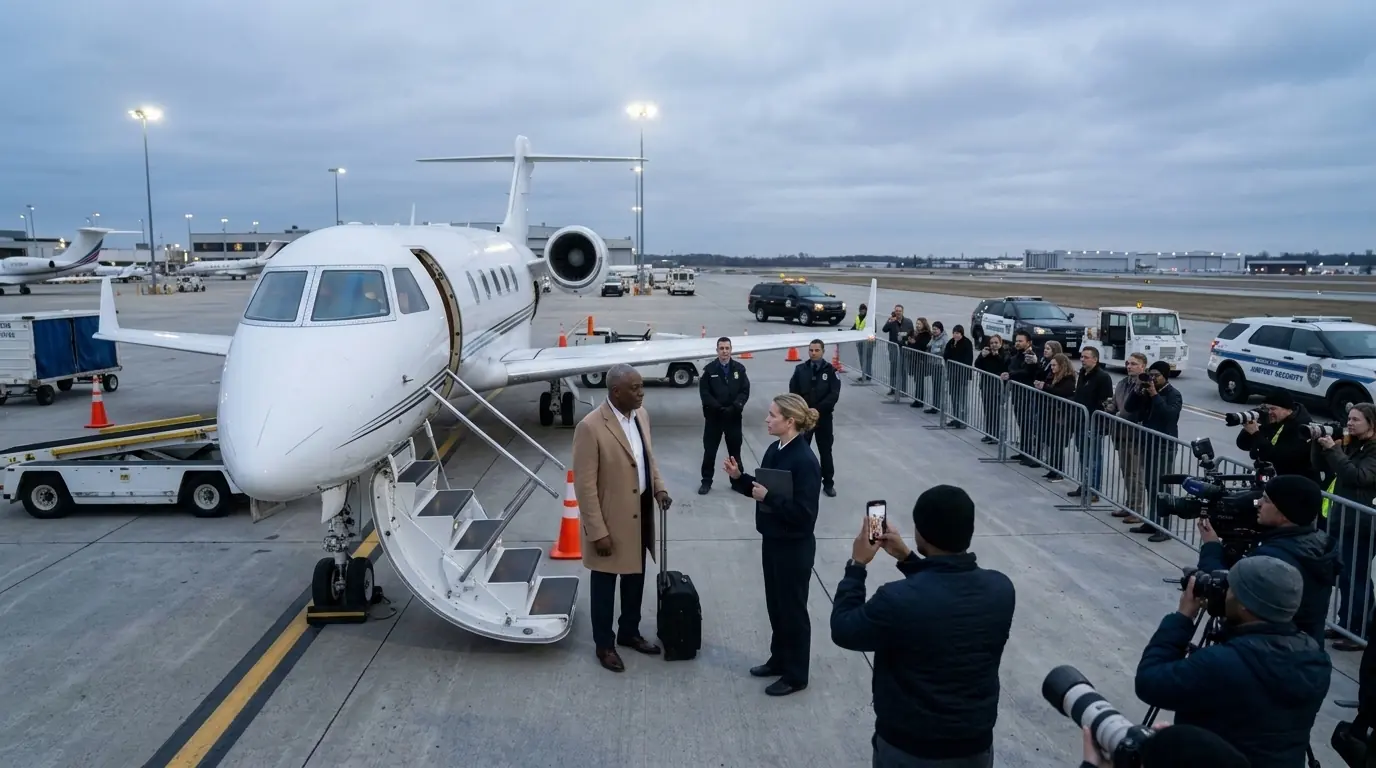
A sleek private jet sat behind a chain of orange cones like a promise no one was allowed to touch. Its white fuselage gleamed under the airport floodlights, nose angled toward the darkening sky. The tail carried a logo in silver—clean, confident, expensive. At the base of the stairs, an older Black man stood with one hand resting lightly on the handle of a small carry-on.
He was calm, still as if the entire world could shout itself hoarse, and he'd remain a stone in the river.
"You can't be here," the attendant said, her voice sharp enough to cut through the wind. She held her tablet like a shield. "Sir, I already explained. This aircraft is reserved."
The man's eyes were tired but clear. His hair was gray at the temples, close-cropped. His coat was dark and well-made, but not flashy. No jewelry, no brand names announced in loud letters. Just a man who looked like he'd learned long ago that real power didn't need to scream.
"I'm aware," he said softly.
"Then you understand why you need to step away from the stairs."
Behind the attendant, two security officers approached with the slow confidence of people used to being obeyed. Their boots clicked on the pavement like punctuation. One of them, tall and broad-shouldered, stopped a few feet away and let his hand hover near his belt.
"Sir," he said, not unkind, but not gentle either, "we're getting a report that you're refusing to comply."
A ripple moved through the small crowd that had formed at the edge of the cordoned-off area: passengers waiting for other flights, airport staff on break, a couple of pilots in shirtsleeves. People who'd smelled conflict and followed it the way smoke draws eyes. A woman in a beige trench coat raised her phone higher. The screen glowed, aimed like a spotlight.
Someone whispered, "Is she recording?"
Someone else answered, "She's live. Look."
And sure enough, a young man in a hoodie held his phone out with both hands, the red 'LIVE' icon pulsing at the top of the display. His face was half-lit by the screen, half-shadowed by excitement.
"This is crazy," he muttered, loud enough to be heard. "They are not letting him on... or what is this?"
The attendant's cheeks were flushed. "Sir," she snapped again. "Your name is not on the manifest."
The older man didn't flinch. "I didn't say it was," he replied.
That made the attendant's eyes widen like she'd just caught him in a lie. "Then what are you doing here?"
The wind whipped his coat open for a second, revealing a simple dress shirt beneath, the collar clean and crisp. His breathing was steady. "I'm going where I'm scheduled to go."
"Sir," he warned, "this area is restricted. If you don't step back, we may have to remove you."
*Remove you.* The words sat heavy, familiar, soaked in a long history that hung in the air like jet fuel.
The older man finally looked up at the jet, then down the stairs, then back at the attendant and the guards. He nodded once, as if acknowledging something deeper than the moment.
"Do what you feel you need to do," he said.
The attendant's mouth tightened. "So you're refusing?"
"No," he said evenly. "I'm waiting."
A murmur rose. "Waiting for what?" someone called.
The older man turned slightly, his gaze passing over the crowd without fear, without performance. "Time," he said.
And then, under the roar of a distant engine spooling up, his phone buzzed once in his coat pocket. He didn't reach for it immediately. He simply breathed, calm as a lighthouse in a storm. Because in exactly twenty minutes, the entire world around this staircase was going to tilt. And everyone watching, everyone recording, was about to learn exactly who they had tried to stop.
***
He had woken before dawn the way he always did: without an alarm. The house was quiet—the kind of quiet that came from a life built with intention. No chaos, no clutter, no wasted movement. He padded to the kitchen in socked feet, set water on the stove, and watched the first flame catch beneath the kettle. Outside his window, the city was still asleep. Inside, his mind was already working.
He made tea the way his mother had taught him: slow, careful, respectful. She'd been a hospital cleaner who worked nights and raised her children on faith and exhaustion. She used to say, *If you're going to do something, do it like it matters, even if nobody's watching.* He carried that sentence like a key in his pocket for decades.
When he was fourteen, he'd polished shoes outside a courthouse for spare change. He learned early which men threw coins like they were tossing scraps to pigeons, and which men looked you in the eye and said, "Thank you."
When he was twenty-three, he'd slept in his car for three months after his first business collapsed. Not because he was lazy, but because a loan officer at the bank had smiled too politely and told him their funding wasn't a "fit." Because the investor had leaned back and asked him, "Do you have the experience to run something like this?" while funding a less qualified man with an easier smile.
He learned to build anyway. To build with less, to build with his hands, his mind, and a patience so deep it scared people. He'd done the math at his kitchen table. He kept every receipt. He'd hired people who couldn't get hired elsewhere—people with records, people with gaps in their resumes, people who only needed one person to say, "I see you."
And over time, the company that started as a small logistics operation with one leased truck became something else entirely. Bigger, smarter, unavoidable. He never forgot what it felt like to be looked through like glass.
That morning, he had dressed without hurry. Dark coat, simple shirt, a tie that wasn't loud, shoes that had been polished with care. He checked his wallet, his watch, his phone, and the folded letter in his inside pocket—an old habit. Not because he needed the letter today, but because he liked the weight of it, the reminder. It was from his mother, written when he'd made the cover of a business magazine years ago.
*I'm proud of you,* it said in shaky handwriting. *But don't let them steal your softness. Power without kindness is just another cage.*
In the garage, the driver waited.
"Morning, sir," the driver said.
The older man nodded. "Morning."
As the car moved through the waking streets, he watched people on sidewalks: nurses with coffee cups, construction workers with hard hats, a young father pushing a stroller while he talked quietly into a phone. The world turned because ordinary people kept turning it. He knew that. He'd built his entire life around respecting it.
His phone rang as they approached the airport. It was his assistant.
"They confirmed the aircraft," she said. Her voice was professional, but he could hear the tension behind it. "There was a last-minute change with the vendor, but everything should be set. The aviation company is handling it."
"Mm," he murmured.
"And the meeting?"
"Board presentation at 11:00, then the signing."
He stared out the window as the airport's signage rose in the distance. "Good," he said. "Let's do it."
He ended the call and sat quietly as the car glided toward the private terminal. He hadn't flown private often when he was younger. Not because he didn't dream about it—because he did—but because he learned early that being seen in certain spaces could cost you. Now, he was in those spaces routinely. And still, every time, he walked in with the same calm. Not because he was trying to prove something, but because he already had.
***
The security officers spread subtly, the way trained people did when they were preparing for escalation. The taller one glanced at his partner and lifted his chin in a silent question.
The attendant stepped forward, her voice rising for the benefit of the crowd. "Sir, step back now."
A few people shifted. Someone's suitcase wheels rattled across the pavement. The live stream phone panned closer. In the comments, hearts and angry emojis began to climb like a digital tide.
"Hey," a bystander called, uncertain. "Maybe he just got confused."
*Confused?* As if an elderly man could wander onto an airfield by accident, like he'd wandered into the wrong grocery aisle.
The older man kept his hands visible. He didn't grip his suitcase. He didn't clench his fists. He didn't raise his voice.
"I'm not confused," he said. "I'm exactly where I'm supposed to be."
The attendant scoffed. "That's what they all say."
"*They all,*" the man repeated gently.
The words hung there, exposed. A woman in the crowd sucked in a breath. Someone else muttered, "Oof." The attendant blinked as if she hadn't realized what she'd just revealed.
The shorter security officer, nervous energy in his shoulders, stepped in. "Sir," he said, "do you have identification?"
The older man reached slowly into his coat pocket and pulled out his wallet. He opened it and held up his ID card. The officer took it with two fingers like it might burn. His eyes moved across the card. His brow furrowed. He handed it back too quickly.
"This doesn't match the manifest," the officer said, louder than necessary.
The older man slid the ID back into his wallet. "That's because you're looking at the wrong list," he said.
The attendant laughed, sharp and brittle. "Are you saying our system is wrong?"
"I'm saying," the older man replied, "that your system doesn't always know what it's missing."
The live stream zoomed in on his face. A comment flashed on the screen: *He's so calm. Why are they acting like he's a criminal?* Another: *This is discrimination, I swear.* Another: *Let that man fly.*
The attendant's patience snapped. "I have a plane full of executives waiting," she said. "Important people. People who pay for this service. I can't have you—"
She stopped herself, but not before the implication landed. *I can't have you.* The crowd heard it. The phones heard it. The internet heard it.
The tallest security officer exhaled like he'd made a decision. "Sir," he said, "I'm giving you one last chance. Step away from the aircraft and come with us to the office. We'll sort this out."
"And if I don't?"
The officer's voice hardened. "Then you'll be trespassing on a secured airfield. That can lead to arrest."
*Arrest.* The word made the crowd tense, made shoulders lift, made people glance at each other, measuring their safety.
The older man didn't move. "I'm not going to your office," he said.
The attendant's eyes flashed. "Unbelievable."
The taller officer motioned toward the older man's suitcase. "What's in the bag?"
"Clothes," the man said.
The officer's partner spoke quickly. "We'll need to inspect it."
The older man tilted his head slightly. "Why?"
"Because we have to ensure—"
"Ensure what?" the older man asked, still calm. "That an old man in a wool coat isn't dangerous enough to step onto a staircase?"
The officer's jaw tightened.
Behind them, the jet door stood open like a mouth. Two men in tailored suits stood at the top of the stairs, impatient, peering down. One of them called, "What's going on?"
The attendant turned and waved up at them with a bright, fake smile. "Just a security issue!" she called back.
*Security issue.* As if the calm man below was a threat simply because he existed where she didn't expect him. The live stream comments accelerated. *Security issue = Black man with a suitcase. This is sick. He hasn't done anything.*
The older man's phone buzzed again. Once, then twice. He glanced down at his pocket as if finally deciding it was time.
The attendant snapped, "Stop stalling."
He slowly reached into his coat, pulled out the phone, and looked at the screen. His expression didn't change, but the atmosphere did, because he smiled just slightly. Not smug, not triumphant, just certain. He looked up at the attendant.
"I told you I was waiting," he said. Then he answered the call. "Yes," he said into the phone. A pause. "I'm on the tarmac." He listened.
The tallest security officer frowned. "Sir, you need to—"
The older man lifted one finger. Not rude, just a gentle request for a moment. "Yes," he said again. "They are here." He listened. Then he said, "All right." He ended the call.
The attendant crossed her arms. "Who was that? Your lawyer?"
The older man looked past her, past the security officers, toward the gate where vehicles entered the restricted area. "Someone who can read a contract," he said.
A new sound approached. Low, official, heavy. A black airport operations SUV rolled onto the tarmac, lights flashing, but no siren. Behind it came another vehicle, sleeker, more expensive. A car that didn't belong to airport staff. The crowd leaned forward as one. The live stream shook as the person holding the phone gasped. The attendant's face paled.
The SUV stopped hard near the cones. A man in a reflective operations jacket stepped out quickly, tablet in hand, eyes scanning. He looked irritated. Then he saw the older man, and his irritation vanished like a candle snuffed out. His posture shifted, straightened, respectful. He hurried across the pavement, ignoring the attendant completely.
"Mr. Langston!" he called.
The older man nodded once. The operations manager stopped a respectful distance away, breathing hard. "I'm so sorry," he said. "I just got the call. This... this should not be happening."
The attendant's mouth fell open. The taller security officer blinked. "Hold on. Who is he?"
The operations manager turned, eyes wide as if the question itself was dangerous. "Who is he?" he repeated, and then his voice lowered into something close to reverence. "He's the client."
A hush fell so fast it felt like the air got sucked out. Even the jet engines in the distance seemed quieter.
The attendant stammered. "No, that's impossible. He's not on the manifest."
The operations manager's face hardened. "He's not on your manifest," he snapped. "Because the manifest you're looking at is for the *passengers*." He raised his tablet. His voice carried. "Mr. Langston is not a passenger." He paused. "He is the owner of the charter."
Silence. A stunned, holy kind of silence.
At the top of the stairs, the suited men froze. One of them gripped the railing like he'd suddenly realized he was standing on a trap door. The attendant's face went slack, her confidence draining out of her like water.
The older man, Mr. Langston, didn't look at her with anger. He looked at her like she was a lesson the world kept forcing him to repeat.
The operations manager continued, his voice tight. "And," he added, "he is also the majority shareholder of the aviation company you work for."
The crowd erupted in whispers. "No way." "Did he say majority shareholder?" "Yo, this is insane." The live stream chat exploded. Hearts flooded the screen like fireworks.
Mr. Langston glanced at the phones pointed at him, and then at the attendant who had tried to tame him into a problem. He spoke softly. "I'm scheduled to board," he said.
The attendant made a small sound, half-gasp, half-sob, as if her body couldn't decide what emotion to choose. The taller security officer swallowed hard.
"Sir," he said, suddenly polite. "I didn't know."
"I know," Mr. Langston replied. That was all. Two simple words, heavy with decades.
The operations manager motioned toward the stairs. "Mr. Langston, please. We'll clear this immediately."
Mr. Langston didn't move yet. He looked at the attendant. She seemed to shrink under his gaze. He said quietly, "You said there were important people on this plane."
She nodded, barely.
He looked up at the suited men still frozen at the top of the stairs. "Yes," he said, "they are." Then he looked back at her. "And you decided I wasn't one of them."
The attendant's eyes filled with tears. "I... I'm sorry," she whispered.
Mr. Langston picked up his carry-on handle. "I believe you are," he said. Then he stepped forward, not hurried, not victorious, just steady. As he placed his foot on the first step, the world around him held its breath. Because everyone could feel what came next: not just a boarding, a reckoning.
***
The reversal didn't end at the top of the stairs. It began there, the moment Mr. Langston entered the jet. The suited men backed away as if space itself belonged to him. Their polished confidence cracked around the edges. One offered a handshake with trembling fingers.
"Mr. Langston," he said, his voice strained. "We weren't told you'd be joining us."
Mr. Langston set his bag down gently. "I wasn't told I would be stopped," he replied.
He took his seat without asking permission. The cabin was quiet except for the soft hum of conditioned air and the sudden awareness that power had just rearranged itself.
Outside, the attendant stood like a statue in the wind. The operations manager spoke to the security officers in sharp, urgent tones. Papers were being pulled up. Calls were being made. Phones kept recording.
The live stream caption changed as the story spread: *Elderly Black man denied boarding private jet. Turns out he OWNS the company.*
Within minutes, it was everywhere. Clipped videos, reaction duets, commentary threads. People who had lived their own versions of that tarmac scene—at hotels, in stores, in boardrooms—shared their stories like sparks catching dry grass. By the time the jet's wheels lifted off, the internet had already decided the attendant's face would be remembered.
But the consequences were not just digital. They were corporate. They were legal. They were real.
At 10:12 a.m., the aviation company's internal crisis team convened on a video call so frantic people forgot to mute themselves.
At 10:28 a.m., the chief operating officer received a message marked urgent: *Client incident, tarmac discrimination allegation viral.*
At 10:31 a.m., the company's stock began to dip. Not dramatically at first, just a nervous wobble, the market sniffing blood.
At 10:40 a.m., one of their largest corporate clients emailed: *We are pausing all bookings pending investigation.*
At 10:45 a.m., a civil rights attorney posted publicly: *If this man wants counsel, I'm here.*
At 11:05 a.m., a regulator from the airport authority requested incident reports, security logs, and camera footage.
At 11:20 a.m., the company's board received a brief, devastating note from Mr. Langston's assistant: *Mr. Langston requests the immediate suspension of all employees involved pending investigation. He will address the board personally today.*
The attendant, back at the terminal, sat in a small office with a bottle of water she couldn't swallow. Her supervisor paced.
"What were you thinking?" he hissed.
"I didn't know," she kept repeating, her voice shaking. "I didn't know."
He slammed his hand on the desk. "You didn't know what? That he... that he was..."
"That he was important?" the supervisor snapped. She flinched at the word. Because the truth wasn't that she didn't know who he was. The truth was that she had decided who he *couldn't* be.
The taller security officer filed his report with hands that trembled. He wrote the words, *Refused to comply*, and then stared at them, feeling them rot on the page. The younger officer avoided eye contact with everyone in the breakroom. Other staff watched the live stream replay on loop, their faces pale, murmuring, "That could have been me," and "I've seen her do that," and "This is going to be bad."
And it was. By noon, the company's public relations statement, carefully worded and sterile, was being shredded online. By 1:00 p.m., an employee leaked internal emails about "appearance-based risk assessments." By 2:00 p.m., a journalist obtained a prior complaint. Another client, another incident, another dismissal. Patterns began to form, and patterns, once visible, are hard to unsee.
***
The jet landed in another city under a brighter sun, but Mr. Langston's expression didn't lighten. He walked into the boardroom with the same calm he carried on the tarmac. The executives rose when he entered. They didn't know whether to fear him or admire him. Maybe both.
A screen at the front of the room showed the viral clip paused on his face mid-confrontation. Someone had tried to turn him into a problem. Now the entire world knew his name. Mr. Langston didn't look at the screen. He looked at the people. He sat at the head of the table without ceremony. Then he spoke. His voice wasn't loud. It didn't need to be.
"When I was a boy," he began, "my mother cleaned hospitals at night. She used to tell me that dignity is something you carry, not something people hand you." The room stilled. He folded his hands.
"Today, on a tarmac, I watched an employee treat dignity like a membership card—like something you own by looking a certain way, sounding a certain way, standing in the right place with the right kind of confidence." He paused, letting the words breathe. "I didn't raise my voice. Not because I wasn't hurt, not because I didn't feel it, but because I've learned something."
He looked around the table, making eye contact one by one. "Bias feeds on reactions. It wants you to become what it expects so it can say, *See.*" Another pause. "I also learned something else." He exhaled slowly. "Power reveals people, but it also tests them." He turned slightly, his gaze sharpening. "I did not need to be stopped to know who I am. But the world needed to see how easy it still is for someone to decide another human being doesn't belong."
The silence deepened. He nodded toward the screen without looking at it. "That video will outlive all of us in some way. It will be watched by children who are learning where they fit. It will be watched by workers who are deciding how to treat the next person in front of them." His voice softened. "And I want to be clear. This is not about destroying someone because they made a mistake."
A few shoulders loosened, hopeful.
Then he continued, "This is about accountability." The hope tightened into attention. "Accountability means consequences. It means training isn't a checklist. It means policies aren't decorations. It means we don't protect a brand by hiding the truth."
He leaned forward slightly. "You cannot say you value people and then build a system that only values some." He let that sentence sit heavy and clean. "Today I was calm because I've had practice being calm in rooms where my humanity was questioned." He glanced down at his hands, then back up. "But nobody should need practice for that."
His voice grew warmer, not weaker. "Kindness isn't soft. Kindness is disciplined. It's the decision to see someone fully, even when your assumptions are screaming." He looked at the executives as if speaking past them, out into the world. "If your first instinct when you see a stranger is suspicion, ask yourself why. If you feel more comfortable when someone looks like your idea of belonging, ask yourself who taught you that idea."
He sat back. "We will investigate. We will correct. We will change. Not because we got caught on camera, but because a person's dignity should not depend on whether the internet is watching." He paused, then finished quietly. "I want a company that doesn't need a rich man to stand at the bottom of a staircase for people to act right."
No one moved. Somewhere in the room, someone swallowed hard. Mr. Langston's eyes were tired again, but steady.
"This isn't revenge," he said. "This is repair."
***
Spring arrived with soft rain and new policies written in hard ink. The aviation company's logo still glinted on tails and letterheads, but the inside of the company didn't feel the same anymore.
After the investigation, the results were released publicly—not buried, not disguised. They admitted what everyone already knew: it wasn't one isolated incident. It was a culture problem. The attendant was terminated, yes, but not as a scapegoat thrown to the crowd. The report made it clear she acted within a pattern of permissiveness. Supervisors had ignored complaints. Training had been rushed. 'Gut feeling' had been treated like policy. Several managers were dismissed. Two executives resigned. A compliance officer was hired from outside, someone with a reputation for turning diversity statements into measurable accountability.
The company implemented body camera protocols for security interactions on private terminals. They required bias training that wasn't a two-hour video, but an ongoing program with audits and consequences. They created a hotline for complaints that didn't route straight back to the very people being accused.
And they did something else, something that cost money, real money. They partnered with a community organization to fund scholarships for aviation mechanics and pilots from underrepresented backgrounds, creating apprenticeships with guaranteed placement. Not as a marketing stunt—as a pipeline, as a promise.
The first scholarship ceremony was held in a hangar, folding chairs lined up under a wing. Mr. Langston attended without cameras invited. But cameras came anyway, because people were still watching him, because that tarmac scene had become a symbol of pain, yes, but also of possibility.
A young woman, newly accepted into the apprenticeship program, approached him after the ceremony. She was nervous, her fingers twisting the strap of a bag. 'Mr. Langston,' she said.
He turned and smiled gently. 'Yes?'
'My dad... he showed me that video,' she said. 'He cried. He doesn't cry.'
Mr. Langston's expression softened.
She swallowed. 'I just... Thank you for not making it about anger. Thank you for making it about change.'
Mr. Langston nodded slowly. 'There's a place for anger,' he said. 'But I've learned something.'
'What?'
He looked past her, toward the hangar doors where sunlight spilled in. 'If you only burn things down,' he said, 'you still have to live in the ash.'
She blinked, absorbing that.
He placed a hand over his heart briefly—a gesture more humble than grand. 'I wanted something you could build on,' he said.
Across the country, the attendant had taken a job far from aviation. She didn't post online. She didn't give interviews. But one day, she wrote a private letter to Mr. Langston. It was shorter than an apology speech and longer than denial. She wrote about her father's fear, about the way suspicion had been served at her dinner table like bread, about the way she'd learned to rank people without realizing she was doing it. She didn't ask for her job back. She didn't ask to be forgiven. She wrote simply, *I'm trying to become someone who doesn't do that again.*
Mr. Langston read it quietly in his office and placed it in a drawer. Not as a trophy, not as a punishment. As a reminder that change was possible, but never automatic.
The company's stock recovered slowly—scarred, but steadier. Some clients returned, some didn't. But the bigger change wasn't on the balance sheet. It was in the small moments. The way staff spoke to people before making assumptions. The way security asked questions without treating them like accusations. The way an older Black man could walk toward a staircase without being turned into a threat.
Mr. Langston still traveled, still worked, still sat in rooms where decisions were made. He didn't become louder with age. He became clearer.
And on a quiet afternoon months later, he stood again on a tarmac. Different city, different jet, same wind. He watched a young employee greet a client who looked nervous, out of place. The employee smiled and said, 'Welcome. Can I help you with your bag?' No hesitation, no suspicion. Just welcome.
Mr. Langston felt something in his chest loosen. Just a little. Not relief—something better. Proof.