The night shift had wrung Andre dry. He climbed the stairs to his apartment on the fourth floor, keys already in hand, and stopped. The door was unlocked. Not broken. Not forced. Just open. His chest tightened. Maya was asleep in there. He pushed inside, every muscle braced, and found her standing in the center of his living room. Elena Vance, his company's CEO. A woman who had no reason, no business, no possible explanation for being inside his home. She stepped toward him, her voice dropping to just above a whisper. You won't be sleeping tonight.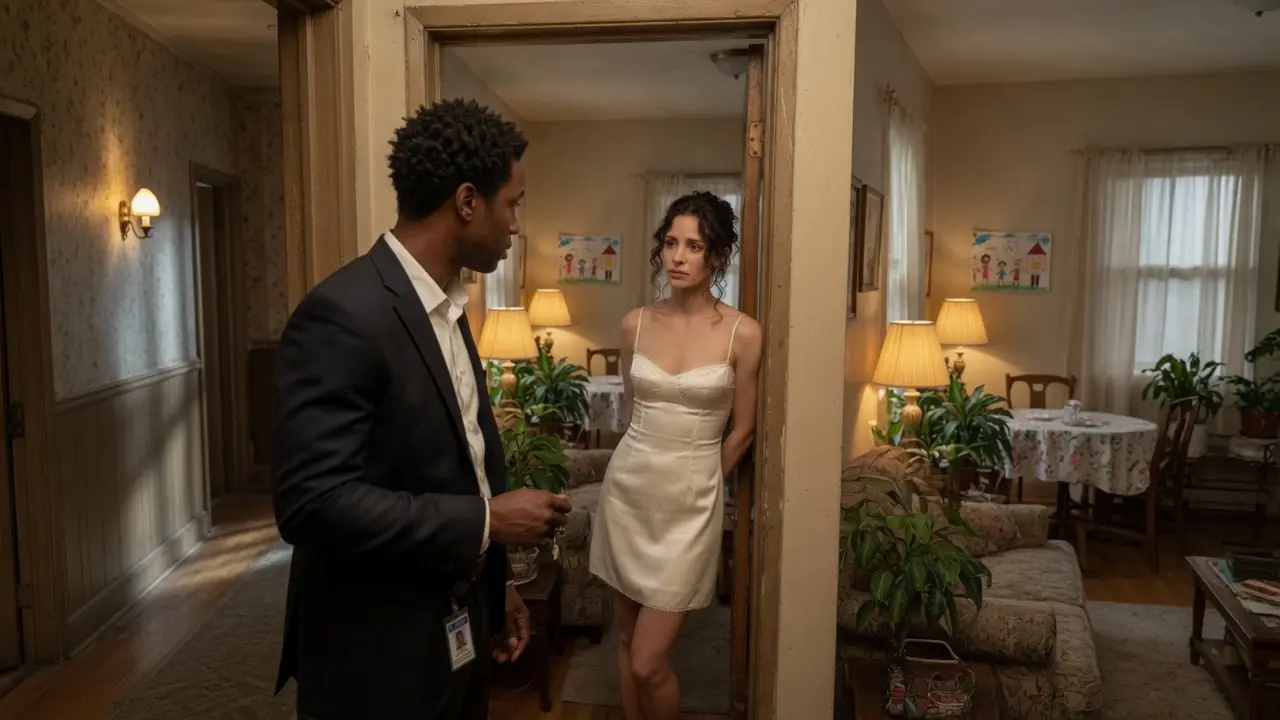
The lock had never been broken. That was the first thing Andre noticed when he finally let himself breathe again. Elena Vance stood in the middle of his living room wearing a blazer that probably cost more than his monthly rent. Her arms crossed loosely over her chest, looking far too composed for someone who had just been found standing uninvited in another person's home at 11:00 at night. Behind her, Aunt Rosie sat at the kitchen table with a cup of tea and an expression that said she had been expecting this exact moment, and had chosen not to warn anyone about it.
Rosie. Andre kept his voice low. Maya's room was just down the hall. What is going on? His aunt wrapped both hands around her mug. Rosie had spent nearly two decades working for the Vance household before her knees gave out, and she retired to the quieter life of watching other people's children. She knew Elena the way you know someone you've watched grow up, not as an equal, but as something closer than a stranger. When Elena had called her in a panic 3 hours ago, Rosie had not hesitated. She had simply given Elena the address. She needed somewhere to go, Rosie said. This was the safest place I could think of.
Andre looked at Elena. Elena looked at the floor, which was, he noted, the first time he had ever seen her look at anything other than whoever she was speaking to. He had worked night security at Vance Technologies for 4 years. In that time, he had spoken to Elena Vance maybe a dozen times, always late, always when something had gone wrong, always when the building was mostly empty and the usual hierarchy felt slightly less rigid in the dark. The first real conversation had happened 18 months ago when a server failure at 2:00 in the morning threatened to wipe a client contract worth more than he would earn in a decade. He had stayed until it was fixed. He hadn't asked for overtime. When she thanked him the next morning via a two-line email, he had read it three times before archiving it, not entirely sure why.
The second time that stayed with him, a Tuesday afternoon break, his phone pressed to his ear, humming something low and soft to Maya because she'd had a bad day at school and sometimes a voice was enough. He hadn't realized Elena was passing the corridor until he glanced up and found her already looking away, walking faster than she needed to. Neither of them had mentioned it. He pulled out a chair and sat down across from Rosie because standing felt like preparing for a fight he hadn't agreed to. Does someone want to explain it to me from the beginning?
Elena finally looked up. Even now, even in whatever this was, there was something in the way she held herself that didn't fully bend, but her voice, when it came, was quieter than he had ever heard it at the office. My parents showed up at my apartment tonight, she said, unannounced. They had someone with them, a man named Julian. They want me to get engaged. I wasn't prepared and I left. I called Rosie because she was the only person I trusted and I needed somewhere they wouldn't think to look.
Elena blinked. It was a small thing, a single break in the composure, but Andre caught it. Thank you, Elena said. Maya padded across the room and looked up at her with the unguarded directness of someone who had not yet learned that some questions aren't supposed to be asked. Are you staying for dinner? Aunt Rosie made the good pasta. It's almost midnight, baby, Andre said. So, yes or no? He was about to redirect her back to bed when his phone buzzed. Then Rosie's phone buzzed. Then Elena's. And the way Elena's face changed when she looked at the screen told him everything before she said a word. They tracked my location. Her voice was flat. They're outside.
Andre stood. Through the window, he could see a black car parked on the street below, too clean, too still for this neighborhood at this hour. He had maybe 90 seconds to make a decision. He could go downstairs, tell two wealthy strangers that their daughter had shown up uninvited, and let the truth handle itself. It was his apartment. He didn't owe anyone a Then he looked at Maya, who was still waiting for an answer about the pasta completely unaware that anything was wrong, and something in him shifted. The knock at the door came before he'd finished the thought.
Richard Vance was a tall man who wore his money the way some men wear armor, not to impress, but to remind. His wife Margaret stood slightly behind him in a coat that looked tailored for exactly this kind of unscheduled arrival. They took in the apartment in the way people do when they're trying not to be seen doing it quickly, thoroughly, with a conclusion already forming. Elena. Richard's voice carried the particular calmness of someone who has never needed to raise it. We'd like to speak with you.
Elena stepped forward, and Andre watched the shift happen in real time. Her shoulders settling back, her chin lifting the CEO, sliding back into place over whatever had been there a moment ago. But her voice, when she spoke, had a slight unevenness to it that hadn't been there before. I'm visiting a friend, she said. Andre, we work together. The word friend did not satisfy Richard Vance. His eyes moved to Andre with the slow deliberateness of an assessment. Elena made the decision in the space of a single breath. We've been seeing each other, she said. I came to see him and meet his daughter.
The silence that followed was the kind that has weight. Andre felt it press against his ribs. He could correct it. He could say simply, calmly, that he had no idea why Ms. Vance had said that, that she had arrived uninvited, that he would like everyone to please go home so his 6-year-old could sleep. Then Maya, who had been listening to all of this with the focused attention of a child who knows she is witnessing something important, reached up and took Elena's hand. She made me draw a butterfly today, Maya announced to the room, which was entirely untrue, but delivered with complete conviction. It was the best butterfly. No one contradicted her.
Andre met Elena's eyes over the top of his daughter's head. He saw the apology in them and the exhaustion behind the apology and something else beneath that, something that looked stripped of all the context and all the distance between their job titles like plain and uncomplicated fear. He turned to Richard Vance. It's late, Andre said. You're welcome to come in for a few minutes, but Maya goes back to bed in 10. There is a particular kind of power that doesn't announce itself. It doesn't arrive in a corner office or a tailored coat. Sometimes it's just a man in a security uniform who decides without fuss how the next 10 minutes are going to go and everyone in the room adjusts accordingly. Andre didn't know he had done anything remarkable. He was just making sure his daughter could sleep.
The kindest thing one person can do for another is offer steadiness when everything else is spinning. Andre didn't agree to Elena's lie because he owed her anything. He agreed because he recognized underneath all the distance between their lives a person who was simply trying not to fall apart in front of the wrong people. That kind of recognition human to human before title or salary or address is where every real connection begins. Richard and Margaret Vance did not leave after 10 minutes. They settled into Andre's living room with the quiet authority of people who have never been asked to leave anywhere and by the time Rosie had guided Maya back to bed, the little girl protesting softly that she hadn't said goodnight to the pretty lady, it was clear that the Vances had decided this visit would end on their terms, not anyone else's.
Andre gave them the couch. He made coffee because it was the kind of thing you do when strangers are sitting in your home at midnight and you need something to do with your hands. Margaret accepted her cup with a smile that didn't reach past her cheekbones. Richard set his on the table without drinking it and looked around the apartment the way a man looks at a balance sheet cataloging, assessing, arriving at a number. You own this unit? Richard asked. I rent it. Andre said. Richard nodded slowly as if this confirmed something he had already suspected. Elena sat beside Andre on the love seat close enough that they were sharing the same cushion and he could feel the tension in her the way you feel a storm through a window not directly but unmistakably. She was performing calm. He was the only one close enough to know the difference.
They got through the night. It was not graceful and it was not comfortable but they got through it. When the conversation exhausted itself sometime after 1:00 in the morning, Richard announced they would stay just to be nearby, he said. Which was the politest way Andre had ever heard anyone say, We don't trust you. Rosie set them up with blankets on the pullout. Andre surrendered his bedroom to Elena, without discussion took a pillow to the couch himself, and lay in the dark listening to the unfamiliar sound of his apartment breathing with too many people in it. He was still awake at 3:00 when he heard Maya cry out. It wasn't loud, just the sharp disoriented sound she made when a bad dream caught her off guard. He was up before his eyes fully opened moving down the hall on instinct the way fathers do. He sat on the edge of her bed and kept his voice low and even talking about nothing in particular the park they'd go to on Saturday, the color she wanted to paint her bookshelf, whether clouds had feelings until her breathing slowed and her grip on his hand loosened.
He didn't hear Elena in the doorway. He only knew she was there when he stood to leave and found a glass of warm water sitting on Maya's nightstand that hadn't been there before. He looked at it for a moment. Then he walked back to the couch and didn't sleep for the rest of the night. Breakfast was a performance with assigned roles that no one had auditioned for. Rosie made eggs. Maya talked about butterflies, the fictional ones she had apparently painted with Elena the night before a story she had now fully committed to and was expanding with new details every few minutes. Margaret watched Elena with the careful attention of a woman who has spent decades reading rooms. Richard addressed most of his questions to the space slightly above Andre's left shoulder.
What does your family do? Richard asked at one point, the question landing lightly like it wasn't the setup for something else. My father was a contractor. Andre said. My mother taught elementary school. Both retired now. And you've been in security work how long? Four years at Vance Technologies. Before that, I did facility management for a hospital system. Richard made a small sound that wasn't quite a response. Margaret refilled her own coffee without being asked, which in this kitchen meant she had already made herself comfortable in a way that had not been offered. Elena said without looking up from her plate, Andre was the one who kept the server infrastructure from collapsing 18 months ago. The Hartley contract would have been voided without him. The table went quiet.
Margaret looked at her daughter. Richard looked at Andre with something slightly different in his expression, not warmth, but the involuntary recalibration of a man who has just been given a data point that doesn't fit his existing model. Andre didn't say anything. He refilled Maya's juice and asked her if she wanted toast. He understood in a way he couldn't have articulated that Elena had not been defending him. She had been telling the truth. There was a difference and it mattered to him that he could tell which one it was. The Vance family gala was held 3 days later at a hotel in the kind of neighborhood where the doormen wore earpieces. Andre owned one suit. He had bought it 3 years ago for a friend's wedding and it still fit, which he counted as a minor victory. He stood outside the entrance with Elena while the valet took a car that belonged to her parents, and she straightened his lapel once without asking, a small automatic gesture that she seemed to realize a half second after she'd done it because her hand dropped and she looked away.
You don't have to be here. she said. I'm already here. he said. Inside the room was everything. His apartment was not. High ceilings, soft orchestral noise, people who wore their money the way his building's tenants wore their exhaustion as a permanent and defining feature. He moved through it carefully, the way he moved through any space where the rules were unspoken and the penalties for breaking them were social rather than written down. Julian found them within 20 minutes. He was the kind of man who had been told he was exceptional so many times and from so young an age that he had simply incorporated it as fact, the way other people incorporate their height or their eye color. He shook Andre's hand with the firm, slightly too long grip of someone performing confidence rather than feeling it, and smiled with all of his teeth.
Security work. Julian said after Elena had made introductions. That's good. Honest work. He said it the way someone says interesting when they mean lesser. Must be quite a change of pace coming to something like this. Andre smiled back. I manage systems that protect about 400 employees and roughly $60 million in proprietary data. The pace isn't that different. Julian's smile held but went still. The evening arranged itself around a long dinner table where seating had been predetermined, and the predetermined seats placed Andre directly across from Julian, which Andre suspected was not an accident. The conversation moved through investments, board decisions, a property development in the northeast, subjects from which Andre was not excluded so much as simply not addressed, which is its own kind of exclusion. He kept his hands steady and his voice, when he used it, measured.
Julian raised his glass sometime before dessert and delivered what he clearly believed was a toast, though it was really a verdict dressed in formal language, something about legacy and stewardship and Elena deserving to stand beside someone who understood the weight of what she was building. He did not look at Andre while he said it. He didn't need to. The entire table understood the geometry. Elena set down her fork. She did it without drama, without announcement, just set it down on the plate with a small clean sound and stood up. 18 months ago, she said, and her voice was the same voice she used in boardrooms, quiet and total. The kind of voice that doesn't need volume because it has never needed to compete. Our primary server architecture failed at 2:00 in the morning. We had a 48-hour window before the Hartley contract triggered a default clause. Every senior engineer we called didn't pick up or couldn't fix it or needed until morning.
She looked down the table, not at Julian, but at her father. Andre stayed until 6:00 a.m. He didn't bill the overtime. He didn't ask for a bonus. He just fixed it and went home. She reached down and took Andre's hand where it rested on the table, folding her fingers over his in front of everyone in that room. So, when you raise a glass to the kind of man I deserve to stand beside, I'd like you to actually look at him. The room did not erupt. Rooms like this one don't erupt. They absorb and cool and carry on. But something had shifted in the air and everyone at the table felt it and Julian smiled with his mouth only and did not speak again for the rest of the evening.
What happened next was not planned. Andre could say that with certainty because there was nothing in him that had planned it. No calculation that preceded it. Only Elena beside him still holding his hand and the compressed heat of the last four days finding a single unguarded exit. He turned toward her. She was already turning toward him. The kiss lasted 3 seconds. It was not theatrical. It was the kind of kiss that happens when two people have been carrying something heavy for longer than they realized and put it down at the same moment. Not because the moment was right, but because they had simply run out of room to keep holding it. They didn't speak in the car on the way back. The city moved past the windows and neither of them reached for it. The silence between them was not empty. It had texture weight. The specific density of something that has changed shape and hasn't been named yet.
When the car stopped in front of his building, Andre got out and stood on the sidewalk and looked at her through the open door. You didn't have to do that for me. He said. Elena looked at him from the back seat and something in her face was different from every version of her face he had cataloged in four years of working in the same building. I know. She said. That's the point. He thought about that for a long time after she went inside. Richard Vance came to find Andre alone the following morning. Not at the apartment at the building in the lower corridor near the server room. The part of the building that Richard Vance had never in his life had any reason to visit. He came without Margaret, without Julian, and without the armor of a social setting. He stood in the fluorescent light of a hallway that smelled like recycled air and cable insulation and looked at Andre with an expression that was stripped of its usual performance. I want to ask you something. Richard said. And I'd like an honest answer.
Andre waited. Do you actually believe, Richard said, that you can give my daughter the life she's built for herself, not the life you could build hers? The one she already has. It was not a threat. That was what made it effective. A threat could be refused. This was a question aimed directly at the fault line Andre had been walking along for days. The quiet doubt he had not said aloud to anyone, not to Rosie, not to himself in the bathroom mirror. What exactly do you think you're doing here? He didn't answer immediately. Not because he didn't have an answer, but because he wanted the answer to be true before he said it. He was still looking for it when Elena told him that same afternoon that her parents had issued the ultimatum. Return to the path they had set Julian the board, the arranged succession of a life, or lose operational control of the company. The shares her parents held were enough. They had always been enough. She had always known they were enough, and she had built her career in the space their generosity permitted, which was not the same thing as freedom, though she had occasionally let herself believe it was.
She told him this standing in his kitchen, her blazer folded over the back of a chair, looking more tired than he had seen her look at any point in the last 4 days, which was saying something. He didn't tell her what her father had said to him. He wasn't ready to hand her that, and he wasn't ready to examine what it meant that he was keeping it. What are you going to do? he asked. I don't know yet, she said. That night she packed her bag. She didn't make an announcement about it. He heard the zipper from the hallway and understood what it meant and didn't go in. When she came out, she looked at him across the length of the small apartment, and there was an apology in it, and something larger than an apology behind it. The particular grief of two people who have arrived at the same door from opposite directions and can't quite figure out how to open it. She left without them resolving anything. He didn't stop her. He wasn't sure he had the right to, and he wasn't sure he trusted himself to do it cleanly without the doubt her father had planted taking root in the middle of whatever he might have said.
The apartment felt different after that. Not empty, Maya was there, and Maya filled spaces efficiently, but quieter in the way that specific absences are quiet, which is to say loudly. There's something worth sitting with here. The most damaging doubt is never the kind someone else places on you openly. It's the kind they slip in through a crack in a question, careful, reasonable-sounding, almost kind. Richard Vance didn't threaten Andre. He simply asked him to measure himself. And the cruelty of that is that Andre had to use his own hands to do it. The walls we build to protect ourselves from being hurt are often the same walls that keep out the people trying to reach us. Both Andre and Elena retreated not out of indifference, but out of the oldest human instinct. If I pull back first, at least the hurt is mine to control. Learning to stay even when leaving feels safer is one of the quieter forms of courage there is.
A week passed the way weeks do when something is wrong, but nothing is broken slowly and with the particular exhaustion of maintaining surfaces. Andre went to work. He badged in at his usual time, ran his usual checks, sat in the lower corridor with his coffee at 2:00 in the morning, and watched the servers blink their quiet, indifferent green. Elena was in the building. He knew this the way you know weather, not by looking directly at it, but by the pressure it creates in the air around you. They did not speak. In the elevator once they stood on opposite sides and both watched the floor numbers change, and when the doors opened at her floor, she walked out without turning around, and he rode the rest of the way up alone. It was fine. It was the way things were supposed to go. He had known from the beginning that the apartment and the gala and the hand-holding in front of her family's dinner table existed in a category of events that did not belong to his real life. A borrowed sequence that had been returned more or less intact to wherever it came from. He told himself this with some regularity and found that it helped less each time.
On the seventh night, Maya came to the kitchen while he was washing dishes and climbed onto the counter stool and watched him for a while without saying anything, which was unusual enough that he turned off the tap. Is Elena coming back? she asked. He dried his hands on the dish towel. She doesn't live here, bug. She was just visiting. Maya considered this with the focused deliberateness she brought to things she wasn't satisfied with. I know. she said. But is she coming back? He didn't have an answer that was both honest and appropriate for a 6-year-old. He kissed the top of her head and told her it was time for bed, and she went without arguing, which was almost worse. He stood at the kitchen sink for a long time after that, looking at the window and the dark outside it, and thought about Richard Vance's question in that fluorescent corridor. Do you actually believe you can give her the life she's built for herself? The thing was, and this was what he hadn't been able to say in the moment because the moment hadn't given him the space to find it, that was the wrong question. The right question was whether Elena wanted the life she'd built or whether she had simply been living inside it because no one had ever handed her a door. He didn't know the answer to that, either, but he thought she might.
He sent the email on a Thursday. It was addressed to her work account, formatted like a standard internal report, because that was the only language between them that had a pre-existing channel four years of professional distance that had made itself useful at last. The subject line read, System review sector four. The body was three short paragraphs of technical language about load balancing and redundancy protocols, accurate enough that it would survive a cursory read from anyone who happened to see it. At the bottom below his name and his employee ID number, he added one line outside the report format. Small, set apart by a single blank space. Every system needs someone to decide if it's worth fixing. I think this one is. He sent it before he could think about it further, then went back to his shift and didn't check for a reply.
Elena read it at 6:17 in the morning, still in yesterday's clothes, sitting at her kitchen table in front of the engagement contract that had been sitting there for a week without her signature. She read the last line four times. Then she set her phone face down on the table and looked at the contract. Really looked at it the way she hadn't let herself since it arrived, because looking at it directly meant acknowledging what signing it would cost her and what refusing it would cost her. And the fact that for the first time in her adult life, those two calculations didn't resolve the way she'd been taught they should. She had built Vance Technologies operational structure from the inside out. The board knew it. Her parents knew it. Julian certainly knew it, which was precisely why he'd never once asked her a question about the work itself, only about the title, only about what the title was worth on paper. She had spent a decade being extraordinary inside a container someone else had built. And she had told herself that was enough, that the work was the work regardless of whose name was on the holding company. She picked up the pen. She signed the document. But not the engagement contract. She signed her resignation. It went to the board at 7:00 a.m. before she could find a reason to delay it further. Her hands were steady. She was surprised to find that they were steady not because she wasn't afraid, but because the fear had a different quality now, the kind that lives on the far side of a decision rather than in front of it.
Her phone rang 20 minutes later. It was her father. She answered it. Richard Vance was not a man who apologized. He had built too much over too many years and too many rooms where apology was indistinguishable from weakness to access that particular language naturally. What he said instead, after a long stretch of quiet that Elena did not fill, was this. I read the incident report. From 18 months ago, the server failure. Elena waited. It had his name on it, Richard said. Footnote, voluntary after-hours assistance declined overtime compensation. Another stretch of quiet. I'm not retracting what I said to you, but I won't touch his position at the company. That's not something I'll do. It was the smallest possible concession from the largest possible distance. Elena understood exactly how much it had cost him to make it because she knew him, because she was made in part from the same material, and she knew that for Richard Vance, this was as close to I was wrong as the architecture of the man would allow. Thank you, she said. She meant it. She hung up, sat for another moment in the quiet of her apartment, and then picked up her keys.
The park two blocks from Andre's building had a bench near the east entrance that caught the morning light at an angle that made it worth sitting in. Elena had discovered this the week she'd spent in his neighborhood, one of a dozen small unremarkable things she'd noticed without meaning to, details that had accumulated the way things do when you're paying attention to a place without realizing you've started to care about it. She was sitting on that bench when Andre found her. He had not strictly speaking gone looking for her there. He'd been heading to the corner store. The park was adjacent. He told himself this later and didn't entirely believe it. He sat down on the other end of the bench. The morning was cool and smelled like cut grass and someone nearby was running their footsteps fading in even intervals. I resigned this morning. Elena said, looking at the path in front of them. Andre looked at her profile. I know. It went through the internal system around 7:00. She turned to look at him then. You saw it. I monitor access and credentialing changes. It's part of the job. He held her gaze. You okay? She thought about it honestly. I don't know yet. Ask me in 6 months. I know somewhere that's hiring. he said. She looked at him for a moment. Then something shifted in her face. Not the CEO composure, not the performance of calm she'd worn through the last 10 days, but something underneath all of it. Something that had been there at 3:00 in the morning in his kitchen putting a glass of water on a nightstand for a child she had known for 4 hours. She laughed, quietly and briefly, but genuinely, the kind of laugh that escapes before the person decides to let it.
Before either of them could say anything else, there was the sound of running feet on the path and then Maya materialized from around the bend. Rosie, a half dozen steps behind her, slightly out of breath, carrying a bag that rattled with the specific sound of playground equipment. Maya registered Elena on the bench with the calm certainty of someone whose expectations have been confirmed rather than surprised. She changed direction without breaking stride, climbed directly onto the bench between them, and settled herself with both their arms within reach. Are you staying for dinner? she asked Elena. Elena looked at Andre over the top of Maya's head. He looked back at her. Yeah, Elena said. I think I am. Six months later, the apartment was the same apartment, same square footage, same fourth-floor walk-up, same window that stuck in humid weather, but it had a different quality of fullness to it. Elena's work filled the kitchen table most mornings. She had started a consulting firm, small and specific, built around the operational knowledge she'd spent a decade accumulating, and it was already pulling more clients than she could comfortably manage alone. She was figuring out how to manage that, which was, Andre observed, a significantly better problem to have than the alternative. Maya had stopped asking if Elena was staying for dinner because the question had become redundant. Margaret Vance sent a birthday card for Maya in the month after Elena moved in. It had a butterfly on the front. Elena taped it to the refrigerator without commenting on it, and Andre didn't ask.
A year after the night Andre had come home to an unlocked door, he came home late from a double shift to find the apartment lit differently than he'd left it. He had designed the lighting system himself, a small, low-cost installation he'd rigged two years ago to give the place more warmth than the overhead fixtures allowed. He had wired it, carefully tested every connection, and then left it mostly on the same setting out of habit, the way you stop seeing things you look at every day. Elena had adjusted every one of them. The light was amber and low and filled the corners of the room in a way that made the space feel twice its actual size. Maya was asleep on the couch, her head resting on Elena's knee, one hand still loosely holding a crayon. Elena was reading, or had been. The book was closed in her lap, and she looked up when he came in and didn't say anything for a moment. Then she reached into the pocket of her jacket, which was folded on the cushion beside her, and held out a key. Not his key. A different one, newer with a small tag attached. He looked at it without taking it. What's this? There's a house, she said. About 12 minutes from here. It has a yard. The previous owners left a swing set. She kept her hand extended, the key resting in her palm. It has good bones. I thought you'd want to see the wiring before we committed. He looked at the key. He looked at Maya asleep and unbothered and holding her crayon. He looked at Elena. He took the key.
Outside the city moved through its ordinary rhythms, indifferent, continuous, unbothered by the small, unannounced moment happening on the fourth floor of a building it would never think to notice. Inside the light Andre had built held the room in amber, and the three of them stayed in it a little longer before the night was done. There's a version of this story where Elena stays, where she signs the engagement contract and takes the safe path and tells herself that what almost happened with Andre was a temporary disruption, a feeling she'd learn to manage the way she'd learn to manage everything else. That version exists. It just doesn't lead anywhere worth going. The things we build from choice, not inheritance, not obligation, not the slow pressure of other people's expectations, have a different weight to them. They don't always look like the things we thought we wanted. Sometimes they look like a fourth-floor apartment with stuck windows and a little girl who believes in butterflies she didn't paint. But they're ours in a way that no title or contract or family legacy can replicate. That kind of ownership is quiet, and it lasts.