Inside Marlowe and Vine, warm pendant light spread across a corner table set for two. The woman had been there over an hour. Two wine glasses untouched. Fingers around a folded napkin. Behind her, the man she had been waiting for—tailored suit, steel watch—tossed a $20 bill onto the bar and walked out without looking back. At the same moment, a Black man in a worn gray shirt stopped beside her table, one hand resting on the empty chair across from her. His voice was low and even.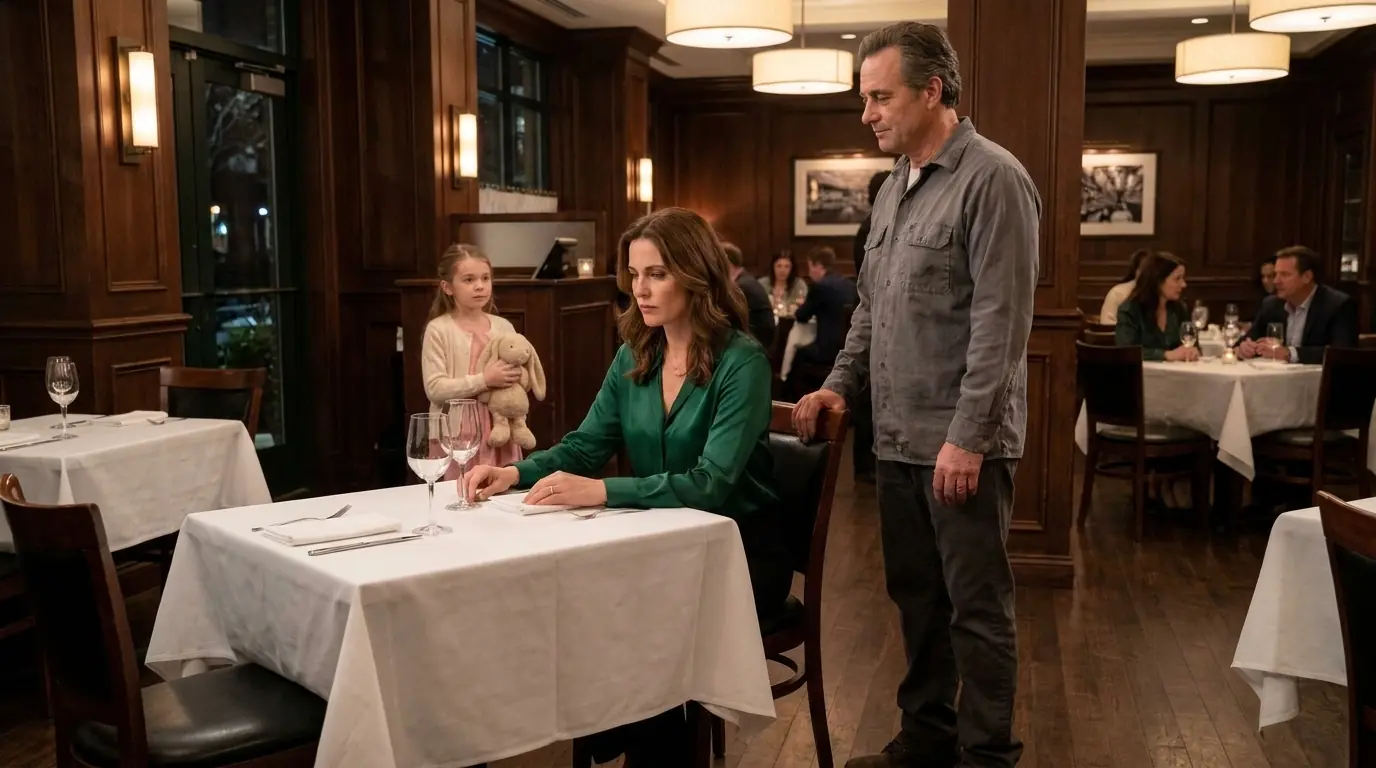
"I'm sorry to bother you, but I don't think you should be sitting here alone tonight." Hadley looked up, startled. Taking a moment to understand what was actually happening at her table, the stranger took half a step back, palms turning open at his sides, his voice softening as he hurried to explain himself. He had no intention of imposing, he said. His 6-year-old daughter was waiting over by the hostess stand, and she had whispered something to him a moment before that he could not let go of.
"She told me that lady looks as sad as we do, Daddy. That was the only reason I came over here." Hadley followed his glance toward the front of the restaurant. There, near the hostess podium, stood a small girl in a soft pink dress clutching a plush rabbit whose ear had clearly been loved threadbare. Her brown eyes were huge and fixed on the table, hopeful in the way only a child waiting on a yes could be hopeful. Hadley's chest released something she hadn't realized she had been holding.
She laughed, just once, soft and surprised. It was the first laugh of the night and it caught even her off guard. "If the invitation is coming from her," Hadley said, meeting his eyes, "then I'm afraid I don't have it in me to say no." His shoulders eased. He introduced himself simply, with no embellishment. "Darius Bellamy." The little girl was Naomi. "Tonight," he added quietly, "was her sixth birthday." Darius walked back to the hostess stand and brought Naomi over. One large hand wrapped gently around her smaller one.
She did not need an introduction. She climbed straight into the chair across from Hadley like the seat had been saved for her all along. She tucked the rabbit carefully against her side. "It's my birthday," Naomi announced, sliding the menu toward herself with the seriousness of a businesswoman. "I'm six now, and I want the chocolate cake. Mommy used to say it's the best one in Boston." The air at the table shifted in a way only Hadley noticed. Darius's shoulders stiffened just slightly, just enough.
He did not correct his daughter. He did not have to. The use of the past tense had already done all the explaining the moment ever needed. Hadley did not ask. She did not let her expression change. She simply folded her menu, signaled the waiter with a small lift of her hand, and ordered for the table the children's pasta with star-shaped noodles for Naomi, two house specials for the adults, a basket of bread, and the chocolate cake to be brought out at the end with a single candle.
She added, almost as an afterthought, that the second wine glass would not be needed any longer. The waiter nodded and left. Darius looked at her across the small white flowers in the center of the table. He did not say thank you—not out loud. The look he gave her instead said it more clearly than the word would have. Naomi, oblivious to the weight of any of it, began telling them both about her teacher Mrs. Pell, who had a real hedgehog in a real cage in her classroom, and whose name she announced as though it were a celebrity's.
He was laughing softly at her concentration when the front door of Marlowe and Vine opened again and the energy of the room shifted in a way Hadley felt before she saw. She turned her head. Grant Ashcombe was back. He stood just inside the doorway, jaw set. His irritation was sharper now than when he had left. His stance was looser. The intervening hour had served him at least two more drinks. His eyes scanned the bar. The leather wallet he had left on the counter was the reason he had come back.
He had nowhere else to be, but pride would not let the wallet stay in a stranger's hand. He spotted it. Then, on the way to retrieve it, he spotted the table. He stopped walking. His gaze moved over Darius first, then dropped to Naomi, then lifted to Hadley sitting where he had abandoned her. Something ugly passed behind his eyes and the half smile that followed was the kind that was meant to be heard before it was meant to be understood. "Well," he said, loud enough that the table behind them turned to look.
"I see the kind of clientele Marlowe and Vine is letting through the door these days. Standards really are slipping." The fork in Naomi's hand stopped halfway to her mouth. She lowered it slowly and looked up at her father. Her small forehead drawing together, not afraid, just confused the way a child is confused when an adult says something that does not fit anything she has been taught about the world. Darius did not move. He did not turn his head. He did not lift his voice.
What he did instead was reach across the small distance between their plates and lay his hand gently over Naomi's on the white tablecloth. His thumb stroked once across her knuckles. That was all. Hadley stood up. She did not raise her voice, either. She did not need to. Marlowe and Vine had the kind of acoustics that carried even a whisper from a steady mouth, and her mouth was very steady. "Pick up your wallet, Grant," she said. "And then walk out that door. And do not come back to a restaurant I am eating at again. Not tomorrow. Not next year. Not ever." A waiter who had been refilling a glass nearby froze mid-pour.
The table behind them did not pretend to look away. Grant opened his mouth. Hadley held his gaze without blinking. And whatever he had been about to say crumbled in his throat. He took the wallet. He walked out. The door closed behind him with the same chime it had used when he had left the first time. And this time, nobody at the corner table flinched. Hadley sat down slowly. Naomi was still looking at her father, and Darius was still holding her hand on the tablecloth.
His eyes lowered just enough to keep his daughter from seeing whatever was in them. He had not said a single word. It was that silence, the deliberate, costly silence of a man who had clearly chosen it many times before that Hadley could not look away from for the rest of the meal. The manager came over himself. A slight man with kind lines at the corners of his eyes, he apologized in the measured voice of someone whose career had taught him how to remove a moment from the air.
"The meal would be on the house," he said, including the cake. He simply set a hand briefly on the back of Darius's chair on his way past, the way a person sets a hand on a friend's shoulder, and then he was gone. The cake arrived 3 minutes later. It was the kind of presentation Marlowe and Vine reserved for milestone dinners. A small chocolate round with glossy ganache, a single white candle in the center. Naomi forgot Grant existed somewhere between the match being struck and the flame catching.
Her face lit up brighter than the flame did. She clapped her hands once, then twice, and threw her arms wide as though she had to make room for the size of her wish. Make it count, Darius murmured. Leaning in, she squeezed her eyes shut. She held the wish in her chest for a long, deliberate second. Then she blew, and the candle went out clean, and the small ring of diners around them broke into the kind of quiet applause that strangers offer a child on her birthday because they remember being six themselves.
When the cake had been cut, and Naomi was busy claiming the corner with the most frosting, Hadley spoke quietly across the table. I'm sorry, she said. For what? he said. I know I did not say it, but I'm sorry that you had to hear it sitting at my table. Darius set his fork down. He was quiet for long enough that Hadley wondered if she had said the wrong thing. Then he looked up, and his eyes were not hard, just tired in a particular way she did not have a name for yet.
You don't owe me an apology, Hadley. He said her name as though he had been turning it over in his mouth for the last hour, and had only just decided to say it out loud. But I want you to know I noticed something. What is that? You didn't pretend not to hear him. A lot of people do. He picked the fork back up, and the smallest smile lifted one corner of his mouth. Naomi noticed, too. She does not have words for it yet, but she noticed.
Hadley could not think of what to say to that, so she said nothing at all, which felt, for once, like the right answer. Naomi, having claimed the corner with the most frosting, reached across the table and grabbed Hadley's hand with chocolate sticky fingers. Her pinky stuck up in the air, deadly serious. Pinky promise, she said. To what? That you come to Boston Common tomorrow to watch me on the monkey bars. I can go all the way across now by myself. Daddy says he has never seen anything like it.
Darius started to say something in apology for the boldness. Probably, but Hadley had already curled her pinky around Naomi's. The promise was sealed before her brain had a chance to argue. When she pulled out her phone to save Darius's number a moment later, she typed only one word into the contact line. Darius. No company, no title, nothing else. Boston Common in the late morning had the particular quality of light that only October in New England could produce slanted, generous. The kind of sun that made even the brown grass look intentional.
Hadley walked in from the Beacon Street entrance carrying two paper cups of coffee in a cardboard tray and a small white box from the donut shop on Tremont. She had taken the T. She had told her driver not to come. The decision had felt, for some reason she did not entirely understand, important. Naomi spotted her first. The little girl came tearing across the field at full speed, both arms pumping, her sneakers slapping the path. She did not even slow down before crashing into Hadley's coat in a full-bodied hug that very nearly tipped the coffees over.
I did it all the way across without falling. Twice. Daddy timed me on his watch. He said it counts as a record. I had better see for myself, Hadley said, balancing the cups. And Naomi was already pulling her by the hand toward the play structure. Darius was standing at the edge of the playground, hands in his pockets, watching with the kind of patient stillness that made other parents nod at him in passing. He was in a plain navy hoodie and jeans, and the slight sheen on his temples said he had been running drills with the high school wrestling team in the field beyond the trees before the sun had fully come up.
He turned when he heard them, and the smile that found his face was the unguarded kind he had not yet worn at the restaurant. You came. I pinky promised. That is not legally binding, he said, taking the coffee she offered. It is in Naomi's jurisdiction. He laughed quietly. Naomi was already halfway up the climbing wall by then, showing off. And they walked together at a slow drift along the edge of the playground, the way new acquaintances walk, when neither of them is ready for the morning to be over.
A man pushing a Greek-style hot dog cart waved as they came down the path toward the pond. "Mr. Bellamy and Miss Naomi." Two with mustard? Three today, Kostas. We have a guest. Ah. The vendor's eyes flicked to Hadley with frank curiosity, but no judgement. A friend of Naomi's is a friend of mine. On the house. Absolutely not. On the house. They argued cheerfully and briefly until Darius lost. Hadley watched, and what she noticed was the way Kostas did not ask any of the things she usually got asked.
He just handed her the hot dog and went back to flipping his next batch. They ate sitting on a bench by the water. Naomi ran in tight circles around the geese, and the geese, with the world-weariness of Boston geese, refused to be impressed. What do you do, anyway? Darius asked between bites. I realized last night I didn't even ask. Hadley took a slow sip of her coffee. The line was small and well-rehearsed. She had used it before at parties, on planes, and in any setting where she did not want the conversation to immediately become about her.
"Renewable energy investments." I help allocate capital into wind and solar projects. A lot of meetings, a lot of travel. He nodded once, took another bite of his hot dog and said, "That sounds like meaningful work." That was it. He did not ask which fund. He did not ask where she was based. He did not pull out his phone to look her up the next time she stepped away. Hadley sat with the silence for a long second, watching the geese refuse to acknowledge a six-year-old and realized that she could not remember the last time someone she had just met had taken her at her word and left it there.
When she saved his number into her phone later, on the T ride home, she did the same thing he had done at dinner. One word. Darius. Nothing after it. No company. No calendar tag. No note. The simplicity felt like a small luxury she had not allowed herself in years. Seven weeks moved by in a rhythm she had not known she had been missing. There was the corner coffee shop on a side street in Roxbury, where the barista, a woman in her 40s with a silver nose ring, knew Darius's order before he opened his mouth and started learning Hadley's by the third visit.
There was Naomi's first grade science fair, where Hadley sat in a folding chair under fluorescent lights between two other parents and clapped sincerely for a poster about why earthworms were underappreciated. There was a Tuesday afternoon at the high school wrestling room, where she sat at the back wall with a borrowed cushion against the cinder block and watched Darius coach with a voice that was somehow firm and patient at the same time. The boys on the team called him Coach B. None of them seemed to find it strange that a woman in a plain coat had started showing up to watch.
They waved at her on their way out, dripping sweat. She found herself looking forward to small things. The texture of an ordinary Tuesday, the smell of cumin and onions from the kitchen down the hall when Darius cooked, the exact way Naomi mispronounced the word particular. None of it scaled. None of it leveraged. None of it generated returns. It just was. One Friday evening, Darius invited her over for a movie night. Naomi was already in pajamas patterned with tiny silver stars, curled up against her father's arm on the couch under a quilt that had clearly been washed a thousand times.
They watched an animated film about a girl who turned into a dragon when she felt too much. Hadley laughed at the same beats Naomi did, and the unspoken rhythm of three people fitting on one couch began to feel less and less unspoken. When the credits rolled, Naomi was already three quarters asleep. Darius carried her down the hallway and tucked her in with the careful efficiency of a man who had done it every night by himself for three years. Hadley stayed on the couch and let her eyes drift around the apartment, the stacked books on the coffee table, the chipped edge of the bookshelf, the photographs of Naomi taped without symmetry to the fridge, a home that told the story of a man who loved a child, not a man who had things.
He came back. He sat down. The space between them on the couch did not feel like distance anymore. He looked at her for a long, quiet moment. He looked at her the way a person looks at something he has been considering carefully for weeks. "You're really good with her," he said. "She has been talking about you between visits. The kind of talking she usually only does about her grandmother." "She's easy to be good with." He reached for her hand. It was not tentative.
He held it for a moment without moving. And when he leaned in, she met him halfway. The kiss was slow and quiet and entirely unhurried, the kind two people share who have already done all the loud parts of life and have only patience left for each other. When they pulled apart, he rested his forehead lightly against hers. Neither of them spoke. What they did not see was Naomi. Sometime past midnight, the little girl padded down the hallway in her star-patterned pajamas, rabbit tucked under one arm, looking for a glass of water.
She stopped at the edge of the living room when she saw them sitting close together on the couch and instead of saying anything, she simply climbed up between them, settled her head against Hadley's shoulder, and was asleep again within a minute. Hadley did not move. She did not even shift her arm. She looked at Darius over the top of the small head between them and in the soft amber light of the lamp behind the couch, she understood, without needing to be told and without being able to take it back, that she had stepped across a line in her own life from which there was no quiet return.
Her phone rang at 6 minutes past 6 on a Saturday morning. Hadley fumbled for it in the dim light of Darius's spare room, where she had finally fallen asleep around 2:00. And the moment she saw the code blinking across the secure line, her chest tightened the way it had not in months. Her chief financial officer's voice came through clipped and tight. The Asian markets were in convulsions. The Singapore branch was under direct pressure. A $1.2 billion power storage deal that had taken her team 11 months to structure was visibly cracking.
And the board was already mid-assembly. They needed her on a plane within 2 hours. She said yes before her brain had caught up with her mouth. By the time she stepped into the kitchen, Darius was already pouring her a coffee in a travel mug, sleep still in his eyes, having heard enough of the call through the thin apartment wall to read the rest of the morning. "Singapore?" he asked, only mildly. "Singapore." Naomi appeared in the kitchen doorway with Rabbit in hand and a question already forming on her face.
Hadley dropped to one knee in front of her without thinking. "I have to go fix something on the other side of the world," she said. "I will be back as soon as I can, and I want a full report on the science fair sketches when I'm back. Every single one, drawn in color. Pinky promise." "Pinky promise." She kissed Darius once at the door, fast and unspoken, and then she was gone. Singapore swallowed her for 9 days. The hours blurred. The calls she managed to make were short.
3 minutes between a meeting and a car. 2 minutes from a hotel hallway. Once, a full 16-minute call from a windowless room at 4:00 in the morning Boston time, when Naomi had refused to go to sleep without hearing her voice. Through none of those calls did she mention what was happening in the meeting rooms she was running. She did not tell him the size of the deal or the size of her team or the size of the room. She did not know while she was there what was happening back home.
A photograph had surfaced on a Boston gossip blog on the third day she was gone. It showed Hadley carrying Naomi away from the Boston Common playground on her hip. Darius walking beside them with a hand resting lightly on the small of Hadley's back. The caption identified her as the head of Pemberton Renewable Holdings and asked, in coy italics, whether the renewables billionaire had a new family. The comments underneath did not stay coy for long. By the second screen of comments, the language had turned ugly, and the ugliness was about the child and her father, not about the woman in the photo.
Darius found it at 11:40 at night, grading essays at the kitchen counter. He read three comments. He stopped reading. He closed the laptop with a kind of quiet that was not calm. He had heard Naomi stir in her bedroom. And a moment later, she padded out for water, rabbit dragging by one ear behind her. He turned, smiled, filled her cup, and did not look back at the laptop until she had returned to bed. The next morning, Hadley called from a car between meetings.
Naomi grabbed the phone first, the way she always did. She talked about her teacher, about a boy named Felix, who had eaten glue, about how the leaves on the oak tree outside her bedroom window had turned the color of butterscotch overnight. Then she went quiet. "Daddy was on the phone earlier," Naomi said. "He sounded sad. Is it because of me?" There was a silence on Hadley's end of the line. It was very short. It was long enough. Darius, sitting at the kitchen counter on the other side of the world, did not need her to say it.
He understood from the shape of that silence that she already knew about the comments. She had known before he had told her, and she had let him find out the way he had. She flew straight home. Her assistant offered the company car. She took a yellow cab from Logan instead. The driver took one look at the address in Roxbury and did not say a word. She paid him in cash, left her suitcase by the door of Darius's building, and rang the bell with her coat still on.
Darius opened it on the second buzz. He did not kiss her, and he did not ask her how the flight was. He looked at her for a long moment in the doorway, and then he stepped back to let her in. "Naomi," he called gently down the hall. "Go pick the next chapter, baby. I'll be in to read in a few minutes." The patter of small feet moved away. He waited until the bedroom door clicked shut. Then he turned to Hadley. "Tell me," he said.
She told him. She told him her last name was Pemberton and that the company bore it, too. She told him the valuation, the number she had been carrying around in her head like a stone for 3 years. She told him about the 1,100 employees, the board of directors, the regulatory hearings, the energy storage patents that had recently been picked up by three governments. She told him that the picture he had seen in the comments was not the worst version of how people in her world would talk about him and Naomi.
There would be more. There would be worse. The blog post had only been the first crack. She told him she had not lied to hide anything from him. She had hidden it to protect what they had from becoming exactly the conversation it had just become. Darius listened until she stopped speaking. He did not interrupt once. When she was done, he sat down on the arm of the couch and rubbed his face slowly with one hand. "Hadley," he said, "I am not afraid of your money. I know. I am afraid Naomi is going to learn how to read a comment section before she learns how to read Shakespeare. I am afraid she is going to ask me one day why someone wrote what they wrote about her. And I am going to have to decide what version of the truth she is old enough to hold." He looked up.
"That is what I am afraid of." Hadley did not have an answer for that one. She had spent the flight back over the Pacific drafting 15 different versions of an answer. And none of them survived contact with the kitchen they were standing in. Behind them, the soft sound of a door opening. Naomi stood in the hallway. Her bare feet rested on the wood floor, Rabbit pressed against her chest. Her eyes were enormous. She had clearly heard the number, a number that did not belong in this apartment even when spoken only once.
"$8 billion," she said. The words came out in pieces. It was the way a child tries on a sentence too big for her mouth. Hadley dropped to her knees on the floor. "Yes, sweetheart, that's a lot of dollars. It is." Naomi looked at her for a long moment, holding the rabbit tighter. She tilted her head the smallest amount, the way she did when she was working out a hard puzzle in her head. Are you still Hadley? The question was not accusatory.
It was actually frightened. Hadley realized, with a small ache, that her own answer to that question over the past 3 years had not always been yes. I'm still Hadley, she said. I'm the same Hadley who pinky promised you at Marlowe and Vine. I just also happened to have a job that is bigger than I knew how to tell your daddy about. That was wrong of me. I am going to fix it. Can you still come to my next science fair? Yes.
Even if you have to fly back from the other side of the world? Even then. Naomi considered her for one more careful second. Then she walked over and laid her small hand against the side of Hadley's face, the way she had probably seen her mother once do, and said, Okay, then. Behind her, Darius watched. His expression was not yet forgiveness, but it was no longer closed. Two evenings later, Hadley sent a single text to Darius. There is something I want to show you.
Both of you. The car she sent for them was black and plain, with no conspicuous plates. Darius helped Naomi into the backseat with her rabbit, and the driver took them up Beacon Hill, past the brick row houses and the gas lamps, and stopped in front of a narrow brownstone with no nameplate beside the door. Three stone steps, two pots of late-season chrysanthemums, a black-painted door with a brass knob worn smooth in the middle from a hundred years of handprints. Hadley opened the door herself.
She had given the household staff the evening off. Darius stepped inside, and Naomi went in after him. And what they walked into was not what either of them had expected. The hallway smelled, faintly, of cinnamon. The hardwood floors were warm and uneven, the way old Beacon Hill floors are. The bookshelves in the living room were stacked two deep, Toni Morrison shoulder to shoulder with James Baldwin. A worn copy of Their Eyes Were Watching God leaning against a hardback by Octavia Butler.
Above the fireplace was a single black and white photograph framed simply. A woman in an apron stood behind a folding table at what was clearly a farmers' market in the early 80s ladling something into a paper cup for a customer. Naomi walked straight to the photograph. "Who is that?" she asked. "My mother." Hadley said. "She sold soup at that market every Saturday for 15 years. That was the year I was seven." Darius did not say anything for a long moment. He was looking around the room, really looking.
He was, Hadley realized, finally seeing her. She poured three glasses. Apple juice in a small glass for Naomi, and wine for the two adults. They sat on the worn leather couch. "I want to tell you what I am going to do," she said. "Not what I want you to do. What I am going to do." She laid it out plainly. Naomi's school would be informed by the end of the week through her personal counsel that any photographer found on the grounds during pickup or drop-off would have a criminal trespass case filed against them by the following morning.
The press desk at Pemberton Renewable Holdings had already been instructed to respond to any inquiry about her personal life with a single sentence. "We do not comment on Miss Pemberton's personal affairs." That sentence would not change for any outlet, any reporter, or any rate of pay. She would not ever allow the company to enter the doorway of their home. Not for events, not for photo opportunities, not for anything. The company existed on one side of a wall. They lived on the other.
She would build the wall and she would maintain it. She did not ask for paperwork tonight. The legal architecture would come later, separate trusts, separate names, separate everything. All of it engineered so that nothing belonging to Naomi could ever be leveraged in a dispute connected to the company. Tonight, she only needed him to believe she had the right intentions. Darius listened. He took a long time before he answered, "I appreciate all of that," he said. "All of it. I want you to know that I heard it. But what I need most isn't on a piece of paper. What I need most is for you to be at parent-teacher night on Thursday in a folding chair, like every other parent. That is the only proof that matters to me. I will be there." From the top of the stairs, a small voice drifted down.
Naomi had wandered up to explore. They could hear her footsteps moving softly above them, opening and closing doors with the curiosity of a child who had clearly decided that this house was, for tonight at least, hers to inventory. A pause, then the voice again, conspiratorial, "Hadley, you can stay in the guest room as long as you want." Hadley looked at Darius. "As long as you don't take Pippa the Bear," the voice added. "That part is non-negotiable." Darius started laughing. It was the first real laugh she had heard from him since she had landed.
Hadley laughed, too. They laughed until Naomi appeared at the top of the stairs wondering what was so funny. And then, they laughed harder. She arrived at Roxbury East School on Thursday evening at 6:45, 15 minutes early, alone. She wore a plain wool sweater, dark pants, and flat shoes that did not draw attention. She brought no entourage. She sat down in a folding chair in the back row of Mrs. Pell's first grade classroom and folded her hands in her lap. Mrs. Pell, who had taught at Roxbury East for 22 years and recognized most of the parents on sight, glanced once at the woman in the back row and did not quite place her.
She started the presentation. She talked about the reading curriculum, about the math, about the way the children were learning to write their own names in cursive. Then, she came to Naomi. "Naomi Bellamy," she said, looking at Darius, who was sitting in the second row, "has recited the most beautiful version of a Langston Hughes poem I have heard from a 6-year-old in my entire career." A small murmur of pride moved through the room. Darius smiled. He did not turn around. He did not need to.
He could feel her sitting back there. A mother in the third row whispered to her husband, and her husband whispered back. And then the husband leaned forward and squinted at the back of the room. Hadley caught the moment of recognition pass through both of them. She held still. She did not look at her phone. She did not look away. She held the chair. When the presentation ended and the parents began to mill toward the snack table at the back, Darius did not go straight to the snack table.
He walked toward her instead, in front of everyone, and he reached for her hand and held it without lowering his voice or his stance, and the whispering stopped. He guided her to the snack table. He introduced her to Mrs. Pell. He told Mrs. Pell that this was Hadley, and that she was important to him and to Naomi. Mrs. Pell shook her hand with the warmth of a woman who had decided not to be impressed by anything other than how a person treated a child, and that was the end of the matter.
That was the easy night. The harder night came the following week at a black-tie fundraiser at the Boston Public Library that Pemberton Renewable Holdings was hosting for a clean water nonprofit. Darius came with her in a charcoal suit he had owned for 6 years and a tie Naomi had insisted on choosing. Hadley introduced him to the room with no softening. At their table, an older board member, a man named Crowley, whose family had owned a New England shipping fortune for four generations, leaned slightly toward his wife and said, just loud enough to carry to Darius's seat, "Ah, the schoolteacher." The way he said the word was small and clean and entirely deniable.
Hadley set down her wine glass. She did not stand. She did not raise her voice. She simply leaned forward over the table, looked Crowley in the eye, and said, in a tone the entire table heard whether they meant to or not, "Mr. Crowley, if any member of this board ever uses that tone again about a member of my family, that member of the board will find his consulting contract under formal review by 9:00 the following morning. I will sign the review order myself. I will sign it from this table if I have to." She picked up her wine glass and took a sip.
Mr. Crowley said nothing. Mr. Crowley said nothing for the rest of the evening and for many evenings after that. Under the table, Darius found her hand and held it. He did not say a word about what had happened. What he said instead, very quietly, was, "Naomi has been asking when you're coming over for pancake Saturday. Tell her I would not miss it." Days later, when Hadley came home from a long day of meetings and stepped into the brownstone kitchen, she found a new drawing taped to the fridge, three figures under a wide green tree, a man, a woman, and a smaller figure between them holding both their hands.
Naomi had signed it carefully in the bottom corner. Underneath the signature, in earnest block letters, she had written, "This is also my fridge now. No take-backs." One year after the night at Marlowe and Vine, the garden behind the brownstone had been strung with small warm lights between the branches of the old oak tree. Naomi had turned seven that afternoon and a chocolate cake ordered with quiet deliberation from Marlowe and Vine itself had been cut, eaten, and divided into Tupperware before she had finally allowed herself to be carried upstairs to bed.
She was already asleep, rabbit tucked under one arm, by the time Darius came back down the stairs and stepped out into the garden. Hadley was standing under the oak with her arms wrapped loosely around herself, looking up at the lights. He came up beside her quietly. He did not say anything for a moment. He just stood with her. Then, he reached into the inside pocket of his jacket and pulled out a small velvet box. He went down on one knee in the grass.
"Hadley," he said. She turned. She saw the box. She put both her hands over her mouth. "I saved for eight months for this." He opened it. The ring inside was modest and beautiful, a single round diamond set in white gold, the kind of ring that had been chosen with care and not with a budget. "I picked up extra hours teaching summer school. I tutored on Sundays. I did this part myself on purpose because there are parts of my life I need to know I did with my own hands. Hadley, you are the woman who sits through puppet shows. You are the woman who eats hot dogs from a cart on the common. You are the woman who reads bedtime stories with all the voices right. You are also the woman who runs a 1,100-employee company and sits at a board table and reviews the contracts of men who deserve to have their contracts reviewed.
You are all of those women. I want all of them." He paused. "Marry me." She was already crying. She was nodding before he had finished saying it. She knelt down on the grass with him and pressed her forehead against his. And he slid the ring onto her finger with hands that were shaking just a little. Upstairs, in the bedroom that had once been the guest room and was now simply her room, Naomi half woke. She rolled toward the window, the rabbit in the crook of her elbow, and squinted down through the glass at the garden. She saw the two of them kneeling under the oak in the warm string of lights. She watched her father slide something onto Hadley's finger. She smiled into the pillow. She closed her eyes again. She went back to sleep. For Hadley Pemberton, who had spent the better part of her adult life believing the most valuable thing she would ever hold was something a stock ticker could measure, the truth had arrived very quietly.
The most valuable thing she would ever hold did not live on any balance sheet. It lived in a brownstone that smelled faintly of cinnamon. It lived in a 6-year-old who had grown into a 7-year-old and had, somewhere along the way, started calling the place home. It lived in the steady weight of the hand of a man who had walked across a crowded restaurant on the worst night of her year and told her, without any reason in the world to bother, that she should not be sitting alone.
He had been the one, in the end, who sat down in the chair another man had walked away from. He had been the one who stayed.