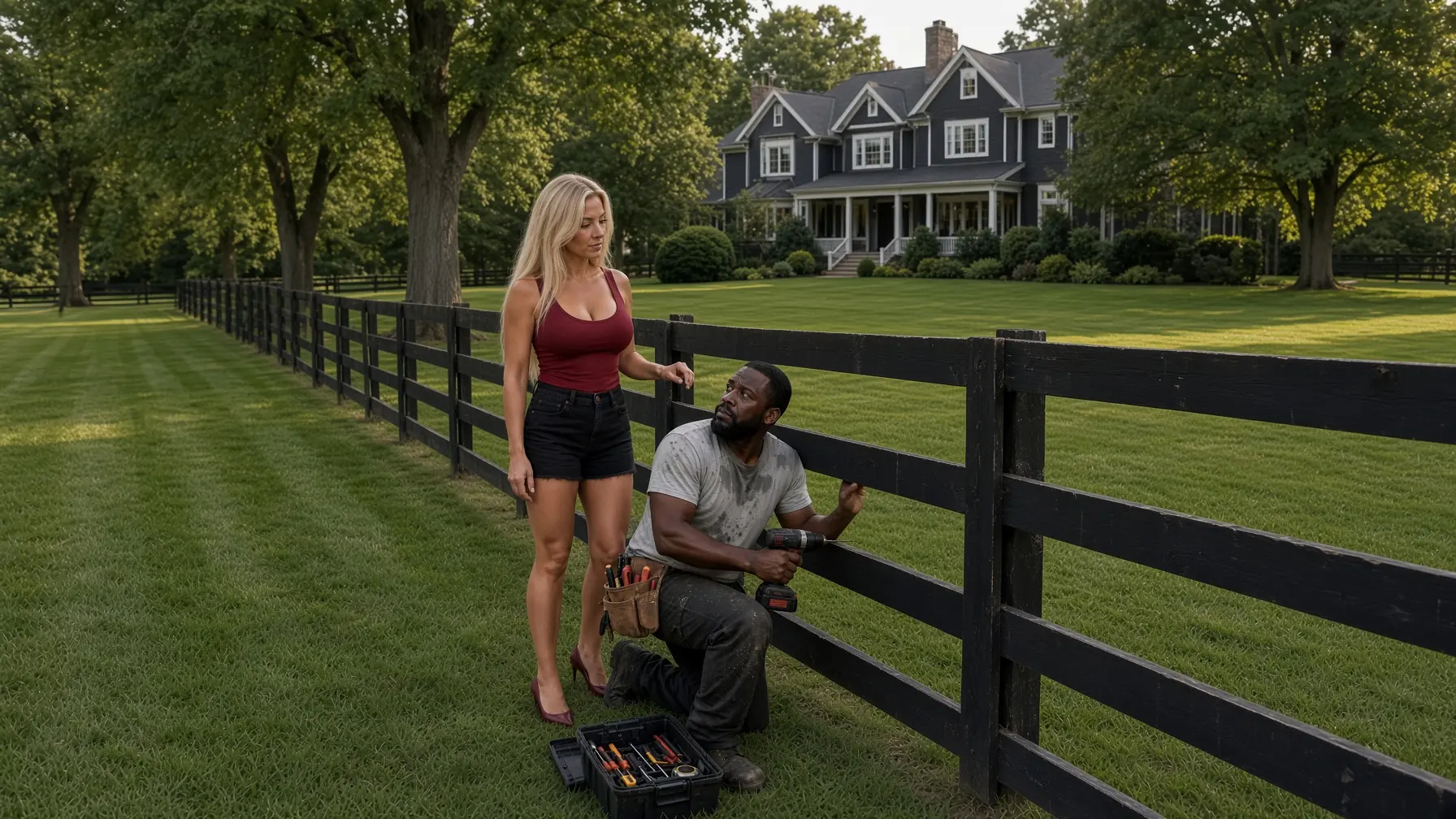
The hammer stops mid-swing. “You should be grateful I’m paying you anything.” David Harrison lowers the tools slowly, sawdust clinging to his forearms, sweat cutting clean lines down a face that hasn’t rested in hours. Behind him, the deck stands finished, every board level, every screw counter sunk. Twelve hours of work done right, done clean.
The homeowner counts out less than half the agreed amount and holds it out like a favor. David doesn’t argue. He learned years ago that arguing with people who already decided not to pay you fair only wastess daylight he doesn’t have. He takes the money, folds it, puts it in his pocket without looking at it again. His truck ticks and groans as he loads his tools into the bed.
The engine light glowing orange on the dashboard like it’s mocking him. $43.18. That’s what sits in his account right now. Rent is due in six days. Nia needs new shoes.
The truck needs a part he can’t afford to name out loud. David climbs into the driver’s seat and sits there a moment, hands on the wheel, saying nothing. The radio doesn’t work. The air conditioning doesn’t work. What still works is the steady, stubborn thing inside his chest that refuses to cut corners, even when cutting corners would be easier.
His phone rings before he can pull out of the driveway. Unknown number. He almost lets it go to voicemail. Almost. “Hello.”
The voice on the other end is a woman’s, tired in a way that has nothing to do with the hour. “I need someone who can start tomorrow morning early. My fence is down. Most of it. Storm damage.”
“Where’s the property?” “Ashwood Estate off Cardinal Ridge Road.” David knows the name. Everyone in Clover Falls knows the name. Twelve acres of land behind Iron Gates, owned by a woman most people have only seen in magazine photos, never in person.
“That’s a big job,” he says. “Might take a few days.” “I don’t care how long it takes,” she says. “I care that it’s done right. Can you be there by seven?”
Something in her voice makes him pause. Not the words, the weight underneath them. Like she’s holding a phone in one hand and something much heavier in the other. “I’ll be there,” David says. The line goes dead before he can ask her name.
He sits in the truck a moment longer, staring at the house behind him, the one that just underpaid him for honest work. Then he starts the engine and drives toward the only person who makes any of this worth it. Nia is sitting on the porch step of the afterchool program when he pulls up, backpack between her feet, swinging her legs like the day hasn’t worn her down the way it’s worn him down. “You’re late,” she says, not unkindly. “I know, baby. Let’s go home.”
She climbs in, buckles herself, and doesn’t ask about money. She never does. Ten years old, and she already knows not to ask questions that might make her father’s shoulders drop lower than they already sit. That night, after her homework is checked and her lunch is packed for tomorrow, David sits at the kitchen table with a stack of bills he already knows he can’t fully pay. He doesn’t sleep much.
He never does the night before a big job. At 6:40 the next morning, his truck rattles down Cardinal Ridge Road, past a rod iron gate standing open, and up a long gravel driveway lined with oak trees older than the town itself. That’s when he sees it. Nearly 300 ft of fencing torn apart in a way no storm has ever done. Posts snapped clean at the base.
Brackets ripped loose like something pulled them, not blew them. Wood splintered in patterns too straight, too deliberate to be weather. David steps out of his truck slowly, eyes narrowing at the damage in front of him. Storms don’t break things like this. Something else did.
David crouches beside the nearest fence post, running his thumb along a jagged edge, and stops cold. This cut isn’t from wind, it’s from a blade. He glances up at the main house, three stories of white brick with dark green shutters, and sees a woman standing at a tall window, phone pressed to her ear, pacing in short, tight steps. She doesn’t come outside to greet him. She barely looks his way.
David gets to work. By nine, he’s pulled apart the wreckage of the first section, laying broken boards in neat piles, separating salvageable wood from ruined wood. He works the way he always works. Steady hands, no wasted motion, silence instead of noise. Harper Pollson finally crosses the lawn around ten, still on the phone, waving off whoever’s on the other end with a clipped, “I’ll call you back.”
“You’re the contractor,” she says. Not really a question. “David Harrison.” “Harper Pollson.” She doesn’t offer a hand.
Her eyes are already moving past him, scanning the damage like she’s looking for something specific and not finding it. “How bad is it?” “Worse than storm damage should be.” That gets her attention. “Meaning?”
David holds up a section of the broken post. “See these cuts? Clean, straight. A storm snaps wood. It doesn’t slice it.” And these brackets, he points to one hanging loose from the frame.
“Somebody loosened these by hand. Bolt by bolt.” Harper’s jaw tightens. “You’re saying someone did this on purpose.” “I’m saying a storm didn’t.” She studies him for a long moment.