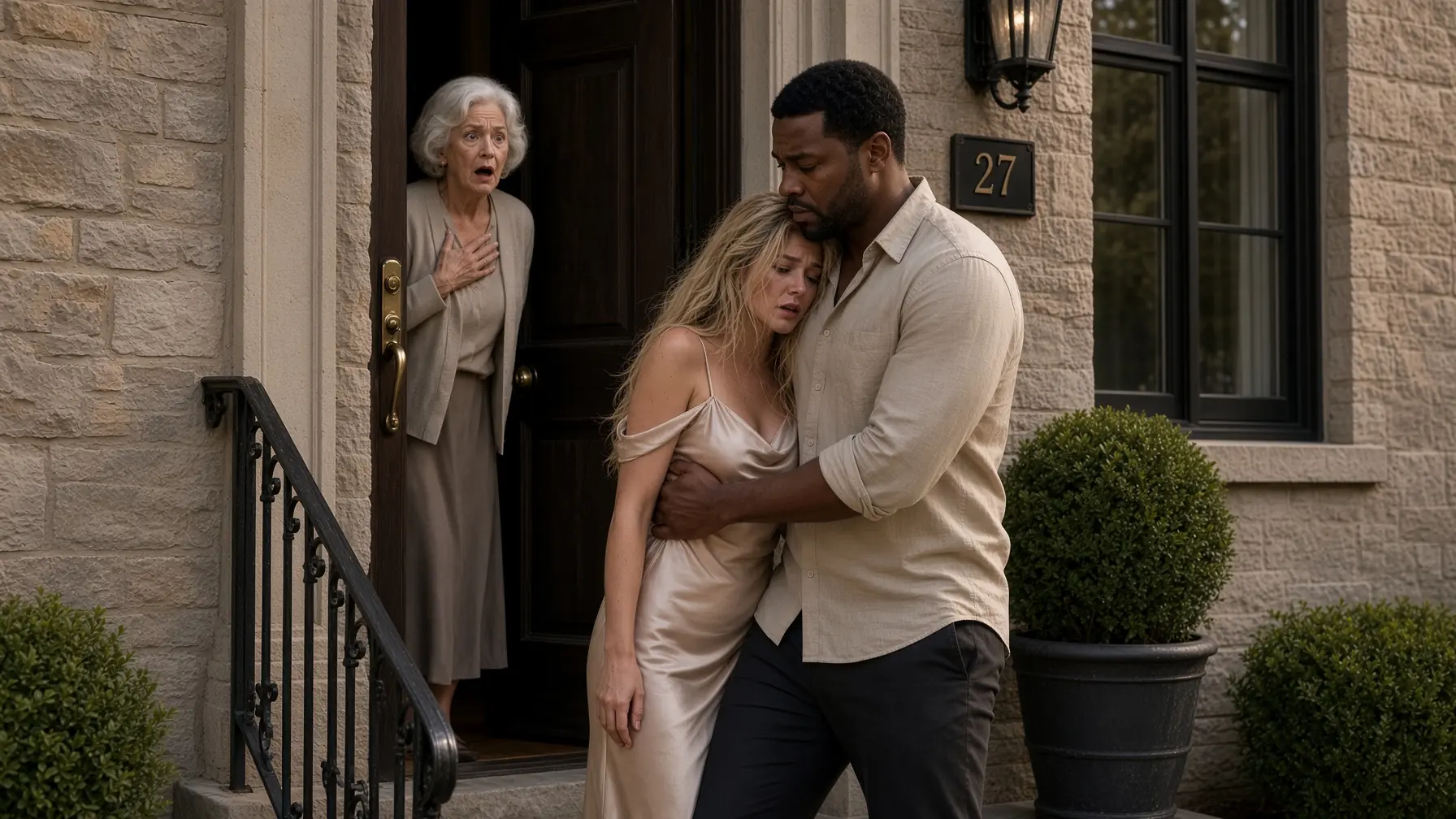
Holt Pemberton caught the woman before she hit the pavement. One hand gripped her arm, the other her briefcase, both slamming against his chest as she stumbled off the curb into oncoming traffic. Headlights, horns. A cab driver laying on his horn so hard the whole block heard it. She didn't even flinch.
She was that far gone. He didn't know her name, didn't know her title, didn't know that carrying her to safety that night would crack open a secret buried for over 30 years. A secret that connected her blood to his grief, her mother to his dead wife, and her family's fortune to his little girl sleeping at home. The rain was the kind that didn't come down hard. It just hung there, cold and relentless, soaking through your collar before you even realized it was happening.
Holt Pemberton had been sitting in his car outside the Meridian Grand Hotel for 45 minutes, engine idling, the heat turned low because he was trying to save gas. He had a daughter at home. Gas mattered. He drove for a rideshare platform three nights a week, sometimes four, when Marlo's school had a field trip coming up or the electric bill climbed past what his pension check covered. It wasn't glamorous.
It wasn't what he'd imagined his life looking like at 53, but it was his, and he'd built it clean, and he wasn't ashamed of a single hour of it. The app pinged at 11:47 p. M. Five-star passenger. Corporate account.
Destination Hadley House, Beacon Hill. He'd heard of Beacon Hill. He'd driven through Beacon Hill. He'd never had a reason to stop there. He pulled around to the side entrance of the hotel where the valets moved with that practiced quiet efficiency of men who'd seen everything and judged nothing.
A woman in a charcoal blazer and black slacks was standing near the bottom of the steps, holding a small clutch against her ribs like it was the only thing keeping her upright. She was tall, mixed race, light complexion, natural hair pinned back at the sides, late 40s, maybe 50, and she was listing just slightly like a ship that hadn't decided yet whether it was going to correct course or go under. One of the valets noticed Holt's car and walked over. You the ride share for Hadley? That's me.
The valet leaned in, slightly dropped his voice. She's had a long night, company event. She's she's going to need a minute. Holt looked at the woman again. She'd found the railing, both hands on it now.
I got her, he said. He got out of the car, unhurried, deliberate, and crossed to the steps. Up close, she smelled like expensive perfume and chardonnay, and her eyes had that glazed quality that told him she was fighting it. Trying to hold on to the last thread of dignity she had. Ma'am, he said, keeping his voice low and even.
I'm your driver. Holt. You ready to head home? She turned toward him slowly. Her eyes tried to focus.
I don't need she started. I know, he said. You're fine. We're just going to walk to the car. That was something he'd learned a long time ago in another life in federal service on cold doorsteps and hospital corridors.
Don't argue. Don't add to the weight a person's already carrying. Just move. She let him take her arm. They made it to the car in about 30 seconds.
He opened the rear door, got her settled, and quietly clicked the seatbelt across her before she could protest. She sank into the seat and closed her eyes. He drove. For the first 20 minutes, she slept. Holt kept the music off, kept the heat at 68, focused on the road the way he always did, checking mirrors, reading the lane ahead, letting the city roll past in streaks of orange and white.
Boston at midnight had a rhythm to it he'd come to appreciate. Quieter than DC, more honest than New York. He'd moved here 4 years ago, after Claire. He didn't like to linger on that after Claire, but it was the dividing line in his life clear as a scar. Before Claire died, he was a man with a plan.
After he was a man with a daughter and a blank calendar and a silence in the house so heavy it had a weight. Marlowe was 7 when her mother passed. She was 11 now. She was the reason he got up every morning and the reason he didn't let himself fall apart at night. He checked the rearview mirror out of habit.
The woman in the back had shifted in her sleep. Her clutch had slid off the seat and fallen open on the floor mat. He could see the corner of a photograph peeking out, glossy, slightly creased, the kind of photo that had been carried around a long time. He didn't reach for it. Wasn't his business.
But at the next red light, the car stopped and the photograph slid another inch and the face in it caught the glow from a street lamp and Holt Pemberton's breath left his body. He didn't move. The light turned green. He didn't move. The car behind him tapped its horn once politely, the way drivers sometimes did after midnight, surprised at their own restraint.
He pressed the gas, but his hands had gone cold. The woman in the photograph was young, mid-30s maybe, laughing. One of those unguarded thrown-back laughs, like someone had said the most ridiculous thing in the world and she'd believed them. She had Claire's cheekbones. She had Claire's laugh.
He couldn't hear it, but he knew it the way you know a song from the of the notes before the sound comes. But, it wasn't Claire. It couldn't be. Claire was gone. And this woman was older, standing in front of a house he didn't recognize wearing clothes from maybe 20, 25 years ago.
Arm around a little girl who couldn't have been more than four or five. The little girl had Claire's eyes. He pulled up to the address on Beacon Hill just past 12:30. The house was what he expected, four stories brick, the kind of place that had been in the same family for generations. Lantern lights on either side of the door.
Boxwood hedges trimmed within an inch of their lives. He put the car in park and sat for a moment deciding. He could leave the photograph on the seat. She'd find it in the morning. None of his business.
But, he couldn't stop thinking about that little girl's eyes. He turned around. Ma'am. He said gently but clearly. We're here.
She stirred. Her eyes opened slowly, confused for a moment, that brief window where a person doesn't know where they are or how they got there. Beacon Hill. He said. Hadley House.
You're home. She sat up, rubbed the back of her hand across her mouth, and reached for her clutch. He reached down and picked up the photograph from the floor mat. This fell out. He said and passed it over the seat.
Her hand closed around it so fast, so tight that he knew the thing mattered. She didn't look at it, just held it. Thank you. She said. Her voice was clearer now, steadier.
The night air through the cracked window had done some of its work. No problem. She opened the door. Paused. You didn't look at it.
She said. It wasn't a question. More like a test or an assessment. He could have lied, would have been easy. I saw it, he said, "Fell out when you shifted.
I didn't pick it up until we stopped. " She was quiet for a moment. "The woman in it," she said, "did you recognize her? " Something moved through Holt's chest. "Careful. Careful now. " "No," he said. "I didn't. " It wasn't entirely a lie.
He didn't know the woman in the photograph. He just knew her face. The woman nodded once. Short, unreadable, climbed out of the car and walked up the steps without looking back. He watched the door close behind her.
Then he sat in the dark for 3 full minutes breathing. Her name was Camille Hadley. He didn't know that yet, not her full name. He'd seen Hadley on the address and on the corporate account name, and he'd heard it from the valet, but it hadn't connected to anything. Not yet.