When a Black single father stopped to help a stranger in a storm, he destroyed the one chance he had at saving his family. Or at least, that was what it looked like in the moment. Ethan Brooks had exactly seventeen minutes to make the interview that could change everything. The woman screaming from inside the flooded luxury car did not know about his empty bank account, his son’s worried eyes, or the eviction notice burning a hole in his pocket.
Every second he spent digging her car out of the mud pushed him closer to disaster. He helped her anyway. By the time he realized what it had cost him, it was already too late. The rain hit Ethan Brooks’s windshield like gravel thrown by an angry god, each impact a small violence that made the world beyond his cracked wipers almost impossible to see.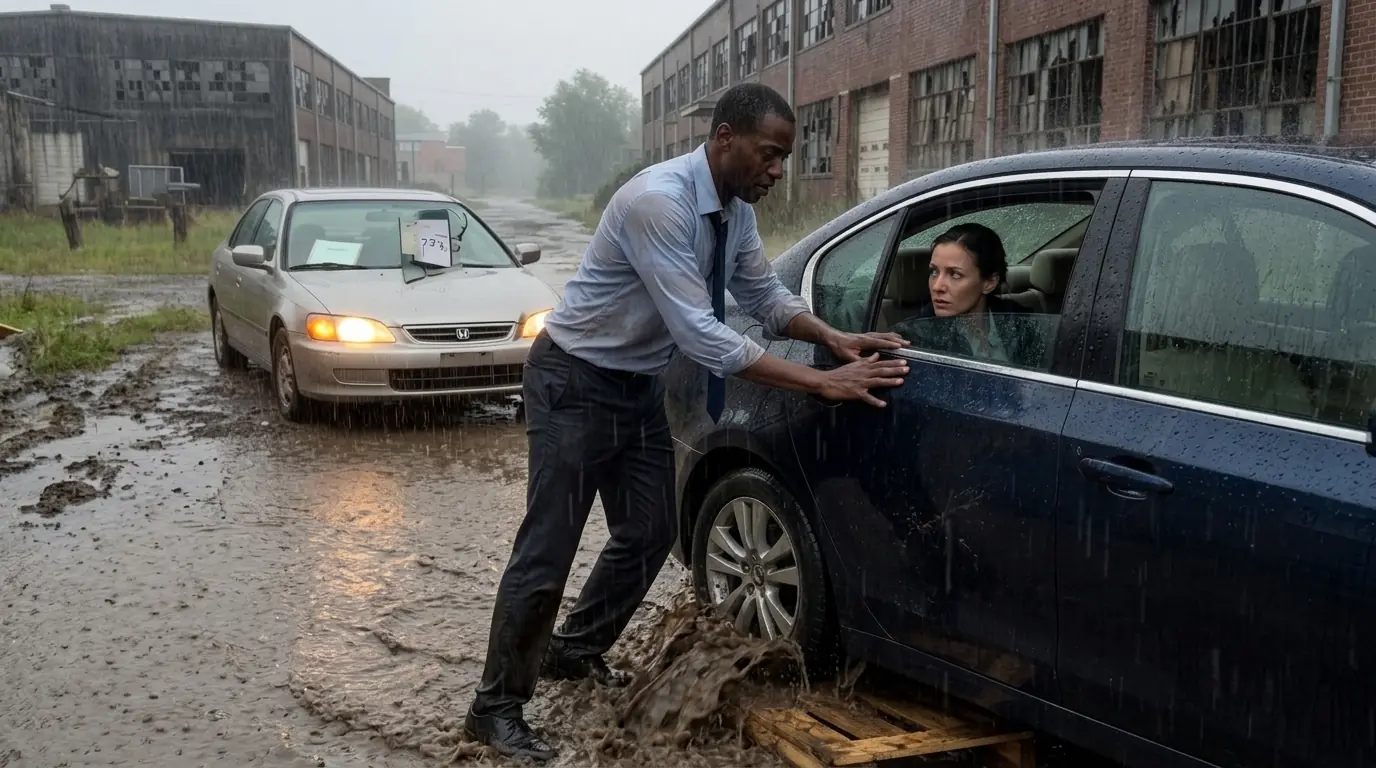
He leaned forward, knuckles white on the steering wheel of his fifteen-year-old Honda, squinting through the downpour at the narrow back road that cut through the forgotten industrial outskirts of the city. It was 7:43 in the morning, and he had seventeen minutes until the interview started. Seventeen minutes to cross twelve miles of flooded roads, navigate morning traffic, find parking, and walk into the glass tower downtown where Hartwell Industries kept its executive offices. Seventeen minutes to smile, shake hands, and convince someone that a thirty-four-year-old Black single father with a community college degree and a seven-year gap in his resume deserved a second chance.
His hands were shaking, not from the cold, though the heater in his car had died two winters ago, but from the electric terror of hope. Real hope, the kind that hurt. From the back seat, a small uncertain voice said, “Dad?” Ethan glanced in the rearview mirror and saw his son, Marcus, eight years old and already too familiar with worry, staring back at him with dark eyes that looked too old for his face.
The boy clutched his backpack against his chest like a shield. “Yeah, buddy?” Ethan said. Marcus looked down, then back up. “Are you going to get the job?”
Ethan’s throat tightened because he had been asking himself the same question for three weeks, ever since the recruiter had called him out of the blue. An interview with Hartwell Industries was not just an opportunity. It was a miracle, the kind of company that did not usually look twice at men like him. Men who had started in engineering, shown real promise, then walked away from it all when their wife died and left them holding a one-year-old baby and a mountain of medical debt.
“I’m going to try my best,” Ethan said, forcing his voice to sound steady. “That’s all anyone can do, right?” Marcus nodded, but he did not look convinced. He was a smart kid, too smart, and he knew what was riding on this.
He had seen the eviction notice taped to their apartment door. He had heard his father on the phone with the landlord, promising, pleading, and buying time they did not have. “Mrs. Chen is going to pick you up from school today, remember?” Ethan said. “I might be late.”
“Because of the interview?” Marcus asked. “Yeah,” Ethan said. “Because of the interview.” Marcus looked down at his backpack again and said, “Dad?”
“Yeah?” Ethan answered. Marcus swallowed. “Good luck.” Something cracked open in Ethan’s chest, and he blinked hard against the burning in his eyes.
“Thanks, buddy,” he said. “Love you.” Marcus nodded. “Love you, too.” Ethan pulled up to the elementary school and watched as Marcus climbed out into the rain, his bright yellow raincoat instantly soaked.
The boy waved once before disappearing through the front doors, and Ethan sat there for one moment longer than he should have, his heart hammering against his ribs. Then he pulled back onto the road and pressed the gas pedal down. The back road was supposed to be faster. That was what the navigation app had promised.
Fifteen minutes saved by cutting through the old industrial district instead of joining the nightmare of morning traffic on the highway. Ethan had driven it twice already that week, timing it, memorizing it, turning his interview into a military operation because he could not afford to leave anything to chance. But the app had not predicted the storm. Rain hammered down so hard it turned the road into a river, with drainage ditches overflowing on both sides and the asphalt disappearing under inches of rushing water.
Ethan’s tires threw up sheets of spray as he drove, and his heart climbed into his throat every time the car hydroplaned, sliding a few inches before the tread caught again. It was 7:47 now. Thirteen minutes. His phone buzzed in the cup holder, but Ethan did not look at it.
He knew what it was. A reminder, an alarm, the kind of helpful notification that felt like mockery now. Interview at Hartwell Industries, 8:00 a.m. Leave early to account for traffic.
“I know,” he muttered to the phone, to himself, and to the universe that seemed determined to keep him down. “I know.” The road curved ahead between two abandoned warehouses with dark, shattered windows. Ethan knew this stretch.
It was a straight shot for another mile, then back onto surface streets, then downtown. He could still make it if the traffic lights were kind, if the flooding did not get worse, if the universe gave him just one break. That was when he saw the car. At first, it was only a shape through the rain, dark, low to the ground, and expensive-looking.
Then his headlights caught it fully, and Ethan’s foot moved automatically to the brake. The car was a midnight-blue luxury sedan, something European and sleek, the kind of vehicle that cost more than Ethan had earned in the past three years combined. It was buried up to its doors in mud. The road widened there, creating a shallow turnout where rainwater had pooled and churned the shoulder into a brown soup of clay and gravel.
The sedan had clearly tried to navigate around some obstacle and misjudged the depth. Now it sat at an angle, its front wheels sunk deep, its rear end tilted up like a ship going down. Inside, behind rain-streaked windows, someone was moving. Ethan’s car slowed to a crawl, and his eyes went to the clock on the dashboard.
It was 7:49. Eleven minutes. His fingers tightened on the wheel. His interview folder sat on the passenger seat, holding his resume, references, and the cover letter he had revised seventeen times.
Everything he needed to walk into that building and prove he was worth the risk was right there beside him. The figure in the car was pounding on the window now, and Ethan could see an arm, a hand, and the pale flash of a face pressed against the glass. He should keep driving. He knew that.
Whoever was in that car had a phone. They could call a tow truck, roadside assistance, or someone who actually had the tools and time to help. Ethan was not that person. Ethan was a man eleven minutes away from losing everything, but his foot was already on the brake.
A second later, his foot was on the gas, pulling his Honda onto the shoulder behind the stranded sedan. The moment he opened his door, the storm tried to push him back inside. Rain hit him like a physical force, instantly soaking through his dress shirt, the only one he owned without stains, and plastering his hair to his forehead. The cold was shocking, needle-sharp, turning his breath into visible clouds.
Ethan ran toward the sedan, his dress shoes, bought at a thrift store three days ago, sinking into the mud with every step. Water filled them immediately, squelching between his toes. He had wanted to look professional and put together. Now he looked like he had crawled out of a swamp.
The driver’s side window was tinted, but through the rain, he could make out a woman inside. Her hands were pressed against the glass. She was shouting something he could not hear over the downpour. Ethan tapped the window and shouted, “Can you open it?”
The woman shook her head violently and pointed down. The window mechanism must have failed from the water and mud. She tried the door handle instead, throwing her shoulder against it, but it would not budge. The pressure of the mud against the frame had sealed it tight.
“Okay, hang on,” Ethan shouted. “I’ll try to rock it free.” He moved to the back of the car, planted his feet in the sucking mud, and pushed. The sedan did not budge.
Premium engineering meant premium weight, and the mud had it gripped like a vise. It was 7:52 now. Eight minutes. Ethan’s mind screamed at him to stop, to get back in his car, and to go.
But his hands were already moving, searching the ground until they found a thick piece of wood, part of an old pallet. He jammed it under the rear wheel for leverage. “Try to reverse,” he shouted, gesturing to the woman inside. “When I push, give it gas.”
He could not see her face clearly, but he saw her nod. Ethan braced himself against the trunk, every muscle in his body coiling. The engine revved. He pushed.
For a moment, nothing happened. Then the wheel caught the wood, and the car lurched backward an inch, then another. It began sliding slowly, agonizingly, pulling free of the mud’s grip with a wet sucking sound that seemed to echo over the rain. The woman gunned the engine, and the sedan shot backward onto solid ground, spraying Ethan with a wave of muddy water that hit him chest-high.
He staggered, coughing and wiping his eyes. When he looked up, the sedan was sitting on the road, engine running, lights on, and safe. The driver’s door opened. The woman who stepped out was tall and sharp-featured, her dark hair pulled back in a twist that had somehow survived the chaos.
She wore a gray suit that looked tailored and expensive, though it was now speckled with mud. Her eyes were fierce, not grateful yet, just fierce, like someone who had been in a fight and was not sure it was over. She looked at Ethan and really looked at him. She took in the ruined dress shirt, the mud-caked shoes, and the way he was shaking from cold and exertion.
“You stopped,” she said. Her voice was clipped and professional, carrying a note of disbelief. “Yeah,” Ethan managed, trying to catch his breath. “You were stuck.”
“I was,” she said. She reached into her car and pulled out a leather purse that probably cost more than his monthly rent. “How much do you want?” Ethan blinked rain out of his eyes.
“What?” he asked. “For your help,” she said. “How much?” She was already pulling out her wallet, her fingers moving with the swift efficiency of someone used to solving problems with money.
“I don’t want anything,” Ethan said, shaking his head. “I just wanted to make sure you were okay.” The woman paused, her hand still on her wallet. She stared at him like he had spoken a foreign language.
“You don’t want money?” she asked. “No, ma’am,” Ethan said. “I just…” He looked back at his car and at the clock glowing on the dashboard.
It was 7:55. “I have to go,” he said. “Wait,” she said, pulling out several crisp bills. “Take this.”
“I’m good,” Ethan said, already backing away, his shoes making obscene sounds in the mud. “Really. Glad you’re safe. Drive carefully.”
He turned and ran back to his car, ignoring her voice calling after him. His hands were shaking so badly he could barely get the key in the ignition. When the engine finally turned over, he threw the car into gear and pulled back onto the road. It was 7:56.
Four minutes. Downtown was twelve miles away. Ethan drove like a man possessed, the speedometer climbing past numbers that would have terrified him on any other day. The rain showed no sign of stopping.
If anything, it was getting worse, turning the world into a gray blur punctuated by the red glow of brake lights ahead. Traffic. Of course there was traffic. A semi had jackknifed on the bridge leading into the city center, blocking two of the three lanes.
Cars were backed up for a quarter mile, their hazard lights creating a chain of desperate blinking warnings. It was 7:58. Two minutes. Ethan sat in his car watching the clock, feeling each second tick away like a countdown to disaster.
His interview was on the forty-seventh floor of Hartwell Tower. He still needed to park, get through security, and take the elevator up. Even if he sprouted wings and flew, he would never make it by eight. He pulled out his phone with trembling fingers and dialed the number the recruiter had given him.
It rang four times before someone picked up. “Hartwell Human Resources, this is Jennifer.” Ethan swallowed. “Hi, yes, this is Ethan Brooks. I have an interview scheduled for eight, but I’m stuck in traffic.”
He glanced at the unmoving line of cars. “There was an accident on the bridge, and I’m not going to make it on time. Is there any way we could—” “Hold, please,” Jennifer said. The line went silent.
Elevator music trickled through the speaker, cheerful and oblivious. Ethan waited, watching the traffic ahead of him inch forward. He moved up six feet, then stopped again. The music cut off.
“Mr. Brooks?” a different voice said, male, older, and less sympathetic. “This is Robert Chen, head of HR. I understand you’re running late.” Ethan gripped the phone. “Yes, sir. There was an accident, and the bridge is—”
“I see,” Robert said. “And what time do you anticipate arriving?” Ethan looked at the line of cars stretching ahead of him and at the rain that showed no signs of stopping. “I don’t know. Maybe 8:30? I’m so sorry. I left early, but there was—”
“Mr. Brooks, we have a very tight schedule this morning,” Robert said. “Your interview was part of a series, and we have other candidates waiting. I’m afraid if you can’t be here by 8:15 at the latest, we’ll need to move on.” Ethan looked at the clock.
It was 8:02. Thirteen minutes to cross six miles of gridlocked city traffic and climb to the forty-seventh floor. “I understand,” he heard himself say. “I’ll do my best.”
“We’ll see you when you arrive,” Robert said. The line went dead. Ethan sat there with the phone pressed to his ear, listening to silence. Then he set it carefully in the cup holder and pressed his forehead against the steering wheel.
This was it. The end. He had stopped to help someone, and it had cost him everything. The traffic moved forward another ten feet.
Ethan lifted his head and drove because there was nothing else to do. Maybe he would make it. Maybe the traffic would clear. Maybe Robert Chen would show mercy.
Maybe. The rain hammered down. By 8:20, Ethan was standing in the lobby of Hartwell Tower, water dripping from his clothes onto the polished marble floor. The security guard had given him a long, doubtful look before waving him through to the elevators.
By 8:25, he was on the forty-seventh floor, standing in front of a reception desk where a woman with perfect makeup and a crisp white blouse looked at him like he had tracked something unpleasant into her pristine space. “I’m here for an interview,” Ethan said, his voice hollow. “Eight o’clock.” The receptionist’s expression did not change.
“I know I’m late, but—” Ethan began. “Name?” she asked. “Ethan Brooks.” She typed something into her computer.
Then she looked up. “I’m sorry, Mr. Brooks. Your interview slot has been filled. Mr. Chen asked me to tell you that while we appreciate your interest in Hartwell Industries, we won’t be moving forward with your application at this time.”
The words hit him like punches. Each one landed in a different place: his chest, his stomach, his throat. “Is there any way I could reschedule?” he asked, struggling to keep his voice steady. “I had an emergency this morning, but I’m here now, and I—”
“I’m sorry,” she said. “The decision is final.” She was already looking past him toward the elevator, dismissing him. “Have a good day.”
Ethan stood there for a moment longer, dripping on her floor, feeling the weight of his ruined clothes, his son’s worried face, and the eviction notice waiting at home. Then he turned and walked back to the elevator. The ride down felt longer than the ride up. He watched the floor numbers descend from forty-seven and tried to figure out what he was going to tell Marcus.
How was he supposed to explain that Daddy had tried his best, but his best had not been good enough? How was he supposed to explain that they might have to move again, maybe to the car for a while, maybe to a shelter? The elevator reached the lobby. The doors opened, and Ethan Brooks, thirty-four years old, Black single father, former engineer, walked out with nothing left to lose.
He made it halfway across the lobby before he heard it. “Mr. Brooks?” The voice was female and authoritative, cutting through the ambient noise of the building like a knife. Ethan turned.
A woman stood near the security desk, tall and sharp-featured, dark hair pulled back in a twist, gray suit now perfectly clean and dry without a speck of mud on it. It was the woman from the storm. Ethan’s brain stuttered trying to process what he was seeing. It could not be her, not here, not in this building.
“Mr. Brooks,” she said again, walking toward him. “I need you to come with me.” She was not asking, and her tone made that clear. It was a statement of fact delivered with the kind of certainty that came from giving orders and having them followed.
“I don’t…” Ethan looked around, half expecting security to appear. “I was just leaving.” “I know,” she said. “Don’t.”
She stopped in front of him, and he realized her eyes were gray, the same color as the storm that had brought them together. “My name is Lena Hartwell,” she said. “I’m the CEO of this company, and I’ve been looking for you.” The lobby seemed to tilt.
Ethan put a hand on the nearest wall to steady himself. “You’re…” “The woman you pulled out of the mud,” she said. “Yes. Also the person who signed your interview authorization.”
Lena’s expression was unreadable. “I got caught in the storm on my way in this morning. I tried to take a shortcut, made a poor choice, and ended up stuck. You stopped to help me.”
She paused. “Then you refused payment and drove off before I could get your name.” Ethan swallowed. “I had an interview.”
“I know,” Lena said. “Here, with us. I pulled your file when I got to the office.” Something shifted in her expression, not quite a smile, but close.
“You’re very punctual, Mr. Brooks,” she said. “Four years at Morrison Engineering, never late, never absent. Then you left to care for your son after your wife passed. The gap in your resume is not a gap. It is a statement of priorities.”
Ethan’s throat tightened. “I missed the interview.” Lena shook her head. “You missed the scheduled time. You didn’t miss the interview.”
She gestured toward the elevator. “Come with me. Now.” Ethan stared at her. “I don’t understand.”
“You don’t have to,” Lena said. “You just have to trust me for the next hour. Can you do that?” Ethan looked at her, really looked at her. He saw the woman who had been terrified in that car, pounding on the window, desperate for help.
He also saw the CEO who commanded this entire building, who could destroy his chances with a word or save them with another. “Yes,” he said. “Good,” Lena replied, already turning toward the elevator. “We’re going to the executive floor.”
They stepped into the elevator. Lena pressed a button marked 52, higher than Ethan had been before and higher than he had imagined going. “You’re wet and muddy, and you look like you’ve had the worst morning of your life,” she said. “None of that matters.”
Ethan looked at her. “What matters?” Lena’s expression sharpened. “Whether you can do what I’m about to ask you to do.” The elevator began to rise.
“What are you going to ask me to do?” Ethan asked quietly. Lena looked at him, her expression sharp as glass. “Prove that the man I met in the storm is the man I need in this building.” The doors opened onto chaos.
The fifty-second floor was all glass and steel, an open workspace dotted with conference rooms and executive offices. Every single person Ethan could see was in motion, phones pressed to ears, laptops open, faces tight with stress. Lena stepped out of the elevator like she was stepping onto a battlefield. Ethan followed, acutely aware of his muddy shoes leaving prints on the pristine floor.
A man in an expensive suit intercepted them immediately. He was silver-haired, sharp-eyed, and radiated the kind of authority that came from decades in power. “Lena, thank God,” he said. “We’ve been trying to reach you for the last thirty minutes.”
He continued quickly. “The Meridian system is down, completely down. We’re losing transactions by the second, and nobody can—” He stopped, finally noticing Ethan. “Who’s this?”
“Someone who’s going to help,” Lena said. “Ethan Brooks, meet Richard Vance, our CFO. Richard, I need you to brief him on the Meridian situation. Everything. Now.”
Richard stared at her like she had lost her mind. “Lena, with all due respect, we don’t have time for—” “Make time,” Lena said. “Brief him, then step back and let him work. That is not a request, Richard.”
For a moment, the CFO looked like he might argue. Then he glanced at Lena’s expression and apparently thought better of it. “Fine,” he said tightly. “This way.”
Richard gestured toward a conference room, already turning away. “But I don’t know what you think he’s going to—” “Just brief him,” Lena said. Then she turned to Ethan. “You have one hour. Maybe less. Show me what you can do.”
She walked away, her heels clicking on the floor, leaving Ethan standing there with a CFO who clearly thought this was a waste of time and a building full of people on the edge of panic. Richard Vance opened the conference room door. Inside, three other people sat around a table covered in laptops and papers. There was a young woman with red hair, an older man in shirt sleeves, and someone who looked barely out of college, their face pale with stress.
“Everyone, this is…” Richard paused, realizing he did not actually know who Ethan was. “Ethan Brooks,” Ethan supplied. “Right. Ethan Brooks,” Richard said. “Lena wants him briefed on Meridian. Make it quick. Sarah, you start.”
The red-haired woman looked up from her laptop. “Okay. The Meridian platform is our proprietary trading system. It handles all automated transactions: stocks, bonds, futures, everything. At any given moment, we have approximately two hundred million dollars in active trades running through it.”
“Had,” the older man corrected grimly. “We had two hundred million. Right now, we have nothing. The system crashed at 7:45 this morning. We’ve been locked out ever since.”
Ethan felt something click in his mind, the same sensation he used to get at Morrison Engineering when a problem suddenly came into focus. “Locked out how?” he asked. The youngest person spoke up. “Authentication failure. The system won’t accept any of our admin credentials.”
They swallowed nervously. “It’s like it doesn’t recognize us anymore. We’ve tried every backup protocol, every override, everything in the manual. Nothing works.” Ethan leaned closer. “And the trades?”
“Frozen mid-transaction,” Sarah said. “Which means we’re hemorrhaging money. Every minute that system is down, we’re losing approximately fifty thousand dollars in missed opportunities and penalty fees.” Richard checked his watch. “It’s been down for forty-three minutes. You do the math.”
Ethan pulled out a chair and sat down. “Show me what you’re seeing.” For the next ten minutes, they walked him through the system logs, error messages, and authentication protocols. Ethan listened, asked questions, and felt his mind working through the problem the way it used to, finding patterns and seeing connections.
“This happened at 7:45 exactly?” he asked. “To the second,” the youngest person confirmed. Ethan looked at the log again. “And that’s when the storm hit hardest?”
“I guess,” the young one said. “I don’t know. I wasn’t paying attention to—” They stopped. “Wait. You think the weather caused this?”
“No,” Ethan said slowly, staring at the error logs. “But I think someone used the weather as cover.” The room went quiet. Richard narrowed his eyes. “What are you saying?”
Ethan pointed to a line of code on the screen. “This authentication failure is not a system error. It’s deliberate. Someone changed the admin credentials from inside the network.”
He continued, his voice growing steadier. “They knew exactly when to do it for maximum impact, right when the storm would keep people from getting to the office, and right when your CEO would be stuck on a back road instead of here to handle it.” Sarah’s eyes widened. “That’s impossible. Only five people have access to change admin credentials, and all of them are—”
“Are all of them here?” Ethan asked. “Right now, in this building?” The three of them looked at one another. The youngest person spoke quietly. “David’s not here.”
“David Morse?” Sarah said. “He’s one of our senior system administrators. He called in sick this morning.” Richard’s face went pale, then red. “Get him on the phone. Now.”
But Ethan was already moving, his fingers flying across the laptop keyboard. “Calling him won’t help,” he said. “If he’s smart, he’s already gone. But he made a mistake.”
“What mistake?” Sarah asked, leaning forward. “He assumed nobody would be able to think like him,” Ethan said. “He built a back door into the authentication system, probably months ago. But he had to leave himself a way back in, just in case he needed it later.”
Ethan pulled up the system architecture, his mind mapping it the way he used to map circuit designs at Morrison. He could see it now, the elegant brutality of the hack, the way it was designed to cause maximum chaos while appearing to be a simple system failure. But he could also see the flaw. It was the tiny arrogant flaw that people always left behind when they thought they were smarter than everyone else.
“Here,” Ethan said, pointing. “This subroutine is running in the background, maintaining the lockout, but it is also listening for a specific input sequence. A kill switch. David needed a way to undo what he did if he ever had to.” Richard leaned closer. “Can you trigger it?”
“I can try,” Ethan said. His fingers moved across the keyboard, typing code from memory and adapting it on the fly. The room was silent except for the clicking of keys and the sound of his breathing. Then, on the screen, something changed.
The authentication error disappeared. The system login appeared, fresh, clean, and waiting. “Oh my God,” Sarah whispered. Ethan typed in the default admin credentials, the ones that would have been active before David changed them.
He hit enter. The screen flashed, then filled with data. Transaction logs, account access, and system status flooded back online. “It’s working,” the youngest person said, their voice shaking. “It’s actually working.”
Ethan did not stop. He navigated through the system, checking each component, making sure nothing else had been tampered with. Then he pulled up the audit logs and began documenting everything David Morse had done, creating a trail that would stand up in any investigation. Forty-seven minutes after he sat down, Ethan pushed back from the laptop and looked up at Richard Vance.
“The Meridian system is back online,” he said. “All transactions are resuming. I’ve locked David Morse out permanently and documented everything he did. You’ll want to get your legal team involved and probably law enforcement, but the immediate crisis is over.”
Richard stared at him, then at the screen, then back at him. “Who the hell are you?” he said. Before Ethan could answer, the conference room door opened. Lena Hartwell walked in, followed by two other people in expensive suits.
She looked at the laptop screen, at the team’s shocked faces, and at Ethan sitting there in his ruined clothes with mud still drying on his shoes. “Status?” she asked. Richard’s voice sounded hollow. “Resolved. He resolved it in less than an hour.”
Lena’s expression did not change. “Good. Everyone except Mr. Brooks, please leave the room.” They left quickly. Sarah grabbed her laptop, the youngest employee practically ran, and Richard moved more slowly, casting one last look at Ethan before closing the door behind him.
Lena sat down across from Ethan. For a long moment, she simply looked at him. “Tell me something,” she finally said. “Why did you stop this morning?”
Ethan did not answer immediately. Lena continued. “You knew you would miss your interview. You knew what it might cost you. Why stop?”
Ethan thought about Marcus’s worried face, the eviction notice, and all the reasons he should have kept driving. “Because she needed help,” he said simply. “You needed help, and I could give it.” Lena watched him closely. “Even though it meant losing everything?”
“I didn’t know it was you,” Ethan said. “I didn’t know I’d lose everything. I just knew someone was stuck, and I could help them get unstuck.” He met her eyes. “I’d make the same choice again.”
Lena nodded slowly. Then she pulled a folder from the stack one of the suited people had brought in and slid it across the table. “This is an employment contract for the position of senior systems analyst,” she said. “Starting salary is one hundred and twenty thousand dollars per year, with full benefits, equity options, and a signing bonus of twenty thousand dollars.”
She paused. “I want you to take it.” Ethan’s hand shook as he opened the folder. The numbers swam in front of his eyes.
“I don’t understand,” he said. “I missed the interview. I’m not qualified for—” “You solved a multi-million-dollar crisis in under an hour,” Lena said. “You saw what my entire technical team missed. You did it in wet clothes after the worst morning of your life, without hesitation.”
She leaned forward. “That is not something I can find in a resume, Mr. Brooks. That is something I can only find in action. You proved yourself twice today: once in the mud, when you thought no one was watching, and once in this building, when everyone was.”
Ethan looked down at the contract, at the numbers that meant a real apartment for Marcus, food on the table, stability, and a future. “Why me?” he asked quietly. “Because the world is full of people who know what to do when everything is going right,” Lena said. “I need people who know what to do when everything is going wrong.”
She stood and extended her hand. “People who stop in the storm. People who help even when it costs them. People who see the problem no one else can see and fix it before it destroys everything.”
Ethan slowly stood. His legs felt unsteady, and his hand was still trembling when he reached out to shake hers. Lena smiled, real and warm this time. “You didn’t miss your interview, Mr. Brooks,” she said. “You aced it. Welcome to Hartwell Industries.”
Outside the glass walls of the conference room, the storm was beginning to clear. Sunlight broke through the clouds in scattered rays, illuminating the city below in patches of gold. Ethan thought about Marcus waiting at school, the eviction notice he would be able to tear up tonight, and the choice he had made in the rain. That choice had cost him everything and given everything back.
“Thank you,” he said, his voice cracking on the words. Lena released his hand. “Thank me by being as good as I think you are.” Ethan nodded. “Deal.”
“One more thing,” Lena said, stopping at the door. “David Morse will face charges, probably jail time. But what he did, locking us out of our own system, was impressive in its own sick way. He knew our weaknesses and exploited them perfectly.”
“Yes, ma’am,” Ethan said. “So from now on, you are also in charge of making sure it never happens again,” Lena said. “I want you to think like him. Find every hole in our security before someone else does. Can you do that?”
Ethan thought about the code he had seen, the elegant brutality of the hack, and all the other systems in the building that might be vulnerable. “Yes,” he said. “I can do that.” “Good,” Lena said, opening the door. “HR will get you set up. You start Monday. Don’t be late.”
She left, and Ethan stood alone in the conference room, holding a contract that weighed almost nothing and meant absolutely everything. His phone buzzed with a text from Mrs. Chen. Picked up Marcus from school. He asked if you got the job. What should I tell him?
Ethan looked out at the city, the clearing storm, and the future spreading before him like sunlight through clouds. He typed back, Tell him yes. The weekend passed in a blur of disbelief and preparation. On Saturday morning, Ethan stood in his apartment staring at the eviction notice still taped to his door.
He carefully peeled it off. The adhesive left a mark on the wood, a ghost of how close they had come to losing everything. He folded the notice once, then twice, and dropped it in the trash can with a satisfaction so profound it made his hands shake. Marcus watched from the doorway of their shared bedroom, his small face cautious with hope.
“So we’re staying?” the boy asked. “We’re staying,” Ethan confirmed. He crossed the tiny living room and knelt down to meet his son’s eyes. “And buddy, we’re going to be okay. Better than okay, I promise.”
Marcus launched himself forward, wrapping thin arms around Ethan’s neck with a force that nearly knocked them both over. Ethan held on tight, breathing in the smell of his son’s shampoo and feeling the weight of responsibility and love pressing down on his shoulders in the best possible way. “Can we get pizza tonight?” Marcus asked, his voice muffled against Ethan’s shoulder. Ethan laughed, the sound strange and rusty from disuse.
“Yeah,” he said. “We can get pizza.” They ordered from the good place, the one with real mozzarella instead of the cheap substitute. Marcus ate three slices and fell asleep on the couch with grease on his chin and a smile on his face.
Ethan covered him with a blanket and sat there in the dark, watching his son breathe. For the first time in years, he let himself believe that the nightmare might actually be over. On Sunday, he used part of the signing bonus to buy new clothes, real professional clothes from an actual store instead of the thrift shop. The young woman who helped him was enthusiastic, pulling shirts, ties, and slacks with an energy that made him feel ancient at thirty-four.
“First day at a new job?” she asked, holding up a navy tie against a crisp white shirt. “Yeah,” Ethan said. “Big opportunity.” She smiled. “Well, you’re going to look amazing, trust me.”
Ethan realized with a start that she was flirting. When was the last time someone had flirted with him? Before the medical bills, before the eviction notices, before he had become a man who lived in survival mode every single day. He bought the tie, the shirt, and two others just like it.
Monday morning arrived with clear skies and crisp autumn air that made the city look freshly washed. Ethan dropped Marcus at school and watched the boy run toward the building with a lightness that had not been there a week ago. Then he drove to Hartwell Tower, his new employee badge clipped to his belt, his heart hammering against his ribs. The security guard recognized him this time.
“Mr. Brooks?” the guard said. “Welcome aboard. Head on up to fifty-two. Ms. Hartwell’s assistant will meet you.” The elevator ride felt different now.
Ethan watched the numbers climb, trying to calm the riot of nerves in his stomach. He belonged here. Lena Hartwell had said so herself. He had earned this.
The doors opened on fifty-two, and Ethan stepped out into controlled chaos. The panic of Friday was gone, replaced by the normal hum of a high-powered workplace. People moved with purpose, phones rang, and computer screens glowed with data and charts. A woman in her fifties with silver hair and kind eyes approached him immediately.
“Mr. Brooks, I’m Patricia Voss, Ms. Hartwell’s executive assistant,” she said. “Welcome to Hartwell Industries.” Ethan shook her hand, grateful that his was not sweating. “Thank you.”
“Ms. Hartwell is in meetings this morning, but she wanted me to get you settled,” Patricia said. “Your office is this way.” Office. The word sent a thrill through him.
He had shared a cubicle at Morrison Engineering back before Marcus, back when he was young and hungry and convinced the world was full of opportunities waiting for him to grab them. Patricia led him down a corridor lined with glass-walled offices. She stopped at one near the end and opened the door with a flourish. “Here we are. Not huge, but the view is decent.”
Decent was an understatement. The office was small but immaculate, with a desk, a computer, and a window that looked out over the city. Ethan could see the bridge where he had been stuck in traffic Friday morning and the industrial district where he had pulled Lena’s car from the mud. “This is perfect,” he said quietly.
Patricia smiled. “I’ll let you get settled. Your computer is already set up with your credentials. Ms. Hartwell has scheduled a meeting with you and the security team at ten to discuss your new responsibilities. Any questions before I go?”
About a thousand, Ethan thought. Instead, he shook his head. “I’m good. Thank you.” Patricia left, closing the door softly behind her.
Ethan stood there alone in his office, in his new clothes, in his new life, and had to put a hand on the desk to steady himself. The morning passed in a whirlwind of introductions and information. The security team consisted of four people, two network specialists, a cybersecurity expert, and a woman named Jennifer Cho who ran the entire department with quiet competence. They walked Ethan through Hartwell’s systems, showing him the architecture, protocols, and safeguards that had failed to stop David Morse.
“We’ve been going over his work history,” Jennifer said, pulling up files on her laptop. “Morse was with us for three years. Exemplary record. No red flags. No indication he was planning anything like this.”
“There wouldn’t be,” Ethan said. “If he was smart enough to build that back door, he was smart enough to hide his tracks. The question is why he did it.” A younger network specialist named Tommy spoke up. He could not have been more than twenty-five.
“We found unusual activity in his personal trading account,” Tommy said. “He made some big bets Friday morning, right before the system went down. Bets that would pay off huge if our stock price tanked.” Jennifer’s face darkened. “Which it would have, if we hadn’t gotten Meridian back online. He was trying to manipulate the market, use inside access to create chaos, short our stock, and make a fortune.”
Ethan felt something cold settle in his stomach. “How much would he have made?” Jennifer closed the file. “If it had worked, probably three million. Maybe more.”
Three million dollars. Enough to disappear, start over, and live like a king in a country without extradition treaties. “Where is he now?” Ethan asked. “The FBI picked him up Saturday night,” Jennifer said. “He had booked a flight to Singapore for Monday morning. He probably figured he had the weekend to get away clean.”
She looked at Ethan. “He didn’t count on you fixing his hack in under an hour.” The meeting wrapped up at 11:30. Ethan returned to his office, his mind spinning with everything he had learned. The systems, the vulnerabilities, and the sheer amount of money flowing through Hartwell’s networks every single day were exhilarating and terrifying in equal measure.
His phone buzzed with a text from an unknown number. Conference Room B. Now. LH. Ethan grabbed his laptop and headed down the corridor.
Conference Room B was smaller than the one where he had fixed the Meridian crisis, with a round table and chairs for six. Lena was already there with Richard Vance and two other people Ethan did not recognize. One was a man in his forties with sharp features, and the other was a woman who looked like she had stepped out of a fashion magazine. Lena gestured to an empty chair.
“Mr. Brooks, good. Sit,” she said. “This is Marcus Winters, our head of operations, and Diana Chen, chief legal counsel. We need to discuss what happened Friday and what we are doing to prevent it from happening again.”
Ethan sat, acutely aware that he was the newest person in the room by far. Marcus Winters looked at him with an expression that was not quite hostile, but was not friendly either. “I’ve reviewed your preliminary security report,” Marcus said. “You’ve identified seventeen potential vulnerabilities in our current systems.”
“Seventeen that I found in the first three hours,” Ethan corrected. “I’d need more time to do a comprehensive audit, but yes, there are significant gaps in your security protocols.” Richard leaned forward. “Such as?”
“Such as the fact that your admin credentials haven’t been rotated in eight months,” Ethan said. “Such as the fact that three of your senior staff use the same password for multiple systems. Such as the fact that your backup authentication system is running on software that is two versions out of date.” Ethan pulled up his laptop and showed them the list he had compiled.
“David Morse exploited one vulnerability,” he said. “But there are at least sixteen others that someone with his skill level could use.” The room was quiet. Diana Chen, the lawyer, broke the silence.
“And you can fix these?” she asked. “I can,” Ethan said. “But it will require changes: new protocols, mandatory security training for anyone with system access, regular audits, and authority to override department heads if I find a critical vulnerability they don’t want to address.”
Marcus Winters’s expression hardened. “You’ve been here less than a day, and you’re asking for authority over people who have been with this company for years?” Ethan kept his voice even. “I’m asking for authority over security protocols. If someone is doing something that compromises our systems, I need to be able to stop it.”
He looked around the table. “That is not about hierarchy. It is about protecting the company.” “He’s right,” Lena said, cutting through the tension like a blade. “Marcus, I appreciate your concern, but Mr. Brooks is not here to make friends.”
She leaned forward slightly. “He is here to make sure we never have another Friday. If that requires stepping on toes, then toes get stepped on. Clear?” Marcus looked like he wanted to argue, then glanced at Lena’s expression and apparently thought better of it.
“Clear,” he said. “Good,” Lena replied. “Diana, draw up the necessary authorizations. Richard, I want this budgeted by the end of the week. Any questions?”
No one spoke. “Excellent,” Lena said. “Mr. Brooks, I want a full security audit on my desk by Friday. Everything you find, no matter how small. If we’re going to fix this company, we need to know exactly how broken it is.”
The meeting ended. As people filed out, Lena caught Ethan’s eye and gestured for him to stay. When they were alone, she closed the door and turned to face him. “How are you holding up?” she asked.
The question surprised him. “Fine,” Ethan said. “Good. This is…” He gestured vaguely at the room, the building, and everything around them. “This is more than I ever expected.”
“You’re overwhelmed,” Lena said. Ethan saw no point in lying. “Completely. But I can do this. I know I can.”
“I know you can, too,” Lena said. “That’s why you’re here. But I need you to understand something.” She sat down, and Ethan realized she looked tired, not physically exhausted, but like someone carrying the weight of a thousand decisions.
“The people in this building are not all going to welcome you,” she said. “Some of them are going to resent you. You came out of nowhere, solved a crisis they couldn’t, and now you have authority they spent years earning. That is going to create friction.”
“I can handle friction,” Ethan said. “Can you?” Lena asked. “Handling friction in a corporate environment is different from fixing a technical problem. There is no code to debug and no system to override.”
She paused. “There are just people with their egos, their politics, and their need to protect their territory. I’m not saying this to discourage you. I’m saying it because I need you to be ready.” Ethan thought about Marcus Winters’s hostile expression and the way the security team had looked at him that morning, part curiosity, part skepticism, part wait and see.
“What do you need me to do?” he asked. “Exactly what you’re doing,” Lena said. “Find the problems. Fix them. Don’t apologize for being good at your job.” She moved toward the door.
“And Ethan,” she added, “if someone gives you trouble, real trouble, you come to me. Understood?” Ethan nodded. “Understood.” Lena left, and Ethan sat there alone in the conference room, feeling the weight of what he had taken on settle onto his shoulders like a physical thing.
The week that followed was brutal. Ethan arrived at seven every morning and left at seven every night, his laptop stuffed with files and reports that he reviewed after Marcus went to bed. He mapped every system, traced every connection, and documented every vulnerability with methodical precision. By Wednesday, he had expanded his list from seventeen vulnerabilities to thirty-two.
By Thursday, he had started implementing fixes, working late into the night while the building emptied around him and the cleaning crew nodded as they passed his office. Friday morning, he walked into Lena’s office and dropped a two-hundred-page security audit on her desk. She looked up from her computer, eyebrows raised. “That was fast.”
“You said Friday,” Ethan said. “It’s Friday.” He sat down without being invited, too tired to care about protocol. “We have problems. Big ones.”
Lena picked up the report and flipped through it. Her expression grew darker with each page. “Thirty-two vulnerabilities,” she said. Ethan nodded. “That’s what I found in five days. Give me another month, and I’ll probably find fifty more.”
“Jesus,” Lena said. She set the report down. “How much is this going to cost to fix?” Ethan answered without hesitation. “Two million, maybe three.”
He explained it clearly. “That includes comprehensive upgrades, new software, security training for everyone with system access, and hiring two additional cybersecurity specialists to maintain everything once it’s in place.” Lena’s fingers drummed against the desk. “And if we don’t fix it?”
Ethan met her eyes. “Then we are one angry employee away from another David Morse situation. Or worse. Some of these vulnerabilities could allow external hackers to access client data, financial records, and proprietary algorithms. We are not just risking our money. We are risking our clients’ trust.”
Lena was quiet for a long moment. Then she picked up her phone and pressed a button. “Patricia, get me Richard Vance. Now.” She looked at Ethan. “You’re about to make some people very unhappy.”
“I know,” Ethan said. “Good,” Lena replied. “As long as you know.” Richard arrived within five minutes, slightly out of breath.
“Lena, I was in the middle of—” “Sit,” Lena said. She pushed the security audit across the desk. “Read.” Richard sat and read.
His face went through several interesting color changes: pale, red, and pale again. “This can’t be right,” he finally said. “Thirty-two vulnerabilities? That’s impossible. We have a security team. We have protocols.”
“We have gaps,” Ethan interrupted. “Big ones. Every day we don’t fix them is another day we are vulnerable.” Richard looked at Lena. “Do you have any idea what this is going to cost? Three million dollars? For what? Making everyone change their passwords more often?”
“For not having our entire company brought to its knees by the next David Morse,” Lena said coldly. “Richard, I appreciate your concern about the budget, but this is not negotiable. We are implementing these fixes, all of them, and we are doing it now.” Richard opened his mouth. “Lena—”
“Now, Richard,” she said. “I want a budget proposal by Monday. Mr. Brooks, I want you to start implementing the critical fixes immediately. Whatever you need, you get. Clear?”
Ethan nodded. Richard looked like he had swallowed something bitter. The meeting ended badly, with Richard storming out and Lena looking like she wanted to throw something. Ethan gathered his papers and stood to leave.
“Ethan,” Lena said. He stopped at the door. “Thank you.” Ethan looked back. “For what?”
“For telling me the truth,” she said. “Even when it is expensive. That is rarer than you would think in this building.” Ethan thought about the careful political dances he had already seen, and about how everyone seemed more concerned with protecting their position than protecting the company. “You hired me to find problems,” he said. “I’m just doing my job.”
“Keep doing it exactly like that,” Lena said. Ethan left her office and headed back to his own, his mind already working through the implementation schedule. The critical fixes came first: password rotation, software updates, and closing the most dangerous vulnerabilities. Then would come training and long-term infrastructure improvements.
His phone buzzed. It was a text from Mrs. Chen. Marcus has a fever. School called. Can you pick him up?
Ethan’s stomach dropped. He looked at his watch. It was 2:30 on a Friday afternoon, and he had three meetings scheduled between then and six, including one with the entire security team to present his findings. He texted back immediately. On my way. Twenty minutes.
Then he grabbed his jacket and headed for the elevator, already composing an apology email to the security team in his head. The meetings would have to wait. Marcus needed him. The school nurse met him at the front office.
Marcus slumped in a chair beside her, his face flushed and his eyes glassy. “101.5,” the nurse said, handing Ethan a thermometer. “Probably just a virus, but he should stay home until the fever breaks.” Ethan pressed his hand to his son’s forehead, feeling the heat radiating off his skin.
“Hey, buddy,” Ethan said softly. “Not feeling so good?” Marcus mumbled, “My head hurts, and I’m cold.” “Okay,” Ethan said. “Let’s get you home.”
Ethan scooped his son up. When had Marcus gotten so heavy? He carried him to the car, and the boy fell asleep before they even left the parking lot, his head lolling against the seat belt. Back at the apartment, Ethan got Marcus settled on the couch with a blanket and a bowl within reach, just in case.
Then he sat at their tiny kitchen table and opened his laptop, trying to salvage what was left of his workday. His phone rang. It was Patricia Voss. “Mr. Brooks, we had to reschedule your security team meeting,” she said. “Ms. Hartwell wanted me to check if everything is all right.”
“My son is sick,” Ethan said, looking over at Marcus, who was sleeping fitfully with the blanket pulled up to his chin. “I had to pick him up from school. I’m sorry about the meeting. I can do it Monday morning if—”
“Don’t apologize,” Patricia said. “Family comes first. Ms. Hartwell was very clear about that when we hired you. We’ll reschedule for Monday at nine. Take care of your son.”
She hung up before Ethan could respond. He sat there, staring at his phone, feeling something loosen in his chest. At Morrison Engineering, leaving early for a sick kid would have earned him a lecture about commitment and team players. Here, it was simply understood.
Maybe this place really was different. Marcus woke up around six, feverish and asking for water. Ethan brought him a glass and some children’s ibuprofen, watching as the boy swallowed the medicine with a grimace. “Dad?” Marcus said.
“Yeah, buddy?” “Are you going to lose your job?” The question hit Ethan like a punch. “What? No. Why would you think that?”
“Because you left work to get me,” Marcus said. His eyes were fever-bright and worried. “What if they get mad?” Ethan sat down on the edge of the couch and pulled his son close.
“They’re not going to get mad,” Ethan said. “My boss said family comes first. That means when you need me, I come. Always. Understand?”
Marcus nodded against his chest. “I’m sorry I got sick.” Ethan tightened his arms around him. “Hey, don’t be sorry. You can’t help being sick, and I would rather be here taking care of you than anywhere else in the world.”
They ordered soup from the Chinese place down the street, wonton for Marcus and hot and sour for Ethan. Marcus managed half the bowl before falling asleep again, his fever finally starting to break. Ethan worked on his laptop until midnight, updating protocols and writing implementation plans with one eye on his son the whole time. By the time he finally closed the computer and stretched out on the floor beside the couch, close enough to hear if Marcus needed him, his back ached and his eyes burned.
But Marcus was breathing easier. The fever was down. They were both safe, warm, and together. Everything else could wait until Monday.
The weekend passed in a blur of fever management and cartoons. By Sunday afternoon, Marcus was well enough to complain about being bored, which Ethan took as a good sign. They spent the evening playing cards and watching a movie, with Marcus wrapped in his blanket like a burrito and Ethan fielding work emails on his phone while trying not to let his son see how many there were. Monday morning arrived cold and clear.
Ethan dropped a fully recovered Marcus at school, listening to the boy chatter excitedly about a science project. Then he headed to Hartwell Tower with his security presentation loaded on his laptop and determination settling over him like armor. The security team meeting went better than expected. Jennifer Cho listened with sharp attention, asking pointed questions but nodding at his conclusions.
Tommy and the other network specialists took notes, occasionally interjecting with technical questions that showed they understood what Ethan was proposing. It was Marcus Winters who caused the explosion. He showed up fifteen minutes into the meeting, uninvited, and stood at the back of the conference room with his arms crossed. “So let me get this straight,” he said when Ethan finished presenting.
“You want to force every employee in this company, including executives, to change their passwords every thirty days, implement two-factor authentication on all systems, and submit to quarterly security training?” “That’s correct,” Ethan said evenly. Marcus laughed without humor. “Do you have any idea how much productivity that will cost? The man-hours spent on password resets, the system slowdowns from authentication checks, the time wasted in training sessions.”
“Less than the productivity we would lose if we get hacked again,” Ethan said. “David Morse cost us two million dollars in forty-three minutes. I’m trying to prevent that from happening again.” Marcus’s voice rose. “By treating everyone like they’re potential criminals? By assuming our people can’t be trusted?”
“By assuming our systems have vulnerabilities, which they do,” Ethan said. “I documented them.” He pulled up his report. “Every single one of these gaps represents a potential entry point for someone with malicious intent. We can either fix them now proactively, or we can wait until someone exploits them and fix them in crisis mode.”
Marcus snapped, “It’s not your choice to make. You’ve been here a week, one week, and you’re trying to restructure our entire security infrastructure based on what? Your gut feeling?” Ethan kept his voice calm, though he could feel heat rising in his chest. “Based on evidence.”
He continued, “Based on the fact that I fixed a crisis your entire team could not solve. Based on the fact that I found thirty-two vulnerabilities in five days that your security team missed in three years.” Jennifer Cho cleared her throat. “Marcus, with all due respect, Mr. Brooks has a point.”
She looked directly at him. “We did miss these vulnerabilities. If he had not been here Friday, we would be dealing with a lawsuit right now instead of a security upgrade.” Marcus turned on her. “So you’re taking his side?”
“I’m taking the side of protecting this company,” Jennifer said. “That’s my job. It’s your job, too, last time I checked.” The tension in the room was thick enough to cut.
Ethan watched Marcus’s face cycle through anger, frustration, and something that looked like wounded pride. “Fine,” Marcus said finally. “Implement your changes. Force everyone to jump through your security hoops. But when productivity drops and people start complaining, don’t come crying to me.”
He walked out, slamming the door hard enough to rattle the walls. Jennifer looked at Ethan. “That went well.” Ethan closed his laptop. “I’m making friends everywhere.”
“For what it’s worth,” Jennifer said, gathering her papers, “you’re right about all of it. Marcus is just territorial. Give him time to cool off. He’ll come around.”
But as the week progressed, Marcus did not cool off. If anything, he got worse. He sent emails questioning Ethan’s decisions to the entire executive team. He scheduled competing meetings during Ethan’s implementation sessions.
He found reasons to delay budget approvals and slow down equipment orders. By Thursday, Ethan was ready to walk into Marcus’s office and have it out with him. Instead, he found himself summoned to Lena’s office at four in the afternoon. She was standing by her window when he arrived, looking out at the city with her arms crossed.
“Marcus came to see me,” she said without turning around. “He thinks you’re overstepping and causing unnecessary disruption. He suggested I might want to reconsider your role here.” Ethan’s stomach dropped. “And?”
“And I told him to go to hell,” Lena said. She turned, and her expression was fierce. “Then I told him that if he undermined you one more time, I would demote him so fast his head would spin.” Ethan exhaled.
“You’re doing exactly what I hired you to do,” Lena said. “Don’t let him make you doubt that.” The relief was so intense it made Ethan dizzy. “Thank you.”
“Don’t thank me,” Lena said. “Just keep doing your job.” She moved back to her desk and picked up a folder. “I’m promoting you. Senior systems analyst was always temporary.”
Ethan blinked. “What?” Lena slid the folder toward him. “As of Monday, you’re director of cybersecurity. Twenty-thousand-dollar raise, your own team, direct report to me instead of Jennifer. You’ve earned it.”
Ethan opened his mouth, closed it, and opened it again. “I’ve been here two weeks.” “And in those two weeks, you have done more to protect this company than most people do in two years,” Lena said. “Take the promotion, Ethan. Build your team. Fix our systems.”
She held his eyes. “And if Marcus or anyone else gives you trouble, you come straight to me. Understood?” Ethan nodded slowly. “Understood.”
He left her office in a daze, clutching the promotion letter, his mind reeling. Director of cybersecurity, his own team, and a salary that would let him give Marcus everything he had never been able to provide before. He called Mrs. Chen from the elevator. “Is everything okay?” she asked immediately.
“Marcus is fine,” she added. “He’s doing his homework right now.” Ethan had to stop and clear his throat. “Everything’s perfect. I just… tell him I’ll be home by six, and ask him what he wants for dinner. Anything he wants. We’re celebrating tonight.”
“Celebrating what?” Mrs. Chen asked. Ethan smiled, looking at the promotion letter in his hand. “The fact that we’re not stuck in the mud anymore.” Marcus wanted pizza again, which made Ethan laugh because of course he did.
They sat at their small kitchen table that night, grease dripping from their slices while Ethan tried to explain what a promotion meant to an eight-year-old who mostly cared about whether they could now afford the pizza with stuffed crust. “So you’re like the boss?” Marcus asked, cheese stretching from his mouth to the slice. “Not the boss,” Ethan said. “But I get to hire people and make decisions about keeping the company safe.”
Marcus processed this, the gears turning behind those dark eyes that looked so much like his mother’s that it sometimes hurt to look at them directly. “Like a superhero,” he said. Ethan smiled softly. “Not exactly like a superhero, buddy.”
“But you saved the company from bad guys,” Marcus said. “That’s what superheroes do.” Ethan supposed the kid had a point. He had stopped David Morse from stealing millions, and now he was protecting Hartwell Industries from future attacks.
“Yeah,” Ethan said softly. “I guess it is kind of like that.” They finished the pizza, and Marcus fell asleep during a movie, sprawled across the couch with his head in Ethan’s lap. Ethan sat there in the flickering television light, one hand resting on his son’s hair, and let himself feel the full weight of how much had changed in two weeks. From eviction notices to promotions, from desperation to stability, from stuck in the mud to director of an entire department.
It felt fragile, like something that could shatter if he breathed wrong. But for tonight, he let himself believe it was real. Monday morning brought new business cards, a larger office on the fifty-third floor, and a staff meeting with the cybersecurity team that was now officially his to lead. Jennifer Cho had been gracious about the reorganization, even relieved to hand off the technical oversight to someone who lived and breathed system security.
“I’m better with people anyway,” she told Ethan when they met Friday to discuss the transition. “You take the tech. I’ll handle HR and compliance. We’ll make a good team.” Now Ethan stood in front of his new team: Jennifer, Tommy, and two new hires who had started that morning.
“I know this is a big change,” he began, looking at each of them in turn. “Some of you have been here much longer than I have. But we all want the same thing: to protect this company and the people who work here. That will require adjustments, new protocols, and yes, some people will push back.”
He let the words settle. “But we do the work anyway. Questions?” Tommy raised his hand. “What do we do when executives refuse to comply? Because you know they will. They always think the rules don’t apply to them.”
“Then we escalate to Lena Hartwell,” Ethan said. “She has made it very clear that security protocols apply to everyone, no exceptions. Anyone who won’t comply gets reported directly to her.” Ethan pulled up the implementation timeline on the screen. “We’re starting with the critical vulnerabilities this week.”
He continued, “Password rotations, two-factor authentication, software updates. I want everything documented: every system we touch, every change we make, every person who gives us trouble. We are building a paper trail so tight that six months from now, nobody can say we did not warn them.” The meeting ran for ninety minutes.
By the end, Ethan had assignments distributed, timelines established, and at least tentative buy-in from his team. It was not perfect, but it was a start. He spent the rest of the day buried in technical documentation, mapping out the security overhaul in granular detail. The work was complex and absorbing, the kind of problem-solving that made hours disappear.
When his phone rang at three in the afternoon, he answered without looking at the caller ID. “This is Ethan Brooks.” “Mr. Brooks, this is Principal Anderson from Marcus’s school. Do you have a moment?” Ethan’s heart kicked into overdrive.
“Is Marcus okay?” he asked. “He’s fine physically,” Principal Anderson said. “But we had an incident today at recess. Marcus got into a fight with another student. We need you to come in.”
The world tilted slightly. Marcus did not fight. Marcus was quiet and careful, the kid who avoided conflict because he had learned early that the adults in his life had enough to worry about without adding his problems to the pile. Ethan grabbed his jacket. “I’ll be there in twenty minutes.”
He texted Patricia that he had a family emergency and headed for the elevator. The drive to the school felt endless, with traffic conspiring to trap him at every red light. By the time he pulled into the parking lot, his hands were shaking on the steering wheel. Principal Anderson met him in the main office.
She was a woman in her fifties with iron-gray hair and an expression that had seen every variety of child-related crisis. Marcus sat in a chair beside her desk, his face blotchy with tears, his knuckles scraped raw. “Dad,” Marcus said. The word came out small and broken.
Ethan knelt in front of his son, taking inventory. Scraped knuckles. A bruise forming on his left cheek. Torn shirt. But whole, breathing, safe.
“What happened?” Ethan asked quietly. Marcus’s face crumpled. “Tyler said you were lying about your job,” he said. “He said people like us don’t get jobs at places like that. He said you probably got fired already and just didn’t tell me.”
His voice broke. “So I pushed him. Then he pushed me back. Then I hit him.” The words landed like punches.
Ethan closed his eyes briefly, pain and fury warring in his chest. Not fury at Marcus, but at Tyler, at whatever poison that child had absorbed from adults, and at a world that taught eight-year-olds that some people deserved less than others. “Marcus didn’t start the fight,” Principal Anderson said carefully. “But he did escalate it physically.”
She continued, “That is a violation of our conduct policy. Normally, that would mean a three-day suspension.” Ethan looked up. “Normally?” Principal Anderson nodded.
“I’m willing to make this a one-day in-school suspension instead, given the provocation,” she said. “But Mr. Brooks, Marcus needs to understand that violence is not how we solve problems, no matter how angry we get.” Ethan looked back at his son. He saw the shame and defiance mixed on that small face, along with the desperate need to believe that what he had done was justified.
“She’s right, buddy,” Ethan said gently. “Tyler was wrong about what he said, but hitting him did not make him less wrong. It just made you hurt, too.” Marcus cried harder. “But he said you were lying. I couldn’t just let him say that.”
“I know,” Ethan said. “I know it made you angry. But there are better ways to handle anger than fighting. You could have told a teacher. You could have walked away. You could have come home and told me, and we could have figured it out together.”
Ethan took his son’s scraped hands carefully. “Violence does not prove you are right. It only proves you are angry. And anger alone does not fix anything.” Marcus was crying silently now, tears tracking down his face.
“I’m sorry,” he whispered. “I know you are,” Ethan said. “And you’re going to apologize to Tyler, too, even though what he said was cruel. Because you don’t get to hurt people just because they hurt you first. That is not who we are. Understand?”
Marcus nodded miserably. Principal Anderson stood. “Marcus, why don’t you wait outside my office while I talk to your father?” Marcus left, shoulders hunched, looking smaller than eight years old.
When the door closed behind him, the principal turned to Ethan. “I want you to know I spoke with Tyler’s parents,” she said. “They were not receptive to hearing that their son had provoked the fight. They seem to believe Marcus is a bad influence.” She paused, choosing her words carefully.
“I got the impression they have opinions about families like yours,” she said. “A Black single father, economic struggles, a child they think does not belong in the same spaces as theirs. I do not share those opinions, Mr. Brooks. But I want you to be aware that Tyler’s parents may cause problems going forward.”
Ethan felt something hard and cold settle in his stomach. “What kind of problems?” “Complaints,” she said. “Questions about whether Marcus belongs at this school. The usual discriminatory nonsense dressed up as concern for their child’s safety.” She met his eyes directly.
“I’ll handle them,” Principal Anderson said. “But you should know it’s coming. Marcus does belong here. He is a good kid, smart and kind. He made one mistake.” Ethan nodded slowly.
“I know,” she said. “I’ve taught long enough to recognize the difference between a troubled child and a good child having a bad day. Marcus is the latter. But Tyler’s parents are going to use this to push their narrative, and I wanted you to be prepared.” Ethan drove Marcus home in silence, the boy staring out the window with his backpack clutched to his chest.
When they got to the apartment, Marcus went straight to his room and closed the door. Ethan stood in the hallway outside, listening to the sound of muffled crying. He fought the urge to go in and fix it, knowing that sometimes kids needed to sit with their feelings. He gave Marcus thirty minutes, then knocked gently on the door.
“Can I come in?” he asked. After a sniff, Marcus said, “Yeah.” Marcus was lying face down on his bed, the picture of misery. Ethan sat on the edge of the mattress.
“You want to talk about it?” he asked. Marcus turned his head slightly. “Are people always going to think we’re not good enough?” The question hit Ethan like a freight train.
He had spent the last two weeks in a bubble, believing that the promotion meant they had escaped that narrative. Working at Hartwell Industries was supposed to mean they were finally on solid ground. But Tyler’s words had shattered that illusion, reminding him that success did not automatically erase people’s prejudices. Ethan decided to be honest.
“Some people will,” he said. “Some people look at us and make assumptions based on where we came from instead of where we are going. Those people are wrong, but they exist.” Marcus wiped his face. “Then why shouldn’t I fight them?”
“Because fighting them just reinforces what they already believe,” Ethan said. “That we’re not good enough. That we don’t belong.” He touched his son’s shoulder gently. “The best way to prove them wrong is to be so good they can’t ignore you.”
Marcus looked up. Ethan continued. “Work hard. Be kind. Be smart. Let their assumptions look stupid. That is how you win, not with your fists, but with who you are.”
“Is that what you do at your job?” Marcus asked. “Every single day,” Ethan said. “There are people at Hartwell who think I don’t belong there. They think I got lucky, or that I’m in over my head. So I work harder than everyone else.”
He leaned closer. “I prove myself every single day, and slowly, they are starting to see that I am not just good enough. I am exactly where I’m supposed to be.” Marcus’s eyes were red-rimmed. “What if I can’t be that good?”
“You’re already that good, buddy,” Ethan said. “You’re smart, brave, and you have a good heart. Those things matter more than where we live or how much money we have. You just have to believe it. Can you do that?”
Marcus nodded slowly. “I’ll try.” “That’s all I’m asking,” Ethan said. He stood and ruffled his son’s hair. “Now come on. Let’s make dinner.”
He continued, “Tomorrow you’re going to apologize to Tyler, serve your in-school suspension, and then you’re going to show that school exactly who Marcus Brooks is. Deal?” Marcus nodded. “Deal.” They made spaghetti together, with Marcus carefully measuring ingredients while Ethan chopped vegetables.
It was mundane and normal, exactly what they both needed. By the time they sat down to eat, some of the tension had drained from the boy’s shoulders, replaced by cautious optimism. That night, after Marcus was asleep, Ethan sat at the kitchen table with his laptop and sent an email to Principal Anderson. He thanked her for the way she had handled the situation and confirmed that Marcus would complete his apology and suspension with grace.
Then Ethan opened a new message and stared at the blank screen for a long time before typing. The email went to Lena Hartwell. The subject line read: Personal Matter, Request for Advice. He explained the situation carefully, clinically, trying to keep emotion out of it.
His son had been bullied, had responded with violence, and was now facing pushback from parents who thought he did not belong. Ethan was not asking for special treatment. He was simply wondering if Lena had ever dealt with similar situations and had any wisdom to share. He sent it before he could second-guess himself, then closed his laptop and went to bed.
The response came at six the next morning while Ethan was making coffee and trying to convince Marcus to eat something before school. Lena had written, “I dealt with similar situations my entire childhood. My father was a janitor. My mother cleaned houses. I went to school with kids whose parents were doctors, lawyers, and CEOs. They made sure I knew I didn’t belong, so I made sure I outworked every single one of them.”
The message continued, “By the time I graduated, I had the highest GPA in my class and scholarship offers from eight universities. Your son has something those other kids don’t: a parent who understands what he’s going through. Use that. Teach him to channel anger into excellence. He’ll be unstoppable.”
Ethan read the email three times, something loosening in his chest. He had been so focused on Lena as his boss, as the powerful CEO who had given him this chance, that he had forgotten she was also a person. A person who had climbed from the same kind of place he had. A person who understood.
He showed the email to Marcus over breakfast. “She really said that?” Marcus asked, eyes wide. “Your boss’s dad was a janitor?” Ethan nodded. “Yeah, and now she runs a billion-dollar company because she didn’t let people tell her what she couldn’t do.”
He leaned against the counter. “She showed them what she could do instead.” Marcus absorbed this quietly while chewing his cereal. Then he looked up. “Dad?”
“Yeah, buddy?” Ethan answered. “I’m going to be like her,” Marcus said. “When I grow up, I’m going to be so good at stuff that nobody can say I don’t belong.” Ethan felt his throat tighten.
“I believe you,” he said. The week that followed was grueling. Marcus served his suspension with quiet dignity, then returned to class and buried himself in schoolwork with an intensity that surprised his teacher. Tyler’s parents filed a formal complaint with the school board, which Principal Anderson handled with professional detachment and a detailed account of their son’s role in provoking the fight.
The complaint was dismissed. At Hartwell, Ethan’s security overhaul moved into full implementation. Password rotations went live company-wide, triggering exactly the flood of complaints Marcus Winters had predicted. Executives grumbled about the inconvenience.
Department heads questioned the necessity. IT support was overwhelmed with reset requests. Ethan held firm. Every complaint got the same response: security protocols apply to everyone, no exceptions.
Those who escalated found themselves in Lena Hartwell’s office getting a lecture about corporate responsibility and the cost of another David Morse incident. Word spread quickly. The complaints dried up. By Thursday, Ethan had implemented two-factor authentication on all critical systems and begun mandatory security training sessions.
By Friday, he had hired two additional cybersecurity specialists and ordered new firewall equipment that would close the most dangerous vulnerabilities in their network architecture. He was working late Friday night, finalizing the training schedule for the following week, when Lena appeared in his office doorway. “You’re still here?” she asked. Ethan looked up from his computer, blinking away the eye strain from staring at screens for twelve hours.
“Just finishing up some things,” he said. “It’s eight on a Friday,” Lena said. “Go home to your son.” “I will. Soon. I just wanted to get this done before the weekend.”
Lena walked into his office uninvited and sat down in one of the visitor chairs. She looked tired, Ethan realized, not physically exhausted, but carrying weight. “How is Marcus doing?” she asked. “After the incident at school?” Ethan closed his laptop.
“Better,” he said. “He’s channeling it into his schoolwork, determined to prove he belongs there. Thank you for the email. It helped more than you know.” Lena nodded.
“I meant what I said about understanding what he’s going through,” she said. “People are going to underestimate him because of where he comes from. The key is teaching him to use that underestimation as fuel. That’s what I did.”
She paused. “Every time someone looked at me and saw a janitor’s daughter instead of a person with potential, I worked harder, studied longer, and became undeniable. It is exhausting, but it is effective.” Ethan looked down at his desk. “It shouldn’t have to be that way.”
“No,” Lena said. “It shouldn’t. But it is. So we play the hand we’re dealt, and we play it better than anyone expects.” Lena stood and moved toward the window.
“You’ve been here three weeks, Ethan,” she said. “In that time, you’ve solved a crisis that could have bankrupted us, identified critical vulnerabilities, implemented company-wide security changes, and done it all while raising a child alone and dealing with discrimination from people who should know better.” She turned to face him. “Do you have any idea how remarkable that is?”
Ethan felt heat rise in his face. “I’m just doing my job.” “You’re doing three people’s jobs,” Lena said. “And you’re doing them exceptionally well. That is why I’m going to tell you something I need you to hear.”
She looked directly at him. “You belong here, not because I gave you a chance, not because you got lucky, but because you are brilliant at what you do. This company is better with you in it. Don’t let anyone make you question that.”
She held his gaze. “Not Marcus Winters, not Tyler’s parents, and not that voice in your head that probably still sounds like every person who ever doubted you. Understood?” Ethan’s throat was tight. “Understood.”
“Good,” Lena said. “Now go home. Spend the weekend with your son. Do not even think about work until Monday morning.” She left, and Ethan sat there in his office, staring at the darkened window reflecting his own face back at him.
He looked different than he had three weeks ago. Less haunted. Less desperate. Like someone who was finally starting to believe he might actually deserve the good things happening to him.
He packed up his laptop and went home. The weekend was quiet. Marcus seemed lighter somehow, like apologizing to Tyler and serving his suspension had lifted some weight off his shoulders. They went to the park Saturday afternoon, threw a football around even though neither of them was particularly good at it, and ate ice cream on a bench while watching other families do the same.
“Dad,” Marcus said, chocolate ice cream smeared across his chin. “Thanks for not being mad at me about the fight.” Ethan looked down at him. “I wasn’t mad, buddy. I was worried. There’s a difference.”
“Tyler’s dad was mad,” Marcus said. “I heard Principal Anderson talking to him on the phone. He was yelling so loud I could hear him from outside the office.” Ethan felt his jaw tighten. “Some people express themselves that way. It doesn’t make them right.”
Marcus kicked his legs under the bench. “Do you ever get mad? Like, really mad?” The question surprised him. Ethan thought about rage, frustration, and all the times in the past seven years when he had wanted to scream at the universe for the unfairness of it all.
Sarah dying. The medical bills. The evictions. The interviews that went nowhere.
The constant grinding weight of trying to survive while raising a child alone. “Yeah,” Ethan said honestly. “I get mad. I got mad when your mom died and left us alone. I got mad every time someone looked at my resume, saw the gap, and decided I wasn’t worth hiring.”
He looked across the park. “I got mad when we got eviction notices because I could not afford rent and groceries at the same time.” Marcus looked up. “What did you do?” Ethan thought carefully before answering.
“I let myself feel it,” he said. “But I did not let it make me mean. I did not let it turn me into someone who hurt other people just because I was hurting. I used it to keep going, to keep trying, and to keep believing things could get better.”
He looked down at his son. “Anger is just energy, Marcus. What you do with that energy matters. You can use it to destroy things, or you can use it to build something better.” Marcus nodded slowly, processing this with the seriousness of a child who had been forced to grow up too fast.
“I want to build something better,” he said. Ethan put an arm around him. “Then that’s what we’ll do. Together.” They finished their ice cream and walked home as the sun set, painting the sky in orange and purple.
It was one of those perfect moments that felt fragile and precious, the kind Ethan wanted to bottle up and save for the hard days he knew were still coming. Monday brought those hard days faster than he expected. Ethan arrived at the office at 7:30 to find his inbox flooded with urgent messages. The subject lines made his stomach drop: security breach, unauthorized access, data compromise.
He pulled up the logs with shaking hands, scanning through gigabytes of information while his coffee went cold on his desk. Someone had attempted to breach their firewall overnight. The attempt had been sophisticated, targeted, and almost successful. Almost.
The new security protocols Ethan had implemented had stopped it, barely. Two-factor authentication had created enough friction to slow the attack. The updated firewall had identified the intrusion attempt and locked it out. But it had been close.
Too close. Ethan pulled up the source of the attack and felt his blood run cold. The attempt had originated from inside the building, from a terminal in the operations department. From Marcus Winters’s office.
He sat back in his chair, mind racing. It could be a coincidence. Someone could have used Marcus’s computer without permission. Marcus could have been compromised, his credentials stolen.
But the timing was too perfect. The attack had come three days after Marcus publicly opposed Ethan’s security measures, and three days after Lena threatened to demote him. Ethan pulled out his phone and called Jennifer Cho. “We have a problem,” he said when she answered.
“I need you in my office. Now. And don’t tell anyone else you’re coming.” Jennifer arrived within ten minutes, her expression shifting from curious to alarmed as Ethan walked her through what he had found. “Marcus Winters?” she said quietly. “You’re sure?”
“The logs don’t lie,” Ethan said. “The breach attempt came from his terminal. Someone with his credentials tried to access our client database at 2:15 this morning.” Jennifer frowned. “Could his credentials have been stolen?”
“Possible, but unlikely,” Ethan said. “The attack was too targeted, too knowledgeable about our systems. Whoever did this knew exactly what they were looking for and how to get it. That suggests inside knowledge, advanced inside knowledge.”
Jennifer stared at the data on his screen for a long moment. “What do you want to do?” “I want to confront him,” Ethan said. “But if I’m wrong, if this is somehow a mistake or a frame job, I’ll have accused a senior executive of corporate espionage with nothing but circumstantial evidence. That could end my career here before it really starts.”
“And if you’re right and you don’t act,” Jennifer said, “the next attack might succeed. We could lose everything.” Ethan rubbed his eyes, exhaustion and stress warring with the need to make the right call. “I need to talk to Lena before I do anything else. This is too big for me to handle alone.”
“Agreed,” Jennifer said. “But Ethan, be careful. Marcus has allies in this building, powerful allies. If you accuse him without ironclad proof, they’ll tear you apart.” Ethan called Patricia and asked for an emergency meeting with Lena.
She fit him in at nine, sliding him between a conference call and a board meeting. When Ethan walked into her office with his laptop and the security logs, Lena took one look at his face and told her assistant to hold all calls. “What happened?” she asked, closing the door. Ethan told her everything.
He explained the breach attempt, the source, and the timing. He showed her the logs, walked her through the technical details, and laid out the evidence with methodical precision. When he finished, Lena sat back in her chair and was quiet for a long time. “You’re certain it was his terminal?” she finally asked.
“Certain,” Ethan said. “But I can’t be certain it was him personally. Someone could have used his computer, stolen his credentials, or framed him.” Lena studied him. “But you don’t think so.”
“No,” Ethan said. “I think he tried to sabotage my security overhaul by proving it doesn’t work. He wanted to show that even with all the new protocols, someone could still breach our systems. If he succeeded, it would make me look incompetent and undermine everything I’ve built in the last three weeks.”
Lena’s expression was unreadable. “That is a serious accusation.” Ethan nodded. “I know. That is why I came to you first.”
He continued, “If I’m wrong, I need you to tell me. If I’m right, I need you to back me up when this gets ugly, because it will get ugly.” Lena stood and paced to her window. “It already is ugly. Marcus has been with this company for fifteen years.”
She looked out at the city. “He is well-liked and well-connected. If we accuse him without absolute proof, the board will revolt. But if we ignore this and you’re right, we are putting the entire company at risk.” Ethan asked quietly, “So what do we do?”
Lena turned to face him. “We get proof. Absolute, incontrovertible proof. Can you do that?” Ethan thought about the logs and what else might be hidden inside their systems.
“I can try,” he said. “But I’ll need access to Marcus’s computer, his email, his personal drives, everything.” Lena nodded. “Then you’ll have it. As of right now, this is a confidential internal investigation.”
She stepped closer. “You report directly to me. Nobody else knows. Not Jennifer, not Richard, nobody. If Marcus is guilty, I want to catch him red-handed. If he is innocent, I want to clear his name completely. Either way, we find the truth. Agreed?”
“Agreed,” Ethan said. He spent the next forty-eight hours living in server logs and email archives, following digital breadcrumbs Marcus Winters had left scattered across Hartwell’s systems. What he found made him sick. The breach attempt was not Marcus’s first move.
It was only his first mistake. For the past six months, Marcus had been slowly and carefully extracting proprietary data from Hartwell’s servers: client lists, financial projections, and trading algorithms. He had hidden it well, routing transfers through proxy servers and dummy accounts, but Ethan’s new security protocols had flagged the latest attempt. Once Ethan knew what to look for, the rest became visible.
Marcus Winters had been preparing to sell Hartwell’s secrets to their competitor. The breach attempt had been his last data grab before making the sale, and Ethan’s security overhaul had stopped him cold. On Wednesday afternoon, Ethan walked into Lena’s office with a USB drive containing every piece of evidence he had collected. She reviewed it in silence, her expression growing harder with every page.
“How much was he going to get?” she asked quietly. “Five million dollars from Garrison Financial, our biggest competitor,” Ethan said. “When was the sale supposed to happen?” “Friday. Two days from now.”
Ethan closed his laptop. “We have him, Lena. Dead to rights. The question is what you want to do about it.” Lena stood, straightening her jacket with sharp, precise movements.
“We’re going to destroy him,” she said. “Professionally, legally, completely. He betrayed this company, betrayed everyone who works here, and tried to sabotage you because you were doing your job too well.” She looked at Ethan. “Are you ready for this? Because once we move, there’s no going back.”
Ethan thought about Marcus’s hostile glares, his undermining emails, and his attempts to get Ethan fired. Then he thought about everyone else at Hartwell who was just trying to do honest work and deserved better than executives selling them out for profit. “I’m ready,” he said. Lena picked up her phone.
“Patricia, get me Richard Vance and Diana Chen in Conference Room A in five minutes,” she said. “And tell security to seal Marcus Winters’s office. Nobody in or out.” She hung up and looked at Ethan. “Let’s go end this.”
Conference Room A was the largest space on the executive floor, with glass walls and leather chairs arranged around a massive table that could seat twenty. When Ethan and Lena walked in, Richard Vance was already there, looking confused and irritated at being summoned without explanation. Diana Chen arrived thirty seconds later, legal pad already out and pen poised. “What is this about?” Richard asked. “I have a meeting with the acquisitions team in twenty minutes.”
“Cancel it,” Lena said, her voice flat and hard. She gestured to Ethan. “Show them.” Ethan connected his laptop to the room’s display system and pulled up the evidence.
He walked them through it methodically, the same way he had presented it to Lena. He explained the breach attempt, the source, the six months of data theft hidden beneath layers of proxy servers and encrypted transfers, and the planned sale to Garrison Financial. Richard’s face went through several color changes as the presentation progressed. Diana remained perfectly still, her pen moving in rapid shorthand across her legal pad.
When Ethan finished, the room was silent except for the hum of the air conditioning. “Marcus Winters,” Richard finally said, his voice hollow. “You’re telling me Marcus Winters has been stealing from us for six months.” Ethan corrected him. “Not just stealing. Preparing to sell proprietary information to our biggest competitor.”
He listed the stolen materials. “Client lists, trading algorithms, financial projections. Everything they would need to undercut us in the market.” Diana looked up from her notes. “How much damage could this have done?”
“If the sale had gone through, Garrison could have poached our major clients, replicated our trading strategies, and undercut our prices,” Ethan said. “Conservatively, we would be looking at fifty to one hundred million in lost revenue over the next year, potentially more.” Richard’s hands were shaking. “And he was going to do this on Friday?”
“That was the timeline we found in his encrypted files,” Ethan said. “The buyer was ready. The price was set at five million dollars. All he needed was one more data package, which he tried to grab Monday night.”
Ethan pulled up the breach attempt logs. “My security protocol stopped him. That is when he knew he was running out of time.” Diana looked at him. “Is this evidence admissible? Will it hold up in court?”
“Every piece of it,” Ethan said. “I documented the chain of custody, used read-only access to preserve the original data, and followed proper forensic protocols throughout the investigation.” He met her eyes. “I’ve done this before. At Morrison Engineering, we had an employee stealing designs to sell to overseas manufacturers. I built the case that sent him to prison for three years.”
Richard stared at him. “You never mentioned that in your interviews.” Ethan kept his voice neutral, but the words carried weight. “You never asked what I did beyond engineering. You saw the gap in my resume and assumed I hadn’t been doing anything important.”
Lena leaned forward. “Diana, what is our next move legally?” Diana flipped a page in her legal pad. “We need to secure all physical and digital evidence immediately. Freeze his access to all systems, preserve his email, and image his hard drives.”
She continued, “Then we bring in law enforcement. Corporate espionage on this scale is a federal crime. The FBI will want to be involved. We also need to determine whether any other employees were involved. This kind of operation rarely happens in complete isolation.”
“Jennifer Cho and I have been monitoring all high-level access for the past forty-eight hours,” Ethan said. “If there are accomplices, we haven’t found them yet, but we are still looking.” Richard stared at the evidence on the screen, his expression somewhere between fury and devastation. “Fifteen years,” he said. “He’s been with us fifteen years. I trusted him. We all trusted him.”
“Which is exactly why he was able to do this for so long,” Lena said. “Trust without verification is just negligence in a nice suit.” She stood, smoothing her jacket. “Richard, quietly notify the board. This will go public eventually, and they need to hear it from us first.”
She turned to Diana. “Start the legal proceedings. I want everything documented and every step defensible. Ethan, work with security to lock down Marcus’s office and devices. Nobody touches anything without your approval.” Diana asked, “What about Marcus himself? Do we confront him? Give him a chance to explain?”
Lena’s smile was cold and sharp. “Oh, we are definitely going to confront him. But not until we have him completely boxed in. I want him to walk into a room and realize there is no way out, no excuses, no explanations, and no possibility of talking his way free.”
She looked at Ethan. “How long do you need to finish securing the evidence?” “Two hours,” Ethan said. “Maybe three.” Lena nodded. “Then we move at four. Conference Room B. Marcus, the two of us, Richard, Diana, and the head of security.”
Her eyes were hard as diamonds. “Ethan, you’ll present the evidence. Let’s make sure he understands exactly what he’s lost.” The next three hours were a controlled frenzy of activity. Ethan worked with the security team to image Marcus’s computer, preserve his email server, and collect every piece of physical evidence from his office.
They found a burner phone in his desk drawer, encrypted messaging apps on his tablet, and handwritten notes outlining the sale timeline hidden in a locked filing cabinet. Each piece of evidence was photographed, documented, and secured in a way that would satisfy the most demanding prosecutor. By 3:45, Ethan had everything ready. At 3:55, Marcus Winters walked into Conference Room B looking annoyed and suspicious.
“What is this about, Lena?” he asked. “I have actual work to do, and Patricia was very mysterious about why you needed to see me immediately.” His eyes swept the room, taking in Richard, Diana, the head of security, Tom Harrison, and Ethan. “Why does this feel like an ambush?”
“Sit down, Marcus,” Lena said. Something in her tone made him hesitate. Then he pulled out a chair and sat, his posture defensive. Diana began in a professional, cold voice.
“Mr. Winters, we are here to discuss irregularities discovered in your computer usage and data access patterns,” she said. “Before we begin, I need to inform you that you have the right to have legal counsel present for this conversation.” Marcus’s face went pale. “Legal counsel? What the hell is this?”
“This is your opportunity to explain why your computer was used to attempt a security breach Monday night,” Lena said. “And why we found evidence of systematic data theft going back six months. And why you have been communicating with executives at Garrison Financial about selling them proprietary Hartwell information for five million dollars.” The silence that followed was absolute.
Marcus’s mouth opened, closed, then opened again. His eyes darted around the room like a trapped animal looking for an exit. “I don’t know what you’re talking about,” he finally said. “My computer was breached. Someone must have stolen my credentials and used my terminal without my knowledge.”
“That’s an interesting theory,” Ethan said. He pulled up the first slide on the display screen. “Unfortunately, the evidence suggests otherwise. These are timestamps from your office security logs. They show that you were physically present in your office at 2:15 Monday morning when the breach attempt occurred.”
He continued, “The building was locked. Security footage shows you entering at 1:53 a.m. and leaving at 2:47 a.m. During that window, someone using your credentials from your terminal tried to access our client database.” Marcus’s jaw tightened.
“I was working late,” Marcus said. “I do that sometimes. Someone could have remotely accessed my computer while I was there.” “Also an interesting theory,” Ethan said. He pulled up another slide.
“Except the access logs show physical keyboard input, not remote access,” Ethan said. “And the typing patterns match your documented keystroke biometrics: speed, rhythm, and even the specific keys you tend to hit harder than others. It’s like a fingerprint, Marcus. This fingerprint is yours.”
“You can’t prove that,” Marcus said. “Actually, we can,” Ethan replied. “We have six months of your typing patterns on file from normal work activity. The patterns from Monday night match with ninety-seven percent accuracy. The probability of that being someone else is about the same as winning the lottery twice in one day.”
Marcus turned to Lena, his expression shifting from defensive to desperate. “Lena, come on. We’ve worked together for fifteen years. You know me. I would never—” “I thought I knew you,” Lena interrupted, her voice like ice. “Turns out I was wrong. Show him the rest, Ethan.”
Ethan pulled up the communications logs: emails between Marcus and a Garrison Financial executive named Robert Klein discussing data packages and payment terms, encrypted messages laying out the timeline, and bank account information for the offshore account where the five million dollars was supposed to be transferred. With each new piece of evidence, Marcus seemed to shrink in his chair. “We also found this,” Ethan said, pulling up a scanned image of Marcus’s handwritten notes. “In your locked filing cabinet. Your handwriting. Your office. Your plans.”
He paused. “You even drew a little chart showing how you would spend the money. Villa in the Caymans. That’s nice. Expensive, but nice.” Marcus’s face had gone from pale to ashen. His hands shook where they rested on the table.
“Why?” Richard asked, his voice thick with anger and betrayal. “Why would you do this? We paid you well. We treated you well. What more did you want?” Marcus’s face twisted with bitterness.
“More than well,” he said. “You paid me well, but guys like him walk in off the street and get promoted over people who have been here for years, people who earned their positions, people who paid their dues.” He jabbed a finger at Ethan. “I watched Lena hand him a directorship after two weeks. Two weeks.”
His voice rose. “Do you know how long it took me to become head of operations? Eight years. Eight years of playing politics and being the good soldier. Then some nobody who pulled her car out of the mud gets fast-tracked because she likes his sad backstory.”
Ethan felt like he had been slapped. The naked resentment in Marcus’s voice was stunning in its intensity. “So this was about me?” Ethan asked quietly. Marcus snapped, “This was about principle. About how this company rewards loyalty, or doesn’t.”
He leaned forward. “I gave Hartwell fifteen years of my life. And what did I get? Passed over for CEO when Lena was appointed. Sidelined when the real power moves happened. Forced to watch while people with half my experience got opportunities I had been working toward my entire career.”
“So you decided to steal from us,” Lena said. “That is your principle? Betraying everyone who works here because you felt underappreciated?” Marcus looked at her with fury. “I decided to take what I was owed, what I had earned. Garrison was willing to pay for my knowledge, my expertise. They saw my value even if you didn’t.”
“We saw your value,” Lena said. “We just didn’t see your character. That was our mistake.” Diana cleared her throat. “Mr. Winters, we will be turning this evidence over to federal authorities.”
She spoke with careful precision. “The FBI will likely want to speak with you regarding charges of corporate espionage, theft of trade secrets, and wire fraud. These are federal crimes carrying sentences of up to ten years per count. I strongly recommend you retain legal counsel immediately.” The color drained from Marcus’s face completely.
“You’re having me arrested?” he asked. “We’re having you prosecuted,” Lena corrected. “There is a difference. Arrested is just the first step.” Marcus looked around the room desperately, searching for an ally.
Finding none, his eyes landed on Ethan last, and the hatred there was pure and undiluted. “This is your fault,” Marcus said. “All of this. You walked in here and ruined everything. If you had just stayed in your lane, been grateful for your little rescue story, and kept your head down, none of this would have happened.”
“If I had kept my head down, you would have succeeded,” Ethan said. “You would have sold our secrets, destroyed this company’s competitive position, and cost hundreds of people their jobs so you could buy a villa and feel important.” His voice remained steady. “You’re right, Marcus. I didn’t stay in my lane. I did my job. And my job was protecting this company from people like you.”
Tom Harrison, the head of security, stood. “Mr. Winters, I need you to surrender your access badge, company laptop, and phone. As of this moment, you are terminated for cause and banned from Hartwell premises. Security will escort you to collect your personal belongings. You have fifteen minutes.”
Marcus stood slowly, his movements mechanical. He pulled his access badge from his belt and dropped it on the table with a plastic clatter. Then his phone. Then his laptop.
“Fifteen years,” he said again, his voice hollow. “I gave you fifteen years.” Lena did not soften. “And you spent the last six months of those years planning to betray us. You do not get credit for loyalty you were faking, Marcus. Now get out of my building.”
Two security officers appeared in the doorway. Marcus walked out between them, his spine rigid with barely controlled fury. The conference room door closed behind him with a soft click that sounded final. For a long moment, nobody spoke.
Then Richard let out a long, shaky breath. “I need a drink.” “You need to call the board,” Lena said. “This is going to hit the news by tomorrow. We need to control the narrative before someone else does.”
She looked at Diana. “How fast can we move on the legal side?” Diana answered, “The FBI will want to review everything before we make any public statements. I estimate forty-eight to seventy-two hours before charges are filed officially. We should prepare a statement for the press emphasizing that our security protocols worked, the breach was contained, and we are cooperating fully with federal authorities.”
“Make it happen,” Lena said. She turned to Ethan. “You did good work. Exceptional work. But I need you to understand that this is going to get ugly.”
Ethan nodded. Lena continued, “Marcus has friends in this industry, people who will believe his version of events, that he is being scapegoated by a CEO trying to protect her pet project. You need to be ready for that.” Ethan thought about Tyler’s parents, about people who made assumptions based on prejudice instead of evidence. “I’m ready,” he said.
“I hope so,” Lena said. “Because tomorrow, you are going to be the subject of some very unpleasant speculation. The guy who brought down a fifteen-year veteran after being here a month. Some people will see you as a hero. Others will see you as a threat. Either way, your life is about to get complicated.”
She was not wrong. The story broke Thursday morning across financial news sites and industry blogs. The headlines varied in tone but hit the same basic points: senior Hartwell executive arrested in espionage case, FBI investigates corporate theft at major financial firm, whistleblower exposes million-dollar data sale plot. Some articles painted Ethan as a security expert who had saved the company.
Others questioned whether a relative newcomer might have misinterpreted innocent behavior as criminal activity. A few suggested that Lena Hartwell was using the incident to consolidate power and eliminate internal opposition. The comment sections were predictably toxic. Ethan made the mistake of reading them during his lunch break and immediately regretted it.
People who had never met him, never seen the evidence, and never worked at Hartwell had very strong opinions about his motives, competence, and character. Some defended him. Many did not. “You’re reading the comments,” Jennifer Cho said, appearing in his office doorway with two cups of coffee.
“Never read the comments.” Ethan closed his laptop and accepted the coffee gratefully. “Noted. I thought catching a corporate spy would be less controversial.” Jennifer sat down across from him.
“You embarrassed powerful people and made them look incompetent,” she said. “That is always going to generate backlash. For what it’s worth, everyone in my department thinks you’re a hero. Marcus was a disaster waiting to happen. You just accelerated the timeline.”
“Tell that to the people calling me an opportunist who used this to advance my career,” Ethan said. “Those people are idiots,” Jennifer replied. “Ignore them.” She sipped her coffee. “How’s Marcus doing? Your Marcus, I mean, with all the press attention?”
Ethan sighed. “He doesn’t really understand it yet. He knows I caught a bad guy at work, which he thinks is cool, but he’s eight. He doesn’t read financial news or understand corporate espionage.” Jennifer gave a small smile. “Lucky him.”
Ethan’s phone buzzed with another news alert. He ignored it. “I got three interview requests this morning. Bloomberg, The Wall Street Journal, some cybersecurity podcast. Lena’s office is handling all of them with no comment. Apparently, I’m not allowed to talk to the press until the legal situation is resolved.”
“Probably smart,” Jennifer said. “Anything you say now could be used against us in court.” She finished her coffee and stood. “Try to get some actual work done today. I know it’s hard with all this noise, but the best thing you can do is keep your head down and let the evidence speak for itself.”
She left, and Ethan tried to follow her advice. He buried himself in security audits and protocol updates, anything to keep his mind off the growing media circus. By the time five o’clock rolled around, he had a splitting headache and a desperate need to see his son. Marcus was waiting at the apartment with Mrs. Chen when Ethan got home, bouncing with barely contained excitement.
“Dad, Mrs. Chen showed me the news on her phone,” Marcus said. “You caught a real spy, like James Bond.” Ethan shot Mrs. Chen a look. She shrugged apologetically. “He was very persistent and very proud of you.”
“Not exactly like James Bond, buddy,” Ethan said, kneeling down to his son’s level. “More like I found someone doing something wrong and made sure they got caught.” Marcus’s eyes widened. “But he was stealing secrets, and you stopped him. That’s what spies do.”
Ethan could not help smiling at his son’s enthusiasm. “I guess when you put it that way, yes. I stopped him.” Marcus threw his arms around Ethan’s neck. “You’re the coolest dad ever.”
The simple declaration, delivered with absolute conviction, made Ethan’s throat tighten. He hugged his son back, breathing in the smell of school, playground, and childhood innocence. “Thanks, buddy,” he said. “You’re pretty cool yourself.”
After Mrs. Chen left and Marcus was busy with homework, Ethan’s phone rang. Unknown number. He almost did not answer, but something made him pick up. “Hello?”
“Mr. Brooks, this is Special Agent Sarah Reeves with the FBI,” the woman said. “I’m the lead investigator on the Hartwell Industries case. Do you have a few minutes to talk?” Ethan’s pulse kicked up. “Yes, of course.”
“I’ve reviewed the evidence you collected,” Agent Reeves said. “I have to say, it is some of the most thorough forensic work I’ve seen from a civilian. You documented everything perfectly.” Ethan leaned against the counter. “I’ve done this before. Different case, different company, but similar situation.”
“So I gathered from your background check,” Agent Reeves said. “Morrison Engineering, 2015. You built the case against Thomas Chen for industrial espionage. The DA said it was one of the cleanest prosecutions he had ever seen.” Ethan had almost forgotten about that.
It had been right before Sarah got sick, back when he still thought he had a future in engineering, before everything fell apart. “That was a long time ago,” he said. “Good work does not expire, Mr. Brooks,” Agent Reeves said. “The reason I’m calling is to let you know we’ll be filing formal charges against Marcus Winters tomorrow morning.”
She listed them clearly. “Wire fraud, theft of trade secrets, and corporate espionage. Based on the evidence you collected, I am confident we will get a conviction.” Ethan released a slow breath. “That’s good news.”
“It is,” she said. “But I need to warn you about something. Winters has retained a very expensive defense attorney, someone who specializes in discrediting witnesses and creating reasonable doubt. They are going to come after you hard.”
Ethan went still. Agent Reeves continued, “They will question your credentials, your motives, and your investigative methods. They will try to paint you as an inexperienced newcomer who got lucky and misinterpreted innocent behavior.” “I documented everything,” Ethan said. “The evidence is solid.”
“The evidence is excellent,” Agent Reeves said. “But juries are not always rational, and defense attorneys are good at creating confusion. I need you to be prepared for aggressive cross-examination.” Ethan thought about standing in front of a jury, defending his work while Marcus Winters’s lawyer tried to tear him apart. The idea terrified him, but it was necessary.
“I can handle it,” he said. “Good,” Agent Reeves replied. “We’ll be in touch about deposition schedules. In the meantime, do not talk to the press, do not discuss the case with anyone except your lawyer and our team, and keep doing exactly what you have been doing.”
She paused. “The best defense against their attacks is continuing to be excellent at your job.” She hung up, and Ethan sat on his couch staring at his phone, feeling the weight of what was coming settle onto his shoulders. A trial. Testimony.
Cross-examination. His competence and character picked apart by lawyers whose job was to destroy his credibility. All of it while trying to do his job, raise his son, and maintain some semblance of normal life. He looked over at Marcus, who was sprawled on the floor with his math homework, tongue stuck out in concentration as he worked through long division problems.
The boy looked up and caught Ethan staring. “You okay, Dad?” “Yeah, buddy,” Ethan said. “I’m okay.” And somehow, despite everything, it was true.
He was okay. Better than okay. He had a job he was good at, a son he loved, and the knowledge that he had done the right thing even when it was hard. Everything else would work itself out.
The weekend passed quietly. Ethan took Marcus to a movie Saturday afternoon, grateful for the dark theater where nobody recognized him or cared about financial news. They ate popcorn and watched superheroes save the world with spectacular special effects and simple moral clarity. Good guys won, bad guys lost, justice prevailed.
If only real life were that clean. Sunday evening, Ethan’s phone rang again. Lena Hartwell. “I hope I’m not interrupting family time,” she said.
“Marcus is reading before bed,” Ethan answered. “I have a few minutes.” “Good,” Lena said. “I wanted to check in and see how you’re holding up with all the media attention.” Ethan leaned against the kitchen counter. “I’m managing. It’s not fun, but I’m managing.”
“I read some of the coverage,” Lena said. “Some of it is pretty brutal.” “Yeah,” Ethan said. He did not elaborate. There was no point dwelling on it.
“For what it’s worth,” Lena continued, “the board met Friday afternoon. I gave them a full briefing on what happened. They unanimously approved a commendation for your work and authorized a fifty-thousand-dollar bonus for preventing what could have been a catastrophic loss.” Ethan did not speak.
“They also wanted me to tell you they have complete confidence in you,” Lena added, “regardless of what certain journalists might be implying.” Ethan felt something loosen in his chest. “That means a lot. Thank you.”
“You earned it,” Lena said. “And Ethan, when this goes to trial and Marcus’s lawyers try to make you look incompetent or opportunistic, remember that the evidence speaks for itself. You did not manufacture a crisis. You solved one. Anyone who actually looks at the facts will see that.”
“I hope you’re right,” Ethan said. Lena’s tone lightened. “I am right. I am always right. It is very annoying for people who work with me.” Ethan smiled despite himself.
“Get some rest,” she said. “Tomorrow will be chaotic when the formal charges hit the news, but we’ll get through it.” She hung up, and Ethan sat there feeling simultaneously grateful and overwhelmed. The bonus alone would let him move to a better apartment, maybe even start a college fund for Marcus.
But it also felt like a target on his back, more evidence for people who wanted to believe he had orchestrated everything for personal gain. He pushed the thought away and went to check on Marcus. The boy was asleep, his book open across his chest, his face peaceful in the glow of the nightlight. Ethan carefully removed the book and pulled the blanket up to his son’s chin.
He stood there for a moment, simply watching him breathe. Whatever happened next, trials, testimony, media scrutiny, Ethan would face it the same way he had faced everything else in the last seven years. One day at a time. One decision at a time.
Doing what was right, even when it was hard. He turned off the light and closed the door softly, then headed to his own room to try to sleep. Tomorrow, the formal charges would be announced. The real storm would begin.
But tonight, his son was safe and sleeping. They had a roof over their heads, food in the fridge, and Ethan had done his job with integrity. For now, that was enough. Monday morning arrived with federal charges and another media firestorm.
Ethan saw the headlines while waiting for his coffee to brew, Marcus still asleep in the next room. The apartment was quiet except for the gurgle of the coffee maker and the buzz of his phone with news alerts he was trying to ignore. Marcus Winters, former head of operations at Hartwell Industries, had been formally charged with three counts of wire fraud, two counts of theft of trade secrets, and one count of corporate espionage. The Department of Justice press release praised the company’s internal security measures and thorough investigative work.
Ethan’s name was not mentioned, but anyone following the story knew exactly who had built the case. His phone rang before he had finished his first cup. It was Patricia Voss. “Mr. Brooks, Ms. Hartwell wants you to know we have received over forty media requests for interviews this morning.”
She continued, “We are declining all of them on your behalf, but you should be prepared for reporters potentially approaching you outside the building or at your son’s school.” Ethan’s stomach dropped. “At Marcus’s school?” “It’s a possibility,” Patricia said. “Some journalists have no boundaries when they are chasing a story.”
She continued, “Ms. Hartwell has already contacted the school principal to alert them to the situation. They have agreed to increase security and not release any information about your son to anyone claiming to be press.” Ethan closed his eyes. “Thank you. I appreciate that.”
“One more thing,” Patricia said. “The FBI wants to schedule your formal deposition for Thursday afternoon. Agent Reeves will call you directly to arrange the details. Ms. Hartwell says to take whatever time you need for that, and if you want company counsel present, we can arrange it.” Ethan thanked her and hung up.
He stared into his coffee, trying to process the fact that his life had become something requiring FBI depositions and school security protocols. Four weeks ago, he had been a man with nothing to lose. Now he had everything to lose, and the weight of it was almost crushing. He woke Marcus gently, got him dressed and fed, and drove him to school with one eye constantly checking the rearview mirror.
The school parking lot looked normal: hurried parents, sleepy children, and the usual Monday morning chaos. But Ethan found himself scanning faces, looking for anyone who seemed too interested or too watchful. “Dad, you’re being weird,” Marcus observed as Ethan walked him to the front door instead of dropping him at the curb like usual. “I just want to make sure you get in okay,” Ethan said.
“I’m not a baby,” Marcus said. “I can walk from the car to the door by myself.” “Humor me, buddy.” Marcus rolled his eyes with all the dramatic exasperation of an eight-year-old but did not argue further.
They reached the entrance where Principal Anderson was greeting students. She caught Ethan’s eye and gave him a subtle nod that said she understood the situation. “Have a good day,” Ethan told his son. “I’ll pick you up at three.”
“You never pick me up,” Marcus said. “Mrs. Chen picks me up.” “Today, I’m picking you up, okay?” Marcus studied his father’s face with those too-old eyes. “Is everything okay?”
Ethan knelt down, adjusting his son’s backpack straps. “Everything’s fine. I just want to spend some extra time with you this week. Is that okay?” Marcus smiled faintly. “Yeah, that’s okay.”
Marcus hugged him quickly, then ran inside to join his friends. Ethan drove to Hartwell Tower with his mind churning through worst-case scenarios. Reporters at the school. His son’s picture in the news.
Marcus, his Marcus, becoming collateral damage in a story about corporate espionage and legal battles. The lobby was crawling with security when he arrived. Tom Harrison had clearly taken the threat of media intrusion seriously. Ethan pushed through and headed to the elevators, nodding at the two additional guards stationed there.
The fifty-third floor felt different when he stepped off. Quieter. People looked at him differently now, some with admiration, some with wariness, and some with the kind of curiosity usually reserved for celebrities or disaster survivors. He was the man who had brought down Marcus Winters.
The hero or the troublemaker, depending on who you asked. Jennifer Cho was waiting at his office. “How are you holding up?” she asked. “I’ve had better Mondays,” Ethan said.
He unlocked his door, and they both went inside. “What’s the temperature in the building?” he asked. Jennifer shrugged. “Mixed. Most people think you did the right thing.”
She continued, “Some think the company overreacted. A few think Marcus got railroaded by someone trying to make a name for himself. Corporate politics. Everyone has an opinion.” Ethan sighed. “Great.”
“But the security team is one hundred percent behind you,” Jennifer said. “We all know what could have happened if you hadn’t caught this. Fifty million in losses, maybe more. Clients jumping ship. Reputation destroyed. You saved this company, Ethan. Don’t let the noise make you forget that.”
Her words helped, but they did not erase the knot of anxiety in his stomach. Ethan spent the morning working on security audits, trying to focus on the technical details that had always been his refuge. Code did not have opinions. Systems did not judge.
Problems either had solutions or they did not. At noon, Lena summoned him to her office. She was standing by her window when he arrived, looking out at the city with her arms crossed. The pose was becoming familiar: Lena processing stress by staring at the skyline as if the view could provide answers the people around her could not.
“The DA called this morning,” she said without turning around. “They want you to testify at the grand jury hearing next month. Help them secure the indictment.” Ethan nodded. “Agent Reeves mentioned that might happen.”
Lena turned. “Are you prepared for that? It won’t be easy. Marcus’s lawyer is apparently very good at making witnesses look unreliable.” Ethan hoped he sounded more confident than he felt.
“I’m prepared,” he said. “The evidence is solid. I documented everything correctly. They can question my experience or my motives all they want, but they can’t argue with the facts.” Lena studied him.
“You’ve been here a month, Ethan,” she said. “One month. In that time, you have solved a crisis that could have bankrupted us, overhauled our entire security infrastructure, caught a corporate spy, and built a federal case the DOJ thinks is airtight. Do you have any idea how rare that is?” Ethan looked down. “I was just doing my job.”
“Stop saying that,” Lena snapped. Her voice was sharper than he expected. “You were not just doing your job. You were doing three people’s jobs, and doing them better than those three people combined.” She stepped closer. “You need to own that.”
She continued, “Because when you get on that witness stand and Marcus’s lawyer tries to make you look like an inexperienced opportunist, you need to believe, really believe, that you earned everything that has happened to you.” Ethan met her eyes. “What if I don’t believe it yet?” Lena answered without hesitation. “Then fake it until you do.”
She softened slightly. “The people in this building are watching you. Some are inspired by your story. Some are threatened by it. Either way, they are watching. What you show them now, how you handle this pressure, will define how they see you for years to come.”
Ethan knew she was right. But knowing it and feeling it were two different things. “I’ll do my best,” he said finally. Lena nodded. “Your best is pretty damn exceptional. Remember that.”
The week crawled by in a blur of work and worry. Ethan threw himself into security protocols, hired another specialist for his team, and implemented the final phase of the infrastructure overhaul. He picked Marcus up from school every day, hypervigilant for reporters or photographers, but none appeared. Maybe they had lost interest.
Maybe they had moved on to other stories. Thursday afternoon, Ethan sat in a conference room with Agent Reeves and two federal prosecutors, walking them through every piece of evidence he had collected on Marcus Winters. They asked detailed questions, probing for weaknesses in his methodology and testing his knowledge of forensic protocols. “How did you know to look at keystroke biometrics?” one prosecutor asked.
“I didn’t, initially,” Ethan said. “I was looking at access logs and noticed patterns that seemed inconsistent with remote access. That led me to investigate physical keyboard usage, which led to biometric analysis. It was simply following the evidence where it led.” The prosecutor nodded.
“And you’re confident this evidence would hold up to expert scrutiny?” “Completely,” Ethan said. “Keystroke biometrics have been used in federal cases for over a decade. The technology is well-established and widely accepted.” They spent three hours going through everything.
By the end, Agent Reeves was smiling. “Mr. Brooks, if all our witnesses were this prepared, my job would be much easier. You’re going to do great at the grand jury hearing.” Ethan left the deposition feeling cautiously optimistic. Maybe this would work out.
Maybe the evidence really would speak for itself. That optimism lasted exactly two days. Saturday morning, Ethan woke to his phone exploding with notifications. Text messages came from Jennifer, Patricia, and people whose numbers he barely recognized.
He grabbed the phone with shaking hands and opened the first link someone had sent him. The article was on a major financial news site, and the headline made his blood run cold. Hartwell Whistleblower’s Troubled Past Raises Questions About Corporate Espionage Case. The piece was a hatchet job, pure and simple.
It detailed Ethan’s departure from Morrison Engineering, framing it not as a father choosing to care for his dying wife and infant son, but as a promising engineer who had abandoned his career under unclear circumstances. It mentioned eviction notices, financial struggles, and the gap in his resume. It quoted anonymous sources suggesting Ethan might have fabricated or exaggerated evidence against Marcus Winters to secure his position at Hartwell. The article never quite accused him of anything illegal.
It simply asked questions, raised doubts, and painted a picture of a desperate Black man who might do desperate things. Ethan read it three times, feeling sicker with each pass. Then he read the comments, which were predictably vicious. People who had never met him debated whether he was a hero or a con artist.
They speculated about his motives, his character, and even his fitness as a parent. His phone rang. Lena. “I saw it,” she said without preamble.
“It’s garbage. Completely unsubstantiated innuendo dressed up as journalism. Our legal team is already preparing a response.” Ethan’s voice sounded hollow in his own ears. “They talked to people from Morrison Engineering. People who knew me.”
He stared at the article. “Someone gave them information about my wife, about Marcus, about things I’ve never discussed publicly.” Lena’s voice hardened. “Marcus Winters’s legal team is behind this. It has their fingerprints all over it. They are trying to poison the jury pool before the case even goes to trial.”
“It’s working,” Ethan said. “Look at the comments. People believe it.” “People believe lots of things that aren’t true,” Lena said firmly. “That does not make them right.”
She continued, “Ethan, listen to me. This is going to get worse before it gets better. They are going to dig into every aspect of your life looking for ammunition. But you know what they are not going to find? Any actual evidence that you did anything wrong, because you didn’t.”
Ethan wanted to believe her, but he kept thinking about Marcus reading this someday. His son might find articles questioning whether his father was honest, whether he had earned his success or manufactured it. “What do I do?” Ethan asked. “You keep doing your job,” Lena said.
“You prepare for the grand jury hearing. You let our lawyers handle the media, and you remember that truth matters more than speculation.” She hung up, and Ethan sat on his couch staring at his phone, feeling the walls closing in. Marcus found him there an hour later, still in his pajamas and still staring at nothing.
“Dad?” Marcus asked. “Are you okay?” Ethan looked at his son and made a decision. He was done hiding and pretending everything was fine when it was not.
Marcus deserved the truth. “Come sit with me, buddy,” Ethan said. The boy climbed onto the couch and tucked himself against Ethan’s side. “What’s wrong?” Marcus asked.
“Remember how I caught the bad guy at work?” Ethan asked. “The one who was stealing?” “Yeah.” Ethan took a breath. “Well, his lawyers are trying to make it look like maybe I made a mistake. Like maybe I got the wrong person. They’re saying things about me that aren’t true, and it’s making me really upset.”
Marcus was quiet for a moment, processing. “But you didn’t make a mistake, right? You caught the right guy?” Ethan nodded. “I did. The evidence is very clear, but sometimes people don’t want to believe evidence because it doesn’t match what they want to be true.”
“Like Tyler’s parents,” Marcus said. “They didn’t want to believe Tyler started the fight, even though Principal Anderson told them he did.” Ethan pulled his son closer. “Yeah. Exactly like that.”
“So what are you going to do?” Marcus asked. “I’m going to tell the truth,” Ethan said. “Even if people don’t want to hear it. Even if it’s hard. Because that’s what we do, right? We tell the truth and do what’s right, even when it’s scary.”
Marcus nodded against his shoulder. “You’re really brave, Dad.” Ethan gave a weak laugh. “I don’t feel very brave right now.” Marcus looked up. “That’s what makes it brave. Doing it even when you’re scared.”
Ethan did not know whether to laugh or cry. His eight-year-old son was giving him courage lessons. “You’re right,” he said softly. “Thank you for reminding me.” They spent the rest of the weekend together, deliberately avoiding news and social media.
They went to the park, played video games, and made elaborate dinners that were more fun than delicious. Ethan tried to be present, focusing on his son instead of the storm brewing around them. Monday brought another article, this one questioning whether Hartwell Industries had rushed to judgment to protect its new security director. Tuesday brought a blog post from a former Morrison Engineering colleague claiming Ethan had always been overly ambitious and willing to cut corners.
By Wednesday, Ethan was numb to it. The attacks kept coming, but they all said the same thing in different words. He was desperate, opportunistic, and possibly dishonest. The accusations never quite crossed the line into libel, because the lawyers were too smart for that, but the implication was clear.
Thursday morning, he got a call from Agent Reeves. “I need you to stay calm,” she said. “Marcus Winters’s defense team has filed a motion to exclude your testimony from the grand jury hearing. They are arguing that you lack the proper credentials to conduct a forensic investigation and that your evidence should be considered tainted.”
Ethan’s hand tightened on the phone. “Can they do that?” “They can try,” Agent Reeves said. “The judge will rule on the motion Friday afternoon, but Mr. Brooks, I want you to understand something. This is a Hail Mary.”
She continued, “They know your evidence is solid. They know they are going to lose at trial if we get that far. So they are trying to get your testimony excluded before we even get to trial. It probably won’t work.”
“Probably?” Ethan asked. “The evidence speaks for itself,” she said. “Keystroke biometrics, access logs, encrypted communications, financial records. Even if they exclude your testimony, we still have all of that.”
She paused. “Your analysis just makes it easier for a jury to understand. The facts exist independent of you.” Ethan frowned. “So why do they want me excluded?”
“Because you’re compelling,” Agent Reeves said. “You’re sympathetic. You are the man who stopped to help someone in a storm and ended up saving a company. Juries like stories like that, stories with clear heroes and villains. They want to take away the hero narrative and make this about dry technical evidence that is easier to confuse.”
She was right. Ethan could see the strategy clearly now. Make him look unreliable, then make the case look complicated. Create enough doubt that a jury might hesitate. “What do I need to do?” he asked.
“Sit tight,” she said. “Let the process work, and prepare for the grand jury hearing like the motion will be denied, because it probably will be.” Friday afternoon, Ethan sat in his office refreshing his email every thirty seconds, waiting for news about the judge’s ruling. His team knew better than to bother him.
Even Jennifer stayed away, sending supportive texts instead of visiting in person. At 3:15, his phone rang. Agent Reeves. “Motion denied,” she said. “The judge called it exactly what it was, a transparent attempt to exclude credible evidence. Your testimony stands. Grand jury hearing is Tuesday at 9:00 a.m.”
Ethan let out a breath he did not know he had been holding. “Thank you.” “Don’t thank me,” Agent Reeves said. “Thank yourself for doing everything by the book. The judge specifically noted the quality of your forensic work in her ruling. She called it exemplary for a civilian investigator with prior relevant experience. That is high praise.”
When he got home that night, Ethan told Marcus they were going out for dinner, somewhere nice, a celebration. “What are we celebrating?” Marcus asked. Ethan smiled. “Doing the right thing, even when it’s hard.” They went to a steakhouse, the kind of place with cloth napkins and prices that would have been unthinkable two months ago.
Marcus ordered a steak bigger than his head and looked so happy that Ethan felt his chest ache with love and gratitude. “Dad,” Marcus said around a mouthful of mashed potatoes, “are the bad guys going to jail?” “Probably,” Ethan said. “If the jury agrees that he did what we know he did.”
“And you’re going to tell them?” Marcus asked. “The jury?” “First, I have to convince some other people called a grand jury that there is enough evidence for a trial,” Ethan explained. “But yes, eventually, I might have to tell a jury what I found.”
Marcus considered this seriously. “Will you be scared?” Ethan smiled faintly. “Probably.” Marcus nodded. “But you’ll do it anyway.”
“Yeah,” Ethan said. “I’ll do it anyway, because it’s the right thing.” Marcus grinned, his face smeared with steak sauce. “You really are like a superhero, Dad.” Tuesday morning arrived cold and clear.
Ethan dropped Marcus at school early, then drove downtown to the federal courthouse. Agent Reeves met him at the security checkpoint and guided him through metal detectors and X-ray machines to a waiting room outside the grand jury chamber. “You’re going to do great,” she said. “Just tell them what you found and how you found it. Answer their questions honestly. Don’t try to be clever or evasive. Just be yourself.”
“What if they don’t believe me?” Ethan asked. “They’ll believe you,” she said. “The evidence is too strong not to. And you’re a credible witness: smart, thorough, no axes to grind. You’re exactly the kind of person grand juries trust.”
Ethan wished he felt as confident as she sounded. The grand jury chamber was smaller than he expected, with rows of seats filled with ordinary people who had been pulled from their lives to decide whether there was enough evidence to put Marcus Winters on trial. They looked at Ethan with curiosity and expectation as he took his seat at the front of the room. The prosecutor walked him through his credentials first: his education, his work at Morrison Engineering, and the previous case he had built.
Then they moved to Hartwell Industries, the David Morse crisis, Ethan’s promotion, and the discovery of Marcus Winters’s activities. “Mr. Brooks, can you walk the jury through how you discovered the breach attempt?” the prosecutor asked. Ethan took a breath and began. He explained the security logs, access patterns, and timestamp analysis.
He showed them evidence, charts, graphs, and data visualizations that made complex technical concepts accessible. He walked them through keystroke biometrics, explaining how the technology worked and why it was reliable. The grand jurors listened intently, asking questions when they did not understand something. Ethan answered patiently, never condescending, always clear.
When they got to the encrypted communications between Marcus and Garrison Financial, Ethan pulled up the messages on the display screen. “These communications were encrypted using military-grade protocols,” he said. “But Mr. Winters made a critical error. He used the same encryption key across multiple devices, and one of those devices was his company laptop, which we were able to image.”
Ethan explained further. “Once we had the key, decrypting the messages was straightforward.” One juror raised a hand. “And these messages clearly show intent to sell proprietary information?” Ethan nodded.
“They show price negotiations, timeline discussions, and specific requests for certain types of data,” he said. “Yes, they clearly show intent.” The testimony lasted three hours. By the end, Ethan’s throat was dry and his back ached from sitting up straight, but he felt good about how it had gone.
The jurors had seemed engaged and convinced. Nobody had looked at him with skepticism or doubt. Agent Reeves met him outside the chamber. “That was perfect,” she said. “Exactly what we needed.”
“How long until they decide?” Ethan asked. “Could be hours, could be days,” she said. “Grand juries move at their own pace. But based on what I saw in there, I would be shocked if they don’t return an indictment.” The call came the next afternoon.
The grand jury had voted to indict Marcus Winters on all charges. The trial was scheduled for eight weeks out. Agent Reeves thanked Ethan for his testimony and said they would be in touch about trial preparation. Ethan sat at his desk staring at his phone, feeling not triumph, but relief.
One step closer to resolution. One step closer to putting this behind him. Lena appeared in his doorway five minutes later. “I heard,” she said. “Congratulations.”
“Thanks,” Ethan said. He set his phone down. “How is the company handling all this?” Lena sat across from him. “Better than expected. The board is pleased with how quickly we contained the damage. Our stock price actually went up this week.”
She continued, “Investors like knowing we take security seriously. You did good work, Ethan. Really good work.” Ethan rubbed his forehead. “I just hope it’s over soon. The media attention, the speculation. I want my life back.”
“It will be,” Lena said. “Once the trial concludes and Winters goes to prison, the story will die down. People will move on to the next scandal. That is how these things work.” She was right, but the wait felt interminable.
The next eight weeks were the strangest of Ethan’s life. He worked his job, refined security protocols, and managed his team. He spent evenings with Marcus, helping with homework, playing games, and being present in all the ways that mattered. But underneath it all was the constant awareness that a trial was coming.
He would have to testify again. This time, Marcus Winters’s defense attorney would be there, trying to destroy him. The media coverage continued, though it began to shift. More articles questioned the strength of the defense’s case.
Legal analysts pointed out that the evidence appeared overwhelming. A few journalists even wrote positive profiles of Ethan, framing him as an example of how doing the right thing could change a person’s life. Marcus, his Marcus, handled it with the resilience of children who learned early that life was not always fair, but you kept going anyway. His grades stayed strong, he made new friends, and he stopped asking about the trial, trusting that his father would handle it.
The trial began on a Monday in February, two months after the rainy morning when Ethan had pulled a stranger’s car from the mud. He sat in the gallery watching jury selection, twelve strangers who would decide Marcus Winters’s fate. Ethan testified on day three. He walked through the same evidence he had presented to the grand jury, but this time Marcus Winters’s attorney was there to challenge him.
The lawyer was exactly what Agent Reeves had warned about: sharp, aggressive, and skilled at creating confusion. He questioned Ethan’s credentials, his experience, and his methodology. He suggested Ethan might have misinterpreted innocent behavior. He implied that Ethan’s rapid promotion created a conflict of interest that tainted his investigation.
But Ethan had prepared for this. He answered every question calmly, referring to evidence and citing established forensic protocols. When the lawyer tried to confuse him with technical jargon, Ethan politely corrected the misunderstanding and explained the concept clearly for the jury. When the lawyer suggested Ethan might have fabricated evidence to secure his position, Ethan looked him in the eye.
“The evidence exists independent of me,” Ethan said. “Anyone with the proper training could verify my findings. The timestamps, access logs, and encrypted communications are all real. They are all documented, and they all point to the same conclusion.”
He kept his voice steady. “Mr. Winters attempted to steal proprietary information and sell it to a competitor. That is not interpretation. That is fact.” The cross-examination lasted six hours.
By the end, Ethan was exhausted but steady. He had stood his ground, defended his work, and told the truth. The jury deliberated for two days. When they returned, the verdict was unanimous on all counts.
Guilty. Marcus Winters stood as the verdict was read, his face pale and expressionless. The judge thanked the jury for their service and scheduled sentencing for three weeks out. Ethan left the courthouse and drove straight to Marcus’s school, arriving twenty minutes early for pickup.
He sat in his car, hands shaking on the steering wheel, feeling the weight of two months lifting off his shoulders. When Marcus climbed into the back seat, chattering about a science project, Ethan turned around to look at his son. “It’s over, buddy,” Ethan said. “The trial is over.”
“Did you win?” Marcus asked. Ethan nodded. “Yeah. We won.” Marcus smiled. “Because you told the truth?”
“Because I told the truth,” Ethan said. “And the truth mattered.” Marcus grinned. “I knew you would win.” They went home, and Ethan made spaghetti, which had apparently become their celebration meal.
They ate together at their small kitchen table in their apartment that did not feel so small anymore. After dinner, Marcus fell asleep on the couch during a movie, and Ethan sat there watching his son breathe, feeling grateful, exhausted, and hopeful all at once. The sentencing hearing came three weeks later. Marcus Winters received seven years in federal prison and a three-million-dollar fine.
The judge called his actions a profound betrayal of trust and noted that stronger punishment was warranted given the potential damage to Hartwell Industries and its employees. The media coverage was extensive but shorter-lived than Ethan had feared. Within a week, other stories had taken over the news cycle. Within a month, people stopped recognizing him in the elevator.
His life began to feel normal again, or what passed for normal now. Six months after the trial, Lena called Ethan to her office. He had been expecting this conversation eventually, the question of whether he still fit at Hartwell now that the crisis had passed and the story had been told. “I have an offer for you,” she said without preamble.
“Vice president of security,” Lena said. “You would oversee cybersecurity, physical security, and data protection for all Hartwell operations. Salary is two hundred and fifty thousand, full executive benefits, equity package. You would report directly to me and have a seat in senior leadership meetings.”
Ethan stared at her. “Vice president?” Lena nodded. “You’ve earned it. You built a security infrastructure that has become the industry standard. Other companies are copying what you implemented here.”
She continued, “You’ve testified as an expert witness in two federal cases. You are one of the most respected security professionals in the financial sector, and you did it all in less than a year.” Ethan shook his head slowly. “I don’t know what to say.”
“Say yes,” Lena said. “Take the job. Keep protecting this company. Keep being excellent at what you do.” Ethan thought about Marcus, about stability, about the future they could build now, and about how far they had come from that rainy morning.
“Yes,” he said. “I’ll take it.” Lena smiled. “Good. Now get out of my office. You have a department to run.”
That evening, Ethan picked up Marcus from school and took him to the park. They sat on a bench eating ice cream, watching other kids play, enjoying the kind of ordinary moment that had once seemed impossibly far away. “Dad,” Marcus said. “Remember when you said we were stuck in the mud?”
“I remember,” Ethan said. “We’re not stuck anymore, are we?” Ethan looked at his son, this brave, smart, resilient kid who had weathered every storm with grace, and felt his throat tighten. “No, buddy. We are not stuck anymore.”
“Because you stopped to help that lady,” Marcus said. Ethan smiled. “Because I stopped to help, because I kept going when things got hard, and because I had you to come home to every day. That made the difference.” Marcus leaned against his shoulder, chocolate ice cream melting down his hand.
“I’m glad you stopped,” Marcus said. “Me, too,” Ethan replied. They finished their ice cream as the sun set, painting the sky in shades of orange and gold. Tomorrow, Ethan would start his new role as vice president.
He would lead his team, protect the company, and keep building something meaningful. But tonight, he was simply a father sitting with his son, grateful for second chances, rainy mornings, and the choices people make when no one is watching. Three years later, Ethan stood at the front of an auditorium at the annual cybersecurity leadership conference, looking out at five hundred professionals who had come to hear him speak about building resilient security infrastructure. His presentation detailed the Hartwell case study: how a comprehensive security overhaul had prevented a catastrophic data breach and caught a corporate spy.
After the presentation, during the Q&A session, a young woman in the front row raised her hand. “Mr. Brooks, your story is incredibly inspiring, but can you talk about what it was like personally, going from unemployment to vice president in less than a year? That is not a typical career trajectory.” Ethan smiled. “No, it’s not typical.”
He looked across the room. “But here is what I learned. Sometimes, the most important decisions we make are not about our careers at all. They are about our character.” The auditorium went quiet.
“I stopped to help someone in a storm because it was the right thing to do,” Ethan said. “Not because I thought it would lead anywhere. I investigated Marcus Winters thoroughly because protecting the company was my job, not because I was trying to advance my career. I testified truthfully at trial because integrity mattered more than convenience.”
He paused. “Success is not about being in the right place at the right time. It is about being the right person when opportunity comes. It is about doing good work even when nobody is watching. It is about making hard choices because they are right, not because they are easy.”
He looked at the audience. “And it is about remembering that the person you are when everything is going wrong matters more than the person you are when everything is going right.” The audience applauded. Ethan answered a few more questions, then stepped off the stage to find Lena waiting in the wings.
“That was good,” she said. “Very inspiring.” Ethan smiled. “You told me to own my story. I’m owning it.” “Yes, you are,” Lena said.
Then her expression shifted. “And speaking of owning things, I have another offer for you.” Ethan laughed. “Lena, I became VP three years ago. What could you possibly be offering me now?”
“Chief Security Officer,” she said. “You would oversee security for all Hartwell operations globally. It is a C-suite position, board seat included. We are expanding into international markets, and I need someone I trust running point on protecting those operations.” Ethan looked at her.
This woman had changed his life by being stuck in the mud on a rainy morning. She had seen something in him that most people missed. She had given him not just a second chance, but a platform to become more than he had ever imagined possible. “Can I think about it?” he asked.
“Take your time,” Lena said. “But Ethan, you have already proven you can do the job. Now you just have to believe you deserve it.” That night, Ethan picked up Marcus from middle school. His son was eleven now, growing tall and confident, and they drove home through streets that had become familiar and comfortable.
Their apartment had become a house in a good neighborhood. The eviction notices were a distant memory. Life had become stable, secure, and abundant. “How was the conference?” Marcus asked.
“Good,” Ethan said. “Really good. They asked me to speak again next year.” Marcus grinned. “Because you’re kind of a big deal now.” Ethan shook his head. “I don’t know about that.”
“Dad, you are literally famous in cybersecurity,” Marcus said. “My computer science teacher knows who you are. That’s weird.” Ethan smiled. “Sorry for being embarrassing.”
“You’re not embarrassing,” Marcus said. “You’re actually pretty cool for a dad.” He paused. “Also, Lena offered you another promotion, didn’t she?” Ethan glanced at him. “How did you know that?”
“Because she always does,” Marcus said. “And you always act all surprised, like you don’t deserve it. But you do deserve it, Dad. You work really hard. You’re really good at what you do. And you’re genuinely a good person. That’s rare.”
Ethan had to blink against the sudden burning in his eyes. When had his kid become so wise? “Thanks, buddy,” he said. “That means a lot.” Marcus looked out the window. “So are you going to take it?”
“I don’t know yet,” Ethan said. “It is a big decision. More responsibility, more travel. It might mean less time with you.” Marcus was quiet for a moment.
Then he said, “Do you remember what you told me when I was worried about you taking the job at Hartwell, back when we were still in the old apartment?” Ethan looked at him. “What did I tell you?” Marcus answered, “You said sometimes the right thing to do is scary, but you do it anyway because that’s what makes it right.”
Ethan listened. Marcus continued, “This promotion scares you because you don’t want to mess up, and you don’t want to be away from me more. But I think you should take it. Because you’ll be amazing at it. And I’m not a little kid anymore. I’ll be okay if you travel sometimes.”
Ethan pulled the car over and turned to look at his son. This incredible human he had raised through grief, poverty, and uncertainty looked back at him with steady eyes. This kid had learned resilience, wisdom, and compassion, not from lectures, but from watching his father navigate impossible choices with integrity. “When did you get so smart?” Ethan asked.
Marcus grinned. “I learned from the best.” Two weeks later, Ethan accepted the position of chief security officer. Six months after that, he was implementing security protocols for Hartwell’s operations in seven countries. A year after that, he was testifying before Congress about corporate cybersecurity best practices, his expertise sought by governments and corporations around the world.
But the accomplishment he was most proud of had nothing to do with titles or recognition. It was Marcus thriving in school, confident and kind, already talking about studying computer science in college. It was the home they had built together, stable and full of laughter. It was the knowledge that when his son looked at him, he saw a father who had faced impossible odds and refused to give up.
On the five-year anniversary of that rainy morning, Ethan drove past the old industrial road where he had pulled Lena’s car from the mud. The area had been redeveloped with new buildings and new businesses, barely recognizable from that desperate morning when he made a choice that changed everything. He stopped the car at the turnout where Lena had been stuck, now paved and landscaped. For a moment, he just sat there remembering.
The rain. The fear. The interview he had missed. The woman who turned out to be his salvation.
His phone buzzed with a text from Marcus. Don’t forget parent-teacher conference tonight at 6. Also, I aced my CS midterm. You’re welcome for being awesome. Ethan laughed and texted back, Congratulations on the midterm. I’ll be there at 6. Love you, buddy.
He pulled back onto the road and headed home, the setting sun painting the sky in familiar shades of gold. Five years earlier, he had been a man with nothing to lose, making a choice in the rain because it was right, not because it was smart. That choice had cost him an interview but given him a future. It had destroyed one path and created another.
It had proven that sometimes the moments that feel like endings are actually beginnings in disguise. Ethan Brooks had stopped to help a stranger in a storm, and in doing so, he found his way out of the mud and into a life he had never dared to dream possible. Not because he got lucky, though luck played a role, but because when it mattered most, he chose character over convenience, integrity over opportunity, and kindness over self-preservation. Those choices made all the difference.