He came to return a box. That was all. Elijah stood in the hallway of his ex-wife's apartment building, rain soaking through his jacket arms, wrapped around a cardboard box full of things that no longer belonged to him. Five minutes. That was all this was supposed to take.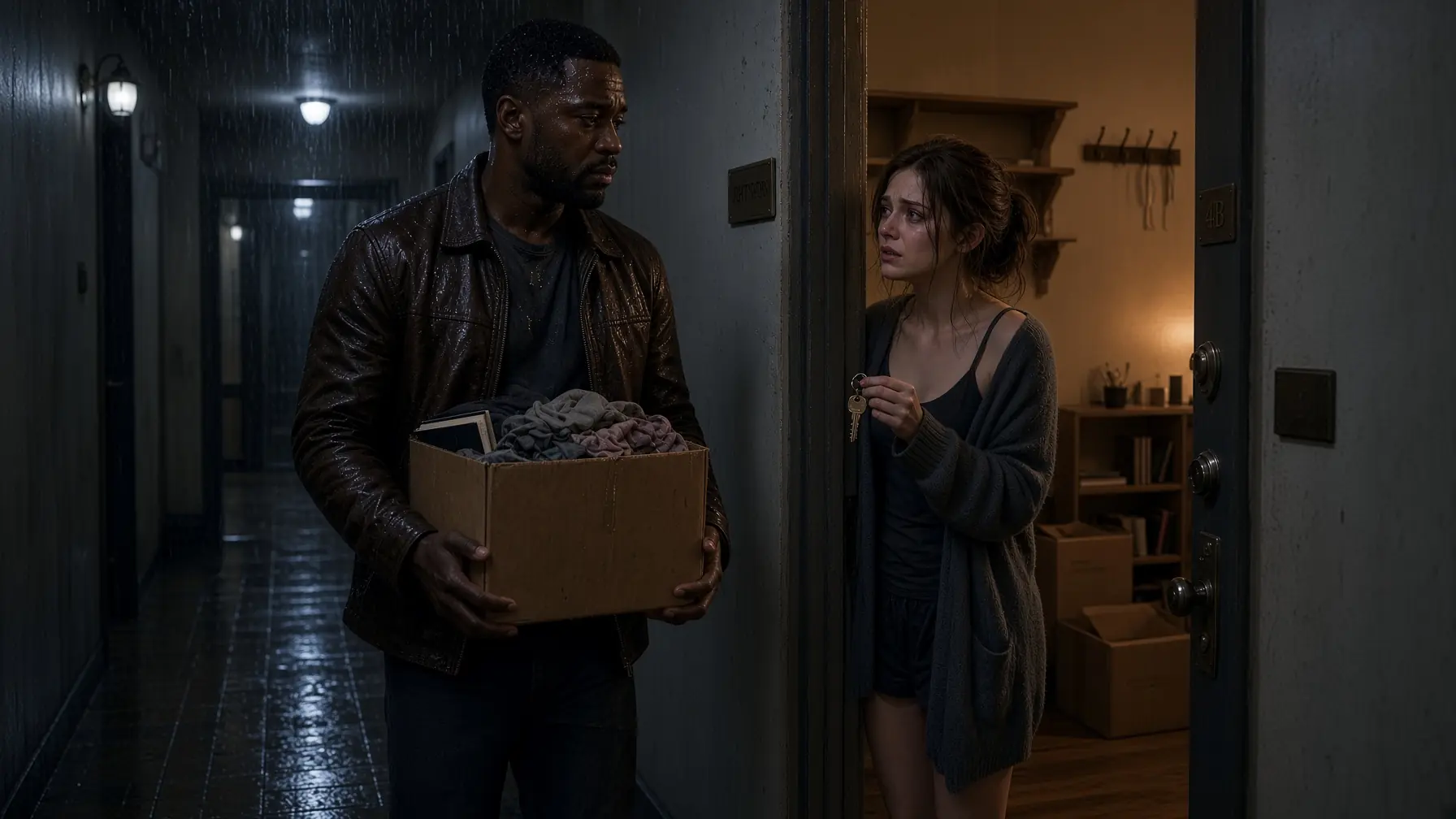
But when the door swung open, it wasn't Lena standing there. It was Mara, Lena's roommate, mascara streaked down her face, a single key pressed between her fingers. She looked at the box. Then she looked at him. She's gone, Mara whispered.
You can stay. The box had been sitting in the corner of Elijah's living room for 3 weeks. He had packed it carefully, the way he did everything, folding each item before placing it in, making sure nothing was crumpled, nothing was damaged. A ceramic mug with a faded logo, a scarf that still smelled faintly of someone else's perfume, two books with dog-eared pages he had never read, small things. The kind of things that don't mean much until they're sitting in a box waiting to be returned, and then suddenly they mean everything or nothing at all.
He wasn't sure which one was worse. Maya was on the floor behind him, cross-legged, a sheet of white paper spread across the hardwood in front of her. She was 6 years old and took drawing very seriously, pressing her crayon down with the full weight of her small hand like she was leaving a mark the world needed to remember. Where are you going, Dad? She asked without looking up.
Elijah lifted the box and turned around. Returning something to someone. I'll be back before dinner. Maya finally looked up. She studied him the way children study adults when they sense something is being left unsaid, not suspicious, just watchful.
Then she held out the drawing. It was a house, crooked walls, a lopsided roof, smoke curling from a chimney even though their apartment had no fireplace. Three large figures stood in front of it and one small one beside them. The lines were unsteady, the proportions completely wrong, but there was something about it, the way every figure stood close together, shoulders nearly touching, that made it feel full. "Take this with you," Maya said, "so you stay warm."
He took it, folded it once and slipped it into the inside pocket of his jacket right against his chest. He dropped Maya off with their neighbor, Mrs. Carter, two floors down, told her he'd be an hour at most, and walked out into the kind of rain that doesn't warn you before it arrives. The drive to the apartment took 22 minutes. He knew because he had made this drive dozens of times before, back when it was still the apartment, when it still meant something to pull up to the curb and see the light on in the second-floor window.
Tonight, the light was on, but it didn't feel like anything. He thought about Lena the way you think about a storm after it's passed, not with anger exactly, but with the particular exhaustion of someone who had spent years watching the sky and still got caught without an umbrella. She hadn't been cruel in the dramatic, obvious ways. She had been something quieter and harder to name. She had looked at the life he was building, the early mornings with Maya, the dinners that stretched late, the way he reorganized his whole professional schedule so their daughter would never come home to an empty apartment, and she had called it small.
Not out loud, but in the way she stopped asking how his day went. In the way she talked about her ambitions, like they existed in a separate country he was not invited to visit. In the way she looked at Maya, sometimes not with love, but with the careful, measuring look of someone calculating what something was going to cost them. The marriage hadn't ended with a fight. It had ended the way a battery dies, gradually and then completely, and then you realize the device has been running on nothing for longer than you knew.
He had not cried when she left. He had sat at the kitchen table and helped Maya with a puzzle and told himself that was enough. That being steady for her was enough. That needing nothing else was not loneliness, it was discipline. He was still telling himself that when he picked up the box and walked up to the second floor.
The door opened before he had a chance to knock a second time. He had expected Lena. Instead, he found Mara. He had met her before briefly at a dinner party two years ago and once more at a birthday gathering he had mostly spent watching the clock. She was Lena's roommate and beyond that he knew very little about her.
Tonight, she was standing in the doorway in a gray sweatshirt, mascara dried in thin dark lines beneath her eyes, holding a single key loosely between two fingers like she had been carrying it for a long time and had only just noticed how heavy it was. She looked at the box. Then she looked at him. "She's gone." Mara said.
The corner where her coat rack had always stood was bare. The room looked the way a conversation looks after the most important thing has already been said, hollow and waiting. Mara held out a folded piece of paper. He already knew what it was before he opened it. Lena's handwriting, clean, efficient.
The handwriting of a woman who considered sentiment a form of clutter. "Give the box to Mara. Don't make this complicated." Rain struck the window at the end of the hallway. The sound of it filled the silence where a conversation should have been.
Elijah stood at the threshold and felt something he hadn't expected to feel. Not anger, not even hurt, but the specific heaviness of a man who has spent so long holding himself together in public that he has forgotten what it costs. He was a black man standing in a hallway in the rain carrying a box of someone else's things and the only person who had thought to open the door was a woman he barely knew. He thought of the armor he had worn for years, the practiced calm, the self-sufficiency that was less a virtue and more a survival strategy. And he thought of Maya's drawing sitting against his chest warm from his body heat.
He had told himself that needing nothing was discipline. But standing there, he understood for the first time that it might also be fear. He stepped inside. There is something particular about the weight a black man carries when he is not allowed to be tired. Society had handed Elijah a set of expectations he had never asked for.
Be strong. Be stoic. Be the man who does not flinch. Who does not ask, who does not sit down in a stranger's apartment because the rain is heavy and his arms are full and he has nowhere else to be. Those expectations had not come from one place.
They had come from a hundred small moments, the way people looked at him differently when he waited outside Maya's school, the way colleagues sometimes seemed surprised when he spoke precisely about something that mattered, the low hum of having to be twice as composed just to be seen as half as capable. Elijah had internalized all of it. He had turned it into something he called strength. But strength and armor are not the same thing. And that night standing in an empty apartment while rain hit the glass, he let himself acknowledge the difference.
Walking through that door was not weakness. It was the first honest thing he had done in a long time. Not every act of courage looks like one. Sometimes it looks like a man setting down a cardboard box in the entryway of an apartment that belongs to no one, shrugging off a wet jacket and accepting a cup of tea from someone he barely knows. Sometimes the bravest thing is simply to stop performing composure for an audience that isn't even watching anymore.
If you have spent so long being the one who holds everything together that you've forgotten what it feels like to let someone hold something for you even briefly, even just for the length of a rainy evening, then you already understand what it cost Elijah to step through that door. That cost was real. And it was worth it. The apartment was quieter than it had any right to be. Mara had made tea not because anyone asked, but because it was the only thing that made sense to do when the situation made none.
She set two mugs on the coffee table and sat at one end of the couch. Elijah sat at the other. Between them, 3 ft of empty cushion held the particular tension of two people who are strangers in the technical sense, but have just been placed inside the same wound. The shelves were bare. The hooks by the door where Lena used to hang her coats were empty.
Even the faint indentations in the carpet where furniture used to sit felt like evidence of something not just absence, but the specific shape of what had been deliberately removed. Lena had not simply moved out. She had erased herself cleanly and completely the way someone destroys a document rather than leaving it where it might be found. Elijah wrapped both hands around his mug and looked at the wall. "She didn't tell you either."
He said. It wasn't a question. Mara shook her head. "I found out this morning. She sent a text at 6:00 a. m. saying she'd accepted a position in Los Angeles and was already at the airport."
She looked down at her tea. "6:00 a. m." They sat with that for a moment. Outside the rain had thickened into something that made the windows sound like they were being tested. Elijah reached into his jacket pocket, not for his phone, not for Lena's note, but for Maya's drawing.
He didn't take it out. He just felt it there folded and slightly warm and left his hand resting against it through the fabric. The messages arrived at the same time. Elijah's phone buzzed first. He glanced at the screen and saw Lena's name, the contact he hadn't yet decided whether to delete.
The message was four words, "Grow up, Elijah. Please." Across the couch, Mara's phone lit up with an email notification. She read it once, then she read it again, her expression shifting in a way that Elijah noticed but didn't immediately understand, a slow tightening like something coming into focus that she had been hoping would stay blurry. "What is it?"
He asked. Mara turned the phone toward him without a word. It was an email from Lena, intended for a production coordinator at the Los Angeles company, but with Mara's address mistakenly entered in the CC field instead of a colleague's. The body of the email was mostly logistical arrival times, onboarding paperwork, housing arrangements. But buried in the second paragraph, between a question about parking validation and a note about her first week's schedule, was a sentence that reoriented everything.
Lena had written that she had arranged for her ex-husband to come by the apartment that evening because Mara would be there and Mara was good at handling people, and it would smooth things over without Lena having to be involved. She had used the phrase, "She's reliable that way," the kind of language you use to describe a tool, not a person. Elijah set the phone down on the cushion between them. He had expected to feel anger. What arrived instead was something colder and more clarifying, the sensation of a fog lifting to reveal terrain that had always been there just hidden.
Lena had not simply left. She had staged her exit, placed two people like props in a scene she had already written, and flown to the other side of the country before the curtain came up. He was not a person she was saying goodbye to. He was a loose end she was tying off. He looked at Mara.
She was staring at the middle distance, jaw set, fingers still around her phone. And then for the first time that evening they saw each other clearly. Not as Lena's ex-husband and Lena's roommate, not as two accidents of her orbit, just as two people who had each handed their trust to the same person and had it spent on something they never agreed to fund. The knock at the door came without warning. Mara answered it.
In the hallway stood the building's landlady, a woman named Mrs. Garner, who managed the property with the particular efficiency of someone who had seen too many tenants treat apartments like borrowed things. She was holding a printed copy of a text message, Lena's name and number at the top. Mrs. Garner explained it plainly.
Lena had contacted her that afternoon to say the unit would be vacated by the end of the month. She had not mentioned Mara. She had not mentioned that the lease still had 3 months remaining. She had not, as far as Mrs. Garner could confirm, asked anyone else's opinion on the matter.
Mara stood very still in the doorway as Mrs. Garner spoke. Her shoulders were level. Her face was composed. But Elijah, watching from the couch, could see the slight movement at the base of her throat, the swallow she was suppressing, the effort it was taking to hold her expression together in front of someone she barely knew.
Mrs. Garner asked if there was anything Mara wanted to say for herself. Elijah stood up. "Give us 24 hours," he said from across the room. His voice was even.
"We'll have something in writing for you tomorrow morning." Mrs. Garner looked at him with the measured skepticism of a woman who had heard many promises in hallways. Then she nodded once and left. Mara closed the door and stood with her back to him for a moment.
When she turned around, the composure was still there, but barely the kind of barely that costs a person something to maintain. "I don't even have a lawyer." She said. "You don't need one." Elijah replied.
"Not yet." It was Mara who found Lena's post. She had not gone looking for it. She had opened the app the way you open a wound you keep forgetting is there automatically before the conscious mind can intervene. And there it was a photo taken at the airport, natural light catching Lena's face at the angle she had always preferred, a carry-on bag visible at her shoulder.
The caption read, "New chapter. New city. Finally free." Mara turned the phone face down on the coffee table. The room was quiet for a long moment.
Rain moved across the windows in slow shifting sheets. Then Mara sat down on the floor. Not the couch, the floor with her back against the base of the couch, knees drawn loosely up. It was the posture of someone who has stopped trying to look like they are managing. "Can I tell you something?"
She said. Elijah moved from the couch and sat on the floor a few feet from her, his back against the wall. He didn't say anything. He just waited. Mara looked at her hands.
"I knew Lena before you did. We met at a gallery opening, this small overcrowded thing in Williamsburg where the wine was bad and the art was worse. We were the only two people there who admitted we didn't actually know what we were looking at." She almost smiled at the memory, then didn't. "I thought she was remarkable.
I thought she saw things the way I did." She let that sit for a moment. "She knew how I felt about her. I never said it directly, but she knew people like Lena always know those things, and she never did anything about it, which I told myself meant she was being respectful. But what she was actually doing was keeping it in reserve, like something she could use later if she needed to.
Mara's voice stayed level, but the effort was visible. The last 2 years, every time she needed help covering rent or someone to talk to at 2:00 in the morning or someone to hold things together when she was falling apart, I was there. Because I thought that was what caring for someone looked like. I thought I was choosing to be generous. She stopped.
I wasn't choosing anything. She had already decided what I was for. Elijah said nothing for a moment. He understood not the specific shape of what Mara had experienced, but the structure underneath it. The particular exhaustion of having been loved at someone else's convenience.
Of having your devotion treated as a resource rather than a gift. She did the same thing to me, he said finally. Just a different version. Mara looked at him, not with the searching look of someone wanting to be consoled, with the direct tired look of someone who has just recognized a fellow traveler on a road they had hoped they were walking alone. There are people who move through other lives the way weather moves through a landscape, reshaping what they find, then continuing on as though the reshaping was simply what wind does.
Lena was not a villain in the classical sense. She was not calculating in the way a predator calculates. She was something more ordinary and in some ways more damaging, a person who had never learned to sit with the weight of what her choices cost others. So she arranged things so that weight would always fall somewhere else. She called it ambition.
She called it freedom. She called it finally being who she was meant to be. None of those things were untrue. But none of them explained why she needed other people's trust and steadiness and silence to accomplish them, why her liberation always seemed to require someone else's cage. The most dangerous kind of selfishness is the kind that doesn't recognize itself.
The kind that operates beneath a convincing surface of warmth, of charm, of I just need you to understand. You can spend years trying to reach someone like that. Years adjusting yourself, years filing down your own edges to fit the shape of what they need and they will never notice because they were never looking. Your kindness is not a default setting others are entitled to access. It comes from somewhere real and specific in you.
And it deserves to go somewhere real and specific in return. Recognizing that someone has been treating your generosity as infrastructure, as something built for their use, maintained at your expense, is not bitterness. It is clarity. And clarity, however late it arrives, is always worth something. Because you cannot begin to build anything honest until you can see the ground you are actually standing on.
They stayed on the floor. Not because it was comfortable, the hardwood was cold and the baseboard behind Elijah's back had a loose edge that pressed into his shoulder, but because neither of them made a move to get up. And after a while, the floor became the appropriate place to be. Some conversations belong at tables. Some belong on couches.
The ones that happen after everything has finally been named tend to happen closer to the ground. The rain was still going. It had settled into the kind of steady, indifferent rhythm that stops feeling like weather and starts feeling like the sound of time passing. Mara was the one who broke the silence, but not with words. She reached over and turned her phone face up, looked at Lena's airport photo one more time, the easy smile, the carry-on bag, the caption, and then she set it back down face down deliberately with a finality that was quiet but absolute.
"I keep waiting to feel something simpler," she said, "like just angry or just sad, but it's all of it at once and I can't tell where one ends and the other starts." Elijah nodded slowly. "That means it was real to you. That's why it's complicated." Mara looked at him.
"Was it real to you with her?" He thought about it honestly, the way he hadn't let himself think about it in the weeks since the marriage had ended. "Parts of it were. Early on there were parts that felt very real." He kept his voice level.
"But I think I spent more of it trying to make it real than actually living inside it. There's a difference." "Yeah." Mara said quietly. "There is."
They sat with that. Outside a car moved slowly through the wet street below its headlights sweeping briefly across the ceiling. Then Elijah said, "Do you have any documentation, lease agreement, payment records, anything with both your names on it?" Mara looked at him. The shift in register from the raw to the practical seemed to catch her off guard for a moment.
Then something in her expression reorganized itself. Not relief exactly. More like the recognition that there was ground beneath her feet after all and someone was pointing at it. "My laptop," she said and got up. They worked at the kitchen table.
Mara pulled up the original lease both her name and Lena's signed 14 months ago with a termination clause that required written notice from all parties no fewer than 60 days in advance. Lena had provided neither the required notice period nor Mara's co-signature. She had sent a text to the landlady and boarded a plane. Elijah read the clause twice then leaned back in his chair. In his professional life he spent his days working with restoration contracts, documents that govern the careful, methodical repair of damaged structures.
He understood the language of obligations and timelines and what happened when someone deviated from agreed terms without authorization. He was not a lawyer, and he told Mara that plainly. But he knew enough to recognize when someone had made provable error, and he knew how to write a letter that said so without leaving room for negotiation on the central facts. "Walk me through every payment you've made in the last 6 months," he said. "Rent, utilities, anything you can show came from your account."
Mara pulled up her banking app and started reading figures aloud. Elijah wrote them down in a column on the back of an envelope he found in a kitchen drawer, the only paper immediately available, building a simple, clear record of her financial presence in the apartment. His handwriting was small and precise, the kind that comes from years of annotating technical documents in the margins. They worked for nearly 2 hours. Mara found emails between herself and Mrs.
Garner about a maintenance request from 3 months ago, correspondence that established her as an active, communicating tenant, not a secondary occupant. Elijah used these to anchor the letter's opening paragraph. When the draft was done, he read it aloud to her once, slowly stopping at each point to explain what it established and why. He was not performing competence for her benefit. He was making sure she understood every sentence before it went anywhere because understanding it meant she could defend it herself if she needed to.
Mara listened carefully. She asked two questions, good ones, precise ones, and they adjusted two sentences accordingly. "Okay," she said when they were finished. "Okay," he agreed. She called Mrs.
Garner at 10 minutes to 11:00 at night, which was late, but the circumstances were exceptional, and Mrs. Garner, to her credit, answered. Mara stood in the kitchen while she spoke, one hand resting on the counter for balance. Her voice was not loud. It was not aggressive.
It was simply steady. The voice of a woman who had spent the last 2 hours understanding exactly what she was entitled to, and had decided to say so clearly. She laid out the relevant lease terms. She noted the absence of proper notice. She cited her documented payment history.
She mentioned that she had written documentation of all of the above and would have it to Mrs. Garner's email before midnight. Mrs. Garner listened. There was a long moment on the line.
Then she said she would review the documents and respond in the morning before making any further decisions about the unit. Mara ended the call and set the phone down on the counter. She stood there for a moment with her hand still resting flat on the surface, and Elijah watched her breathe one slow breath, then another. The kind of breathing that isn't about air, but about recalibrating. "You didn't need me to do that," he said from across the table.
Mara turned around. "No," she agreed. "But I'm glad you were here." They sent the email at 11:47. Mara typed it.
Elijah proofread it once more before she hit send, and at the bottom they attached every document they had compiled: the original lease, the payment records, the maintenance correspondence with Mrs. Garner, and a clear summary of the specific clauses Lena had violated by acting unilaterally. It was not a threat. It was a record, precise, complete, and impossible to dismiss. The box of Lena's belongings was still sitting near the entryway where Elijah had placed it when he first came in.
At some point during the evening, it had stopped being the central object in the room and become something peripheral background furniture, like a thing that had already been dealt with and simply hadn't been moved yet. Elijah picked it up and carried it to the far side of the entryway, setting it against the wall beside the door. The gesture was small. Mara noticed it anyway. "What are you going to do with it?"
She asked. "Mail it." He said. "Let her deal with the postage." Something crossed Mara's face that wasn't quite a smile and wasn't quite sadness, but existed in the space between them.
"That's the right answer." She said. They moved back to the couch. The urgency of the last two hours had settled into something quieter. Not the uncomfortable quiet of two strangers, but the particular quiet of two people who have been through something together and are still deciding what to make of it.
Mara asked about Maya. It wasn't a polite question, not the kind you ask to fill silence. She asked it directly like she actually wanted to know and Elijah found himself answering in a way he rarely did with people who inquired about his daughter. He talked about the drawings. About the way Maya narrated her artwork while she made it providing detailed explanations of houses and people and events that existed entirely in her own imagination.
About the puzzle they had done together the night Lena left neither of them speaking, just fitting pieces together on the kitchen floor until it was done and bedtime was long past. He reached into his jacket and took out the drawing, the house, the crooked roof, the four figures standing close together. Mara took it carefully the way you handle something someone has kept close to their body. She looked at it for a long time. The three large figures, the one small one.
The lopsided chimney releasing a curl of smoke from a building that had no fireplace. "She drew three adults." Mara said. Elijah had noticed that, too. He had not said anything about it to anyone.
"She has a big imagination," he said. Mara handed the drawing back. Their fingers overlapped briefly at the edge of the paper, and neither of them commented on it. It was close to 2:00 in the morning when Mara's eyes started losing the battle with exhaustion. She had been sitting upright for the last 20 minutes by will alone, and the will was clearly running out.
She tipped slowly sideways until her head came to rest against Elijah's shoulder. Not deliberately, not with intention, just the way the body moves when it has finally decided it is done performing alertness. Elijah sat still for a moment. He was aware of her breathing evening out, aware of the weight of her head, aware of the rain still moving against the glass in long unhurried intervals. Then he stood up carefully so she didn't startle and took the folded blanket from the arm of the couch.
He shook it open and draped it over her shoulders. She stirred slightly but didn't wake. "Get some rest," he said quietly. "There's still tomorrow." He took his jacket from the back of the chair and spread it over the length of the sofa.
It wasn't long enough to cover him properly, but he had slept in worse conditions and the discomfort felt strangely like the right kind of honesty. He lay down and looked up at the ceiling. He could have done something different in that moment. He was aware of it, the specific gravity of two people who have been through something together late at night in an empty apartment, the ease with which closeness can become something it isn't ready to be. He had felt it.
He was fairly certain she had, too. But Elijah had spent the better part of a decade watching what happened when you built something on top of pain before the pain had been properly acknowledged. He had watched it with Lena, and before Lena, and in the marriages of people he knew and respected. The architecture always showed the flaw eventually. He did not want that with Mara, and the fact that he already felt strongly enough to think in terms of what he did and didn't want with her told him that tonight was not the night to act on it.
Whatever this was, whatever it might become, it deserved better ground than a rainy evening in someone else's wreckage. He closed his eyes. He thought about Maya's drawing. Four figures in front of a house. He thought about the word tomorrow and how rarely it meant something specific and how tonight it did.
The email from Mrs. Garner arrived at 8:14 the following morning. She had reviewed the documents. The original lease terms were clear. She would not be proceeding with the vacate notice as submitted by the departing tenant.
Mara's tenancy remained valid through the end of the original lease term. The formal documentation they had sent the previous night, the lease violations, the payment records, the evidence of Lena's unilateral breach had also been forwarded to Lena directly with a note from Mrs. Garner that she would be pursuing the outstanding lease obligation through proper channels if it was not settled within 72 hours. By early afternoon, Lena had transferred the full remaining balance of her lease share, three months delivered without comment, and without a reply to either of them. It was in its own way the most honest thing she had done throughout the entire situation.
The acknowledgement that comes not from conscience, but from consequence. The box was dropped at the post office that same afternoon. Elijah paid the shipping. Mara wrote Lena's Los Angeles address on the label in clear, unhurried handwriting. They did not discuss the contents of the box.
They did not discuss Lena at all. The box was taped, labeled, handed across the counter, and that was the end of it. Within two weeks, Mara had found a new roommate, a graduate student named Diane, quiet and reliable, who paid her share on time and kept mostly to herself. The apartment, which had felt like a site of damage for the better part of a month, became simply a place where Mara lived again. The rooms filled back up at their own pace with Mara's own choices, and the shape of what had been removed stopped being the first thing you noticed when you walked in.
The days after that were ordinary in the way that only days following extraordinary nights can be. Elijah texted Mara 3 days later. Not about the lease, not about Mrs. Garner, not about anything that required resolution. He asked whether she preferred or tea.
She replied coffee, but only if it's strong enough to mean it. Why? He replied, "No reason. Useful information." Two Saturdays later, they met at a small place near Prospect Park, a cafe that had no particular design ambition beyond a good espresso machine and tables that didn't wobble.
They sat for 2 hours. They talked about their work, about Brooklyn in the winter, about the particular loneliness of being competent in a crisis, and not knowing what to do with yourself when the crisis is over. They talked about things that had nothing to do with Lena and everything to do with who they were when nobody needed anything from them. It was not a date. It was not not a date.
It was two people choosing with full awareness and no urgency to spend time in each other's company. That choice felt different from any choice either of them had made in a long time, precisely because nothing about it was designed to fill a gap or smooth something over. It was just, "I want to be here. Do you?" They both did.
The first time Elijah brought Maya to meet Mara was a Sunday in early spring. He had told Maya they were going to see a friend, which Maya accepted without interrogation. She was a child who cared less about context than about what was going to happen when they got there. What happened was that Mara opened the door, and Maya looked up at her with the frank assessing gaze of a 6-year-old conducting an evaluation and then said without preamble, "Do you know how to draw?" Mara crouched down to Maya's eye level.
"A little." She said. "Do you?" Maya considered this a moment weighing the claim. "I'll show you."
She decided. They They spent the next two hours on the floor of Mara's apartment, the same apartment reordered now different in the small ways that come from living somewhere on your own terms. Maya produced seven drawings. Mara contributed four, which Maya critiqued with the seriousness of a senior colleague reviewing a junior's portfolio. Elijah sat on the couch above them drinking coffee that was strong enough to mean it watching the two of them argue pleasantly about whether a dog needed four legs or whether three was fine if it was a fast dog.
He thought about the drawing Maya had given him tucked now into the frame of the mirror in his bedroom where he had placed it deliberately in a spot he would see every morning. The house with the crooked chimney. Three large figures and one small one. He had never asked Maya why she drew three adults. He thought he was beginning to understand.
Years moved the way years do when they contain things worth keeping, not quickly, not slowly, but with the accumulated weight of ordinary days that turn out in retrospect to have mattered more than they seemed at the time. There were hard days in those years. There were nights when Elijah woke at 3:00 in the morning with the nameless worry that lives in the chest of every single parent. There were moments when Mara and Elijah had to navigate carefully and honestly the complicated territory of building something new without pretending the old damage wasn't there. They did not always get it right, but they kept choosing to try and they kept telling each other the truth and it turned out those two things together were sufficient foundation for most of what they needed to build.
One evening, Maya was nine by then, nearly 10 already, announcing plans for a career that changed weekly. Elijah stood in the doorway of the living room of the house they had made their own and watched Mara and Maya sitting together on the floor. They were drawing. This was not unusual. What stopped him was the paper spread between them, a house rendered with considerably more skill than the original, but recognizably in the same tradition.
Four figures stood in front of it close together, shoulders touching. The lines were steadier now. The house was larger. The chimney was still slightly crooked because Maya had decided years ago that chimneys looked better that way and had never seen a reason to change her position. Elijah stood in the doorway for a long time.
He thought about the night he had driven through the rain with a cardboard box and an errand that was supposed to take 5 minutes. He thought about a door opening onto an empty apartment and a woman with mascara on her face and a single key. He thought about a floor and a kitchen table and an email sent just before midnight and a blanket laid over sleeping shoulders and a word tomorrow spoken quietly into a dark room and meant. He had come that night to return something that no longer belonged to him. He had not known, standing in that hallway, that what he was actually doing was finding his way back to something he had never quite had before.
Not a version of what he'd lost, not a replacement or a consolation, but something built from different materials entirely, honesty and patience and the willingness to wait for the right moment rather than clutch at the available one. He had found it. They had built it. And it was still standing. There are doors that close in your life that feel in the moment like the end of the architecture, like the building itself is coming down and you are standing in the rubble with nothing but the habit of surviving.
What you cannot see from inside that rubble is what gets built on the cleared ground afterward. The life that finds you after a real ending is not a consolation prize. It is not the universe apologizing. It is simply what becomes possible when you stop spending your energy maintaining something that was never as solid as you needed it to be. When you put down what isn't yours to carry.
When you show up at the right door, even if you arrived there by accident, even if your arms were full of someone else's things, even if all you had in your pocket was a child's drawing of a house you didn't yet live in, the best things tend to arrive like that. Not announced, not scheduled, not preceded by any of the signs you were taught to watch for. Just a door opening.
Just someone on the other side who isn't who you expected. Just the rain and the choice of whether to step in from it. Step in.