Caleb Morrison grabbed his daughter's outstretched hand and yanked it down fast, hard, desperate, like she just pointed a loaded guns at someone. Ava, stop. But the damage was done because the woman had already turned around and she was staring straight at them. 30 seconds ago, his 7-year-old daughter had looked at a complete stranger, a woman surrounded by bodyguards, carrying a bag that probably cost more than his truck and announced to the entire park. Dad, marry her.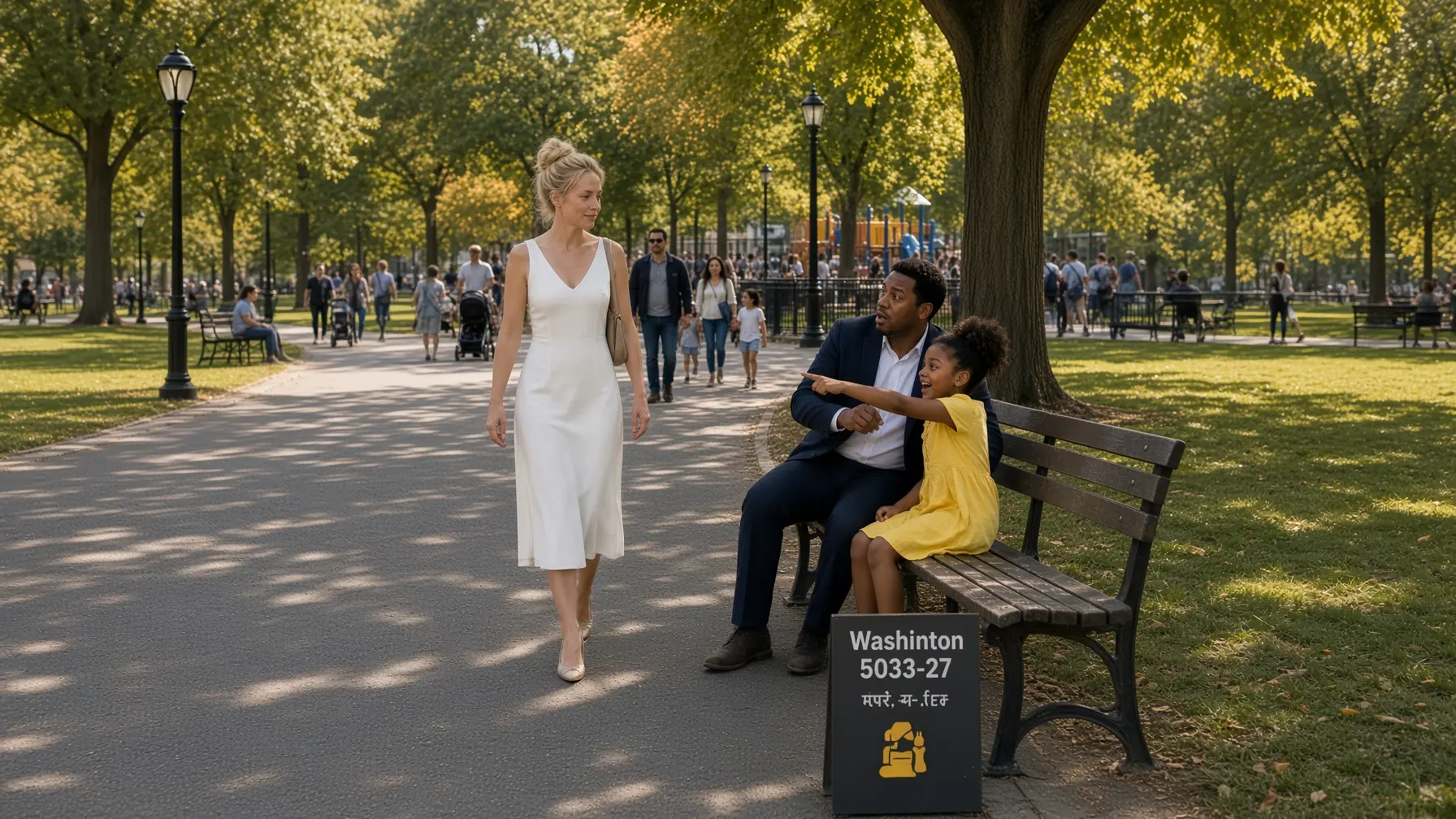
What Caleb didn't know yet was that this stranger already knew his name. Caleb Morrison was not supposed to be doing this alone. That was the thought that hit him every single morning. Not like a whisper, not like a gentle reminder, but like a fist, like something physical that found the same bruise in the same spot every day without fail. He'd wake up before the alarm, lie there in the dark of a bedroom that used to smell like jasmine and now smelled like nothing.
And for exactly 4 seconds, he'd forget. 4 seconds of peace. Then it would come back. She's gone. And then he'd hear Ava down the hall, the soft creek of her mattress.
The shuffle of small feet finding the floor. And Caleb would close his eyes, breathe once through his nose, and make himself get up. Not because he wanted to, not because the world felt worth facing, because she needed him to. That was the only math that still worked in his life. He'd grown up in southeast Washington DC in the kind of neighborhood where ambition was either your armor or your enemy.
His mother, Doris Morrison, had raised three boys in a rowhouse on Naylor Road with a radiator that only worked when it felt like it and a front door lock that required a specific four knock rhythm to open from the outside. She worked double shifts at a hospital laundry facility for 22 years. never complained, never explained, just worked. Caleb was the middle son, which meant he was invisible in all the useful ways and responsible in all the exhausting ones. His older brother, Darnell, got the attention. His younger brother, Marcus, got the grace.
Caleb got the expectation, do right, don't embarrass us, hold things together. He learned early that feelings were something you processed in private and presented in public as competence. By 19, he had a junior technician certification. By 21, he was lead repair specialist at a commercial kitchen equipment company, the kind of work nobody thinks about until a restaurant's walk-in freezer goes down at 11p hem on a Friday and $10,000 of food is at risk. He'd show up in the rain.
He'd show up at midnight. He'd diagnose the problem in 12 minutes, flat, and fix it in 40. And the restaurant manager would shake his hand and say something like, "Good, man." And Caleb would nod and drive home and feel nothing in particular because feeling things in particular wasn't really part of the plan. Then he met Diane.
He met her at a church fundraiser he didn't want to go to, organized by a cousin he barely knew in a church basement that smelled like old carpet and lemon pledge. He was there to drop off a food donation from his mother and leave within 10 minutes. Diane was standing at the drink table pouring lemonade into small paper cups with the focused on hurried attention of someone who took small tasks seriously. She had a yellow ribbon in her hair and paint on her left thumb she hadn't noticed yet. And when Caleb accidentally knocked an entire stack of cups off the edge of the table, reaching past her for a napkin, she looked at the scattered cups on the floor, looked at him, and started laughing.
Not politely. Not the kind of laugh people give you to make you feel better. Genuinely laughing like it was the funniest thing she'd seen all week. He'd never married a laugh before. But he decided in that basement watching her pick up cups off the floor while still laughing.
That if he ever did get married, it would be to someone who laughed like that. They dated for 14 months. He proposed in the kitchen of her apartment while she was cooking rice. No restaurant, no crowd, no ring hidden in a dessert. He just turned off the burner, took both her hands in his, and told her she was the only person he'd ever felt completely known by, and he didn't want to spend a single unnecessary day not being her husband.
She said yes before he finished the sentence. They were married the following spring. Ava was born 18 months later, 7 lb 3 o with a full head of dark hair and her mother's eyes. Caleb held her in the delivery room and didn't cry because Caleb didn't cry. But something happened in his chest that he had no previous language for.
Something rearranged. Something that had always been slightly offbalance finally clicked into place. He thought, "This is what I was supposed to be." He had 3 years. That's all he got.
Dian's diagnosis came on a Tuesday in March, 14 months after Ava was born. They'd noticed a lump. They'd told themselves it was nothing. They'd gone to the appointment together. Ava strapped into her stroller, cheerfully destroying a rice cracker, while a doctor in a white coat used words like aggressive and staging and options.
Caleb sat perfectly still through the entire appointment. He asked the right questions. He wrote things down. He thanked the doctor with a firm handshake. He got to the parking garage, strapped AA into her car seat, closed the back door of his truck, walked around to the driver's side, sat down, and pressed his forehead against the steering wheel.
He stayed like that for 6 minutes. Then he started the truck and drove home. That was how Caleb Morrison handled catastrophe. Diane fought for 22 months. She fought with everything she had with chemo and radiation and clinical trials and the stubborn furious refusal of a woman who had too much to live for.
She had good weeks, she had terrible weeks. She had one stretch of 3 months where they almost let themselves believe. Caleb worked every shift he could get. He arranged his hours around her treatments. He learned which nurses were which and remembered their names and brought coffee on the hard days.
He read to Ava every night when Diane was too tired doing all the voices, even the ridiculous ones, because Diane said it made her happy to hear them laughing from the other room. He didn't let Ava see him break. He was very careful about that. He broke in the parking lots of hospitals. In the shower at 5:00 a. m. in the truck on the way to Jobs, pulled over on the side of the highway for 4 minutes at a time, hand pressed flat against the dashboard like he was trying to hold something down.
When Diane died, Ava was three years old. Ava remembered her mother the way very young children remember things in fragments, in feelings, the smell of a particular lotion, a song, the specific warmth of a specific kind of hug. She didn't have words for the loss yet. She just had a question. She asked Caleb every few weeks for the first year, where did mama go?
And every time Caleb would pull her into his lap, look her in the eye, and say the truest thing he knew. She loved you more than anything in this world. And she's somewhere she can still see you. She doesn't miss a single thing. He said it until he believed it.
3 years after Dian's death, Caleb had built something that functioned like a life. He had a two-bedroom apartment in Silver Spring. Marilyn the second bedroom painted lavender because Ava had spent 20 minutes at the hardware store debating between lavender and regular purple before making her final decision with great ceremony. He had a truck with 140,000 miles on it that he kept running through a combination of skill and stubbornness. He had a good supervisor at work named Ry who had stopped pretending Caleb ever took breaks and had instead started leaving protein bars on his toolbox.
He had a neighbor named Mrs. Chen who watched Ava on the rare double shift nights and taught her how to fold paper cranes and always sent them home with a container of soup Caleb had specifically said she didn't need to make. He had a daughter who was despite everything extraordinary. Ava Morrison was 7 years old and already operating at a frequency most adults couldn't access. She was quiet in the way rivers are quiet.
There was constant movement under the surface, and when she finally spoke, it was with a directness that caught grown people off guard. She noticed things. She remembered everything. She asked questions that required Caleb to think for a full 30 seconds before answering. She was also, according to her teacher, Miss Patterson, withdrawing lately, getting quieter at school, playing alone at recess more than she used to, completing her work perfectly, but not raising her hand.
Miss Patterson had called Caleb about it the previous week. She's not in trouble, Mr. Morrison. She's doing beautifully academically. I just I want to make sure she has support.
She seems like she's carrying something she doesn't know how to put down. Caleb had thanked her, hung up, and sat at his kitchen table for a long time, looking at nothing because he knew exactly what his daughter was carrying. She was carrying it the same way he'd learned to quietly, efficiently, without making it anyone else's problem. That Saturday, because the week had been relentless, and because Ava had been asking for 3 days, and because sometimes the only thing you can do is give a child some open space and let them run, Caleb took her to the park. It was one of those October afternoons that couldn't decide what season it was.
The trees were just starting to turn amber and rust at the edges, but still mostly green, and the air had specific clean sharpness that hits the back of your throat when summer finally surrenders. The park was full in the unhurried way weekend parks get full. Families, joggers, an old man feeding pigeons with the focused devotion of someone fulfilling a daily obligation. A group of collegeage kids throwing a Frisbee with more optimism than coordination. Caleb found a bench close enough to the playground to watch Ava, but far enough to feel like he'd exhaled for the first time all week.
He had a coffee he'd picked up on the way. Already half cold, held in both hands like it was still worth something. His back hurt from a crawl space job on Friday. His phone had 17 unread messages he'd promised himself he'd handle on Monday. Ava ran straight for the swings.
She always went to the swings first. For a while, everything was ordinary. He watched her pump her legs, chasing altitude with the single-minded focus only children on swings possess. He drank his cold coffee. A dog ran past with a tennis ball.
Someone's toddler fell down, paused to evaluate the situation and decided not to cry. He was thinking about nothing specific. He was thinking about everything vaguely. He was doing the particular kind of tired man thinking that moves slow and doesn't land anywhere. Then Ava stopped.
She didn't slow down gradually. She dragged her feet and stopped. The swing jerking forward as she stood up and pointed. The pointing was specific, deliberate, the way Ava did most things. She was pointing at a woman who had just appeared at the edge of the park walking and along the path that cut between the trees and the playground. not part of the park scene, more like someone passing through it.
She was dressed in a camel-coled coat that moved when she walked, like it had been designed specifically for how she moved. She was looking at her phone and then not looking at her phone and then at the trees, and there was something in the way. She was walking, a strange directionless quality that didn't match her clothes or her posture or the polished certainty she seemed to project from 10 ft away. Behind her at a respectful distance were two men in dark jackets who were clearly not there for the Frisbee. Ava dropped her arm.
Caleb was already moving toward her because he'd seen the look on his daughter's face. And the look said something had just happened inside her that she was about to put into words. He reached her in six steps. He crouched down to her level. What's up, bug?
She looked at the woman. She looked at Caleb. Dad, marry her. The words were so calm, so clear. So Ava, he felt something knocked lux loose in his chest that had no business being by a seven-year-old in a park on a Saturday afternoon.
And then because Caleb was human because he was tired, because he was a 32-year-old man crouched in the grass being ambushed by his daughter's cosmic certainty, he did the thing that parents do when they have absolutely no idea what to say. He laughed. It came out wrong. It came out too loud and too short. The laugh of a man who's been caught off guard and is trying to disguise it as casual.
People don't just marry strangers. Ava, she didn't look at him. She kept looking at the woman. She looked sad. He opened his mouth.
He closed it. He looked at the woman really looked for the first time instead of just registering her as the direction his daughter was pointing. And something about what Ava said landed on him like a key in the wrong door that somehow still turned. The woman wasn't sad in any obvious way. She wasn't crying.
She wasn't slumped. She was collected, composed, expensive. She was the picture of a person who had arranged themselves very carefully. But but she was standing at the edge of a playground full of children and families and the entire loud, warm chaos of a Saturday afternoon. And she wasn't inside it.
She was outside it, slightly separate, looking in from a specific kind of distance that Caleb recognized in his blood. Because he'd stood in that exact same distance, he stood up. He took Ava's hand. Come on, let's go to the climbing frame. She went with him.
She didn't argue. But when he glanced back 3 minutes later, she was looking over her shoulder toward where the woman had been. And that should have been the end of it. That should have been a funny story Caleb told his brother Darnell over ofund while washing dot what Ava said today man I almost died and nothing more but then the woman half turned and Caleb who was not looking who was absolutely not looking looked and she saw him not the way strangers glance at each other across a park not the reflex eye contact you make and immediately dissolve she looked at him like she'd heard something like a sound had carried across the distance that shouldn't have been audible. One of the men in dark jackets moved forward slightly.
She raised a hand, a small gesture, and he stopped. Then she turned back to the path and kept walking. Caleb turned back to his daughter. Ava was on the climbing frame, moving with the confident chaos of a child who trusts that she will not fall. But she glanced at her father with an expression he'd seen before. steady, patient, like she was waiting for someone to figure out something she already knew.
He said nothing. He sat on the edge of the climbing frames platform, forearms on his knees, coffee in hand. He told himself the thing Ava had said was nothing. Kids said impossible things. Kids believed in things adults had learned to stop believing in because adults had been burned by the believing.
He told himself that for the rest of the afternoon, he told himself that on the drive home, one hand on the wheel, Ava asleep in the back seat before they even hit the highway, he told himself that in the kitchen reheating leftovers, standing over the stove in the thin light of a Saturday evening, he told himself that right up until the moment he got into bed in the dark that still smelled like nothing and stared at the ceiling, and then he stopped telling himself things and just lay there quiet while three words his daughter had said she looked sad sat in the center of his chest and refused to be reasonable. He carried it for four days. Four days of jobs and pickups and homework and dinner and the thousand small transactions of a life held together by routine. He didn't think about it consciously. It was like it was running in the background, a program he hadn't opened but couldn't close.
On Thursday morning, he drove Ava to the appointment he'd made with the child Fosb his daughter's school had referred him to. He'd made the appointment the same evening as the phone call from Ms. Patterson because whatever else Caleb was or wasn't, he was the kind of father who made the appointment and kept it. The practice was in a building he'd never been to in a neighborhood just east of downtown, third floor, suite 310. The directory said the elevator smelled like new carpet.
The waiting room had good lighting and the specific quality of quiet that someone had worked hard to create. The receptionist looked up, smiled at Ava, and said the specialist would be right out. Caleb sat. Ava sat next to him, feet not touching the floor, pulling at a loose thread on her coat sleeve. A door opened.
Caleb looked up. Every muscle in his body processed the information before his brain did. It was her, the woman from the park. She was dressed differently, simpler, more deliberately professional, but her face was the same. The composure was the same.
The way she held herself was the same. She looked at him. He looked at her. Neither of them spoke for one full second. Then Ava looked up and smiled.
Not a surprised smile. Not a what are you doing here? smile. A smile that said, "Of course." The woman recovered first. She crossed the room in a few steps and crouched down to Ava's level smoothly, naturally without performing it.
You must be Ava. I'm Dr. Whitmore. I've been looking forward to meeting you. Ava looked at her with those calm assessing eyes.
Do you remember me? Something flickered across the woman's face. Should I? We saw you at the park. Ava said it without guilt, without calculation.
Just a fact. You looked sad. The room was very quiet. The woman, Dr. Whitmore stayed crouched for a moment longer than was strictly professional.
His hands felt strange at his sides. Yeah, he said. Yeah, let's do that. They went through the door. And Caleb Morrison, who had spent three years constructing a life in which he did not get surprised, walked into a room that would take everything he'd built and quietly, irrevocably, begin to change it.
He just didn't know that yet. He was still trying to figure out why his daughter was smiling like that. The session lasted 55 minutes. Caleb sat in a chair near the door while Dr. Whitmore worked with Ava.
He'd expected forms, clinical observation, maybe some guided activity where she took notes on a clipboard and spoke in the measured tones of someone completing a professional assessment. That's not what happened. What happened was that Natalie Whitmore sat on the floor, not in a chair, not behind a desk. She sat on the floor across from his daughter with a small collection of objects. between them wooden blocks, a few figures, some cards with images, and she talked to Ava the way people talk when they're genuinely interested in what the other person is going to say. Caleb watched.
Ava started quiet the way she always did in new situations, testing the ground before committing weight. She answered in short sentences. She watched Dr. Whitmore carefully. And then something happened around the 20 minute mark.
Doctor Whitmore picked up one of the small figures, a simple wooden shape, nothing elaborate, and said, "What do you think this person is thinking right now?" Ava looked at it for a moment. She's thinking about something she left somewhere, but she's not sure if she should go back and get it. Dr. Whitmore looked at the figure.
Why isn't she sure? Because going back feels scary, but leaving it feels worse. Nobody spoke for a moment. Then Dr. Whitmore set the figure down carefully and said, "That's a very honest answer.
It's what the figure told me. I believe you." Caleb looked at his hands. He believed her, too. 40 minutes into the session, Ava had shown Dr.
Whitmore her drawing she'd brought in her backpack, a habit she'd developed of carrying paper and markers everywhere. Another trait Caleb had never discouraged. The drawing was of three people standing in a line. The first two were clearly Caleb and Ava. He could tell by the truck.
Ava had drawn next to them, a detail she always included. The third figure was newer, added recently, a woman in what appeared to be a long coat standing slightly to the side of them, but still inside the frame. Dr. Whitmore looked at the drawing for a long time, and she looked at Caleb. He looked back.
I didn't put her up to this, his expression said. I have no idea what is happening. Dr. Whitmore looked back at the drawing. Who's this?
She asked Ava. I don't know yet, Ava said, but she belongs there. After the session, doctor Whitmore stepped out briefly and Ava went to use the restroom. Caleb stood in the office, not sitting, too unsettled to sit, looking at a framed print on the wall that he wasn't actually seeing. When the door opened, he turned.
She stood in the doorway. Professional distance, appropriate distance. She's perceptive beyond her age. What she's carrying emotionally is real, but she's not in crisis. She's grieving still, and she's doing it in a very structured inward way.
Like her father, he didn't plan to say it. It came out before he could decide. Something happened at the corner of her mouth. Not quite a smile, something more careful. I'd like to see her twice a month if you're open to it.
I think she needs a space where she's allowed to put things down. She works very hard to hold things up. She's seven. Yes. He rubbed the back of his neck, looked at the floor, then back at her.
Dr. Whitmore. Natalie. A pause. Caleb.
She nodded. He looked at her directly. The way he rarely looked at people directly because he'd learned that that people directly meant letting them see that you were looking. The park you saw us. I did.
She said something. I know. I'm sorry. She's She says things. She doesn't mean she meant it.
Her voice was even. Not warm, not cold. Just true. Children her age don't gesture at strangers in parks unless something makes them do it. She's reacting to something she read.
Whatever she read, she was probably right. He stared at her. Okay, he said finally. That's the most unsettling thing anyone has said to me in a long time. The corner of her mouth moved again.
Twice a month, she said. First and third Thursday, I'll have the front desk send the calendar. Yeah, he said. Okay. The door to the restroom opened and Ava came out, looked at both of them standing there and then looked at Caleb with an expression that was entirely too composed for a 7-year-old.
"Ready?" Caleb said. "Mhm," he held out his hand. She took it. They walked toward the elevator.
At the hallway bend, Ava glanced back once. Then she looked up at her father. "I like her," she said. Caleb pressed the elevator button. "I noticed.
Did you?" He looked down at his daughter. She was already looking forward. He pressed the button again, though it was already lit because sometimes a man just needs something to do with his hands. The elevator came.
They got in. The doors closed. And in the narrow quiet of that elevator, with his daughter's hand in his and the memory of a woman's gaze sitting somewhere in the center of his chest, Caleb Morrison, who had spent 3 years being very good at not feeling things in particular, felt something. He didn't name it. He wasn't ready to name it.
But it was there, and it was not nothing. The first Thursday came faster than Caleb expected. He'd spent the week telling himself it was just an appointment, a clinical appointment for his daughter, arranged by her school, staffed by a professional. He'd dropped Ava off at school, handled two service calls, eaten lunch standing over his truck's tailgate in a parking lot in Rockville, and driven home to shower and change before pickup. He'd done all of it efficiently, mechanically, the way he did most things.
He did not think about Natalie Witmore. He thought about her constantly, not in the way that embarrassed him, or not only in that way. He thought about her the way you think about a puzzle that doesn't fit any category you already have. She was a child development specialist in a quiet suite on the third floor of a professional building. She sat on the floor with a 7-year-old and talked about wooden figures with the patience of someone who had nowhere else to be.
She had two bodyguards at the park on a Saturday. She'd told him his daughter was right without flinching. Those things didn't fit together into any coherent picture. And Caleb Morrison was a man who needed things to fit together. He diagnosed problems for a living.
He found the broken part. He fixed it. He needed to understand what he was looking at before he touched it. He didn't understand what he was looking at. So, he'd done the only reasonable thing.
He'd looked her up. He told himself it was due diligence. He was bringing his daughter to this woman twice a month. He should know who he was dealing with. 15 minutes on his phone Thursday evening and he knew he'd made an error in judgment, not about looking her up, about everything else.
Doctor Natalie Whitmore, 29 years old, founder and CEO of Whitmore Global Technologies, a company she'd started at 23 out of a converted garage apartment in Austin, Texas. The company now operated in 11 countries and had a current valuation. He'd read the number of $4 billion. She held two degrees from MIT, had been on the cover of three business publications in the last 18 months, and had been described in a Forbes profile as pathologically focused and constitutionally to the ordinary. She was also, he'd discovered from a single footnote in a long Bloomberg piece, quietly certified in child developmental psychology, a degree she'd completed in parallel with her MBA. apparently during a stretch of her mid-ents that the article characterized as inexplicable to everyone who knew her.
He'd set his phone down on the kitchen counter. He'd stood there for a while. Then he'd gone to check on Ava. She was asleep with a library book open on her chest and her nightlight making soft patterns on the lavender wall. And he'd stood in the doorway of his daughter's room in his modest Silver Spring apartment, thinking about the specific and enormous distance his life. and Natalie Witmore's life and he'd concluded with the certainty of a man who fixed things and understood measurements that the distance was too large to ab constitute a real distance.
It was just a different dimension entirely. He picked Ava up from school the following Thursday, and she talked the entire drive about a disagreement she'd had with a classmate over the correct pronunciation of a word, about the lunch she'd eaten, about a bird she'd seen on the window ledge of her classroom that had stayed for almost 10 minutes. She talked without expectation of response, the way she did when she was comfortable, just narrating the world to him, because he was the person she narrated the world to. He listened to every word. They pulled into the parking garage of the building.
In the elevator, Ava straightened her collar, a small automatic gesture that she developed recently, and that broke his heart slightly every time because it was something Diane used to do. He didn't say anything about it. The waiting room was the same. Quiet, good lighting, the smell of new carpet. The receptionist smiled at Ava.
He sat. He waited. The door opened and whatever composure he'd been constructing in the five days since he'd read that Bloomberg article dissolved in approximately the time it took Natalie Witmore to cross the room because she looked at his daughter first, always his daughter first. She crouched down, said something quiet that made Ava laugh, an actual laugh, surprised and real, and then straightened and looked at Caleb with a professionalism that was entirely intact, and somehow also said, "Yes, I know you looked me up, and we're both going to pretend you didn't for now." He stood, Mr.
Morrison Caleb. A slight pause and then something that was almost a smile. We'll be about an hour. He sat back down. He looked at his phone.
He looked at nothing. He listened to the muffled sound of his daughter's voice through the office door and occasionally the lower quieter sound of Natalie's voice responding and he told himself he wasn't listening. When the session ended and Ava came out, she walked directly to Caleb and announced that doctor Whitmore had a fish tank in her office with three fish and one of them was named Gerald. Gerald, Caleb repeated, she didn't name them. They were already named when she got them.
Who names a fish? Gerald? Ava thought about it seriously. The previous person. Natalie appeared in the doorway.
She'd heard. Something in her expression shifted a warmth that surfaced and then was carefully managed back into composure. She asked a lot of questions today about Gerald specifically. He sounds like a complicated fish. Gerald has layers.
It was a ridiculous exchange. It was absolutely nothing. Caleb laughed. Actually laughed. Not the short wrong laugh from the park, but a real one and felt like he'd used a muscle that had been locked up for a long time.
Natalie looked at him when he laughed. Just for a second. Then she looked at Ava. Same time in 2 weeks. We'll be here, Caleb said.
On the way to the elevator, Ava slipped her hand into his. He squeezed it. She squeezed back. Neither of them said anything. The sessions settled into a rhythm.
Every other Thursday, an hour, Caleb in the waiting room, Ava in the office. He'd bring work, sometimes paperwork, invoices, the administrative accumulation of a small professional life, and spread it across his knees and stare at it and do about 40% of what he'd intended. The other 60% he spent in the specific awareness of sound through a door. After the third session, Natalie started coming to the waiting room after Ava to give him a brief summary. not long, three or four minutes, what she'd observed, what they'd worked on. She'd stand near the door, arms slightly crossed, not defensive, he'd decided, just contained, and deliver the information in the efficient, precise language of a professional who didn't waste words.
He'd stand near the window, wait back on one foot, and listen. After the fourth session, he asked her a question. She drew another picture today. She wouldn't show me. She showed me a beat, a table, four chairs, people at them.
She hasn't decided who all of them are yet. He looked at her steadily. She has a very specific and slightly terrifying inner life. She's processing what she wants. Children her age often work through desire before they have the vocabulary for it.
The drawings are safe. Let her draw. I wasn't going to stop her. I know. A pause settled between them.
Not uncomfortable. the kind of pause that exists when two people have said the thing they meant to say and neither of them is in a hurry to fill the space. "She's getting better," Natalie said. "She's lighter than she was at the first session." Caleb exhaled slowly. "Yeah, I noticed."
"You're doing something right, Caleb." He looked at her. She was looking at Ava, who had found a children's magazine on the side table and was flipping through it with the dedicated focus she applied to everything. I'm mostly just trying not to get it wrong. He said that's all any of us can do.
He wanted to say something then. He wasn't sure what. The impulse was there, shapeless, pressing, completely inconvenient. But Ava looked up from her magazine and the moment passed and they said their professional goodbyes and went to the elevator. He started looking forward to Thursdays.
He hated himself a little for that. The thing about Natalie Witmore was that she was very good at being looked at and not revealing anything. Caleb understood this now, having been in the same room with her eight times across four weeks. She had a kind of surface that managed to seem open. She smiled.
She responded. She maintained excellent eye contact while giving away almost nothing about the machinery running underneath. It was a skill, a very developed practice skill, and Caleb recognized it because he had a version of it himself. The difference was that Caleb had learned it from grief. He suspected Natalie had learned it earlier, much earlier.
The first time he glimpsed the machinery was on a Thursday in late October in the parking garage by accident. He'd taken the wrong elevator. The garage had two sets, and he'd gone left when he should have gone right and come out on the wrong level. And as he was turning back, he'd heard voices, not loud, not arguing, but tight, he recognized one of the voices. One of the men in dark jackets, the same two who'd been at the park.
Not bodyguards, he'd since decided something more like personal security mixed with logistics management for someone whose calendar and location were worth tracking. He couldn't hear what they were saying, but he could see Natalie's face in the partial light of the parking garage. And what he saw on her face in that unguarded 60 seconds was something she never showed in sweet 310. Pressure real dense pressing in from all sides. Pressure.
She was shaking her head. The man in the dark jacket was saying something with his hands spread open the body language of someone delivering news that can't be changed. only managed. She turned away from him, pressing two fingers to her forehead. And for just a moment, her composure didn't just slip, it failed. She looked in that 60 seconds like someone who was holding a structure up from inside and feeling it start to give.
Then she turned back, said something sharp and decisive, and the man in the jacket nodded and stepped back. And she was composed again like a switch. Caleb stepped back behind the elevator door. He waited 30 seconds. He went back to the correct elevator.
He didn't tell her he'd seen it, but he thought about it on the drive home. He thought about his daughter, pointing at a woman in a park and saying, "She looks sad." He thought about the specific exhaustion of being the person who holds the structure up from inside. He knew that exhaustion. He knew it in his body.
The conversation that changed things happened after the sixth session, which fell on the first Thursday of November. Ava had fallen asleep in the waiting room, genuinely fully asleep, slumped against the arm of the chair with her coat bunched under her cheek, which meant when Natalie came out, Caleb was standing 3 ft from his sleeping daughter, speaking in a low voice, and Natalie matched it without being asked. She's out. She's been fighting a cold all week. I should have rescheduled.
No, she was good today. She needed the session. Natalie looked at Ava with an expression. Caleb was starting to recognize something careful and warm that she seemed unaware she was showing. How are you?
He blinked. How are I? You look tired. I'm always tired. Different tired.
He looked at her. He was quiet for a moment. Double shift Tuesday. A walk-in freezer at a restaurant in Bethesda decided to stop working at 10 at night. And I was there until 2:30. dropped Ava at school on 4 hours of sleep, handled two service calls, picked her up, made dinner, and then apparently still looked energetic enough that she wanted to stay up until nine playing cards.
Did she win? She always wins. The ghost of something crossed Natalie's face. Affection, maybe. Real affection, undisguised.
She cheats a little, Caleb added. She absolutely does. She cheated at the card game we played in the session today. And when I caught her, she looked me dead in the eye and said, "Strategic advantage." He pressed his hand over his mouth to keep the laugh quiet.
"She's seven," he said through his hand. "She's terrifying. She really is." The laughing settled. The quiet that followed was different from the professional pauses they'd had before.
It had more room in it. Natalie leaned against the wall, arms crossed, and looked at the sleeping child for a moment. She asked me today if I have a family. He waited. I told her, "I have a mother in Connecticut and a brother in California and a company with 400 employees.
What did she say?" She said, "That's not what I meant." Caleb exhaled. "I'm sorry. She don't be sorry."
Natalie's voice was quiet. Even she wasn't wrong. He looked at her profile, the careful, composed line of her. She was looking at Ava. She told me she used to have a mom, Natalie said.
She said it the way she says most things very directly. She said, "I used to have a mom, but now I just have my dad, and my dad is the best person I know." And then she picked up the wooden figure and said she thought it was time to be Gerald's friend. The back of Caleb's throat did something. He wasn't going to examine closely.
She's just stopped. Started again. She just says things. She says true things. She's been saying something specific about you.
He watched her carefully since the park. She just she keeps circling back. She doesn't push it on me directly, but I can feel her thinking it. Natalie turned and looked at him. Full direct.
What does she think? He met her eyes. That you belong in the picture. Neither of them moved. The air in the waiting room had a specific quality now. careful, full of the particular electricity of a thing being acknowledged before any huos what to do with it.
Natalie looked away first down at her hands. I'm your daughter's therapist, Caleb. I know that line exists for good reasons. I know. I don't.
She stopped. Her jaw moved slightly like she was selecting from several things she could say. I don't do this. Whatever this is. I don't do this.
Neither do I. Good. Good. A pause. She's a remarkable kid.
Natalie said her voice was lower now. Steadier than it should have been for what she was actually saying. She sees things. The thing she said in the first session about the figure who left something behind and wasn't sure if she should go back and get it. She wasn't talking about the figure.
I know she was talking about herself, but she was also talking about she stopped again. Caleb didn't push. He waited. She picked up the sentence differently. I grew up with money, not the way I have now, but comfortable.
My father was a surgeon. My mother managed the life that happens around a surgeon's schedule, which is its own full-time job. I was the child who did well. Grades, tests, achievements. I was very good at doing well.
And somewhere in the process of doing well, I stopped being someone who knew how to stop. He listened without moving. I built the company because I had an idea and I couldn't not build it. I scaled it because the alternative was to look around at my life and notice what wasn't in it. I hired excellent people.
I made excellent decisions. And now I'm 29 years old and I own four apartments in three cities. And I can't remember the last time I was somewhere because I wanted to be there and not because I needed to be. The quiet stretched. I'm at the park on a Saturday, Caleb said slowly.
Because Ava wanted to go to the park. She looked at him. I know. I noticed. She said it simply without weight.
I noticed because I used to know how to be in a park. Because I wanted to be in a park. I used to know that. I don't anymore. And I don't know exactly when I lost it.
What were you doing there? Walking. Marcus, one of my security team had been following me for 40 minutes through four different parts of the city. I couldn't tell you where I was going. I couldn't tell you why.
I just needed to be somewhere that wasn't a meeting room or an airport. He looked at her for a long moment. You were lost. I was very, very lost. A short exhale that was almost a laugh except without the humor.
And then a 7-year-old pointed at me. Yeah. He rubbed the back of his neck. I'm still working on an apology for that. Don't.
Her voice was firm in a way that surprised him. Don't apologize for it. It was the most honest thing that had happened to me in months. Ava stirred in the chair. Both of them looked at her.
She resettled, still asleep, coat bunching further under her cheek. Caleb looked back at Natalie. I should get her home. Yes. Neither of them moved immediately.
There's a conflict of interest, Natalie said quietly, as though she was working something out. The therapeutic relationship with Ava is real and I take it seriously and there are ethics involved that I won't compromise. I'm not asking you to. I know. I'm saying I'm saying that I need to think about how to handle this in a way that's right for her.
She met his eyes because she matters. She matters more than she stopped more than the other thing. Caleb finished. Yes, I agree. He said she matters most.
A pause. Then I could refer her to a colleague, someone equally qualified, someone she'd be comfortable with. She paused if it seemed like something else needed room. He looked at her for a long time. He thought about 3 years of parking lot breakdowns.
4 seconds of peace every morning. The smell of a room that no longer smelled like anything. He thought about what it cost to open a door you'd sealed shut and whether the thing on the other side had any chance of being worth it. He thought about his daughter in a park pointing at a stranger with absolute uncomplicated certainty. Let's not decide anything right now.
He said, "Okay, let's just let's just see." She nodded slowly. "Let's see." He bent down and gathered Ava carefully, her head against his shoulder, her arms, arms limp with the complete trust of a sleeping child, her coat trailing from his arm. She stirred, murmured something, and went back under.
Natalie held the waiting room door. He carried his daughter through it. In the hallway at the elevator, he turned back. She was standing in the waiting room doorway, arms slightly crossed, watching. He looked at her.
She looked at him. Thursday after next, he said. Thursday after next, she said. He pressed the elevator button. She turned and went back inside.
He stood in the hallway for a moment while the elevator came, his daughter breathing slow and even against his shoulder. The warmth of her the most reliable thing he knew. Let's just see. He stepped into the elevator. What followed was the specific, confusing, terrible, ordinary experience of two people trying to figure out what they are to each other while both pretending they're not doing that.
They didn't change anything directly. That was the mutual agreement they'd reached without fully stating it. Ava Sessions continued. Natalie remained professional inside suite 310. Caleb remained appropriate in the waiting room.
Nothing happened that anyone could point to except that things kept happening. The November session. After their parking lot conversation, Nackly Natalie appeared in the waiting room 10 minutes before the session should have ended. Caleb looked up from his paperwork. Everything okay?
She asked to stop early. She said she'd said everything she needed to say today. And she wanted to see what you were doing. She actually said that word for word. I want to see what my dad's doing.
Then she straightened up her area and waited by the door. He looked at his paperwork. Efficient. Extremely. Ava appeared beside Natalie in the doorway.
Backpack on. Coat already zipped. Hi, Dad. Hi, bug. Finished.
For today. For today, he repeated. He looked at Natalie. She was watching Ava with that expression again. The unguarded warmth.
The thing she didn't seem to know was visible. Ava, he said it carefully. Do you want to ask Dr. Whitmore if she has time for a coffee or something? On the way out, Ava's head turned to him with the speed of a child who has been waiting for an adult to figure something out for a very long time.
She turned to Natalie. Do you have time? Natalie looked at Caleb. He looked back at her. An entire conversation happened in the space between those two glances.
I have time, Natalie said. Ava reached up and took Natalie's hand. She took it naturally. Without calculation, the way she took Caleb's hand simply because she decided. Natalie looked down at the small hand in hers.
Something crossed her face that she didn't manage. There's a coffee place on the corner, Ava said. Dad always gets the dark roast. It's too strong for me, but he likes it. Dark roast, Natalie said.
Her voice was slightly different. Softer. What do you get? Ava asked her. I don't know.
She looked up at Caleb. I usually just drink whatever's available at the office. That's very sad, Ava said. Caleb pressed his lips together. It kind of is, he agreed.
Natalie laughed. A real one surprised, short, unguarded. Ava looked satisfied. They walked to the elevator together. Ava between them, still holding Natalie's hand, narrating something about Gerald the fish that Natalie was responding to with complete genuine engagement.
In the elevator, Caleb looked straight ahead, but he could see it in the reflection of the metal door. Ava, animated and certain. Natalie, listening with her whole body. The composed surface dissolved into something real and unmanaged. And in the reflection, Natalie glanced up, met his eyes in the metal, held it for exactly one second, looked back at Ava.
He looked back at his own reflection. The elevator opened. They walked into the evening. November became a strange month. Not in an obvious way, in the way of small things accumulating.
Coffee three times after sessions, the three of them. Ava controlling the conversation with the efficient certainty of a small benevolent dictator. Text messages that started as scheduling and drifted. A Saturday, Ava had asked with her specific calm directness. if doctor Whitmore could come to the farmers market because she'd seen a stall selling honey that looked like something doctor Whitmore would like and Caleb had sent the text with his heart doing something irregular and Natalie had replied in 11 minutes. She came she stood at the honey stall with a 7-year-old explaining the differences between varieties with the focus of a subject matter expert and she listened to every word and she bought three jars.
Caleb stood two feet away watching two people who had only met six weeks ago talk about honey like they'd been doing this their whole lives. Darnell called him that evening. You sound different. I don't sound different. You sound like something happened.
Nothing happened. Something happened. Caleb looked at the honey on his kitchen counter. Ava had arranged the three jars by color, lightest to darkest. I took Ava to the farmers market with who?
A pause. A friend. A friend. A friend. Darnell.
Silence on the other end of the line. Caleb, don't. I'm just saying your name. You're saying my name in the voice you use when you're about to say something I don't want to hear. How long has it been?
He didn't answer. 3 years. Darnell said. I know how long it's been. She would want.
I know what she would want. Darnell. His voice came out quieter than he intended. I know. I know that better than anyone.
It's not about permission. Then what is it about? He was quiet for a long time. Fear, he said finally. It's about fear.
Darnold didn't say anything. He didn't push. He just stayed on the line. Present. The way older brothers stay on the line when there's nothing to say.
That's more useful than being there. Caleb stopped. I don't know what she is. She's something I don't have a category for. That might be the point.
Yeah, be careful. Darnell said. It wasn't a warning. It was the other kind of careful. The kind that means don't hold back too hard either.
Yeah. And Caleb? What? He closed his eyes. Yeah.
He said, "I know. The thing Caleb didn't know. The thing Natalie hadn't told him yet was what was sitting on her desk on a Thursday morning, the week after the farmers market. She'd come into her office early while the building was still quiet, while the city outside the high window was still deciding what kind of day it was going to be. She'd had her coffee.
She'd reviewed her session notes. She'd looked at Gerald's tank for a while, which was a habit she'd developed recently that she didn't examine too closely. And then her assistant had sent through a document. She'd read it twice. It was a proposal from the board, clear, professional, written with the careful language of people who knew how to present something that looked like an offer, but was structured like an expectation.
A new division. West Coast expansion, a position that would require her as founder and active CEO to relocate to San Francisco for a minimum of 18 months, potentially longer. The financial projections were aggressive and entirely achievable. The timeline was tight, but manageable. It was on paper exactly what she'd told herself she was building toward.
She'd looked at that document for a long time. Then she'd gotten up, told her assistant. She needed to reschedule her morning meetings and walked for 45 minutes through a city that didn't notice her, past a park she recognized without meaning to. Stopping at a bench she'd passed once before on an afternoon when she was very, very lost. She sat on it.
She thought about a wooden figure that left something behind and wasn't sure if she should go back and get it. She thought about a 7-year-old who had taken her hand without asking. She thought about a man who carried his sleeping daughter through a doorway like it was the most natural thing in the world. She thought about an apartment she'd bought in three different cities, all of them beautiful, none of them home. She thought about the question Ava had asked her two sessions ago, which she hadn't told Caleb about.
Do you have a place that feels like yours? She'd said, "I have several places." And Ava had looked at her with those old quiet eyes and said, "That's not the same thing." Natalie sat on the bench. Above her, the trees had lost most of their leaves.
The park was thinner now, more structural, all bone and branch instead of fullness. You could see further through it. You could see what it was made of. She took out her phone. She looked at Caleb's number.
She didn't call. Not yet. But she looked at it for a long time, sitting on a fence in November, while the question of where she belonged turned over and over in the space behind her ribs, and refused to resolve. She'd built a company. She'd built a career.
She'd built a very convincing image of a woman who had everything together. And every single piece of it had been built on movement forward, forward, always forward. Because if you stopped moving, you had to sit with the distance between what you had and what you wanted. And that distance was the one measurement she'd never been brave enough to take. She was sitting with it now.
It was exactly as uncomfortable as she'd expected. She put her phone back in her pocket. She sat in the November cold and she stayed there long past the point where staying was comfortable. Because staying somewhere past the point of comfort woo was a thing she'd almost completely forgotten how to do. She was remembering slowly, painfully, but she was remembering.
She called him on a Friday evening, not for a reason, not with an agenda. That was the thing that scared her most about it. She picked up the phone and dialed his number before she'd given herself a justification, which meant she was operating on something below the level of strategy. And that was territory she'd spent the last six years of her life very carefully avoiding. It rang three times.
Hey. His voice was slightly out of breath. Background noise, dishes, water running, the specific domestic percussion of a kitchen in the early evening. Did I catch you at a bad time? No, just hang on.
The water stopped. Okay. What's up? She was standing at her office window, 14 floors up, looking at the city going dark. She'd been at her desk for 11 hours.
She had a board response to draft, three executive emails sitting open, a call scheduled with her COO in 40 minutes. I don't actually have a reason, she said. A pause. Okay. I just was going to draft a document and I picked up the phone instead.
That's not something I do. Call people without a reason. Call anyone without a reason. Another pause softer. Ava's at Mrs.
Chen's tonight. I'm heating up leftover rice and watching something terrible on TV. What kind of terrible? The kind where someone renovates a house in 30 minutes and everyone cries at the reveal. She looked at her reflection in the dark window.
That sounds genuinely awful. It really is. You want to join via speakerphone? I can provide live commentary. She laughed.
It came out before she could shape [ __ ] into anything appropriate. I have a call in 40 minutes. Okay. Call me after. She opened her mouth to say something professional and reasonable about boundaries and schedules.
"Okay," she said. She called him after. The board call ran long. 40 minutes became 70. Because the board of a 4 billion company had a specific genius for extending conversations past the point of their own utility.
And when she finally hung up, it was past 9 and she almost didn't call. She called. He answered on the first ring. House got revealed. There were tears.
Who's the couple? The contractor. Two of the neighbors who had no business being emotionally invested. Were you? I had dust in my eye.
Both eyes. It's a dusty television. She sat down on the floor of her office, back against the desk. Coat still on, shoes still on. Because she'd been standing for 11 hours, and the floor was the closest thing to stopping.
She looked at the ceiling. I got a proposal, she said. The house renovation commentary stopped. Yeah, from my board. A new division, West Coast, 18 months minimum in San Francisco, possibly longer.
He was quiet. It's a good offer. Financially, it's it's significant. It's the kind of growth the company needs, and it's the kind of role I built the company specifically to eventually take. But she closed her eyes.
But I've been sitting on it for a week, and I haven't sent a response. And I can't figure out why. Because 6 months ago, I would have sent a response in 48 hours. He was quiet for a moment. When he spoke, his voice was careful, not protective, careful, honest.
Careful. What happened 6 months ago to change that? She knew the answer. She didn't say it. I don't know, she said instead, which was the first lie she'd told him.
He let it go. What does the proposal look like? If you want to talk through it, I don't want to talk through it. What do you want? She looked at the ceiling of her office, at the geometry of a room she'd designed to project a specific kind of authority, at the city through the glass, all that lit up ambition.
All those people moving towards something. I don't know, she said this time it wasn't a lie. Well, he said slowly. That might be the most honest thing I've heard you say. She pressed her hand flat against the carpet.
I'm not dishonest. I didn't say dishonest. I said, "You usually know what you want and you say it precisely and you move toward it with a kind of there's no wasted motion with you. It's like watching someone who decided a long time ago that the fastest distance between two points is a straight line, isn't it? Mathematically, yeah, but you miss everything on the sides."
She didn't answer. Natalie, what? How long have you been in your office? She checked her watch, looked at the ceiling. 11 and 1/2 hours.
Go home. I have whatever you have. It'll still be there in the morning. And you called me without a reason on a Friday night, which means some part of you already knows you should stop working. She pulled her knees to her chest, coat, and all, sitting on the floor of her 14th floor office, like a woman who had just recently remembered that floors existed.
I don't know where home is, she said very quietly. Not as a metaphor, or not only as a metaphor. He was quiet for long enough that she thought the call had dropped. The apartment here, she clarified. In DC?
I've had it for 2 years. I'm in it maybe 8 days a month. Does it feel like anything? It has very good furniture. That's not what I asked.
No, it doesn't feel like anything, she exhaled. None of them do. The one in New York is closest because that's where the company started. But even that's just it's a place I store myself between being places I need to be. Come to dinner.
She blinked. What? Tomorrow, Saturday? Ava's been asking to make her grandma chicken and rice, which is above her ability to execute alone and mine to execute competently. Come for dinner, Caleb.
It's dinner in an apartment with a 7-year-old who will absolutely take over the cooking and a man who will try to help and mostly be corrected. It's not. I'm not asking you to decide anything. I'm asking you to come eat food in a place that feels like something. She was very still.
You're not worried about the line? Yes, I am. I'm also worried about a lot of other things, his voice was even. I'm worried about you sitting on that office floor. I'm worried about the fact that you've been carrying something heavy for a long time and you're very good at making it look light.
I'm worried about being the wrong kind of selfish at the wrong time. I worry about most things simultaneously and do them anyway because that's what my life requires. She pressed her fingers against her eyes. I'll think about it, she said. Okay, Caleb.
Yeah, thank you for answering both times. A pause. Warm, careful. Go home, Natalie. She went home.
She stared at the very good furniture. She texted him at midnight. What time is dinner? He replied in 3 minutes. 6.
Ava says to come hungry and prepared to follow instructions. She set her phone down. She looked at the ceiling of an apartment she'd owned for 2 years and spent 8 days a month in. She smiled. She showed up at 5:55 because she was constitutionally incapable of being late. stood in front of a door in a Silver Spring apartment building with a bottle of wine she wasn't sure was appropriate and a small bunch of flowers she was almost certain were too much and stood there for 20 full seconds before knocking.
The door opened immediately. Ava stood on the other side in an apron that was approximately three times her size, belted at the waist with what appeared to be a piece of twine, holding a wooden spoon with the authority of someone who had been waiting. You're early. I'm exactly on time. We said 6:00.
It's 5:55. Ava considered this. You can come in, but you have to wash your hands before you touch anything. Understood. She stepped inside.
The apartment was modest in the way that real life is modest. Not artful, small, not curated, minimal, just actual, honest. This is what we have. Small. There was a couch with a throw blanket draped over one arm in the pattern of something Ava had clearly chosen.
There was a coffee table with a ring stain on one edge and a stack of library books on the other. There were drawings taped to the refrigerator. Ava's clearly a progression of figures and places and one that was unmistakably Gerald the fish rendered in blue crayon with a small crown. The kitchen smelled like garlic and something slow and rich and old in the way of handed down recipes. It felt like something.
Caleb appeared from the kitchen, dish towel over one shoulder, and stopped when he saw her. Just for a second, just long enough for something to move through his expression that he managed quickly. You brought flowers. I brought wine also, so I didn't know which was more appropriate for a Saturday in November with a 7-year-old who controls the cooking. Both are appropriate.
He took both. Come in. I told her to wash her hands, Ava said from the kitchen, having already returned to her post. Did you wash your hands? Caleb called toward the kitchen.
Yes, Dad. Did you? The answer is still yes, Dad. Natalie met Caleb's eyes. He pressed his lips together.
She washed her hands at the kitchen sink, following Ava's instructions on the angle and duration with complete seriousness, and then was assigned the task of stirring because Ava determined after a 30-se secondond assessment that Natalie's upper body strength was adequate for the task. What am I stirring the base counterclockwise for now? Why counterclockwise? Ava looked at her because that's how Grandma Doris does it. Natalie stirred counterclockwise.
Caleb leaned against the counter and watched the two of them and said nothing, which was the right thing to do, which Natalie understood only because she could feel the specific quality of his silence not withdrawn, not absent, just present, just watching something he'd been hoping for with the careful attention of a man who doesn't want to startle it. Ava talked the whole time they cooked. She talked about Gerald, about a disagreement she'd had at school that she had resolved through what she described as negotiation, about a book she was reading that she felt had an unsatisfying ending because the character made a decision she disagreed with. "What decision?" Natalie asked.
She left when she should have stayed. Caleb moved slightly. Natalie kept stirring counterclockwise. Why should she have stayed? because everything she was looking for was already where she was. She just didn't look at it right.
Natalie looked at the pot. How do you know she didn't look at it right? Ava turned and looked at her with those dark calibrated eyes. Because she kept looking at what wasn't there instead of what was. The kitchen was very quiet for a moment.
That's a very good reading of a book, Natalie said. I know, Ava said and went back to her spoon. Caleb looked at Natalie over Ava's head. She looked back at him. She went back to counterclockwise.
Dinner was the best meal Natalie Whitmore had eaten in a year and a half. Not because the chicken and rice was technically exceptional, though it was heavy with the kind of flavor that only comes from time and love and someone's grandmother's specific insistence on a particular process. It was the best meal because of everything around it. Because Ava sat across from her and explained thoroughly the political situation among the four fish in the tank. Gerald was apparently in a complex relationship with the other three that Natalie needed several clarifications to follow.
Because Caleb ate with the uncomplicated hunger of someone who'd been on his feet all day and was genuinely grateful for good food. because the table was slightly wobbly on one side and Caleb had put a folded piece of cardboard under the short leg and hadn't apologized for it. Because the flowers she'd brought were in a tall glass on the counter because they didn't own a vase and nobody treated that as a problem. She ate until she was full. She couldn't remember the last time she'd done that either. After dinner, Ava disappeared to her room with the stated intention of drawing something, which Natalie and Caleb both understood meant she was giving them space. executed with the thoughtfulness of a child who understood more than anyone had taught her.
They sat at the wobbly table with the wine she'd brought. And the city outside the window did the things cities do at night sent up its low constant light, its ambient hum, its evidence that everyone else was also just figuring it out in real time. The proposal, Caleb said, not pushing, just placing it on the table like an object they should probably look at together. She wrapped both hands around her glass. I keep picking it up and putting it down.
What does it feel like when you pick it up? Like something I built. Like something that makes complete sense in the language of who I've been for 6 years. And when you put it down, she looked at her glass like I can breathe. He didn't move.
She could feel him being very careful with himself. Natalie, I need to say something and I need you to know I'm not saying it to influence your decision. She looked at him. Whatever you decide about San Francisco, I mean that. Whatever you decide, Ava's well-being is separate and I can find her an excellent therapist who will be just as good for her and she will adjust because she is seven and resilient and she adjusts.
Your career is yours. Your company is yours. I don't have any claim on any of it and I'm not trying to create one. She waited. But I want you to know that whatever you're feeling when you put the proposal down, that's real and it's worth something.
That's all I'm saying. She looked at him for a long time. How do you do that? She said, do what? Say the thing that respects the other person's autonomy and still somehow manages to say everything else at the same time.
He turned his glass slowly on the table. I had a marriage for 3 years to someone who understood that love doesn't mean ownership. She was very clear about that from the beginning. She used to say the difference between loving someone and needing them is that love wants the other person to be whole, even if whole means away from you. The apartment was quiet.
She sounds like someone I would have wanted to know, Natalie said carefully. She was remarkable. She was also extremely exasperated by me on a regular basis because I have a tendency to work problems by going silent. And she said silence was not a communication strategy. It was a communication absence.
She wasn't wrong. She was almost never wrong. It was one of her more irritating qualities. He said it with the specific tenderness of someone who has learned to hold grief and love in the same hand. She would have figured you out in about 11 minutes. figured me out how she had this.
She would look at someone and she'd say, "I know what you need." Not like a party trick, like a genuine read. And she was almost always right. He looked at Natalie. She would have looked at you and said, "You need someone who doesn't need you to be anything you're not."
Natalie's chest did something she wasn't going to examine right now. Most people look at the company and decide who I need to be to match it. Yeah, I noticed. I looked you up. She raised an eyebrow.
You looked me up. Due diligence. I was bringing my daughter to your office. And then I He paused. And then I read the Bloomberg piece and I sat in my kitchen for a while and tried to understand what someone like me was supposed to do with someone like you.
What did you conclude? That categories are mostly useful and occasionally completely useless. He looked at her directly and that my daughter is smarter than both of us. She laughed. a real one. She really is.
She's also, and I say this with complete love, slightly unnerving. Gerald has layers, Caleb. Gerald, he shook his head. She's given that fish more character development than most novels I've read. The evening had gone very still around them.
The kind of still that happens when everyone else in a place is quiet and the two of you are the only sound. I need to tell you something, Natalie said. Her voice changed just slightly. He heard it. He waited.
The therapeutic relationship with Ava. I thought about it carefully like I said I would. And I've been talking with a colleague of mine, doctor Patricia Owens. She's excellent. She works specifically with children who've experienced loss.
She's she's better than me for what Ava needs now. He was very still. I don't want to pull that rug out from under her. She's attached. I know.
I want to handle the transition carefully with Ava's involvement, with her understanding of why, not abruptly, not in a way that feels like abandonment. She looked at him steadily. I would never do that to her. But I think I think I need to be honest about the fact that my objectivity in that room has limits now. And Ava deserves someone without limits.
He looked at his hands. You're not. He stopped. What? You're not doing this to create room for something else. or not only for that.
No, I'm because it's the right clinical decision and I should have made it three sessions ago and I didn't because she stopped honest because I didn't want to. He looked up because those sessions were the only legitimate reason I had to be here in this apartment at this table. She pressed her thumb against the base of her wine glass. I know what that means about me. I'm not proud of it.
It means you're a person. It means I used my patients needs as cover for my own. Natalie, you gave my daughter those sashen that she didn't have before. Every decision you made in that room was right. The fact that you also wanted to be there doesn't undo what you gave her.
She was quiet. Patricia Owens, she said finally. She's genuinely excellent. She published a paper last year that I made Ava's previous team read. Yes, then that's who we call together if you're open to it.
I want Ava to feel like she's choosing, not being transferred, he nodded together, he said. The words sat between them in the specific space where complicated things become simple. Telling Ava was its own experience. They did it the following Saturday at the kitchen table with the gentleness of two adults who had thought very carefully about how to do this right. Natalie sat across from Ava and explained that she was going to introduce her to someone new, a doctor named Patricia, who was brilliant and who Natalie herself had learned from.
Ava listened without interrupting. When Natalie finished, Ava looked at her for a moment. Are you leaving because of us? Natalie met the child's gaze with complete honesty. No, I'm changing because of me. because I'm not able to be your doctor and be your friend at the same time and I think I'm more useful to you as a friend.
Ava thought about this. Can Dr. Patricia take care of Gerald if something happens? I'll make sure she knows about Gerald. And the political situation with the other fish I'll write a full briefing.
Ava looked at the table, looked at Caleb, looked at Natalie. Okay, she said, but you have to still come to dinner sometimes. I'd like that very much. If your dad agrees. Ava turned to Caleb.
He looked at his daughter. He looked at Natalie. Saturday's work, he said. Ava slid off her chair, walked around the table, and hugged Natalie with the same directness she applied to everything fully without preamble. Natalie went still for a moment.
The way people go still when something they've been braced against turns out to be safe. Then she put her arms around the seven-year-old and held on. Caleb looked at the wobbly table. He pressed his thumb into the edge of it. He breathed.
December came and Natalie still hadn't sent the board her response. Her assistant had started asking in a tone that tried to be neutral and wasn't. Her COO had referenced it obliquely in three separate calls. The board chair, a man named Harwick, who had known Natalie since her first funding round and who expressed concern in the form of precision, had sent a single email that read, "The window isn't unlimited, Natalie." She'd read it, closed it, and opened it again four times.
She was at the office gym at 6:30 one morning because she slept badly and the gym was the only place where physical exertion the scanup gave her a justification for not thinking when her phone lit up with Caleb's name. She answered immediately breathing hard. It's 6:30. I know Ava's sick. She stopped walking.
How sick. Fever 102. She's been up since 4:00 and she's asking for you. Natalie stood on a treadmill in a gym on the 14th floor. She's asking for me.
She knows you've been a doctor. She says doctors know things. I'm a child psychologist, not a pediatrician. I know. I tried explaining that.
She said, and I'm quoting directly, "She'll still know more than you, Dad." Natalie had her jacket on before she reached the elevator. She was at his apartment in 22 minutes. He opened the door looking like a man who'd been up since 4:00, which he had in a worn gray shirt, shadows under his eyes, the specific dishment of someone managing competently while running on empty. You didn't have to come, he said, but he stepped back to let her in.
"Where is she?" "Her room," she went. Ava was in her lavender room under two blankets, hair flattened, eyes glassy, with the particular misery of a sick child. She looked up when Natalie appeared. I knew you'd come.
Natalie sat on the edge of the bed and pressed the back of her hand to Ava's forehead. She checked her pulse with the automatic competency of who'd spent enough time in clinical settings to know the basics. She looked at her eyes, her color, the quality of her breathing. Sore throat? No.
Ears? No. Just my head feels heavy. That's the fever. Your body is working on something.
That's good. It means it's doing its job. Is it doing a good job? It seems very committed. Ava almost smiled.
I don't like being sick. Nobody does. Dad sits outside the door when I'm sick. He thinks I don't know, but I can hear him. Natalie glanced back through the open door.
Caleb was standing in the hallway, arms crossed, watching. She looked back at Ava. That sounds like something he'd do. He doesn't like when I'm not okay. No, he doesn't.
It makes him scared. Yes, because of mom. Natalie was quiet for a moment. Do you know what I think? she said gently. Ava looked at her.
I think when you love someone the way your dad loves you. Every single moment they're not okay. Carries the memory of every other scary moment. It doesn't mean he's fragile. It means you're the most important thing in his world.
Ava thought about this for a long time. The way she thought about everything slow, thorough to the bottom. You're important to him, too, she said. Natalie looked at the small girl in the lavender room. Ava, I'm not trying to do something.
I'm just telling you what's true. How do you know what's true? Because I watch. She shifted under the blankets. Mom used to say I came out of her already watching.
She said, "I looked at everything like I was taking notes." Natalie's throat tightened. She sounds like she knew you exactly. She did. A pause.
Do you have someone who knows you exactly? The question was quiet and devastating and entirely without malice. Natalie looked at her hands. I'm working on it. Okay.
Ava closed her eyes. The fever was pulling her down. You can stay if you want. I don't mind. I'll stay until you fall asleep.
Ava was asleep in 8 minutes. Natalie sat on the edge of the lavender bed for a while, longer than she needed to. Then she got up, walked quietly out of the room, and pulled the door, too. Caleb was in the kitchen. He'd made coffee, two cups, she noticed.
He pushed one toward her without asking. She sat down at the wobbly table. They were quiet for a long moment. She told me she sit outside her door when she's sick. Natalie said caught.
She said she can hear you. I move quietly. Not quietly enough. She wrapped her hands around the mug. She also told me you're important to me in case I didn't know.
He looked at his coffee. She's feverish. She was cleareyed when she said it. He looked up. They looked at each other across the table with its cardboard shimmed leg and its ring stain and its flowers in a glass from a Saturday two weeks ago that she'd he noticed he hadn't taken down.
Caleb, yeah, I think I'm going to tell the board no. He was very still. I haven't decided completely, but I think I think I've been saying yes to every version of Forward for 6 years because standing still felt like dying. and I need to figure out whether that's still true or whether it's just a pattern I haven't questioned. She looked at her coffee and I can't figure that out from San Francisco. He didn't say anything.
That's not about you, she said. Or not only about you. I know I need to stay because I need to learn how to stay because I've forgotten what it feels like to want to be somewhere and just be there and I think I need to practice that in a place where I've started to feel something. She looked at him directly and I feel something here. He was quiet for a long time.
Outside the apartment, the city was waking up. The particular sounds of a Saturday morning. Zone's door, the elevator, the faroff cadence of a weekend that had decided to be ordinary. I feel something, too. He said, "Lo, careful.
Real." She exhaled. I'm not good at this. Neither am I. I'll probably get it wrong.
I definitely will. I need it to be slow. As slow as you need. She looked at him, this man in his worn gray shirt in his honest kitchen with his sick daughter asleep down the hall. And she felt something locate itself in her chest.
Something that had been moving around without a fixed address for longer than she could name. Something that was trying to settle. She didn't stop it. Thank you for calling me this morning, she said. She asked for you.
You could have not called. He looked at her. No, he said quietly. I couldn't. From down the hall, Ava made a small sound in her sleep, adjusting, resettling the involuntary sounds of a sick child chasing comfort in her own dreams.
Both of them heard it. Both of them listened until it went quiet. And in that kitchen, in the early light of a December Saturday, with a cup of coffee that was exactly the right temperature, and a table that was slightly wobbly, but held everything you put on it, Natalie Witmore, who had spent 6 years building empires and forgetting how to be still, sat across from a man who had spent 3 years learning to survive, and hadn't yet dared to want more. Neither of them moved. Neither of them needed to.
For the first time in longer than she could calculate, she was exactly where she was, not planning the next thing, not managing the exit, just there, just present, just staying. And it was terrifying, and it was the most like herself she had felt in years. She sent the email to the board on a Monday morning at 7:43. Not a long email. Natalie Whitmore did not write long emails.
She wrote precise ones, and this one was four sentences. She'd reviewed the proposal thoroughly. She appreciated the board's confidence in her vision. She was declining the relocation requirement at this time, and she remained committed to exploring West Coast expansion through alternative structural arrangements that did not require her physical presence in San Francisco. Four sentences.
14 years of conditioning to always say yes to the next thing. overridden in four sentences. She hit send before she could revise it. Then she sat at her desk and waited for the world to catch fire. It took 40 minutes. Harwick called first.
He didn't waste time with preamble. I need to understand what I'm reading. You're reading a decline of the relocation component. The expansion itself I'm fully committed to. I want to build the West Coast Division.
I want it operational within the timeline. The board projected. I'm proposing a model where I oversee it remotely with a strong on-site general manager. I have three candidates in mind already. The board's expectation was founderled in person for the first 18 months.
The board's expectation was designed around a version of this company that exists 18 months ago. We have the infrastructure now to execute this differently. Natalie, a pause. His voice shifted into the register he used when he was genuinely concerned and trying not to show it. Is everything all right?
She looked out her window at the city. Everything is very all right, Richard. That's actually the issue. A silence I don't follow. I've spent 6 years making decisions in the negative space.
What do I need to do to not fail, not stagnate, not fall behind? This is the first decision I've made in a long time in the positive space. What do I actually want to build? Where do I actually want to be? And you want to be in DC?
I want to stop treating every city I'm in as temporary. Another silence longer. You understand the optics. The board will see this as a loss of momentum. Then I'll show them what momentum looks like from here.
Her voice was steady. Not defensive, decided. I'm not asking permission, Richard. I'm informing you of my decision and offering a path forward that achieves everything the board projected. If the board decides that's insufficient, I'm prepared to have that conversation.
She heard him exhale. Send me the three candidate profiles by Wednesday. You'll have them Tuesday. Of course, I will. A pause and then unexpectedly something that was almost warmth.
For what it's worth, in 17 years of working with founders, the ones who figure out they're a person first tend to build better companies in the second half. She was quiet for a moment. That's the most human thing you've ever said to me, Richard. I have my moments Tuesday. He hung up.
She put her phone down. She looked at Gerald's tank. She'd brought it to the office when Ava mentioned in passing that Gerald would probably like more light. And now Gerald lived on her credenza. and she talked to him more than she'd like to admit. And she said to a fish named Gerald, "We're staying."
Gerald did not respond, but he moved with what she chose to interpret as approval. She didn't tell Caleb what she'd done right away, not because she was hiding it, because she wanted to sit with it herself first, to let it be a decision she'd made for herself before it became part of a conversation that involved someone else's feelings and someone else's hope. and all the complicated weight of mattering to other people. She'd made the decision for herself. She needed to know that clearly before anything else. She sat with it for 2 days.
On Wednesday evening, he texted her just checking in. Ava had her first session with Dr. Patricia Owens that afternoon, and he wanted her to know it had gone well. Ava had declared Patricia acceptable and had explained the Gerald political situation in full detail within the first 15 minutes. Patricia had apparently listened with complete seriousness and asked three follow-up questions.
Natalie read the text standing in her kitchen, her D C, the one she'd been in for 2 years and had mostly used to make coffee and felt something loosen in her chest that had been tight since Monday morning. She called him. She accepted Patricia. She accepted Patricia with conditions. She wants to bring a drawing to the next session to help Patricia understand the fish dynamics visually.
That's that's actually therapeutically sound. Visual anchoring helps establish trust. I'm going to tell her you said that and she will be insufferably pleased. Tell her a pause. How are you?
His voice carried something careful. Something that had been waiting. I sent the email Monday. She said he was quiet. Which email?
To the board. She could feel him holding still on the other end. I declined the relocation. I'm staying. I'm building the division from here with an on-site manager.
She said it evenly, clearly without any of the ornamentation that might make it sound like she was waiting to be talked into or out of it. It's done. A long pause. Natalie, I did it for me. I need you to know that.
I know that. I need you to actually know it, not just say it. I know it, he said. And the way he said it made clear he meant it. No performance in it.
No relief he was claiming credit for. How does it feel? She looked at her kitchen. At the counter where she'd started keeping actual food, not just coffee, but real food, things that required preparation. At the one framed photograph she'd put up last week, a photo she'd had on her phone for months.
Ava at the farmers market holding up the darkest jar of honey with an expression of pure scientific authority. It feels like I made a decision instead of a calculation, she said. Yeah. His voice was quiet. That's a different thing.
It's a very different thing. She leaned against the counter. Richard Harwick told me that founders who figure out they're a person first tend to build better companies in the second half. Smart man. He has his moments.
A pause. Come over Thursday. Ava has school Friday. I know. Come over Thursday anyway.
I'll cook something. I'm practicing. You're practicing cooking. I bought a cookbook. It has photographs.
I'm taking it seriously. He was quiet for a moment. What are you making? I'm deciding between three options and I'm going to make the one that has the fewest steps where I could go badly wrong. That's a reasonable strategy.
It's how I approach most problems. Natalie, what? I'm glad you're staying. She pressed her hand against the counter. I know, she said.
Me, too. Thursday dinner was a qualified success. The pasta was slightly overcooked, which Natalie noted, and Caleb ate with complete enthusiasm and zero acknowledgement of the issue, which she found more touching than she expected. They sat in her apartment larger than his, quieter, filled with the good furniture that still didn't quite feel like anything, and ate at a table that did not wobble. And she found herself missing the wobble.
"It needs something," she said, looking around. "The pasta? The apartment?" He looked around with the practical eye of someone who assesses pay spaces for a living. "It's a good apartment.
It's a very good apartment. That's the problem." She turned her wine glass slowly. Everything in it was selected for quality. None of it was selected because it meant something.
What would mean something? She thought about it. Honestly, the flowers in the glass, the drawing on the refrigerator, the cardboard under the table leg. He looked at her. You want cardboard under your table leg?
I want evidence that someone lives here. She looked at her hands. I've owned this apartment for 2 years and it looks like a showroom. It looks like somewhere someone stays, not somewhere someone is. He was quiet for a moment, thoughtful.
What's the first thing you'd put up? If you were going to make it yours, she didn't hesitate. The photograph. The one on my phone. Ava with the honey at the farmers market.
Print it. I don't have a frame. Frames exist at every CVS in the city. She looked at him. That's a very practical solution.
I'm a practical person. He leaned forward, elbows on her table. that didn't wobble. You want to make somewhere feel like yours. You start by putting things in it that remind you of moments you were glad to be alive. Everything else follows.
She looked at him for a long time. Did you know you were going to say something like that? Or did it just come out? Just came out. It was very good.
Don't tell anyone. It'll ruin my reputation for being straightforward and low drama. She laughed. He looked at her laugh. She caught him doing it.
Not in a way that was intrusive, but in the way of someone who's been in a lot of quiet rooms and recognizes when a sound belongs. Can I ask you something? She said. Yeah, Diane. She said the name carefully.
Do you talk about her? He was still for a moment. Not tensed, just taking stock of something. With Ava? Yes.
With Darnell sometimes, not a lot with other people. You don't have to with me. I'm not asking you to perform anything. She met his eyes. I'm asking because she's part of who you are and who Ava is, and I don't want to be someone who acts like she isn't there.
I'd rather know about her. He looked at the table. She was louder than me. Most people are, but Diane especially. She laughed from her whole body.
She had an opinion about everything. And she delivered opinions like she was doing you a favor by sharing them, which she genuinely believed she was. Something moved through his expression. complicated integrated ache of love that's learned to coexist with loss. She was a first grade teacher. She taught for six years and she knew every single one of her students by the end of the first week.
Not just their names, their things, their specific fears, their specific enthusiasms. She said, "Kids come in already fully formed and the job was to find the form." Natalie was very quiet. She sounds like someone who would have been very easy to love. She was very easy to love.
She was also very clear about what she needed and completely uninterested in pretending otherwise, which sometimes was a lot to keep up with and which I would give anything to navigate again. He looked up. She would have a lot of opinions about you. Good opinions or interrogating opinions, both. Simultaneously, she would have asked you 50 questions in the first 20 minutes and then turned to me and said, "She's exactly what I thought."
And refused to explain what she meant. That sounds like how Ava operates. It's entirely where Ava got it from. A pause. I think she'd be glad.
I think she'd want. She was very clear that my life didn't stop with her. She said that when things got bad near the end, she made me promise. His voice went quiet. I haven't always known what to do with a promise like that.
It's a hard kind of permission to carry. Natalie put her hand on the table between them, not reaching for his hand, just there, present. Thank you for telling me that, she said. He looked at her hand on the table. Then he put his hand next to hers, not touching, adjacent.
They sat like that for a while. Two people in a room that didn't wobble and didn't quite feel like home yet. in the particular companionship of people who have both learned that lost doesn't disqualify you from wanting. It just changes what wanting costs. January arrived with the brutal honesty of January cold, stripped down, no holiday warmth left to borrow against, and brought with it the thing that Caleb had been quietly bracing for, without fully admitting it. His brother Darnell came to visit.
Darnell Morrison was 40 years old, 6'2, and constitutionally incapable of anything resembling subtlety. He arrived on a Saturday afternoon with a duffel bag, a bottle of bourbon, and the specific energy of an older brother who has been receiving carefully edited phone call information for 3 months and has finally decided to to come see the unedited version in person. He walked into the apartment, said hello to Ava, who immediately took him to see her drawings and explained the Gerald situation in full. And when Ava disappeared to her room to retrieve a specific drawing she needed Darnell to see, Dart turned to Caleb and said, "Where is she?" Caleb was getting glasses from the cabinet.
Who? Caleb? She's not here. She's at a board thing today. But she's been here.
Yes, a lot. some. Darnell sat at the wobbly table and looked at the photograph on the refrigerator. Not the honey photograph, which Natalie had printed and framed and put in her apartment, but a different one. A photograph Ava had taken on her own using Caleb's phone, slightly tilted, slightly blurry, of Natalie and Caleb standing in the kitchen, making something that had not turned out well. Both of them looking at whatever had gone wrong with expressions of identical assessment.
Ava had printed it and put it on the refrigerator with a magnet shaped like a sun. Darnell looked at the photograph for a while. She fixed the pasta problem. She's improving. That's hers.
What? That expression in the photo. I've seen you make that face at broken equipment. She's making the same face. Darnell looked at Caleb.
She fits. Caleb poured bourbon. Don't. I'm not doing anything. I'm making an observation.
Make it quietly. How serious is it? We're taking it slow. How slow is slow? Slow.
Slow. The way things go when both people are terrified and trying to be honest about being terrified. Darnell was quiet for a moment. Is she good to Ava? Caleb looked at the photograph.
She sat on the floor of Ava's room for an hour when Ava had a fever in December. She fell asleep in the chair next to the bed. I found both of them at 2:00 in the morning. Ava asleep in the bed. Natalie asleep in the chair with one hand on the edge of the mattress.
Darnell didn't say anything. She didn't plan to fall asleep. She would have been embarrassed if I'd woken her up. She just she was there and she stayed. He looked at his glass.
That's the whole thing. She's learning to stay. Darnell looked at the table. And you are you learning to let someone? Caleb was quiet.
I'm trying. He said Diane know she made you promise. I know, Darnell. I was there. Then stop treating the promise like a burden and start treating it like a gift.
His brother's voice wasn't rough. It was the kind of direct that comes from love. From three decades of knowing someone. She didn't give you permission because she wanted you to struggle with it. She gave it because she knew you.
She knew you'd find a way to feel guilty about being alive. Caleb pressed his thumb into the edge of the table. It's not guilt exactly. What is it? He thought about it for a long time.
Fear, he said finally. Same as before. I loved someone with everything I had and I lost her. And I know I know the math doesn't add up. I know that what happened to Diane isn't a pattern.
I know that. He stopped. But knowing a thing and feeling safe from it are different things. Yeah. Darnell picked up his glass.
They are. That's true. So, I'm slow because slow feels manageable. Slow feels like I can handle what happens if it goes wrong. What if it goes right?
Caleb looked at his brother. Darnell raised his glass. I'm just asking. Ava appeared with her drawing, which turned out to be a detailed map of the park where everything had started labeled in her careful 7-year-old handwriting with locations that included the bench, the swing, the place dad got scared, and the place where the lady was. Darnell looked at the map for a long time.
"The place where dad got scared? He froze, Ava said simply. When I pointed, his feet stopped working. Darnell looked at Caleb. Caleb said nothing.
Can I keep this? Darnell asked. Ava. No, it's for the wall. Ava took it back with the authority of a curator.
But I can make you one. I'd like that very much. Ava went to get paper. Darnell looked at the space where she'd been and then at Caleb. She's Dian's granddaughter, I swear.
Right down to the way she holds a pencil. I know. Diane would have lost her mind over this kid. I know. She would have been at that school every week volunteering.
Darnell, I'm just saying she'd be real proud of what you built here. The whole thing, Ava, the apartment, whatever is happening with this woman. He looked at his younger brother with the uncomplicated love of someone who has watched you since you were small. She'd be real proud. Caleb looked at the table.
He pressed his lips together. He breathed through his nose. He did not cry because Caleb Morrison did not cry. But something shifted in his chest, moved, rearranged, set down a weight that had been in one place for 3 years and found cautiously a different position. Yeah, he said.
His voice came out lower than usual. I know she would. The crisis came in February. The way crises always come not announced, not dramatic. arriving in ordinary clothes on an ordinary Tuesday. Natalie called him at noon.
Her voice was precise, which meant something was wrong. I need to tell you something and I need to tell you before you hear it somewhere else. He was in a parking lot in Rockville midway through a service call, he straightened. Tell me there's a piece running in a business publication tomorrow. A profile.
It's mostly about the West Coast decision. The board response why I declined the relocation the alternative model standard coverage but the writer she did background on my personal life it's a small section she mentions DC she mentions a change in personal circumstances she mentions you by name the parking lot was very quiet how did she get my name I don't know I have someone looking into it my communications team is managing the scope a pause your name is in the piece Caleb just your name, not your work, not Ava, not anything specific, but it's there. He processed this. The specific feeling of your private life becoming a data point in someone else's story. Does it affect Ava in any way?
No, she's not mentioned. I made that an absolute condition with my legal team when we found out about the piece. No minor, no specifics. Your name is literally just your name in a sentence about personal circumstances. Okay, I'm sorry.
I should have Natalie. I should have managed the exposure better from the beginning. Hey, his voice was calm level. Are you apologizing for having a life that people write about? A pause.
I'm apologizing for not thinking carefully enough about what my visibility means for people around me. That's fair. That's a real thing. He leaned against the truck. But a sentence with my name in a business article isn't the end of anything.
I'm a 32-year-old equipment technician in Silver Spring. I'm not exactly a public figure at risk. I don't want you to feel like you have no privacy. I'm okay. You're sure?
I'm sure. What I need to know is whether you're okay. A pause longer. My mother called me this morning. She said, "My mother reads everything."
She called before I'd even sent you the message. She asked me, she asked me if I'd lost my mind. What did you tell her? I told her I'd found it. He was quiet and she cried.
My mother does not cry. She was born in Connecticut and she has never expressed an emotion with more force than a firmly worded sentence in my entire life. And she cried. Another pause. I think she's been waiting for me to find it for a long time.
What does she think you found? He heard something shift in Natalie's voice, a quality he'd learned to recognize over 4 months. The sound of her lowering a layer. She said, "I sound like myself." She said, "The last time I sounded like myself, I was 19 years old and hadn't decided yet to be someone impressive.
He didn't say anything. Let it land where it needed to. She wants to come visit." Natalie said, "That sounds terrifying." It is.
She'll have opinions about everything. How many opinions does one woman have? Her opinions have opinions. She's from Connecticut. They're very thorough up there.
A pause that had warmth in it. I think I want her to meet you if that's if that's not moving too fast. We've been slow for 4 months. I think we can handle meeting a mother. She will ask you direct questions.
I can handle direct questions. She once made a cardiologist cry by asking follow-up questions. I'm not a cardiologist. That's not the relevant variable. He laughed.
A real one in a parking lot in Rockville on a Tuesday in February. Tell your mother to come. He said, "We'll make the chicken and rice. Ava controls the chicken and rice. Then Ava will run the meeting and your mother will be charmed and everything will be fine."
A pause. You have a remarkable amount of faith in a 7-year-old. She's earned it. He heard something on the other end. Soft exhaled the sound of a woman who has been holding tension and just let some of it go.
Caleb. Yeah. The article is going to say, "I declined the move because of a change in personal priorities." Okay, is that accurate? He looked at the parking lot at the ordinary Tuesday reality of it.
At the way his life had looked the same from the outside for years and had been changing from the inside since October. Yeah, he said. I think that's accurate. The article ran on Wednesday. It was 6,000 words about Natalie Whitmore's strategic pivot, the alternative model for West Coast expansion. her decision to remain in D C and what the publication called a quiet but apparently significant shift in the founders's definition of growth.
There was one paragraph near the end that mentioned personal circumstances and included Caleb's name in a sentence that said nothing more than that he existed and was based in D C. His phone had four texts from co-workers who had varying levels of interest in business journalism and all managed to convey congratulations without being specific about what they were congratulating him on. His supervisor, Ray, left a protein bar on his toolbox with a post-it note that said, "Nice article and nothing else." His mother, Doris, called and talked for 45 minutes, during which she expressed that she'd been praying for exactly this, that she knew it. when he told her about the park, that Diane was looking down and smiling, and that she expected to meet this woman at a family dinner within a reasonable time frame, which she defined as before Easter. He told his mother she was getting ahead of things.
She told him she was 71 years old and did not have time to be behind things. He could not argue with this. Natalie called him that evening to tell him the article had been wellreceived by the board, that Harwick had sent a one-line email saying the alternative model proposal was solid, and that three other founders had reached out to discuss similar structural approaches, which was the part of it she was actually interested in. The business coverage is what matters to you, he said. The business coverage is what I built.
The paragraph about personal circumstances is she paused. It's strange being visible in that way. I've been written about for years. I've never been written about as someone who made a choice that wasn't strategic. Was it not strategic?
It was the most strategic thing I've ever done. I just can't explain the strategy in terms of a quarterly report would accept. What terms would it accept? She was quiet for a moment. sustainability, long-term viability, the recognition that a company is only as good as the person running it, and a person is only as good as the life they've built to support them. That's actually a pretty good business case, I know, but the foundation of it is sitting at a wobbly table and eating pasta that's slightly overcooked, and quarterly reports don't have a field for that.
He smiled at his phone. Next Thursday, he said, "Your mother is coming for Saturday, but Thursday before that, come over." Ava's been asking about the honey, and I think she wants to do a comparative tasting. A comparative tasting? She has a methodology.
She explained it to me last week. There's a scoring system. Of course there is, Natalie. What? 4 months ago, you were a stranger at a park.
A pause. I know. And now you're coming to a honey tasting on Thursday and meeting my mother at some point before Easter and my brother made you explain Gerald twice and my daughter mapped out the park and labeled the exact spot where I froze. She was quiet. She labeled it.
Natalie said softly. She labeled it. What does the label say? The place where dad got scared. A long warm quiet.
I have a copy of that map. Natalie said she made me one. I framed it. It's next to the honey photograph. He looked at the ceiling of his apartment.
He breathed. "Yeah," he said. "We're going to be okay." She didn't rush to agree. She sat with it the way she was learning to sit with things and let the statement occupy its full space before she responded.
"Yeah," she said. And then quieter I think we are. Out both their windows, February was doing what February does dark early, cold without apology. The kind of month that doesn't pretend to be anything other than the thing between winter and the possibility of spring. Not beautiful, not dramatic, just real, the way real things usually are.
The Saturday Natalie's mother arrived began the way Saturdays at Caleb's apartment had begun since November with Ava in control of the kitchen situation and Caleb managing logistics around her authority. Eleanor Whitmore arrived at 11:00 a. m. which was 45 minutes before she was expected because she was Natalie's mother and she had her opinions about timeliness. She was 63, sharpeyed and carrying a container of cookies she'd made herself because she explained to Caleb when he opened the door. She didn't arrive anywhere empty-handed. He stepped back.
She walked in. She looked at the apartment, the drawing on the refrigerator, the flowers in a glass, the photograph Ava had taken, the book stack on the coffee table, the whole honest accumulation of a life being lived. She looked at all of it, and then she looked at Caleb with the thorough, unhurried attention, of a woman who forms accurate opinions quickly. "You're Caleb?" "Yes, ma'am.
My daughter says you fix things. Commercial kitchen equipment mostly. You fix broken things," she repeated. Not a question anymore. Yes, ma'am.
She looked at him for another moment. Good, she said, and walked into the kitchen to introduce herself to Ava. Natalie appeared behind him in the doorway, two steps late from parallel parking, looking at her mother's back. With the expression of someone who has spent decades being exactly one move behind this woman. She approves, Caleb said quietly.
How do you know? She said, "Good." Natalie looked at him. She said, "Good." In a very specific tone.
Natalie looked back at her mother, who had already found a spot beside Ava at the counter and was examining the honey jars with the focused interest of someone who was not going to pretend she wasn't interested. She's going to take over the kitchen. Natalie said Ava won't let her. My mother has never not taken over a kitchen. Your mother has never met Ava.
From the kitchen, they heard Ava's voice. You can help with the stirring. Counterclockwise. And Eleanor Whitmore, 63 years old, Connecticut born, constitutionally thorough, said counterclockwise. Got it.
Natalie turned to Caleb. He looked at her. Something moved between them. Quick, warm. The shared recognition of two people watching something they hadn't fully believed was possible simply and quietly begin.
He reached out and took her hand. Not dramatically, not like a statement. The way you take someone's hand when you're standing next to the them and you want them to know you're there. She looked down at their hands. Then she looked up at him and she held on.
In the kitchen, Ava was explaining the honeyscoring system to Eleanor Whitmore, who was asking follow-up questions with the thoroughess of a woman who had strong opinions about methodology. and Caleb Morrison, who had frozen in a park in October, who had spent three years surviving, who had built his life out of love and loss and stubborn, practical, dayby-day endurance, stood in the doorway of his honest apartment, and held the hand of a woman who was learning to stay, and felt something he hadn't felt in 3 years complete itself. Not loudly, not dramatically, quietly, in the ordinary light of a February Saturday, with the smell of chicken and rice and honey, and the sound of his daughter explaining a scoring system to a grandmother she'd just met, as though they'd known each other forever. That was how love came back to Caleb Morrison. Not like a wave, like weather changing slowly, then completely. And then, as if it had always been exactly this.
March came in with its particular pro promise. Not fully warm yet, not still winter, something suspended between the two that felt exactly like hope without guarantee. The trees were beginning their hesitant return. Just enough green at the edges to remind you that bare branches are temporary. The air had a quality to it that Natalie noticed on her morning walks she'd started taking them.
Real ones without destination, the kind she'd forgotten how to take 6 years ago. a quality that felt like breathing in something the season was still deciding. She noticed things differently now. She'd always been observant. Her entire professional life had been built on observation pattern recognition, data synthesis, the ability to read a room and understand what it needed before anyone asked. But that kind of noticing was instrumental.
It was noticing in the service of an outcome. What she was doing now was different. She was noticing in the service of nothing. She was noticing because she was present enough to see. The way Caleb always set her coffee cup slightly to the right of center on his counter because he'd observed without commenting that she reached with her right hand.
The way Ava narrated the world differently on days when something was bothering her quieter, more internal, her observations about external things more detailed, as though she were building a wall of facts around whatever she didn't want to say yet. The way the building where she worked looked different at 8:00 in the morning than it had a year ago. Same glass, same angles, same city behind it, but different because she was arriving from somewhere now instead of just arriving. Small things, true things. The kind of things you only see when you stop moving long enough to look.
She was learning slowly, imperfectly with a frequency of missteps that she was trying, still trying. It was an ongoing effort not to grade herself on. She'd canceled on Caleb twice in February when work had closed in on her from all sides, and both times the cancellation had cost her something. She didn't have a precise name for, not guilt, something more like loss of altitude. The feeling of having risen to a height and then been asked to come back down.
The second time she canled, he'd said, "It's okay. Things happen." And she'd said, "I don't want to be someone things just happen to. I want to be someone who makes choices." And he'd been quiet for a moment and then said, "Then what do you choose?"
She'd rescheduled for the next evening. She'd driven to his apartment after a 9-hour day and sat at the wobbly table and eaten reheated food and talked to Ava about the ongoing Gerald's situation, which had developed new complexity, apparently, and felt the altitude come back. That was the thing about staying. It wasn't a single decision. It was a decision you made again every day against every competing force that told you movement was safer than stillness.
That achievement was more legible than presence. That building something you could point to was worth more than building something you could only feel. She kept making it. Most days she made it well. Some days she made it barely.
But she made it. The conversation that she hadn't planned to have happened on a Thursday in late March at the kitchen table in his apartment after Ava had gone to bed. They'd been talking the easy ranging way they talked now about everything and nothing about his work week and her board calls and a book Ava was reading and a documentary Natal Abby had watched and thought he'd like. And somewhere in the middle of it, a silence settled that was different from their regular silences. She felt him sitting with something.
She'd learned to recognize it. The specific quality of Caleb Morrison processing something he was about to say. She waited. I want to ask you something, he said. And I want you to know before I ask it.
That the answer doesn't have to be yes. Any answer you give is the right answer. She looked at him. Okay. He looked at his hands on the table, then at her.
What do you actually want? Not from the company. Not professionally. not the strategic version. His voice was quiet, deliberate. What do you want when you imagine your life working?
When you see the thing you're building toward, not the company, just your life, what does it look like? She was quiet. I've been asking myself that question for 4 months, she said. I know. I'm asking because I think you might have an answer now that you didn't have.
Then she looked at the table at the cardboard under the short leg at the ring stain she'd made herself three Saturdays ago and which she had felt something private and specific about. Ever since I want Saturday mornings, she said the actual ones, not the ones where I'm reviewing documents while pretending to have a morning. The ones where something gets cooked and someone complains about something small and there's nowhere to be. She paused. I want to know what Ava becomes.
I want to be someone who got to watch that. Her voice was very even. She was not performing composure. She was just telling the truth, which had its own kind of steadiness. I want to be in a place that has a ring stain on the table and flowers in a glass and the smell of something cooking.
I want to be somewhere I chose to be because I wanted to be there, not because a calendar required it. He was watching her with the full level attention he gave to things that mattered. I want to be with you, she said. Not in the next step, not in the plan, not in the structure of something that makes logical sense. Just with you, the way we've been, but without the part where I keep waiting for the version of myself that decides to leave.
He was still for a moment. Are you afraid she's still in there? Yes. Honest, unguarded. She's been in charge for a long time.
I don't always know which version of me is making a decision. How do you tell them apart? She thought about it. The old one makes decisions in the negative space. What she needs to do to not lose to fall behind, not be left.
The version of me that's here makes decisions in the positive space. She looked at him. What she actually wants and you want to stay? I want to stay. He reached across the table and covered her hand with his.
Not a gesture, not a statement, just contact the specific warmth of a hand that had spent years working that was strong and certain that closed over hers like a door finding its frame. Then stay, he said. I'm not going anywhere. She turned her hand under his. Held it.
I know, she said. That's why I can. April arrived and Ava turned 8. The birthday party was held at the apartment. Caleb had offered a venue, something with more room, somewhere that could accommodate eight small children and their parents, and the specific chaos of that demographic.
And Ava had looked at him with this expression that indicated she found the suggestion slightly bewildering. It's my party, she said. It should be at home. So, it was at home. Natalie arrived two hours early to help, which Ava had requested specifically, and which Caleb had relayed with the careful neutrality of a man who was not going to editorialize.
She brought balloons, good ones, not the cheap kind that deflated by evening, and a cake she had not made herself, but had ordered from a bakery after an extremely thorough research process that involved consulting three separate review sources. She also brought a gift. She'd wrapped herself imperfectly with the slightly overtaped gift hunson who didn't wrap gifts often and was not going to pretend otherwise. Ava opened the gift with her characteristic ceremony deliberate attentive like each layer of paper contained information worth having. When she got to the box inside and opened it, she was quiet for a moment.
It was a book, old cloth covered, the kind that had weight to it. a collection of illustrations detailed, precise, the kind of thing that rewarded looking closely. And inside the front cover, in Natalie's handwriting, a note. Not long, just a few sentences. Ava read it. She looked up.
You said you're glad I pointed. She said, "I'm very glad you pointed." Ava looked at the book. Looked at Natalie. Looked at Caleb, who was standing against the kitchen doorway, pretending to be occupied with something else.
"I knew," Ava said simply. I know you did. Dad didn't know. He figured it out eventually. Ava said it with the precise, affectionate judgment of someone who has been patient about a thing for a long time.
He's slow sometimes. He's thorough. Natalie said there's a difference. Ava considered this. He's thorough.
She agreed. From the kitchen doorway, Caleb said nothing. But the back of his neck went slightly red, which both of them noticed, and neither of them commented on. The eight small children arrived. The apartment became briefly the most noise a space that size had ever contained.
There was cake. Ava presided over its cutting with the authority she applied to all things involving a kitchen and games that Ava had designed herself with a complexity that defeated several adults and delighted all the children. There was a moment somewhere in the middle of it where Caleb looked across the room at Natalie who was crouched beside two of Ava's friends helping them with something. And the look on her face was unguarded in a way he had to look away from because it was too much to take in all at once. She looked like she belonged there.
Not because she'd arranged herself to fit. Not because she was performing belonging. Because she did because she'd grown in the space the way things grow to spaces when they're given enough time and not enough want enough gradually naturally until the absence of them would be the thing that looked wrong. He looked away. He went back to managing eight children, but he kept it.
Filed it somewhere in the place where he kept the things he didn't have language for yet. The evening after Ava's party, after the children had gone and the balloons had been coralled, and Ava had been put to bed. With her new book, Caleb and Natalie sat on the floor of the living room with their backs against the couch. the specific exhaustion of people who have successfully managed a child's birthday party settling over them like something something comfortable. Neither of them spoke for a while. Eight.
Caleb said, "She's going to be extraordinary. She already is. I know. I mean, she's going to be extraordinary in ways we can't predict yet. The things she thinks about."
Natalie turned her head to look at him. She asked me last week what I thought happened after you die. Not morbidly, just philosophically. She had a position already formulated. She just wanted input.
What was her position? That the people who loved you keep a version of you alive in the way they think and the way they act. And so you're never actually fully gone. Just distributed, bred out through people. Natalie looked at the ceiling.
She's 8 tomorrow. She was seven when she worked that out. Caleb was quiet. She told me once that her mom is still seeing everything through her. He said that her mom lives in how she looks at things.
She's not wrong. No, she's not. He turned to look at Natalie. She gets it from Diane. Diane used to say that love wasn't a feeling.
It was a practice, something you do consistently until it becomes the shape of who you are. She sounds like someone who thought about things carefully. She thought about everything carefully. She was a first grade teacher who believed ideas had weight and you were responsible for the ones you put into children. He was quiet for a moment.
She would have liked you. I know I've said that before, but she would have she would have recognized you. The thing you're doing, choosing to stay, learning to be present, she would have called that brave. She called that kind of thing brave. She thought it was the hardest thing.
Natalie looked at him. Is it brave? It doesn't feel brave. It feels like I'm finally doing the obvious thing. The obvious things are the hardest ones.
That's why people spend so long not doing them. She looked at her hands in her lap. I talked to my mother last week, she said. Really talked. Not the managed version I give her.
Not the update where I explain what I've accomplished so she won't worry. Actually talked. She paused. She told me she knew something was wrong with me for years, but didn't know how to say it because I kept presenting evidence of success. She said success is the best camouflage for loneliness she's ever seen.
He didn't say anything. She said she watched me build an empire and kept waiting for me to build a home and she'd stopped hoping. Her voice was steady. She said Saturday the chicken and rice the wobbly table. Ava explaining the honey scoring system.
She said it was the first time she'd seen me eat a meal. You eat, I fuel. There's a difference. She saw it. Natalie looked at the room.
She cried again on the phone. My Connecticut mother, who expresses emotion through precise sentences, cried twice in 6 weeks because her daughter finally learned to eat a meal. That's a lot. It is a pause. Caleb, I want to tell you something.
He turned to her. I was going to leave, she said. Not San Francisco. Before that, when Ava started the sessions, those first few weeks, I was going to manufacture a reason to refer her to someone else and remove myself from the situation. I had the referral drafted.
Dr. Patricia Owens, the same person I eventually transitioned Ava to, but for different reasons. I was going to do it because I could feel what was happening, and I'd spent 6 years running from exactly that feeling. He was very still. What stopped you?
She looked at him. Ava asked me what the figure had left behind and whether she should go back and get it. Her voice was quiet, and I realized I'd been asking myself the same question for longer than I could track, and the answer I kept arriving at was, "Yes, go back. Whatever you left, go back and get it." She met his eyes steadily.
You were the thing I almost left behind before I'd even started. The room was completely quiet. He looked at her for a long time with the full honest open attention he gave things when he'd stopped managing what he felt about them. I froze in a park in October. He said 7-year-old points at a stranger and something in me just stopped.
I haven't frozen like that since Dian's diagnosis. Since the parking garage, he paused. My body knew before my head did. My head took months. You're thorough, she said softly, almost the way Ava had said it.
I'm thorough. He looked at their hands side by side on the floor. I love you. He said it the way he said most things simply directly without ornamentation. The way a person says something true.
I'm not saying it because it's the right time or the right scene. I'm saying it because it's the thing that's true. And I've spent enough of my life not saying true things in time. She breathed in. She breathed out.
She looked at him with everything. She was the composed surface entirely gone, not broken, not stripped away, just set down voluntarily. The way you set something down when you've arrived somewhere safe enough to put it. I love you, she said. I'm terrified and I love you, he reached over.
He took her hand the way he'd taken it in February in the doorway before Eleanor Whitmore had walked into his kitchen. Simple, certain, without statement. She held on. They sat on the floor of his living room, backs against the couch, hands connected, while the apartment held all its honest, imperfect evidence of a life being built. The balloon that had drifted into the corner, the cake plate on the counter, the map on the wall with its careful labels, the flowers in the glass, the ring stain on the table, the photograph of two people looking at something that had gone wrong in the kitchen with identical expressions of assessment.
Everything ordinary, everything exactly right. On a Sunday in May, the park's best month, when the trees had made good on everything, March had started. Caleb took Ava to the park. Natalie came. Nobody arranged it formally.
It wasn't scheduled. Ava had said over breakfast that she wanted to go to the park, the specific one, the one from the beginning. and she'd looked at Natalie with the quiet certainty of a child who already knows the answer to the question she's about to ask. "Will you come?" "Yes," Natalie said. They took Caleb's truck, which had 148,000 m on it now, and which Natalie had stopped noticing, except as the sound of a vehicle she recognized pulling up outside her building when he came to get her.
Ava sat in the back and narrated three separate observations about the clouds on the way there. At the park, Ava went immediately to the swings, always the swings first. Caleb and Natalie walked to the bench, the same one. She knew which one because she'd walked past it twice since October. Both times alone.
Both times in the particular way of returning to the place where something started. They sat. The park moved around them. families, dogs, the old man with the pigeons, different pigeons now, or maybe the same ones, she couldn't tell. And the May warmth that had finally made good on the cold month's promise. Ava was pumping the swing, chasing altitude.
The same single-minded joy she'd had in October. The same child, 8 months older, in the same place. But the park looked completely different from this bench. Different because of who was on it. I've thought about that day a lot.
Natalie said, "Me, too. I was lost. Genuinely completely lost. I couldn't have told you where I was going or why. I was just moving.
Stopping felt worse. And then a 7-year-old pointed at you. And then a 7-year-old pointed at me. She looked at Ava on the swing. I saw her point from across the park.
I saw the gesture and I almost kept walking. I almost did not turn around." He looked at her, but you did. He did. She was quiet for a moment.
I think I turned around because something in me already knew. The way you know things before you know them. Something in me had been waiting for a reason to stop moving. And here was this small person with her arm out. And I just I turned.
He looked at Ava. She saw you before I did. He said she saw the real thing. Not the coat, not the security team. The actual person under all of it.
I know. She told me in so many words over many sessions. What did she say exactly? Natalie looked at the swing. She said, "You both looked like people who had something missing."
But she said, "The thing you were missing was the same shape, like puzzle pieces." A pause. I asked her how she knew, and she said she didn't know how she knew. She just looked and saw. He breathed slowly.
She's going to be something else when she grows up. She already is something else. They sat in the May afternoon, the bench warm under them, the park doing its ordinary Saturday work around them. Ava looked over from the swing. She saw them on the bench together, side by side, exactly where they were, and she smiled.
The smile of a child who has been patient about something for 8 months, and is watching it be exactly what she knew it would be. She pumped her legs higher. She let the swing carry her. Caleb watched his daughter. He felt Natalie's shoulder against his.
He thought about October and the specific physical full body freeze of a man who hadn't been surprised in 3 years. Being surprised by three words from a 7-year-old, he thought about everything that had happened between that moment. And this one, the parking garage, the waiting room, the coffee place on the corner, Gerald and his layers, the wobbly table, the honey scoring system, the fever in December, the email to the board, the ring stain, February and the hand in the doorway, the birthday party, the floor of the living room, the true thing said out loud. He thought about Diane. He thought about her clearly without flinching the way he'd been learning to think about her. the way that held both the loss and the love without requiring him to choose between them.
She was in Ava's way of seeing. She was in the promise Caleb had carried and finally carefully started to honor. She was in every good decision he'd made because she'd spent 3 years teaching him what a good decision looked like. He felt her approval the way he sometimes did not mystically, not dramatically, just the settled sense of a man who knew someone well enough to know what she would have thought and what she would have thought was good. Finally, "Good," he exhaled.
"Natalie felt it. She turned to look at him. He looked back at her. "You okay?" She said.
"He meant it completely." "Yeah, I'm okay." She held his gaze for a moment, reading him the way she'd learned to read him. the specific literacy of two people who have let each other in past the managed surface into the actual thing underneath. She nodded. She looked back at Ava from the swing.
Ava called out not urgently. Just making sure they were paying attention. Are you watching? We're watching. Caleb called back.
Good. She pumped higher. Watch this. She let go of the chains at the top of the ark. For one impossible second, she was suspended.
8 years old, airborne. Between the swing in the ground, between the thing she'd left and the place she was going, and her face in that second was pure, uncomplicated joy. The face of a child who trusts completely that the ground will catch her. It caught her. She landed in the grass.
Both feet stumbled two steps and turned around, grinning. Did you see? We saw, Natalie said. Ava looked at them on the bench. this man and this woman, her father and the person her father was going to love for the rest of his life. The family that had assembled itself out of a park and a pointing finger and three words she'd know true before she understood what truth cost and she looked at them with the satisfaction of someone who has been right about something important.
I knew she said simply the way she said everything simply. Caleb looked at Natalie. Natalie looked at Caleb and on a bench in a May park in the ordinary warmth of a Sunday afternoon that would become the kind of ordinary they built their whole life around. Something completed itself not with fanfare, not with drama, not with the loud punctuation of movie moments, but with the quiet total irrevocable certainty of a thing that was always going to be true.
A man who had learned to survive discovered he was finally fully living. A woman who had spent six years running arrived at the place she'd been running toward without knowing it. And a seven-year-old who had known it all along stood in the grass of the park where everything began with dirt on her knees and the wind in her hair and let them figure the rest out. Because she always knew they would.
Because love, when it is real and patient and willing to do the hard work of staying, does not ask your permission. It simply waits for you to stop running long enough to see it was there the whole time. Standing in the park, wearing a camel colored coat, turning around when a child pointed. It waits and then it holds on and it does not let