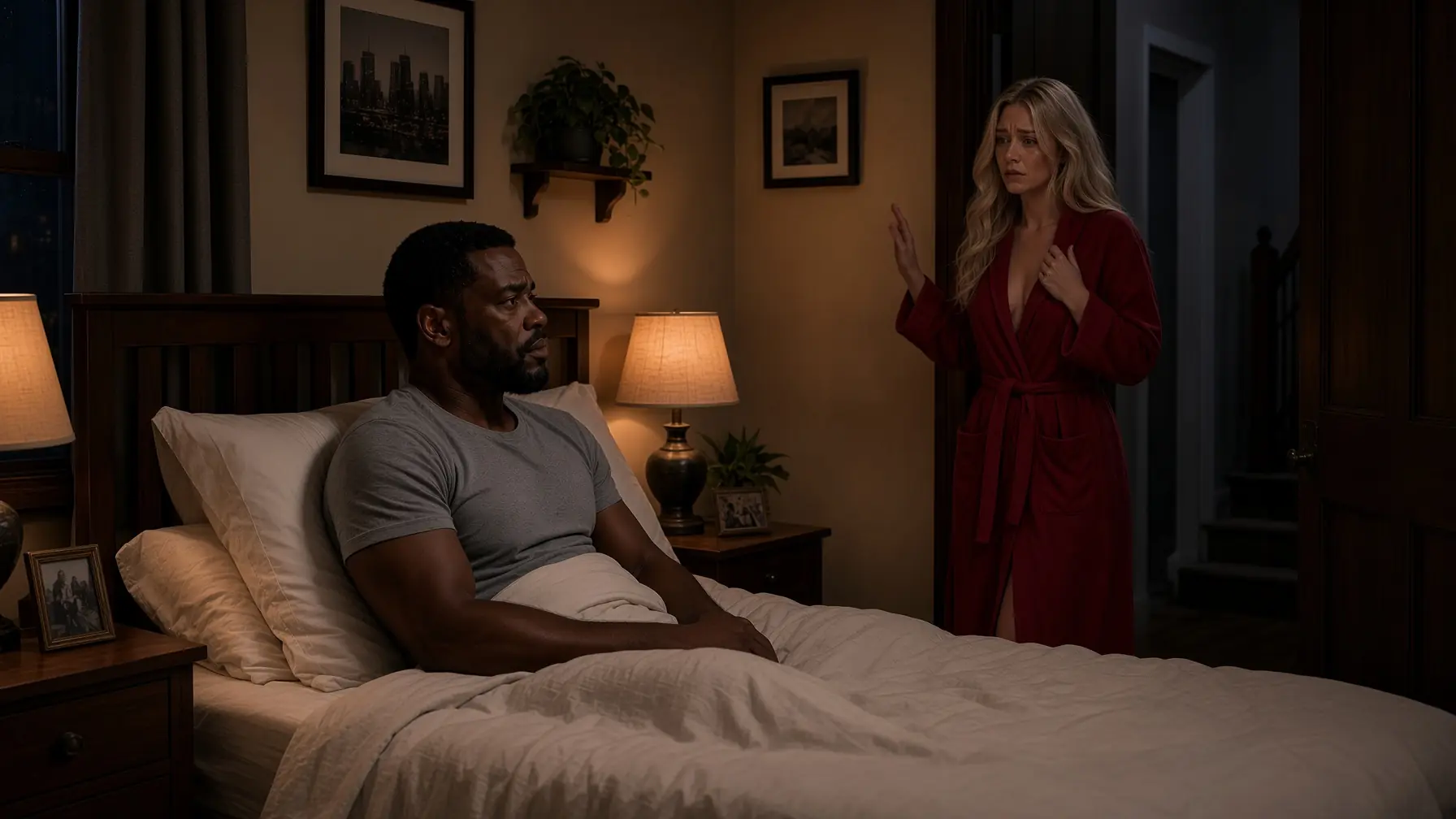
At 11:38 on a Wednesday night, Darnell Carter opened his front door holding a Louisville Slugger across his chest because nobody knocked that hard after midnight-adjacent hours in Atlanta unless something was wrong. The woman on his porch was Evelyn Shaw, the white interior designer who lived three houses down, barefoot inside expensive sneakers, hair damp against her neck, a duffel bag hanging from one shoulder. She looked at the bat, looked at him, and said, “My air conditioner died. Can I stay here tonight?” Darnell lowered the bat slowly, not because he trusted the situation, but because something in her face looked less like inconvenience and more like somebody trying very hard not to panic.
He should have asked more questions before letting her inside. Two mornings later, Darnell would stand behind Evelyn’s townhouse with a flashlight between his teeth and discover that her eight-year-old condenser was perfectly healthy. The electrical disconnect had been physically pulled from the box and taken away, leaving the system dead without so much as a hum. Someone had wanted her home to become unbearable in the middle of the worst heat wave Atlanta had seen in years.
But Darnell did not know that yet.
At 11:38, he knew only that he had been home for twenty-three minutes. He had spent nearly sixteen hours repairing air conditioners in attics hot enough to make breathing feel like work, then driven food deliveries after his regular shift because summer overtime had stopped being optional three years earlier. His undershirt was still damp from sweat, his work pants had a tear near the left knee, and his daughter Ava was asleep down the hall beneath a fan pointed directly at her bed.
“Evelyn,” he said.
“Hi.”
“It’s almost midnight.”
“I know.”
“You knocked like somebody was dying.”
“I knocked four times.”
“You knocked like somebody was dying four times.”
That got a laugh from her, but it sounded wrong. Too quick, too sharp, almost like the laugh escaped before she gave it permission.
Darnell noticed.
He had become good at noticing sounds people made when the words they were using were not carrying the whole story.
“How hot is your place?”
“One hundred and three.”
Darnell stared at her.
“Inside?”
“Yes.”
“At eleven-thirty?”
“I checked twice.”
The temperature that week had become its own news segment. Fourteen straight days above one hundred, transformers failing across older neighborhoods, emergency shelters opening inside churches, and three elderly residents found dead in apartments where the power had failed. Darnell knew every number because he fixed cooling systems for a living and because the people most likely to die when air conditioning stopped were often the same people most likely to ask whether they could pay him next month.
He had already stopped charging several of them.
That was why he was delivering fried chicken and sushi after ten at night while half the other HVAC techs he knew were buying new trucks.
Darnell leaned against the doorframe.
“You call a hotel?”
“Yes.”
“And?”
“Booked.”
“Friends?”
Evelyn looked away.
That answer was enough.
Darnell looked toward the street. Across from him, Mrs. Priscilla Boone’s porch light was on, as it always was, and a single blind near her front room looked slightly bent. Darnell had lived on the block six years and could not remember one night when that light was completely dark.
He hated what he was about to ask.
“You drove here?”
“For a while.”
“How long?”
Evelyn shifted the duffel.
“Maybe two hours.”
“You drove around Atlanta for two hours instead of knocking on my door?”
“I didn’t want to make it weird.”
Darnell nearly laughed.
“Evelyn, you’re standing on a Black man’s porch close to midnight asking to sleep inside while half the neighborhood watches curtains move.”
Her expression changed.
Not offended.
Realization.
“Oh.”
“Yeah.”
“I didn’t think about that.”
“No.”
Darnell said it gently.
That somehow made Evelyn look more embarrassed than anger would have.
She adjusted the bag. “I can leave.”
“Where?”
“I’ll figure something out.”
“Your car?”
“If I have to.”
“With the engine running all night?”
She did not answer.
Darnell rubbed both hands over his face.
“You know people have died in parked cars during this heat?”
“I’ll crack a window.”
“That makes it worse.”
“I don’t want to be a problem.”
The sentence hit him harder than it should have.
Three years earlier, his wife Monique Carter had said those exact words from a hospital bed set up in their back bedroom. Ovarian cancer had reduced an attorney’s paralegal with a voice strong enough to silence a room into someone apologizing for needing help walking to the bathroom. Toward the end, Monique apologized for everything—medicine, laundry, food, the sound of the oxygen machine—as though dying in her own house had become an inconvenience she was imposing on the family.
Darnell stepped aside.
“Come in.”
Evelyn stared.
“Really?”
“Take your shoes off.”
She entered.
“Keep your voice down.”
“My daughter’s asleep.”
From the hallway came a small voice.
“No, I’m not.”
Darnell closed his eyes.
Eight-year-old Ava Carter appeared in an oversized T-shirt covered in cartoon planets, one hand gripping the hallway trim like she was preparing to cross-examine a witness. She looked at Evelyn, then the duffel, then her father.
“Is she staying here?”
“Tonight.”
“Why?”
“Her AC broke.”
Ava looked at Evelyn.
“My dad fixes air conditioners.”
“I know.”
“Then why didn’t you ask him to fix it?”
The room became quiet.
Darnell felt something small move in the back of his mind.
Not suspicion.
Something adjacent.
Evelyn looked toward the carpet.
“Because it’s late.”
“You woke him up anyway.”
“Ava.”
“What?”
“Bed.”
She sighed.
Then looked toward Evelyn.
“There’s another fan in the linen closet.”
“Thank you.”
“My dad puts it beside me when the power goes out.”
Then Ava walked away.
Evelyn waited until the bedroom door closed.
“Your daughter is terrifying.”
“She gets that from her mother.”
The words left his mouth before he could stop them.
Evelyn’s expression softened.
Darnell looked away.
He found a blanket, a pillow, and the old box fan.
The pillowcase still carried the faintest trace of Monique’s lavender shampoo, or maybe Darnell only imagined that it did because memory becomes another kind of smell after enough time.
He almost changed it.
Then did not.
“Couch is yours.”
“You sure?”
“It’s furniture.”
Evelyn looked toward him.
“It isn’t just furniture.”
“Tonight it is.”
He killed the living-room light.
“Good night.”
“Darnell.”
He stopped.
“Thank you.”
“Don’t make it bigger than it is.”
She was quiet for a moment.
“It’s one hundred and three degrees in my home.”
“I have hundreds of people in my phone.”
“I drove around Atlanta for two hours.”
“And I ended up knocking on the door of a man I barely know.”
Darnell stood in the hallway.
“How many words have we actually said before tonight?”
Evelyn almost laughed.
“I don’t know.”
“About twelve.”
“You counted?”
“I repair things for a living.”
“I count.”
That made her laugh properly.
Not much.
Enough.
Darnell went to bed.
He did not sleep.
At 5:37 the next morning, he found Evelyn in the kitchen making coffee with the old stainless-steel stovetop percolator nobody had touched since Monique died.
She immediately put both hands up.
“I’m sorry.”
Darnell stared at the pot.
“That’s one.”
“One what?”
“Apology.”
“You’re counting?”
“Starting now.”
She looked toward the percolator.
“I couldn’t find a regular coffee machine.”
“Because there isn’t one.”
“Who uses this thing?”
“My wife did.”
The word stopped both of them.
Evelyn lowered her eyes.
“I’m—”
Darnell pointed.
“Two.”
She stopped.
Then smiled slightly.
“Understood.”
They drank coffee standing at the counter.
After a minute, Darnell asked, “Your AC.”
Evelyn nodded.
“What exactly happened?”
“It stopped.”
“Stopped how?”
“Just stopped.”
“No air?”
“No air.”
“Warm air?”
“Nothing.”
“Noise?”
“No.”
“Outdoor unit?”
“I didn’t check.”
Darnell stared.
“You didn’t walk outside?”
“It was midnight.”
“It was one hundred and three inside.”
“I panicked.”
Her voice rose.
Then she stopped herself.
Darnell saw something underneath the irritation.
Fear.
Not embarrassment.
Fear.
“I woke up drenched,” Evelyn said.
“My phone said one hundred and three.”
“I sat there trying to think what a normal person does when an air conditioner dies.”
“And for some reason the only useful person I could picture was the man down the street with a tool truck.”
Darnell took another sip.
“I’ll look at it.”
“You don’t have to.”
“I’ve been fixing systems since I was nineteen.”
“It physically bothers me knowing one is broken nearby.”
“That sounds unhealthy.”
“My wife agreed.”
That was the second time he had mentioned Monique in less than ten minutes.
Evelyn noticed.
Darnell did too.
Before either could say more, his dispatch phone rang.
Mrs. Dorothy Ellis. Seventy-nine. No cooling for two days. Grandson calling from Birmingham.
Darnell was out the door six minutes later.
He did not return for nearly twelve hours.
When he finally came home, his own house felt wrong.
Cold.
Actually cold.
The thermostat read seventy-two.
Darnell stood in the doorway.
Music played quietly from the living room.
Then Ava laughed.
Not the polite little laugh she sometimes gave adults.
Not the laugh she used at cartoons because she knew the funny part was coming.
A full, reckless laugh.
Darnell remained on the porch listening.
He had not heard that sound from his daughter in longer than he could admit.
Inside, Evelyn sat cross-legged on the carpet beside Ava’s homework.
“You cannot spell ‘restaurant’ with a W.”
“I hear a W.”
“That is an excellent argument.”
“It is still wrong.”
Ava laughed again.
Darnell stepped inside.
Both looked up.
Evelyn stood too quickly.
“Hi.”
“Why is my house seventy-two degrees?”
Ava raised her hand.
“Because Miss Evelyn paid the electric bill.”
Darnell looked at Evelyn.
She winced.
“Say something.”
“You paid my bill.”
“You were gone all day.”
“I ran your system.”
“That costs money.”
“So I looked at the bill.”
Darnell’s face changed.
Evelyn continued quickly.
“It was sitting on the counter.”
“I didn’t search anything.”
“I saw the past-due amount.”
“How much?”
She hesitated.
“Evelyn.”
“Three hundred and eighty-six.”
The house went silent except for the old compressor outside doing something it rarely got permission to do.
Rest.
Darnell removed his work gloves.
“I’ll pay you Friday.”
“No.”
“Yes.”
“Darnell.”
“Friday.”
“You let me stay here.”
“That was free.”