When Marcus and Michael Thompson joined Warriors Path Karate Dojo, they knew being two of the only Black students in a predominantly white school might make them more visible than they wanted. They did not expect that visibility to turn into a target. From their first day, seventeen-year-old black belts Jake Harrison and Connor Mills treated the fourteen-year-old twins as intruders who had wandered into a place that did not belong to them. The harassment began with mocking looks and cruel jokes, then grew into a deliberate campaign to humiliate and drive them away.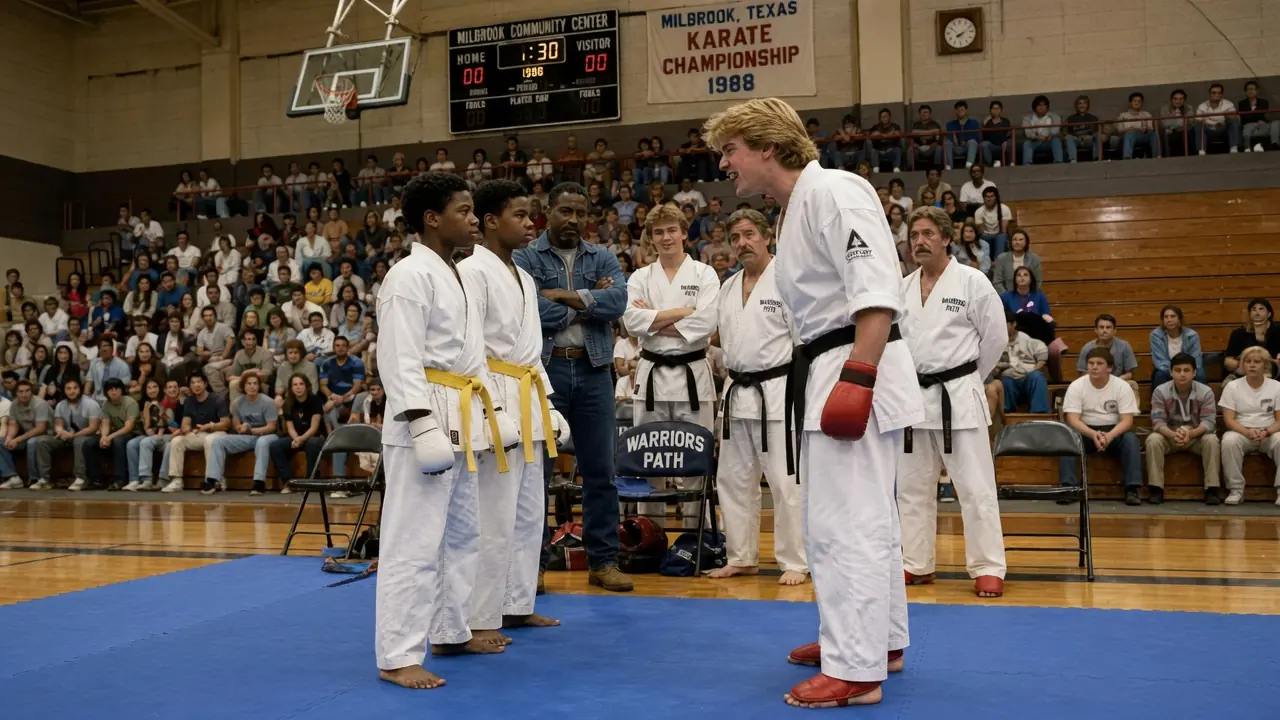
The twins were still beginners. They had earned their yellow belts only two weeks earlier after three months of white-belt training, and even simple combinations required concentration. Marcus tended to move with emotion, fast and forceful when he grew frustrated, while Michael studied every movement before committing to it. Even so, they possessed the unconscious synchronization that had followed them since birth.
When Marcus shifted his stance, Michael adjusted with him; when Michael raised his guard, Marcus often did the same without realizing it. One Tuesday afternoon, the heavy bag swayed under Marcus's uncertain strikes while Michael practiced beside him. Sensei Robert Mitchell, the fifty-year-old owner of the dojo, called the yellow belts toward the center of the room. His black belt was worn soft from years of use, and framed certificates covered the walls behind him.
To any parent watching through the front windows, he looked like an experienced instructor running a disciplined school. "Horse stance. Hold for one minute," Mitchell ordered. Marcus and Michael lowered themselves into position.
Their thighs began burning almost immediately, but neither wanted to be the first to rise. Around them, advanced students moved through forms with smooth precision, making the twins' inexperience impossible to hide. "Look at them," Jake said from across the mat, loud enough for others to hear. His voice carried a degrading comparison suggesting that people like Marcus and Michael could only imitate what others had mastered.
Connor laughed. "Maybe they should train somewhere meant for people like them." Several students heard the comment. Their eyes shifted uneasily toward Sensei Mitchell, who stood less than ten feet away.
He did not correct Jake or Connor. He simply told the twins to straighten their backs and continued the lesson as though nothing had happened. Michael's jaw tightened. Marcus felt his brother's anger as clearly as his own, their bond turning each insult into a shared wound.
When one of them was humiliated, the other carried it too. "Time for sparring drills," Mitchell announced. "Partner with someone near your skill level. Light contact only. This is about technique, not power."
Marcus looked for another yellow belt, but Jake and Connor were already approaching. Jake wore a cruel smile, while Connor rolled his shoulders as if preparing for a serious match rather than a beginner's drill. "Fresh targets," Jake said. "Let us see what they can actually do." "We should work with other yellow belts," Michael replied quietly.
Connor stepped between them and the rest of the class. "Do not worry. We will teach you real technique, unless you would rather return to the place you supposedly belong." Marcus started forward, but Michael caught his arm.
The glance they exchanged carried an entire conversation: stay calm, stay together, survive the class. Marcus faced Connor while Michael bowed to Jake. The first exchange showed exactly what the black belts intended. Connor's kick landed far harder than any light-contact drill required, driving the breath from Marcus and sending him stumbling.
Connor immediately put on a performance of concern. "You have to keep your guard up," he said. "Beginners are softer than they think." On the adjacent mat, Jake deflected Michael's basic combination and swept him to the floor.
He offered no hand until Sensei Mitchell glanced in their direction. Then Jake pulled Michael upright with unnecessary force. "Stay down there if you cannot keep up," Jake murmured. "That is where you belong anyway."
For ten minutes, the abuse continued beneath the appearance of instruction. Jake and Connor struck too hard, used advanced takedowns on inexperienced students, and corrected the twins with shoves and humiliating remarks. Mitchell remained nearby, yet he found reasons to watch every other part of the room. Connor made comments about basketball and claimed Marcus should stick to what people like him were supposedly good at.
Jake told Michael that Warriors Path had standards and suggested the twins would not last another month. When class finally ended, both brothers were sore, bruised, and struggling to hide how badly the session had affected them. "Good work today," Mitchell told the class. "Remember, martial arts builds character through discipline and respect."
The irony followed Marcus and Michael to the equipment rack. As they gathered their bags, they overheard Jake and Connor speculating that their father was probably no better than they were and saying the twins should stay among their own kind. Michael's step faltered. Marcus felt his brother's control beginning to slip.
Before either could respond, their father's pickup truck entered the parking lot. David Thompson climbed out with the efficient movements of a man who had spent eight years in the Army before building a construction business and raising a family. He took one look at his sons and noticed the split lip, reddened forearms, stiff movements, and forced casualness. "How was class?"
he asked. "Fine," both boys answered at once. Their perfect synchronization did not make the lie more convincing. David studied them for several seconds, then asked whether they had learned anything useful. "We learned a lot," Marcus replied.
He and Michael exchanged a glance that meant something very different from what their father understood. Over the next three weeks, the pattern became predictable. Every Tuesday and Thursday, the twins arrived determined to improve. Every session, Jake and Connor found a way to become their partners, their demonstrators, or their self-appointed mentors.
The black belts learned how to hurt them while preserving the appearance of legitimate training. During partner rotation in the sixth week, Jake demonstrated a block for Michael with exaggerated patience while parents watched from the observation area. The moment their attention shifted, his follow-up strike landed solidly in Michael's midsection. "You dropped your guard," Jake said. "In a real emergency, hesitation gets you hurt."
Marcus moved toward his brother, but Connor stopped him with a hand on his shoulder. "He needs to learn for himself," Connor said. "Unless you think he is too weak to handle real training." "I can handle whatever you have," Marcus replied.
Connor smiled. For the next twenty minutes, he disguised rough treatment as instruction. He corrected Marcus with unnecessary force, sent him to the mat whenever he questioned anything, and suggested that the boy's anger proved people like him lacked control. Across the room, Jake used every demonstration to place Michael on his back and tell him he should choose a more natural hobby.
When one parent questioned the intensity, he explained that traditional martial arts built character through adversity. He described Warriors Path as a school with high standards and implied that students who objected simply were not suited to serious training. After class, Marcus and Michael sat in David's truck with ice packs pressed against their injuries. The silence between them held more than pain. "Dad is going to notice eventually," Michael said. "We tell him we are learning," Marcus replied. "Learning what? That we do not belong here?"
Marcus turned toward him. Although they looked nearly identical, adversity moved through them differently. Marcus's anger rose quickly and openly. Michael absorbed each insult until it became something quiet and heavy. "We belong anywhere we choose to be," Marcus said. "They do not get to decide that for us."
Two days later, David surprised them by parking the truck and walking inside. He said he wanted to observe a class. The twins exchanged nervous looks as their father settled into the parents' seating area. David's presence changed the room immediately.
Jake and Connor became more controlled. Their comments turned subtle, their strikes became easier to explain, and their faces adopted the patient expressions of responsible senior students. "Good effort," Jake told Michael after a rough grappling exchange. "You are improving. Your father must be proud of how well you are adapting to our environment."
The word adapting carried a meaning only the twins fully understood. Connor used the same method with Marcus. "You are getting better at taking direction," he said. "It is good to see you learning your proper place in the hierarchy."
From across the room, the words sounded like praise. Up close, they were meant to cut. After class, David spoke with Mitchell about the boys' progress. Mitchell said they possessed natural athletic ability but needed to understand that martial arts involved fitting into a structured environment.
David answered that his sons had been raised to respect authority and work hard. "With the right guidance, they will find their proper place here," Mitchell said. David heard reassurance. Marcus and Michael heard a warning.
During the drive home, David praised the school's discipline and the senior students' apparent willingness to help newcomers. Marcus stared through the passenger window while familiar streets passed in a blur. His father seemed to have visited a different dojo, one where mentorship replaced humiliation and abuse hid perfectly behind polite language. "They are teaching us a lot," Michael said from the back seat.
Technically, it was true. They were learning how institutions protected favored people, how prejudice could hide behind tradition, and how authority figures could ignore harm when acknowledging it would become inconvenient. That night, the twins lay awake in their shared bedroom. "It is not getting better," Michael whispered. "I know." "What if we tell Dad everything?"
Marcus considered it. Their father had taught them to face challenges, work hard, and avoid quitting when things became difficult. If they complained after David had observed an apparently normal class, he might believe they were looking for an excuse to leave. "They made it look normal for him," Marcus said. "If we tell him now, we look like we cannot handle real training."
Michael remained silent for a long time. "Then we get better," he finally said. "Strong enough that they cannot keep doing this." "They are black belts. We just earned yellow." "There has to be a way."
Outside, their quiet suburban street rested beneath the streetlights. Inside, two fourteen-year-old boys tried to plan their survival in a conflict their father could not yet see and their instructor refused to acknowledge. By the eighth week, the twins had begun supplementing their lessons at home with basic conditioning and publicly available training videos. Their footwork improved, and their forms became cleaner.
The improvement did not protect them. It merely gave Jake and Connor a new reason to prove that the hierarchy had not changed. One evening, Sensei Mitchell announced a drill on defending against more than one attacker. The exercise was intended for advanced students, yet Marcus and Michael were selected as the demonstration partners.
Jake and Connor volunteered before anyone else could speak. "The key is staying mobile," Jake told the watching class as he and Connor circled the twins. "When you are outnumbered, you cannot stand still and trade strikes." What followed was not a responsible demonstration.
Beneath the language of instruction, Jake and Connor subjected the twins to a sustained, punishing exercise that kept both boys off balance and unable to recover. Whenever Marcus tried to reach Michael, Jake blocked him. Whenever Michael regained his footing, Connor forced him down again. "See how they are retreating?"
Connor said after sweeping Michael to the mat. "That is exactly what not to do. Instinct without proper training will fail you." Marcus moved to help his brother, but Jake intercepted him and held him against the mat. "Focus on your own survival first," Jake told the class. "You cannot help anyone when you are the one on the ground."
The demonstration continued far longer than necessary. Every exchange allowed the black belts to reinforce the same message: the twins were weak, their natural reactions were wrong, and Warriors Path would never truly accept them. Sensei Mitchell did not stop it. At the end of class, Marcus and Michael gathered their bags in silence.
Their bodies ached, and their confidence had been ground down through eight weeks of humiliation. They had survived again, but survival no longer felt like progress. Outside, they saw David's pickup truck entering the lot. His contractor meeting had ended early, and he had decided to surprise them with a ride home.
From the driver's seat, he could hear Jake and Connor laughing beside the equipment rack through the dojo's partially open door. "Did you see how quickly they went down?" Connor said. Jake answered with another degrading comment about the twins supposedly lacking discipline and control.
This time there were no careful phrases designed for parents. The contempt was clear. Then Marcus and Michael emerged. Under the parking-lot lights, David finally saw what he had missed: Marcus's swollen lip and torn gi, Michael's guarded ribs, the identical exhaustion in both faces.
His years in the Army had taught him how to recognize injuries that came from repeated abuse rather than ordinary practice. "Get in the truck," he said quietly. At home, the kitchen lights made concealment impossible. Lisa Thompson was working a late shift at the hospital, leaving David alone with the boys.
He looked from one son to the other. "How long?" Marcus tried to minimize it, but David repeated the question in the command voice they had rarely heard directed at them. "Since the beginning," Michael admitted. "Since our first day."
The truth came out in pieces and then all at once. They told him about the discriminatory remarks, the excessive contact, the staged demonstrations, the students who looked away, and Mitchell's refusal to intervene. They explained how Jake and Connor had changed whenever David or other parents watched. David paced to the window.
For weeks he had praised the very system that was harming his sons. The realization carried anger, guilt, and a humiliation of his own. "The instructor was present?" he asked. "He was always there," Marcus said. "When you visited, they made everything look normal." "What do we do now?"
Michael asked. David considered the options with deliberate care. He wanted to walk into the dojo immediately, but anger without a plan would give Mitchell an excuse to dismiss him as an unreasonable parent. "We give him one chance to make this right," David said. "I will speak with Mitchell tomorrow." "What if he refuses?"
Marcus asked. David's expression hardened. "Then we protect you through every lawful channel available, and we make certain the truth cannot remain hidden." The next evening, David entered Warriors Path alone.
Mitchell greeted him with professional courtesy, but concern flickered across his face when he saw that the twins were not beside him. "Mr. Thompson, what can I do for you?" "We need to discuss my sons and what has been happening in your classes." Mitchell invited him into the cramped office behind the front desk.
Framed certificates, tournament photographs, and motivational posters covered the walls. The room projected discipline and respectability, the same image that had helped hide what was taking place on the mat. David remained standing. "My sons have been systematically harassed, targeted with discriminatory comments, and injured by two of your black-belt students for two months," he said. "It happened under your supervision."
Mitchell arranged his face into practiced concern. "Training can be intense, especially for beginners. What you are describing does not sound like the program we run here." "Jake Harrison and Connor Mills have used my boys as targets while you watched." "Those are serious allegations. Jake and Connor are exemplary students from respected families. They have trained here for years."
David heard the emphasis on respected families. "Are you saying my sons are lying?" "I am saying that young people sometimes misinterpret firm instruction as harassment. Martial arts can be challenging, and not every student is suited to it." "Last night, I heard those boys using degrading language about my sons. You were close enough to hear it too."
Mitchell's composure shifted. "I was not aware of inappropriate language." "Do not insult my intelligence." A long silence followed.
Mitchell shuffled papers, then tried a different approach. "The Harrison and Mills families have supported this dojo for years," he said. "Their contributions help us remain open and provide opportunities for other students. I have to maintain a balance that benefits the entire school." "You are protecting them because their parents pay you." "I am managing a difficult situation. Your sons are capable, but perhaps they would be more comfortable in another environment, one better suited to their background."
David stepped closer to the desk. "Their background? You mean being Black?" "I mean being new to a structured training environment. Some students adjust to traditional discipline better than others." "Two black belts abusing yellow belts is not discipline. It is cowardice, and allowing it is complicity."
Mitchell stood. "I have run this dojo for fifteen years. I know the difference between demanding instruction and abuse. If your sons cannot handle the intensity, perhaps this is not the school for them."
The answer confirmed what David had begun to suspect. Mitchell was not merely oblivious. He understood enough to protect the donors, preserve the school's image, and remove the victims if they became inconvenient. "You have until tomorrow night to correct this," David said. "Separate the students, investigate the harassment, discipline Jake and Connor, and make it clear that the behavior ends." "And if I do not?" "Then I document everything, report this school, and protect my sons somewhere else."
David left the office without raising his voice. Through the open doorway, he saw Jake and Connor watching him. Their expressions had lost some of their arrogance. Mitchell sat heavily behind his desk.
The Harrison and Mills families supplied nearly a third of the dojo's revenue through fees, private lessons, tournament expenses, and equipment purchases. Meaningful discipline risked losing them. Doing nothing risked David Thompson exposing the school. At home, Marcus and Michael waited over their homework.
When David returned, they read the answer in his face before he spoke. "Mitchell cares more about his donors than his students," he said. "He knows enough to understand what is happening, but he does not intend to confront the people paying him." "So what now?"
Michael asked. "Now we prepare for the possibility that the system will not protect you." "Are we quitting?" Marcus asked. "Not tonight. But whether you stay or leave, nobody should be able to make you helpless again."
David cleared part of the garage and hung an old heavy bag from a reinforced beam. He brought out focus mitts and protective pads from storage. The twins watched the ordinary workspace become a private training area. "Your mother does not need to worry about this until we understand what happens next," he said. "But this is not a revenge class. I am going to teach you awareness, balance, controlled counters, how to protect one another, and how to leave danger safely." "You learned all that in the Army?"
Michael asked. "I learned that real danger does not follow tournament rules. I also learned that force without judgment creates more problems than it solves. You use only what is necessary to get safe. You do not become the people who hurt you."
That distinction mattered to Michael. Marcus, still burning with anger, had to hear it twice. The first session focused on movement rather than power. David showed them how to remain balanced under pressure, how to recognize when someone was preparing to grab or rush them, and how to create distance without panicking.
He corrected their instinct to freeze whenever an advanced student broke through their guard. The change was not limited to the Thompson home. Across town, Jake Harrison sat at an expensive dining table while his father, Richard, cut into a steak and asked about the dojo. Richard was a successful insurance executive who treated Jake's black belt as proof that discipline, money, and status naturally produced superior results.
Jake understood exactly what kind of story his parents expected to hear. "Sensei Mitchell says there may be problems with some newer students," Richard said. "Something about cultural differences affecting the way they respond to training." Jake kept his expression neutral. "There are twin brothers who joined a few months ago. They have trouble adapting to discipline. Connor and I have tried to help, but they get frustrated and do not show proper respect to senior students."
His mother frowned sympathetically. "Some children are not raised to understand structure." "Mitchell is patient with them," Jake continued. "But they might not be a good fit for traditional martial arts."
The account transformed repeated abuse into mentorship and made every reaction from the twins appear to prove the prejudice behind it. Richard accepted the explanation because it confirmed what he already believed. He told Jake that not everyone possessed the character required for serious training and praised his son for helping less capable students. Connor presented a similar story at home.
Bill Mills, an attorney who measured success through credentials and competition, heard that his son was mentoring difficult beginners. He never asked what the beginners said about those sessions. Neither family imagined that the twins' silence came from fear rather than gratitude. At the Thompson home, the garage sessions continued after homework and dinner.
David made the boys repeat the safest movements until fatigue stripped away panic. He stopped them whenever anger caused them to lose control. "You are not preparing to punish Jake or Connor," he said. "You are preparing to remain functional when someone tries to frighten you. Those are different goals."
Marcus found that distinction harder than Michael did. Months of humiliation had left him wanting a visible reversal. He imagined Jake's face when the supposedly helpless yellow belt refused to fall. David recognized that desire and refused to feed it. "Anger can make you fast for a few seconds," he told Marcus. "It can also make you careless. If you let them control your emotions, they are still controlling you."
Michael approached every session like a problem to solve. He wrote notes after class, not instructions for injuring anyone, but observations about pressure, timing, and the moments when fear made him stop thinking. Marcus teased him about the notebook until David pointed out that careful observation had always been Michael's strength. The twins also worked on endurance.
David knew that exhaustion had made them vulnerable during the long demonstrations at Warriors Path. They ran before school, practiced controlled movement after dinner, and learned how to communicate with a glance without both reacting to the same threat at once. Some nights, the garage filled with confidence. On others, an old injury or remembered insult made one of them question everything.
David never promised they would defeat experienced black belts after a few weeks. He promised only that they would be harder to isolate, harder to frighten, and better able to protect themselves long enough for responsible adults to intervene. That final condition remained uncertain. Mitchell had already shown what kind of adult he intended to be.
Their months at the dojo had given them a basic foundation. Their athleticism helped, but their greatest advantage remained the connection between them. David taught them to use it deliberately, to move without blocking each other's path and to watch for the moment when one brother needed the other. "You are not learning how to hunt for fights," David reminded them. "You are learning how to avoid being trapped in one."
The next evening, they returned to Warriors Path. Mitchell had not separated the students or announced any discipline. He had merely warned Jake and Connor to be more careful when adults were watching. The black belts interpreted caution as permission.
Their comments became quieter, and their abuse became easier to disguise. Marcus and Michael endured the session, but their reactions had changed. Instead of becoming overwhelmed, they observed. Marcus noticed that Connor always shifted his weight before trying to sweep him.
Michael saw that Jake became careless whenever he believed an opponent was frightened. They cataloged habits rather than absorbing humiliation. "They seem different," Jake told Connor during a water break. "Maybe they finally gave up," Connor replied.
They had not given up. That night in the garage, they described every movement to David. He helped them understand how to stay safe without turning the training into a set of dangerous instructions. The goal remained control, not injury.
Four weeks of private practice changed their posture, conditioning, and confidence. It also created a moral struggle neither brother expected. They wanted justice, but they did not want to become obsessed with punishment. One night, Michael sat on the edge of his bed and admitted what had been troubling him. "This feels wrong sometimes," he said. "The secrecy. Thinking about proving we can hurt them. What if we become exactly like them?"
Marcus looked toward the heavy bag visible through the open garage door downstairs. "What is wrong is letting them believe they can treat us however they want." "Defending ourselves is one thing. Wanting revenge is another."
Marcus did not answer immediately. Michael's question had reached the fear beneath his anger. "Then we make sure it is not revenge," he said at last. "We prove we belong, and we stop when the threat stops."
David was wrestling with the same issue. He had spent his sons' lives teaching them to work within institutions, respect instructors, and avoid unnecessary violence. Now he was helping them prepare for the failure of those institutions. He could justify the training as protection, but he knew anger could distort even a good purpose.
The answer arrived in the form of a tournament notice. The Tri-County Open would take place in three weeks at the Milbrook Community Center. It offered ordinary divisions by belt rank, but it also included an open sparring division for competitors willing to face opponents of any rank. David placed the flyer on the garage workbench. "Registration closes tomorrow," he said. "You need to decide whether you want the open division."
Marcus understood immediately. "Jake and Connor will be there." "Most likely." Michael studied the flyer. "If we enter as yellow belts, everyone will assume we are easy matches." "They will," David said. "But the tournament has referees, rules, witnesses, and cameras. If you want to prove your training and confront them in a legitimate setting, this is the safest place available."
Michael looked at his brother. "If we do this, there is no going back." "We are not the same boys who entered that dojo," Marcus said. "What if four weeks is not enough?"
David answered without bravado. "Then you compete honorably, learn from the result, and walk away with your dignity. Winning is not permission to lose control, and losing is not proof that they were right about you." That answer settled the question more than any promise of victory could have. "Register us," Michael said.
Marcus nodded. "Open division." For the final three weeks, the garage became a place of disciplined preparation. David emphasized conditioning, restraint, awareness, and the tournament rules.
The twins practiced against pressure and fatigue. They also practiced stopping immediately when a point was called. Mitchell's warning to Jake and Connor came after the next class. He waited until most students had left, then called both black belts to the front desk. "Mr. Thompson made serious complaints," he said. "From now on, be careful with the twins. I do not want unnecessary attention on our training methods."
Jake's eyes narrowed. "Are you telling us to go easy?" "I am telling you to make certain every drill looks legitimate if a parent or camera is present. No obvious comments. No loss of control."
Connor understood immediately. Mitchell had not forbidden the campaign. He had instructed them to improve its appearance. The following sessions became quieter and more calculated.
Jake corrected Michael in a low voice instead of humiliating him across the room. Connor waited until Mitchell turned away before using unnecessary force. To the twins, the adjustment confirmed everything David had said about systems that valued appearances over safety. They pretended not to notice.
That pretense became part of their preparation. Marcus still allowed Connor to believe intimidation worked. Michael continued behaving cautiously around Jake. Neither revealed how much their balance, conditioning, and awareness had improved.
During the walk home, they compared what they had seen. "Connor is more careful now," Michael said. "Careful makes him predictable," Marcus replied. "Jake keeps looking toward the desk before he does anything. If Mitchell is watching, he changes the drill." "Then Mitchell knows." "We already knew that. Now we can prove it."
David began recording dates, injuries, and descriptions of each class. He photographed bruises with the boys' permission and saved copies of tournament information, membership records, and communications with Mitchell. The binder grew thicker each week. The process gave the family a second form of protection, one based not on fighting but on evidence.
Lisa eventually noticed the late-night activity in the garage. David told her enough to explain the training but not the full extent of the tournament plan. She was angry that all three had tried to protect her through silence. "I am their mother," she said. "You do not get to decide that I am too worried to hear the truth."
The boys apologized first. David followed. From then on, Lisa helped monitor injuries and insisted that the twins rest when their bodies needed recovery. Her nursing experience also made the rules clearer: no training through dizziness, serious pain, or signs that required medical attention.
The family entered the final week before the tournament as a united group rather than a secret alliance. That mattered more than David had expected. Marcus and Michael were no longer carrying the conflict alone, and David was no longer trying to solve it without Lisa's judgment. The twins still debated what victory should mean.
Marcus wanted the public proof of defeating the black belts. Michael wanted exposure of the system that had allowed the abuse. By the night before the tournament, they agreed on one principle. "We compete under the rules," Michael said. "We stop when the referee stops us." "And if they attack outside the rules?"
Marcus asked. "We protect ourselves and stop when we are safe." David nodded. "That is the only version of tomorrow I will support."
The tournament would be more than a competition. It would be the first time the twins could face Jake and Connor in a setting where the bullies did not control the rules and Mitchell could not look away. The Milbrook Community Center buzzed with nervous energy on the morning of the Tri-County Open. Banners from martial arts schools across the region hung from the rafters, and several competition rings covered the polished gymnasium floor.
Families filled the folding chairs while competitors stretched, rehearsed forms, and tried to hide their nerves. Marcus and Michael sat near the registration table, their yellow belts conspicuous among the advanced students warming up for the open division. David stood behind them, quiet and watchful. The tournament coordinator checked his clipboard twice. "Marcus and Michael Thompson? You understand that you registered for open sparring, not the yellow-belt bracket?" "We understand," Marcus said. "There is still time to change divisions." "We are staying," Michael replied.
Across the gym, Jake Harrison and Connor Mills stretched with the Warriors Path team. Both wore their black belts with the casual confidence of students accustomed to admiration. When they noticed the twins, Connor laughed. "This should be entertaining," he said.
Jake glanced at their yellow belts. "I almost feel sorry for them. Almost." Sensei Mitchell approached David with a smile that did not reach his eyes. "Mr. Thompson, I was not aware your sons were competing today." "There are many things you were not aware of," David answered.
The first open-division pairing was announced over the loudspeaker. "Ring Three: Connor Mills versus Michael Thompson." The Warriors Path section grew suddenly quiet. Parents exchanged knowing looks.
Most expected a quick lesson in why rank mattered. Michael stepped into the ring and bowed respectfully. Connor's bow was perfunctory and nearly mocking. "Competitors ready? Begin."
Connor attacked immediately, expecting Michael to retreat in the same frightened pattern he had seen at the dojo. Michael did not. He moved aside with calm timing, stayed balanced, and answered with a legal body counter that forced Connor backward. "Point, Thompson," the referee called.
For a moment, Connor appeared unable to understand what had happened. A yellow belt had scored first, and not by luck. Michael had read the attack, avoided it, and responded without panic. Connor reset with his embarrassment already turning into aggression.
His second rush was faster but less controlled. Michael absorbed the pressure on his guard, waited for the opening, and answered with another precise counter. "Point, Thompson. Match, Thompson."
The referee raised Michael's hand. The Warriors Path section stared in silence. Connor remained in the ring, face flushed and breathing hard. "That is impossible," he said. "He is a yellow belt."
The referee told him to leave the competition area. Michael returned to David and Marcus without celebrating. His hands trembled only after he stepped outside the ring. Before anyone could fully process the result, the next pairing was announced. "Ring Two: Jake Harrison versus Marcus Thompson."
Jake's confidence had been shaken by Connor's defeat. He faced Marcus with anger rather than composure. "That will not happen to me," Jake said. "I have trained since I was eight." "Then you should know how to lose properly," Marcus replied.
The referee started the match. Jake attacked with the polished combinations he had practiced for years, but his frustration made him commit too heavily. Marcus stayed patient. When Jake overextended, Marcus disrupted his balance and sent him to the mat with a clean, controlled throw. "Point, Thompson."
The gymnasium began to buzz. Jake rose with tears of anger bright in his eyes. The second exchange was shorter. He rushed, Marcus avoided the attack, and another legal counter ended the match. "Point, Thompson. Match, Thompson."
For several seconds, Jake remained on the mat. The defeat itself was not physically devastating, but the public collapse of his certainty was. He had spent months treating Marcus as naturally inferior. Now hundreds of spectators had watched the yellow belt defeat him under neutral rules.
The Warriors Path section erupted. Richard Harrison and Bill Mills, the boys' fathers, pushed toward the tournament officials, accusing the twins of hiding their experience. "Those boys are not real yellow belts," Richard shouted. "This is sandbagging." "Someone trained them illegally," Bill added. "No beginner moves like that."
Sensei Mitchell joined them, his own reputation now tied to the outcome. "There must be a mistake," he said. "Two months ago, they could barely defend themselves." The tournament director, a patient man in his sixties, examined the registration records. "Their rank was issued by Warriors Path Karate Dojo," he said. "Your own school certified them as yellow belts. The matches were conducted under open-division rules, and both results stand."
Richard pointed toward David. "His sons are frauds." David approached with controlled calm. "My sons earned their rank at Mitchell's school. They entered the division openly, followed the rules, and won. Perhaps your sons were never as superior as you believed."
That suggestion struck deeper than the losses themselves. Richard and Bill had invested money, status, and parental pride in the belief that Jake and Connor were exceptional. The twins' victories threatened that entire story. "They humiliated our boys on purpose," Richard said.
Marcus stepped beside his father. "We competed. They lost. That is not humiliation unless they believed they were entitled to win."
Jake started toward him, but tournament staff intervened. "Enough," the director said. "The matches were fair. The results are final."
Marcus and Michael collected their certificates. They had expected relief, but the air around the Warriors Path group felt dangerous rather than settled. Jake and Connor stood together, whispering through their anger. "This is not over," Jake said.
The accusations after the matches revealed how deeply the adults had invested in the hierarchy. Richard Harrison did not ask Jake whether he had respected the referee or why his technique had collapsed under pressure. Bill Mills did not ask Connor whether he had underestimated Michael. Both fathers searched immediately for a rule that would restore the result they expected. "They must have concealed prior experience," Richard insisted. "No legitimate beginner can improve that quickly."
The tournament director asked whether Warriors Path had verified the twins' rank when issuing their yellow belts. Mitchell had to admit that it had. "Then your own records establish their eligibility," the director said. "The open division allows any rank. They disclosed who they were and competed in public."
Several coaches from other schools had watched the matches. One commented that Jake and Connor had not lost because the twins performed impossible techniques. They lost because they became emotional, ignored openings, and expected fear to do most of their work. That observation spread through the crowd and injured the black belts' pride more than any point on the scoreboard.
Their reputation had depended on the belief that rank alone proved character. The matches showed skill without discipline collapsing under pressure. Some Warriors Path parents began asking questions of their own. Why had two yellow belts improved so dramatically outside Mitchell's instruction?
Why did the twins appear calmer under neutral referees than during ordinary classes? Why did Jake and Connor react to defeat with rage instead of sportsmanship? Mitchell tried to move his students away from the discussion, but the post-match attack prevented the controversy from fading. The moment Jake and Connor rushed the twins from behind, every earlier question acquired a clearer answer.
The Thompson family began walking toward the exit. David was speaking with an official when Jake and Connor broke away from their parents and approached the twins from behind. "You think you proved something?" Connor shouted.
Marcus and Michael turned. Confidence from the victories made them slower to recognize the desperation in the black belts' faces. "We proved we can compete with you," Marcus said. Connor threw the first reckless punch.
Jake lunged at Marcus at nearly the same moment. The twins were knocked off balance by the surprise attack, and the crowd erupted in alarm. The struggle that followed was not tournament sparring. There were no bows, no referee's command, and no agreement to stop at a point.
Jake and Connor attacked from anger and humiliation. Marcus and Michael relied on the awareness and discipline David had taught them, protected one another, regained their footing, and used controlled counters to keep the attackers from overwhelming them. "Stop!" officials shouted as security moved through the crowd.
Jake rushed Marcus a second time, but Marcus stepped away and redirected him to the floor. Connor landed one wild blow on Michael's shoulder before Michael forced him backward into a row of folding chairs. Neither twin pursued once the immediate danger ended. Security guards reached the group and separated all four boys.
Jake and Connor were bruised, disheveled, and furious. Marcus and Michael were breathing hard, with minor injuries from the surprise attack, but both remained standing. The tournament director demanded an explanation. "They attacked us from behind," Michael said. "We were leaving." "They provoked us all day," Jake protested. "By defeating you in matches?"
Marcus asked. David reached his sons and checked them for serious injuries. Richard Harrison and Bill Mills arrived seconds later, shouting that the twins had assaulted their children. The tournament director consulted the referees, security staff, and spectators who had witnessed the incident.
Several cameras had captured the attack clearly. His decision was immediate. "Jake Harrison and Connor Mills are disqualified and banned from regional competition until they are eighteen," he announced. "Attacking competitors after legitimate matches is unacceptable."
Bill pointed toward the twins. "They fought back." "They defended themselves against an unprovoked attack and stopped when security arrived. That is not the same thing."
Sensei Mitchell protested, but the director turned on him. "The only mistake was allowing those students to represent your school without proper discipline. You should examine what your program has been teaching them." Medical staff evaluated all four boys.
Jake and Connor required treatment for several painful injuries sustained during the struggle. Marcus and Michael had fewer injuries despite being attacked first, a fact that made the black belts' parents even angrier. Richard threatened to press charges. David reminded him that security footage, tournament cameras, and two hundred witnesses had seen who initiated the attack. "This is not over," Richard said as the families separated. "It is over for your sons' tournament careers," David replied. "They made that choice themselves."
The drive home should have felt triumphant. The twins had won fairly, survived an unfair attack, and exposed their tormentors before the regional martial arts community. Yet the fathers' threats remained in the car like a cold draft. "They looked dangerous when we left," Michael said. "People make bad decisions when they cannot accept that the world is not arranged around them," David answered. "What do you think they will do?"
Marcus asked. David watched the road. "Probably nothing wise." At home, he checked the doors and armed the security system.
Lisa had been told the full story by then, and her pride in the boys was mixed with anger that the abuse had continued so long without her knowledge. David promised that secrecy would not happen again. Across town, the Harrison and Mills families gathered in Richard's living room. The rational response would have been to accept the tournament ruling, seek counseling for their sons, and confront the prejudice that had led to the conflict.
Instead, they searched for a version of events in which they remained victims. Jake insisted the twins had cheated. Connor said yellow belts could not possibly have defeated them honestly. Their fathers repeated those claims until outrage replaced evidence. "Seven years of training," Richard said, pacing beside the fireplace. "Tournament fees, camps, private lessons, college opportunities, all damaged in one afternoon." "They need to understand what they cost us," Bill replied.
By late evening, anger had become a plan. Richard and Bill decided to visit the Thompson home and demand an explanation, an apology, and financial compensation. Their sons remained behind, but the same entitlement that had driven Jake and Connor now carried their fathers through the night. At 10:47 p.m., the Thompson doorbell rang.
Lisa was finishing the dishes. Marcus and Michael were upstairs. David looked through the front window and recognized Richard Harrison and Bill Mills standing beneath the porch light. "Take the boys away from the front of the house," he told Lisa. "Stay inside."
He opened the door with the security chain still engaged. "It is late for a social call," he said. "We need to talk about what your boys did to ours," Richard answered. "Your sons attacked mine after losing fair matches. There is nothing to discuss at this hour."
Bill stepped closer. "Open the door. We are not conducting this conversation through a crack." "You are not conducting it at all. Leave my property."
David began closing the door. Richard pushed against it, keeping it from shutting completely. "Do you understand how much money we invested?" he demanded. "Seven years of training, equipment, travel, and camps. Your sons destroyed all of it." "Your money produced two entitled bullies. That is not my debt."
Bill said Connor had been considered for scholarships and claimed the ban had ruined his future. David replied that Connor should have considered his future before attacking another competitor from behind. Then the demand became explicit. "We want compensation," Bill said. "You owe us for what your family caused."
David laughed once without humor. "I owe you nothing." Richard pushed against the door again. "We are going to settle this properly." "Properly means you leave before I call the police."
Bill threatened to tell the authorities about the twins' private training. David answered that he would gladly provide the same authorities with evidence of months of discriminatory harassment, injuries, Mitchell's refusal to act, and the tournament footage. The men did not leave. David unhooked the chain, stepped outside, and closed the door behind him so the confrontation would remain away from his family.
Richard and Bill spread apart, attempting to intimidate him. "You think your Army service makes you better than us?" Richard asked. "No," David replied. "I know that I raised sons who understand consequences better than you did."
Bill finally said openly what the families had hidden beneath phrases such as background and proper place. The discriminatory meaning was unmistakable. David gave them one final warning. "Walk away now."
Richard threw a wild punch. David avoided it and used his training to stop the advance without losing control. Bill rushed in next and was redirected away from the doorway. The brief struggle ended with both visitors restrained and unable to continue, while David remained on his feet.
He stepped back the moment they stopped attacking. "You came to my home," he said. "You refused to leave. You chose this."
Sirens approached before either man could answer. A neighbor had called the police after hearing the shouting, and David had triggered the security alarm as soon as he stepped outside. Officer Elena Martinez exited the first patrol car with her partner, Officer Johnson. She saw two injured men on the porch and one homeowner standing calmly with his hands visible. "Someone reported a disturbance," she said. "I did," David answered. "These men came to my home after 10:00 p.m., made threats, refused repeated instructions to leave, forced the door, and attacked me."
Richard tried to stand. "He assaulted us. We came to talk." Officer Johnson had already begun speaking with neighbors.
Mrs. Patterson across the street reported seeing the men push against the door while David attempted to close it. Another neighbor had recorded part of the confrontation on a phone. Martinez asked David about his background after noticing how one-sided the struggle had been. "Eight years in the Army, including two overseas deployments," he replied.
She nodded, then addressed Richard and Bill. "You came onto private property late at night, refused to leave, interfered with the homeowner's door, and initiated a physical confrontation. You will both be cited for trespassing, harassment, and disturbing the peace. The evidence will determine whether additional charges are appropriate."
Bill protested that David's sons had destroyed their children's futures. Martinez asked what had happened at the tournament. Richard claimed the twins had attacked Jake and Connor. David explained the legitimate matches and the later ambush.
He offered the tournament director's contact information and said security footage documented everything. "If the footage confirms that your sons initiated the second confrontation," Martinez told the fathers, "their competition ban is a consequence of their own behavior, not something the Thompson family did to them." The police remained at the Thompson home long enough to separate anger from fact. Officer Johnson photographed the damaged door area and collected the neighbor's phone recording.
Martinez asked Lisa and the boys to describe what they had heard from inside without allowing them to listen to one another's statements first. Richard and Bill continued interrupting until Martinez warned that further interference would be recorded. Their demands for compensation, repeated on the porch and captured on the security audio, weakened their claim that the visit had been a peaceful conversation. "You came here to pressure this family after a public dispute," Martinez said. "You refused to leave when instructed. Whatever grievance you believe you have does not authorize you to force your way into a private home."
Richard pointed toward David's uninjured face. "Look at him. He was prepared for this." "Being capable of defending himself does not make him responsible for your decision to attack," she replied.
The officers offered medical assistance to both visitors. Richard initially refused because accepting treatment seemed to him like another admission of defeat. Bill accepted after the pain in his shoulder worsened. David gave the officers the tournament director's name, the dojo address, and the binder containing dates and photographs.
Martinez paused when she saw how long the record had been kept. "You should have reported this earlier," she said. "I know," David answered. "I thought I could force the school to correct itself." "Institutions rarely correct themselves when the people benefiting from the problem control the response. Preserve all of this. An investigator may want it."
Her warning proved accurate. The next morning, the regional association contacted the family after receiving reports from tournament officials. The police record gave the investigators a second reason to examine the conduct surrounding Warriors Path. Inside the house, Marcus and Michael watched from an upstairs window.
Lisa stood behind them, still wearing her hospital scrubs from an earlier shift. "Dad is all right," Marcus whispered. "He called the police before it got worse," Michael said. Lisa rested a hand on each son's shoulder. "Your father is good at handling emergencies, but none of this should ever have reached your home. From now on, this family tells the truth before a problem grows this large."
Outside, the officers completed their reports. Martinez advised David to install exterior cameras, preserve all tournament records, and vary the family's routine temporarily in case resentment continued. "Already planned," he said. As the patrol cars departed, David remained on the porch for a moment.
The confrontation he had expected after the tournament was over, but the night had confirmed something important: prejudice and entitlement did not disappear merely because they were exposed. They had to be answered with evidence, boundaries, and consequences. Marcus and Michael came outside after the street grew quiet. "Is it over?"
Michael asked. "This part is," David said. "But there will be reports, investigations, and difficult conversations." Marcus looked toward the road. "We do not start fights, but we finish them."
David corrected him gently. "We do not look for fights. We protect ourselves, stop when the threat stops, and let evidence finish what anger cannot. That is the lesson."
Both boys nodded. It was a more difficult lesson than revenge, and a more lasting one. The events at the tournament and the Thompson home could not remain private. Videos circulated through the local martial arts community within hours.
Some showed the twins' legitimate victories. Others showed Jake and Connor attacking after the matches and security pulling the boys apart. The police reports from Maple Street added a second record of the same pattern: members of the Harrison and Mills families refusing to accept boundaries once they no longer controlled the outcome. The regional martial arts association opened an investigation into Warriors Path.
Investigators interviewed students, parents, referees, and tournament staff. They requested attendance records, injury reports, disciplinary files, and communications between Mitchell and the families who donated heavily to the dojo. At first, several students hesitated. They had watched what happened to Marcus and Michael and feared becoming the next targets.
Once one family spoke honestly, others followed. A younger student described asking to change partners after Jake struck him too hard. Mitchell had told the boy that fear was part of growth. Another parent remembered Connor making discriminatory remarks near the front desk while Mitchell continued arranging equipment.
Several students admitted that Jake and Connor were permitted to choose beginners for demonstrations and that their favored status was common knowledge. The investigators also spoke with the Thompson twins separately. Marcus described the first insult, the rough sparring, and the months of trying not to appear weak. Michael explained how the abuse changed whenever parents watched and how Mitchell's phrases about structure, background, and proper place reinforced the same message as the bullies' remarks. "Why did you remain at the school?"
one investigator asked. Michael considered the question. "Because leaving felt like agreeing that they were right about us," he said. "We thought staying was the only way to prove we belonged." "And do you still believe that?" "I believe we belonged. I do not believe we should have had to be injured to prove it."
Marcus gave a similar answer in his own way. "We were afraid that complaining would make us look weak. That was part of how the place controlled us." The investigation found that Mitchell had no meaningful system for reporting harassment, no written record of the twins' repeated injuries, and no disciplinary action against Jake or Connor despite multiple witnesses.
Messages recovered from the weeks before the tournament showed that Mitchell had warned the black belts to be more subtle after David complained, not to stop. That message destroyed the last argument that the instructor had merely failed to notice. He had recognized the risk and chosen better appearances instead of better conduct. The regional association revoked Mitchell's teaching certification.
Warriors Path lost its charter with the national organization, and the school was barred from hosting sanctioned events. Parents withdrew their children as the findings became public. Within two weeks, thirty families canceled their memberships. Without the fees from ordinary students and the large contributions from the Harrison and Mills families, Warriors Path could not meet its rent.
The landlord informed Mitchell that the lease would not be renewed. Six weeks after the tournament, Mitchell stood alone in the empty dojo, packing equipment into cardboard boxes. The certificates remained on the walls, but they no longer carried the authority they once had. He wrapped his old belts in tissue paper and looked across the mat where so many students had been taught that silence mattered more than safety. "Fifteen years," he said to the empty room. "Fifteen years gone."
What he did not say was that the school had not collapsed because one family complained. It collapsed because his choices had finally become visible. Jake Harrison and Connor Mills faced consequences beyond the regional ban. Milbrook High reviewed the tournament footage and the testimony about their conduct at the dojo.
Both boys were removed from school athletic leadership roles. Connor's family transferred him to an online program after repeated confrontations with classmates who had seen the videos. Jake began working afternoons at his father's insurance office while completing school under stricter supervision. Their parents also discovered that reputation could not be purchased back once trust was lost.
Several clients left Richard Harrison's insurance business after learning about the late-night confrontation and police citations. Bill Mills was passed over for a promotion at his law firm after colleagues raised concerns about his judgment. None of those consequences brought Marcus or Michael joy. The twins had imagined for months that victory would feel like a clean reversal, one glorious moment when the bullies understood what they had done.
Instead, the aftermath felt complicated. They were relieved, vindicated, and still carrying memories they could not erase. "I thought I would be happier about them losing everything," Marcus admitted one evening. Michael sat beside him on the back steps. "Maybe because becoming like them was never what we wanted." "I wanted them to be afraid of us." "They probably are. Does that fix anything?"
Marcus looked toward the garage, where the heavy bag now hung still. "No," he said. "But helping somebody else might." That opportunity appeared sooner than expected.
A former Marine named Daniel Chen opened Integrity Martial Arts Academy across town. Chen had taught for years in a program built around student safety, controlled training, and clear reporting procedures. Many families who left Warriors Path enrolled with him. David met Chen before allowing the twins to join.
He asked about partner assignments, supervision, injury protocols, and how the school handled harassment. Chen answered every question without defensiveness. "Rank does not excuse cruelty," he said. "An advanced student has more responsibility, not more permission."
Marcus and Michael began again as yellow belts. On their first evening, Chen paired them with students near their own level and watched every exchange. When one student used too much force, he stopped the drill immediately, corrected the behavior, and required an apology. The twins nearly laughed from relief.
The intervention was so simple that it made Warriors Path seem even more indefensible. Under Chen's guidance, their progress continued, but the purpose of training changed. David's garage lessons had given them confidence and practical awareness. Chen taught them how to place those skills inside a larger discipline built on restraint, consent, and responsibility.
The closing of Warriors Path affected the East Gate Shopping Plaza as visibly as it affected the families. For years, the dojo's windows had displayed tournament trophies and photographs of black-belt promotions. After the charter was suspended, those displays looked less like proof of excellence and more like evidence of how successfully an institution could protect its image. Parents arrived to collect uniforms, equipment, and prepaid records.
Some apologized to the Thompson family through messages. Others admitted they had noticed the twins' treatment but assumed Mitchell knew what he was doing. A few resisted the findings and blamed the scandal on publicity rather than misconduct. David answered only the messages that accepted responsibility.
He had no interest in debating people determined to preserve a comforting lie. Master Chen purchased none of Mitchell's trophies or branded equipment when it was offered for sale. He did buy several usable mats through the landlord after the Warriors Path name had been removed. "Equipment has no morality," he told David. "A school gives it meaning through what happens on it. We will make these mats part of something better."
At Integrity Academy, Chen established a written student-safety agreement. Beginners could request a different partner without being shamed. Parents received clear reporting instructions. Senior students were evaluated on how safely they trained others, not only on competition results.
Marcus and Michael helped review the youth version of the agreement. They insisted on one sentence: Asking for help is not weakness, and leaving an unsafe drill is not quitting. That line later appeared beside the training floor where every student could see it. Within a month, both boys earned orange belts.
The promotion was not based merely on their tournament performance. Chen evaluated their forms, judgment, consistency, and willingness to help others. They soon began assisting younger students. Marcus worked especially well with children who became frustrated and wanted to rush.
Michael could break complicated movements into patient, logical steps. One afternoon, an eight-year-old white-belt student struggled with a basic block. His eyes filled with embarrassment when several older children passed nearby. Marcus knelt so they were at the same height. "Nobody is born knowing this," he said. "You do not have to be perfect. You only have to keep learning."
Master Chen watched from across the mat. "That is what real martial arts means," he told the class later. "Strength used to protect, never to make someone smaller." The words stayed with the twins because they answered the question their experience had left behind.
Strength itself was not the problem. The purpose behind it was. At Milbrook High, the tournament story became local legend. Students who had once seen Marcus and Michael as quiet newcomers now recognized them as the brothers who exposed a corrupt training culture.
People repeatedly asked them to describe the matches and the fight afterward. "It is strange being known for fighting," Michael said as they walked home from Integrity Academy. Marcus gave him a tired grin. "Better than being known only as the kids who got hurt." "I would rather be known for what we are doing now." "Me too."
At home, David installed the last exterior security camera. The Harrison and Mills families had made no further contact after the police citations, but he preferred preparation to hope. "How was class?" he asked when the boys entered through the garage. "Good," Michael said. "Master Chen thinks we might be ready for green belts by Christmas." "More importantly, we helped three new students today," Marcus added. "Nobody gets singled out at that school."
David nodded with satisfaction. His sons had moved beyond proving that they could not be bullied. They were learning how to prevent the same thing from happening to others. Lisa joined them from the kitchen.
Her work as a nurse made her proud of their discipline but wary of the attention the story continued to attract. "Any news about Warriors Path?" she asked. "It closes at the end of the month," David said. "Mitchell is trying to sell the equipment, but few schools want anything connected to the program." "What about Jake and Connor?"
Marcus shrugged. "They are banned from competition until they are eighteen. Whatever they do after that is their responsibility." The answer showed how far he had come.
Months earlier, he would have wanted every detail of their downfall. Now he understood that his future did not need to remain attached to theirs. A knock sounded at the front door. The noise still created a moment of alertness in the Thompson home, but this visitor was expected.
Master Chen stood on the porch with a manila envelope. "I wanted to deliver these personally," he said. Inside were the twins' official orange-belt certificates and two letters from the state martial arts association. The organization was developing a youth leadership initiative focused on preventing harassment, improving reporting systems, and teaching instructors how to recognize abuse hidden inside ordinary drills. "They have heard your sons' story," Chen explained. "They would like Marcus and Michael to speak with instructors and younger students about what happened at Warriors Path. The focus would not be the fight. It would be the warning signs, the silence, and what responsible adults should have done sooner."
The twins exchanged the familiar glance that still carried more than words. "We would be honored," Michael said for both of them. The first leadership session took place several weeks later. Marcus and Michael stood in front of instructors from schools across the state.
Their orange belts were visible, but no longer the most important thing about them. Michael explained how abuse had been disguised as advanced instruction. Marcus described the pressure victims felt to remain silent so they would not appear weak. Together, they emphasized that safety required adults who listened before injuries became evidence. "Do not make beginners earn the right to be protected," Michael told the group. "And do not confuse endurance with consent," Marcus added. "We kept coming back because we thought leaving meant the bullies had won. An instructor should have made it clear that reporting harm was not quitting."
David and Lisa sat in the back row. David felt pride, but also humility. His sons had become leaders partly because he had eventually believed them, yet he would always regret how long it took him to see the truth. After the session, he told them so. "I should have asked better questions earlier," he said. "I saw injuries and accepted the easy explanation."
Marcus looked at Michael, then back at their father. "You believed us when we told you." "Eventually is not the same as immediately." "Then that is part of the lesson too," Michael said. "Parents can miss things. What matters is whether they listen when the truth comes out."
The family's recovery was not perfect. Marcus still became tense when a senior student approached too quickly. Michael sometimes replayed the multiple-attacker demonstration in his dreams. Lisa encouraged both boys to speak with a counselor who worked with young athletes, and David supported the decision without treating it as weakness.
The counselor helped them understand that victory did not erase fear. Healing was not another contest they could win in one afternoon. It was a slower process of learning that every new room would not become Warriors Path. By winter, the heavy bag in the garage was used less often.
The twins still trained with David, but the sessions no longer revolved around Jake and Connor. They worked on conditioning, balance, and confidence. Sometimes Lisa stood in the doorway and laughed when all three became too serious. On the evening their green-belt evaluations were announced, the family ate dinner together.
The orange-belt certificates hung in simple frames near the kitchen, beside the letters from the state association. "Are you proud of what you accomplished?" David asked. "Proud we did not quit on ourselves," Marcus said. "Proud we proved we belong wherever we choose to learn," Michael added.
Then they spoke together, their synchronization still intact. "And proud we can help other kids avoid what happened to us." Outside, Milbrook continued its ordinary suburban life. The shopping plaza where Warriors Path had once operated eventually gained a new tenant.
The empty windows were cleaned, the old dojo sign removed, and the place that had seemed permanent disappeared into memory. The power dynamics that had ruled that room had been rewritten. Jake and Connor were no longer protected by rank and money. Mitchell could no longer call silence discipline.
Marcus and Michael were no longer isolated beginners trying to survive beneath the eyes of adults who chose not to see. They had become respected students, patient mentors, and voices in a larger effort to make martial arts schools safer. Their story was not proof that victims needed to become more dangerous than their bullies. It was proof that courage, evidence, family support, and responsible leadership could transform people who had been targeted into protectors who refused to repeat the harm.
Justice had arrived through several paths: fair competition, witnesses, police reports, an institutional investigation, and finally a community willing to change. The twins learned that standing up for themselves mattered. They also learned that the strongest victory was not making their enemies suffer. It was building a place where the next frightened beginner would never have to fight alone.