The December wind in Nebraska was not just cold; it cut through flesh like a dull blade, leaving raw burns where it passed. On a trail crusted with ice, Evelyn Carter pulled her old wool scarf tighter around her neck, each breath turning to a thin wisp of smoke that vanished before it reached the air. Her worn shoes sank into frozen mud, every step heavy as though she carried her whole bleak past upon her back. She had walked eight miles from the stage stop—two days on an empty stomach, fourteen months on an empty heart, ever since her husband fell, leaving her alone in a world with no room for poor widows, and even less for a Black one. 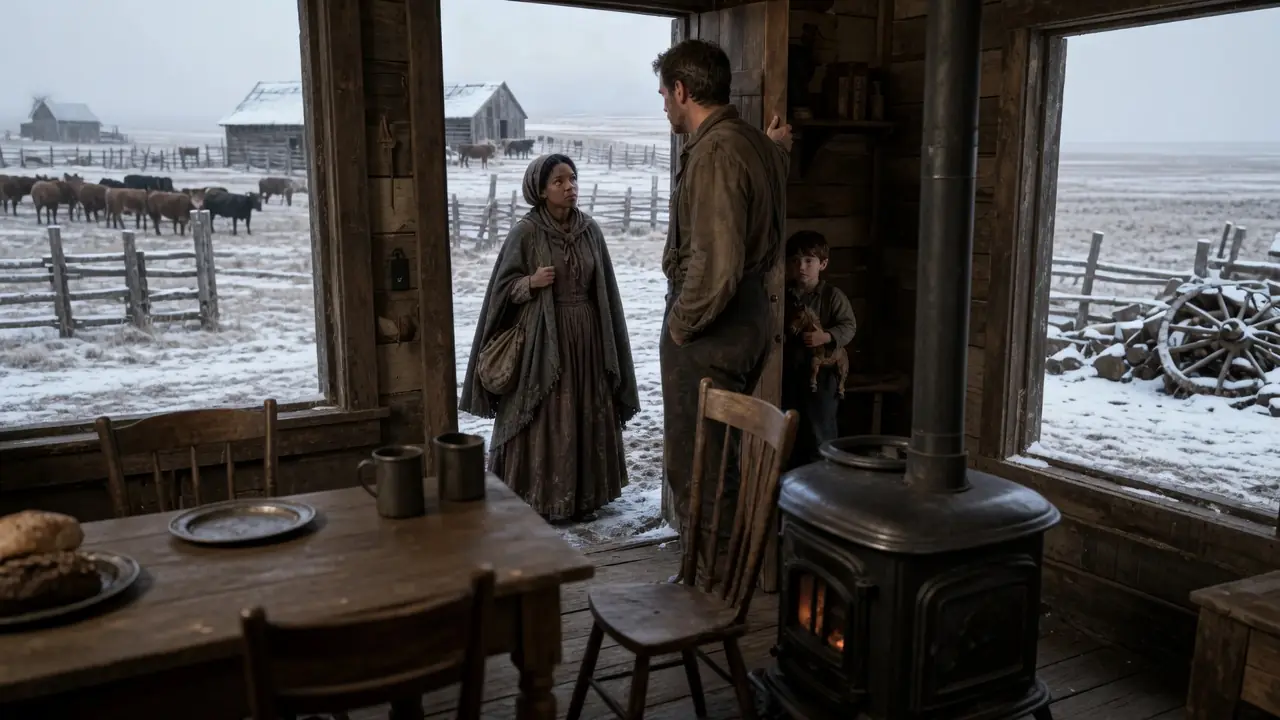
When the wind tore away the fog, the house appeared—a long, low cabin hunched against the prairie storm. Behind it, barns and fences stretched into the haze, not quite ruined, but not thriving either. Its weary look mirrored a man forced to endure long after his strength was gone.
Evelyn stopped, her palm tightening on the strap of her bag. The freighter in town had looked at her with that mix of pity and suspicion, saying only, "Try the Hail Ranch. Might be they need help." That *might* was all she had left to wager.
She knocked. The sound on hollow wood echoed like a fist on a coffin lid. For an instant, an old memory rose: another door, another man, her husband's body brought back in a wagon, his face broken by hooves. She shook her head hard, driving it off.
The door swung open, and a man filled the frame. Thomas Hail was tall and broad-shouldered, his face carved harsh, as if the land itself had cut him from stone. Every line was stern, his gray eyes cool and judging—not threatening, not welcoming, only a verdict already decided.
"We don't need anything," he said, his hand moving to close the door.
"Wait." Her voice cracked, hoarse from wind and hunger. But desperation gave it strength. "I heard you might need help. I can cook, mend, clean. I've worked cattle before. I'll do anything."
He paused, his eyes raking over the patched dress, the calloused hands, and the sun-darkened skin of too many miles. Evelyn felt herself weighed and measured like a horse on an auction block.
"No pay," he said flatly. "Just shelter, just food."
The words leaped before pride could stop them: "Through the winter, I'll work my keep."
The silence stretched, broken only by the gale against the walls. Then Thomas spoke, his voice low, dragged from a chest bound tight by the cold wind. "There's only one job here. Wife."
The word fell heavy, colder than the snow outside. Heat rushed to Evelyn's face—shame and fury alike. She had come to beg for labor, not to barter her body. Yet in his face she saw no jest, no lust, only a bare, ruthless bargain for survival.
"I'm not that kind of woman," she said, her tone steady, though her hands trembled.
"Never said you were," he said, shifting slightly, letting a sliver of lamplight spill out.
The view revealed a bare kitchen and a wooden table with three chairs, only one worn from use. By the unlit hearth, a child's toy horse lay forgotten.
"I've got a son, six," Thomas said. "He hasn't spoken a word since his mama died last spring. The house needs a woman's hand. The boy needs someone. I need a wife, not a worker, not a boarder."
Evelyn's heart clenched. A child, motherless and silent with grief. She knew that hollow silence. After James died, she too had lived in a world without words.
"That isn't marriage," she murmured.
"Marriage is a bargain. Folks dress it up with pretty names." He stepped closer. "I have no time for pretty."
His answer cut like steel. She should turn away, let the storm fill her face, and walk on into the dark. But there was nowhere left; her last coin had bought the coach fare. Inside stood a boy locked in silence, and within her a stubborn ember still burned—the will to live.
"All right," she heard herself say. "I want to see the boy first."
She crossed the threshold. The cold clung, then loosened to the meager warmth of the house. The room was broad and lonely, the sturdy furniture gone dry for lack of care. Dust traced months of a widower's neglect.
A movement at the doorway froze her. A slim figure lingered in the shadow, wide, dark eyes gleaming against the dimness. The boy.
Evelyn slowly bent down, lowering herself to his gaze. She spoke no word, offered no hand; she let him choose. The seconds stretched stiffly, the wind rattling the windowpanes. Then he stepped out slowly, holding the small wooden horse. He did not hand it over, only raised it as if to show her a guarded secret. His eyes met hers—silent, piercing, testing if trust could take root in a stranger.
In that gaze, Evelyn knew that whatever bargain she struck with Thomas Hail, she had not come here only to survive. She had come to fill a hollow space, and that hollow in turn was beginning to fill her.
***
The first morning at the Hail Ranch began not with a rooster's crow or soft rays of sun, but with a silence so thick Evelyn felt the cabin had never known human life. Wind slipped through the cracks of the planks, moaning low like the voices of wandering spirits.
She woke on a narrow bed tucked at the end of the hall. The thin blanket, the scent of old wood—all of it recalled the makeshift quarters given to colored laborers during the war, places meant only to keep flesh alive, not to offer comfort.
Stepping into the hall, she realized the house was larger than she thought. Yet, every corner bore the absence of a woman's hand. Frames hung crooked on the walls, dust lay thick on the shelves, and the stove was cold, with only gray cinders left behind. At the table stood three chairs: two barely touched, one worn smooth at the backrest. Evelyn brushed it with her fingertips, the chill sinking into her palm as if she had touched a life she did not belong to.
On the shelf by the wall sat a vase of faded flowers, their stems brittle and broken. Beside it lay a silver comb with snapped teeth and strands of brown hair darkened by time. Evelyn understood: the woman of this house still lingered in these objects, a ghost no hand could sweep away. She had once sat in this chair, combed her hair at this window. And Evelyn, the one who had come after, was being asked to step in, to carry on, but never to replace.
The heavy thud of boots on the porch startled her. Thomas Hail entered, carrying the bite of hay and cold air. He set his hat on the table, his glance brushing over her—neither lingering nor cold, just a brief acknowledgement.
"Coffee's in the pot if you want." His voice was rough, clipped.
She nodded, found the blackened kettle, and poured two cups. The metal stung her fingers with heat. When she passed one to him, her hand brushed his calloused fingers. It was only a second, but a spark was there, quick as a struck match. They said nothing, only drank. The coffee was bitter and harsh, like the only language they could share.
From the doorway behind them, the boy appeared. He clutched the wooden horse tight, his hair falling across his brow, his dark eyes fixed on Evelyn. He did not speak, did not smile, only stood, measuring what this stranger would do.
Evelyn eased into her chair, her tone gentle. "That's a fine horse. Did you make it yourself?"
The boy blinked but gave no answer. Slowly, he walked closer and set the wooden horse on the table beside her. She reached out, touched it, then handed it back. Her fingers brushed his small hand—warm, trembling. Life itself, fragile and uncertain, was placed in her palm. For a heartbeat, his eyes held hers, showing not just silence, but a heart waiting to trust.
Across the table, Thomas watched. His stony gaze shifted, not softening, but unsettled. He had seen the boy hide for nearly a year, refusing everyone, even his father. Yet now he stepped forward, daring to place his treasure in a stranger's keeping.
Evelyn bent close, smiling faintly, speaking no more. She knew words could shatter what was fragile; small gestures and a steady presence were enough to plant a seed.
Thomas cleared his throat and pushed back his chair. "Work in the barn needs doing before the sun's high. I'll be out." He left, but his last glance lingered on the sight of Evelyn and the boy, joined by a simple toy horse.
The door shut, and the wind howled once more. Evelyn ran her fingers over the carved mane, the warmth of the boy's hand still clinging to hers. The house remained empty of laughter, barren of joy, but she had seen a crack of light in the dark, and within her a fragile hope stirred that her presence here might yet mean something.
***
That afternoon, as pale light slipped through the cracks in the cabin walls, Evelyn sat at the long table, her hands laced tight against the rough wood. All day she had worked—sweeping dust from summers past, stirring a fire in the dead stove, trying to press life back into corners that had grown hollow. Yet the harder she tried, the clearer it became: this house had never been opened to anyone beyond the memory of the woman who was gone.
Thomas came in at dusk, the fields swallowed by shadow. He carried the smell of hay and winter earth, his boots caked with frozen mud. He stripped off his coat and set his hat hard on the table, as if that motion alone had become his habit.
Evelyn watched him a breath longer than she meant to, then drew in air to steady herself. This was the moment to speak, whether her voice broke or not.
"Mr. Hail."
He lifted his head, his gray eyes sharp with that guarded look he always wore. The coldness of it almost crushed the words in her throat, but she thought of the boy clutching his wooden horse, staring at her with eyes she could not shake. She would not live here as a shadow.
"If you truly want a wife," she said, each word firm, "then I must be a wife in truth—not a ghost to stand in another's place, not an empty name for folks to call. I need a room of my own, not a corner, not a cot, but a place where I belong. And I need a voice in this ranch: the kitchen, the market, even the land when spring comes. Otherwise, I'm nothing more than a servant without wages, and I will not live like that."
The silence that followed was heavy. Outside, the wind clawed at the eaves. Inside, her heart beat too quickly, each thud louder than sense. She was certain she had ruined everything, that he would turn and order her out into the night.
But Thomas Hail did not raise his voice. He only stood looking at her, long and steady, until she felt as if he were cutting down to her soul. Then, with no warning, he nodded once. "Fine."
One word, dry as dust, heavy as stone. Evelyn froze, scarcely believing she had heard right. "You... you don't object?"
"I didn't bring you here to play housemaid. If you carry the name of wife, then you'll have a place in this home. Take whichever room you see fit. The market, the kitchen—yours to mind. The land is mine to decide, but if you've thoughts, I'll listen. I said before, I have no use for pretty talk. A wife is a wife."
Something stirred in her chest—not warmth, not joy, but recognition. His words were rough, his face still cut from stone, but he had granted her standing here, a claim beyond survival.
The side door creaked. Evelyn turned to see the boy step out. He held his wooden horse close, paused, then, for once, did not slip back into the shadow. He came forward, stopping beside her chair. His round eyes moved from his father to her, weighing, choosing. At last, he leaned his thin shoulder against her side, small and certain.
Evelyn laid her hand gently on his shoulder. He did not pull away. It was a quiet moment, small but complete, a sign of trust.
Thomas looked on, and for the first time, the iron gray in his gaze shifted—not softening, but cracking, as if a warmer wind brushed across his weather-worn face. It passed quickly, and he turned, bending to stoke the fire. But Evelyn had seen it. In that fleeting instant, she knew an unseen thread had begun to tie the three of them together. And for the first time since crossing this threshold, the house no longer felt drowned in shadow.
***
Morning laid a film of white mist across the prairie. Frost clung to the stiff grass, catching light like shards of glass, while inside the Hail cabin, the chill of dust and old ash still lingered. Evelyn stood in the kitchen, her eyes roaming the room. Once another woman's hands had shaped this space, kept it neat, set fresh flowers in a vase, and filled it with laughter. Now all that remained were tired traces of neglect.
The boy slipped in quietly, his dark eyes fastened on the wooden horse he always carried. He lingered by the door, neither coming closer nor turning back. Evelyn bent, picked up a worn rag, then glanced at him with a faint smile.
"Would you like to help me?" She didn't expect words, only held out a clean cloth.
The boy hesitated, then slowly stepped forward and took it from her. His small fingers brushed hers—warm, trembling. Fragile trust was being passed across that touch.
All morning they worked side by side, wiping shelves and stacking dusty books. On top of a cupboard, Evelyn spotted a picture frame lying face down. She reached for it, but her arm fell short. The boy fetched a stool, climbed up, and carefully handed it down. Their hands met on the cold wood of the frame, their eyes lifting to one another, uncertain but no longer entirely guarded.
Inside was a photograph: a young woman with brown hair loose around her shoulders, cradling an infant—the boy himself. Her gentleness seemed to spread into the room, pressing on Evelyn's chest with a heavy ache. She set the frame upright, brushing the dust away as though promising not to erase the woman's presence.
At noon, Evelyn found a small notebook tucked in a drawer, the handwriting slanted and fading. Inside were recipes, one for a simple cake of flour and molasses—the late wife's hand. Evelyn paused, then decided to try it. The kitchen, long cold, came alive with the fire's warmth. She kneaded the dough. The boy stood watching, his eyes wide. When a smear of flour streaked her nose, he let out a quiet laugh—the first sound of joy, quick and shy, but strong enough to shake her heart.
"You can stir for me," she said gently, sliding the bowl toward him.
He nodded, slow but sure, taking the wooden spoon. His small hand circled clumsily in the mix. Evelyn placed her hand over his, guiding him; he did not pull away.
When the cake was baked, the sweet scent of molasses filled the kitchen. She cut a slice and set it before him. The boy hesitated, then bit into it. The soft sweetness melted on his tongue, and his eyes lit up. Then came a smile, full and unguarded, breaking through a year of silence.
Evelyn stilled, her throat tight, unwilling to disturb the fragile gift. She only reached out, brushing his hair back. The boy looked up, trust shining between them like a taut thread.
At the doorway, Thomas Hail stood silent, unseen until now. His eyes were fixed on the sight: his son, whom he had failed to draw from grief, was now smiling because of this woman. He said nothing, did not enter, only clenched his fist at his side until his knuckles went pale. For the first time, the cold gray of his gaze glimmered with a crack of something else.
In the kitchen, Evelyn offered another piece of cake. The boy accepted it, their hands touching once more, his smile lingering. And in that moment, the long-dead hearth was lit again—not only with wood and flame, but with the presence of someone willing to stay.
***
That winter came harsher than any reckoning. Snow swallowed the paths, ice sealed the streams, and the wind lashed long and hard, as though it meant to tear the last remnants of life from the prairie. The Hail Ranch, already thinned from the failed harvest, held only a few sacks of seed, some shriveled potatoes, and a handful of lean cattle clinging to survival.
Thomas Hail worked from dawn until dark, as if pausing for a breath would bring ruin down upon them all. He split wood, mended fences blown apart by gales, and checked on the livestock. His clothes soaked in sweat, then froze stiff against his body. Evelyn watched him wear himself thin, every motion etched with the burden of keeping a household from breaking.
The toll showed in the cracked flesh of his hands, torn open like dry earth under a drought. One evening, he staggered inside, his coat heavy, his fingers bloodied and raw. He dropped the bundle of wood with a thud and sank into his chair as though he'd come back from war. Evelyn fetched a clean cloth and a tin of salves she had unearthed from an old chest.
"Leave it," he muttered, his voice ragged.
"No." Her tone was calm, unyielding. "You keep those hands like this, you'll have no strength tomorrow."
He meant to pull away, but the steadiness in her gaze stilled him. She sat across from him, lifted his coarse hand—the skin split deep, red seeping into old scars. Her fingers were soft, warm, utterly opposite. She worked the salve in slow strokes, pressing gently along the veins and creases. Thomas stared into the fire, his breath thickening. He said nothing, but the silence was no longer cold; it weighed heavy with something else, a closeness he had not allowed himself in a long while.
Evelyn said nothing either. She only felt the thud of her own heart as her hands passed over his. That large, battered hand had borne the whole weight of this house; now it was covered by hers, not in pity, but in quiet sharing.
The boy sat near the hearth, the wooden horse in his lap, his dark eyes watching every gesture. When Evelyn finished binding Thomas's palm, she lingered by the fire to dry the cloth. The boy crept close and then slipped his small hand into hers.
Evelyn froze, then curled her fingers gently around his. Warmth spread from his touch, chasing out the deep cold. He said nothing, only leaned his head against her arm, his eyes fixed on the flame. Evelyn closed her eyes a moment. This was the first time he had chosen her, not with a look, but with a touch—certain and trusting.
When Thomas turned, he saw it: his new wife at the hearth, his silent son clutching her hand, the two bound together in stillness. He flexed the hand she had tended, strange stirrings moving beneath the frost he had buried in himself long ago.
That night, the three sat around the rough table. Supper was no more than stale bread and thin broth, yet the hollowness had lifted. Evelyn set the small piece of meat into the boy's bowl first, then Thomas's. He glanced at it, then pushed it back, leaving more for the others. Evelyn did not speak, but when her eyes met his, they carried a softness that unsettled him.
The house, once so bound in silence, began to find its own rhythm—the shuffle of the boy's steps across the floor, the clink of dishes as Evelyn laid the table, the sigh from Thomas that no longer sounded so sharp. It was a shared cadence, fragile but real: a family's pulse.
Outside, the storm still raged, shrieking to bury them. But inside, by the glow of the fire, three people sat close, hands linked to hands. And the price of winter—loneliness, loss—was being met by a bond no blizzard could undo.
***
The wind howled like a thousand wounded beasts, tearing across the Nebraska prairie in a night black as coal. Windows rattled, the wooden frame of the cabin收 shuddering as though it might splinter apart. Inside, Evelyn stood frozen before the hearth, her hands clenched tight.
Thomas had left at dusk, saying only he'd check the horses and fetch more hay. He promised he'd be back before dark, but the storm had come early, and now midnight had passed. The boy huddled near, his wooden horse pressed against his chest, his dark eyes wide and unblinking. Each time the gale slammed against the roof, he flinched and looked to Evelyn. In his gaze, she saw her own fear—the dread that the man would not return.
She could not wait longer. Evelyn threw on her wool cloak, tying it firm at her throat. Kneeling before the boy, she set a hand on his small shoulder.
"Stay here. Keep the fire. I'll bring your father home."
His eyes pleaded with her, but the boy only nodded, clutching her hand for one second before letting go.
Evelyn stepped into the storm. The wind struck like shards of glass, the snow blinding her to all but a blur of white. She bent low, forcing each step toward the barn. There, in the drifted yard, she saw a body crumpled in the snow. Thomas. He lay half-buried, one shoulder stained dark, his hands still gripping a bundle of hay—as if even in collapse, he would not surrender.
"Thomas!"
Evelyn fell to her knees, her hand trembling as it touched his frozen face. His breath was faint but present. Blood soaked through his coat, his arm gone purple with cold. She bit down, hauling him up, dragging his weight against her slight frame. Step by step, her teeth clenched until her lip bled, she fought the storm.
The cabin door burst open, the wind clawing inside, snuffing the fire near dead. The boy ran to her, tears bright, helping lift his father to the bed. Evelyn rushed to the hearth, sparked the flames alive, then returned to him.
Thomas drifted in fever, his skin burning, sweat beading his brow. Evelyn tore away his soaked coat, peeling back the layers beneath. The wound at his shoulder was torn wide, the crimson deepening. Her hands shook but did not falter; she cleansed it with heated water, bound it with strips of cloth, and wrapped him until the bleeding slowed.
He groaned, his lids fluttering. For a breath, his gray eyes cracked open, dulled and questioning why she had braved death for him.
"Don't leave us," she whispered, her voice breaking. "Don't leave the boy. Don't leave me."
He could not speak, only panted, but his bloodied hand reached out and closed weakly around her wrist. That frail grip carried more than words ever could.
The storm roared on, but inside, the firelight and the heat of bodies pressed close pushed the cold away. Evelyn sat at his side, clasping his hand. The boy, exhausted, curled in a chair, his wooden horse clutched tight as sleep finally took him.
When the pain eased, Thomas stirred again. He fixed his gaze on her, his rough voice rasping, "You shouldn't have gone out. Too dangerous."
"And you thought I'd let you lie there and never come back?" Her eyes burned in the firelight.
A silence fell, taut as a drawn bowstring. Then his good hand lifted and brushed her cheek. It was clumsy, rough, but it set her trembling. It had been so long since anyone touched her like she was something to keep, not discard.
Evelyn bent down, her lips trembling against his. At first, it was a desperate plea, a gasp torn from fear. But when he answered, the kiss deepened—fierce, as if two souls had collided in the dark and clung to life. It was no vow, no duty; it was instinct. The terror of loss turned into the hunger to hold on.
That night, as the gale battered the walls, Evelyn and Thomas drew together. No words, no ornament—only two worn bodies clinging to warmth, proving they were alive, proving they still needed one another.
When at last she lay still in his arms, his chest rising strong beneath her ear, Evelyn closed her eyes. The storm outside screamed, but in that moment, she knew something had shifted forever. It was no longer just a bargain for survival. Between them, love had begun.
***
The storm passed, leaving the Nebraska prairie scarred with ice and drifts piled high against the fences. Yet inside the Hail cabin, the air had shifted. It was no longer a shelter for three souls bound only by circumstance; it had become a home alive with footsteps, with the crackle of the hearth, with the rhythm of shared breath.
Thomas lay in the main room bed, his shoulder bound, but his color returning day by day. Evelyn tended his meals, his medicines, and adjusted the pillows so he could rest easier. The boy stayed near, unwilling to let either slip from his sight, as if the storm had carved into him the fear of losing both father and new mother in the same night.
Each morning, Evelyn opened the shutters wide. The glass, once filmed with grime, now shone clear. Sunlight poured across the floor, catching on her thin but steady face. Thomas often watched her at that moment. His gaze no longer weighed her like a stranger at his door; there was something softer now, a feeling he could not shape into words.
"You don't have to do it all," Thomas said one morning, his voice rough.
Evelyn set the bowl of porridge down and shook her head. "If I don't, who will?"
He said nothing, then gave a faint smile—a rare thing, breaking through the hard lines carved by years of burden.
At night, the boy often crept from his small bed, curling near the fire where his father and Evelyn sat. Once, when Thomas drifted into sleep under the balm of medicine, the boy's head slid onto Evelyn's lap. In that half-dream state, his lips parted. "Mama."
The sound was cracked, gravelly from a throat long silent. Evelyn stiffened, tears rising sharp. She bent down, stroking his tangle of dark hair. Thomas stirred, waking in time to hear it clearly. His eyes found Evelyn's across the dim glow. In them, no suspicion, no cold bargain remained—only recognition. This woman had stepped into the deepest hollow of their lives and filled it with a tenderness no one else could.
The next morning, as Evelyn brought warm water to tend his wound, Thomas caught her hand. "Evelyn, this isn't an arrangement anymore." His voice was firm, steady. "From now on, it's a partnership together."
Simple words, but for him they were a vow. Evelyn nodded, her hand still in his. For a long breath, they needed no further speech; their eyes spoke enough, the fire crackling as if to bear witness.
The boy ran in then, his wooden horse clutched tight, clambered onto a chair, and leaned into Evelyn. He said nothing, but the way he pressed against her side was its own declaration. Thomas understood. The boy had chosen, and so had he.
From that day, Evelyn was no longer the widow come begging for work. She was the mother the boy whispered for in his sleep, the wife Thomas began to see with the eyes of a true companion. Outside, the snow held fast, the earth still locked in frost. But within the cabin walls, spring had already begun.
***
Morning broke clear, though snow still clung thick along the trail into town. Wagon ruts cut deep, winding across a sheet of ice that cracked beneath the wheels. Evelyn sat in the old wooden wagon, the boy beside her, his small hand woven into her roughened palm. Thomas held the reins, his shoulder bound, but his gaze steady.
"You sure you're strong enough?" Evelyn asked quietly.
He only nodded, his voice clipped but resolute. "Folk need to see. We don't bow."
The town came into view—weather-worn wooden houses gray from wind and years, thin threads of chimney smoke curling into the cold sky. When the wagon halted before Henderson's general store, heads turned. Men outside the saloon broke off their talk. Wives with market baskets leaned close to one another, whispering.
Evelyn felt each look pricking her back like needles. She knew well what fed their murmurs: a Black widow stepping down from Thomas Hail's wagon, the same man who had lived shut away since his wife's death. She squeezed the boy's hand. He tilted his dark eyes up at her, wordless, as if asking, *Should we go on?*
Evelyn drew a breath, lifted her chin, and stepped down first. "Come on, son," she said aloud, offering her free hand for him to take.
In that moment, Thomas came around the wagon, planting himself at her side, his stare sweeping the onlookers. His voice carried just enough for the nearest to hear. "Mrs. Hail, you go on in and pick out cloth. The boy and I will follow."
The air shifted like canvas tearing in the wind. *Mrs. Hail.* The words spread fast through the street, caught in every ear. Henderson stiffened behind his counter, then forced a smile. Women whispered sharper, their eyes wide.
Evelyn froze, warmth rushing to her cheeks. She had never heard him call her that before others. The title fell like a shield before her—a declaration plain as stone. No longer the widow Carter begging for work, but mistress of the Hail Ranch. She lifted her head and led the boy inside.
The bell above the door rang clear, the air within heavy with flour, cloth, and dried tobacco. Henderson bobbed his head, though his eyes darted between her and Thomas, measuring. Evelyn chose bolts of fabric—brown for work clothes, blue for the boy, and one rare strip of white, not for vanity, but to sew a tablecloth.
She placed them on the counter, her voice even. "Add needles, buttons, and a stick of candy for the boy."
The boy's lips parted in a small smile at the word *candy*. Evelyn squeezed his hand—a simple gesture that lit his eyes brighter than the store's lamp. Thomas entered then, slow and upright. As Henderson wrote in his ledger, Thomas set his hand against Evelyn's back—a brief, unconscious touch, but enough for every witness to see.
The whispers flared: *He's claiming her outright. A widow, and Black at that.*
Evelyn did not lower her gaze. She held the boy close at her side, lifted her chin, a calm smile softening her face. Outside, the wind bit sharp, yet her chest warmed. She caught the boy looking from his father to her, his eyes glowing with a trust newly born.
On the road home, words were scarce. Snow gleamed white across the fields. At last, Thomas spoke. "They'll talk for a while."
"Let them," Evelyn answered, her eyes on the endless, pale horizon. "What matters is your boy won't have to bow his head again."
Thomas turned, studying her long. In his gray eyes, there was a gentleness that had never been there before. He said nothing more, only tightened the reins, his other hand shifting to brush the back of hers—a hidden touch meant for her alone.
The wagon rolled on, leaving behind the murmuring town. For the three within, life had altered. This was no arrangement; this was a choice, clear, public, and sealed in the words Thomas had spoken before them all: *Mrs. Hail.*
***
The March wind carried the thaw of spring, snow melting along the fence line to reveal black, damp earth beneath. Evelyn was hanging wash on the line, the boy nearby with his wooden horse, when a well-kept carriage rolled into the yard. Dust still hung in the air when a tall woman stepped down, dressed in fine Denver fashion, a feathered hat trembling in the breeze.
"Thomas!" Her voice rang out, sharp and cold as metal.
Thomas emerged from the barn, his limp still heavy from the wound winter had left behind. He stopped short, his eyes dimming. "Catherine."
Evelyn knew at once: Thomas's sister, Catherine Hail, long settled in Denver. No explanation was needed; the air itself grew taut.
Catherine strode forward, her eyes flicking over Evelyn, pausing with pointed weight. "So it's true," Catherine said, her tone like flint. "You've brought another woman into Mary's house, into my sister-in-law's place before her grave has cooled."
Heat rose to Evelyn's face, but she held her spine straight, her gaze steady. "I have not replaced anyone. I'm here for the boy, because this house needed breath again."
Catherine's laugh was brittle and sharp. "Bireath. You stand where Mary once stood. Sleep in her bed. Now teach her son to call you mother. Shameless."
Evelyn's hands trembled around the cloth she held, but she bit back her tongue.
Thomas stepped forward, his voice hard. "Enough, Catherine. Evelyn saved my life in the storm. She's kept this ranch from falling. And the boy... the boy is Hail blood."
Catherine cut in, her eyes flashing. "He needs protection, not a widow looking for shelter."
The yard fell silent, save for the hiss of wind along the fence. The boy had been standing on the porch, his wooden horse clutched tight, his eyes wide at the fury flaring between grown folk. Then, with sudden resolve, he stepped into the yard. His lips quivered, his throat straining to force words that seemed torn from stone—broken, rough, but clear:
"Mama... stays."
All three adults froze. Evelyn's breath caught sharp in her chest. It was the first time the boy had spoken the word—not in a fever dream, not whispered half-asleep, but aloud, strong before them all.
Tears welled in Catherine's eyes. She looked at her nephew—the boy who had stayed silent since Mary's passing was speaking again, and the word he chose was not her sister's name, but Evelyn's. She turned aside, her shoulders shaking. "God above. He's never spoken. Not to me, not to anyone." Her voice broke, tears running down her cheeks.
Evelyn sank to her knees, her arms folding the boy close. "I'm here, my son," she whispered, her voice trembling. "I won't leave you."
The boy buried himself into her shoulder, clutching her dress as though afraid she'd vanish. Thomas watched, the iron gray of his eyes glistening.
Catherine steadied herself and wiped at her face, her voice softened by grief. "Perhaps I was wrong, Evelyn. If he's chosen you, if his voice has returned because of you, then maybe Mary would have wanted it so." She came closer, laying a trembling hand on the boy's dark hair. "My boy, you've been silent too long. If this is what brings your voice back, I have no right to deny it."
Evelyn lifted her gaze, her eyes wet. "I never sought to replace Mary, only to keep her spirit alive in his smile."
Catherine studied her a long moment, then gave a slow nod. "Then do it—for the boy, and for Thomas."
In that moment, the quarrel eased, and suspicion melted. On the Nebraska prairie, a new family was claimed—not by papers or gossip, but by the first word torn from a child's silence, a word that bound them all together: *Mama stays.*
***
That spring came slow but certain. The last of the snow melted from the fence line, revealing dark, damp soil beneath. Evelyn knelt in the garden, her hands muddy as she pressed carrot and cabbage seeds into the furrows. Beside her, the boy worked with a small wooden spade Thomas had whittled for him. When the boy dropped a handful of seed, Evelyn gently corrected him, her smile soft.
"Good, Caleb," she whispered.
This time he answered, not with silence, but with a word, halting and rough: "Good."
Evelyn froze, then smiled until tears blurred her sight. Thomas, near the barn, pretended to busy himself with fence posts, but his ears strained toward them. Since the boy had spoken those first words, his voice had returned more and more. Each new word lit Evelyn's face as if it set the whole yard aglow.
Inside, Evelyn hung fresh curtains and spread the white tablecloth she had sewn from that Denver cloth. Supper was no longer stale bread alone, but steaming soup, and sometimes a pie. Caleb laughed aloud now—a sound so strange Thomas had stilled the first time he heard it, turning aside quickly to hide the wet in his eyes.
One evening, Evelyn was tending the fire when Thomas came in with an armful of wood. He set it down, turned, and nearly brushed against her. His hand shot out, his rough palm grazing her waist. The touch lasted but a breath, yet Evelyn stiffened, her heart racing. She looked up, and their eyes met. For a moment, both stilled, then turned away to their tasks. But afterward, each accidental touch carried new weight—not clumsy anymore, but a quiet acknowledgement.
Another day, the three of them worked in the hayshed. Thomas stood on the ladder, passing bundles down. Evelyn caught them, their hands meeting in the exchange. At first, he pulled away too quickly. Then, slower, he passed the next, letting their fingers linger. Evelyn said nothing, only pressed her lips together, though the faintest smile tugged at her. Caleb saw, giggled, and lifted his wooden horse to hide his face, as if guarding their secret.
The fields outside grew green again. Evelyn and Caleb planted marigolds along the fence, so mornings brought not just the scent of grass, but the sweet drift of blossoms. From Denver, Catherine sent small packages: seeds and books for Caleb. Evelyn welcomed them with gratitude, knowing they meant more than their use; they meant acceptance.
One quiet afternoon, Thomas led his horse across the pasture, Evelyn walking with Caleb beside him. The prairie stretched golden in the sun, birds calling from distant trees. Caleb ran ahead, his small legs kicking up dust. Evelyn watched him, then turned to Thomas. He seemed changed. His eyes no longer carried that heavy shadow. Though words were still few, his silence felt lighter.
"Do you see?" she said softly. "He not only speaks now, he laughs. He's alive again."
Thomas halted, his hand steadying the reins. He turned toward her, his voice low. "Not just the boy. The house, too."
Evelyn understood. He no longer saw her as a stranger widow at his door, but as the woman beside him, rebuilding what had been broken. They needed no vows, no fine phrases—only the weight of a glance, the brush of hands at work, and the boy's laughter weaving them into one.
That spring, the Hail Ranch emerged from winter not merely endured, but renewed. It lived again through patience, through shared labor, and through a love sprouting quiet and strong, like green shoots rising from dark soil after a long frost.
***
That summer, the Nebraska sky stretched wide and blue, the sun spilling gold across the prairie like a great cloth unfurled. The wind carried the scent of young grain rustling through the cottonwoods by the creek. Beneath one old giant, proud and shading, Thomas chose to marry Evelyn. No church, no grandeur—this wedding bore no mark of survival, no trace of a bargain. It was a vow, plain and true, before land and sky, and before those who had seen their journey: a beginning born not of need, but of choice.
The town's folk came together, setting rows of wooden benches under the tree. Women tied bundles of wildflowers along the aisles, white and violet bright against the green grass. Children laughed and darted about, their joy rising like a summer hymn. Catherine stood off to the side, simple in dress, peace at last upon her face, her doubts gone, leaving only quiet gladness.
Evelyn stepped from the cabin in a cream dress Catherine had sent from Denver. It was not elaborate, but in the morning light, the fabric glowed. Her hands trembled, yet her heart steadied when she saw Caleb waiting ahead—his shirt crisp, his hair combed neat, a shy smile touching his lips.
Thomas stood beneath the cottonwood, his coat worn but pressed, a yellow marigold from Evelyn's garden pinned at his chest. When he saw her approach, his gray eyes, once so cold, lit bright—not as a man merely surviving storms, but as one who had chosen to stay, to trust.
The town preacher opened his book, his voice steady and deep, carried on the breeze, mingling with the birdsong. His blessing needed no flourish; it rang true as earth itself. Evelyn's chest tightened, her hand gripping her skirt. Then her glance fell to Caleb's bright eyes, and calm returned.
When the rings were called for, all turned to the boy. Caleb walked forward slowly, holding a small wooden box tight in both hands. He opened it to reveal two plain iron bands—rings Thomas had forged from old nails in the barn fire. The boy held them up, his gaze steady.
Thomas took them, then knelt to his son's height, giving a silent nod of thanks. He rose and slid one onto Evelyn's hand. "This ring," he said, his voice rough but firm, "is not polished nor fine, but it was made in fire and steel, like what we've come through."
The words hung in the hush. Evelyn's hands shook as she received it, tears brimming. Then Caleb reached into his pocket and drew out a thin gold ring, aged and dulled by time. The crowd stilled. Evelyn knew it at once: it was Mary's wedding ring.
The boy lifted it, his lips trembling. "Mama."
Evelyn broke, tears running freely. This was no whispered dream, no half-uttered sleep; this was his choice, plain in the light of day. With both hands, he offered it to her—not as a relic of the past, but as his last seal that she belonged.
Evelyn sank to her knees, wrapping him close, her cheek against his tangled, dark hair. "I'm here, son," she whispered. "I'll always be here."
Around them, Catherine pressed a hand to her face. Neighbors who once whispered now bowed their heads, their eyes wet. They were not witnessing a wedding alone, but the stitching of a family, bound not by force, but by love and choosing.
Evelyn placed the gold ring into Thomas's hand. He slid it onto her finger, his calloused hand closing over hers. Their eyes met, no words needed, the vow already written clear.
When the preacher declared them husband and wife, Thomas bent down and kissed her. It was not the frantic kiss of the storm, nor the clumsy one of two strangers; it was their first kiss in daylight, before everyone, the seal of having found and chosen one another.
Applause rose, rolling as the wind swept the cottonwood leaves. Children cheered, women smiled, and men nodded firmly. Caleb stood between them, his small hands clasped tight in theirs, his dark eyes shining like stars. In that moment, Evelyn knew this was no longer a house patched for survival, but a home renewed. It was built from grief, steadied by patience, and at last raised upon love. And the wedding beneath the cottonwood, simple yet full, would forever stand as witness to that choice.
***
Spring returned to the Nebraska prairie, not with biting frost, but with the scent of damp soil and young grass rising from beneath the thaw. The fields before the ranch spread green, dotted with purple and yellow wildflowers trembling in the breeze. The barn no longer stood in gloom, the pasture lay open, and the garden behind the house, where Evelyn had knelt day after day to sow, now pushed up neat rows of tender shoots. Along the creek, the cottonwoods stretched wide, sheltering all that belonged to this home.
In the sunlit kitchen, Evelyn placed a jar of wildflowers in the center of the table. Their faint fragrance mingled with the warm smell of fresh bread, filling the room with quiet comfort. Caleb sat on the long bench, hunched over, a blunt pencil clutched in hand, working in the worn exercise book Catherine had sent from Denver. His tongue peeked at the corner of his lips, his dark eyes fixed with the gravity of a grown man on serious work. Now and then he looked up, seeking Evelyn's nod before bending again to his task.
Thomas entered from the door, his boots muddy, his shoulders carrying the scent of hay. He stopped short. Before him was a scene he'd once thought impossible: his son, once mute with grief, now whispering, reading, writing; the woman nearby, her hair falling soft at her shoulders, watching him with patience and tenderness; and in that space, the faint murmur of a boy's voice—an echo long absent from these walls.
"Finished," Caleb whispered. His voice was thin and unsteady, but it carried weight.
He slid the notebook toward Evelyn. She opened it, her heart catching at the crooked words:
*My family.*
Beneath, three lines were spelled out in shaky letters:
*Papa Thomas,*
*Mama Evelyn,*
*Mama Mary.*
The room stilled. Evelyn's eyes blurred, her throat tight. Thomas stepped closer, bending to read. Those misshapen letters held both past and present—the love for Mary, the wife now gone, and the love for Evelyn, who had come not to erase, but to carry forward.
Evelyn knelt down, pulling Caleb into her arms. Tears streamed, yet her smile broke through. "That's right, son," she whispered, kissing his soft hair. "That's our family."
Thomas laid his rough hand upon them both—scarred, weathered, yet steady with warmth. He did not need words. His grip alone told her the circle had closed, not in loss, but in wholeness.
That evening, as the sun sank red against the horizon, the three sat on the porch together. The spring wind carried the scent of tilled earth and green grass. Caleb sat between them, his small hands clasping his father's on one side and his mother's on the other. Evelyn felt the warmth flow through that fragile bridge of fingers, binding the three as one.
Thomas turned, his gaze resting on her, no longer distant, no longer guarded. In his gray eyes lay only trust and peace—a man who had lost much but learned to open again. Evelyn answered with a soft smile, her eyes shining with the unspoken words: *I am here. I will always be here.*
The prairie burned with sunset fire, orange and red spilling across the wide sky. Evelyn leaned her head on Thomas's shoulder. Caleb nestled against her chest. None spoke; there was no need.
In the stillness, Evelyn understood: love does not erase the past nor deny what once was. It widens the circle, making space for the new while honoring the old. Mary would always live on in memory and in Caleb's heart, and Evelyn would carry that thread forward—not replacing, but continuing. This family, broken once, had found its way closed again. Mary was not forgotten, Evelyn was no longer an outsider, and Caleb, once silent through his grief, now could speak mama with a whole heart.
Hands tightened together as the last light faded. An unseen thread bound past, present, and the life yet to come. At the Hail Ranch, winter had given way not just to spring, but to a true home.