The words land in the first-class cabin of British Airways flight 408 like a stone dropped through glass, sharp, irreversible.
Every passenger within earshot goes still. A man in 3A lowers his champagne flute. A woman in row four stops mid-sentence. 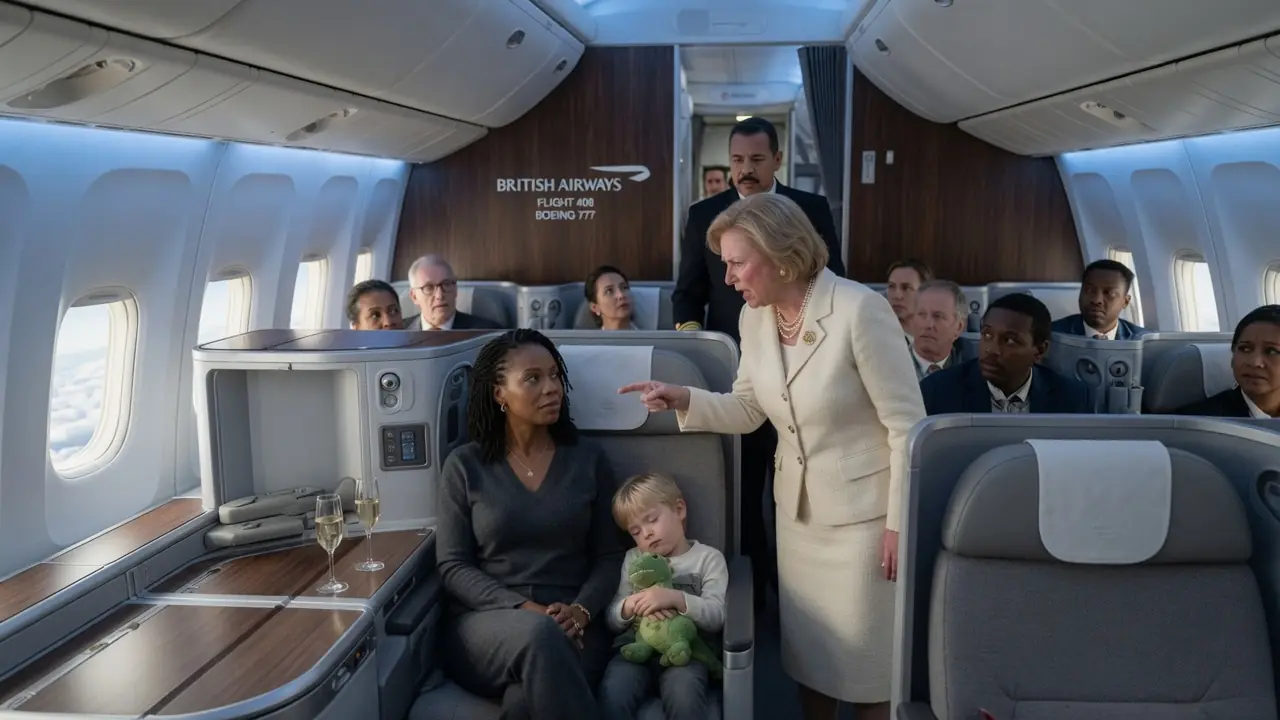
The ambient hum of the Boeing 777 seems to hold its breath. The voice belongs to a woman in a cream Chanel suit standing in the aisle of the most expensive section of the aircraft, one hand gripping the overhead bin, the other pointing with absolute certainty at a black woman seated calmly in suite 1A.
Alongside the black woman tucked under a soft ivory blanket is a 4-year-old boy with sandy blonde hair and pale skin and green eyes sleeping with one hand curled around a small plush dinosaur. The woman in the Chanel suit is not whispering. She is not uncertain.
She delivers the words the way people deliver policy with the smooth confidence of someone who has never once been told they are wrong. And the woman she is pointing at, the woman in the simple charcoal cashmere set and white sneakers, the woman with deep brown skin and a crown of micro locks and eyes that have seen this particular moment before in different rooms with different faces wearing different clothes, does not flinch.
She does not raise her voice. She does not stand up yet. She simply looks at the woman pointing at her and something moves behind her eyes. Not anger, not hurt, something cooler and more patient than either of those things.
Something that looks to anyone paying close attention a great deal like certainty. What Margaret Harlow does not know standing in that aisle with her Hermes scarf and her $45,000 Cartier watch and 30 years of unquestioned social authority behind her is that she has just made the single most expensive mistake of her life.
Not expensive in the way that word usually means. Not a misstep, not a social faux pas, not an awkward moment she will retell with a rueful laugh at her next charity luncheon. Expensive in the way that ends things.
In less than 48 hours, Margaret Harlow will lose her marriage. She will lose her Park Avenue penthouse, her Hamptons estate, her seat on three charity boards, her membership to every social institution she has spent three decades cultivating.
She will lose her husband's career, and because of that, the financial foundation on which every piece of her world has been built. She will lose all of it. And the woman she just called a nanny, she will be the reason why.
But to understand how a single sentence spoken at 35,000 feet over the Atlantic Ocean dismantles an entire life, we have to go back. Not to the plane. Not yet.
We have to go back to gate 22 at JFK International Airport to the British Airways flagship lounge 45 minutes before boarding, where two women and one little boy and one confidential corporate dossier and one very expensive watch all ended up in the same room at the same time for reasons that would take the rest of the flight to fully unravel.
The British Airways flagship lounge at JFK Terminal 7 is the kind of space designed to make certain people feel like they have already arrived somewhere even before the plane has left the ground. The lighting is warm and low.
The furniture is leather, deep cushioned, arranged in clusters that suggest privacy without actually providing it. The air smells of fresh coffee and something faintly floral, an expensive diffuser scent that costs more per month than most people's groceries.
There is the quiet clink of crystal. There are hushed business calls conducted in corners, voices measured and controlled, the tones of people accustomed to speaking in rooms where their words carry weight.
A departures board updates silently overhead scrolling through destinations with the calm indifference of a system that moves whether you are ready or not. Dr. Josephine Carter sits in a corner booth near the window and she is not performing anything for anyone.
She is 38 years old. Her skin is a rich deep brown, luminous even under the warm lounge lighting. The kind of skin that photographs beautifully and ages even better.
Her hair is pulled back from her face in a crown of microlocs, each one neat and precise. The product of a Saturday morning ritual she has maintained for 11 years, regardless of what city she wakes up in.
She is wearing a charcoal cashmere lounge set, unbranded and white sneakers that have been worn exactly four times. She is not wearing jewelry. She is not carrying a designer bag.
She has a slim iPad in her lap and a half-finished cup of green tea on the table beside her and she looks like what she is, a woman who is genuinely exhausted and genuinely unbothered by the fact that it shows. The exhaustion is bone-deep.
The kind that only comes from the specific combination of surgical precision and corporate warfare. The kind that a 70-hour workweek produces in a body that has been running at that pace for most of its adult life.
She has spent the last month in relentless merger negotiations across three time zones and she is finally, finally on her way to London to sign the final documents. She is not thinking about London right now. She is thinking about the boy beside her.
Leo is 4 years old and he is currently holding a crystal tumbler that is nearly as big as both his hands combined filled with apple juice that he has been nursing with extraordinary concentration for the past 15 minutes. As though the act of drinking it slowly is a personal challenge he has accepted with great seriousness.
He has sandy blonde hair that falls across his forehead in the way his father's does. He has pale skin and striking green eyes and a gap between his two front teeth that he only recently stopped being self-conscious about after Josephine spent a full 20 minutes one evening explaining to him that the gap was called diastema and that several of the most beautiful people in the history of the world had one and that furthermore dinosaurs also had gaps in their teeth.
And Leo had found this last piece of information so compelling that he had not mentioned the gap again. Leo is the son of Josephine's late sister Maya. Maya had been the warmer one, the louder one, the one who filled rooms with her laugh and remembered everyone's birthdays, and cried at every movie, including animated ones.
She had married a gentle, quiet architect named Thomas, who worked overseas most of the year, and they had made Leo together in the early happy years of their marriage. And then Maya had gotten sick, and then Maya had been gone.
And then there was only Leo and Thomas and Josephine. And Josephine had restructured her entire life around the hours Leo needed someone who was not leaving. She had never talked about that restructuring. She had simply done it.
Rearranged board meetings. Rescheduled surgical consultations. Booked first-class seats with enough room for a 4-year-old who needed to sleep on long flights, and enough quiet for the work she brought aboard in her leather tote bag.
She had done it because Maya would have done it for her. It was that simple. "Auntie Jo," Leo says now, holding up the tumbler. "Can I have more juice?" He says it as a statement, not a question, which is a habit he has picked up from her.
"Just water for now, little man," Josephine says, pressing a kiss to the top of his head. "Long flight. I need you to sleep, not bounce off the airplane walls." Leo considers this.
He puts the tumbler down. He picks up his plush dinosaur, a faded green brontosaurus named Gerald, and holds it against his chest with the solemn care of a diplomat carrying sensitive documents.
Josephine goes back to her iPad. The Neural Bridge Systems Merger Term Sheet is open on the screen. Final addendums. She has read this document four times in the past week, and she is reading it again because that is what she does.
She reads things again. She checks. She verifies. She does not leave the final version of anything to the assumption that the previous version was correct.
This is, among other things, why she is worth what she is worth. Across the lounge, not close enough to intrude but near enough to notice, a man in a navy Henley sits at a single table with a laptop open in front of him and a cold brew coffee sweating onto a paper napkin.
He is 33 years old with dark hair and quick eyes and the particular quality of stillness that belongs to people who are paid to observe things. His name is Bradley Ortiz.
He is a digital marketing strategist and travel content creator with 2.1 million followers across platforms and he is currently working on a campaign brief that he will not think about for the rest of the day.
He looks up when Josephine and Leo settle into their booth. He registers them the way he registers everything, not intrusively, not with any particular intent, just the automatic cataloging of a person who notices things.
A black woman, a blond boy, a tender unselfconscious ease between them. He goes back to his laptop. This moment will matter later.
He will think about it later on the aircraft when everything changes and he will be glad he was paying attention from the beginning. The atmosphere in the lounge shifts before Margaret Harlow is even fully through the door.
This is something people say about her later in the aftermath when the journalists and the internet sleuths and the former charity board members are piecing together the story of her undoing. They say that Margaret had a way of entering rooms that announced itself before she arrived.
A kind of atmospheric pressure change. The air got a little tighter. People straightened without knowing why.
She comes through the entrance of the flagship lounge at 10:47 a.m. and she is wearing a cream Chanel bouclé suit that has been pressed to within an inch of its life and a silk Hermès scarf in shades of coral and gold draped with the practiced nonchalance of someone who has been draping Hermes scarves for three decades.
She is 54 years old and she is beautiful in the way that expensive maintenance and righteous certainty can make a person beautiful. Not warm beauty, not approachable beauty, but the kind that photographs well and intimidates in person.
Her husband Richard follows two steps behind her, which is the geographic position he has occupied in this marriage for the past decade. He is 57 with the distinguished silver temples and the subtle softening of a man who was handsome in his 40s and is now merely presentable.
He is carrying a leather briefcase in one hand and holding his phone in the other and his eyes have not left the phone since they left the check-in counter. He is the executive vice president of acquisitions at Stanton Global Pharma.
He has been in that role for nine years. He is very good at it, or he was until the patent cliff began to close in on the company like a slow-moving tide and the only viable lifeline became a single biotech firm whose neural mapping patent he has been trying for six months through a wall of ruthless corporate lawyers to acquire.
The acquisition meeting is tomorrow morning in London. Richard is thinking about that meeting. He is always thinking about that meeting.
Margaret sweeps into the lounge with her cataloging gaze already working. Moving from face to face, table to table, assessing the room's occupants with the brisk efficiency of someone conducting a social inventory.
She is determining in the space of perhaps 4 seconds whether the other people in this lounge are her kind of people. Her gaze reaches Josephine's corner booth. It stops.
The perfectly arched line of Margaret's eyebrow makes the smallest possible movement. Her eyes travel the route that they always travel when they land on something that does not fit her expectations.
From Josephine's brown skin to Leo's blonde hair to Josephine's charcoal cashmere set and white sneakers. The assumption forms in the time it takes to blink.
It settles into certainty before a single word has been spoken. The help is sitting in the lounge. Margaret leans toward Richard.
The acoustics of the quiet room are not her friend. Her voice calibrated for what she considers a discreet murmur carries cleanly across the space between them.
"Richard, I genuinely do not understand why the airline allows domestic staff to wait in the flagship lounge. It completely ruins the exclusivity of the experience. They should be waiting at the gate with everyone else."
Richard does not look up from his phone. "Just ignore it, Margaret. Do not start." But Margaret has already started in the private courtroom of her own judgment and the verdict has already been delivered.
She does not say anything else. She moves toward the champagne bar charting a path that takes her deliberately past Josephine's corner booth. The way certain people move through spaces they consider to be their own, checking the perimeter.
She stops beside the table. She looks down at Leo's napkin. There is a single cracker resting on it unbroken exactly as it was when Josephine put it there.
"Excuse me," Margaret says with the theatrical concern of someone who is performing consideration rather than feeling it. "You should know the child is making a mess with those crackers. As his caretaker, I would expect you to be a bit more attentive. The cleaning staff should not have to work overtime because you are distracted."
Josephine looks up from her iPad. She looks at the unbroken cracker on the napkin. She looks at Margaret's face at the powdered certainty of it, at the settled, unexamined confidence of a woman who has never once had her assumptions corrected by reality.
Josephine's voice is calm. Not the calm of someone suppressing something. The calm of someone who has nothing to suppress because she has been here before and she knows exactly how it ends.
"He is fine," Josephine says. "There is no mess. Enjoy your flight." Margaret scoffs. She mutters something that includes the word insolent and turns on one heel and walks toward the champagne bar.
Josephine takes one slow breath. She is familiar with the specific interior weather of this moment. The small, hot spike of something that rises when you are reduced by a stranger.
The brief fury of being seen as less than you are. She has felt it enough times to know that it passes, that the correct response is to let it move through her, and then go back to work.
And that is what she does. She picks up her iPad. She goes back to the merger documents. People who underestimate you are not obstacles.
She learned that somewhere in her 20s in a hospital stairwell on a day when she cried for three breaths and then straightened up and kept going. The people who underestimate you are not obstacles. They are opportunities.
She just does not know yet that this particular opportunity is going to be the largest she has ever been handed. The priority boarding call comes at 11:24 a.m. At the gate, a young British Airways agent named Elena Ruiz processes the priority passengers with the focused efficiency of someone who loves her job and is good at it.
She is 29 with dark hair pulled back and a genuine smile that she deploys freely. Not the performance smile of customer service training, but the real kind. The kind that reaches the eyes.
When she scans Josephine's boarding pass, "Dr. Carter, welcome." She looks at Leo. "And you must be Leo. Are you ready for your big adventure?"
Leo looks up from Gerald the dinosaur with immense gravity. "Gerald is ready," he says. Elena laughs an actual laugh and waves them through.
At the forward aircraft door, Jonathan Reyes is positioned where he always is, where he has been for 21 years with British Airways, straight back, immaculate, the particular stillness of a person who is always the calmest presence in any room.
He is 47 with silver at his temples and dark eyes that miss very little. He has been the chief flight purser on this route for 6 years. He recognizes Josephine when she steps through the door.
Not from headlines, not from a press release, from 2 years ago, a flight from London to New York, when she had been traveling alone and had spent the entire journey working and had thanked him at the end with the kind of specific, genuine warmth that people rarely bother with because they do not think the purser notices.
He had noticed. "Dr. Carter," Jonathan says, and there is something in his voice beyond professional courtesy. "Good to have you back with us."
"Thank you, Jonathan," Josephine says. "Long one today?" Jonathan nods. He looks at Leo.
Leo holds up Gerald. Jonathan regards the dinosaur with appropriate seriousness and says, "First class accommodations for Gerald as well. Naturally."
Leo is satisfied with this response. Josephine settles into suite 1A and 1K. She adjusts Leo's seatbelt.
She pulls out his noise-canceling headphones and his small travel pillow and his extra packet of fruit snacks for when he wakes up. And she does all of this with the unhurried ease of a woman who has made this same sequence of preparations enough times to do it without thinking.
In the lounge before he boarded, Richard Harlow spread the contents of his confidential dossier across the low table and spent 20 minutes staring at a problem with no good solution. Stanton Global Pharma is in trouble, not quietly, gradually in trouble the way large companies sometimes are with years of restructuring ahead of them and options on the table.
Acutely in trouble. The kind of trouble that keeps a 57-year-old executive vice president awake at 4:00 in the morning running numbers that keep coming out wrong.
Their flagship patent expires in 14 months. The pipeline behind it is thin. The board has been applying pressure for 2 years to identify an acquisition target that can bridge the gap.
Something with genuine intellectual property. Something defensible. Something that changes the story they are telling shareholders.
There is one target that fits every criterion. One company whose neural mapping patent is genuinely revolutionary, whose founder has been approached six times through formal channels, and has declined every overture, who communicates exclusively through a team of lawyers so formidable that Stanton's own legal department has begun describing the negotiations in terms usually reserved for international diplomacy.
Neural Bridge Systems, founded by one Dr. Josephine Carter. The acquisition meeting is tomorrow morning in London. They have been negotiating for 6 months.
Richard believes they are close. He taps his Mont Blanc pen against the tray table and reviews the final term sheet for the fourth time and tells himself again that they are close.
He does not know that the woman he has been trying to meet for 6 months is seated three rows ahead of him on this aircraft. He does not know that the folder visible in the leather tote bag beneath seat 1A contains the identical document resting on his own tray table.
He will know soon enough. The first-class cabin of British Airways flight 408 is one of the more quietly spectacular rooms that most people will never sit in.
14 private suites arranged in a configuration that provides each passenger with a door, a lie-flat bed, ambient lighting in a shade of blue that is specifically designed to ease the body into the rhythms of whatever time zone it is heading toward, and the kind of intentional hush that money buys when it is applied to acoustics.
The leather is soft enough that you notice it without meaning to. The air is cooler than the economy cabin by several degrees, and it carries a faint scent of something that is not quite lavender and not quite cedar, but somewhere between the two.
The champagne poured before the boarding door closes is vintage and served in proper crystal, not plastic, and the crew moves through the space with the specific unhurried grace of people who have been trained to be invisible until they are needed.
Josephine has booked suites 1A and 1K, the absolute front row, which she chose for the same reason she always chooses the front, maximum privacy, minimum foot traffic, and a forward-facing view that Leo finds exciting even when there is nothing to see outside except clouds.
She settles him in. Seatbelt? Headphones? Pillow? Gerald tucked under his left arm in the position he prefers, which she knows without asking.
He is already beginning to drift, the particular softening of a 4-year-old who has had an early morning and knows on some wordless level that sleep is the appropriate response to the gentle vibration of an aircraft at rest.
She opens her laptop. She goes back to the merger documents. Four rows behind her, Bradley Ortiz takes his seat in 4A and arranges himself with the practiced ease of a person who spends a significant portion of his life on aircraft.
Laptop, phone on the seat edge, noise-canceling headphones around his neck, not on his ears because he prefers to hear what is happening around him. He keeps a low profile in first class, which is easier than it sounds when you have 2.1 million followers who would recognize your face in a departure lounge.
He tends to move through the world quietly observing. He notices Josephine in 1A. He places her as the woman from the lounge, the one with the boy and the iPad and the particular quality of presence that he associates with people who are not performing their success for anyone.
He opens his campaign brief. He will not look at it again. The heels announce themselves before she is fully through the door.
The deliberate rhythmic strike of expensive footwear on the jet bridge growing louder and then Margaret Harlow is stepping into the first class cabin and Richard Harlow is two steps behind her and the first thing Margaret says is, "No, Richard, but I specifically asked for row two. I cannot stand sitting near the galley. The galley smell is intolerable on long flights, you know this."
Richard is looking at his phone. He makes a sound that could generously be interpreted as acknowledgement. Margaret steps into the aisle. She sees Josephine.
The sequence of her reaction is visible to anyone watching carefully and Bradley Ortiz is watching carefully. Recognition of a particular kind. Not the recognition of knowing someone, but the recognition of having already decided who someone is.
The recognition of an assumption encountering the evidence it expects to find. Her eyes move from Josephine's brown skin to Leo's sleeping blond head and back to Josephine's casual clothes and then to the open laptop and the papers and the leather tote bag on the floor and something in Margaret's face settles into a kind of satisfied certainty.
She was right in the lounge and here is the confirmation. Behind her, Richard has finally looked up from his phone. He sees the look on his wife's face.
He sees where she is looking. He looks back at his phone. He says nothing.
He does not say, "Margaret, do not do this." He does not say, let us just find our seats. He says nothing at all, and this silence, this particular and precise silence is the decision that will cost him everything, though he does not know it yet.
Margaret moves toward Josephine's suite. She stops at the edge of it. She reaches out and taps Josephine's shoulder twice with the brisk tap of someone accustomed to summoning people's attention.
"Excuse me." Josephine turns slowly. She looks at Margaret's hand. She looks at Margaret's face.
When she speaks, her voice is level and cold and final. "Do not touch me." Margaret recoils slightly. She rallies faster than most people would, which says something about the depth of her conviction.
"I think you are in the wrong cabin," Margaret says. Her voice is controlled now, moderated to what she believes is reasonable. "Economy is toward the back. You and the child need to move before the actual passengers board."
Josephine picks up her phone from the seat console. She turns the screen toward Margaret, showing the digital boarding pass. Seat 1A and 1K. Flight 408, departing JFK at 12:15. Her name at the top, clear and specific and undeniable.
"I am in my assigned seat," Josephine says, "as is he." Margaret produces a sharp incredulous laugh that contains zero humor.
"Oh, please. I know exactly how this works. His parents are in business class. They purchased you an economy ticket and you slipped up here to get him settled before they board. I have seen this before. Well, you need to go back to your assigned seat right now because nannies do not belong in first class."
She says "employer's child" the way certain people say certain things with the extra emphasis of someone who considers the word itself to be a kind of verdict. Josephine does not respond immediately.
She is aware of the cabin. She is aware of the elderly man in 3A who has gone completely still. She is aware of the young couple in row four who have stopped whispering.
She is aware of Bradley Ortiz in 4A whose hand has moved very slowly to rest beside his phone, not touching it, just resting beside it. She is also aware of Jonathan Reyes who has appeared at the front of the cabin with the smooth purposeful movement of someone who has been watching since Margaret entered and was waiting to see if this would escalate.
It has escalated. "Is there a problem here?" Jonathan says. It is professional and measured and gives nothing away.
But his eyes move to Josephine first and that movement is not nothing. "Yes, Jonathan, there absolutely is." Margaret says immediately pivoting toward him with the energy of someone who has been waiting for an authority figure to appear and validate her.
"This woman is occupying a first-class suite with her employer's child and I am quite certain she is not meant to be here. I am requesting that she be returned to economy before we depart."
Jonathan turns to Josephine. His manner is respectful. His face is neutral in the way that trained professionals can make their faces neutral while their judgment has already been formed.
"Ma'am, may I see your boarding passes, please?" Josephine hands him her phone. Jonathan scans both QR codes. He reads the screen. He looks up.
He smiles and it is a real smile, specific and warm, not the generic customer service version. "Thank you, Dr. Carter. Everything is perfectly in order. Welcome aboard and please let me know if Leo needs anything at all during the flight."
"Dr. Carter." The name lands in the cabin air differently than Margaret anticipated. Margaret blinks. Her mouth opens and closes once.
"Dr. Carter," she repeats. Her voice has gone slightly flat. "Check the system again. There must be a glitch. There is no way she paid for those seats personally."
Richard, who has been standing two steps back in the aisle, tugs at Margaret's sleeve. "Margaret, sit down." Margaret shakes him off.
She does not look at him. "This airline used to have standards," she says, and her voice has risen now, the aristocratic modulation beginning to slip. "I am not going to share a luxury cabin with hired help who has no concept of where she belongs."
The cabin has gone dead silent. The elderly man in 3A is no longer even pretending to look elsewhere. He is watching Margaret with an expression that is not subtle.
The young couple in row four have stopped whispering. Bradley Ortiz has not touched his phone. He is watching.
Josephine stands up. She is shorter than Margaret, several inches shorter, and she fills the aisle completely in a way that has nothing to do with height and everything to do with the specific gravity of a person who knows exactly what she is standing in.
Her voice does not rise. It drops, actually, to something quieter than before, the way certain sounds become more rather than less powerful when they get quieter.
"Let me make something exceptionally clear to you," Josephine says. The cabin leans in. "I am not a nanny. I am Leo's aunt. His mother was my sister. I hold three board certifications in neuroscience and I am a licensed surgeon. I founded a company that is currently worth considerably more than your entire family estate, and I purchased these seats myself with my own money for this flight tonight like any other passenger on this aircraft. Now, you have two choices. You can take your seat and remain completely silent for the duration of this flight, or I can inform the captain that you are aggressively interfering with the boarding process, which is a federal offense. I will let you decide. What will it be, Margaret?"
She uses the name the way a surgeon uses a scalpel, precise, deliberate, cutting exactly where she intends to cut. Margaret stands absolutely still.
Her face moves through several colors, red from fury, white from something closer to the first genuine uncertainty she has experienced in a very long time. Richard takes her arm.
"Margaret, sit down, now." This time she lets herself be moved. She does not look at Josephine again.
She sits in 2D and she picks up the glass of champagne that has been waiting on her tray table and she holds it without drinking it and her knuckles around the stem are white.
Richard sits beside her. He opens his dossier. He goes back to work. He has said nothing to Josephine.
He has not acknowledged her. He has managed the situation by managing his wife, which is different from doing the right thing and somewhere in the part of him that still knows the difference he is aware of that.
The boarding door closes. The ground crew disconnects the jet bridge with a heavy mechanical thunk. The engines begin to power up beneath the fuselage, a low sustained vibration that moves through the soles of your feet if you're paying attention.
And in suite 2D, Margaret Harlow lifts her champagne glass and takes a long, slow sip and her eyes drift to the Cartier watch on her wrist and then across the aisle to the leather tote bag visible on the floor of suite 1A and she does something that no one is watching closely enough to see.
She smiles. She could be patient when it mattered. She had always been able to be patient when it mattered. She does not act immediately. That is important to understand about Margaret.
She is not impulsive. The people who think she is impulsive have misread her entirely. The outbursts, the declarations, the theatrical indignations, those are calculated.
She knows exactly how much noise to make and when. She has spent 30 years calibrating those calculations. What she is doing now, sitting with her champagne and her composure restored to its surface shine, is planning.
She looks at the watch. $45,000 fully insured. The insurance claim has been filed once before when it went missing at a resort in St. Bart's for 48 hours before being found in the hotel safe where she herself had left it.
The insurance company had been gracious about the inquiry. She had found the whole thing very straightforward. She looks at the leather tote bag under seat 1A.
A laptop is visible at the top. Below it, the edge of a thick legal folder. The cabin is full of people. Jonathan moves back and forth.
The boarding door is sealed. She waits. She sips her champagne. She watches Jonathan.
She can be very patient when it matters. The seatbelt sign chimes off at 31,000 ft and the first-class cabin of flight 408 begins its transformation into the thing it was designed to be, a pressurized sanctuary dimly lit.
Hushed, the outside world replaced by the ambient blue light and the muffled roar of engines that becomes, after enough flights, a kind of white noise that the body learns to find restful. Crew members move through the suites with the unhurried grace that the altitude and the training and the particular ethic of this part of the aircraft produces.
Champagne is poured. Menus are presented. The turn-down service is initiated in stages. The plush duvets unfolded, the lie-flat beds prepped for passengers who will choose to sleep.
Leo is already asleep. He went under about 12 minutes after takeoff, the way very young children sometimes do on aircraft, as though the vibration is a specific frequency their bodies were pre-calibrated to respond to.
He is curled on his side with Gerald tucked under one arm and his mouth slightly open, and his breathing completely even. And Josephine adjusts the duvet over him with one hand without looking away from her laptop screen.
She is reviewing the final addendums to the Neural Bridge Systems term sheet. There is one clause in section 14 that her attorneys flagged 2 days ago that she wants to read again before tomorrow morning's meeting.
She has the kind of focus that shuts out everything peripheral, the kind that is not trained but constitutional, built into the way her brain has always worked since she was a child doing homework at a kitchen table while her mother and Maya argued good-naturedly over what to watch on television.
Four suites behind her, Richard Harlow is also working. And the thing he is working on is the same document she is working on, and he does not know this yet, but the knowledge is coming.
He keeps his briefcase open on the seat beside him, and his confidential dossier spread on the tray table, and his Montblanc pen moving in small rhythmic taps against the edge of the folder, a nervous habit Margaret has asked him to stop at least 400 times.
He is not aware he is doing it. He is reading the Neural Bridge term sheet and calculating the probability that tomorrow's meeting will close and telling himself again that it will because it has to, because the alternative is a conversation with the board that he does not want to have.
He glances forward once the way you sometimes glance toward the front of a cabin without any particular reason. He sees the back of Josephine's head, the microlocs.
He looks back at his folder. Two feet to his right, Margaret is sitting with untouched champagne and a festering internal weather that she is working very hard to keep off her face.
She says, in the tight controlled voice she reserves for conversations she does not want Jonathan to overhear, "I cannot believe you just sat there." Richard does not look up.
"You made an assumption. You were wrong. It is done." "She threatened me."
"She stated her credentials. There is a difference. Let it go." Margaret does not let it go.
She has never once in her adult life let something go. But she says nothing else. She sits back.
She looks at the watch on her wrist. She waits. It is the small nod that does it.
Jonathan walks past suite 1A and he glances at Josephine with the particular brief acknowledgement of someone who sees her not as a passenger to be managed but as a person who has been in this space before and earned the right to be comfortable in it.
And something about that quiet nod catches her off guard in the way that kindness sometimes does when it arrives without preamble. She looks up from her laptop.
She looks at Leo sleeping and she is 19 again in a fluorescent-lit office at Johns Hopkins University sitting across a desk from a man named Mr. Pritchard who is looking at her financial aid application without opening it.
The chair across from him is slightly too low which she has always suspected is not accidental. The fluorescent light above his desk flickers every 40 seconds or so, a small persistent malfunction that the university has apparently decided does not rise to the level of requiring repair.
There is a poster on the wall behind him that says something about reaching for your potential with a photograph of a mountain and a sunrise and she has been staring at it for the past 6 minutes while he reviews paperwork that he has not actually reviewed.
Mr. Pritchard slides the application back across the desk to her. He does not open it. He folds his hands on top of it.
"Medicine is a very demanding field," he says. He says it kindly. That is the worst part about what follows, the fact that he says it kindly as though what he is about to tell her is something he is doing for her rather than to her.
"Have you considered nursing? There are excellent programs or medical administration. Very solid career paths. I think you might find them a better fit." He smiles. He is done.
Josephine looks at the application on the desk. She thinks about the two buses she took to get here this morning. She thinks about the folder of documents she organized twice before she left the apartment because she wanted to be certain she had everything they could possibly ask for.
She thinks about the notebook she keeps under her mattress where she has been writing since she was 15. The name of every step in a neurosurgical procedure, practicing the vocabulary.
The way other girls practiced song lyrics, repeating it until it was part of her. She picks up the folder. She folds it in half. She stands up.
"I will take that as a no on the scholarship," she says. She walks out of the office. She walks down the hallway and through the fire door and into the stairwell.
And in the stairwell, where no one is watching, she cries. Three breaths. Not more. She counts them deliberately the way she has learned to count things that want to swallow her whole.
One, two, three. Then she straightens up. She picks up her bag.
She walks down the stairs and out of the building and into the afternoon sun. And she begins in the specific and practical way that she approaches every problem to figure out what she is going to do instead.
She works double shifts at the hospital administration desk for 2 years. She files a different scholarship application every month for 18 months.
She sleeps 6 hours a night because six is what she can afford and still function. She graduates at the top of her surgical program at 26.
She publishes her first neural mapping paper at 29. She files her first patent at 31.
She founds Neural Bridge Systems in a rented room in Baltimore at 35, on a laptop that is 3 years old with a first team of four people who believe in her enough to work for equity before there is any equity to speak of.
At 37, Neural Bridge is valued at half a billion dollars. At 38, she is on a British Airways first-class flight to London to finalize the acquisition that will double that number.
Mr. Pritchard retired from Johns Hopkins 3 years ago. There was a small departmental function. Someone sent her an email about it, a colleague who knew she had been a student there.
She did not attend the function. She did send a donation to the financial aid scholarship fund the week after Neural Bridge's series B closed, a substantial one submitted anonymously.
She did not attach a note. She did not need to. Back in suite 1A at 35,000 ft above the Atlantic Ocean, Josephine blinks.
She looks at her laptop screen. She looks at Leo's sleeping face. She reaches over and tucks the edge of the duvet more securely under his arm.
Some doors close in your face, she thinks. And you find out later that they were the wrong doors anyway. She goes back to the merger document.
90 minutes into the flight, Josephine tells Jonathan she is going to change Leo into his pajamas. She asks with the easy courtesy of a frequent traveler who knows the crew's routine if he can keep an eye on their suites.
"Of course, Dr. Carter," Jonathan says. "Take your time." She scoops Leo into her arms.
He stirs but does not wake fully doing the particular boneless reorganization of a child whose body understands it is being carried somewhere safe and has no objection.
She moves forward to the spacious first-class lavatory, Leo's head on her shoulder, Gerald trailing from his hand. Margaret watches them go.
She watches Jonathan, who is briefly called to the galley by a question from the passenger in row four, a logistics question about meal timing. The front of the cabin is unwatched.
The idea, which has been developing for 90 minutes with the patience of a very deliberate person, moves from consideration to decision. Margaret unclasps the Cartier Panthère watch from her wrist.
She turns it once in her fingers. The diamonds catch the blue ambient light. She holds it loosely the way you hold something you have already decided to put down.
She stands. She stretches her arms above her head, the performance of a passenger relieving stiffness. She moves into the aisle.
She walks forward slowly, not hurrying, looking toward the galley as though that is her destination. She stops at the edge of suite 1A.
Josephine's leather tote bag sits on the floor beneath the ottoman, open at the top. A laptop is visible.
Below it, a thick stack of legal documents in a black folder. Below that, the dark interior of the bag. Margaret reaches down.
Her hand is steady. She has always had steady hands. It is something she has always been quietly proud of.
She drops the watch. It slides between the legal folder and the interior lining of the bag with a small, nearly inaudible sound. She straightens.
She continues forward to the galley, pours herself a small glass of water from the carafe on the counter, and walks back to suite 2D. She sits down.
She arranges her blanket. She picks up her champagne glass. When Josephine returns 3 minutes later with a pajama-clad Leo, heavy-eyed and clutching Gerald, Margaret is sipping champagne and looking out the window at the darkness above the Atlantic.
She wears a small, satisfied expression that she does not intend anyone to read. She's wrong about that. Bradley Ortiz, in seat 4A, is not looking at her, but he is aware of her.
He has been aware of her since the boarding confrontation in the way that a person becomes aware of a particular element in a room after the element has already revealed its character. He does not know what he just did or did not see.
He is not certain. He files it in the back of his awareness and goes on watching.
Let's see, Margaret thinks watching the reflection of the cabin in the dark window how much applause the doctor gets when Scotland Yard boards this aircraft. Josephine gets Leo settled back into his suite.
She pulls the duvet up to his chin. She checks that Gerald is in the correct position. She sits back in 1A and opens her laptop and looks at the merger document and then she closes the laptop just for a moment because her lower back is stiff from sitting and she wants to be still for a few minutes before she returns to section 14.
She had learned somewhere in her early 30s that the work was the only thing that never betrayed her. Not in a bitter way, not in the way of a person who has given up on other things, but in the practical empirical way of someone who has tested the proposition repeatedly and found it consistently true.
The work was honest. The work did not decide who you were before you opened your mouth. The work did not look at your face and calculate your belonging.
You showed up for it and it showed up for you. She is 31 sitting at the end of a long conference table in a hospital boardroom in Baltimore and the presentation she has prepared has taken 6 weeks to build and four rehearsals to refine.
And she is 4 minutes into it when a man named Gerald Foster, heavy-set mid-60s board member for 11 years, interrupts her. "How long have you been in the medical device space, Dr. Carter?" he asks.
She tells him, "18 months with NeuralBridge, 7 years prior in clinical neurology." He nods. He turns to the man beside him.
The man beside him is named Robert Chambers and has the particular quality of the person who follows the lead of whoever in the room seems most certain. Foster is certain.
Foster leans toward Chambers and says not quietly enough, "Who is her backer? There has to be someone with money behind this. Women do not usually get this far on their own in this space."
Chambers makes a sound of agreement. They are already looking at the next slide. Josephine stops the presentation.
She does not raise her voice. She does not perform anger. She waits until the room has noticed that she has stopped, and then she says very calmly in the voice she has been developing since the stairwell at Johns Hopkins.
The voice that is quiet and absolute and does not require volume to fill a space. "I am my own backer, Mr. Foster. I funded the first 18 months from surgical income. The patent is mine. The intellectual property is mine. The team is mine. I am not here to find a co-signer. I am here to offer your institution a partnership that will reduce your diagnostic error rate by 40% in the first year. The question is whether you would like to participate in that or whether you would prefer to continue your current approach."
Silence. Gerald Foster is quiet for a long moment. Then he says, "Proceed with the presentation." She gets the contract.
Gerald Foster retires 2 years later. There is a small departmental gathering. She sends flowers to his going away party. White lilies for his assistant's guidance.
The card reads, "Congratulations on your tenure." She does not mention the board meeting. She does not need to.
Back in 1A, she opens her laptop. She goes back to section 14. Some battles you win quietly. Those are the best kind.
3 hours out from Heathrow, most of the cabin is asleep. The lights are at their lowest setting. The only sounds are the steady engine roar and the occasional movement of crew members through the aisles.
The silence shatters at 2:43 a.m. London time. Richard Margaret's voice cuts through the cabin, sharp and carrying.
"My watch, my Cartier watch is gone." Richard startles awake from a half sleep. His dossier slides from his lap and hits the floor.
He looks at her disoriented. "What? You were just wearing it." "I know I was just wearing it." Margaret says, her voice pitched at a volume that she has calculated will wake exactly the people she wants it to wake.
"I took it off to apply hand cream and I set it on the console and now it is not on the console and it is not in my bag and it is gone." She is already standing.
She is searching through her seat with movements too large and too dramatic for the space designed to attract attention rather than to efficiently locate a missing object. Jonathan appears with the speed of someone who has been partially awake at the galley station as crew members on night flights tend to be.
"Mrs. Harlow." He says, his voice low and controlled. "Please lower your voice." "How can I help?"
"My $45,000 watch has been stolen." Margaret announces. Not to Jonathan specifically. To the cabin.
Several passengers have woken. The elderly businessman in 3A is sitting up. The couple in row four.
A woman in 5C pulls earbuds out and looks forward with the cautious attention of someone assessing whether they need to be concerned. Jonathan searches the suite methodically with a flashlight.
Between the seat cushions, under the console, along the edges of the lie-flat bed. The watch is not there.
Margaret stands up to her full height. She turns. She looks at Josephine who is awake and working and has been awake and working since the noise began and who lowers her pen and looks back at Margaret with a stillness that is entirely unlike surprise.
She knew, or she suspected, or she has been on enough flights and in enough rooms to know how this particular performance ends. "I saw her walk past my seat earlier." Margaret says.
Her voice is certain the way all of her voices are certain. "She must have taken it while I dozed off." Her eyes stay on Josephine.
Richard, now fully awake, grabs her arm. "Margaret, stop right now. You cannot accuse people of grand larceny." "Why not?" Margaret says.
She does not move. "Look at her. Real wealth does not travel like this, Richard. She probably spent everything she had on that seat just so she could access the kind of people worth stealing from."
The accusation hangs in the cabin air. It lands on every person in the space differently. The businessman in 3A makes a sound that is not a word, but contains considerable judgment.
The couple in row four look at each other. The woman in 5C has picked up her phone and is holding it in a way that suggests she is considering using it.
Bradley Ortiz has not moved. He is completely still. His phone is in his hand.
He is thinking about something he saw 90 minutes ago that he was not certain he saw, and he is becoming more certain. Josephine puts her pen down.
She does not rush. She does not react. She looks at the accusation the way she looks at every problem as something to be addressed with precision.
She takes one slow breath. She unbuckles her seatbelt. Josephine stands up.
The movement is unhurried. She does not bolt upright. She does not perform indignation.
She simply stands the way a person stands when they have decided something and the decision is already made, and what remains is only execution. The temperature in the cabin, which was already cool, seems to drop further.
Several passengers have registered this on a level below conscious thought. Something in the room has changed. Some quality of the air around suite 1A.
Josephine's voice when she speaks is quieter than everything that has come before. This is deliberate. Quiet voices in rooms where everyone is listening are louder than anything else.
"Jonathan," she says. He looks at her.
Her voice drops. It becomes very quiet and very particular like a door closing on a very specific subject. "Does British Airways still operate the high definition security cameras in the first class galley and the discreet overhead lenses in the cabin aisles? The ones installed for passenger safety documentation."
Jonathan is still for a half second. He has been a flight purser for 21 years. He has dealt with passenger disputes, medical emergencies, security situations, diplomatic incidents at altitude and at least two events that he has never discussed in any formal context.
He is very good at reading rooms. He reads this room in approximately two seconds. "Yes," he says.
"We maintain full 4K coverage of the entire first class cabin, Dr. Carter. Specifically for incidents exactly like this one." The color drains from Margaret's face, not gradually, immediately the way water drains from a glass when the bottom is removed.
"Excellent," Josephine says. Her voice has dropped to a sound that barely carries beyond the front row of the cabin, but every awake person is leaning forward to catch it and they catch it.
"Have the captains secure and lock the footage from the past 3 hours, please. Every frame. Because when the Metropolitan Police board this aircraft at Heathrow, I want them to see exactly who put that watch in my bag."
Then she turns to Richard. He has not moved from his position against the partition. He looks like a man waiting for a sentence to be delivered and Richard Josephine says, "I would strongly suggest you contact your CEO the moment this aircraft lands. The neural bridge acquisition is terminated."
She says it the way she says everything consequential quietly, completely, without drama. Richard opens his mouth. He closes it.
He looks at the floor. The PA chime is soft. The captain's voice is measured and authoritative and contains the specific quality of calm that pilots use when they are telling passengers something they need to hear without alarming them unnecessarily.
"Ladies and gentlemen, this is your captain speaking. We have begun our initial descent into London Heathrow. We ask that the cabin crew prepare for landing. Additionally, upon our arrival at terminal 5, all passengers will be required to remain seated with seat belts fastened. No one is to stand or open overhead bins until instructed to do so by the crew. We appreciate your cooperation. Thank you."
The cabin understands what this means in the way that a room full of reasonably intelligent adults understands the implication of an announcement that departs from the standard landing script. This is not turbulence protocol.
This is not a routine instruction. This is the aircraft telling you in the careful language of aviation that something is going to happen when the wheels touch the ground.
Margaret understands it, too. She sinks back into her seat. The triumph has drained away completely and what is left in its place is a cold and expanding dread like a draft entering a room through a gap you did not know was there.
She looks up at the ceiling of the cabin. At the slim, nearly invisible dome of dark glass integrated into the architecture above the aisle. At the camera she did not think about when she stood up 90 minutes ago and walked toward suite 1A.
Josephine is not watching Margaret. Josephine is already attending to Leo who has stirred at the sound of the PA announcement.
She wakes him gently pressing a kiss to his forehead speaking to him in the quiet voice she uses when she does not want to startle him. "Good morning little man, we are almost in London."
Leo opens one eye. "Is Gerald okay?" "Gerald is fine. Gerald is excellent. Are you hungry?"
Leo thinks about this with great seriousness and concludes that he is and Josephine produces the fruit snack packet from the console where Jonathan placed it and hands it to him.
And Leo settles back against his pillow with the packet and Gerald and the unhurried contentment of a four-year-old who has all his most important things within arms reach. Josephine reaches into her tote bag.
She pulls out Leo's travel clothes. She begins calmly and without any visible hurry to help him change from his pajamas.
She looks like a woman who is about to take her nephew to breakfast in London. She looks like a woman who has accounted for every possibility and found herself comfortable with all of them.
She looks exactly like what she is. The aircraft taxies to an isolated gate at Terminal 5. The jet bridge attaches with a mechanical sequence that sounds in the dead silent cabin louder than usual.
The seatbelt sign remains illuminated. Nobody moves. Jonathan stands at the forward port door.
He looks at Josephine once, a tight and contained nod. The kind of nod that means I see you and I know what I did and I would do it again. Then he turns the handle.
Three officers of the Metropolitan Police Service step into the cabin. Inspector Fiona Gallagher leads. She is in her late 40s with gray eyes that move through the space efficiently and a bearing that is entirely calmly in control.
Behind her Constable Davies and a second officer who takes a position at the forward galley and does not speak. "Good morning," Inspector Gallagher says.
Her voice fills the cabin without effort. "We are responding to a midair report of grand larceny on British Airways flight 408. I need everyone to remain exactly where they are."
Margaret unbuckles her seatbelt. She stands. Her face is composed into a performance of relieved victimhood. A woman who has been wronged and has been waiting patiently for competent authority to arrive and address the wrong.
"Officers." Margaret says her voice carefully modulated. "Thank heavens. I am Margaret Harlow. I reported the theft. That woman..." she points at Josephine "stole my Cartier watch. It was found in her bag and I want her taken into custody immediately."
Inspector Gallagher holds up one gloved hand. She does not look at where Margaret is pointing. She looks at Margaret. "Sit down, madam."
The two words are not loud. They do not need to be. Margaret sits. Inspector Gallagher turns to Jonathan.
"You are the chief flight purser. I understand you have secured the CCTV footage from the first-class cabin as requested by the captain." "I have, Inspector."
Jonathan steps forward and produces a British Airways proprietary tablet, the screen already cued to a specific timestamp. "The footage from the past 4 hours has been isolated and downloaded. The incident in question occurred approximately 2 hours and 40 minutes ago."
Margaret looks at the tablet. She looks at the ceiling camera. Something in her chest collapses slowly like a wall that has been undermined from below.
Inspector Gallagher and Constable Davies position themselves around the tablet. Jonathan taps the screen to play. The cabin does not breathe.
Gallagher watches. Her face is professionally neutral. And then as the footage plays, it shifts.
The neutrality gives way to something harder. "All right," Constable Davies narrates his voice flat and procedural. "There go Dr. Carter and the child. Moving toward the forward lavatory. The aisle is clear."
He advances the footage and there is the complainant. The woman who reported the theft moving from suite 2D into the aisle.
She is removing a watch from her wrist. Inspector Gallagher's jaw tightens almost imperceptibly. "She is moving to suite 1A."
Davies continues. "She is bending down. She is dropping the watch into the open leather bag on the floor of suite 1A."
Gallagher reaches forward and pauses the footage. She hands the tablet back to Jonathan. She turns.
She walks slowly down the aisle to suite 2D. She stands beside it. She looks down at Margaret Harlow who is sitting with her hands in her lap and her eyes closed and her breath coming in small effortful measures.
"It was a misunderstanding," Margaret says. Her voice is barely audible. "I was disoriented. The altitude. The medication I take for long flights. I was not fully aware of what I was doing."
"Save it," Inspector Gallagher says. "Margaret Harlow, please stand up." Margaret shakes her head. Tears have appeared, real ones this time. Not performed, the tears of a woman who has arrived at the edge of a thing she cannot talk or spend or threaten her way out of.
"You do not understand who I am. My husband is a senior executive at a global pharmaceutical company. We are American citizens. You cannot possibly do this."
"I assure you madam," Inspector Gallagher says. "I can." She signals to Constable Davies. He steps forward. He unclips the handcuffs from his tactical belt.
"Margaret Harlow." Gallagher's voice is clear and carries to every suite in the cabin. "I am arresting you on suspicion of attempting to pervert the course of public justice, making a false report to police and public order offenses. You do not have to say anything but it may harm your defense if you do not mention when questioned something which you later rely on in court. Anything you do say may be given in evidence."
"Richard!" Margaret cries out. Her voice breaks. "Richard, do something. Please, do something."
Richard Harlow is sitting in suite 2D with his hands on his knees and his eyes on the floor. He does not move. He does not speak.
He does not look at his wife. It is the same silence he has been offering all night, and it cost him everything for the same reason it always has. Not because the silence was cruel, but because the moment required something better than silence, and he had nothing better to offer.
The metallic click of the handcuffs sounds like a period at the end of a very long sentence. Margaret sobs as Constable Davies leads her to the aisle.
She stumbles once against the edge of a suite. She is wearing the Chanel suit she boarded in, still pressed at the shoulder seams, but ruined everywhere else, and she passes each row of the first-class cabin in succession.
The aisle that she walked down 3 hours ago with her scarf and her watch and her certainty of belonging. The elderly businessman in 3A begins to clap. Slowly at first, a single sustained rhythm.
Then the couple in row four. Then the woman in 5C. Then in a matter of seconds, the entire first-class cabin minus one is applauding.
Bradley Ortiz is clapping. He has his phone in his other hand. He is not filming the arrest.
He is composing a caption. Margaret Harlow was walked off British Airways flight 408 at London Heathrow, still crying, no longer a woman who belongs at the front of anything.
Inspector Gallagher turns to Josephine. Her expression has softened, not dramatically, but genuinely. "Doctor Carter, I am deeply sorry for the distress this caused you and your nephew. We have the watch, we have the evidence, and we have the footage. We will need a formal statement from you, but we can have an officer meet you at your hotel at whatever time is convenient."
"Thank you," Josephine says. She is standing in suite 1A with Leo's hand in hers, and Leo is eating fruit snacks and watching the police officers with the calm assessing interest of a 4-year-old who has decided the situation is interesting rather than alarming.
"I will have my legal team contact your precinct this afternoon." Gallagher nods. She tips her head. She walks off the aircraft.
The ding sounds. Passengers may disembark. As passengers begin to gather their belongings, Richard steps into the aisle.
He positions himself specifically in Josephine's path. He is not blocking her aggressively. He is standing the way people stand when they have something to say and no confidence that they deserve to say it.
His hands are not quite clasped, hovering in front of him in the posture of supplication. He looks, Josephine thinks, like a man who has recently aged a significant amount in a very short time.
"Dr. Carter," he says. His voice has gone raw. "Please, I am so profoundly sorry for my wife's behavior. She is deeply unwell. I want you to know that I have never, not once, shared her views. But please do not let her personal failings impact the neural bridge acquisition. Stanton Global has acted in complete good faith. My job, my livelihood, depends on this merger."
Josephine holds up one hand. It is a small gesture, and it stops him completely. "Richard," she says, "Your wife's behavior did not end this deal."
He blinks. "Your silence did." He absorbs this. She watches him absorb it.
"You sat in that cabin while she verbally assaulted me." she continues. "Not once, not twice, but across the full length of this flight from the lounge at JFK to this jet bridge. You watched her perform. You watched her accuse me. And you said nothing, offered nothing, did nothing until the moment you realized the cost would land on you. That is not the behavior of a partner. It is not the behavior of a man with integrity. And NeuralBridge Systems does not enter agreements with people who have demonstrated under pressure that their integrity is contingent on personal consequence."
She lets that settle. "If Stanton Global contacts my offices again, my attorneys will file a restraining order. I wish you well, Richard. I genuinely do."
She steps around him. "Come along, Leo. Let us find some breakfast in this city." Leo, who has been listening to none of this and all of this simultaneously in the way that four-year-olds absorb the emotional weather of adult conversations without necessarily tracking the content, says, "Does London have good eggs?"
Josephine smiles. "The best," she says. Bradley Ortiz posts at 7:43 a.m. London time.
He does not post the confrontation footage. He is not the kind of person who films confrontations, which is one of the things that makes him trustworthy as an observer of them.
He posts the arrest, and even that he frames carefully the way someone frames something they want to be understood rather than simply shared. His caption reads, "Entitled passenger tries to frame a black female CEO for theft on BA first class to get her removed from the cabin. Gets arrested instead."
The applause when they walked her off the plane. I cannot. BA408.
He posted on X and TikTok and goes to find his luggage. By the time he reaches the baggage carousel, the post has 40,000 views. By the time he clears customs, 400,000.
The internet, when it is properly fed something that satisfies the particular hunger for justice that large platforms have both cultivated and come to depend on responds with the kind of speed and intensity that has no real-world analog.
The video spreads from timeline to timeline with the momentum of something that people do not simply watch, but feel the need to share as though the sharing is itself a form of participation in the outcome. By midday London time, 8 million people have seen Margaret Harlow in handcuffs. By midnight, 40 million.
The internet sleuths arrive within hours of the first significant surge. They work with the cheerful, relentless efficiency of people who have discovered a talent for research and a cause that seems to justify applying it.
They find Margaret's name on three charity board websites. They find her photograph at 11 years worth of Metropolitan Arts Foundation galas, always in the front row, always with her scarf and her watch, and the polished certainty of a woman who has never once doubted her right to be exactly where she is.
They find Richard's executive profile on the Stanton Global Pharma corporate website. His headshot, his title, his LinkedIn page. They find the property records, the Park Avenue penthouse, the Hamptons estate, the country club memberships.
The headlines arrive in the afternoon, first in the British tabloids, then in the American press, then globally. Socialite arrested after planting watch in black CEO's bag on transatlantic flight. Executive's wife charged after first class frame-up. NeuroBridge CEO Dr. Josephine Carter.
What really happened on flight 408? And then, the profile pieces begin. The technology writers who cover biotech, the cultural writers who cover what it means to be a black woman of extraordinary accomplishment in spaces that still in the year they are writing these pieces look at your clothes and your skin and your child and decide before you have opened your mouth exactly who you are.
Dr. Josephine Carter reads none of it. She is in a penthouse suite at the Savoy Hotel working. The subterranean holding facility used by the aviation policing command at Heathrow is not designed for comfort.
It is designed to be what it is, a functional institutional space where people are held while their situations are processed, and it applies equally to everyone who enters it regardless of how much their suit cost before it got wrinkled.
Margaret's Chanel jacket is badly creased at the elbows and back. Her Hermes scarf has been folded into an evidence bag along with her other belongings. Her Cartier watch is in a separate evidence bag in a separate room.
Her hair has flattened on one side. For the first 4 hours, she sustains herself on indignation. She demands to speak to the American Embassy.
She threatens the custody sergeant with consequences she names specifically and colorfully. She recites her board memberships, her husband's title, her property addresses, the names of people she personally knows in positions of governmental authority.
The custody sergeant receives all of this with the professional neutrality of someone who has heard many variations of it. By afternoon, the indignation burns itself out. It has nowhere to go.
The walls of the holding cell do not respond to it. And Margaret, who has spent 30 years in an environment where her certainty of herself operated as a form of social currency, discovers that in this room at this moment, it is worth exactly nothing.
She is permitted one call. She calls Richard. The phone rings four times, then voicemail. She calls again.
Again. On the fifth attempt, the line connects. Richard's voice sounds like a man who has been compressed, like something essential has been removed from it.
"Margaret." His voice is hollow. "Richard. Thank God. You need to come here. They processed me. They took my fingerprints. You need to contact our attorneys and post bail and get me out of this place right now."
There is a pause on the other end of the line that goes on long enough to be its own form of communication. "I cannot," Margaret Richard says.
"What do you mean you cannot? Richard, I am your wife." "I just got off a video call with the Stanton Global board," he says.
His voice does not rise. It has nowhere left to rise to. "Dr. Carter's legal team contacted them this morning. They have formally and permanently withdrawn the Neural Bridge merger. The cited reason is a gross breach of corporate ethics and targeted personal harassment by an executive spouse. They sent the board a written summary of the police report from this flight along with a link to a video that currently has, as of 1 hour ago, 42 million views."
Margaret stops breathing. Richard continues, "I was terminated this afternoon effective immediately with cause. My severance package is voided. My unvested equity is canceled. The board is filing a personal lawsuit against me for fiduciary breach seeking to recover the millions we spent on merger negotiations. I was escorted out of the building by corporate security. My access cards were deactivated while I was still in the elevator."
"Margaret," he says, and his voice has gone completely flat. "I am 57 years old and I have no job, no title, no deal, and no income. I cannot post bail. I cannot call the lawyers. I cannot fix this. Call a bondsman. Or call Patricia Voss at the Metropolitan Arts Foundation. See how far her loyalty extends."
The line goes dead. Margaret holds the institutional telephone receiver against her ear for a long moment after the call ends. The fluorescent light of the holding cell is steady and indifferent.
The stainless steel bench is cold through the fabric of her ruined suit. She is not performing anything now. There is no audience.
She puts the phone down. Richard Harlow flies back to New York in economy class. This is not a symbolic choice.
It is a practical one. His corporate card is declined at the hotel when he attempts to extend his London stay. His personal card processes correctly and he is grateful for this because for approximately the next 4 to 6 months gratitude for small functional things is going to be the primary emotional register available to him.
He books the middle seat on the first available transatlantic flight because that is what was left. At Stanton Global headquarters in Manhattan, he does not make it past the lobby.
Corporate security is waiting for him. They escort him to a ground-floor conference room that he has never been in before. It is a room designed for exactly this kind of meeting, windowless, stripped of the things that make corporate spaces feel like they belong to the people who work in them.
Maxwell Greer, the CEO of Stanton Global, is there. The board members are there via a conference screen. The legal team is present in person.
Maxwell does not offer a chair. He does not offer anything that might suggest this is a conversation rather than a pronouncement. "Because of your wife's conduct and your documented failure to intervene at any point during the incident," he says "our only viable acquisition target has permanently withdrawn. Word reached the financial press within hours of the flight landing. Our share price dropped significantly before the close of trading. In a single morning, you have damaged this company in ways that will take years to address."
Richard opens his mouth. Maxwell closes it. "Your employment is terminated immediately with cause. Severance is voided. Options canceled. The board has authorized a personal lawsuit against you to recover expenditures related to the Neural Bridge acquisition process. You will hear from our attorneys. Now, please leave."
The cardboard box is already prepared. It sits on the conference room table with the items from his desk in it, assembled by someone else, and it contains everything that remains of a 23-year career at this company.
Richard carries it out through the lobby, past the security desk, onto the Manhattan pavement. He stands there for a moment in the afternoon light. He is 57 years old, and the world is very loud, and he has nothing to do next.
He calls his personal attorney. Before the day is over, he files for divorce, citing irreconcilable differences. He also reaches out to Josephine's legal team in London.
He offers to provide sworn testimony about his wife's behavior on the aircraft in exchange for a reduction in his personal financial exposure in the civil proceedings. Josephine's attorney notes the offer. He says they will be in touch.
The black car that picks Margaret up from a bail processing location outside Heathrow smells of air freshener and is not the car service she uses at home. She has been in this car for 11 minutes when her phone rings.
It is Patricia Voss. Patricia is the president of the Metropolitan Arts Foundation, which Margaret has chaired for 8 years, whose annual gala she has organized for six of those 8 years, whose donor relationships she has cultivated with the attentive care of a person who understands that social power is maintained through constant strategic investment.
"Margaret," Patricia says. She does not say anything warmer than the name. "The board held an emergency vote this morning. Your membership is revoked effective immediately. Your gala donation from last year is being refunded. We are formally requesting that you step down from the Botanical Society, the Children's Hospital Auxiliary Board, and the Country Club, effective immediately."
"Patricia Margaret says. Her voice is high and thin, and she hears it as though it belongs to someone else. You know me. We have worked together for 8 years. The video does not show everything. It was edited. It does not tell the whole story."
"I know that you are a liability," Patricia says. "Our donors have been contacting us since this morning. Two of our largest institutional sponsors have indicated they will withdraw funding if your name remains associated with our letterhead. You have become something I cannot manage or explain. Please do not attempt to attend the spring luncheon. Security has been instructed."
The line goes dead. Margaret puts the phone in her lap. Outside the car window, London slides past in its gray, indifferent afternoon light.
She is looking at it, but not seeing it. The Metropolitan Arts Foundation is not a charity to Margaret. It is or was the center of everything.
The room where she is most herself, where her name on the invitation list is itself a form of authority, where the work of organizing and funding and attending is indistinguishable from the work of existing as the person she has spent her life becoming.
Without it, she is not certain who she is. She sits in the back of the unfamiliar car and begins for the first time and without any audience to perform it for to understand what she has done.
Three months later, a mediation room in downtown Manhattan, 23rd floor. Josephine is not in the room. She is in Baltimore in her office at Neural Bridge Systems reviewing the first applications for a new initiative she has been quietly building for 9 weeks.
Her attorney, David Okafor, is in the room. He is one of the most methodical litigators in the state of New York, and he has had over the past 3 months an exceptionally strong hand to work with.
The criminal matter resolved first. Margaret entered a guilty plea to a reduced charge, public mischief and making a false police report, in exchange for the more serious charges being set aside.
She paid a substantial fine. She received a permanent lifetime ban from entering the United Kingdom. She now has a criminal record attached to her name, which appears prominently in any search engine result that includes those two words.
The civil matter took longer, but arrived at the same destination. The Harlows, facing simultaneous legal pressure from Josephine's defamation and emotional distress claims and from Stanton Global's personal lawsuit against Richard, ran out of room.
The Hamptons estate went first at auction for considerably less than its assessed value. The Park Avenue penthouse followed. The art collection, the vehicles, the contents of wardrobes assembled over decades.
The settlement number, when it is finally agreed upon, is significant. Okafor calls Josephine to confirm. She listens to the number.
She says, "Good." She says, "Proceed." She says, "And the foundation documentation is ready to file."
"Yes," Okafor says, "everything is ready." "File it," Josephine says.
Richard Harlow takes a consulting role at a mid-sized firm in New Jersey, 6 months after his termination. It is not a corner office. It is not a title he would have previously considered.
He does the work, which is the only thing left to do, and he does it adequately. He is the cautionary tale that gets mentioned at the kinds of dinners he no longer attends by people who knew him, when who say his name in the past tense even though he is still alive.
Margaret, having paid an enormous fine and carried the weight of a guilty plea and a globally viral video back to the United States, rents a two-bedroom apartment in a suburb of New Jersey. The apartment is clean and functional and located in a building where no one on the board of any cultural institution has ever lived.
Her name, when it appears in search results, appears in a specific context that she cannot alter and cannot remove. She is 54 years old. She is not destitute.
But, she is alone in a life she was not built to be, in a world from which every room that once held her name on the guest list has quietly removed it.
The Cartier watch remains in an evidence locker at Heathrow. It will not be returned. Josephine does not keep a cent of the settlement, not one dollar.
She announces the establishment of the Carter Maya Foundation at a press event in London, chosen deliberately, the city where the story ended and where she wants the new chapter to begin. The foundation is named for her sister.
The naming is the only public statement she makes about Maya. She does not elaborate on it at the press event. She does not need to.
The mandate of the Carter Maya Foundation is specific and unbending. Full ride comprehensive scholarships in STEM and medicine for gifted young women of color in the United States and the United Kingdom.
The scholarship covers tuition, housing, books, and a mentorship program that connects each scholar with a professional in their chosen field for the duration of their education. The first cohort is 12 scholars.
They are between 17 and 22 years old. They come from Newark, from Baltimore, from Birmingham, from Glasgow, from neighborhoods where the school counselors are overworked and the resources are thin and the message delivered in a hundred small ways every year is that the doors ahead of you are not the same doors that open for other people.
Every single one of them has heard some version of it. Have you considered something more practical? Have you thought about whether this field is really the right fit for someone like you? Are you sure you are looking at the right programs?
Every single one of them chose anyway to keep walking. Leo is at the press event. He's four and a half now and he's wearing the button-down shirt that Josephine makes him wear for occasions she considers important, a pale blue one with small white buttons that he has learned not to argue about.
He has Gerald in his jacket pocket. He sits in the front row with his feet not quite reaching the floor and watches his aunt at the podium with the concentrated attention of someone who understands that what is happening is significant, even if he cannot yet articulate why.
When the applause starts, he joins in. He claps very seriously with both hands watching Josephine to see if she is pleased. She is.
She is also thinking about other things the way she usually is. She is thinking about the scholarship review committee she is organizing and the first site visit to one of the partner universities and the legal structure of the foundation's governance and whether the catering at this event is going to include something Leo can eat because he has become in the past 6 months very specific about certain foods.
She is also in the part of herself that is always present, even when she is thinking about everything else, thinking about Maya. About what Maya would have said about all of this.
Maya would have cried, which she did at everything. She would have made a joke about the fact that Josephine named a major charitable foundation after her and had not managed to mention it in advance.
She would have picked Leo up and swung him around until he laughed. She would have been so proud. She would have said so loudly in front of everyone.
In the car back to the hotel after the press event, after the photographs and the brief interviews and the handshakes, Leo asks from his car seat, "Auntie Jo, are those girls your friends now? The ones you were talking about at the microphone."
Josephine looks at him. He is holding Gerald against his chest and looking at her with the open unreserved curiosity of a child who has not yet learned that some questions are complicated.
She thinks about the financial aid office at Johns Hopkins with its flickering fluorescent light. She thinks about Gerald Foster and his Montblanc pen.
She thinks about a first-class cabin at 35,000 ft and a woman in a cream Chanel suit who looked at her and saw hired help and decided without a single piece of evidence exactly who she was. She thinks about 12 young women opening an envelope reading their name at the top of a scholarship letter sitting very still for a moment before the reality of it lands.
"They will be," Josephine says, "they just do not know it yet." Leo nods. He accepts this.
He goes back to Gerald. Outside the car window, London is doing what London does in the early evening, going about its business with the unhurried confidence of a city that has been here a very long time and expects to be here considerably longer.
The Thames catches the last of the daylight. A red bus makes a wide turn at an intersection. People walk with their hands in their pockets and their faces turned toward where they are going.
Josephine watches all of it pass. She does not look triumphant. She never looks triumphant after something is over.
What she looks like is exactly what she is. A woman who has finished one chapter and is already quietly reading the first lines of the next one.
Margaret Harlow thought she could decide who belonged at the front of the plane. What she never understood, what the woman in the cream Chanel suit and the $45,000 watch and the 30 years of unquestioned social authority never once understood, is that the woman she pointed at had already earned her seat a thousand times over.
In hospital corridors at 2:00 in the morning. In financial aid offices with flickering lights. In boardrooms full of men who asked who her backer was and discovered too late that the answer was her.
She did not need Margaret's permission to belong. She never had.
And every young woman who opens a Carter Maya scholarship letter and reads her own name at the top will understand something that Margaret Harlow, sitting alone in a suburb of New Jersey, will spend the rest of her life trying to forget.
That dignity was never Margaret's to grant or withhold. It always belonged to Josephine. And now in 12 new forms, in 12 extraordinary young women who were told the wrong doors were the only doors it belongs to them, too.