Ten-year-old Owen Brooks first heard the car before he saw the woman crying beside it.
It was a thin, helpless clicking sound coming from the old gas station at the edge of Franklin, Kentucky. The station had been closed for years, but people still pulled into the cracked parking lot sometimes when their cars acted up or when they needed to turn around before the long empty stretch of road leading out toward the farms.
Owen was walking home from school with his backpack hanging from one shoulder and his father’s small wrench wrapped in a cloth inside the front pocket. He always carried it. His mother said he should leave it at home, but Owen liked knowing it was there. It was the last tool his father had ever put in his hand.
“Always listen first,” his father used to say. “Most broken things tell you what they need before you touch them.”
Back then, Owen had been little enough to sit on a wooden crate in the garage while his father worked. He remembered the smell of oil, the radio playing low, the warm sound of his father laughing whenever Owen asked too many questions.
Then his father got sick.
Then the garage closed.
Then the house got quieter than any place Owen had ever known.
Now Owen and his mother, Sarah Brooks, lived in a small apartment behind a laundromat. Sarah worked mornings at a grocery store and evenings cleaning offices. She never complained, but Owen noticed everything. He noticed when she skipped dinner and said she had eaten at work. He noticed when she folded bills into little piles and pressed her fingers to her forehead. He noticed when she smiled too quickly because she did not want him to worry.
But he worried anyway.
That afternoon, the sky was gray and heavy with the promise of rain. The wind pushed dry leaves across the road, and Owen was already late getting home. He should have kept walking.
Then the clicking sound came again.
Click-click-click.
Pause.
Click.
Owen stopped.
At the far end of the old gas station lot sat a pale yellow station wagon, the kind of car most people would call too old to bother with. Its hood was raised. Beside it stood an elderly woman wearing a navy coat, a white scarf, and brown shoes that looked too thin for the cold. Her silver hair had slipped loose from a bun, and both of her hands were pressed against the front of the car as if she were trying to keep herself steady.
She turned the key again.
Click-click-click.
Nothing.
The woman lowered her head.
Owen waited for a passing driver to stop.
No one did.
A truck went by. Then a sedan. Then a van. Each one slowed slightly, then continued down the road.
Owen looked toward home.
Then he looked back at the woman.
His mother would worry if he was late. But his father would not have walked past.
So Owen crossed the road carefully and stepped into the broken gas station lot.
“Ma’am?”
The old woman turned quickly, startled.
“Oh,” she said, wiping at her face. “Hello, dear.”
“Your car won’t start?”
She tried to smile, but it trembled.
“I’m afraid not. And my phone has no service out here.”
Owen looked at the car.
“Can I hear it once more?”
The woman blinked.
“Hear it?”
“Yes, ma’am. The sound matters.”
Most adults would have laughed. She did not. She looked at him with tired but curious eyes.
“What’s your name?”
“Owen Brooks.”
“I’m Margaret Ellison.”
Owen nodded politely.
“Nice to meet you, Mrs. Ellison.”
She smiled a little at how serious he sounded.
Then she climbed back into the driver’s seat and turned the key.
Click-click-click.
Owen tilted his head, listening.
“Your battery isn’t fully dead,” he said. “The lights are still strong. It might be a loose cable or a bad ground.”
Margaret stared at him.
“You know cars?”
“A little.”
“My husband used to say that,” she said softly. “Then he would fix something everyone else had given up on.”
“My dad said it too.”
Margaret’s face softened.
“Was your father a mechanic?”
Owen looked down.
“Yes, ma’am.”
The silence after that told her enough.
“I’m sorry,” she whispered.
Owen nodded once, then stepped closer to the engine. He stood on his toes to see better. The battery sat near the front, and the cable on one terminal looked loose. There was also corrosion around the clamp, white and powdery, exactly like his father had once shown him.
“Do you have any tools?” Owen asked.
Margaret looked embarrassed.
“I have an emergency kit. I’m not sure what’s inside.”
She opened the back of the station wagon. The trunk was filled with old boxes, folded blankets, a basket of yarn, a bag of groceries, and a small roadside kit. Owen opened the kit and found a flashlight, jumper cables, a screwdriver, and a small adjustable wrench.
“This might work,” he said.
He wrapped part of his sleeve around his hand, carefully loosened the cable, brushed away what corrosion he could with an old napkin, then tightened the clamp. His fingers were cold, and the wrench slipped once, but he did not rush.
Margaret watched in silence.
“You’re very careful,” she said.
“My dad said rushing breaks more things.”
“He was right.”
Owen stepped back.
“Try now.”
Margaret turned the key.
The engine struggled once.
Then it started.
The station wagon rumbled softly in the empty lot.
Margaret sat frozen behind the wheel, one hand covering her mouth. For a moment, she looked as if the car starting had given her more than transportation. It had given her permission to breathe.
Owen lowered the hood carefully.
“It needs a real cleaning,” he said. “And maybe a new cable soon. This might not hold forever.”
Margaret got out slowly.
“How much do I owe you?”
Owen shook his head immediately.
“Nothing.”
“No, dear. You helped me.”
“My mom says you don’t charge people for being decent.”
Margaret’s eyes filled again, but this time she smiled.
“Your mother raised you beautifully.”
Owen looked away, embarrassed.
Margaret reached into the back seat and picked up a paper bag.
“At least take something to eat.”
Owen stepped back again.
“I shouldn’t.”
“Not payment,” she said gently. “A thank-you.”
Inside the bag was a loaf of bread from the bakery, a small jar of peanut butter, and two apples.
Owen’s stomach tightened. He had eaten only a school lunch, and dinner at home would probably be soup again.
Still, he hesitated.
Margaret noticed.
“Would your mother be upset if an old woman gave you food she had too much of?”
Owen thought about that.
“No,” he said quietly. “Not if it was extra.”
“Then it is extra.”
He accepted the bag with both hands.
“Thank you.”
Margaret reached into her purse and pulled out a small card.
“If the car acts up again, I suppose I should call someone who knows what he’s doing,” she said.
Owen took the card.
Margaret Ellison
Ellison County Historical Society
Underneath was an address downtown.
“You work at the museum?” Owen asked.
“I used to run the historical society. Now I mostly argue with dusty boxes and old records.”
Owen almost smiled.
Margaret looked toward the sky.
“You should get home before the rain starts.”
Owen nodded.
“Yes, ma’am.”
He hurried away with the paper bag under one arm and the card tucked into his pocket.
When he got home, his mother was already standing in the doorway.
“Owen Brooks.”
He stopped at the bottom of the stairs.
“I’m sorry.”
“Where were you?”
“There was an old lady stuck at the closed gas station. Her car wouldn’t start.”
Sarah closed her eyes and let out a breath that sounded like fear turning into exhaustion.
“Owen.”
“I fixed the battery cable.”
“You are ten years old.”
“I know.”
“You cannot just stop with strangers on the side of the road.”
“She was scared.”
Sarah stepped down and knelt in front of him, holding his shoulders.
“And I was scared.”
Owen looked at the ground.
“I didn’t mean to.”
His mother looked at the paper bag.
“What is that?”
“She gave it to me. She said it was extra.”
Sarah opened the bag and saw the bread, peanut butter, and apples. Her face changed. Pride, sadness, worry, and hunger all passed through her expression at once.
“She didn’t pay me,” Owen said quickly.
Sarah looked back at him.
“I know.”
“I told her we don’t charge people for being decent.”
His mother’s eyes filled.
“That sounds like your father.”
Owen’s throat tightened.
“He would’ve stopped too.”
Sarah pulled him close and held him for a long time.
“Yes,” she whispered. “He would have.”
That night, they ate toast with peanut butter and sliced apples for dinner. It was simple, but it felt like a feast. Sarah asked questions about Margaret, about the station wagon, about what Owen had touched and what he had not touched. He answered honestly.
“You were careful,” Sarah said finally.
“Yes.”
“But next time, you find an adult first.”
“Yes, Mom.”
“And you come home on time.”
“I’ll try.”
She gave him a look.
“I will,” he corrected.
After dinner, Owen placed Margaret’s card on his desk beside his father’s photograph. In the picture, his father stood in front of their old garage, smiling with grease on his cheek and one hand resting on Owen’s shoulder.
Owen touched the edge of the frame.
“I fixed it,” he whispered.
The next day after school, Margaret Ellison was waiting outside the laundromat.
Owen stopped when he saw the yellow station wagon parked at the curb.
Margaret stood beside it holding a covered basket.
His mother came out of the laundromat office behind him, wiping her hands on a towel.
“Mrs. Ellison?” Sarah asked.
Margaret smiled politely.
“You must be Owen’s mother.”
Sarah looked cautious but kind.
“Yes. Sarah Brooks.”
Margaret held out the basket.
“I wanted to thank you properly. Your son helped me yesterday.”
Sarah glanced at Owen.
“He told me.”
Margaret looked at him too.
“He also refused money.”
Sarah’s mouth twitched slightly.
“That also sounds like him.”
Margaret gave them the basket. Inside were homemade muffins, a jar of jam, and a small note written in careful handwriting.
Thank you for raising a boy who stops when others pass by.
Sarah read it and looked away for a moment.
Margaret noticed, but did not mention the tears in her eyes.
“I also came because I wondered if Owen might like to visit the historical society sometime,” Margaret said. “We have old maps, old machines, farm tools, photographs, even some early automobile manuals. Nothing dangerous. Just history.”
Owen’s eyes lit up immediately.
“Automobile manuals?”
Sarah saw his face and grew cautious.
Margaret continued, “Only with your permission, of course. You would be welcome to come too.”
Sarah hesitated.
“We’re busy.”
“I understand.”
“And I don’t want him becoming a project.”
Margaret’s expression softened.
“Neither do I.”
Sarah studied her carefully.
Margaret spoke quietly. “My husband and I never had children. But we spent our lives preserving stories. Yesterday, your son reminded me that sometimes the most important stories are still being written.”
Sarah did not answer right away.
Then she said, “We can visit once.”
Owen nearly smiled too hard.
“One visit,” Sarah warned him.
“Yes, Mom.”
The Ellison County Historical Society sat inside an old brick building downtown with tall windows, creaking floors, and shelves packed with boxes labeled in black marker. It smelled like paper, wood polish, dust, and raincoats. Owen loved it immediately.
Margaret gave them a tour.
There were photographs of Franklin from a hundred years ago. Glass cases with old coins, letters, farming tools, and handmade quilts. A wall of maps showing how the town had grown along the railroad. In the back room, there were shelves of manuals, ledgers, and binders.
Owen found a stack of old automotive repair guides and froze.
“Can I look?”
Margaret smiled.
“That is why I brought you.”
Sarah sat nearby while Owen carefully opened a book from 1978. It showed diagrams of engines, wiring systems, brakes, belts, and transmissions. He traced the lines with his finger like they were treasure maps.
Margaret watched him from across the table.
“He has a gift.”
Sarah sighed softly.
“His father did too.”
“Was he a mechanic?”
“The best kind,” Sarah said. “Honest. Patient. Never made people feel small.”
Margaret nodded.
“Those are rare people.”
“They are.”
Owen looked up from the book.
“Mom, this shows how old ignition systems work.”
Sarah smiled faintly.
“I can see that.”
Margaret sat beside him.
“My husband, Arthur, restored old farm equipment for the museum. He would have liked you very much.”
“Did he fix cars too?”
“He fixed everything. Cars, clocks, radios, doors, broken hearts if he could manage it.”
Owen smiled.
“Where is he?”
The room grew quiet.
Margaret looked toward a photograph on the wall of a man standing beside a red tractor.
“He passed away four years ago.”
Owen lowered his voice.
“I’m sorry.”
“So am I,” she said softly.
For a moment, neither of them spoke. Then Margaret tapped the manual gently.
“Would you like to help me sort some of these books someday? They need careful hands.”
Owen looked at his mother.
Sarah saw the hope in his eyes.
“One afternoon a week,” she said slowly. “Homework first. I stay nearby until I’m comfortable. No tools unless I say so.”
Owen nodded rapidly.
“Yes, Mom.”
That was how Owen began spending Thursdays at the historical society.
At first, he only sorted manuals by year and subject. Then he helped Margaret organize old photographs of repair shops, farms, gas stations, and town vehicles. He learned about the first bus route through Franklin, the old rail depot, the blacksmith shop that became a service station, and the family-owned garage that had once stood on Maple Street.
One afternoon, while sorting a box of old newspaper clippings, Owen found a photo that made him stop.
It showed a young man standing in front of a small garage with a painted sign:
BROOKS AUTO REPAIR
Owen stared at it.
“That’s my dad’s garage,” he whispered.
Margaret came over.
Sarah, who was labeling folders nearby, looked up sharply.
The photograph was old, from before Owen was born. His father, David Brooks, stood beside the garage holding a wrench and smiling proudly. Under the photo was a caption:
Local Mechanic Opens Community Repair Shop For Families In Need
Sarah covered her mouth.
Owen looked at his mother.
“I didn’t know there was a newspaper picture.”
Sarah’s voice trembled.
“Neither did I.”
Margaret gently lifted the clipping.
“There may be more.”
They searched the box together.
There were three articles.
One about the garage opening.
One about David Brooks repairing cars for elderly residents during a winter storm.
One about a youth workshop he had planned to start before he became sick.
Owen read the last headline twice.
LOCAL MECHANIC HOPES TO TEACH KIDS PRACTICAL SKILLS
His father had wanted to teach children.
Owen felt something move in his chest.
Not sadness exactly.
Something bigger.
Something that hurt and helped at the same time.
Sarah sat down slowly.
“He talked about this,” she whispered. “I forgot. Or maybe I couldn’t bear remembering.”
Margaret placed a hand over hers.
“Grief hides things from us until we’re ready.”
Owen looked at the article.
“Did Dad ever start it?”
Sarah shook her head, tears slipping down her face.
“He got sick before he could.”
Owen folded his hands together under the table.
The room felt very quiet.
That night, he could not sleep.
He lay in bed thinking about the newspaper clipping. About his father’s garage. About the youth workshop that never happened. About Margaret’s old station wagon clicking in the empty gas station lot.
The next Thursday, Owen asked Margaret, “Do you think old dreams can be fixed?”
Margaret looked up from a box of postcards.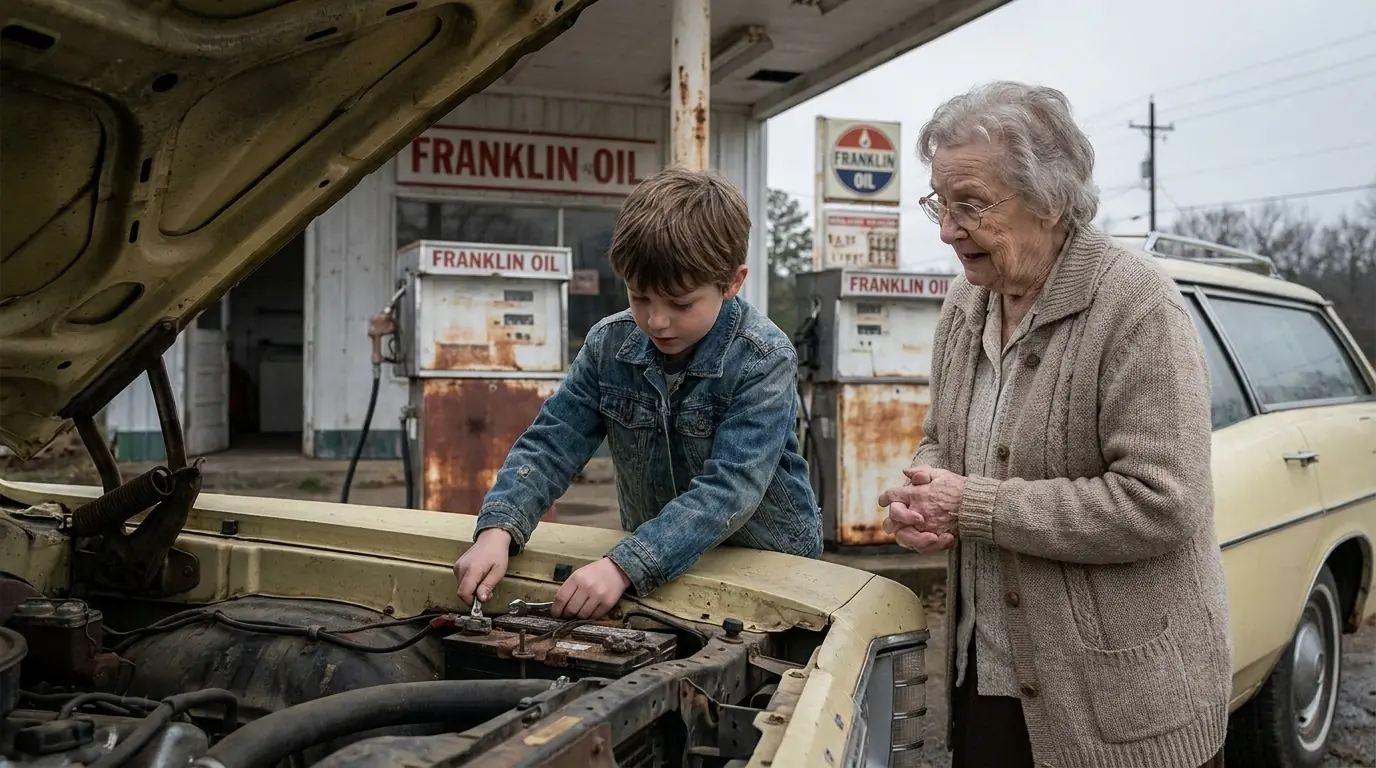
“I think some dreams wait for new hands.”
That became their secret project.
Not a real workshop at first. Just a folder. Margaret helped Owen collect every article about his father’s garage. Sarah found old photos in a shoebox. Owen made notes about what a safe kids’ repair class might include: tool names, bicycle chains, flashlight batteries, tire pressure, simple screws, no dangerous machines, always adults nearby.
Margaret added historical lessons about how people used to repair things instead of throwing them away.
Sarah added a rule page.
SAFETY FIRST. ALWAYS.
Owen wrote the first lesson title:
Listen Before Fixing.
Margaret loved that.
But life did not become easy just because hope returned.
By December, Sarah’s cleaning job ended when the office building changed companies. The laundromat apartment rent went up. The grocery store cut her hours after the holiday rush. Bills began piling up again.
Owen noticed.
He always noticed.
One night, he found his mother sitting at the kitchen table with her head in her hands.
“Mom?”
She quickly wiped her face.
“I’m okay.”
“No, you’re not.”
Sarah tried to smile.
“I’m figuring it out.”
Owen hated that phrase.
It meant she was scared.
A week later, Margaret noticed Owen was quiet while sorting manuals.
“What happened?”
“Nothing.”
She looked at him over her glasses.
“Owen.”
He stared at the table.
“We might have to move.”
Margaret sat still.
“Why?”
“Rent. Mom’s work. Everything.”
His voice cracked on the last word.
“If we move, I can’t come here anymore.”
Margaret reached across the table and held his hand.
For a moment, she did not speak.
Then she said, “I need to talk to your mother.”
Owen shook his head.
“She won’t want help.”
“I know.”
“She hates people feeling sorry for us.”
“I am not sorry for you,” Margaret said gently. “I respect you. There is a difference.”
That evening, Margaret invited Sarah and Owen to her house for dinner.
Her home sat on a quiet street lined with oak trees. It was a small white house with green shutters, a porch swing, and flowerpots Margaret had not yet emptied for winter. Inside, the house was warm and full of books, photographs, and old clocks that ticked softly in different rhythms.
They ate chicken stew, cornbread, and apple cake.
Owen ate carefully, trying not to seem too hungry.
Margaret pretended not to notice and gave him seconds anyway.
After dinner, Margaret led them to the detached garage behind the house.
When she opened the door and turned on the light, Owen stopped in the doorway.
Inside was a workshop.
An old but beautiful workshop.
Tools hung neatly on the walls. A wooden bench stretched along one side. There were shelves of labeled jars, boxes of parts, a small drill press with a cover over it, and an old red tool chest standing in the corner.
Everything was dusty, but cared for.
“This was Arthur’s workshop,” Margaret said.
Owen stepped inside slowly.
Sarah stayed near the door.
Margaret touched the workbench.
“After he died, I closed it. I told myself I was preserving it. Really, I was hiding from it.”
Owen looked at the tools with wide eyes.
“It’s amazing.”
Margaret smiled sadly.
“It used to be full of noise. Arthur humming. Machines running. Neighbors stopping by with broken lamps and wobbly chairs. After he was gone, the quiet felt too loud.”
Sarah understood that. Owen could see it in her face.
Margaret turned to her.
“I have a proposal.”
Sarah tensed immediately.
“Mrs. Ellison—”
“Please hear it first.”
Sarah nodded, though her expression remained guarded.
“The historical society received a small community grant. We were planning to use it for a storage project, but I believe we can do something better. A children’s practical history program. Repair, tools, local trades, basic skills. Nothing dangerous. Everything supervised.”
Owen’s heart began to pound.
Margaret continued, “We would use the historical society building and this workshop for preparation. Owen’s folder already has the bones of the curriculum.”
Sarah looked at Owen.
“You made a curriculum?”
“A little one,” he said.
Margaret smiled.
“A thoughtful one.”
Sarah turned back to her.
“What does that have to do with me?”
“We need a coordinator. Someone organized, careful, good with children and parents. Someone who understands what families actually need. The grant can pay part-time to start.”
Sarah stared at her.
“Me?”
“Yes.”
“I don’t have museum experience.”
“You have life experience. You have patience. You have common sense. And you raised the boy who reminded me that old dreams can still be useful.”
Sarah’s eyes filled.
“I don’t want charity.”
“This is work,” Margaret said firmly. “Real work. Work I cannot do alone.”
Sarah looked around the garage.
Owen could tell she was trying not to hope too quickly.
“What if the grant ends?”
“Then we find another. Or we adjust. Or we build slowly. But we begin.”
Sarah wiped one tear from her cheek.
“I’m tired of beginning over and over.”
Margaret’s voice softened.
“Then maybe this time, you begin with people beside you.”
Owen looked at his mother.
“Mom?”
Sarah closed her eyes for a long moment.
Then she whispered, “We can try.”
The program began in January with six children.
They met every Saturday morning in a back room of the historical society. Sarah handled sign-ups, permission forms, snacks, parent calls, and schedules. Margaret taught local history. Mr. Jennings, a retired shop teacher, volunteered to teach tool safety. Owen was not a teacher, of course. He was ten. But he was the first student assistant.
He handed out pencils.
Organized practice tools.
Helped younger kids label parts.
Showed everyone how to check bicycle tire pressure.
And before each lesson, Margaret made him read the first rule aloud.
“Listen before fixing.”
The children repeated it.
At first, Owen felt embarrassed.
Then proud.
The program grew.
Parents told other parents. The school counselor asked if more students could join. A hardware store donated safety glasses and gloves. The newspaper wrote an article about the program and included the old photograph of David Brooks standing in front of his garage.
The headline read:
SON HELPS REVIVE LATE FATHER’S DREAM THROUGH CHILDREN’S REPAIR PROGRAM
When Owen saw it, he cried for the first time in months.
Sarah cried too.
Margaret framed the article and hung it in the historical society.
By spring, Sarah had enough paid hours through the program to leave one of her cleaning jobs. She still worked hard, but differently. She came home less exhausted. Sometimes she laughed while making dinner. Sometimes she talked about plans instead of bills.
Owen noticed that too.
One Saturday afternoon after class, Margaret asked Owen and Sarah to stay behind.
She led them to a locked room at the back of the historical society.
“I want to show you something,” she said.
Inside were boxes, old signs, and furniture covered with sheets. Against the far wall stood a dusty wooden sign Owen recognized from the newspaper clipping.
BROOKS AUTO REPAIR
Owen froze.
Sarah gasped softly.
“How do you have that?” she whispered.
Margaret smiled gently.
“After your husband’s garage closed, the sign was donated during an estate cleanout. It has been here for years.”
Owen walked toward it slowly and touched the faded letters.
His father’s name.
His father’s dream.
Still here.
Not gone.
Margaret reached into her pocket and pulled out a key.
“There is something else.”
She led them outside and down the block to an empty storefront beside the historical society. It had once been a hardware shop. The windows were dusty, and the inside was bare, but the space was bright and open.
Margaret unlocked the door.
Sunlight fell across the wooden floor.
Owen stepped inside.
“What is this?”
Margaret looked at him, then at Sarah.
“The historical society owns this building. It has been unused for too long. The board approved my proposal yesterday.”
Sarah pressed a hand to her chest.
“What proposal?”
Margaret’s eyes shone.
“This will become the Brooks Learning Workshop. A permanent home for the children’s repair program.”
Owen stopped breathing.
Margaret continued, “The front will have tables for lessons. The back will have supervised workbenches. The walls will tell the history of local trades, including your father’s garage. Children will learn practical skills here. Families will come here. Broken things will be repaired here.”
Sarah was crying openly now.
Owen could barely speak.
“My dad’s name?”
“Yes,” Margaret said softly. “If you both allow it.”
Owen looked at his mother.
Sarah nodded through tears.
Margaret placed the key in Owen’s hand.
“You fixed my car at a closed gas station,” she said. “But you also helped me open a part of my life I had locked away. I think you should be the first to open this door.”
Owen stared at the key.
It was small and brass, warm from Margaret’s hand.
He closed his fingers around it.
For the first time since his father died, Owen felt something inside him settle.
Not because the sadness was gone.
It was not.
But because his father’s love had found somewhere to keep moving.
The workshop took months to prepare.
Volunteers painted walls. The hardware store donated shelves. Mr. Jennings built child-safe tool boards. Margaret brought Arthur’s old workbench from her garage. Sarah organized everything with labels so neat that Margaret joked she had brought order to history itself.
Owen helped after school. He swept floors, sorted screws, cleaned donated tools, and helped decide where to hang the Brooks Auto Repair sign.
They placed it above the main teaching wall.
Under it, Sarah added a framed photograph of David Brooks.
Next to that, Margaret placed a photograph of Arthur Ellison smiling in his workshop.
Below both photos was the first rule:
LISTEN BEFORE FIXING.
Opening day came on a bright Saturday in early June.
The whole town seemed to show up. Children stood with their parents near the front door. Teachers came. Volunteers came. People who had known Owen’s father came and told stories Sarah had never heard before.
One elderly man said, “Your husband fixed my truck during a snowstorm and wouldn’t charge me full price.”
A woman said, “He helped my son build a bicycle from spare parts.”
Another man said, “He made people feel like they weren’t foolish for needing help.”
Owen listened to every word.
Each story felt like a piece of his father being returned.
Margaret stood at the doorway with Sarah and Owen.
The brass key was in Owen’s hand.
Sarah knelt beside him.
“You ready?”
Owen looked at the sign above the door.
BROOKS LEARNING WORKSHOP
Then he looked at Margaret.
“Thank you.”
Margaret touched his cheek gently.
“No, dear. Thank you for stopping that day.”
Owen unlocked the door.
People clapped as the workshop opened.
Inside, sunlight touched the workbenches, the tools, the photographs, the old sign, the new chairs, the shelves of manuals, the future waiting to begin.
Owen walked in first.
Not because he owned it.
Because he had helped bring it home.
Years passed.
The Brooks Learning Workshop became one of Franklin’s most loved places. Children learned how to fix bicycles, lamps, loose cabinet handles, torn backpack straps, small wooden stools, and simple machines. They learned local history, tool safety, patience, and pride.
Sarah became the full-time program director after the workshop received more funding. She no longer worked double shifts. She still worked hard, but now she worked in a place where her husband’s memory felt alive instead of painful.
Margaret visited every Saturday, growing older and slower but never losing the brightness in her eyes. She sat near the front and watched children discover that their hands could solve problems their hearts had been afraid of.
Owen grew taller.
At twelve, he taught younger kids how to identify tools.
At fourteen, he helped restore bicycles for families who needed transportation.
At sixteen, he rebuilt an old lawn mower engine under supervision.
At eighteen, he received a scholarship through the workshop’s community fund to study mechanical engineering.
Before he left for college, Margaret gave him one final gift.
It was not money.
It was not a car.
It was a folded map.
Owen opened it carefully. It was an old road map of Kentucky, yellowed at the edges, with a small circle drawn around Franklin. Beside it, in Margaret’s handwriting, were the words:
This is where you began. Do not forget that beginning small does not mean staying small.
Owen looked up.
Margaret smiled.
“Arthur carried that map in the station wagon for years. I want you to have it.”
“I can’t take this.”
“You can,” she said. “Because you understand that roads matter.”
Owen held the map gently.
Margaret’s voice softened.
“Some roads bring us home. Some roads lead us forward. And some roads break down just long enough for the right people to meet.”
Owen hugged her carefully.
“I’ll come back.”
“I know,” she whispered.
And he did.
Years later, after college, Owen returned to Franklin and expanded the Brooks Learning Workshop into a larger center for children interested in trades, engineering, mechanics, and practical design. The center helped kids who could not afford private programs. It helped parents who needed safe after-school spaces. It helped elderly neighbors who had small repairs they could not manage alone.
Above Owen’s office desk hung three things.
His father’s old wrench.
The first newspaper photo of Brooks Auto Repair.
And Margaret’s map.
Whenever children asked why the workshop’s first rule was “Listen before fixing,” Owen would bring them to the wall of photographs.
He would point to his father.
Then to Arthur.
Then to Margaret standing proudly beside the yellow station wagon after it had been fully restored by the workshop’s students years later.
And then he would tell them the story.
About a gray afternoon.
A closed gas station.
A stranded old woman.
A clicking engine.
A ten-year-old boy who was late getting home but stopped anyway.
He always told the truth.
“I thought I was fixing a battery cable,” Owen would say. “But really, that car was leading me back to my father’s dream.”
Then he would hand a student a tool, smile gently, and repeat the lesson that had carried him through grief, poverty, fear, and hope.
“Listen first,” he would say. “Broken things are often telling you how to help.”