Why Your Mindset Matters for Your Health
Mental and physical health are deeply connected.
Long-term stress activates the body's stress response, increasing cortisol and adrenaline. While these hormones help us survive immediate danger, remaining in a constant state of emotional tension can contribute to anxiety, poor sleep, high blood pressure, weakened immunity, digestive problems, and burnout.
Psychologists often emphasize that healthy thinking patterns don't eliminate hardship—they help us respond to it more effectively.
These ten lessons reflect principles commonly found in cognitive psychology, resilience research, and behavioral science.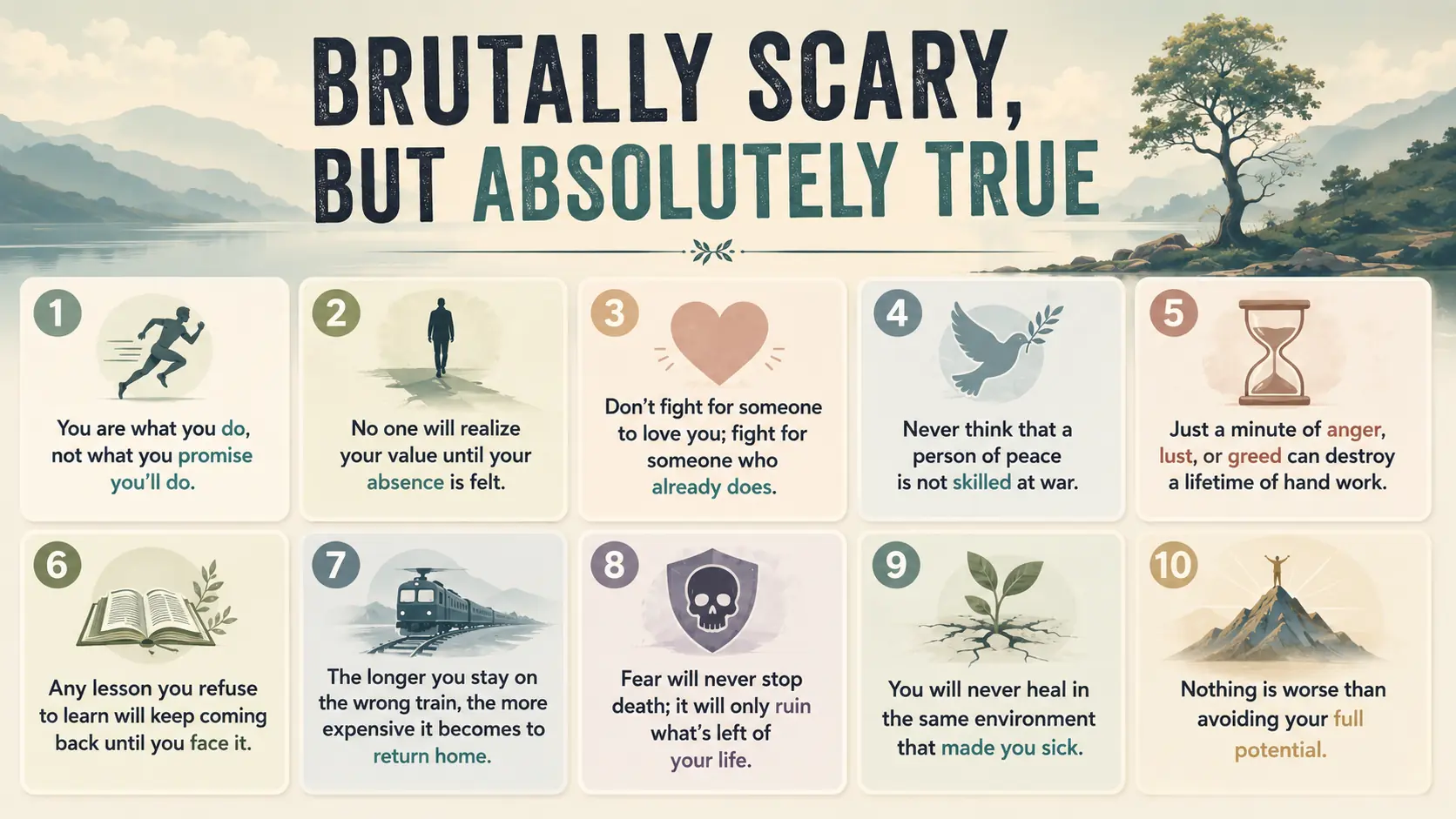
1. You Are What You Do—Not What You Promise You'll Do
Intentions matter, but behavior creates results.
Many people spend years planning to exercise, eat healthier, save money, or repair relationships. Unfortunately, our brains often reward planning almost as much as action, creating the illusion of progress.
Behavioral psychology consistently shows that lasting change comes from repeated actions rather than motivation alone.
Instead of asking yourself what you hope to become, ask:
- What did I actually do today?
- Did my actions match my values?
- Am I building habits that support the future I want?
Small consistent actions shape identity far more than occasional bursts of motivation.
2. People Often Appreciate Your Value Only After You're Gone
Human beings naturally adapt to what becomes familiar.
Psychologists call this hedonic adaptation—our tendency to gradually take people, experiences, and blessings for granted.
This doesn't mean your worth depends on others noticing it.
Instead, it reminds us not to build our self-esteem solely around external validation.
Healthy self-worth comes from recognizing your own value even when others overlook it.
Likewise, it's worth asking ourselves:
Who in our own lives have we quietly started taking for granted?
Practicing gratitude benefits both relationships and mental health.
3. Don't Chase Someone Who Doesn't Choose You
One of the strongest predictors of emotional well-being is the quality of our relationships.
Healthy relationships are built on:
- mutual respect
- trust
- communication
- emotional safety
- reciprocity
Constantly trying to earn someone's affection often leads to chronic stress, anxiety, and low self-esteem.
Psychologists encourage investing emotional energy where care flows both directions.
Love should never require abandoning your own dignity.
4. Never Mistake Peace for Weakness
Calm people are often misunderstood.
Remaining composed during conflict doesn't necessarily reflect fear or passivity.
In psychology, emotional regulation refers to the ability to manage emotions without allowing them to control behavior.
People with strong emotional regulation are often better at:
- solving problems
- making decisions
- resolving conflict
- maintaining healthy relationships
Real strength is frequently quiet.
Choosing peace can require far more discipline than reacting with anger.
5. A Single Moment of Poor Judgment Can Change Everything
One impulsive decision made during anger, greed, jealousy, or intense emotion can create consequences that last for years.
Neuroscience explains part of this phenomenon.
During intense emotional states, activity in the brain's emotional centers increases while thoughtful decision-making in the prefrontal cortex becomes less effective.
This is why experts recommend pausing before making important decisions when emotionally overwhelmed.
Simple habits can help:
- taking deep breaths
- stepping away briefly
- sleeping on major decisions
- discussing situations with someone you trust
Self-control is less about perfection and more about creating enough space between emotion and action.
6. The Lessons You Avoid Often Return
Many people notice similar relationship conflicts, financial struggles, or emotional patterns repeating throughout life.
Psychologists sometimes describe this as repeating learned behavioral patterns.
Ignoring uncomfortable problems rarely makes them disappear.
Instead, growth often begins when we ask difficult questions:
- Why does this situation keep happening?
- What role am I playing?
- What can I change?
Facing uncomfortable truths may feel painful initially, but avoidance often prolongs suffering.
7. Staying on the Wrong Path Gets More Expensive Over Time
Whether it's an unhealthy relationship, an unfulfilling job, or destructive habits, staying somewhere that no longer serves your well-being often becomes increasingly difficult.
Behavioral economists describe something called the sunk cost fallacy.
People continue investing in situations simply because they've already invested so much.
But time already spent should never be the only reason to keep moving in the wrong direction.
Sometimes the healthiest decision is changing course.
The earlier we recognize it, the easier recovery often becomes.
8. Fear Doesn't Prevent Life's Uncertainties
Fear is a normal human emotion.
In appropriate situations, it protects us from danger.
But chronic fear about events we cannot control often steals peace without improving outcomes.
Persistent anxiety has been associated with:
- sleep disturbances
- elevated blood pressure
- digestive symptoms
- fatigue
- reduced concentration
Learning to distinguish between realistic preparation and excessive worry is one of the most valuable mental health skills.
We cannot eliminate uncertainty.
We can learn healthier ways to live alongside it.
9. Healing Often Requires a Different Environment
One of the most powerful insights in psychology is that environment influences behavior.
Our surroundings affect:
- stress levels
- sleep
- eating habits
- emotional triggers
- relationships
- motivation
Healing doesn't always require moving to another city.
Sometimes changing the environment means:
- setting healthier boundaries
- limiting toxic interactions
- improving work-life balance
- creating healthier daily routines
- spending more time with supportive people
Recovery becomes much easier when your surroundings support your goals instead of constantly working against them.
10. Few Things Hurt More Than Unused Potential
Many people fear failure.
Yet research suggests many older adults regret opportunities they never pursued more than mistakes they made.
Potential is difficult to measure, but growth usually begins outside our comfort zone.
This doesn't mean becoming perfect.
It means continuing to learn, adapt, and challenge yourself regardless of age.
Purpose has been associated with:
- greater life satisfaction
- lower rates of depression
- healthier aging
- improved resilience
- better overall well-being
Living according to your values matters far more than chasing perfection.
The Bigger Lesson: Mental Health Is Built Through Daily Choices
There is no single moment when someone suddenly becomes emotionally resilient.
Mental wellness develops through repeated habits like:
- practicing gratitude
- exercising regularly
- getting enough sleep
- maintaining supportive relationships
- managing stress
- asking for help when needed
- setting healthy boundaries
- learning from mistakes
None of these habits erase life's hardships.
But together, they make us more capable of facing them.
When Personal Growth Should Include Professional Help
While mindset is powerful, it cannot replace appropriate medical or psychological care.
If you experience persistent symptoms such as:
- overwhelming anxiety
- ongoing depression
- panic attacks
- thoughts of self-harm
- severe emotional distress
- inability to function in daily life
it's important to seek help from a qualified healthcare professional or licensed mental health provider.
Strength isn't pretending everything is fine.
Strength is recognizing when support is needed.
Conclusion
Life rarely changes because of one dramatic breakthrough.
It changes through thousands of small decisions repeated over time.
Choosing action over promises.
Valuing healthy relationships.
Managing emotions instead of reacting impulsively.
Learning from difficult experiences.
Leaving situations that no longer support your well-being.
Living with courage despite uncertainty.
These lessons may sound brutally honest, but they're ultimately hopeful. They remind us that while we cannot control everything that happens to us, we can influence how we respond—and those responses shape not only our future but also our mental, emotional, and physical health.
Real growth isn't about becoming someone else.
It's about becoming the healthiest version of the person you already are.