In the spring of 1993, Room 214 at Fairmont High was supposed to be the quietest classroom in the building. It sat at the end of the second-floor hallway, beside the old stairwell and across from a row of lockers that never closed properly. The room smelled like chalk dust, sharpened pencils, old textbooks, and the burnt coffee Mr. Caldwell drank from a brown mug every morning. For most students, it was just an American history classroom, but for Nathan Cole, it was the only place where he could think without someone shouting over him.
Nathan sat near the windows in the third row, wearing a faded denim jacket over a gray shirt. His hair fell over his forehead whenever he looked down, and most days he kept his eyes on whatever book, notebook, or chessboard was in front of him. He was seventeen, quiet, careful, and smarter than he allowed most people to know. At Fairmont High, being smart could help you get a scholarship, but it could also make you a target.
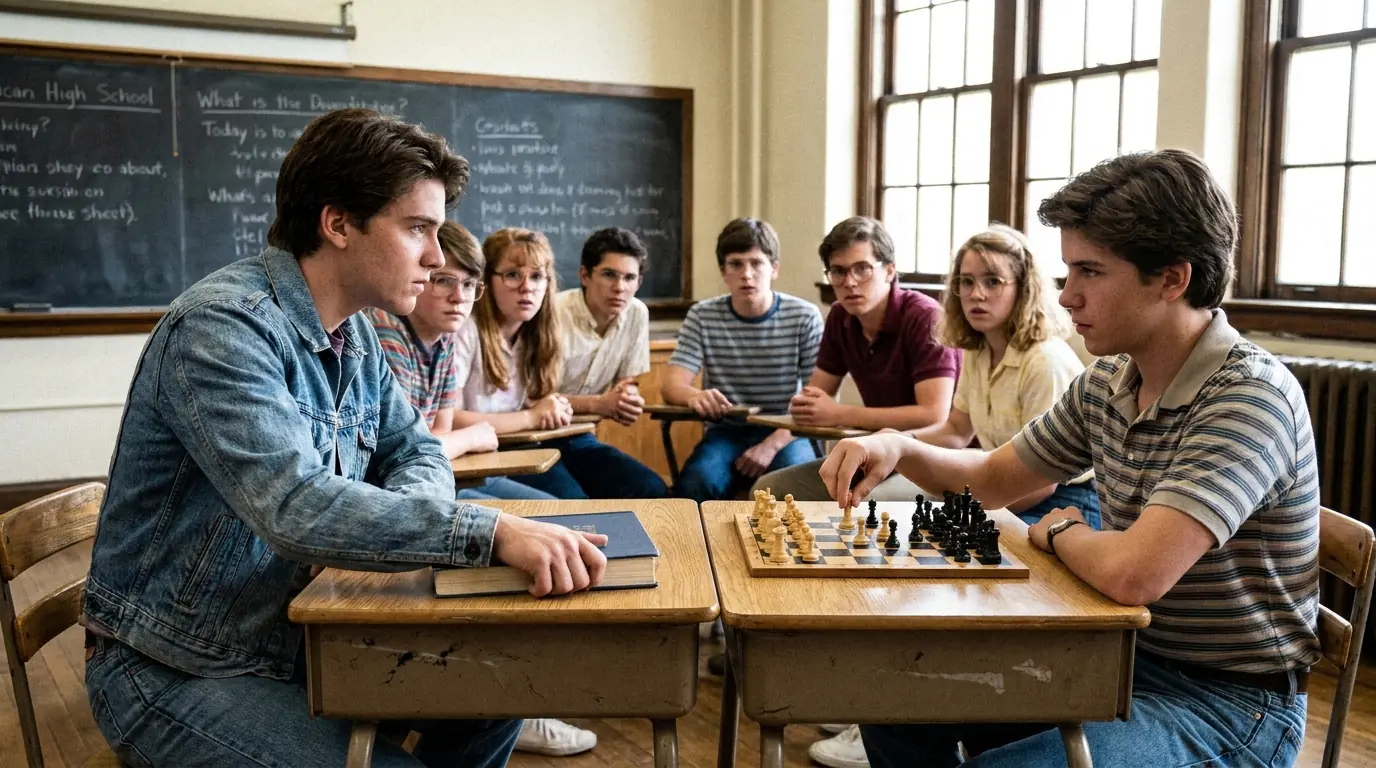
On that Thursday afternoon, Nathan had a history worksheet open beside a chessboard. The board belonged to Mr. Caldwell, who let students use it during study period as long as nobody lost the pieces. Nathan liked chess because every move had a reason, and every mistake could be studied instead of mocked. He liked that a small pawn, if it survived long enough, could become something powerful.
Across from him sat Tommy Reeves, a sophomore who had joined chess club because Nathan had once helped him avoid failing algebra. Tommy watched the board with wide eyes, tapping a pencil against his notebook. He was still learning how not to move his queen too early. Nathan was explaining why patience mattered when the classroom door opened hard enough to hit the stopper.
Dylan Mercer walked in like the room belonged to him. He wore a black polo with the collar slightly turned up, light jeans, and a grin that made trouble seem casual. Behind him came Shane Porter and Lucas Trent, two boys who rarely started anything themselves but laughed at everything Dylan did. Dylan was a senior, a baseball player, and the kind of student teachers described as “high energy” when they did not want to admit he was cruel.
Dylan had been bothering Nathan since the beginning of junior year. He called him “Professor,” “chess freak,” and “library statue,” depending on the day. He knocked books off Nathan’s desk, stole his pencils, and once moved every piece on the chessboard while Nathan was in the restroom. Each time, Nathan fixed what he could, stayed quiet, and told himself that not reacting was a kind of victory.
But silence did not make Dylan stop. It only taught him that Nathan would clean up whatever mess he left behind. By spring, Dylan no longer needed a reason to bother him. He only needed an audience.
Mr. Caldwell was not in the room when Dylan entered. He had stepped into the hallway to speak with another teacher, leaving the class in that loose, dangerous silence that came when students realized no adult was watching closely. Most students kept working, but several looked up when Dylan moved toward Nathan’s table. They knew that walk.
Tommy’s pencil stopped tapping. “Nathan,” he whispered.
Nathan kept his eyes on the board. “Just ignore him.”
Dylan reached the table and leaned over Nathan’s shoulder. “Look at this,” he said loudly. “The little grandmaster is teaching chess like anybody asked.” Shane laughed from behind him. Lucas dropped into the empty desk nearby, ready for the show.
Nathan did not answer. He moved his knight to protect Tommy’s bishop and said, “Your turn.” Tommy stared at the board but did not move. His face had gone pale.
Dylan picked up a white pawn and rolled it between his fingers. “What’s this one do?” he asked. Nathan held out his hand. “Put it back.” Dylan smiled. “I asked a question.”
“It moves forward,” Nathan said. “Unlike some people.”
The room went quiet.
It was not a loud insult. It was not even cruel. But it was the first time Nathan had answered Dylan with something sharper than silence. Tommy’s eyes widened. Shane muttered, “Oh, man,” under his breath.
Dylan’s grin stayed in place, but his eyes changed. “What did you say?” Nathan looked up slowly. “I said put it back.” Dylan tilted his head, pretending to consider it. Then he dropped the pawn onto the board, knocking two other pieces out of place.
A few students near the back laughed before they could stop themselves. Dylan heard it. His face tightened with the quick anger of someone who had built his whole reputation on never being laughed at.
He reached across the table and grabbed Nathan’s history worksheet. Nathan stood immediately. “Don’t touch that.” Dylan held the paper above the board, scanning it with fake interest. “Wow. Full sentences and everything.” Shane leaned closer and laughed. Lucas lifted a hand to cover his mouth.
Nathan stepped around the desk. “Give it back.”
Dylan backed up just enough to make Nathan follow. “What’s the problem? You afraid I’m going to learn something?” He lifted the worksheet higher, then looked toward the class. “Everybody, listen. Nathan Cole wrote an essay about courage. That’s funny, right?”
Nathan’s hands curled into fists at his sides. The worksheet was not just homework. It was the outline for his scholarship essay, folded into the history assignment because he had been working on both during study period. He had written about his father, who fixed radios and televisions in a small repair shop and taught Nathan that quiet work still mattered.
Dylan did not know that. He did not care. To him, anything in Nathan’s hands existed only to become a joke.
“Give it back,” Nathan said again.
Dylan smiled and slapped the paper down onto the table, but not in front of Nathan. He slapped it across the chessboard, scattering pawns, knocking the black king onto its side, and sending one rook rolling to the floor. The sound was small, but the whole class seemed to feel it. Tommy flinched like the paper had struck him too.
Dylan leaned over the table, one hand pressed on Nathan’s worksheet. “There,” he said. “Your little paper is safe.”
Nathan looked at the scattered chess pieces. Then he looked at the bent corner of his worksheet under Dylan’s palm. The classroom around him blurred slightly, not from fear, but from the sudden clarity of a line being crossed.
For two years, Nathan had let Dylan take small things. A pencil. A notebook. A seat. A quiet moment. He had told himself those things were not worth fighting for, but now he understood that Dylan had never been taking the objects. He had been taking permission.
Nathan reached down and picked up the fallen rook from the floor. He set it carefully on the table. Then he looked at Dylan and said, “Move your hand.”
Dylan laughed once. “Or what?”
Nathan removed his glasses from the open book beside him and placed them in his jacket pocket. He did not wear them all the time, only for reading, but the movement made the classroom go still. It was too calm. Too deliberate.
Dylan’s smile weakened for half a second. “What are you doing?”
Nathan stepped closer. “Making sure you don’t break them.”
Shane stopped laughing. Lucas sat up straighter. Tommy whispered, “Nathan, don’t.” But Nathan barely heard him.
Dylan shoved the worksheet toward Nathan’s chest. “Take your paper and sit down.” Nathan caught it, folded it once, and placed it beside the chessboard. Then he stood between Dylan and the table.
“No,” Nathan said.
Dylan’s eyes narrowed. “No?”
“No,” Nathan repeated. “You’re done touching my work. You’re done touching my board. You’re done walking over here because you need everyone to think you’re bigger than you are.”
The words carried across the room. Students who had been pretending not to listen were fully turned now. A girl near the chalkboard lowered her textbook. Someone near the back whispered, “Finally.”
Dylan heard that too. His face flushed with embarrassment, and embarrassment made him dangerous. He stepped close enough that Nathan could feel his breath. “You think because Caldwell’s in the hall, you can talk tough?”
Nathan held his ground. “I think because everyone is watching, you can’t pretend this is a joke.”
Dylan shoved him.
Nathan stumbled backward into the edge of the desk, but he did not fall. Tommy jumped up from his chair, and several students gasped. Dylan pointed at Nathan’s chest. “Sit down before I put you down.”
Nathan straightened slowly. The classroom seemed to narrow around the two of them. The chessboard, the worksheet, the chalkboard, the clock above the door, all of it became part of one quiet moment.
Dylan reached for Nathan’s jacket, intending to grab him by the collar. Nathan moved first. He caught Dylan’s wrist with both hands, stepped sideways, and turned his shoulder under Dylan’s arm. It was not wild. It was not reckless. It was the simple defensive move his older brother had taught him in their garage after Nathan came home with a bruised shoulder the year before.
Dylan’s balance broke. His forward momentum carried him past Nathan, and Nathan swept one foot behind Dylan’s ankle. Dylan stumbled, twisted, and dropped hard onto the classroom floor beside the table.
The room froze.
Dylan Mercer, the boy who had made half the school laugh on command, was sitting on the floor next to a scattered chessboard with shock written across his face. His hand was still half-curled from where he had tried to grab Nathan. For one second, nobody moved, because nobody had ever imagined the scene ending this way.
Nathan stood over him, breathing hard. His fists were not raised. He did not strike again. He simply looked down at Dylan and said, “Don’t touch me again.”
The door opened.
Mr. Caldwell stepped back into the room and stopped instantly. His eyes moved from Dylan on the floor to Nathan standing beside the desk, then to the scattered papers and chess pieces. The entire class seemed to hold its breath.
“What happened?” Mr. Caldwell asked.
Dylan scrambled to his feet, face red. “He attacked me!”
Tommy spoke before Nathan could. “No, he didn’t. Dylan took his paper and shoved him first.” The girl near the chalkboard added, “He slapped the paper across the chessboard.” Another student said, “He was messing with him the whole time.”
Dylan looked around, furious that the room was not helping him. Shane stared at the floor. Lucas suddenly became interested in the wall clock. The audience Dylan had always counted on had gone silent at the exact moment he needed them most.
Mr. Caldwell’s voice hardened. “Dylan, office. Now.”
Dylan pointed at Nathan. “What about him?”
Mr. Caldwell looked at Nathan, who was still breathing hard but standing still. “Nathan will come too. But you will go first.”
Dylan stormed toward the door, muttering under his breath. Shane and Lucas followed after Mr. Caldwell ordered them to join him. When the door closed behind them, the room remained quiet.
Nathan looked at the chessboard. The black king was still lying on its side. Several pawns had rolled near Tommy’s notebook. Nathan reached for them, but Tommy touched his arm gently.
“Leave it,” Tommy said. “Everyone saw.”
Nathan looked at him. That sentence felt heavier than it should have. Everyone saw. For once, the truth had witnesses before Dylan could turn it into something else.
In the office, Dylan tried to explain first. He said Nathan had overreacted. He said they were joking. He said Nathan had suddenly “gone crazy” for no reason. But one by one, the witnesses told the same story.
Mr. Caldwell told Assistant Principal Harris that Nathan had been a respectful student all year and that Dylan had a record of “classroom disruption.” Tommy gave a careful statement. The girl by the chalkboard, whose name was Rachel Kim, said clearly that Dylan had been bullying Nathan for months and that teachers had missed more than they realized.
When Mr. Harris asked Nathan if Dylan had bothered him before, Nathan almost said, “Not really.” The words came from habit, from the old need to shrink the truth so adults would not call it drama. But the image of the black king lying on its side stayed in his mind.
“Yes,” Nathan said.
Mr. Harris looked up. “How long?”
Nathan swallowed. “Since junior year.”
The room became quiet.
He told them about the names, the desk shoves, the stolen pencils, the ruined notes, the hallway comments, and the day Dylan had dumped his backpack in the stairwell. He told them he had stayed quiet because every incident seemed too small to report by itself. He told them that, together, they had made school feel like a place where he was always waiting for the next hand to knock something away.
Mr. Harris wrote slowly. His expression changed as the pattern formed on paper. “I’m sorry this went on that long,” he said.
Nathan did not know whether to accept the apology. So he only nodded.
Dylan received a suspension and was removed from the next baseball game. Shane and Lucas got detention for lying at first and encouraging the incident. More importantly, Mr. Harris started asking questions, and soon other students admitted Dylan had done similar things to them. A ripped art project. A hidden backpack. A lunch tray kicked under a table. Small humiliations that had survived because everyone called them jokes.
By the next morning, the story had spread through Fairmont High. Some students exaggerated the fall, claiming Dylan had flown over a desk, which was not true. Some said Nathan had trained in karate, which was also not true. But the part that mattered stayed the same.
Dylan had touched Nathan’s work, shoved him, grabbed at him, and ended up on the classroom floor.
At lunch, Nathan carried his tray toward his usual empty corner near the windows. Before he reached it, Rachel Kim called his name from a table near the center of the cafeteria. Tommy was sitting there too, along with two students from history class. There was an empty seat between them.
Rachel nodded toward it. “Sit here.”
Nathan hesitated. He was not used to invitations, especially public ones. The cafeteria was loud, and Dylan’s usual table was empty because of the suspension, but his presence still seemed to hang over the room. Nathan looked at the empty chair and felt the old instinct to keep walking.
Tommy smiled nervously. “We saved you a spot.”
Nathan sat.
For a few minutes, nobody spoke about what happened. Rachel complained about a math quiz. Tommy asked whether Nathan would help him finish their chess game later. Someone traded chips for a cookie. The normalness felt strange and almost painful.
Then Rachel said quietly, “He ruined my art portfolio last semester.”
Nathan looked up.
She stared at her tray. “He said it fell off the table, but he pushed it. I didn’t say anything because I thought nobody would care.” She looked at Nathan then. “Yesterday made me wish I had.”
Nathan did not know how to answer. Finally, he said, “I wish I had said something sooner too.”
That was the first honest conversation their table had.
Over the next week, Room 214 changed. Mr. Caldwell moved Nathan’s seat, not to isolate him, but to place him near students who had spoken up. He also started keeping the classroom door open during study periods and made it clear that chessboards, notebooks, art projects, and personal work were not props for anyone else’s entertainment.
One afternoon, he asked Nathan to stay after class. Nathan expected another discussion about behavior. Instead, Mr. Caldwell handed him a clean copy of the scholarship essay form.
“Your original worksheet was bent,” he said. “I thought you might want this.”
Nathan took it carefully. “Thanks.”
Mr. Caldwell leaned against his desk. “What you said about Dylan needing everyone to think he was bigger than he was. That was a strong observation.”
Nathan looked embarrassed. “I was angry.”
“Anger can still tell the truth,” Mr. Caldwell said. “The trick is learning what to do after it speaks.”
Nathan thought about Dylan on the floor and the way his own hands had shaken afterward. “I don’t want to be like him.”
“You weren’t,” Mr. Caldwell said. “You stopped when the danger stopped. That matters.”
Those words helped Nathan more than he expected.
Dylan returned the following Monday. Without his baseball jacket and without his usual smirk, he looked less like the ruler of the hallway and more like a student who had discovered consequences were real. People watched him, but not with admiration. They watched the way people watch a chair after one leg has cracked.
Nathan saw him near the lockers before history class. Dylan stopped several feet away. The hallway noise lowered around them.
“I have to say something,” Dylan muttered.
Nathan closed his locker. “Then say it.”
Dylan glanced around. “Not here.”
Nathan shook his head. “You embarrassed me in public. If this is an apology, say it in public.”
Dylan’s face reddened, but he did not walk away. He looked at the floor, then back at Nathan. “I’m sorry I messed with your paper. And the board. And for pushing you.”
Nathan waited.
Dylan’s jaw tightened. “And for the other stuff.”
“Why did you do it?” Nathan asked.
Dylan looked irritated. “What?”
“Why?”
Dylan opened his mouth, then closed it. For once, no easy answer arrived. Finally, he said, “Because people laughed.”
Nathan shook his head. “That’s what you got from it. Not why you did it.”
The words made Dylan look away. A few students nearby had gone very still. Dylan swallowed, struggling against his own pride.
“Because I liked feeling like I could,” Dylan said quietly.
Nathan believed that answer because it sounded too ugly to be fake.
“I’m not forgiving you today,” Nathan said.
Dylan nodded once. “I know.”
“And I’m not going back to being quiet just so you can feel comfortable.”
Dylan looked at him, then gave another small nod. “Yeah. I figured.”
Nathan walked past him into Room 214. The chessboard was already set up on the table near the windows. Tommy was sitting across from it, studying the pieces with great seriousness. Rachel sat nearby, sketching in the corner of her notebook.
“You ready?” Tommy asked.
Nathan looked at the board. The black king stood upright now, surrounded by pieces waiting for their purpose. He sat down and moved a pawn forward.
“Yeah,” he said. “I’m ready.”
By the end of the semester, Nathan’s scholarship essay was selected as one of three Fairmont entries for a statewide writing contest. He wrote about quiet people, visible work, and the danger of mistaking endurance for permission. He did not mention Dylan by name. He did not need to.
The essay ended with a line Mr. Caldwell underlined in blue ink: A person can survive a hundred small humiliations, but courage begins the day he stops calling survival the same thing as peace.
Nathan won second place.
At the final school assembly, Mr. Harris announced the award in front of the whole student body. Nathan walked onto the stage with his face warm and his hands cold. The applause surprised him. It was not wild or mocking. It was steady.
From the side of the auditorium, Rachel gave him a thumbs-up. Tommy clapped like Nathan had won a championship. Mr. Caldwell stood near the wall with his arms folded and a proud smile on his face.
Dylan did not clap at first. Nathan saw him sitting with the baseball team, looking uncomfortable. Then, after a few seconds, Dylan brought his hands together once, then again. It was not enough to fix anything, but it was enough to show he understood the room had changed.
After the assembly, Dylan approached Nathan near the hallway by Room 214. This time, there was no crowd and no performance.
“I read your essay,” Dylan said.
Nathan looked at him carefully. “Why?”
“Caldwell put it on the bulletin board.”
Nathan waited.
Dylan shifted his backpack. “It was good.” He paused. “The line about survival and peace.”
Nathan said nothing.
Dylan looked down the hallway. “I made a lot of people survive me, didn’t I?”
It was the first time he had said something that sounded less like apology and more like understanding. Nathan did not soften the truth.
“Yeah,” he said. “You did.”
Dylan nodded slowly. “I’m trying not to be that guy.”
Nathan adjusted the strap of his backpack. “Then try when nobody gives you credit for it.”
Dylan absorbed that, then walked away.
Graduation arrived in June under a bright, cloudless sky. Fairmont held the ceremony on the football field, with folding chairs set in neat rows and the band playing slightly off-key near the end zone. Nathan wore his blue cap and gown, and his father sat in the crowd wearing the only suit he owned. His mother kept waving even when Nathan pretended not to see.
When Nathan’s name was called, he crossed the stage and accepted his diploma. The applause rose around him, and this time he did not feel like hiding from it. He looked toward his parents, then toward Mr. Caldwell, who stood with the teachers near the track.
After the ceremony, Nathan returned to Room 214 one last time. The classroom was empty, warm from the afternoon sun, and quieter than it had ever seemed during school hours. The chessboard sat on the back shelf, pieces stored neatly in a wooden box.
Nathan opened the box and took out the black king. He turned it once in his hand, remembering how it had fallen when Dylan slapped the paper across the board. Then he placed it upright in the center of the table.
Mr. Caldwell appeared in the doorway. “Thought I might find you here.”
Nathan smiled. “Just checking the board.”
Mr. Caldwell walked in and looked at the king. “You know, in chess, the king is not the strongest piece.”
“I know,” Nathan said. “But everything changes when people stop protecting the wrong one.”
Mr. Caldwell laughed softly. “That sounds like another essay.”
Nathan placed the king back in the box. “Maybe later.”
Years later, students at Fairmont still told the story of the day Dylan Mercer tried to humiliate the quiet boy in Room 214. Some remembered the paper flying across the chessboard. Some remembered Dylan hitting the floor. Some remembered Nathan standing there, breathing hard, with the whole class finally seeing what had been happening for years.
But Nathan remembered something smaller.
He remembered picking up the rook.
He remembered setting it back on the table.
He remembered realizing that dignity was not something Dylan had taken from him. It was something Nathan had been waiting to defend.
And once he did, the whole classroom learned a lesson no textbook had managed to teach.
The quiet boy was never weak.
He was only studying the board, waiting for the right move.