A 14-year-old boy collapsed in a high school parking lot that October afternoon. He had just stepped between five bullies and a younger student he did not even know. For two years, this child had tried to tell someone what was happening. Forty-seven times, adults looked the other way.
But the boy he protected was a Hells Angels son, and within minutes, eighty-three brothers were on their way to that school. What happened next would prove that when the system fails, sometimes family shows up wearing leather and riding motorcycles. This is Wyatt and Reaper’s story. And the school board president did not see it coming.
Wyatt Sullivan’s lips moved. Blood flecked the words that emerged, barely audible above the October wind picking up speed across the Riverside High parking lot.
“Mason. Is he okay?”
Those five words, whispered through split skin and a swelling jaw, were the first Wyatt Michael Sullivan had spoken in eleven months. The silence had not started with cruelty. It had started with grief.
Twenty-four months before that October afternoon, Wyatt had been a different boy. Twelve years old, thriving in a small private school with autism support, loved by a father who translated the world’s chaos into something manageable. Sergeant Garrett Sullivan, First Battalion, Seventh Marines, had been Wyatt’s advocate, protector, and interpreter.
He taught his son self-defense because the world won’t always be kind, son. And he had made Wyatt promise that if he could not speak, he would write everything down. But never stay silent when you see wrong. That is not what warriors do.
The IED explosion in Afghanistan took Garrett Sullivan on a Tuesday morning in October, twenty-two months ago. The government notification arrived on a Thursday. Wyatt kept speaking for four more months, even as his mother, Claire, fought ovarian cancer with the $287,000 life insurance policy that evaporated into medical bills like water on hot asphalt.
When Claire Sullivan died in a hospice room twelve months ago, Wyatt’s last words before silence were, “Is Mom going to be okay?” The answer had been no, and Wyatt stopped asking questions aloud. Now, at fourteen, he was five foot three and ninety-seven pounds, underweight because he had not eaten lunch at school in two months.
He moved through Riverside High School’s hallways like a ghost wearing his dead father’s oversized Marine Corps T-shirt. The eagle graphic, faded from countless washings, hung to his knees over navy cargo pants with frayed hems. His left Converse sneaker sole was separating from the shoe, held together with super glue he reapplied every three days.
The notebook he carried everywhere, a black Moleskine with water-damaged pages filled with observations and things he would say if he could, was his only voice. Teachers had learned to ignore it. When Wyatt wrote responses to questions, they would sigh and move to the next student. When he tried to hand them notes about what was happening, they would accept them with tight smiles and file them nowhere.
The tap-tap-tap of his thumb against his index finger in sets of four was the rhythm his body remembered when words failed. Four taps, pause. Four taps, pause. The stim kept him regulated when fluorescent lights buzzed too loud and hallways crowded too close.
What people did not see behind his neutral mask and intelligent dark brown eyes was a boy drowning in a system designed to protect everyone except him.
October 17th had started the way every day started, badly. At 7:15 that morning, three sophomore cheerleaders had blocked the school entrance, forming a human wall while one filmed on her phone.
“Watch the freak do his little dance,” she had narrated as Wyatt tried to squeeze past, his shoulders hunched inward, making himself smaller.
They had timed it perfectly to make him late to homeroom, his fourth tardy that month, which meant detention he could not verbally explain his way out of. By 11:30, when Wyatt approached the cafeteria with a stomach cramping from hunger, the lunch table of junior boys had slid their backpacks across the bench before he even reached them.
“Seats taken,” Raymond announced loudly enough for surrounding tables to hear the laughter that followed.
Wyatt had turned and walked to the second-floor bathroom end stall, where he spent lunch period reading the same three pages of a library book he could not focus on. His hands shook as he turned pages. The words blurred.
His body registered hunger the way it registered everything else, as background noise he had learned to tune out because addressing it required speaking, and speaking required hope that someone would listen. No one listened anymore.
At 2:15 in biology, his assigned lab partner had raised her hand before the teacher even finished the pairing announcement.
“Mr. Dorsey, can I switch? He doesn’t talk. How am I supposed to work with that? It’ll hurt my grade.”
The teacher, who had witnessed this exact scene four times before, agreed without hesitation, moving Wyatt to a solo station in the back where broken Bunsen burners went to die. Wyatt had set up his workspace with methodical precision, checking valves he knew would not work, reading instructions for an experiment he would complete alone.
His lab partner, reassigned to a student who spoke, laughed with relief loud enough for the whole class to hear.
But the moment that shattered something fundamental happened at 3:20. Wyatt had been running an attendance sheet to the main office, a teacher’s errand that offered five minutes of hallway silence, when he heard voices through Principal Vernon Dalton’s half-open door. He recognized the principal’s measured tone immediately.
The second voice belonged to Harrison Ashford, school board president, Brantley’s father, a man whose Brooks Brothers suits and American flag lapel pin appeared at Riverside High with suspicious frequency.
“The Ashford boy again. Another bruising incident.” Principal Dalton’s voice carried the weariness of a man discussing a recurring inconvenience rather than a child’s welfare.
Harrison Ashford’s attorney voice, smooth as aged whiskey, cut through whatever hesitation might have existed. “Lawrence, the boy’s autistic. They injure themselves. It’s documented. My son’s a good kid, honor student, team captain. We can’t ruin his future over a special needs child who can’t even articulate what happened.”
Wyatt had frozen three feet from the door, attendance sheet crumpling in his fist. His breath caught in his throat. The hallway, empty during class time, felt suddenly airless.
Dr. Dalton’s response arrived after a calculated pause. “You’re right, Harrison. I’ll note it as self-injury. We protect our students. The ones with futures.”
The ones with futures.
Wyatt had stood there, visible through the door gap, if either man had bothered to look. They had not. He delivered the attendance sheet to the front desk with hands that no longer shook because shock had replaced the trembling with something colder.
He walked to his locker with the careful, deliberate steps of someone whose internal structure had just collapsed. He pulled out his notebook and wrote four words in block letters.
No one will help.
Then he crossed them out and wrote four more.
No one ever did.
The truth was simpler and more devastating than anger. The system was not broken. The system was working exactly as designed. It protected the students who mattered.
The ones whose fathers donated $60,000 every time their sons’ assault charges needed sealing. The ones whose futures were worth preserving at the cost of someone else’s present. Wyatt closed the notebook and went to his last class.
He sat in the back. He watched the clock count down to 3:30 dismissal. And for the first time in two years of systematic torture, he stopped hoping someone would intervene. Hope, it turned out, was more painful than resignation.
The October sky was overcast when Wyatt pushed through Riverside High’s north exit at 3:42. Sixty-seven degrees, wind picking up, dry leaves skittering across the mostly empty student parking lot. Most teachers had left by 3:30. The buses had already rumbled away, leaving diesel fumes and silence.
Dorothy Whitmore’s foster home was seven blocks away, a walk Wyatt could manage in twenty minutes if he kept his head down and his pace steady. Dorothy was a well-meaning 62-year-old overwhelmed by three other foster kids. She called the school after finding bruises, received assurances that Wyatt misunderstood horseplay, and returned to managing the chaos of her small house, where second-hand clothes were bought in bulk and sizes were guessed at.
Wyatt was crossing the north parking lot, taking the perimeter route close to the chain-link fence, when he heard it.
“Hey, leave me alone.”
The voice was young, panicked, unfamiliar. Wyatt’s head turned toward the isolated corner near the dumpsters, where the parking lot curved away from the main building and sightlines disappeared. Five figures in Riverside Rams varsity jackets surrounded a smaller boy.
Wyatt recognized the jackets instantly, recognized the shapes wearing them even more. Brantley Ashford. Grant Holloway. Connor Hayes. Brett Sanderson. Jace Whitman.
The boy they had cornered could not have been more than thirteen, new enough to school that Wyatt did not recognize him. He was backing against a car door, hands up defensively, backpack clutched to his chest like armor that would not hold.
And that was when Wyatt made the choice. His father’s voice echoed across the years, across grief and silence, and eleven months of words trapped behind a dam of pain.
Protect those who can’t protect themselves, son. Even if no one protects you. Especially then. That’s what separates warriors from survivors. Warriors act.
Wyatt’s worn sneakers changed direction. The tap-tap-tap of his finger pattern stopped. His grip on his notebook tightened as he walked directly toward the group, abandoning the safety of the perimeter, stepping into open asphalt where there was nowhere to hide.
He had made it six feet from the group when Brantley turned.
“Well, look who decided to play hero.”
Brantley Ashford’s voice carried that particular brand of cruelty perfected over two years of practice. Six foot two, 210 pounds of muscle wrapped in varsity leather and entitlement, he turned from the cornered boy to face Wyatt with a smile that never reached his eyes.
“The freak’s got something to say. Oh, wait. You don’t talk, do you?”
Grant Holloway, the linebacker who had perfected the art of shoving Wyatt into lockers hard enough to leave bruises but not hard enough to leave witnesses, laughed. Connor Hayes, the one who filmed incidents for the team’s group chat, raised his phone immediately.
“Oh, this is going to be good.”
Leave him alone.
The words hung in the October air. Simple. Direct. The first boundary Wyatt had drawn in two years.
Brantley’s smile widened. He cracked his knuckles in a gesture he had performed so many times it was practically choreographed.
“You’ve got five seconds to turn around and walk away, freak. Five.”
Wyatt did not move.
“Four.”
Behind Brantley, the younger boy, tears streaming down his face, shook his head frantically at Wyatt.
Run, he mouthed. Please run.
“Three.”
Wyatt looked at the boy, really looked. He saw himself two years ago, before the silence, before the resignation, when he still believed adults would help if he just asked clearly enough. This kid did not know yet. Did not know that the system was designed to fail him. Did not know that waiting for help meant waiting forever.
“Two.”
Wyatt stepped forward. Not back. Forward. He positioned his body between Brantley and the 13-year-old boy, meeting Brantley’s eyes with the same dark, intelligent gaze that teachers mistook for incomprehension.
“One.”
The first shove sent Wyatt stumbling backward into the car. His notebook flew from his hands. Pages scattered across asphalt as the wind caught them, carrying his words, his observations, his two years of documented pain across the parking lot like wounded birds.
The second shove came from Grant Holloway, 220 pounds of muscle taught to tackle, trained to hit hard enough to stop runners twice his size. Wyatt went down. His palms hit asphalt, scraping skin. The impact jarred his wrists.
“Stay down,” Brett Sanderson hissed.
But Wyatt was already pushing himself to hands and knees, already repositioning himself between the five and the boy they had renamed their target. Already becoming the barrier his father had taught him to be.
That was when the kicks started.
Now, you might be thinking a 14-year-old autistic boy in foster care facing five senior football players would break. That fear would override training. That survival instinct would make him run. And maybe for some kids, that is exactly what would have happened.
But Wyatt Michael Sullivan was Sergeant Garrett Sullivan’s son. And Marines taught their children that courage is not the absence of fear. It is the refusal to let fear choose your actions.
The first kick caught his ribs. The second caught his shoulder. The third, a knee to his lower back that would later be diagnosed as a cracked L4 vertebra, made his vision white out for three seconds.
When it cleared, he was curled on the ground, arms protecting his head, but his body was still positioned between them and the boy. He did not move from that position.
“Dad. Dad, you have to come now.”
Through the ringing in his ears and the copper taste of blood filling his mouth, Wyatt heard the cornered boy screaming into a phone. He heard running footsteps as the five varsity jackets scattered at the sound of an approaching car. He heard the distant rumble of a motorcycle engine that would change everything.
But in that moment, as consciousness started to slip and pain registered in waves his nervous system could not fully process, Wyatt had one thought.
The boy got away.
His father would have been proud.
Cole “Reaper” Thornton had been test riding a 1979 Harley Shovelhead when his phone rang. Forty-one years old, six foot four, 240 pounds of former Marine combat engineer turned Hells Angels road captain, he had spent the afternoon ensuring the rebuilt engine purred exactly right for the customer picking it up tomorrow.
It was one of those rare moments of peace. Mason settling into his new Nashville school after they had moved six weeks ago for a fresh start. The October sun breaking through clouds. The Shovelhead running smooth beneath him on Riverside Parkway.
Then his son’s panicked voice shattered that peace.
“Dad. Dad, you have to come now. Riverside High, north parking lot. They beat him, Dad. They really beat him. There’s so much blood, and he tried to protect me. Dad, he took the hits for me, and he’s not moving right, and I don’t know what to do.”
Reaper’s voice dropped into the combat calm that eight years of Marine Corps and eight years of Hells Angels had honed to instinct.
“Mason, listen to me. Are you safe right now?”
“Yes. They ran when a car came.”
“911 called?”
“Yes. Called them first, then you.”
“Good boy. Stay on the line. I’m thirty seconds away.”
The Shovelhead roared to life beneath him. Reaper did not bother with turn signals or speed limits. Four-tenths of a mile stood between his position and Riverside High, and he covered it in exactly twenty-eight seconds.
The bike mounted the curb into the north parking lot, engine killing before the kickstand fully deployed. Reaper was off and moving, his leather cut with the road captain rocker and Hells Angels patch swinging as his combat boots hit asphalt in a dead run.
The first thing he saw was Mason kneeling beside a curled form in an oversized Marine Corps T-shirt. Blood pooling. Notebook pages scattered like wounded birds in the October wind.
The second thing he saw was the boy’s extended arm, still reaching toward Mason, even unconscious. Fingers showing the bloody scrapes of someone who had crawled across glass-covered pavement trying to make sure the person he had protected was safe.
Reaper dropped to one knee beside the boy. Two fingers moved to his neck to check pulse while his other hand stabilized the kid’s head. Twenty-two years since combat engineer training, but the muscle memory of triage never left.
He scanned with practiced efficiency. Swelling around left eye. Blood from nose and mouth. Breathing pattern shallow and pained. Skin color shock pale. Defensive wounds on knuckles and forearms.
“Don’t move, son. Help’s coming. You’re safe now.”
His leather cut came off in one smooth motion, folded beneath the boy’s head to keep the airway open and provide cushion against cold asphalt. His hand settled on the kid’s shoulder. The universal signal. The only language that mattered.
I’m here. You’re not alone.
And that was when the boy’s eyes fluttered open.
Wyatt’s vision swam, doubled, and refocused on the face above him. A man with a beard threaded with gray, hard features carved by experiences Wyatt recognized even through the haze of pain, and a tattoo on his left forearm that made Wyatt’s chest tighten with recognition.
First Battalion, Seventh Marines. USMC.
The man’s hand on his shoulder was steady, warm, present. Behind him, Mason was safe. Standing, crying, but safe.
Wyatt’s mouth moved, forming words he had not spoken in eleven months. They came out in a whisper, blood-flecked and broken, but they came.
“Mason. Is he okay? They going to hurt him. Had to stop them.”
Something shifted in the man’s expression. A tightening around the eyes that Wyatt recognized from the few times he had seen his father process grief he refused to show. Sirens approached in the distance. Two minutes out. Maybe less.
“Mason’s fine.” The man’s voice carried the gravel of authority tempered by gentleness. “You saved him. What’s your name, son?”
The dam Wyatt had built from his mother’s death, his father’s sacrifice, forty-seven buried incident reports, and two years of systematic torture finally cracked.
“Wyatt. Wyatt Sullivan.”
The words hurt his split lip, but he kept going. Twenty-two words poured out like a confession.
“They do this every week. Two years now. Every week. No one stops them. No one cares. I’m used to it.”
Reaper’s jaw tightened. The Marine Corps tattoo on his forearm flexed as his hand remained steady on Wyatt’s shoulder. He looked up at Mason. His son understood the unspoken question.
“Brantley Ashford,” Mason said, his voice shaking. “Football players. Five of them. They had me cornered, and he just walked up and stood between us, and they beat him, and he never moved. Dad, he stayed down protecting me even when they were kicking him.”
The ambulance pulled into the parking lot, EMTs moving with practiced efficiency toward them. But Reaper leaned close enough that only Wyatt could hear his next question.
“I need you to tell me true. Is there anyone coming for your family?”
That was when Wyatt’s working eye met Reaper’s, and the truth spilled out in thirty-three words that would become the foundation of everything that followed.
“Foster care. Mom died. Dad died. Afghanistan. Marines, like your tattoo. Brantley’s father’s school board president. Gave school money. Buried forty-seven reports. No one’s coming. No one ever comes. I’m alone.”
The pause hung heavy. EMTs were positioning the stretcher. Reaper had maybe ten seconds before they moved Wyatt, before this moment would end.
Wyatt added quieter, the part that broke something fundamental in Reaper’s chest.
“But Mason’s okay. That’s what matters. Dad taught me protect those who can’t protect themselves, even if no one protects you.”
Reaper’s hand moved from Wyatt’s shoulder to his extended hand, the one still reaching toward Mason, still making sure his mission was complete even after his body had failed him.
“Your father was a warrior. He taught you right.” Reaper’s voice carried the weight of an oath, the kind Marines made to brothers who never came home. “But here’s what he’d want you to know. Warriors protect each other. You protected my son. That makes you my brother. And I don’t abandon my brothers. Do you understand me?”
Wyatt tried to nod, then winced as pain shot through his neck.
“Those boys,” Reaper continued, his eyes holding Wyatt’s with absolute certainty, “they’re done. That school is done protecting them. Your dad’s not here, but I am. And I’ve got eighty-two more brothers who will stand with me. You’re not alone anymore, Wyatt Sullivan.”
Reaper reached to his leather cut and pulled off his road captain patch, the one that marked his rank in the Hells Angels Nashville chapter, earned through eight years of loyalty and leadership. He folded it carefully and placed it in Wyatt’s hand, closing the boy’s bloody fingers around it.
“You hold on to this. When you wake up, that’s how you’ll know I’m coming back. Marines don’t lie to Marines. Your dad’s watching, and he’s proud.”
The EMTs loaded Wyatt onto the stretcher with professional care, but Reaper caught the lead medic’s arm.
“Vanderbilt Medical Center. I want the best trauma team you’ve got on that kid. Route him there.”
“Sir, we typically—”
“Vanderbilt,” Reaper repeated.
Something in his tone, and the way twenty-two years of combat and brotherhood compressed into a single word, made it clear this was not a request.
As the ambulance pulled away, lights flashing but siren silent for now, Reaper stood in the parking lot holding his leather cut, watching his son collect scattered notebook pages from the asphalt with hands that shook. Mason was careful not to let the wind steal any more.
“Dad,” Mason said quietly, looking at the pages covered in neat handwriting.
Observations about classes. Notes about books. Detailed descriptions of what had been done to him and when. Two years of documentation in a boy’s careful hand.
“What are you going to do?”
Reaper pulled out his phone and scrolled to a group chat labeled HAMC TN. Eighty-two members across three Tennessee chapters. Brothers he had ridden with through storms and funerals, celebrations and standoffs. Men who understood that the Hells Angels had a code older than any written law.
Protect the helpless. Stand for those who cannot stand alone. And when the system fails, become the justice it refuses to deliver.
What Wyatt did not know, what the school board president and his quarterback son could not possibly understand, was that they had just crossed a line. Not the line of hurting a kid. They had been doing that for two years with impunity.
They had crossed the line of hurting someone who protected a Hells Angels son. And that changed everything.
“I’m going to teach a town what happens when you hurt one of ours.”
Reaper’s thumb moved across his phone screen. The message he typed was efficient, military, unmistakable.
Reaper. Marine son, fourteen, autistic, orphaned. Beaten by five high school football players in two-year campaign. Forty-seven buried incident reports. School board president paying for silence. Kid’s at Vanderbilt trauma. We ride 0600 tomorrow. Riverside High School, 1847 Riverside Parkway. Full colors. This is the one that matters.
He hit send at 4:17 p.m. By 4:19, his phone was vibrating with responses. By 4:47, Gideon “Tiny” Wallace, Nashville chapter president, had replied with three words.
Every Nashville brother.
By 5:03, the final count came in. Eighty-three confirmed. Three chapters united. Brothers from Memphis rolling two hours. Brothers from Knoxville leaving before dawn. Men who had not ridden together since Jackson’s funeral in 2019, all converging on one school because a 14-year-old orphan had done what the entire education system refused to do.
Stand up.
But what happened in those first hours after Wyatt Sullivan was loaded into an ambulance was not about eighty-three motorcycles or leather cuts or the kind of justice that makes headlines. It was about three men working through the night in ways that would prove more devastating than any fist.
James “Lawman” Patterson, fifty-two, ex-Nashville PD detective, retired early after twenty-two years watching department corruption bury cases, sat in his home office with three monitors glowing and a pot of coffee going cold. He had learned how to navigate public records, financial disclosures, and the digital trails people assumed were private.
By 11:47 p.m., he had found the pattern. Harrison Ashford’s Athletic Excellence Fund donations to Riverside High. August, twenty-three months ago, $60,000, two weeks after Brantley’s first sealed assault charge. January this year, $60,000, one week after a complaint filed by Katherine Brennan about her son Owen. July, $60,000, three days after teacher Sandra Hayes submitted incident report thirty-one.
Total: $180,000 over twenty-three months.
But that was not the bombshell. Lawman cross-referenced property records and found Harrison Ashford’s father. Walter Ashford, seventy-four, estranged from his son for eight years, living in a modest apartment in East Nashville. A man who had tried to tell his son he was raising a monster and had been called weak for his trouble.
One phone call later, Walter Ashford was scheduled to meet the brothers tomorrow at 5:30 a.m. And he was bringing documents Harrison did not know he had kept.
Robert “Doc” Hensley, sixty-one, Iraq War combat medic, the kind of man who had seen too much death to tolerate preventable suffering, kept his promise. He arrived at Vanderbilt Medical Center at 6:30 p.m. and simply did not leave. The nurses recognized the type. Veteran, protective, would not be moved without a fight.
They stopped trying to remove him and started directing him to the family waiting area.
By 9:15, Doc had Wyatt’s complete medical file memorized. He had spoken with the trauma surgeon, the neurologist, and the social worker assigned to foster care cases. He had learned that Wyatt’s injuries showed a pattern.
Old fractures improperly healed. Scar tissue consistent with repeated blunt force trauma. Defensive wounds on his forearms that were weeks old.
“This child,” the trauma surgeon had said quietly, meeting Doc’s eyes with the exhaustion of someone who had seen this too many times, “has been systematically beaten for months, possibly years. And nobody documented it properly, or if they did, someone made those documents disappear.”
Doc pulled out his phone and added those details to the group chat. Evidence. Documentation. The kind of medical testimony that could not be dismissed as horseplay or self-injury or any of the other lies adults told themselves when protecting children became inconvenient.
But it was what happened at 6:00 p.m., when Wyatt Sullivan woke up in a hospital room with machines beeping and morphine dulling the worst of the pain, that would determine whether eighty-three motorcycles rode for vengeance or justice. There was a difference, and Wyatt would have to choose which one he wanted.
The first thing Wyatt saw when his eyes opened was Doc Hensley sitting in the chair beside his bed, reading a Louis L’Amour western with reading glasses that made him look grandfatherly rather than intimidating. The second thing he saw was the road captain patch pinned carefully to his hospital gown, exactly where Reaper had promised it would be.
“Hey there, kid.” Doc’s voice was gentle as he set down his book. “You’ve had quite a day.”
Wyatt’s hand moved to his chest, feeling for something. The patch was there. Proof that the parking lot had not been a morphine dream. Proof that someone had actually come.
“Reaper kept his promise,” Doc said, following Wyatt’s gaze. “All eighty-three of us did. Well, eighty-two are still out there handling things. I pulled bedside duty because someone needed to be here when you woke up.”
Wyatt’s throat was dry. His ribs screamed with each breath, but his hand fumbled for something, anything to communicate with. Doc handed him a tablet with a text-to-speech app already open, the kind designed for nonverbal communication.
“David Kim, one of our brothers, used to be a special education teacher,” Doc explained. “Set this up for you. Take your time.”
Wyatt’s fingers moved slowly across the screen, each keystroke deliberate. When he was done, he pressed play, and a computerized voice spoke the words he could not yet form.
“Why did you help me? You don’t know me.”
Doc read the words on the screen, then met Wyatt’s eyes with the kind of honesty that came from sixty-one years of living through things that stripped away pretense.
“Your father was a Marine. You’re a Marine son. That makes you family, and family doesn’t let family fight alone.” He paused, letting that sink in. “Also, kid, what you did yesterday, throwing yourself between five bullies and a stranger’s child, that’s the definition of a hero. We don’t abandon heroes.”
Wyatt’s eyes filled with tears, not from pain, but from something more complicated. Something that felt like hope trying to take root in soil that had been barren for two years.
He typed again.
“What happens now?”
Doc smiled, but it was not the kind of smile that promised everything would be easy. It was the smile of a man who had seen enough combat to know that victory always had a cost.
“Now you make a choice, and it’s important you understand what I’m offering before you decide.”
He leaned forward, elbows on his knees, the leather of his vest creaking.
“Reaper called in every brother we’ve got. Eighty-three men are ready to ride to that school tomorrow morning. We’ve got evidence. We’ve got witnesses. We’ve got lawyers who work for free for cases like yours. We can make this right, Wyatt. We can make sure those boys, and that principal, and every adult who looked the other way faces consequences. But—”
Doc let the word hang there.
“This is your fight, not ours. We’re here to support you, to stand witness, to make sure people listen when you speak. But you have to be the one who speaks. You have to be the one who decides you’re worth fighting for. Because if you don’t believe that, if you just let us handle it while you stay silent, you’ll never really heal from this.”
Wyatt stared at the tablet. His fingers hovered over the keys. The morphine made his thoughts swim, but underneath the haze was a clarity he had not felt in eleven months.
“Everyone who helps me gets hurt,” he typed.
Doc read it and nodded slowly. “That’s what you believe. And I understand why. Your dad died protecting people. Your mom died fighting cancer. And somewhere along the way, you decided that needing help was the same as causing harm.”
He reached out, careful not to touch Wyatt without permission, and tapped the tablet screen where Wyatt’s words still glowed.
“But son, I’m sixty-one years old. I’ve been shot at, blown up, and divorced twice. I’ve buried brothers and made peace with enemies. And I’m still here choosing to help you with full knowledge of what it might cost. That’s not your burden to carry. That’s my choice to make.”
The door opened. Reaper walked in, still in his leather cut, Mason trailing behind him with Wyatt’s notebook, the pages carefully collected and pressed flat. Mason’s eyes were red from crying, but when he saw Wyatt awake, his face lit up.
“You’re okay,” Mason breathed. “Oh man, I was so scared you weren’t going to wake up.”
Wyatt looked at this 13-year-old boy he had never met before yesterday. This kid who was safe because Wyatt had chosen pain over walking away. And something in his chest, something that had been frozen since his mother’s last breath, cracked a little wider.
Reaper pulled up a chair on the other side of the bed. His presence was solid, grounded, the kind of calm that came from years of making hard decisions and living with their consequences.
“I’m going to be straight with you, Wyatt, because you deserve that. Tomorrow morning, eighty-three Hells Angels are riding to Riverside High. We’re going to park our bikes in that lot, and we’re going to stand there until someone listens. Until someone looks at what happened to you and decides that no amount of money, no athletic scholarship, no future potential matters more than the fact that you were tortured for two years while adults looked away.”
“But,” he leaned forward, “I’m not doing this for revenge. I’m doing this for justice. And there’s a difference. Revenge is about making them hurt the way they hurt you. Justice is about making sure they never hurt anyone again.”
He reached into his pocket and pulled out a piece of paper, a list of names.
“These are the boys who beat you. These are the adults who knew and did nothing. These are the witnesses who saw and stayed silent. Tomorrow, every single one of them is going to face consequences, but only if you’re ready to stand up and say what happened.”
Wyatt took the paper and read the names. Principal Vernon Dalton. Harrison Ashford. The five football players. Teacher Sandra Hayes, who had filed reports that disappeared. Cafeteria manager Patricia Dalton, who had watched him go hungry. Guidance counselor Rebecca Morris, who told Dorothy Whitmore that autistic children often misinterpret social situations.
Forty-seven times, adults had been told what was happening. Forty-seven times, they had made the choice to protect Brantley Ashford instead of Wyatt Sullivan.
Tomorrow would be the forty-eighth report, and this time Wyatt had to be the one to file it. He looked at Reaper, at Doc, at Mason, who was clutching that notebook like it was precious.
“I need to write it all down,” Wyatt typed. “Everything, with dates and witnesses and exactly what happened each time. Not just notes. A real report. The kind they can’t ignore.”
Reaper’s face broke into something that was not quite a smile, but carried the weight of respect.
“Then that’s what we’ll help you do. But Wyatt, you need to understand something. When you write this report, when you speak up, there’s going to be pushback. People are going to try to discredit you. They’re going to say you’re confused, that your autism makes you unreliable, that you’re making things up for attention. It’s going to hurt almost as much as the beating did.”
“I know,” Wyatt typed. “I heard them. Principal Dalton and Mr. Ashford. They said I don’t have a future. That I’m not worth protecting.”
“And what do you think?” Doc asked quietly.
Wyatt’s fingers moved across the tablet. The words came slower this time, like he was discovering them as he typed, rather than already knowing what he wanted to say.
“I think my dad didn’t die so I could give up. I think my mom didn’t fight cancer so I could stay silent. I think if I don’t speak up now, I’ll spend the rest of my life wondering if I could have stopped them from hurting someone else.”
He pressed play. The computerized voice filled the room with a clarity Wyatt’s own voice had not carried in eleven months.
When the last word faded, Reaper stood up. He extended his hand, and Wyatt, with effort that made his ribs scream, reached out and took it.
“Then tomorrow we ride. Not for revenge, for justice. And you’re going to be the one who delivers it.”
The rest of the night passed in careful documentation. Doc had brought Wyatt’s notebook, and together they went through every page, every incident, every date, every witness. Wyatt added details he had been too afraid to write down before.
The times Brantley had cornered him in the bathroom. The threats made in whispers that teachers could not hear. The systematic campaign to isolate him from any potential friend or ally.
By midnight, they had a timeline. Twenty-four months. Forty-seven documented incidents. A pattern so clear that even the most willful blindness could not ignore it.
But it was at 12:30 a.m., when Wyatt’s eyelids were drooping from exhaustion and pain medication, that the door opened again. A woman stood in the doorway, mid-40s, dark hair pulled back, eyes that carried the particular weariness of someone who had fought a battle and lost.
She looked at Wyatt with an expression that mixed guilt and determination in equal measure.
“My name is Katherine Brennan,” she said quietly, stepping into the room only after Doc nodded permission. “I’m the mother of Owen Brennan. Three years ago, my son attended Riverside High for eight months. He’s in a wheelchair, cerebral palsy, verbal but physically vulnerable. And Brantley Ashford broke his wrist in gym class.”
She pulled a chair close to Wyatt’s bed but did not sit, like she did not deserve to be comfortable during this confession.
“They ruled it an accident, said Owen’s wheelchair caught on equipment and he fell awkwardly. But I saw the bruises. I heard Owen describe exactly how it happened. Brantley grabbed his arm during a drill and twisted until something snapped. I filed thirteen reports over six months. Every single one disappeared.”
Her voice cracked.
“Harrison Ashford came to my house with a check for $47,000 and a nondisclosure agreement. He said if I kept fighting, he’d make sure Owen never got accepted to any decent school. That colleges would see us as troublemakers, litigious, the kind of family that causes problems. And I was scared. So I took the money, I signed the paper, I pulled Owen out of Riverside and moved him to a school in Chattanooga, where he’s thriving now.”
She finally met Wyatt’s eyes.
“But I’ve spent three years unable to sleep because I knew Brantley would do it again. I knew there would be another victim, and I told myself it wasn’t my responsibility to protect other people’s children when I could barely protect my own.”
Catherine pulled a folder from her bag. Inside were copies, medical records, photos of Owen’s broken wrist, the thirteen incident reports she had filed, email exchanges with Principal Dalton, and most damning, a copy of the settlement agreement with Harrison Ashford’s signature.
“I kept everything,” she said, “even though the NDA said I had to destroy all documentation. I kept it because some part of me hoped that one day someone would be brave enough to stand up to them. And when I heard on the news tonight about a 14-year-old boy beaten in the Riverside parking lot, I knew. I knew it was him. Knew it was Brantley. And I knew I couldn’t stay silent anymore.”
She set the folder on Wyatt’s bed.
“I’m breaking the NDA. Harrison will sue me. I’ll probably lose the settlement money paying lawyers, but I’m done being the person who took blood money to protect a monster. If you’re willing to speak up, I’ll stand beside you. I’ll testify. I’ll show them that this wasn’t one incident. This was a pattern. And every adult who knew, every adult who took money or made excuses, or just looked away, is complicit.”
Wyatt stared at the folder, at this woman who had made the choice he had been terrified to make. Who had chosen her son’s safety over justice and was now trying to pay that debt forward.
He reached for the tablet and typed slowly.
“Why now? Why not three years ago?”
Catherine’s eyes filled with tears.
“Because three years ago, I was alone. I was a single mother with a disabled son and medical bills and no support system. I was terrified and overwhelmed, and I made the choice that felt like survival. But you’re not alone. You have eighty-three men ready to stand with you. And maybe if I stand with you, too, we can make sure no other parent has to make the choice I made.”
She wiped her eyes.
“I can’t undo what I did, but I can make sure it matters. I can make sure my silence didn’t just enable more violence. Owen knows I’m here. He asked me to give you this.”
She pulled out a piece of paper. On it, in careful handwriting, was a message.
Dear Wyatt,
My name is Owen. I’m sixteen now. Three years ago, Brantley Ashford broke my wrist and got away with it because my mom was too scared to keep fighting. I don’t blame her. She did what she thought she had to do.
But I’ve spent three years wondering if there was another kid out there getting hurt the way I got hurt. I’m sorry it took you getting beaten for someone to finally stand up. But I’m glad someone finally did. You’re braver than I was. Braver than my mom was.
And if you need anything, if you need someone who understands what it’s like to be the kid everyone decided wasn’t worth protecting, I’m here. We both are. You’re not alone anymore.
Wyatt read it three times. Then he looked at Catherine Brennan, this woman who had made a choice she regretted and was trying to make it right. He picked up the tablet.
“Will you help me write the report? I want to make sure I do it right. So they can’t say I’m confused or making things up.”
Catherine nodded, tears streaming freely now. “Every word, every detail, every piece of evidence. We’ll make it airtight. And tomorrow, when those eighty-three motorcycles show up, we’ll hand them a case so solid that even Harrison Ashford’s money can’t make it disappear.”
They worked until 3:00 a.m. Wyatt dictating, Catherine typing, Doc fact-checking against medical records, Reaper cross-referencing with Lawman’s financial investigation. What emerged was forty-two pages of documentation that read less like a victim statement and more like a prosecutor’s brief.
The systematic abuse of Wyatt Sullivan. A 24-month campaign of violence enabled by institutional corruption.
It had dates, times, witnesses, medical evidence, financial transactions. A complete timeline that showed how Harrison Ashford had spent $180,000 over twenty-three months to protect his son from consequences. How Principal Dalton had accepted those donations and buried reports. How teachers had been threatened into silence. How a guidance counselor had gaslit a concerned foster parent into thinking she was overreacting.
And at the center of it all was Wyatt Sullivan. Fourteen years old, autistic, orphaned, who had spent two years documenting his own torture in a black notebook because he had been raised by a Marine who taught him that warriors do not stay silent when they see wrong.
But there was one more piece missing, and Reaper knew it.
At 3:15 a.m., when Catherine had gone home to sleep for a few hours before the morning’s confrontation, Reaper pulled his chair close to Wyatt’s bed.
“There’s something we haven’t talked about yet,” he said quietly. “The hardest part.”
Wyatt looked at him, exhausted but unable to sleep despite the morphine.
“Tomorrow those eighty-three motorcycles are going to make sure people pay attention. Lawman’s investigation will make sure the evidence gets to the right authorities. Catherine’s testimony will prove this was a pattern. But at some point, probably at a school board meeting or in court, you’re going to have to speak out loud in front of strangers. And I need to know if you’re ready for that.”
Wyatt’s hand moved to his throat. He had typed hundreds of words tonight. But speaking them, using his actual voice after eleven months of silence, that was different.
“I don’t know if I can,” he typed.
“That’s fair,” Reaper said. “And if you can’t, we’ll find another way. The tablet works. Written statements are legal testimony. But Wyatt, I’m going to tell you something I learned in Iraq.”
He leaned back, his eyes distant with memory.
“There was a village we were trying to protect. Insurgents kept attacking, and the villagers wouldn’t tell us who was helping them. They were too scared. And I understood that. Fear is a rational response to power. But there was this one kid, couldn’t have been more than twelve, who finally walked up to my unit one day and pointed out the house where the weapons were hidden. He was shaking so hard I thought he might pass out. But he spoke. And because he spoke, we saved that village.”
Reaper met Wyatt’s eyes.
“I asked him later why he did it. Why he took that risk. And he said something I’ve never forgotten. He said, ‘They told me if I spoke, they’d kill me. But I realized I was already dead. Living in fear is just a slower death. At least this way, I die meaning something.’”
He reached out and tapped the tablet.
“I’m not asking you to die for anything. I’m asking you to live. Really live. Not as the boy who stayed silent, but as the man your father raised you to be. The warrior who protects others even when no one protects him. And sometimes being that warrior means your voice, your actual voice, is the weapon that ends the battle.”
Wyatt stared at the ceiling. Tears streamed down his temples into the pillow. His ribs hurt. His back hurt. Everything hurt. But underneath the pain was something else. Something that felt like his father’s hand on his shoulder. Like his mother’s voice reading him bedtime stories. Like the weight of a legacy he had been given and had not known how to carry.
He reached for the tablet, but this time he did not type a question.
“I’ll speak. Not tomorrow. I’m not ready tomorrow. But when the time comes, when they try to say I’m lying or confused or making it up, I’ll speak. I’ll use my actual voice. Because you’re right. My dad didn’t raise me to hide.”
Reaper smiled. Not the kind of smile that promised everything would be easy. The kind that acknowledged how hard this would be and respected Wyatt for choosing it anyway.
“Then get some sleep, warrior. Tomorrow we ride. And you’re going to need your strength.”
At 5:27 a.m., as the October sun was just starting to lighten the eastern horizon, an old pickup truck pulled into Vanderbilt Medical Center’s parking lot. Walter Ashford, seventy-four years old, climbed out with a cardboard box that looked like it weighed more than its physical contents.
He had worn his Gulf War veteran baseball cap, not as a badge of honor, but as a reminder of the code he had once lived by and his son had abandoned.
Reaper met him at the entrance. Behind him, Tiny and Lawman stood witness. Three men who understood that sometimes the most devastating testimony came from family turning against family.
“Mr. Ashford,” Reaper said, extending his hand.
Walter shook it with the grip of a man who had done hard labor his whole life. “Call me Walt. And before we go any further, I need you to know something. I love my grandson, but I won’t protect a monster. Not anymore.”
He set the box down on the hood of Reaper’s truck and opened it. Inside were documents that Harrison thought had been destroyed years ago. School records from Springfield Academy, where 15-year-old Brantley had been expelled for breaking another student’s nose. Transfer papers from Lakewood Prep, where he had left after parents threatened a lawsuit. Sealed settlement agreements from Brentwood High, where a girl had filed harassment charges that Harrison paid $70,000 to make disappear.
Three schools. Same pattern. Violence enabled by money.
“I kept all of it,” Walt said, his voice rough. “Told myself it was for protection in case Harrison ever turned on me the way he turned on everyone else who tried to hold him accountable. But that was a lie. I kept it because I knew someday someone would need proof that my son raised a predator and spent his career covering it up.”
He pulled out the most damaging document, an email exchange between Harrison and the headmaster at Brentwood High. In it, Harrison explicitly acknowledged that Brantley had assaulted a female student, but argued that since she came from a low-income family with no legal resources, they could manage the situation quietly.
“I confronted Harrison about this eight years ago,” Walt said. “Told him he was teaching his son that violence had no consequences as long as you had money. He called me weak, said the world belonged to people who were strong enough to take what they wanted and smart enough to avoid consequences. We haven’t spoken since.”
He looked at Reaper with eyes that carried the weight of eight years of estrangement and seventy-four years of living with choices made and unmade.
“But I heard about that boy yesterday. Heard he’s fourteen, orphaned, autistic. Heard he spent two years being tortured while adults looked away. And I realized I had become one of those adults. By staying silent, by not coming forward with this evidence, I was just as complicit as everyone else.”
Walt reached into the box and pulled out one more item. A photograph of young Brantley, maybe nine years old, standing with his father and grandfather. They were all smiling.
“This was before it got bad,” Walt said quietly. “Before Harrison started teaching him that being Ashford meant you were above consequences. I look at this picture and I wonder if I’d spoken up earlier, if I’d fought harder, maybe that boy would have grown up different.”
He set the photo on top of the documents.
“I can’t change the past, but I can make sure it matters. Every piece of evidence in this box is yours. Use it however you need to. Make sure my grandson faces consequences. Make sure my son’s corruption gets exposed. And make sure that Sullivan boy knows that not every adult failed him. Some of us just failed slower.”
Lawman took the box and started photographing every document. Walt watched, his jaw tight.
“They’re going to destroy me for this,” he said. “Harrison will make sure I lose my veteran benefits. My housing, everything. He’s got lawyers and connections, and he’ll use every bit of power he has to punish me.”
Reaper put a hand on the old man’s shoulder.
“You let us worry about that. You just did the hardest thing a man can do. You chose what was right over what was easy. Your grandson might not forgive you. Your son definitely won’t. But somewhere, a Marine named Garrett Sullivan is proud as hell that his son found allies willing to sacrifice for justice.”
Walt’s eyes filled with tears. He nodded once, climbed back in his truck, and drove away knowing he had just burned every bridge he had left for the sake of a boy he had never met.
At 5:53 a.m., the rumble started. Low, distant, like thunder rolling across Nashville’s eastern horizon. Residents along Riverside Parkway stepped onto porches, coffee mugs in hand, trying to identify the source of the sound that rattled windows and set off car alarms in a cascading wave.
Then they saw the formation.
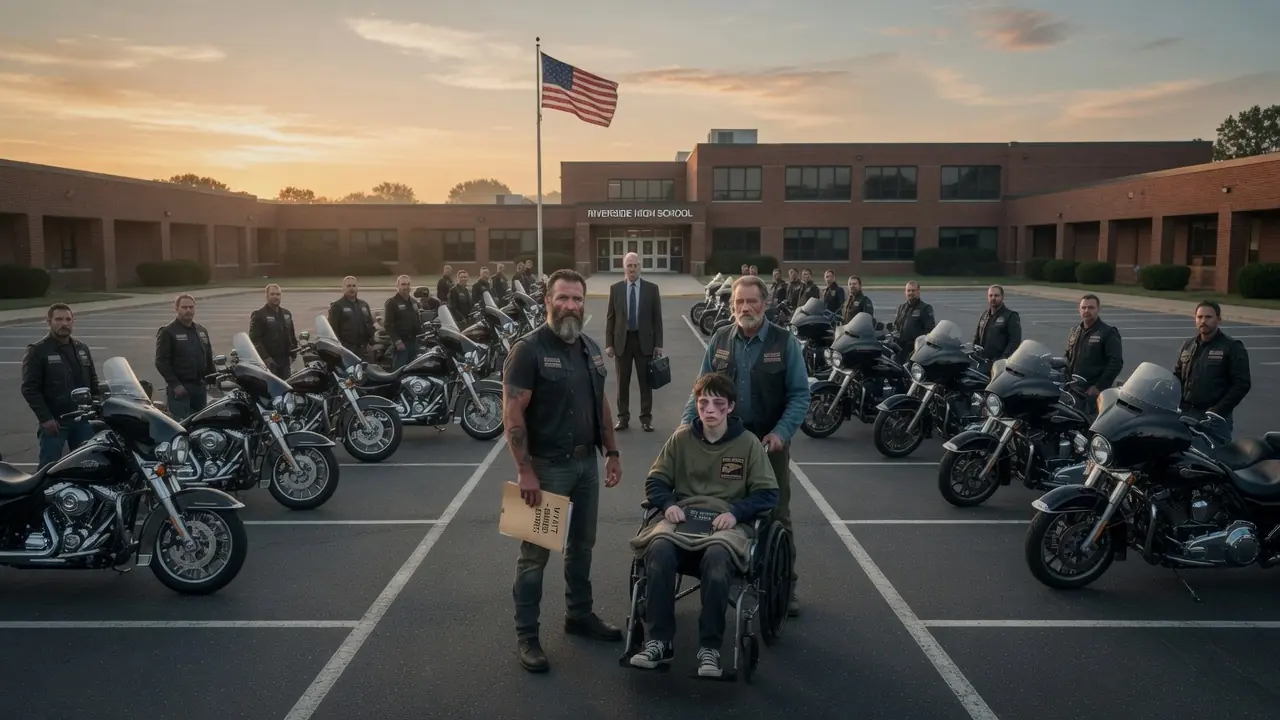
Eighty-three motorcycles riding in disciplined rows, tight and smooth with the synchronization of men who had spent years moving as one unit. Hells Angels patches caught the early light, Nashville chapter leading, Memphis and Knoxville flanking in perfect V formation.
They rolled into Riverside High’s main parking lot at exactly 0600 hours. Engines roaring in unison, chrome gleaming, leather cuts bearing the insignia that made civilians nervous and criminals terrified. Then, almost in unison, the engines died.
The sudden silence after all that noise felt heavy, expectant.
Eighty-three men dismounted with coordinated efficiency. Not a protest fueled by anger. Not a mob looking for violence. A peaceful stand executed with military precision.
And at the center of it all, in a hospital bed three miles away, Wyatt Sullivan slept. Doc Hensley read in the chair beside him. The road captain patch was still pinned to his gown. The 42-page report Catherine had helped him write sat on the bedside table, ready to be delivered, ready to be the forty-eighth voice demanding justice, ready to prove that sometimes warriors won their battles not with fists, but with words that refused to stay silent anymore.
Principal Vernon Dalton pulled into his reserved parking spot at 6:23 a.m. and found his school surrounded. His first thought was that someone had called in a threat. His second thought, as he saw the patches and the formation and the sheer disciplined presence of eighty-three men who had positioned themselves like a human barrier between the school and escape, was that he had severely miscalculated something.
Tiny Wallace stepped forward. Six foot seven, 280 pounds, fifty-eight years old. Gulf War veteran who had lost his own son to a drunk driver and spent the last twenty years making sure other people’s children did not become statistics. His presence commanded immediate attention without requiring theatrics.
Behind him, the brothers stood in silent rows, waiting. Three men flanked Tiny. Lawman with a document folder. Reaper with Catherine Brennan’s testimony. And a man Dalton did not recognize but would soon learn was Walter Ashford, carrying a box that represented thirty years of enabled violence.
“Dr. Dalton,” Tiny said as the principal emerged from his sedan, his face cycling through confusion to recognition to carefully constructed authority. “We need to talk about Wyatt Sullivan.”
Dalton’s jaw tightened. He glanced at the motorcycles, the cameras already appearing in windows of nearby houses, the crowd beginning to gather. His hand moved toward his phone.
“Gentlemen, this is school property. I’ll have to ask you to—”
“Forty-seven incident reports.” Lawman opened his folder, pulling out a spreadsheet with highlighted rows. “Forty-seven documented complaints filed by students, teachers, and staff about Brantley Ashford over four years at this school. We’ve got copies of twelve of them provided by sources who kept records when you didn’t. Would you like to explain where the other thirty-five went?”
Dalton’s face paled slightly, but his lawyer instincts kicked in.
“I don’t know what you think you found, but personnel matters are confidential. I can’t discuss—”
“One hundred eighty thousand dollars.”
Lawman pulled out the second document. Bank statements. Board meeting minutes. Donation records.
“Harrison Ashford’s Athletic Excellence Fund. Three donations over twenty-three months, each one perfectly timed with assault charges and complaint escalations. This is a public school, Dr. Dalton. These financial records are public information, and they show a pattern of quid pro quo that’s going to interest the district attorney.”
A crowd was gathering. Teachers arriving for 7:00 a.m. prep period. Early students. Parents dropping off kids. And seventy-nine more Hells Angels standing silent witness, phone cameras recording every word.
“There’s another pattern,” Lawman continued, his voice carrying across the parking lot with prosecutorial precision. “March 22, three years ago. Student named Owen Brennan, wheelchair user, attended Riverside for eight months. Thirteen complaints filed by his mother about Brantley Ashford, all dismissed. Owen was hospitalized twice, broken wrist, cracked ribs, both ruled accidents. Then the Brennan family transferred their son to Chattanooga, and your records show a sealed settlement paid by the Ashford family for $47,000 with a nondisclosure agreement attached.”
He held up a document with Katherine Brennan’s signature and yesterday’s date.
“Owen’s mother kept copies. She’s been waiting three years for someone to ask the right questions. We asked, she answered, and she’s willing to testify that you personally told her if she kept making trouble, you’d make sure Owen never got into a decent college.”
Dalton’s carefully constructed authority cracked. His hand, still holding his phone, trembled slightly.
By 7:15, the situation had escalated beyond anything Dalton could manage alone. He had called Superintendent Rebecca Torres and school board president Harrison Ashford. Both arrived within twenty minutes.
What they found was eighty-three bikers, a growing crowd of parents and students, and four witnesses who had been silent for too long.
Patricia Dalton, the cafeteria manager, no relation to the principal despite sharing a surname, stepped forward first. Sixty-seven years old, she had worn the same hairnet and apron for so many shifts they had become part of her identity. Now she stood in civilian clothes, hands shaking, but voice clear.
“I saw Brantley Ashford dump Wyatt Sullivan’s lunch tray three times in one week last April,” she said, holding Tiny’s gaze like a lifeline. “I saw him trip Wyatt in the lunch line. I saw his friends block Wyatt from getting food until the period ended, and he had to go to class hungry.”
Her voice broke.
“I told Principal Dalton six times. Six separate incidents. He told me to focus on my job, not discipline. Said boys work things out. I watched that child get thinner every month, and I did nothing. I served food to the boys who starved him.”
She could not meet anyone’s eyes.
“I knew something was wrong. I just didn’t want to lose my job. I’m two years from retirement. I told myself someone else would handle it.”
David “Professor” Kim, who had positioned himself as witness coordinator, made notes on his tablet. One documented witness. One confession of institutional silence.
The second witness was devastating. Sandra Hayes stepped out of the crowd at 7:38. Fifty-four years old, former Riverside English teacher who had quit three months ago after being told to retract an incident report.
“I documented everything,” she said, pulling a flash drive from her jacket pocket. “Every incident I witnessed. Every report I filed that mysteriously got lost. I kept digital copies because I knew this school was choosing football wins over student safety.”
She handed the flash drive to Lawman.
“Forty-seven incidents across two years. Dates, times, witnesses present, administrative responses, including the email from Principal Dalton telling me that if I continued to file frivolous complaints about student athletes, my contract wouldn’t be renewed.”
Sandra’s voice hardened.
“I chose my paycheck over doing what was right. I quit because I couldn’t live with that choice anymore. But I kept the evidence because I hoped someday someone would care enough to use it.”
By 0800 hours, Tyler “Tech” Morrison, twenty-nine, Iraq War veteran and youngest Nashville chapter member, had live-streamed the entire proceeding to the club’s social media. 8.3 million views and climbing. Justice for Wyatt trending across Tennessee. The court of public opinion had arrived before the legal system even woke up.
But it was the third witness who proved that betrayal sometimes came from inside the family.
Walter Ashford stepped forward at 8:17 carrying his cardboard box. Harrison, arriving in his Mercedes, went rigid when he saw his father. For eight years, they had not spoken. Now Walter stood in front of cameras and witnesses, about to burn the last bridge that connected them.
“My grandson has been a bully since he was nine years old,” Walter said, his voice carrying across the parking lot with the authority of a man who had stopped caring about consequences. “I told my son Harrison that he was raising a monster. He said I was weak, old-fashioned, that boys need aggression to succeed.”
He opened the box.
“These are incident reports from three previous schools before Brantley came to Riverside. Springfield Academy, expelled for breaking another student’s nose. Lakewood Prep, transferred after parents threatened lawsuit. Brentwood High, left after a girl filed harassment charges that Harrison paid to seal.”
Walter’s hands trembled as he held up the papers.
“My son has spent approximately $120,000 over Brantley’s school career making problems disappear. And I watched it happen because I thought family loyalty meant silence.”
He looked directly at Harrison, who had gone pale with rage and shock.
“I was wrong. Loyalty to a monster makes you complicit in his crimes. I should have spoken years ago. I’m speaking now.”
Harrison’s voice, when it came, was ice. “You have no idea what you’ve done.”
Walter met his son’s eyes without flinching.
“I know exactly what I’ve done. I’ve chosen a 14-year-old orphan I’ve never met over the son I raised wrong and the grandson I failed to protect from your corruption. I’ll live with that choice just fine.”
What happened next unfolded with the procedural efficiency of a system that had been backed into a corner with no escape route and television cameras recording every moment. Superintendent Torres, recognizing a PR disaster spiraling beyond control, made two phone calls. One to the district attorney’s office. One to Nashville PD.
At 9:47 a.m., two unmarked police cars pulled into Riverside High’s parking lot. Detectives, not patrol officers. The kind who handle cases with media attention and political implications.
They found Brantley Ashford in first period AP history, sitting in the back row, earbuds in, scrolling through his phone. The same kid who had put Wyatt Sullivan in the hospital sixty hours earlier. He looked up when the detectives entered, confused but not yet concerned, entitled enough to assume that whatever this was, his father would make it go away.
“Brantley Ashford?” Detective Sarah Klein asked.
“Yeah?”
“You need to come with us.”
The class went silent. Brantley’s confusion shifted to irritation.
“I’m in class. Whatever this is about—”
“Now,” Detective Klein repeated.
They walked him out through hallways that had gone quiet as word spread. Students pressed against classroom door windows watching. Teachers stood in doorways. Eighty-three bikers still stood in the parking lot, silent witness to accountability arriving seventeen months too late, but arriving nonetheless.
When they brought Brantley outside, his father was already there. Harrison Ashford, stripped of his usual authority by the crowd of cameras and parents and brothers who had created a barrier of presence he could not buy or threaten his way through.
“Don’t say anything,” Harrison hissed to his son. “I’ll call our attorney.”
“Mr. Ashford,” Detective Klein interrupted, “you’re welcome to arrange representation, but your son is being charged as an adult. Felony assault, child endangerment, conspiracy to commit assault, and we’ll be opening investigations into forty-seven additional incidents.”
She turned to Brantley, who had gone pale.
“You have the right to remain silent.”
The Miranda rights echoed across a parking lot that had become a courtroom without walls. Grant Holloway, Connor Hayes, Brett Sanderson, and Jace Whitman were pulled from classes within the next thirty minutes. Five varsity jackets. Five sets of handcuffs.
The arrest happened at 10:23 a.m., barely sixty-seven hours after Wyatt had whispered his first words in eleven months.
But the moment that would be replayed across every Nashville news station happened at 10:57, when Harrison Ashford, watching his carefully constructed world collapse in real time, made a choice that would define everything that followed.
He turned to Reaper. His voice, when he spoke, carried the calm authority of a man accustomed to buying his way out of problems.
“Mr. Thornton,” he said, pulling out his phone, “I understand you’re upset. What happened to that boy was unfortunate, but pressing charges ruins five young men’s futures. Let’s be reasonable.”
He opened his banking app.
“I’m prepared to offer $250,000, split among your club, the boy’s medical fund, whatever you want. My son made a mistake. He doesn’t deserve to have his life destroyed.”
The parking lot went silent. Phone cameras zoomed in. This was the moment that would either prove the Hells Angels were just as corrupt as everyone else, or that some things could not be bought.
Reaper’s response was quiet, measured, the kind of calm that came from eight years of combat and eight years of brotherhood teaching him that violence was not the only form of power.
“Your son didn’t make a mistake, Mr. Ashford. Mistakes are accidents. What he did to Wyatt was systematic torture for two years. And you enabled it with money just like you’re trying now.”
He stepped closer.
“I don’t want your money. I want your son in prison where he belongs. I want you disbarred, broke, and understanding what it feels like when nobody comes to help.”
He turned his back.
“You have ten seconds to walk away before I add attempted bribery of witnesses to your charges.”
Harrison’s face went from assured to uncertain to desperate. He looked at the cameras, the witnesses, his father who stood silent and refused to intervene. And he made the second choice that would seal his fate.
He pulled out his phone and made a call. Not to his lawyer, to someone else. Someone who within the hour would leak Wyatt Sullivan’s CPS files to every media outlet in Tennessee.
“If I’m going down,” Harrison said quietly, loud enough for only Reaper to hear, “I’m taking that boy’s credibility with me. Let’s see how sympathetic people are when they learn he’s been in and out of psychiatric evaluation. When they see his autism diagnosis framed as mental instability. When they understand he’s a troubled foster kid with an axe to grind.”
Reaper’s hands clenched into fists. But before he could respond, Detective Klein was there, handcuffs out.
“Harrison Ashford, you’re under arrest for conspiracy to obstruct justice, bribery of a public official, and accessory after the fact to multiple felony assaults. And for the record, that threat you just made was recorded by about forty different cameras. So add witness intimidation to the list.”
As they led Harrison away, he looked back at the school he had controlled through money and influence for eight years. At his father, who refused to meet his eyes. At eighty-three men who had proven that some battles could not be won with checkbooks and sealed settlements.
Evil, it turned out, wore Brooks Brothers suits and American flag lapel pins and looked confused when consequences finally arrived.
By 2:00 p.m., Principal Dalton had been placed on administrative leave. By 5:00, the Nashville DA had announced a special investigation into corruption in Metro Nashville public schools. And by 6:15, when Wyatt woke from a morphine nap in his hospital room, the news was already showing footage of five teenagers in handcuffs and a school board president being led to a police car.
Doc showed him the tablet with the news coverage. Wyatt watched in silence, his face unreadable.
“They’re calling you brave,” Doc said quietly. “A hero. The kid who stood up to a corrupt system.”
Wyatt reached for his communication tablet and typed slowly.
“They’re also going to call me mentally unstable. Mr. Ashford leaked my files. I heard the nurses talking.”
Doc nodded. He had heard the same conversations, seen the headlines already appearing online. Mentally ill foster child causes five arrests. Autistic teen’s vendetta destroys promising athletes. The narrative Harrison had promised to spin was already taking shape.
“Yeah,” he admitted, “they are. And it’s going to hurt. People are going to doubt you, question your motives, suggest you’re confused or making things up. That’s the cost of standing up, Wyatt. Justice isn’t clean. It’s messy and public, and sometimes the people you’re fighting have enough power to make you look like the problem.”
“Is it worth it?” Wyatt typed.
Doc leaned back in his chair and considered the question with the seriousness it deserved.
“Only you can answer that. But I’ll tell you what I know. Owen Brennan is sixteen years old right now, thriving in a school where nobody breaks his bones and gets away with it. And that only happened because his mom finally broke her silence. Was it worth it for him? For the kids who won’t be Brantley’s next victims? For the system that just got exposed?”
He met Wyatt’s eyes.
“The question isn’t whether it’s worth it. The question is whether you can live with yourself if you stop now.”
Before Wyatt could respond, the door opened. Katherine Brennan walked in, followed by a teenage boy in a wheelchair. Owen had Katherine’s eyes and the particular resilience of someone who had survived something terrible and chosen to keep going anyway.
“Wyatt,” Katherine said gently, “this is my son Owen. He wanted to meet you.”
Owen rolled his chair close to the bed and extended his hand. When Wyatt took it, Owen’s grip was firm.
“My mom told me what you did,” Owen said. “How you stood between them and that kid even after they started hitting you. How you didn’t run.”
He glanced at his mother, then back to Wyatt.
“Three years ago, I couldn’t do that. I tried to fight back once, and Brantley broke my wrist so badly I needed two surgeries. After that, I was too scared. I let him get away with it, let my mom sign that paper and take that money because I just wanted it to be over.”
Owen’s voice cracked.
“I’ve spent three years wondering if there was another kid out there getting hurt because I stayed silent. And I’m so sorry it was you. I’m sorry you had to be the one brave enough to do what I couldn’t.”
Wyatt stared at this boy who was two years older, but understood exactly what it felt like to be the kid the system decided was not worth protecting. He reached for his tablet.
“You were thirteen. You did what you had to do to survive. That’s not the same as giving up.”
Owen read it, nodded, and wiped his eyes.
“Maybe. But you were fourteen, and you didn’t just survive. You stood up. And because you did, Brantley’s done. He’ll never hurt anyone again. That matters, Wyatt. That really matters.”
Katherine stepped forward.
“We came to ask you something, and I need you to know you can say no. But after you’re discharged, after this media storm dies down, would you want to come stay with us? Not as a placement, as family. Owen and I, we understand what it’s like to be failed by the system. We’d like to make sure you’re not failed again.”
Wyatt looked at them. This woman who had made a choice she regretted, and this boy who had survived the same monster. They were not offering rescue or charity. They were offering something harder and more real.
Understanding.
“I don’t want anyone else to get hurt because of me,” Wyatt typed.
Catherine read it and sat down on the edge of the bed.
“Wyatt, people getting hurt isn’t because of you. It’s because of choices other people made. Harrison chose to enable his son. Principal Dalton chose to take bribes. Those five boys chose to use their fists. None of that is your fault. And choosing to let people care about you isn’t the same as causing them harm.”
She reached out, asking permission with her eyes. When Wyatt nodded, she took his hand.
“Owen and I, we spent three years living with the choice we made to stay silent. It’s eaten at us every single day. Being able to stand with you now, to offer you a home, to make sure at least one kid doesn’t have to fight alone, that’s not a burden. That’s healing. For all of us.”
Wyatt’s eyes filled with tears. The morphine made everything feel distant and close at the same time, but through the haze was a clarity he had been searching for since his mother died.
“Can I think about it?” he typed.
“Of course,” Catherine said. “Take all the time you need. We’re not going anywhere.”
They stayed for another hour. Owen told stories about his new school in Chattanooga, the friends he had made, the accessibility accommodations that actually worked. Catherine described the house, the separate room Wyatt would have, the weighted blankets and noise-canceling headphones, and all the autism supports she had learned about raising Owen.
It was not a sales pitch. It was an offering. A door left open for when Wyatt was ready to walk through it.
After they left, Doc handed Wyatt his communication tablet. On it was a message from Reaper.
Meeting tomorrow at the hospital, 10:00 a.m. School board called an emergency session. They want your testimony. You don’t have to speak out loud if you’re not ready. Written statement is legal. But this is the moment, kid. This is when you decide if you’re the boy who stayed silent or the man who spoke up. No pressure either way. We’ve got your back regardless.
Wyatt read it three times. Then he looked at Doc.
“If I speak, if I use my actual voice, will it make a difference? Or will people just say I’m mentally unstable like Mr. Ashford claims?”
Doc set down his book and leaned forward with the intensity of someone delivering a truth that could not be softened.
“I don’t know,” he said honestly. “Some people will believe you no matter what. Some won’t believe you no matter what evidence we show them. But Wyatt, that’s not the point. The point is that your voice, your actual voice, has been silent for eleven months. And every day you don’t speak, the people who hurt you win a little more. Not because you owe the world your voice, but because you deserve to reclaim it for yourself.”
He tapped the tablet where Reaper’s message still glowed.
“Tomorrow’s not about convincing everyone. It’s about refusing to let fear and trauma and other people’s cruelty steal the voice your father raised you to use. It’s about standing up not because you’ll win, but because standing up is what warriors do. Even when they’re scared. Especially when they’re scared.”
That night, Wyatt did not sleep much. He lay in the hospital bed, machines beeping, morphine keeping the worst of the pain at bay, and thought about his father. About the last conversation they had before Garrett deployed to Afghanistan.
“Promise me something, son,” his father had said, kneeling down to Wyatt’s 12-year-old eye level. “If you ever see someone who can’t protect themselves, you stand up for them. Even if it’s hard. Even if it costs you something. That’s what makes a warrior. Not the gun or the uniform. The choice to act when action matters.”
Wyatt had promised, and he had kept that promise in a parking lot three days ago when he positioned his body between five bullies and a stranger’s child. Now it was time to make a different promise. To himself.
At 9:57 a.m. on October 21st, four days after the beating that had finally shattered a system of institutionalized cruelty, Wyatt Sullivan was wheeled into a conference room at Vanderbilt Medical Center. The school board had moved the meeting here, officially because Wyatt could not travel, unofficially because eighty-three motorcycles parked outside the administration building were bad optics.
The room was packed. School board members. District attorney. Superintendent Torres. Media representatives. Catherine and Owen. Doc and Reaper. And outside in the hallway, seventy-nine more Hells Angels standing silent witness.
Harrison Ashford was notably absent, currently being held on $200,000 bail. But his lawyer was there, ready to argue that a 14-year-old autistic boy was an unreliable witness whose claims were the product of grief-induced delusions.
Wyatt positioned his wheelchair at the table. His ribs were wrapped. His left eye was still swollen, mostly shut. The L4 vertebra fracture meant he could not sit for more than thirty minutes without pain screaming up his spine.
But he was there.
The board chair, Margaret Brennan, different family despite the name, called the meeting to order.
“We’re here to take testimony regarding allegations of systematic abuse at Riverside High School and institutional failure to protect a student under our care. Mr. Sullivan, you have prepared a written statement. We’re prepared to accept that as testimony if speaking is too difficult.”
Wyatt looked at the 42-page document Catherine had helped him write. He looked at Reaper, who nodded once. He looked at Doc, who gave him a small smile that said, You’ve got this.
Then he looked at the microphone on the table in front of him. His hand trembled as he reached for it. Eleven months since he had spoken to anyone outside that parking lot. Eleven months of words trapped behind a dam of grief and fear and learned helplessness.
His throat felt tight. His chest hurt from more than just cracked ribs, but he pulled the microphone close and he spoke.
“My name is Wyatt Michael Sullivan.”
The voice was quiet, rough from disuse, but it was his voice, the one his father had taught him to use, the one his mother had encouraged him to find.
“I’m fourteen years old. I have autism. My father, Sergeant Garrett Sullivan, First Battalion, Seventh Marines, was killed in action twenty-two months ago. My mother, Claire Sullivan, died of ovarian cancer twelve months ago. I stopped speaking after my mother’s funeral because I had nothing left to say to a world that had taken everyone I loved.”
His hand shook. He gripped the microphone harder.
“But I’m speaking now because staying silent didn’t protect me. It didn’t make the violence stop. It just made it easier for adults to pretend they didn’t see what was happening.”
He looked directly at Superintendent Torres.
“For two years, Brantley Ashford and four other students systematically tortured me. They dumped my lunch. They blocked me from food. They locked me in closets. They beat me in bathrooms where teachers wouldn’t see. And forty-seven times, I reported it. Forty-seven times, adults told me I was confused, that I misunderstood, that boys were just being boys.”
His voice cracked. He paused, breathed.
“I heard Principal Dalton tell Mr. Ashford that they needed to protect students with futures. He didn’t say all students. He said students with futures. He meant students whose parents donate money, students who play football, students who matter.”
Wyatt’s working eye met every board member in turn.
“I didn’t matter. That’s what I learned. That’s what two years of being beaten and starved and ignored taught me. That some children are worth protecting and some aren’t. That money matters more than safety. That winning football games matters more than whether kids like me survive high school.”
The room was silent except for Wyatt’s voice, growing stronger with each word.
“Three days ago, I saw five football players surrounding a 13-year-old boy. And I had a choice. I could walk away like I had learned to do. Or I could stand up even though I knew it would hurt, even though I knew no one would help me, because my father taught me that warriors protect people who can’t protect themselves.”
He paused.
“They broke my ribs. They fractured my spine. They put me in this hospital. And if that boy’s father hadn’t shown up when he did, they might have killed me. But that boy is safe. And for the first time in two years, I don’t feel like the system won.”
Wyatt looked at Harrison’s lawyer, who had been taking notes, preparing rebuttals.
“Mr. Ashford’s lawyer is going to say I’m mentally unstable, that my autism makes me an unreliable witness, that I’m making this up. But I have documentation. I have medical records. I have witnesses. I have financial evidence of bribes. And I have something else.”
He pulled out the black Moleskine notebook. The pages were wrinkled and water-stained, but every word was still legible.
“Two years of notes. Every incident. Every date. Every witness. Because my father, before he died, made me promise that if I couldn’t speak, I’d write everything down. So I did. And now I’m speaking, and you’re going to listen.”
He set the notebook on the table.
“This isn’t about revenge. This is about making sure no other kid has to spend two years writing down abuse that nobody reads. This is about making sure that money doesn’t determine who gets protected. This is about making sure that when adults say they’re here to keep students safe, they mean all students. Not just the ones with futures you’ve decided are worth investing in.”
Wyatt’s voice dropped to almost a whisper, but the microphone carried it clearly.
“My father died protecting people. My mother died fighting cancer. I stopped talking because I thought silence would hurt less than hope. But these last four days, I learned something. Sometimes the bravest thing you can do is speak up, even when you are terrified. Even when you know people will doubt you. Even when the system that failed you tries to make you look like the problem.”
He met Margaret Brennan’s eyes.
“I’m not the problem. The problem is that it took eighty-three motorcycle club members showing up at this school for anyone to take forty-seven reports seriously. The problem is that it took me getting beaten nearly to death for anyone to investigate corruption that has been happening for years. The problem is that you’re all sitting here right now, not because you care about me, but because there are cameras outside and you can’t afford the bad publicity anymore.”
The silence that followed was devastating.
Then Katherine Brennan stood up, walked to the front of the room, and set her folder of documentation on the table next to Wyatt’s notebook.
“My name is Katherine Brennan. Three years ago, my son Owen was a student at Riverside High. Brantley Ashford broke his wrist. Principal Dalton buried thirteen reports. Harrison Ashford paid me $47,000 to sign a nondisclosure agreement and go away quietly. I took the money. I stayed silent. And I’ve regretted it every single day since.”
She opened the folder.
“I’m breaking the NDA. Here are medical records, incident reports, email exchanges, and the settlement agreement. Everything Wyatt just described happened to my son, too. And it would have kept happening to more children if Wyatt hadn’t been brave enough to do what I wasn’t. Stand up, speak out, refuse to stay silent.”
Walter Ashford was next, rising from his seat in the back, walking to the front with a box of documents that represented thirty years of enabled violence.
“I’m Walter Ashford, Harrison’s father, Brantley’s grandfather, and I’m here to tell you that my grandson has been a violent bully since he was nine years old. Three schools before Riverside. Three patterns of assault covered up with money. And I stayed silent because I thought family loyalty was more important than protecting strangers’ children.”
He set the box down.
“I was wrong. And my silence enabled this. All of this. Every bruise on Wyatt’s body. Every trauma Owen carries. Every future victim who’ll grow up wondering why nobody protected them. That’s on me. That’s on every adult in this system who chose comfort over courage.”
By noon, when the meeting finally adjourned, the school board had voted unanimously to terminate Principal Dalton, suspend three coaches who had witnessed abuse, and implement district-wide reforms. By 2:00 p.m., the district attorney had announced expanded charges against all five teenagers and Harrison Ashford. By 5:00 p.m., Superintendent Torres had resigned.
But the real change, the kind that mattered, happened quietly.
The arrests were swift. The reforms immediate. But they were only the beginning. The real healing, the kind that could not be legislated or mandated, would take longer.
In hospital rooms and living rooms, and anywhere people gathered to watch the news coverage, parents started asking their children harder questions. Teachers started documenting incidents more carefully. Students started speaking up about bullying they had witnessed. And slowly, incrementally, the culture that had enabled Brantley Ashford started to crack.
The real change happened in smaller moments. In hospital waiting rooms where parents finally asked their children, “Has anyone hurt you?” In staff meetings where teachers stopped accepting “boys will be boys” as explanation. In therapy sessions where Wyatt learned that healing was not linear, that some days he would speak and some days he would not, and both were okay.
Catherine Brennan’s office stood open, a room waiting, a family ready, but Wyatt needed time to believe he deserved it.
Three weeks after the school board meeting, on a November morning when Nashville’s trees had turned amber and gold, Wyatt packed the few belongings he had. Dorothy Whitmore cried as she helped him, not because she had failed him, but because she tried her best and it had not been enough.
“You’re a good kid, Wyatt,” she said, folding his father’s Marine Corps T-shirt with careful hands. “I’m sorry I couldn’t protect you.”
Wyatt looked at her. This woman who had called the school seventeen times, who had brought him to doctors and documented bruises and been dismissed as an overreacting foster parent. She had done what she could. The system had failed them both.
“You tried,” he said aloud.
Two words that took eleven months to return.
“That’s more than most people did.”
Catherine’s house in East Nashville had a room painted soft blue, weighted blankets, noise-canceling headphones, a desk positioned away from the window because Owen had explained that direct sunlight could be overwhelming. They had prepared for Wyatt the way the system never had, with care, with research, with the understanding that accommodation was not charity. It was basic respect.
The first night, Wyatt could not sleep, not from nightmares, but from the unfamiliar safety of a locked door he controlled, a bed that was his, a family downstairs who had chosen him not because they had to, but because they wanted to.
Owen rolled into his room at 2:00 a.m., both of them awake.
“First night’s always weird,” Owen said. “Want to watch something stupid?”
They spent the next three hours watching cooking competition shows, Owen providing sarcastic commentary that made Wyatt laugh until his still-healing ribs ached. Family, Wyatt learned, was not always dramatic declarations. Sometimes it was just someone staying up with you when sleep would not come.
Six months later, April arrived with warmth that made Nashville forget winter had ever existed. Wyatt turned fifteen surrounded by eighty-three brothers, two families merged through shared trauma and healing, and a future that finally felt possible.
He had written his birthday speech weeks in advance, practicing in his room with Catherine coaching patiently. When the moment came to stand before everyone, the words that had lived in his notebook for two years finally found voice. Not because he owed anyone his voice, but because reclaiming it felt like honoring every promise he had made to his father.
Every word his mother had encouraged him to find. Every moment he had survived when survival felt impossible.
The Hells Angels Nashville chapter had declared it Wyatt Day. Catherine’s backyard was decorated with Marine Corps flags honoring Garrett and motorcycle-themed banners honoring his new family.
A table sagged under food. Doc’s wife’s potato salad. Tiny’s partner’s cake. Reaper’s grilled chicken that Mason still claimed credit for.
Owen rolled his wheelchair up beside Wyatt and typed on his AAC device.
Heard you’re speaking in full sentences now. My mom cries every time you call her Mom. It’s embarrassing.
Wyatt smiled. He still typed more than he spoke, but when he spoke, the words came easier now.
“Better than making her cry because I won’t talk to her.”
They sat in comfortable silence. Two boys crushed by the same system now sitting at the same table because eighty-three men had decided silence was not acceptable.
The changes over six months were measurable. Legal outcomes. Brantley pleaded guilty to felony assault, three years juvenile detention with transfer to adult prison if he violated after eighteen. Grant, Brett, Connor, jail and detention or probation. Harrison facing trial in August, already disbarred, law firm dissolved. Principal Dalton’s teaching license revoked permanently.
School reforms. New principal at Riverside. Mandatory autism awareness training. Anonymous reporting system. Angels Watch program formalized, bikers serving as mentors at three metro schools. Bullying reports dropped seventy-eight percent in four months.
Personal milestones. Wyatt in therapy twice weekly with Dr. Michaela Torres. New school in January, small classes, autism support. Two friends, David, who also used AAC, and Riley, who had asked him to prom eight months early so he would have time to prepare. Speaking selectively but consistently.
His first word after the hospital had been “Reaper” when Cole walked into Catherine’s house in November. Then “Mom” when Catherine tucked him in that first night, and he had whispered it like a question, testing if the word could belong to someone new.
But there were harder truths too. PTSD that woke him with nightmares. Days when speaking felt impossible again. The ongoing media attention that made him anxious. Harrison’s trial looming. The knowledge that victory had cost him privacy, normalcy, the ability to just be a kid without being the kid from the news.
Justice was not clean. It was messy and ongoing and incomplete.
At 2:30, Wyatt stood without being asked and tapped his glass with a spoon. The backyard went quiet. Eighty-three brothers and their families watched a 15-year-old who had been silent for nearly a year prepare to speak.
He typed his speech on the tablet first, practicing for weeks with Catherine’s help. But when the moment came, he set the tablet down and used his actual voice.
“For most of my life, I thought being strong meant being silent. Not bothering people. Not making my pain their problem.”
His voice was quiet but clear.
“My dad taught me to protect people who can’t protect themselves, but I forgot the second part. Warriors protect each other. Asking for help isn’t weakness. It’s what makes us human.”
He looked at Reaper, at Doc, at Tiny, at Catherine and Owen.
“You all showed me that family isn’t just blood. It’s showing up. It’s standing witness. It’s refusing to let someone fight alone.”
He raised his glass of lemonade.
“To the brothers who became my family. Thank you for teaching me that being seen isn’t a burden. It’s a right.”
Eighty-three glasses raised. Tiny Wallace, Gulf War veteran who had lost his son and found purpose in protecting others, wiped his eyes without shame.
“To Wyatt,” his voice carried across the backyard. “Who taught us that courage looks like a 14-year-old throwing himself between predators and prey. Who reminded us why we wear these patches. To Wyatt, warrior, brother, hero.”
“To Wyatt,” eighty-three voices echoed.
That evening, as the sun set over Nashville and the party wound down, Reaper found Wyatt sitting alone on the back porch. The road captain patch was displayed in a frame on his wall now, but Reaper had given him something else. A leather vest with honorary brother stitched across the back.
“You okay, kid?”
Wyatt nodded. “Mostly.”
Reaper sat down beside him. They watched fireflies start their evening dance.
“I’ve been thinking about your dad,” Reaper said, “about what he’d say if he could see you now.”
Wyatt’s throat tightened. “What would he say?”
Reaper smiled. “That you did it right. You protected someone weaker. You stood up when it cost you something. You spoke even when you were terrified. That’s exactly what he taught you to do. He’d be proud as hell.”
He clapped Wyatt on the shoulder.
“But more than that, he’d be relieved because you found people who protect you back. That’s the part warriors sometimes forget. You don’t have to fight alone. You’re not supposed to.”
They sat in comfortable silence for a while. Then Wyatt spoke, his voice barely above a whisper.
“Sometimes I still wonder if it was worth it. All the pain, the media attention, the trial coming up. If I just stayed quiet, maybe—”
Reaper interrupted gently.
“Maybe Brantley would still be hurting kids. Maybe Harrison would still be buying his way out of consequences. Maybe the next victim would be someone without eighty-three brothers ready to stand up. You’ll never know who you saved by speaking up, Wyatt. But I guarantee you saved someone.”
He stood up and stretched.
“Justice isn’t about feeling good. It’s about making things right, even when making things right hurts. Your dad knew that. Now you do, too.”
After Reaper rejoined the party, Wyatt pulled out his phone. The nightly ritual he had started three months ago.
Day 183. Spoke at my birthday party. Full sentences. Real voice. Still hard sometimes. Still wake up checking locks, but getting better. Learning that healing isn’t linear. That some days I’ll speak and some days I won’t. Both are okay. Dad would be proud. Mom, too. Catherine says I can call her Mom now if I want. I’m trying. I’m learning to be proud of myself. Reaper says that’s the hardest part. He’s right.
The real story was never about bikers or patches or viral videos. It was about a boy who learned his voice mattered. About a father’s legacy living through his son’s courage. About eighty-three men proving that true strength is not silencing pain. It is standing witness when someone finally speaks.
Justice was not clean. Brantley would serve his time and eventually be released. Harrison’s trial would drag through appeals. The scars would never fully fade. But Wyatt had learned what Sergeant Garrett Sullivan knew.
You do not fight because you will win. You fight because it is right.
And sometimes that is enough.