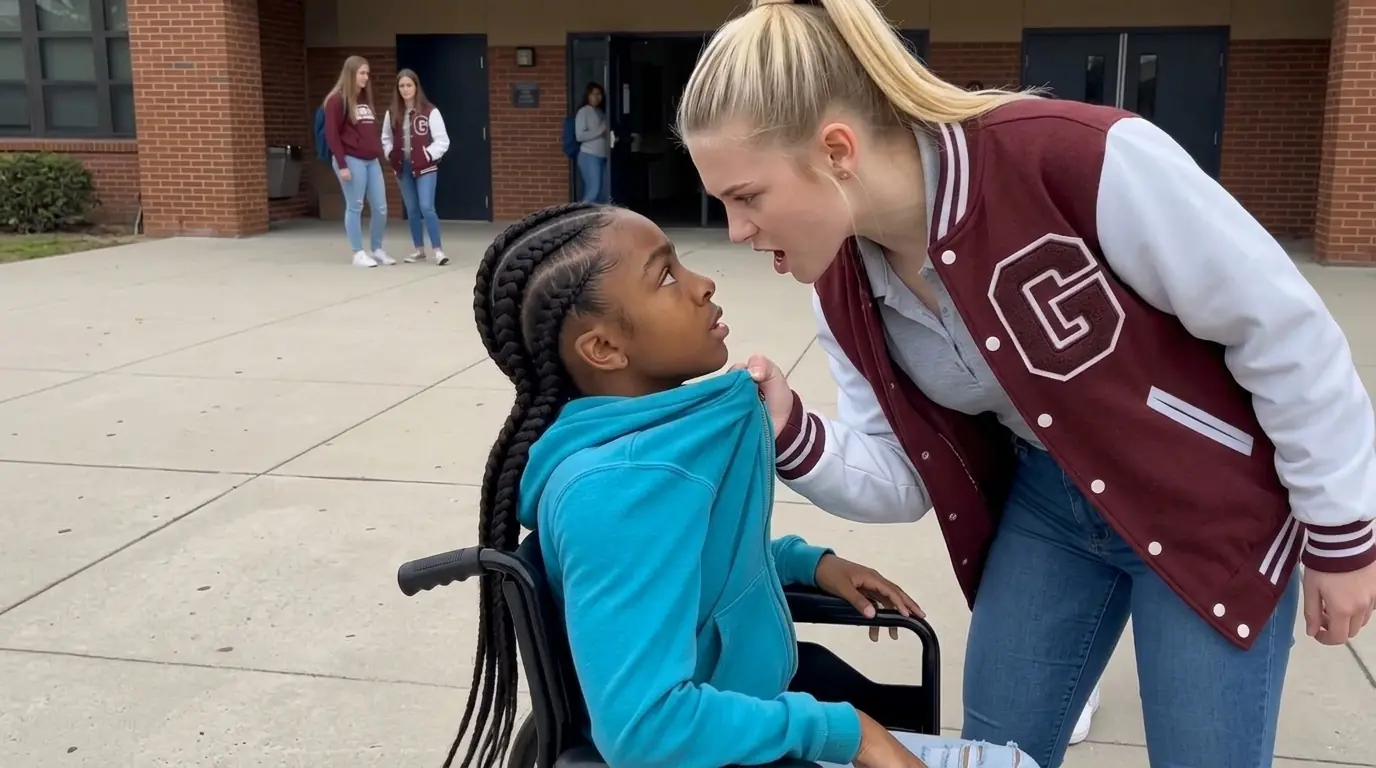
Six months after the accident, seventeen-year-old Maya Bennett still hated the sound of automatic doors opening in front of her. They reminded her of hospitals, rehabilitation centers, orthopedic clinics, and every building she had entered while learning that life could change faster than a human mind could catch up. On the first Monday of September, those doors belonged to Westbridge Academy, one of the wealthiest public magnet schools in northern Virginia. Maya rolled through them in a charcoal wheelchair while hundreds of strangers turned to look.
Her father drove her to school that morning because neither of them trusted the accessible bus route yet. Colonel Aaron Bennett had retired from the Army three years earlier after spending much of his career teaching defensive tactics and close-quarters combat to soldiers. He was fifty, broad through the shoulders, quiet by nature, and possessed the kind of calm that made people lower their own voices without understanding why. Before Maya opened the car door, he looked at her and asked, “You want me to walk in?”
Maya shook her head. “I need to do this part myself.” Aaron nodded because he understood what the sentence cost her. Then he leaned over and adjusted the backpack strap that had twisted behind her wheelchair.
“Fresh start,” he said. Maya gave him the kind of smile children give parents when they are trying to protect them. “Fresh start.”
Six months earlier, Maya had been captain of the junior martial arts demonstration team at her old school in Richmond. She trained in judo, taekwondo, and practical self-defense from childhood, first because Aaron believed discipline belonged in every child’s education and later because Maya genuinely loved it. She could break down movement the way some people understood music, seeing balance, timing, and distance before anyone else noticed them.
Then came a stormy March night. A pickup lost control on wet pavement, crossed the center line, and struck the passenger side of the car in which Maya was riding. She woke two days later with pelvic fractures, spinal swelling, nerve damage, and doctors unwilling to tell the family exactly how much lower-body function would return.
For weeks, Maya could not move either leg intentionally. Then one toe moved. A month later, her left quadriceps began responding.
By summer, she could stand briefly between parallel bars with braces and assistance. Walking independently remained distant, and most of daily life still required the wheelchair. Doctors described the injury as incomplete rather than permanent, a word Maya clung to carefully because hope could become cruel when treated like a promise.
Westbridge was supposed to give her something rehabilitation could not. Normal teenage life. Classes, homework, music in hallways, arguments about lunch tables, annoying teachers, college applications, and friends who discussed things other than nerve recovery.
Instead, within twenty minutes, Maya understood she had entered another kind of rehabilitation.
Students stared openly.
Some looked curious. Others looked sympathetic.
A few looked annoyed, as though the wheelchair itself were a demand being placed upon them.
Maya collected her schedule from the front office. The secretary, Mrs. Elaine Foster, was warm without becoming overly helpful, which Maya appreciated immediately. She explained the elevator locations, accessible entrances, and who to contact if any route between classes became difficult.
Then the office door opened.
Three girls entered together.
The first was Claire Whitmore.
Maya did not know her name yet, but almost everybody else did. Claire was seventeen, blonde, captain of the varsity cheer squad, junior-class social chair, and daughter of Grant Whitmore, a real-estate developer whose family name appeared on the school’s renovated athletic pavilion. Behind her came Paige Lawson and Emily Crane, both dressed in the same polished, effortless style that suggested they had never once worried whether they would fit into a room.
Claire’s gaze moved toward Maya. Then toward the wheelchair.
She whispered something to Paige.
All three laughed.
Mrs. Foster heard enough to look up, but Claire immediately smiled. “Morning, Mrs. Foster.”
“Good morning, Claire.” The change was immediate.
Perfect student.
Perfect tone.
Maya rolled past them without reacting.
In the hallway, she heard Paige ask, “Is that the new transfer?” Emily answered, “Apparently.”
Then Claire said, “Westbridge really is checking every diversity box now.”
Maya kept moving.
Her first class was AP United States History. Mr. Daniel Grant cleared a front-row space for her and welcomed her without turning the moment into an announcement. Maya thanked him and tried to focus on Reconstruction.
From the back row came a whisper.
“Bet she gets extra time on everything.”
Another voice followed. “Probably doesn’t even have to come to gym.”
Then Claire.
“Must be nice.”
Maya gripped the wheel rim.
She had spent four months learning not to panic when her body refused instructions. She could survive three spoiled girls whispering behind her.
That was what she told herself.
After class, Claire blocked the doorway.
Paige stood beside her while Emily leaned against the wall.
“You’re Maya, right?” Claire smiled.
“Yes.” Maya waited.
“I’m Claire. We just wanted to welcome you.”
The sweetness in her voice felt theatrical.
“Thanks.” Maya gestured toward the doorway. “Can I get through?”
Claire moved only halfway. “Of course.”
Then she looked down at the wheelchair.
“You probably need lots of extra space.”
Paige laughed quietly.
Maya met Claire’s eyes. “I need about the same amount of space as anyone else if they stop standing in the doorway.”
For one second, Claire’s smile vanished.
Then it returned.
“Oh.” She stepped aside. “She has attitude.”
Maya rolled away.
Behind her, Paige whispered, “That’s going to be fun.”
The first week contained no dramatic incident. That made it harder to explain.
Claire understood something instinctively about bullying that many adults did not. The most effective cruelty rarely looked dramatic from across a classroom.
It looked helpful.
On Tuesday morning of the second week, Maya approached geometry class through a crowded hallway. Claire appeared behind her.
“Let us help you.” Before Maya could refuse, Paige grabbed both wheelchair handles.
The chair surged forward.
Maya’s stomach dropped.
“Stop.” She grabbed the rims, but Paige pushed harder.
Students jumped aside while Claire laughed. “Make room, everybody. Special delivery.”
By the time Paige released the handles near the classroom, Maya’s palms burned from trying to control the wheels. The chair struck the doorframe.
Claire gasped theatrically.
“Oh my God, Paige. Be careful.”
Then she placed one hand dramatically over her chest.
“Maya can’t exactly catch herself like everybody else.”
A few students laughed.
Maya stared at them.
Paige patted her shoulder. “Sorry. We were helping.”
“You weren’t.” Maya’s voice shook.
Claire smiled. “See? This is why people are afraid to help disabled students. Everything becomes offensive.”
The teacher appeared.
Claire immediately changed.
“We were just making sure Maya got through the crowd.”
Maya looked toward the teacher.
Then at Claire.
She understood the trap.
Any explanation would require proving intent that Claire had carefully hidden beneath kindness.
So Maya entered class.
The incidents multiplied.
At lunch, Emily deliberately dropped a tray directly in front of Maya’s wheels, then loudly apologized while students moved aside. In gym, Claire announced that everyone should “be extra careful” around Maya even though Maya was sitting twenty feet from the volleyball court.
Once, Paige moved Maya’s backpack from the hook behind her chair and placed it on a shelf Maya could not reach. When Maya asked for it back, Paige replied, “I thought independence was important.”
Teachers saw fragments.
They rarely saw the pattern.
Adults witnessed girls smiling, offering help, moving objects, and apologizing. Maya experienced people grabbing her chair without permission, isolating her, making disability into entertainment, and then treating every objection as evidence that she was oversensitive.
That was what frightened her most.
Claire did not simply insult people.
She controlled how the insult looked from the outside.
At home, Maya said nothing.
Aaron built a rehabilitation area inside the detached garage shortly after she left the hospital. Parallel bars ran along one wall, resistance bands hung from hooks, thick mats covered the floor, and an adjustable training dummy stood near an old heavy bag.
Before the accident, Maya used the garage for martial arts drills.
Now it was where she learned to trust her body again.
Aaron watched one afternoon as she transferred from the wheelchair to the mat and began upper-body balance drills with unusual intensity. She repeated them until sweat ran down her temples.
“Maya.” She kept moving.
“Again.” She shifted her weight.
“Maya.” Aaron stepped closer.
She stopped.
“That’s enough.” She shook her head.
“I’m fine.”
“You’re angry.” Maya looked away.
Aaron knelt so they were at the same level.
“At yourself?”
“No.”
“At school?”
Her face changed slightly.
Aaron saw it.
“Someone giving you trouble?” Maya immediately shook her head.
“It’s just school.” Aaron waited.
Maya hated that he never filled silence for her.
“People are weird about the chair.” Aaron nodded.
“That happens.”
“It’s fine.”
“That’s different from saying it doesn’t hurt.”
Maya looked toward the parallel bars.
“I don’t want you showing up and turning everything into some military operation.”
Aaron smiled faintly.
“You’ve seen too many movies.”
“You know what I mean.”
“Yes.” His smile disappeared.
“And I also know you’re never a burden.”
Maya lowered her eyes.
“I didn’t say I was.”
“You didn’t need to.”
Aaron placed one hand on the wheelchair armrest.
“Whatever happens, don’t confuse strength with handling everything alone.”
Maya nodded.
Then ignored the advice.
Her mother noticed too.
Dr. Renee Bennett worked as a physical therapist and had spent the previous six months learning the strange pain of being medically knowledgeable while watching her own daughter recover. At dinner, she noticed Maya becoming quieter.
“How’s Westbridge?” Renee asked.
“Fine.”
“Friends?”
“A couple.”
“Teachers?”
“Mostly good.”
Renee watched her.
“Maya.”
“What?”
“You answer questions like someone being deposed.”
Aaron hid a smile behind his water glass.
Maya sighed.
“I’m tired.”
Renee let the subject go.
But after Maya disappeared into her room, Renee looked toward Aaron.
“You see it too?”
“Yes.”
“Are you going to ask again?”
“No.”
Renee frowned.
“Why?”
“Because she’ll talk when she decides telling us isn’t the same as failing.”
Renee looked toward the hallway.
“I hate waiting.”
“So do I.”
The next Friday changed everything.
School ended at 3:05. Maya’s closest friend, Leah Torres, walked with her toward the student parking lot.
Leah had dark curly hair, an easy laugh, and absolutely no interest in Westbridge’s social hierarchy. She met Maya during orientation and began eating lunch with her before she knew who Claire Whitmore was.
Maya liked that.
Leah’s small Honda sat in the accessible row. Maya positioned the wheelchair beside the passenger door and prepared to transfer.
It required concentration.
Brake.
Foot placement.
One hand on the doorframe.
One hand on the seat.
Shift.
Before she could begin, someone grabbed the wheelchair handles.
Maya froze.
Claire’s voice came from behind.
“Let us help.”
The chair moved.
Maya caught the car door before she fell.
“What are you doing?”
Claire laughed.
Paige pulled the wheelchair backward while Emily lifted her phone.
Then Claire sat in it.
Maya stared.
Claire spun one wheel.
“Wow.” She looked toward the camera. “So this is what special treatment feels like.”
“Get out of my chair.”
Claire tilted her head.
“Why?”
Maya’s voice tightened. “Because I need it.”
Claire smiled.
“Then come take it.”
Emily stepped closer with the phone.
“You used to do martial arts, right?” she asked.
The question surprised Maya.
Someone had searched her old social-media photos.
Claire laughed.
“That was before.”
Then she looked down at Maya’s legs.
“Can you even stand?”
Leah stepped forward.
“That’s enough.”
Claire’s smile disappeared.
“Stay out of this, Leah.”