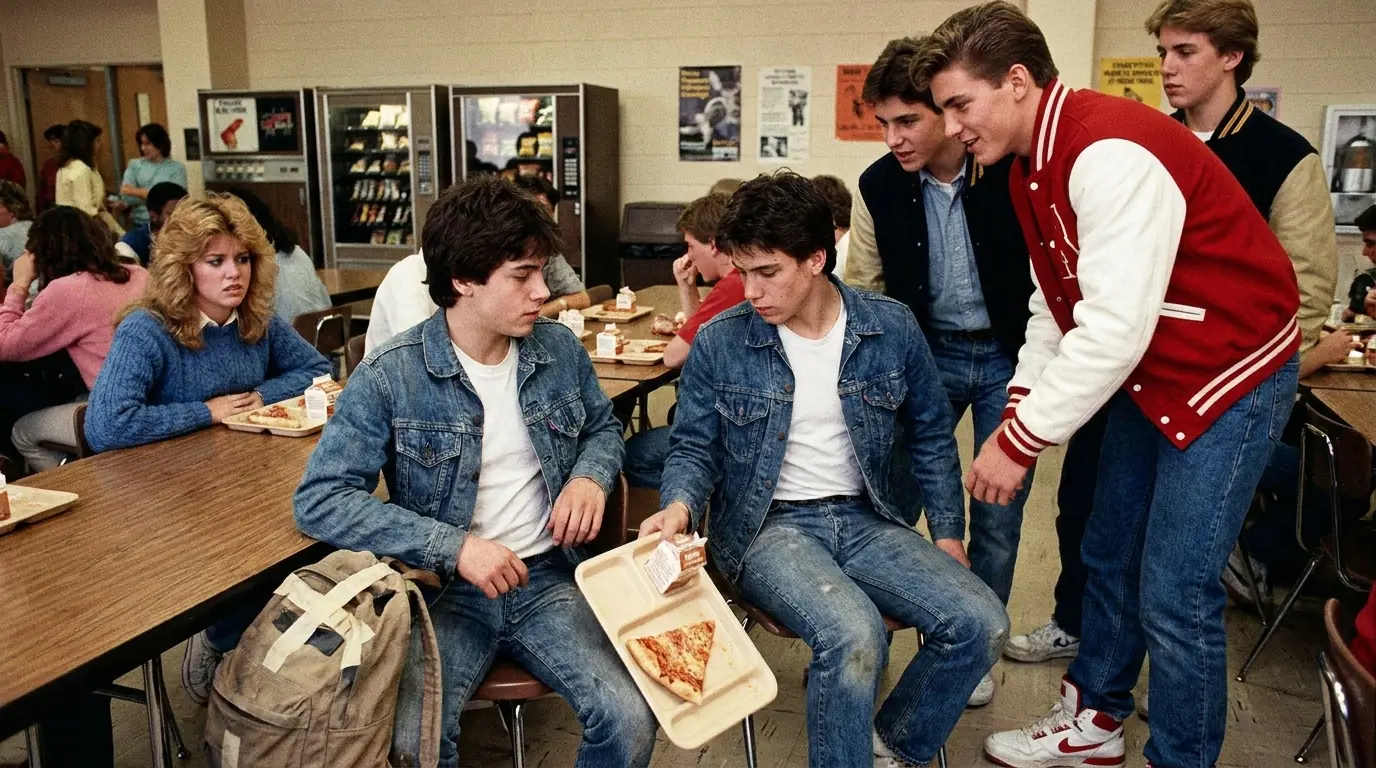
At Westbrook High, lunch was never just lunch. It was a daily map of power, popularity, fear, and survival, all arranged across plastic trays and long cafeteria tables. The athletes owned the center tables near the windows, the student council kids took the front corner by the vending machines, and the quieter students learned to sit wherever they could finish a meal without becoming entertainment. Ryan Wells had spent most of senior year eating in the far corner beside the recycling bins, where nobody bothered to look twice.
Ryan was seventeen, lean, quiet, and stronger than most people guessed from the way he carried himself. He had dark brown hair that always fell slightly over his eyes, a faded denim jacket, and a backpack patched at the bottom with black tape. His mother worked the early shift at a bakery, and Ryan spent weekends helping his uncle repair motorcycles in a small garage outside town. At school, though, people mostly knew him as the boy who kept his head down, answered teachers politely, and never joined the noise unless he had to.
That changed the day Harper Lane sat across from him at lunch. Harper was the girl everyone at Westbrook seemed to notice without trying. She was captain of the dance team, homecoming queen, student council treasurer, and the kind of person whose smile could make a hallway pause for half a second. People called her perfect, but Ryan had learned during the past month that perfection was often just pressure with better lighting.
They had become friends because of an English project, though nobody believed that explanation once they saw them together. Mrs. Keller had paired them for a senior presentation on American short stories, and Harper had surprised Ryan by actually caring about the work. She showed up to the library after school with color-coded notes, asked real questions, and listened when Ryan explained why certain characters hid behind silence. By the third week, they were talking about more than the assignment.
Harper told him she hated the way people treated her like a prize instead of a person. Ryan told her he hated the way people assumed quiet meant harmless. Harper admitted she sometimes smiled through conversations she wanted to escape because disappointing people felt dangerous in a different way. Ryan admitted he sometimes avoided the cafeteria because being ignored was easier than being noticed by the wrong person.
The wrong person, at Westbrook High, was Chase Marlow. Chase was the school’s golden boy, a senior basketball star with expensive sneakers, bright teeth, and the kind of confidence adults praised because they rarely saw what it became when no teachers were close. He had liked Harper since sophomore year and treated that feeling like a claim everyone else was supposed to respect. When Harper laughed with other boys, Chase joked too loudly; when she ignored him, he turned mean just long enough to remind the room he still had power.
Chase had never cared much about Ryan before. He had called him “garage boy” once, made a joke about his jacket, and knocked into his shoulder near the gym, but Ryan was not important enough to become a regular target. That changed when Chase saw Harper waiting for Ryan outside the library one afternoon. By the next morning, half the school was whispering that Harper Lane was spending time with the quiet kid from the back tables.
Ryan told himself the rumors did not matter. He told himself Harper could sit wherever she wanted and talk to whoever she wanted, and Chase’s wounded pride was not his responsibility. But telling himself that did not make the hallway feel less narrow when Chase and his friends watched him pass. It did not stop the comments that followed him between classes.
“Careful, Wells,” Chase said one morning by the lockers. “Harper probably thinks you’re a charity project.” His friends, Tyler Briggs and Mason Holt, laughed immediately. Tyler was tall and broad with a permanent smirk, while Mason was smaller but quicker with his phone, always ready to record someone else’s embarrassment. Ryan kept walking that day, but Chase’s words stayed with him.
On Thursday, Harper asked Ryan to sit with her at lunch. She said it casually, as if it were nothing, but Ryan heard the challenge inside it. Sitting with Harper meant sitting in the open, not hiding in the corner by the recycling bins. It meant giving the school a clear picture of something Chase did not want to accept.
“You don’t have to,” Harper said when Ryan hesitated near his locker. Her voice softened because she understood him better than most people did. “But I’m tired of everyone acting like I need permission to choose who I spend time with.” Ryan looked at her, then toward the cafeteria doors at the end of the hall.
“I’m not scared of eating lunch,” he said. Harper raised an eyebrow. “That sounded almost true.” Ryan laughed despite himself, and that made the decision easier. “Fine. I’ll sit with you.”
Harper sat first. Ryan sat across from her, placing his tray down carefully. He could feel eyes on his back, but Harper opened her notebook like nothing unusual was happening. “Okay,” she said, tapping her pen on the page. “For the presentation, I think you should explain the ending because you make sad things sound less boring.”
Ryan almost smiled. “That might be the strangest compliment I’ve ever gotten.” Harper dipped a fry into ketchup. “Take it. I don’t give many.” For a few minutes, the cafeteria noise softened around them, and Ryan let himself believe lunch could be simple.
Then Chase stood from the athlete table. Tyler and Mason followed like shadows. Ryan noticed the movement before Harper did because he had spent years learning to track danger without appearing to look. Chase moved through the cafeteria with an easy smile, but his eyes were fixed on Ryan’s tray. Mason already had one hand near his phone.
Harper saw Ryan’s expression change and turned. Her face tightened. “Chase, don’t.” Chase stopped beside their table with one hand over his heart, pretending to be wounded. “Don’t what? I’m just saying hello.”
“You never just say hello,” Harper said. Chase laughed and looked at Ryan. “Man, she’s defensive today. What did you do, Wells? Teach her how to change a tire and now she thinks you’re deep?” Tyler snorted. Mason lifted his phone halfway, pretending to check a message while pointing the camera toward the table.
Ryan kept his hands near his tray. “We’re eating lunch.” Chase looked down at the spaghetti, then back at him. “Yeah, I see that. Big romantic cafeteria date.” He leaned closer. “Did you save up for this?”
Harper’s voice sharpened. “Stop.” Chase did not look at her. He kept his eyes on Ryan because the real performance was not about Harper anymore. It was about proving that Ryan had stepped into a place he was not allowed to occupy.
Ryan spoke calmly. “Walk away, Chase.” The words were not loud, but they reached the surrounding tables. A few students turned fully now, sensing the moment had shifted from teasing into something heavier. Chase smiled slowly.
“Walk away,” Chase repeated. “Listen to that. One lunch with Harper and suddenly garage boy thinks he can give orders.” Tyler laughed behind him. Mason’s phone rose another inch.
Ryan looked at the phone. “Recording this won’t make you look better.” Mason’s grin faltered. Chase’s eyes narrowed, annoyed that Ryan had noticed. “Nobody’s recording you, man. You’re not that important.”
Harper stood halfway from her chair. “Chase, leave us alone.” Chase finally looked at her, and his smile became almost gentle in a way that made Ryan’s stomach tighten. “Harper, I’m trying to help you. People are laughing.”
“No,” Harper said. “You are trying to make them laugh.” That sentence landed harder than she expected. Several students nearby grew quiet, and Chase’s face shifted just enough to show anger beneath the charm.
He turned back to Ryan. “You really think she picked you because you’re special?” Ryan did not answer. Chase stepped closer to the table, voice dropping but still loud enough for the watching students. “She’s making a point. Girls like Harper do that sometimes. They stand next to a guy like you so everybody thinks they’re kind.”
Harper’s eyes flashed. “You don’t get to speak for me.” Chase ignored her. He tapped one finger against the edge of Ryan’s tray. “You should be thanking me. I’m giving you a way out before you embarrass yourself worse.”
Ryan looked down at Chase’s finger on the tray. His lunch suddenly seemed like the smallest object in the world and the largest. It was spaghetti, a bread roll, milk, and an apple, nothing worth fighting over. But it was also the table Harper had chosen, the seat Ryan had decided not to hide from, and the simple dignity of being allowed to eat without someone turning him into a joke.
“Move your hand,” Ryan said. Chase’s smile disappeared. “What?” Ryan looked up. “Move your hand off my tray.”
The cafeteria seemed to hold its breath. Chase could have laughed it off, stepped back, and saved himself. Instead, his pride made the next move for him. He gripped the edge of Ryan’s tray and flipped it sideways.
Spaghetti slid across the table and spilled onto the floor. The chocolate milk burst open against Ryan’s jacket. The bread roll bounced under a chair, and the apple rolled toward the aisle. Harper jumped back as sauce splattered near her notebook.
For one second, nobody spoke. The sound of the tray hitting the floor echoed beneath the cafeteria noise. Then Tyler laughed, loud and ugly, trying to teach the room how to respond. A few students laughed with him, but most did not.
Ryan looked down at the milk soaking into his denim jacket. He looked at the spaghetti on the floor, at Harper’s ruined notebook, at Mason’s phone now fully raised. His hands were shaking, but his face went strangely calm. That calm scared Harper more than anger would have.
Chase leaned closer, smiling again. “Oops.” He glanced at Harper. “See? This is why we don’t let people bring junk to the center tables.” Tyler laughed again, but it sounded thinner now. Mason kept recording.
Ryan stood slowly. The chair legs scraped against the cafeteria floor, loud enough to make nearby tables turn. Harper reached toward him. “Ryan.” He glanced at her just long enough to show he had heard her. Then he looked back at Chase.
“Pick it up,” Ryan said. Chase blinked, then laughed once. “Excuse me?” Ryan’s voice stayed level. “Pick up the tray. Apologize to Harper. Then walk away.”
The cafeteria went quieter than Ryan had ever heard it. Even the lunch staff behind the counter stopped moving. Chase stared at him as if the words were in another language. Boys like Chase understood being challenged in a game, but not being corrected by someone they had already decided was beneath them.
Chase stepped close, chest nearly touching Ryan’s. “You want me to clean up your mess?” Ryan looked at the tray on the floor. “It became your mess when you threw it.” Chase’s face reddened.
Tyler moved to Ryan’s side. “You better sit down.” Mason circled slightly for a better angle with his phone. Harper stood now, her voice cutting through the tension. “Back off, all of you.”
Chase’s eyes stayed on Ryan. “This is your last chance to act smart.” Ryan gave a humorless half-smile. “Funny. I was about to say the same thing.” A soft wave of surprised murmurs moved through the cafeteria.
Chase shoved him with both hands. Ryan stumbled back one step into the table, knocking Harper’s lemonade over. Students gasped. Harper shouted, “Chase!” A teacher near the doors turned, finally realizing this was not just cafeteria noise.
Ryan looked at the spilled lemonade, then back at Chase. He had promised his mother a hundred times he would not fight at school. He had kept that promise through comments, shoulder checks, and jokes about his clothes. But his uncle had also told him something in the garage after Ryan came home with a split lip in tenth grade.
“Never start it,” Uncle Mark had said, tightening a bolt under a motorcycle frame. “But if someone puts hands on you and walking away means they own the next kid too, end it clean.” Ryan had not understood that sentence fully until now.
Chase grabbed the front of Ryan’s jacket. “You don’t belong here,” he said through clenched teeth. Ryan looked at the fist twisted in his denim. “Neither does your hand.”
Then Ryan moved. He caught Chase’s wrist, turned his shoulder, and stepped to the side with the practiced balance of someone who had spent weekends lifting engines and learning how not to be thrown around by heavier men in a garage. Chase expected Ryan to pull backward or panic. Instead, Ryan used Chase’s forward pressure against him.
Chase stumbled. Ryan swept one foot behind Chase’s ankle and guided him down hard onto the cafeteria floor beside the overturned tray. It was fast, controlled, and unmistakable. Chase hit the floor with a shocked grunt, not seriously hurt, but completely stunned.
The cafeteria froze. The golden boy of Westbrook High was lying next to spilled spaghetti and a crushed milk carton, staring up at the quiet kid he had tried to humiliate. Ryan stood over him, breathing hard, his jacket wet, his hands open at his sides. He did not swing again. He did not shout.
“Don’t touch me again,” Ryan said. Then he pointed toward Harper’s notebook on the table. “And don’t ever act like embarrassing me gives you the right to speak for her.”
For a moment, the silence was absolute. Then someone clapped. It was a freshman girl near the vending machines, small and nervous, but she kept clapping anyway. A second student joined. Then another. Within seconds, the sound spread across the cafeteria until students were standing beside their tables, applauding not because a boy had fallen, but because a pattern had finally broken.
Chase pushed himself up on one elbow, face burning red. “He attacked me!” he shouted. The words sounded desperate.
Harper’s voice came immediately. “You shoved him first.” A boy from the next table added, “And you flipped his tray.” Another student called out, “Mason recorded the whole thing!” Mason lowered his phone too late.
Mr. Daniels, the assistant principal, arrived with two teachers beside him. He looked from the spilled food to Chase on the floor to Ryan’s soaked jacket. “Everyone sit down,” he said, but his voice had a careful edge. The cafeteria slowly obeyed, though the air still buzzed.
Chase scrambled to his feet. “He threw me down!” Ryan nodded once. “After you grabbed me.” That calm answer seemed to frustrate Chase more than any insult could have. He opened his mouth again, but Harper stepped between them.
“You ruined his lunch because you couldn’t stand seeing me sit with him,” she said. Her voice shook, but it carried. “That’s not confidence, Chase. That’s weakness with an audience.”
The words hit harder than Ryan’s takedown. Chase looked around the cafeteria, searching for laughter, loyalty, anything that could return him to the role he understood. Tyler stared at the floor. Mason hid his phone behind his leg. The athlete table did not cheer.
Mr. Daniels pointed toward the office hallway. “Chase, Tyler, Mason. With me.” Chase’s mouth opened. Mr. Daniels cut him off. “Now.” Then he looked at Ryan. “Ryan, you come too. Harper, I’ll need your statement.”
Ryan nodded. He bent to pick up the tray, but Harper stopped him. “Don’t,” she said softly. He looked at her. She looked back at him, eyes bright with anger and something gentler underneath. “He made the mess.”
A lunch worker came around the counter with a mop, but before she reached the spill, the freshman girl who had clapped first stood and picked up the fallen apple. Another student lifted the tray. A third gathered napkins. Soon several students were helping, not because a teacher told them to, but because the room seemed to understand the cleanup was not Ryan’s burden alone.
That almost broke him. Not the shove, not the ruined lunch, not Chase on the floor. It was the sight of other students finally bending down to pick up what cruelty had knocked away.
In the office, Chase tried to speak first, as he always did. He said Ryan had overreacted. He said the tray had slipped. He said Harper was making it dramatic. But Mason’s video told a cleaner story than any of them could twist.
It showed Chase tapping the tray, mocking Ryan, flipping the food, shoving him, grabbing his jacket, and then falling when Ryan defended himself. It also captured Harper saying, “You are trying to make them laugh,” and Chase proving her right seconds later. Mr. Daniels watched the video twice without speaking.
When it was Ryan’s turn to give a statement, he did not minimize anything. He told the truth in order. He described the comments from earlier in the week, Chase’s jealousy over Harper, the phone recording, the tray, the shove, and the grab. He admitted he had used a defensive move to get Chase off him and that he stopped immediately after Chase fell.
Mr. Daniels folded his hands on the desk. “Has Chase bothered you before today?” Ryan almost said no. The instinct rose from years of avoiding trouble, years of believing that if he named something, it would grow teeth. Then he remembered the cafeteria clapping, Harper standing beside him, and the apple being picked up by a freshman who did not even know him.
“Yes,” Ryan said. “Not every day. But enough.”
Mr. Daniels looked at him carefully. “Enough how?” Ryan took a breath. “Comments. Shoulder checks. Jokes about my clothes, my family, my job at my uncle’s garage. Nothing huge by itself.” He paused. “That’s how people get away with it.”
Harper, sitting beside him, nodded. “He does that to people all the time. He just makes it sound like flirting or joking when adults are close.” Mr. Daniels wrote that down. His expression had changed, not dramatically, but enough for Ryan to see that the pattern was finally visible.
Chase received a suspension, removal from the next basketball game, and a formal conduct review. Tyler and Mason received detention and phone restrictions for recording and encouraging the harassment. More importantly, the school opened a wider investigation after several students submitted statements about past incidents involving Chase.
By the final bell, the video had already spread through Westbrook. Ryan hated that at first. He hated the idea of strangers replaying his soaked jacket, the food on the floor, the moment his anger became public. But the clip did not travel the way Chase had intended. Students were not laughing at Ryan.
They were repeating Harper’s line. Weakness with an audience. Someone wrote it on a sticky note and placed it inside a locker. Someone else said it during sixth period when a boy tried to mock a freshman’s shoes. By the next morning, the phrase had become bigger than the cafeteria.
Ryan almost stayed home on Friday. His mother had washed the denim jacket twice, but the faint smell of chocolate milk still clung to the fabric. At breakfast, she watched him push eggs around his plate and finally said, “You don’t have to prove anything by going back today.”
Ryan looked at her tired face, the flour still under one fingernail from the bakery shift. “If I don’t go, it feels like he still gets the table.” His mother studied him for a long moment. “Then go take the table.”
So he did.
The cafeteria felt different when Ryan walked in at lunch. Students looked up, but the laughter he feared did not come. Harper was already sitting at the same middle table with two trays in front of her. One was hers. One was for him.
Ryan stopped beside the chair. “You bought me lunch?” Harper shrugged. “Technically, Chase should have, but I didn’t want to wait for character development.” Ryan laughed for the first time all day. It came out quiet, but real.
He sat across from her. Around them, the cafeteria watched, but this time it felt less like a trial and more like a decision being made. Harper pushed the tray toward him. “Spaghetti again,” she said. Ryan looked at it and raised an eyebrow. “Bold choice.”
“You deserved a rematch,” she said. He picked up the fork, then glanced toward the athlete table. Chase’s seat was empty. Tyler and Mason sat apart from the others, unusually silent.
A freshman girl approached the table with her tray held close to her chest. Ryan recognized her as the one who had clapped first. “Can I sit here?” she asked. Harper smiled immediately. “Of course.” The girl sat, introduced herself as Sophie, and admitted in a rush that Chase had once dumped her backpack in the hallway because she bumped his shoulder.
Ryan listened. Then he said, “You should tell Mr. Daniels.” Sophie looked doubtful. Harper leaned forward. “We’ll go with you if you want.” Sophie stared at them, surprised by the word we, then nodded slowly.
By the end of lunch, two more students had joined the table. One was a sophomore Chase had mocked during gym. Another was a junior who had stopped eating in the cafeteria after Tyler filmed him spilling soup. The table did not become popular in the usual Westbrook way. It became something stronger than popular.
It became safe.
On Monday, Chase returned to school without his letterman jacket. That detail traveled through the building faster than the morning announcements. Without the jacket, without Tyler and Mason walking close behind him, Chase looked less like Westbrook’s untouchable star and more like a boy trying not to hear the whispers he once created for others.
Ryan saw him near the main hallway before English. Chase stopped several feet away. For a second, the old fear tightened Ryan’s chest. Then he remembered Chase on the cafeteria floor, not as a victory, but as proof that fear was not permanent.
“I need to talk to you,” Chase said. Ryan kept one hand on his backpack strap. “Then talk.” Chase glanced around at the students slowing nearby. “Not here.” Ryan shook his head. “You flipped my tray in public. If this is about that, say it in public.”
Chase’s jaw tightened. He hated the audience now, which told Ryan exactly how much things had changed. After a long pause, Chase said, “I’m sorry I knocked your tray over.” Ryan waited. Chase swallowed. “And for grabbing you. And for the stuff I said about Harper.”
Harper had come up behind Ryan during the conversation, but she did not interrupt. Chase noticed her and looked away. Ryan asked, “Why did you do it?” Chase gave the first answer too quickly. “I was mad.”
Ryan shook his head. “That’s not why. That’s just what you felt.” Chase’s face reddened, but he did not lash out. He looked down at the floor, then back up. “Because I thought if people laughed at you, they wouldn’t laugh at me.”
The honesty surprised Ryan. It did not fix anything, but it made the apology feel less like a script. Harper’s expression softened slightly, though not enough to become forgiveness.
Ryan said, “I’m not going to tell you it’s fine.” Chase nodded once. “I know.” Ryan continued, “And Harper doesn’t owe you kindness just because you finally realized she can say no.” Chase looked at her, then lowered his eyes. “I know that too.”
Harper crossed her arms. “Do you?” Chase’s voice was quieter. “I’m trying to.” Harper studied him for a moment. “Then try when nobody’s watching.”
Chase nodded and stepped aside. Ryan and Harper walked past him together. For the first time, the hallway did not feel like Chase’s space with everyone else passing through. It felt like a school again.
The weeks that followed did not turn Westbrook into a perfect place. Students still whispered. Some people still laughed when they should have stayed quiet. Some only became kinder when teachers were close. But the cafeteria had changed in a way nobody could fully deny.
Teachers stood closer during lunch. Students became more willing to call out cruel jokes before they grew. When Mason lifted his phone to record a freshman dropping a tray, Sophie said loudly, “Don’t be that guy,” and Mason put the phone away. Tyler stopped making comments at Ryan’s table after Harper looked at him once and said, “You want another audience?”
Ryan changed too. He stopped sitting in the far corner unless he actually wanted quiet. He still worked weekends at his uncle’s garage, still wore the taped backpack, still preferred listening over talking. But he no longer confused keeping peace with surrendering space.
One afternoon, Mrs. Keller asked him to read part of his and Harper’s English presentation aloud. The topic was character transformation, and Ryan’s section discussed how people often mistake silence for weakness until a turning point reveals what the character has been carrying all along. When he finished, the room stayed quiet for half a second longer than usual.
Mrs. Keller smiled. “That was very clear, Ryan.” Harper looked over at him with a grin. “Told you sad things sound better when you explain them.” Ryan rolled his eyes, but he was smiling too.
At the end of the semester, Westbrook held a senior lunch on the football field. Long tables were set up near the track, music played from old speakers, and students signed yearbooks under the bright May sun. Ryan sat with Harper, Sophie, and several others who had somehow become a real group without anyone announcing it.
Chase approached near the end of lunch. Ryan noticed him before the others did. Chase looked nervous, which was still strange to see. He stopped at a respectful distance from the table, holding a cafeteria tray.
Ryan raised an eyebrow. “You lost?” Chase shook his head. He placed the tray on the table. It held spaghetti, a bread roll, chocolate milk, and an apple. The same lunch Ryan had carried that day.
“I should have replaced it sooner,” Chase said. His voice was low, but the table heard. “I know this doesn’t fix it.” Ryan looked at the tray, then at Chase. “No, it doesn’t.”
Chase nodded. “I know.” He hesitated, then added, “But I wanted to do one thing that wasn’t just words.” Harper studied him carefully. Sophie watched with open suspicion.
Ryan looked at the tray again. Part of him wanted to reject it, to make Chase carry the discomfort longer. Another part understood that accepting a small act did not mean erasing the past. It only meant Ryan no longer needed to prove his dignity by refusing every attempt at repair.
He took the apple from the tray. “I’ll take this.” Chase looked surprised, then nodded. “Okay.” Ryan held his gaze. “Keep doing things that cost you pride. Then maybe people will believe the apology.”
Chase nodded again and walked away. Harper waited until he was gone, then said, “That was mature.” Ryan bit into the apple. “Don’t spread that rumor.” She laughed, and the table relaxed.
Graduation came three weeks later under a clear blue sky. Ryan crossed the stage in a blue gown, his mother cheering loudly from the bleachers with Uncle Mark beside her in a clean work shirt. Harper crossed later, smiling when the crowd erupted for her, but her eyes found Ryan’s row afterward. They were not a fairy-tale couple in the way people at Westbrook had tried to imagine or mock. They were two people who had chosen each other’s truth when the room wanted a performance.
After the ceremony, families gathered for photos near the football field. Harper found Ryan beside the fence and handed him a folded page. It was the final copy of their English presentation, with a note written at the bottom in her neat handwriting. Thank you for teaching me that quiet people are sometimes the bravest ones in the room.
Ryan read it twice. “You make me sound better than I am.” Harper shook her head. “No. I make you sound like what everyone else was too distracted to see.”
He looked across the field at Westbrook High, at the cafeteria windows reflecting the afternoon light. For years, that building had taught him how to avoid becoming a target. Then one spilled tray had taught him something different. It had taught him that dignity could survive humiliation if a person refused to leave it on the floor.
Years later, students at Westbrook still talked about the day Chase Marlow knocked Ryan Wells’s lunch tray away in front of Harper Lane. Some remembered Chase falling beside the spaghetti. Some remembered Harper calling him weakness with an audience. Some remembered the cafeteria standing up when the quiet boy finally stopped backing down.
But Ryan remembered the smaller thing. He remembered students bending down to pick up the tray, the apple, the napkins, and the pieces of a moment that cruelty had tried to scatter. He remembered realizing he had not been alone as completely as he thought.
And whenever he thought about that day, he did not remember the food first.
He remembered the table.
Because that was what the whole fight had really been about.
The right to sit where he wanted, with whom he wanted, without lowering his head for anyone.