"Get this," he laughed, lifting his phone. "Dumbest waitress in Ohio."
Then Colton Ashford tipped a full cup of hot coffee onto her hand.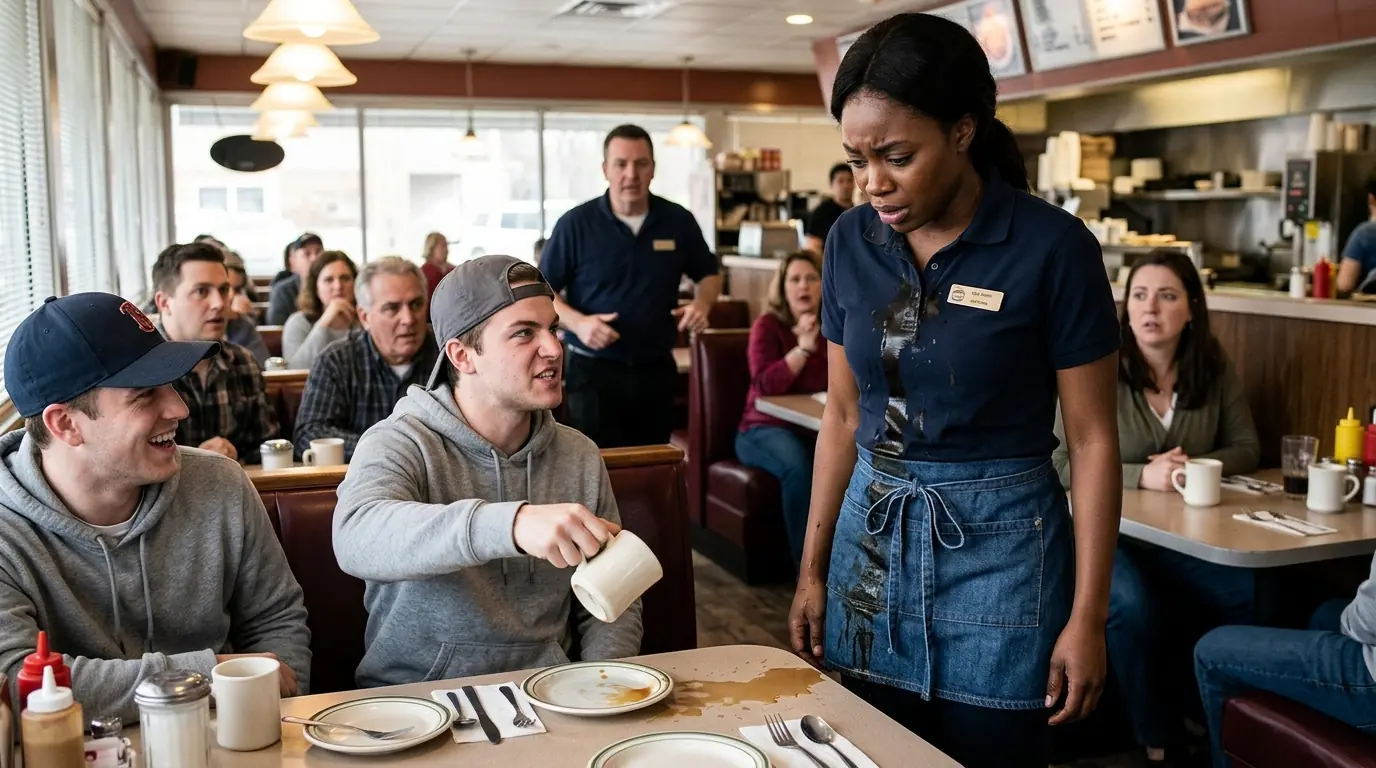
The whole diner went silent. Forks stopped midair. Harper Voss didn't scream. She didn't cry. She picked up a napkin, wiped her hand clean, and looked him dead in the eye.
"I've had worse burns than this," she said. "Try again."
Nobody in that town knew what she was. Not the four young men filming her humiliation. Not the councilman's son, who thought money made him untouchable. And certainly not the powerful family about to discover that the quiet girl refilling their coffee had spent 10 years training in secret with a retired Navy SEAL who owed her dead father everything.
4 days later, in front of the whole county, she would finally show them. They picked the wrong waitress. They just didn't know it yet.
Ridgefield, Ohio is the kind of town most people drive past without ever learning its name. One traffic light, one grocery store, one diner that has stayed open since before most of its regulars were born. That diner is called Millie's.
On a quiet Tuesday morning in early October, nobody inside that diner knew they were about to witness something the whole county would talk about for years. This is the story of a young woman named Harper Voss, a waitress, 24 years old, polite, easy to overlook if you didn't know any better. This is also the story of an old man who sat in the corner booth every single morning and rarely said a word. Most people in town figured he was just another lonely veteran passing time. They had no idea what he really was. And they had no idea what he'd spent the last 10 years doing quietly for the young woman who poured his coffee.
By the end of this story, you'll understand exactly why people call what happened next legendary. But first, you need to know how it began. And it began with something small. It always does.
Millie's diner opened at 6 every morning. Rain or shine. By 6:30, the regulars had already claimed their booths. Walter, 81 years old, ordered the same two eggs and rye toast he'd ordered for 11 straight years. Eleanor Pratt, a widow in her 70s, came in more for the company than the coffee. A table of retired factory men argued about football scores as if the game had happened yesterday, not decades ago.
And in the corner booth sat a man named Emmett Doyle, 68 years old, gray hair cropped close, eyes that seemed to take in everything without ever appearing to look directly at anything. He always sat facing the door. Folks in Ridgefield chalked that up to old habits. Old soldiers, they said, do strange things. Nobody thought the word dangerous belonged anywhere near him. They were wrong about that.
Every morning, Harper brought him the same cup of black coffee. No sugar, no cream. Every morning he said the same three words back. "Thank you, Harper." It was a small ritual easy to miss if you weren't paying attention. But it meant far more than most people in that diner ever guessed because Emmett Doyle wasn't simply a lonely old man nursing coffee alone. He was the reason Harper Voss was still standing. In a matter of days, the whole town would understand that, too. Just not yet.
Harper had worked at Millie's since she turned 18. Six years of carrying plates, refilling cups, remembering exactly which regular wanted extra ketchup, and which one couldn't stand cilantro anywhere near his food. She was good at the job. Fast, kind, impossible to rattle. Millie, the diner's owner, a sharp-tongued woman pushing 60, liked to tell suppliers that Harper was the best hire she'd made in three decades of running that place.
"That girl never complains," Millie said once. "Not once."
What Millie didn't know was why. Harper had learned a long time ago that complaining rarely fixed anything. She learned that lesson at 14, standing in a church, watching her mother hold a folded flag against her chest. That was the day her father died.
His name was Daniel Voss. He'd served his country for 12 years. A quiet man who almost never talked about the details of his work, but who came home every leave with the same tired smile and the same tight hug for his daughter. Then one year he didn't come home at all.
Harper was 14 when two men in uniform knocked on the door of their small house on Elm Street. She remembered every piece of that morning. The sound of her mother's coffee mug shattering against the kitchen floor. The ordinary light coming through the window, indifferent to how much was about to change. Her father had died overseas in the middle of a mission nobody ever fully explained to a grieving 14-year-old.
What she eventually learned years later from the man who'd actually been there was simpler than any official report. Her father had given his life saving someone else's. That was the part Harper needed to know most because the man who told her that story was the same man who now sat in the corner booth of Millie's diner drinking black coffee, saying three quiet words every morning: "Thank you, Harper."
After the funeral, Emmett Doyle showed up at their door. He was a stranger to Harper then, tall, tired-eyed, carrying a folded American flag under one arm. He handed the flag to her mother. He said very little, but he came back a week later and again the week after that. He never overstayed his welcome. He never tried to fill the space her father had left behind. He simply kept showing up quietly again and again, like a promise he intended to honor, no matter how long it took.
One afternoon when Harper was still 14, still raw with grief, Emmett sat down across from her at the kitchen table. "Your dad asked me for one thing," he said, "before he went out that last time."
Harper looked up.
"He asked me to make sure you could take care of yourself, no matter what life threw at you."
She didn't understand what that meant. Not that day. She understood a little more the following spring when Emmett appeared at the old barn behind their house carrying two worn pairs of gloves and a roll of athletic tape.
"We're not doing this because the world is cruel," he told her that first afternoon. "We're doing this because someday it might be. And I made a promise."
Harper was 14 years old. She thought he meant learning how to throw a punch. She had no idea what she was actually being given.
10 years. That's how long Emmett Doyle trained Harper Voss. Not every day, not always in a straight line. There were stretches when grief pushed her away entirely. Weeks she skipped their sessions out of pure anger at the world. Emmett never chased her down. He simply waited. She always came back slowly, quietly in that dirt-floored barn with a single bulb hanging overhead.
Harper learned things nobody in Ridgefield would ever guess she knew. She learned how to fall without breaking anything important. She learned how to read a room the way some people read a book. Noticing exits, noticing hands, noticing the difference between a man who was simply loud and a man who was actually dangerous. Most of all, she learned patience.