"Why do you smell like that? Is poverty like a perfume where you come from? This is inspiring me. No, that's a better look for you, honestly." The courtyard roared with laughter.
Not one person moved. But then, the crying new girl stood up, wiped the mud off her face, and looked Brittany dead in the eyes. What those bullies didn't know was that the girl was about to flip every last one of them. Let me take you back to the beginning. Crestwood Academy sat on 12 acres of manicured land in northern Virginia.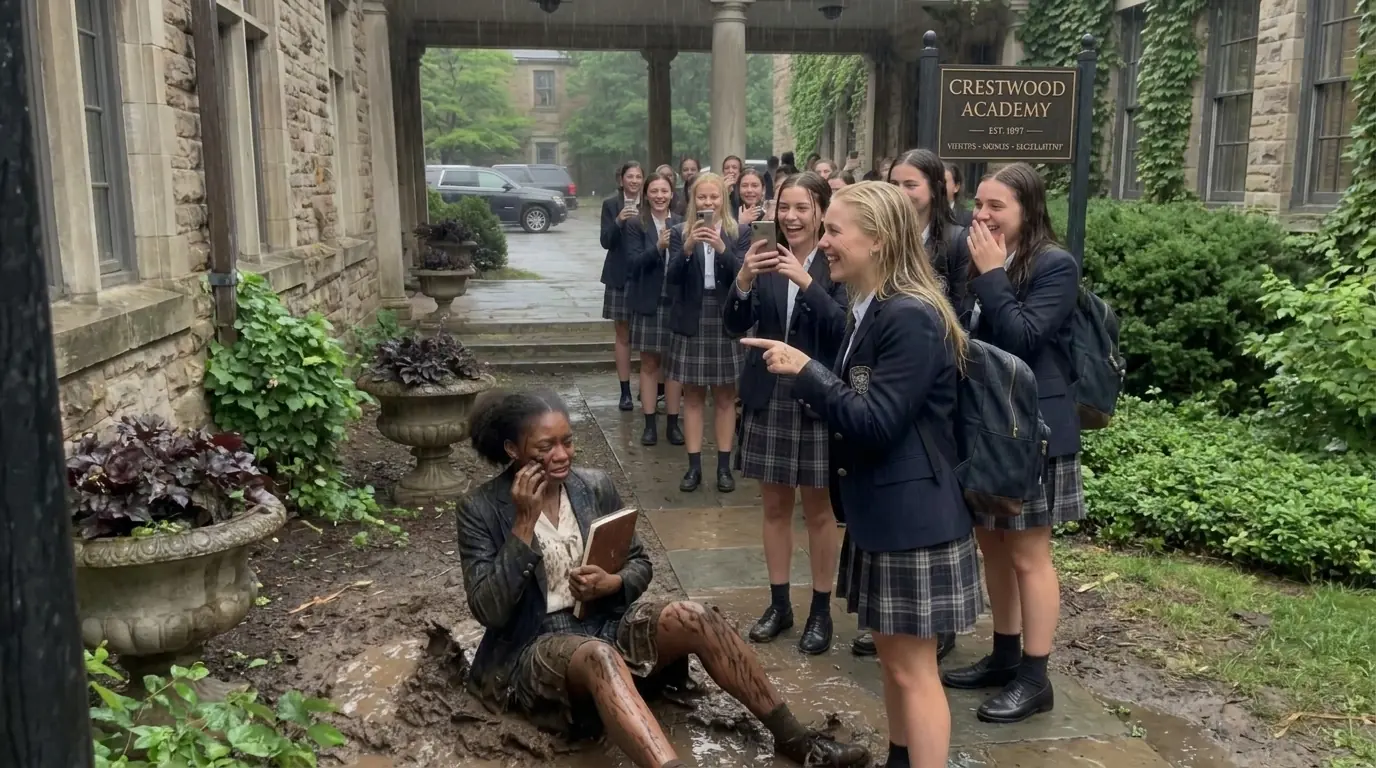
It was the kind of school where the buildings looked like they belonged in a British period drama. Stone columns, ivy crawling up brick walls, a Latin motto carved above the front entrance that nobody could actually translate, but everyone pretended to understand. Tuition? $42,000 a year. And that didn't include the polo uniforms, the ski trip to Aspen, or the voluntary donation every family made at the fall gala. The student body was almost entirely white.
Old money, legacy admissions. Kids who got dropped off in Range Rovers and BMWs, and knew each other's grandparents by first name. The few students of color who walked those halls learned one rule fast. Stay quiet, stay invisible, stay out of the way. That was the world Grace Taylor walked into on a Tuesday morning in early September.
She was 16, tall for her age, with her natural hair pulled back in a neat puff. She carried a worn leather notebook under her arm, the kind with the elastic strap and coffee-stained pages. She wrote in it constantly. Observations, feelings, conversations she overheard. It was a habit she picked up from years of being the new kid.
This was her fourth school in 5 years. Her mother, Denise Taylor, dropped her off a block away from the main entrance. Not because they couldn't afford the carpool lane, and not because their car wasn't nice enough, but because Denise didn't want attention. See, Denise had just accepted a position as the director of the Civil Rights Division at the United States Department of Justice. The family relocated from Chicago specifically for this role.
It was the kind of job that came with a security detail and a direct line to the Attorney General. But Grace didn't mention any of that. Not on the application, not in her interview, not to a single soul at Crestwood. Denise had chosen this school deliberately. The brochure said all the right things, inclusive community, diverse perspectives, character-driven education.
Grace had her doubts the second she saw the parking lot. She walked through the front gate that morning carrying nothing but her notebook and a quiet kind of courage that most adults don't have. The air smelled like wet leaves and expensive cologne. Sprinklers hissed along the front lawn. A gardener trimmed hedges near the entrance and didn't look up when she passed.
She paused at a bronze plaque near the gymnasium entrance. Collins Athletic Center, donated by the Collins family. She read it, stored it, kept walking. Now, let's talk about Brittany Collins. Brittany arrived 7 minutes after Grace.
White Range Rover. Her older brother drove. She stepped out of that car like the courtyard was her personal runway. Designer backpack, hair freshly blown out, sunglasses pushed up on her head even though the sky was overcast. Her father was Glenn Collins, a real estate developer and Crestwood board member, the man who built the gym, funded the new science lab, and had the principal's personal cell phone number.
Brittany inherited her father's confidence and none of his subtlety. She was charming when teachers watched, ruthless when they didn't. She spoke in a voice sweet enough to sound harmless on a recording, but sharp enough to leave scars. And she had a pattern. Last year, a biracial sophomore named Alyssa transferred out mid-semester after a month's-long bullying campaign.
Racist notes in her locker, social media rumors, a cruel nickname that spread through the entire junior class. Alyssa's parents filed a complaint. Principal Donald Anderson investigated. Two days later Glenn Collins made a phone call. The complaint disappeared.
Alyssa disappeared. And Brittany never missed a single day of school. That was how Crestwood worked. Money talked. Power protected.
And silence was the price of admission. Now, there was one more detail about that courtyard. Something nobody paid attention to on the first day of school. Mounted on the stone pillar near the main walkway just above eye level was a small security camera. Black dome, tiny red light blinking every few seconds.
It recorded everything. The laughter, the shove, the mud, the tears. Grace Taylor, the girl who noticed everything, wrote everything down, and never forgot a face or a word, noticed that camera the second she walked through the gate. She just didn't say anything about it. Not yet.
Grace's first full day at Crestwood started with silence and ended with humiliation. Morning classes were tolerable. She sat in the back row of every room, took notes, didn't raise her hand, didn't speak unless a teacher called on her directly. In AP English, the teacher, a thin woman with reading glasses on a chain, asked the class to introduce themselves with their name and one interesting fact. When Grace said she'd moved from Chicago, a boy in the second row whispered to his friend, "Bet she knows all the dangerous neighborhoods."
The friend laughed behind his hand. The teacher either didn't hear or didn't care. Grace wrote the time and the quote in her notebook. She underlined it twice. By third period, the whispers had spread.
The new girl, the black girl, the one Brittany already marked on day one. Word traveled fast at Crestwood, not through hallways, but through group chats, disappearing messages, and glances exchanged across classrooms. Grace felt it. That specific kind of visibility where everyone sees you, but nobody looks at you. Then came lunch.
The cafeteria at Crestwood didn't look like a cafeteria. It looked like a restaurant. Round tables with actual tablecloths, a salad bar with quinoa and roasted beets, floor-to-ceiling windows overlooking the athletic fields. The smell of rosemary chicken and fresh bread drifted through the room. Grace grabbed a tray and found an empty table near the window.
Nobody sat there unless invited. Brittany noticed Grace within 30 seconds. She didn't lower her voice. She never did. "Oh my God, is that the same girl from this morning?
"The mud girl?" Megan leaned forward. "She's sitting alone." "Shocking. I mean, what did they expect?"
Brittany said, loud enough for three surrounding tables to hear. "You can't just drop a diversity admit into this school and think she'll fit in. That's not how it works." A girl at the next table looked uncomfortable. She stared at her plate, said nothing.
A boy behind Brittany smirked, also said nothing. That was the ecosystem. Brittany spoke. Everyone else performed silence. Grace didn't look up.
She kept her pen moving across the page, but her hand was shaking. Just slightly. Just enough that she pressed harder than usual and the ink bled through to the next page. She wrote the time. She wrote the words.
She wrote who laughed. Lunch ended. Grace picked up her tray, dumped it, and walked out with her notebook pressed tight against her chest. Her jaw was clenched so hard her teeth ached. The hallway after lunch was where it escalated.
Grace was walking toward her locker on the second floor. The corridor smelled like floor polish and whiteboard markers. Her sneakers squeaked on the tile. Most students were still filtering out of the cafeteria, so the hallway was almost empty. Almost.
Brittany appeared from around the corner. Megan was two steps behind her. They were walking fast. Fast enough that the collision didn't look accidental, but slow enough that a teacher might believe it was. Brittany's shoulder hit Grace square in the chest.
Grace's books flew. Her notebook hit the tile and slid. Papers scattered across the hallway. Her schedule, a printed campus map, a handwritten list of classroom numbers. Brittany stopped, looked down at the mess, then looked at Grace with a smile that had no warmth in it.
"Oh my God, I'm so sorry. I literally didn't even see you there." She paused and tilted her head. "Maybe you should wear something brighter, you know, so people can actually spot you." Megan laughed.
Not a real laugh, a performance. She had her phone out, angled low, recording. Grace knelt on the floor and picked up her papers one by one. Her hands were steady now, not because she wasn't angry, but because she'd made a decision to be still. She reached for her notebook last.
It had landed face open. The page with today's entries was visible. The times, the quotes, the names. She closed it, tucked it under her arm, stood up, and right at that moment, a teacher walked by. Mr. Bradley, history department, gray blazer, coffee in hand.
He saw Grace on her knees. He saw the papers on the floor. He saw Brittany standing over her with Megan's phone out. He made eye contact with Grace for exactly 1 second. Then he looked away.
Picked up his pace, turned the corner, gone. Grace watched him leave. She memorized his face, too. That afternoon, the rain started. It came down hard during sixth period.
Grace could hear it hammering against the classroom windows. By the time the final bell rang, the courtyard was soaked. Puddles sat in the low spots near the garden beds. The sky had turned the color of wet concrete. Grace walked toward the pickup area on the far side of campus.
She had her phone in one hand, texting her mother. Her backpack hung from one shoulder. Her shoes were already damp. She passed the garden beds. The stone walkway narrowed here, and the ground on either side was soft.
A patch of exposed earth that the rain had turned into thick, dark mud. That's where they were waiting. Brittany stood on the walkway, Megan on the left, Haley on the right. Three points of a triangle. The geometry was deliberate.
There was nowhere to go. "Hey, new girl." Brittany's voice was cheerful, almost friendly. "We just wanted to welcome you properly, you know, since we didn't really get a chance this morning." Grace stopped.
Her eyes moved between the three of them. She already knew what was happening. She could feel it in her stomach, that cold sinking weight. "I just want to go home," Grace said quietly. "Aw," Brittany pouted.
"That's sweet, but we're not done talking to you yet." Haley stepped closer from the right. Megan shifted left. The gap behind Grace closed. "You know what your problem is?"
Brittany said. "You walk around here like you belong, like somebody invited you, but nobody did." She stepped forward, close, too close. "You got in on a quota. Everyone knows it.
"You're here because some committee somewhere felt guilty, not because you earned it, not because you deserve it." Grace's lip trembled. Her eyes burned, but she held Brittany's gaze. "That's not true," she said. Brittany smiled, slow and cold.
"Yeah? Then why are you crying?" She put both hands on Grace's shoulders and shoved. Grace stumbled backward off the walkway. Her feet hit the mud.
Her balance broke. She went down, hard. Her back hit the wet earth first, then her elbows, then her palms. Mud splashed across her uniform, her neck, her face. Her notebook landed in a puddle and soaked through instantly.
The sound she made wasn't a scream. It was a gasp, the kind that gets stuck between your chest and your throat. 20 students watched from the covered walkway. Some had their phones out recording. Others just stood there, frozen, uncomfortable, looking at each other for permission to do something.
Nobody moved. Brittany looked down at Grace like she was examining something unpleasant on the bottom of her shoe. "See? That's where you belong." More laughter.
Not from everyone, but enough. Grace sat in the mud for five full seconds. Rain on her face, tears mixing with the dirt, her ruined notebook beside her. Then she did something none of them expected. She stood up, slowly, deliberately, mud dripping from her blazer.
She picked up her notebook. She wiped her face with the back of her sleeve, one long, steady stroke across her cheek. And she looked at Brittany Collins with an expression that wasn't anger, wasn't sadness. It was memory. She was recording every face, every laugh, every phone held up, every person who did nothing.
She didn't say a word. She turned around and walked away. Mud in her hair, mud on her shoes, back straight, head level. Brittany watched her go and felt nothing. Megan put her phone away.
Haley checked her lipstick in a compact mirror. None of them noticed the security camera above the courtyard pillar. Its red light blinked once, then again, then again. And none of them knew that in 45 minutes, Grace Taylor would walk through her front door covered in mud, hand her mother a list of names, and set something in motion that none of them, not Brittany, not Glenn Collins, not Principal Anderson, could stop. Grace walked through the front door at 4:17 p.m. Denise Taylor was in the kitchen, laptop open, reading glasses on, reviewing case files from her first week at the DOJ.
A mug of chamomile tea sat beside her, still full, still steaming. The house smelled like lemon cleaner and fresh laundry. She looked up when the door opened, and then she stopped breathing. Her daughter stood in the hallway, mud caked across her blazer, mud in her hair, mud drying on her cheeks in streaks that followed the path of her tears. Her notebook, the one she carried everywhere, the one Denise gave her on her 13th birthday, hung from her hand, dripping brown water onto the hardwood floor.
Denise didn't gasp, didn't yell, didn't rush over with a towel. She closed her laptop, took off her glasses, folded her hands on the table. "Tell me everything." Grace sat down across from her mother. She didn't change clothes first.
She didn't wash her face. She sat in the kitchen chair with mud still on her skin and told her mother every single thing. The courtyard remark, the cafeteria comments, the hallway collision, Megan's phone recording, the teacher who looked away, the shove, the mud, the laughter, the names. She opened her notebook to the pages that weren't ruined. She'd written it all.
Times, quotes, descriptions, locations. Denise listened without interrupting, not once. Her face didn't change, but her right hand, resting flat on the table, had gone completely rigid. Her knuckles pressed white against the wood. When Grace finished, Denise asked one question.
"Were there cameras in the courtyard?" Grace nodded. Denise picked up her phone. She didn't call the school. She didn't call the principal.
She didn't call the parent hotline listed on the Crestwood website. She called her former colleague at the FBI's Civil Rights Unit. The conversation lasted 4 minutes. Grace couldn't hear the other end, but she heard her mother say three things clearly. "Pattern of conduct."
"Student witnesses." "Preserved surveillance." When Denise hung up, she looked at her daughter. "Go shower, eat something, then write down every name you remember, every single one." Grace nodded and walked upstairs.
She paused on the third step. "Mom, are you going to call the school?" Denise's expression didn't change. "Not yet." The next morning, Denise called Principal Donald Anderson.
But this wasn't an emotional phone call from an upset parent. This was a formal request. She identified herself as Grace Taylor's mother. She requested a meeting to discuss a physical assault on school grounds. She used that word specifically, assault, not bullying, not conflict, assault.
Anderson's voice shifted immediately, friendly but controlled, managing. "Mrs. Taylor, I appreciate you reaching out. We take every concern seriously here at Crestwood." He paused. She could hear him choosing his words.
"That said, kids this age—you know how they are. It's the first week. Emotions run high. I'm sure we can sort this out with a conversation between the girls." "My daughter was physically pushed to the ground in front of witnesses," Denise said.
"There's security footage." Another pause, longer this time. "I understand your concern. We'll certainly look into it, but I want to assure you, Crestwood has a long-standing culture of respect. I'm sure this was a misunderstanding."
"A misunderstanding?" "These things often look worse than they are. Both sides usually have a part in it." Denise let the silence stretch for 3 seconds. Then she said, "I'd like a formal meeting this week.
"I'd also like a copy of the school's anti-bullying and anti-discrimination policies." "Of course. I'll have my assistant send those over." They never arrived. What Anderson did instead was hang up the phone and immediately call Glenn Collins.
"Glenn, heads up. The new student's mother is making noise about the courtyard incident. Sounds like she wants to escalate." Glenn Collins was in his office. Mahogany desk.
A view of the Potomac through floor-to-ceiling windows. He leaned back in his leather chair and laughed. "Are you serious? Some new kid can't handle a little teasing and her mother wants a meeting? Tell her we'll look into it and move on.
"This is Crestwood, Don, not a daycare." She mentioned the security cameras. A beat of silence. "Then make sure the footage goes through the normal retention cycle," Glenn said. "30 days, right?
"Just let it expire." "Glenn, I don't know if—" "Don, I built that gym. I funded your parking lot renovation. My daughter is not getting written up because some transfer student can't take a joke. Handle it."
Anderson hung up. He opened his desk drawer, took out a bottle of antacid, and chewed three tablets. He didn't know that Denise had recorded the entire phone call. Virginia is a one-party consent state. She only needed her own permission.
At school, the message was clear. Nothing happened. No consequences. No meeting. No email.
Nothing. And Brittany Collins received that message like a green light. Within 3 days, the attacks escalated. Monday, Grace opened her locker and found a drawing taped to the inside of the door. A crude caricature with exaggerated features.
Dark skin colored in with brown marker. Lips drawn oversized. The word "quota" written in red underneath. Grace's hands trembled when she peeled it off. She didn't crumple it.
She put it in a plastic sleeve and slid it into her notebook. Tuesday, Grace's gym clothes disappeared from her locker during fourth period. She found them 40 minutes later stuffed inside a toilet in the girls' bathroom, soaking wet, unwearable. She photographed them before touching anything. Timestamp visible on her phone screen.
Wednesday, a screenshot circulated through the junior class group chat. Brittany had written a message referring to Grace using a racial slur. Not coded, not abbreviated, the full word. Followed by a laughing emoji and the sentence, "Can't believe they actually let her stay." 46 students saw that message.
Not one reported it. Fear of Brittany ran deeper than any school policy, but someone, one student whose name Grace still doesn't know, took a screenshot and sent it to Grace through an anonymous Instagram account. No message, just the image. Grace saved it, added it to the file. Thursday, the line crossed.
Grace was in the second-floor bathroom after fifth period, washing her hands. The faucet dripped unevenly, a metallic tapping against the porcelain sink. The fluorescent light above the mirror buzzed and flickered. The door opened. Brittany walked in first.
Megan followed and stood against the door, blocking it. Brittany didn't smile this time. Her face was different, harder. She moved close, too close. Grace could smell mint gum and hairspray.
"I heard your mommy made a phone call to Anderson." Grace didn't move. Her hands were still wet. "Let me make something really clear to you." Brittany's voice was low, almost a whisper.
"My dad built half this school. He owns the board. He owns Anderson. And if you think running to your mother is going to change anything, you're dumber than you look." She leaned in closer, her mouth inches from Grace's ear.
"If you snitch again, I will make your life here so miserable you'll beg to leave, just like the last girl." Megan had her phone out, recording. She thought she was building leverage, a video to hold over Grace. She didn't realize she was building evidence. Grace said nothing.
Her heart hammered in her chest, her vision narrowed. But she stayed still. And the small pendant hanging from her neck, a simple silver chain her mother gave her before the first day, recorded every single word. Built-in microphone, continuous loop, 50 hours of storage. Denise Taylor didn't send her daughter into a war zone unarmed.
The next day, the school made its final move. Glenn Collins called Anderson again and demanded Grace be transferred to different classes to reduce conflict, he said. Anderson complied within 24 hours. Grace, the victim, was the one moved. Separated from her existing schedule, dropped into random sections mid-lesson.
Teachers looked at her with confusion. Students whispered. She was punished for being attacked. Denise filed a formal written complaint with the Crestwood school board. Detailed, documented, 14 pages, evidence attached.
The board chair, a man named Richard Caldwell who played golf with Glenn Collins every other Saturday at the same country club, sent back a two-sentence reply. "Your complaint has been received and is under review. We will follow up at the appropriate time." They never followed up. But Denise Taylor was not building a school case.
She was building a federal one. Quietly, she contacted the DOJ's Educational Opportunities Section, her own department. She recused herself formally to avoid any conflict of interest and handed the case file to a trusted colleague named Patricia Wells. She also called the National Civil Rights Legal Defense Fund. They assigned a team within 48 hours.
And she made one more call. To a senior investigative reporter at the Washington Post who covered education and racial equity. She gave the reporter nothing on the record, not yet. Just a name, a school, and a question. How many complaints has Crestwood Academy buried in the last 10 years?
The reporter started digging that same afternoon. Nobody at Crestwood knew. Not Anderson, not Glenn, not Brittany, not a single member of the board. The gears were turning, slowly, quietly, the way they always turn when someone who understands the system decides to use it. Two weeks passed.
Two weeks of Grace documenting. Two weeks of Denise building. Two weeks of Brittany Collins walking the halls of Crestwood Academy like nothing could touch her. And then came the assembly. Every September Crestwood held what they called the Community Values Assembly.
A school-wide event in the main auditorium. Parents invited. Board members in the front row. The whole production. Podium draped in the school crest.
A string quartet playing softly as families filed in. Programs printed on heavy cardstock. The auditorium smelled like wood polish and perfume. Leather seats creaked as parents settled in. Chandeliers cast warm yellow light across the ceiling.
It felt expensive. It felt safe. Glenn Collins sat in the front row. Navy blazer. School pin on his lapel.
Legs crossed. He shook hands with three different parents before the lights dimmed. His daughter sat two rows behind him with Megan and Haley, whispering and scrolling through their phones. Principal Anderson took the podium at exactly 10:00 a.m. He adjusted the microphone, cleared his throat, smiled the way people smile when they've rehearsed. "Good morning, Crestwood family.
"Welcome to our annual Community Values Assembly. Today we celebrate what makes this institution exceptional: our commitment to character, to excellence, and above all, to inclusion." He paused for applause. He got it. "At Crestwood, every student is valued.
"Every voice matters, and every family is part of something bigger than themselves." More applause. Glenn Collins clapped the loudest. Anderson continued for 6 more minutes. Words like integrity and belonging floated through the auditorium like helium balloons.
Pretty, weightless, empty. Then the back doors opened. Not loudly, not dramatically, just opened. Two people walked in. A man and a woman.
Both in dark suits. Both carrying leather folders. Both wearing credentials on lanyards around their necks. They didn't sit down. They walked straight down the center aisle.
The string quartet stopped playing. Heads turned. Murmurs rippled through the rows. Anderson saw them from the podium. His smile froze.
The woman reached the front of the auditorium and spoke clearly. No microphone needed. Her voice carried. "Principal Anderson, my name is Special Agent Diane Crawford, and this is Agent Thomas Bennett. We're with the United States Department of Justice, Civil Rights Division."
The auditorium went dead silent. Not quiet, silent. The kind of silence that presses against your eardrums. "We are here to deliver formal notice that Crestwood Academy is under federal investigation for systemic racial discrimination, targeted harassment of students of color, and deliberate institutional failure to enforce civil rights protections." She placed a document on the podium in front of Anderson.
He didn't touch it. His hands gripped the edges of the podium like it was the only thing keeping him upright. Glenn Collins was on his feet before the agent finished her sentence. "This is outrageous. This is absolutely outrageous."
His voice boomed across the auditorium. His face was red. A vein pulsed visibly on his temple. "Who authorized this? On what grounds?
"I am a board member of this institution and I was not consulted." Agent Crawford turned to face him. Her expression didn't change. "The investigation was initiated following a formal referral supported by documented evidence. The referring party's identity is protected under federal procedure.
"The evidence was reviewed and approved by the director of the Civil Rights Division." Glenn's jaw tightened. He looked at Anderson. Anderson looked at the floor. "And who?"
Glenn said slowly, each word heavy with contempt, "is the director of the Civil Rights Division?" The auditorium doors opened one more time. Denise Taylor walked in. She wore a charcoal gray suit, DOJ credential on a lanyard around her neck, hair pulled back, heels clicking against the hardwood floor with a rhythm that sounded like a countdown. She didn't rush.
She didn't look at Glenn Collins. She didn't look at Anderson. She didn't look at Brittany or Megan or Haley. She walked down the center aisle past the agents and sat down in an empty seat in the third row, right next to Grace. Grace looked at her mother and for the first time since she walked through the gates of Crestwood Academy, she smiled.
The murmurs exploded. Parents turned to each other. Students craned their necks. Phones came out despite the no-phone policy. Brittany Collins stared at Grace from two rows back.
The color drained from her face like water emptying from a sink. Her lips parted but no sound came out. Megan grabbed Brittany's arm. "Wait, that's her mom?" Agent Crawford spoke again.
"We have obtained and preserved the following evidence: Security camera footage from the main courtyard dated September 3rd. Multiple student-recorded videos of physical assault and verbal harassment. Screenshots of a junior class group chat containing racial slurs directed at a student. And an audio recording captured on September 11th documenting a direct verbal threat made inside the school." She let each item land separately.
Each one hit the room like a stone dropping into still water. Anderson's hand trembled against the podium. Glenn Collins reached into his jacket pocket and pulled out his phone. His fingers moved fast, calling his lawyer. But the room wasn't watching Glenn anymore.
The room was watching Grace Taylor, the girl who was pushed into the mud. The girl who was called a charity case. The girl whose gym clothes were stuffed in a toilet. The girl who was told she didn't belong. She sat beside her mother, back straight, hands folded in her lap, eyes clear.
She didn't say a word. She didn't have to. The silence that once made her invisible now made her untouchable. The assembly ended in chaos. Not the loud kind, the suffocating kind.
The kind where nobody knows what to say so they say everything at once in whispers. Parents clutched their programs like shields. Students sat frozen in their seats. The string quartet never played another note. Principal Anderson was escorted to his office by Agent Bennett within 10 minutes of the announcement.
The door closed behind them. Through the frosted glass, parents walking past could see Anderson sitting with his head in his hands while the agent laid documents across his desk one by one. By noon, Anderson was placed on administrative leave. His recorded phone call, the one where he dismissed Denise's complaint and immediately tipped off Glenn Collins, was already part of the federal evidence file. He told Glenn to let the security footage expire.
He'd called a mother's report of assault a misunderstanding. He never returned to that office again. The three girls were next. Brittany, Megan, and Haley were pulled from their classes before lunch, one at a time. Each walked into the front office and found their parents already sitting there, called in by the interim administration.
The room smelled like stale coffee and panic. All three were immediately suspended pending formal expulsion hearings. Brittany's reaction was the loudest. She stood in the office and looked at her father, who had driven straight from the auditorium. His tie was loose, his face still red.
He was on his fourth phone call with his attorney. "Daddy, do something," Brittany said, her voice cracking, not from remorse, from disbelief. She had never been on this side of a consequence before. The ground beneath her had always been solid, bought and paid for. Now it was crumbling.
Glenn put his hand over the phone. "Not now, Brittany." She sat down. Her leg bounced. She picked at her cuticles until they bled.
Megan Davis broke within the first 15 minutes. Tears, hyperventilating. She turned on Brittany so fast it was almost comical, if any of it had been funny. "It was her idea. Everything was her idea.
"I just went along with it. I didn't want to be on her bad side. You don't understand. If you say no to Brittany, she comes for you next." Her mother sat beside her, white-faced, saying nothing.
Haley Moore's parents hired a lawyer before the suspension letter was even printed. They arrived with a legal pad and a demand for due process. The lawyer used words like disproportionate and a rush to judgment. Nobody used the word innocent. Then came the moment the narrator wants you to see clearly.
That afternoon, as Grace walked through the main corridor toward her mother's car, Brittany spotted her from the front office. The glass door was propped open. Parents and administrators filled the hallway. Dozens of eyes watched. Brittany stood up.
She walked toward Grace. Her suspended status meant she wasn't supposed to be in the hallway, but nobody stopped her. Not yet. "Grace. Grace, wait."
Grace stopped. She turned around. Brittany's face was blotchy. Mascara smudged under her eyes. Her voice was high and thin.
The performance voice. The one she used when adults were watching. "I'm sorry, okay? I'm really sorry. I didn't mean for it to go this far.
"It was just—it was stupid. I was being stupid. Can we just—can we talk about this?" Grace looked at her. She didn't blink.
She didn't soften. She didn't nod. She looked at Brittany Collins the same way she looked at her from the mud. With memory. With absolute clarity.
With the quiet understanding that an apology performed for an audience is not an apology at all. Then she turned around and walked away. No words. No dramatic speech. Just the sound of her shoes on the tile floor.
Steady and even. Growing quieter until she pushed through the front door and stepped into the afternoon sunlight. Brittany stood in the hallway with her arms at her sides. For the first time in her life, she said sorry. And it changed nothing.
That evening, the school board chair, Richard Caldwell, Glenn's golf partner, submitted his resignation. Two sentences. Effective immediately. For personal reasons. No press statement.
No farewell. Just gone. And at 6:47 p.m., while families across northern Virginia sat down to dinner, The Washington Post published its first article. The headline read, "Elite Virginia Academy under federal investigation for racial harassment. Board member's daughter identified as primary aggressor."
By midnight, it had been shared over 40,000 times. Glenn Collins turned off his phone at 9:00 p.m. It didn't matter. The story didn't need his participation to spread. The dominoes were falling, and not a single one of them could be stood back up. The Washington Post article was a match.
Social media was the gasoline. By morning, the story had been picked up by CNN, NBC, and three national education outlets. The headline lived on every platform, shared, screenshotted, quoted, debated. Comment sections exploded. Hashtags formed overnight.
#CrestwoodAcademy trended on X before the school's front office even opened. But the article wasn't the investigation. It was just the surface. Underneath, the DOJ team had been working for days. And what they found went far deeper than one girl pushed into the mud.
Agent Crawford's team subpoenaed 10 years of internal records from Crestwood Academy. Emails, disciplinary files, complaint logs, board meeting minutes, financial records tied to donor influence over school policy. What they uncovered was a system, not a single incident, but a machine built to protect wealth and silence victims. 14 formal complaints of racial harassment had been filed by families of color over the past decade. 14.
Every single one had been closed without action. The language in the resolution files was almost identical each time. Investigated and resolved or insufficient evidence to proceed. Copy and paste over and over. But the emails told a different story.
In one exchange from 3 years ago, Anderson wrote to a board member. "The Williams family is threatening to go public. Glenn says he'll handle it. Suggest we close the file and move on." In another from 5 years ago: "Another complaint from a minority parent.
"Same hallway, same group of students. I recommend we transfer the complainant to a different section to avoid further disruption." Transfer the complainant, not the aggressor, the victim. The pattern was surgical. Every time a student of color reported harassment, the school responded by isolating the reporter, moving their schedule, switching their classes, sometimes encouraging the family to consider other educational options.
Three families had pulled their children out of Crestwood after being told the school might not be the right fit for their child. Those families were all black or biracial. The school never used the word race in writing. They didn't need to. The pattern spoke for itself.
And at the center of that pattern, again and again, was Glenn Collins. His fingerprints were on every buried complaint. Phone calls to Anderson, emails to board members, donations that arrived within weeks of a complaint being closed. The connection wasn't subtle. It was transactional.
The DOJ filed a federal civil rights lawsuit against Crestwood Academy in the Eastern District of Virginia. The complaint named the school, the board, and Glenn Collins individually as a party who exerted undue influence over disciplinary proceedings to suppress racial harassment claims. The court moved fast. A consent decree hearing was scheduled within 6 weeks. Glenn Collins hired the most expensive law firm in Northern Virginia.
Three attorneys, two paralegals, a crisis communications consultant. His strategy was predictable. Deny, deflect, delay. It didn't work because the people started coming forward. First, it was Alyssa, the biracial student who transferred out the year before.
Her family had kept quiet out of exhaustion and fear. But when they saw the Washington Post article, her mother picked up the phone and called Agent Crawford's direct line. Alyssa's testimony was devastating. She described months of targeted harassment, notes in her locker, social exclusion, a nickname so cruel the narrator won't repeat it. She described reporting it to Anderson.
She described being told the school would handle it. She described her father receiving a phone call from Glenn Collins himself suggesting that Alyssa might be happier at a school that's a better cultural fit. Then came the Robinsons, a black family whose son attended Crestwood 4 years ago. Same story, same phrases, same outcome. Then the Carters, then the Marshalls.
Five families, 10 years, one script. The consent decree hearing was held in a federal courtroom in Alexandria. Wood-paneled walls, American flag behind the judge's bench. The room was packed. Reporters in the back rows, parents on both sides, DOJ attorneys at one table, Crestwood's legal team at the other.
Judge Harold Brown presided. 63 years old, silver hair, reading glasses he only wore when he wanted people to know he was reading carefully. Grace Taylor took the stand. She wore a navy blouse and sat with her hands folded on the witness table. She didn't fidget.
She didn't cry. She spoke the way her mother taught her. Clearly, specifically, and without embellishment. She described her first day, the courtyard, the cafeteria, the hallway, the mud, the locker, the bathroom, the group chat, the transfer. And then she opened her notebook.
The mud-stained one. The one that fell in the puddle the day Brittany pushed her. The pages were warped and discolored. Some of the ink had bled. The entries were legible.
Every single one. She read aloud the entry from the night of the mud incident: "Today I was pushed into the dirt in front of people who watched and did nothing. I don't know their names yet, but I will. I wrote down what I could see through the mud on my eyelashes. Three girls, 30 witnesses, one camera, zero help."
The courtroom was silent. A reporter in the back row wiped her eyes. Grace closed the notebook. She looked at Judge Brown. "I did everything I was supposed to do.
"I told the truth. I kept records. I asked for help, and the school chose to protect the people who hurt me." She paused. "I'm 16.
"I shouldn't have had to build a federal case to be safe at school." Judge Brown removed his glasses. He let the silence hold for a long moment. Then he spoke. "This court has reviewed extensive documentation of a pattern of deliberate institutional failure.
"Crestwood Academy did not merely fail to protect its students of color; it actively participated in silencing them to preserve its financial relationships. That is not negligence. That is complicity." The ruling was comprehensive. Crestwood was placed under a federal consent decree with independent oversight for 5 years.
Mandatory anti-discrimination training for all staff, faculty, and board members annually. An external review of every disciplinary action involving students of color from the past decade. A full-time civil rights compliance officer installed on campus. Glenn Collins was formally removed from the school board. His name was stripped from the athletic wing.
The bronze plaque Grace had paused to read on her first day, Collins Athletic Center, was unbolted from the wall and carried out in a cardboard box. Brittany Collins was formally expelled. She faced a juvenile petition for assault and criminal harassment. The court ordered 200 hours of community service, 18 months of mandatory counseling, and participation in a restorative justice program. Megan Davis and Haley Moore were expelled as well.
Both received community service and mandatory counseling. The gavel came down. The courtroom exhaled. And somewhere in the third row, Grace Taylor sat beside her mother, notebook on her lap, back straight, eyes clear. She didn't celebrate.
She just wrote the date at the top of a new page. Three months after the ruling, Grace Taylor transferred out of Crestwood Academy. Not because she was pushed out, not because she was afraid, not because anyone asked her to leave. She chose to go. Denise offered to keep her enrolled.
The new administration would have welcomed her back with open arms. The consent decree guaranteed protections that didn't exist before. Crestwood on paper was a different school, but Grace didn't want to walk those halls anymore. Not because of the memories—she carried those in her notebook regardless of where she went. But because she wanted to start fresh somewhere that didn't need a federal court order to treat her like a human being.
She enrolled at Westfield High, a public school 15 minutes from their house. Brick building, metal detectors at the front door, no string quartet, no quinoa at lunch. The hallways smelled like floor wax and rubber sneakers. Grace loved it. Within her first month, she started a student advocacy group called The Record.
The name came from her notebook, the act of writing things down, of refusing to let moments disappear. The group met every Thursday after school in a borrowed classroom. Any student who had experienced bullying, discrimination, or harassment could come. They didn't have to share. They just had to show up.
By December, The Record had 31 members. They created a resource guide for students who wanted to file complaints. They partnered with a local civil rights nonprofit to run workshops on documentation, how to screenshot, how to save messages, how to write a timeline. Grace still carried the mud-stained notebook. She never replaced it.
The pages were warped. The cover was discolored. Some entries were barely readable through the water damage. She kept it on purpose. "It reminds me that the worst day can become the most important day," she told a local reporter who covered The Record's launch.
"I don't want to forget what it felt like. Because if I forget, I stop fighting." Denise Taylor was profiled in a national magazine that winter. The article focused on her dual role, a mother who watched her daughter come home covered in mud, and a federal official who knew exactly how to turn pain into precedent. When the interviewer asked how she felt about the outcome, Denise shrugged.
"I just taught my daughter to document everything. She did the rest." Now, Brittany. The narrator isn't going to pretend she became a different person overnight. That's not how it works.
Counseling takes time. Accountability takes longer. But 6 months into her mandated program, Brittany wrote Grace a letter. Not an email, not a text, a handwritten letter on plain white paper. No audience, no cameras, no performance.
The contents of that letter were private. Grace never shared them publicly. She never confirmed whether she read it or not, but the narrator will say this. The letter wasn't sent from the same girl who stood in that courtyard. Whether that change lasts is something only time will answer, but the fact that it was written in silence, without witnesses, without anything to gain, that means something.
Accountability, when it's real, doesn't need an audience. Crestwood Academy reopened in January under the federal consent decree. The new principal was Dr. Evelyn Moore, a black woman recruited from a public school district in Maryland known nationally for equity-focused leadership. Her first act was to commission a student-designed mural for the courtyard. The same courtyard where Grace fell in the mud.
The same spot where 30 students watched and nobody moved. The mural took 2 months to complete. 12 students painted it. The design showed hands of different colors lifting each other upward. Beneath the image, in clean black letters, was a single line: "Dignity is not a privilege; it is a right."
Grace didn't paint any of it. She wasn't at Crestwood anymore, but she came back for the unveiling. She stood at the edge of the courtyard with her notebook under her arm and looked at the wall for a long time. She didn't say anything.
She just wrote the date. Sometimes the quietest person in the room is the one building the strongest case. Don't mistake silence for weakness. Ever.