The sun hung low and heavy over the western horizon, a bleeding yolk that stained the sky in bruised purples and burnt oranges. It cast long, distorted shadows across the baked earth of the New Mexico Territory. The wind did not offer relief. It only shoved grit into the deep lines of a man’s face and dried the sweat on his skin until it felt like a second, tighter layer of clothing.
Elias Ward rode with his hat pulled low, his eyes narrowed against the glare and the stinging dust. His horse, a sturdy but aging bay gelding that had seen better years, plodded forward with a resigned rhythm. The animal favored its left foreleg, a subtle limp that Elias felt in his own bones. They were both tired.
They were both worn down by the miles and the years that seemed to stretch out behind them like a long, dry scar. The town of Ocotillo Wells rose out of the scrub brush and alkali flats like a bad tooth. It was a collection of rough-hewn timber buildings and adobe structures that seemed to huddle together against the vast emptiness of the desert. There was no welcome here.
Only the promise of tepid water, overpriced grain, and whiskey that tasted of kerosene. Elias had no intention of staying. His plan was simple and born of necessity. He would sell the bay if he could find a fool or a desperate man to buy him, purchase a mule if the coin stretched far enough, pack his bags with coffee and beans, and disappear back into the solitude of the high country.
He did not want company. He did not want conversation. He wanted the silence that did not judge him for the things he had done. He guided the gelding down the main thoroughfare. The town felt restless.
It was late afternoon, the time when work slowed and the saloons began to fill. But there was an unusual energy in the air today. It vibrated in the voices of the men loitering on the boardwalks and drifted on the wind like the scent of ozone before a storm. Elias tightened his grip on the reins.
He kept his eyes moving, a habit from the days when a moment of inattention meant an arrow in the lung or a knife in the dark. He reached the livery stable intending to haggle with the proprietor, but a knot of men blocked the wide doors. They were laughing, a harsh, grating sound that made the hair on the back of Elias’s neck stand up. He reined the bay to a halt and swung down from the saddle, his boots hitting the dust with a heavy thud.
He tied the horse to the hitching rail and patted its sweat-damp neck. “You rest easy,” he murmured to the animal.
Elias dusted his trousers and adjusted the gun belt that hung low on his hips. He meant to walk past the crowd, to ignore whatever cruel sport had drawn their attention, but a voice rose above the others, loud and slurring with drink.
“I tell you, there is good stock in this lot, not just the young ones. Some of the Apache wives know how to work a man’s land and his bed.”
The words hit Elias like a physical blow. A cold knot formed in his stomach, a familiar sickness that tasted of bile and old ashes. He knew that tone. He knew what it meant. He had heard it in the barracks, in the trading posts, and around the campfires where men boasted of things that should have been buried in the dark.
He wanted to turn away. He wanted to walk into the mercantile, buy his beans, and ride out until the town was a speck behind him. But his feet did not move, drawn by a mixture of morbid curiosity and a deep, simmering unease.
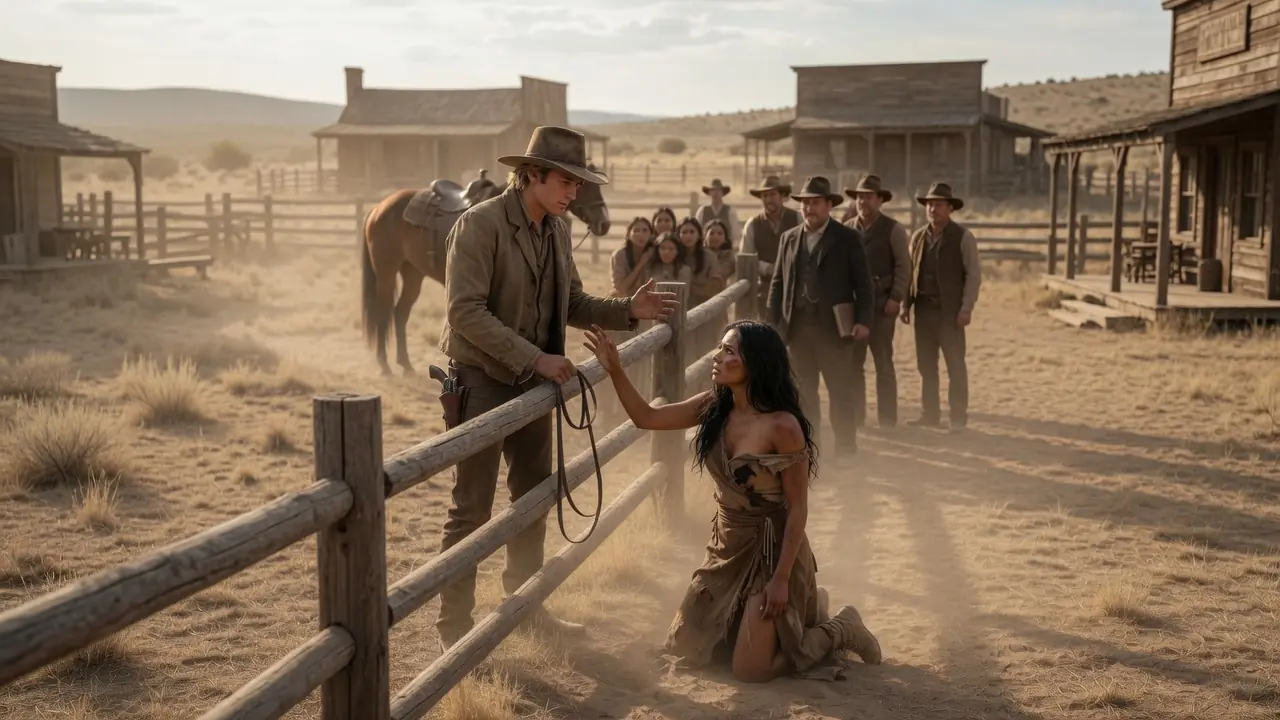
Elias stepped onto the boardwalk and moved toward the side of the livery, behind the stable, where the corrals usually held mustangs or cattle meant for slaughter. A different kind of herd had been gathered. A rough pen made of split rails held twenty or thirty people. They were Apaches.
Most were women, their skirts torn and dusty, their hair matted from days of travel. There were a few teenagers, boys with eyes like trapped wolves, and children clinging to their mothers’ legs. Around the corral, armed men stood guard, their rifles resting casually in the crooks of their arms.
Elias leaned against a support post, tipping his hat back just enough to see. He saw the local Indian agent, a man named Silas Thorne, standing on a crate with a ledger in his hand. Thorne was a sweating, rotund man in a suit that was too tight and covered in road dust. Beside him stood a man Elias recognized by reputation, if not by face, a cattle baron whose brand was burned onto half the livestock in the county.
The baron looked bored, smoking a cigar as he surveyed the women in the pen as if they were heifers at a county fair.
“These are work contracts, gentlemen,” Thorne bellowed, his voice oily and practiced. “The government cannot support every stray band that surrenders. These hostiles need to learn the value of honest labor. You sign the paper, you pay the fee for their transport and processing, and you take a servant for a term of five years.”
It was a lie. Elias knew it, and every man in the crowd knew it. This was a slave auction dressed up in the thin, ragged clothes of bureaucracy.
Elias watched the faces in the pen. He saw fear, naked and trembling. In the younger girls, he saw the dull, glazed look of shock in the mothers. And then his gaze stopped near the center of the corral.
Standing slightly apart from the huddled mass was a woman who did not look at the ground. She was tall for an Apache woman, with broad shoulders and a spine that looked like it had been forged from iron. She wore a faded calico dress that had likely been stripped from a settler’s cabin or given as charity, but she wore it with a strange, fierce dignity.
Her hair was black as a raven’s wing, pulled back from a face that was not beautiful in the soft, easy way of the women in the eastern magazines, but striking. It was a face of planes and angles, weather-beaten and sun-browned. This was Naya.
Elias did not know her name yet, but he felt the weight of her presence. She was watching the men outside the rail. Her dark eyes moved from face to face, calculating, assessing. She was not paralyzed like the others. She was thinking. She was hunting for a way out of the trap.
Elias shifted his weight, the leather of his holster creaking softly. The crowd pressed closer. A miner with a beard stained by tobacco juice shouted out, “What about the young one there, the one with the red ribbon? I need someone to wash clothes up at the camp.”
Laughter rippled through the group.
“Wash clothes? Is that what you call it, Jeb?”
Elias clenched his jaw so hard his teeth ached. He heard them discussing the fate of these women. Some were destined for the brothels in the mining towns up in the mountains, places where life was cheap and women were used up and discarded like broken tools. Others were being traded for labor on distant ranches where they would be worked until they dropped.
Memory surged up in Elias’s mind, unbidden and violent. He remembered the smell of burning lodges. He remembered the sound of women screaming as the cavalry charged through the winter camps. He had been a scout then, young and foolish, believing he was helping to bring order to the frontier.
He had believed the lies about treaties and reservations. He had led the soldiers to the hidden canyons, tracking the bands by the signs they left in the earth. He remembered the aftermath, the bodies in the snow, the way the soldiers looked at the survivors. The shame washed over him now, hot and suffocating.
He had ridden away from that life five years ago, but he had never ridden fast enough to outrun the ghosts.
In the corral, Naya shifted her stance. She saw the way the men looked at the teenage girl near her. She saw the lust and the cruelty in their eyes. She knew her own chances were fading with every minute that the sun sank lower. She was not young.
She was in her late twenties, perhaps thirty, an old woman by the standards of this hard land. She had borne a child. She had buried a husband. She had walked hundreds of miles in forced marches. She was not the prize these men wanted, and that terrified her more than being chosen.
If she was not bought, she would be sent to the reservation, or worse, given to the soldiers to do with as they pleased. Or perhaps she would be sold to the brothel keeper as a discount lot, to scrub floors and serve the men who could not afford the younger ones.
A rancher near the front, a man with a jagged scar running down his cheek, pointed a finger at Naya.
“What about that tall one? She looks strong enough to pull a plow.”
Another man spat on the ground.
“Too old. Look at her eyes. That is a wild mare that has been ridden too hard. You would have to beat the spirit out of her before she would boil your coffee.”
Naya lifted her chin. She did not flinch at the words. Instead, she stepped away from the other women, isolating herself. It was a dangerous move, drawing attention, but she had to see. She had to find a loophole.
Her eyes scanned the crowd, bypassing the drunkards, the leering miners, and the arrogant cattle baron. She was looking for something else. She was looking for a hesitation.
Her gaze landed on Elias. He stood back from the rail, his arms crossed over his chest. He was not laughing. He was not shouting. His face was a mask of grim distaste. He looked dusty and travel-worn, his clothes patched and his hat stained with sweat.
But there was a stillness in him that spoke of a different kind of man. He looked like a man who knew what it meant to be hunted.
Naya felt his eyes on her. He looked up and met her stare. The noise of the crowd seemed to fade into a dull roar. For a heartbeat, there was only the space between them.
He saw the exhaustion in her face, the deep, bruising shadows under her eyes. But he also saw the defiance. She was asking him a question without speaking a word. She was measuring him.
She saw him flinch when the man beside him made a crude joke about breeding stock. She saw his hand twitch toward his gun belt and then stop. She sensed the conflict in him, the man on the edge of walking away.
Naya made her choice. It was a gamble that could cost her everything. But she had nothing left to lose.
She slipped under the bottom rail of the corral. The guard shouted, but she moved with the fluid grace of a stalking cat. She did not run. She walked straight toward Elias, ignoring the other men who reached out to grab at her skirts.
She stopped two feet in front of him. She smelled of wood smoke and old fear, but her head was high. The crowd went quiet, confused by the sudden breach of protocol.
Naya looked up into Elias’s face. Her eyes were dark pools, bottomless and pleading. Though her face remained stoic, she spoke in a low voice, her English broken and heavy with the accent of her people. But the words were clear enough to cut through the dusty air.
“Buy me, cowboy. I am experienced, and I can give you offspring.”
Elias stared at her, stunned. The bluntness of it, the desperate dignity she wrapped around the offer, struck him silent. She was not offering herself as a servant. She was offering her body, her life, and the promise of children, the most primal currency she had, in exchange for safety.
He saw the tremor in her hands, which she held clenched at her sides to hide the shaking. He realized in that second that she was terrified. She had picked him out of the crowd and pinned all her hope on the slim chance that he was not like the others.
If he turned away now, if he walked back to his horse and rode out, she would be destroyed. The man with the scar would take her, or the brothel owner would drag her away. He would be leaving her to a slow death.
Elias looked at the Indian agent, who was pushing his way through the crowd, his face red with indignation.
“Get back in the pen,” Thorne shouted. “You do not choose the buyer, woman.”
The rancher with the scar stepped forward, grinning.
“I will take her off your hands, Thorne. She has got spirit. I will have fun breaking that one. I will give you ten dollars for the trouble. Ten dollars, the price of a good saddle blanket.”
Elias felt the anger flare hot and white in his chest. It burned away the fatigue. It burned away the desire to be invisible.
He looked at Naya. She was still watching him, her breath held in her chest, waiting for his verdict.
“Twenty dollars,” Elias said.
His voice was rasping, unused to speaking so loudly, but it carried. The crowd turned to him.
The rancher scowled. “Who are you?”
“I am the man buying this woman,” Elias said, his voice steadying. “I bid twenty dollars.”
The rancher spat. “Twenty-five.”
“Thirty,” Elias countered without blinking.
The rancher hesitated. Thirty dollars was a lot of money for a woman he considered old and troublesome. He looked at Elias, saw the hand hovering near the worn walnut grip of the Colt on his hip, and saw the cold, dead look in Elias’s gray eyes.
The rancher shrugged and stepped back.
“She is all yours, stranger. Hope she cuts your throat in your sleep.”
Elias ignored him. He walked up to the crate where the agent stood. He reached into his pocket and pulled out the small pouch where he kept his savings. It was money meant for winter supplies, for grain, for lumber to fix the leaking roof of his cabin.
He counted out the coins, silver dollars and a few crumpled bills.
“Thirty dollars,” Elias said, placing the money on the crate. “But I want the paper written my way.”
Thorne looked at the money, greed warring with irritation.
“What do you mean, your way?”
Elias looked back at Naya. She had not moved. She was watching him with a look of intense, bewildered relief.
“Write it down,” Elias said. “She is not a servant. She is not property to be traded again. She is under my protection as a wife.”
A ripple of shock went through the crowd. A white man marrying an Apache was not unheard of, but it was looked upon with scorn, a step down into the dirt.
Thorne laughed, a nervous, bubbling sound. “A wife? You want to marry her? Suit yourself, mister. It makes no difference to the government as long as she is off the roster.”
“Write it,” Elias commanded.
Thorne scribbled on the document, the pen scratching loudly in the silence. He signed it and shoved the paper toward Elias. Elias picked it up, reading the words carefully to ensure there was no trickery.
Naya, ward of Elias Ward, wife.
He folded the paper and tucked it into his shirt pocket, next to his heart. Then he turned to Naya.
“Let us go,” he said quietly.
She nodded, a single, sharp motion. She did not look back at the other women in the pen. She could not. To look back was to break, and she had to be strong now.
She followed him to the hitching rail. Elias untied the bay. He looked at Naya’s feet. She wore moccasins that were worn through at the soles.
“Can you ride?” he asked.
“I can ride,” she answered. Her voice was smoother now, less halted, though still thick with accent.
He mounted the horse and then held out a hand to her. She hesitated for only a second before gripping his forearm. Her grip was strong, her fingers calloused.
She swung up behind him, settling on the rump of the horse. She did not wrap her arms around his waist. She gripped the back of the saddle cantle, keeping a careful inch of space between her body and his back.
They rode out of Ocotillo Wells as the sun began to dip below the horizon, painting the world in shades of gray and indigo. The town fell silent behind them, the jeers of the men fading into the wind.
Elias did not speak until the town was gone, hidden by the rise and fall of the dunes. He kept the horse at a steady walk. The burden of another rider was heavy for the old gelding, but the animal pushed on.
Finally, Elias cleared his throat.
“I want you to know,” he said, keeping his eyes on the darkening trail ahead. “I did not buy you to use you. I am not that kind of man.”
Naya was silent for a long time. He could feel the heat of her body radiating against his back, even through the space she tried to keep.
“You paid money,” she said flatly. “That makes it a sale.”
“I paid money to get you out of that pen,” Elias corrected. “The paper says you are my wife. That means the law cannot touch you. It means the army cannot take you back to the reservation.”
“And what does it mean for you?” she asked.
“It means I have someone to cook beans,” Elias said, trying to make a joke of it, though his heart felt heavy. “Look, I live alone. It is a hard place. I am not asking for anything you do not want to give.”
Naya looked at the back of his head. She studied the way his hair curled over his collar, the tension in his shoulders. She had survived this long by reading men, by knowing when to fight and when to yield.
She did not trust him. Trust was a luxury she could not afford, but she believed him when he said he would not force her, at least not tonight.
“Without your name,” she said, her voice quiet, almost swallowed by the wind. “Without your name, they would hunt me. They would drag me back. If I am your wife, I am invisible to them. That is enough.”
It was a bargain, a transaction. There was no romance in it, only the brutal arithmetic of survival.
They rode until the moon was high and white, a polished bone in the black sky. The temperature dropped rapidly, the desert shedding its heat like a snake shedding skin.
Elias found a sheltered spot in the lee of a rocky outcrop, a place where the wind would blow over them rather than through them.
“We will camp here,” he said, reining the horse in.
Naya slid off the horse before he could offer help. She landed lightly on her feet, while Elias unsaddled the bay and rubbed him down with a handful of dry grass.
Naya moved into the darkness. She returned a few minutes later with an armful of dried sage and mesquite root. She knelt and arranged the wood with practiced efficiency, shielding the spark with her body until a small, smokeless fire crackled to life.
Elias watched her. She moved with an economy of motion that he admired. She knew this land better than he ever would. She knew how to find the dry wood that would not smoke and reveal their position. She knew how to read the wind.
Elias set his coffee pot on the stones near the fire. They sat in silence as the water boiled. He poured a tin cup for her and one for himself. The coffee was bitter and black, but it was hot.
“Thank you,” she said.
Elias nodded. He unrolled his bedroll, spreading the canvas and the wool blanket on the hard ground. He looked at it, then at her. She had nothing, no blanket, no coat, only the thin dress.
He took the blanket and started to tear it in half. No, he could not do that. He sighed and laid the blanket out fully.
“You take the blanket,” he said. “I have my coat.”
“No,” Naya said. “It is your blanket. I am used to the cold.”
“Take the damn blanket,” Elias said, his voice sharper than he intended.
She looked at him, surprised by the flash of temper. She moved to the blanket and sat on one edge of it, pulling the corner over her shoulders. She did not lie down. She sat upright, watching the fire.
Elias put on his heavy canvas coat and buttoned it to the chin. He sat on his saddle, leaning back against the rock, his hat pulled down over his eyes.
He was not going to sleep. He could not sleep with a stranger five feet away, a stranger who had every reason to hate his kind.
Naya watched him from beneath her lashes. She saw the way his hand rested near his gun even in repose. She saw the lines of pain around his mouth. He was a broken man, she decided, like a pot that had been cracked and glued back together, holding water but always in danger of shattering again.
The wind whistled through the rocks above them. A coyote howled in the distance, a lonely, shivering sound. Elias shifted, trying to find comfort against the stone.
“Go to sleep, Naya,” he said softly. “I will keep watch.”
She did not answer, but after a while, she lay down, curling into a tight ball beneath the wool. She did not close her eyes fully. She watched the fire die down to embers. She watched the cowboy who had bought her.
They were two ghosts on the edge of the world, bound together by a piece of paper and thirty dollars. There was no trust between them yet, only the wary respect of two predators circling each other in the dark, waiting to see if they would share the kill or turn on one another.
The night stretched out, cold and endless, as the stars wheeled slowly overhead, indifferent to the small, fragile alliance formed in the dust below.
The dawn broke over the horizon like a bruise healing into yellow, spilling weak, watery light across the plains. Elias Ward’s ranch revealed itself in the gray morning not as a kingdom, but as a scar upon the land.
It was a tired cluster of buildings huddled against the vastness of the territory, the wood bleached silver by the relentless sun and the wind. The main house was a low-slung cabin of rough-hewn logs and adobe chinking, its roof sagging slightly in the middle like a swaybacked horse. A barn, leaning precariously to the west, stood nearby, surrounded by corrals where the rails were splintered and tied together with fraying rope.
Elias pulled the bay gelding to a halt in the dust of the yard. He felt a sudden, sharp pang of shame. He had seen this place every day for five years, but seeing it now through the eyes of the woman sitting behind him, it looked destitute. It looked like the home of a man who had stopped trying.
Naya slid from the back of the horse, her moccasins making no sound as they touched the earth. She did not speak immediately. She stood tall, her spine unbending despite the exhaustion of the long ride, and her dark eyes swept over the property.
She looked at the gaps in the fence where the wind whistled through. She looked at the dry water trough. She looked at the few head of scrawny cattle grazing on the scrub brush in the distance. Elias waited for her disdain.
He waited for her to ask why he had bought her if he could barely feed himself. Instead, Naya walked to the nearest corral post. She placed a hand on the wood, testing its strength. She looked at the horizon, noting the line of the dry creek bed and the way the land sloped to shelter the house from the worst of the north wind.
“It is good land,” she said finally, her voice rough with fatigue but devoid of judgment. “But it is thirsty.”
“It has been a dry year,” Elias muttered, dismounting and leading the horse toward the barn. “Come inside. I will show you where you sleep.”
The interior of the cabin was dark and smelled of stale coffee, wood smoke, and the dust that found its way through every crack. It was a bachelor space, utilitarian and cluttered. A table with two mismatched chairs, a cast-iron stove that served for both heat and cooking, and a narrow cot in the corner where Elias slept.
Elias moved to the back of the room where a heavy blanket hung over a doorway. He pulled it aside to reveal a small lean-to addition he had built two years ago and never used. It was little more than a storage room, filled with broken tack and crates of old tools, but it had a window and a sturdy floor.
“This is yours,” Elias said. “I will clear the junk out. You will have your own space. A door with a latch.”
Naya stepped past him, peering into the gloom of the small room. She turned back to him, her expression unreadable.
“And where do you sleep?” she asked.
Elias pointed to the cot in the main room.
“Out here?”
She studied him for a long moment, searching his face for the lie. In the camps of the soldiers and in the towns she had been dragged through, men did not buy women to give them their own rooms. They bought them to warm their beds.
She waited for him to smile, that twisted smile men gave when they were pretending to be kind before they took what they wanted. But Elias simply stood there, his hat in his hands, looking uncomfortable.
“We have an understanding, Naya,” he said, his voice low and serious. “You are my wife on paper. That protects you. But in this house, you are your own woman. I will not cross that threshold unless you invite me. We share the work and we share the food. That is all.”
Naya nodded slowly. It was a strange arrangement, one that defied the laws of her people and his, but she accepted it.
“I will clean the room,” she said.
For the next three days, they moved around each other like ghosts. The silence between them was thick, not with hostility, but with a profound, awkward caution. They were two wounded animals trapped in the same cage, each waiting for the other to bite. But the bite never came.
Naya began to transform the ranch with a terrifying efficiency. She did not ask for permission. She simply saw what was broken and fixed it.
On the fourth morning, Elias walked out of the house to find her in the corral. She had found a coil of fresh rope in the barn and was repairing the splintered rails, lashing the wood together with knots he had never seen before, tight, complex weaves that held the timber as clear as iron bolts.
She was working with the horses, the three unbroken colts he had traded for last month and had not yet found the energy to start. She moved among them without fear. She did not shout or wave her arms as Elias often did. She moved like water, flowing around the nervous animals, her hand resting gently on a flank, her voice a low, rhythmic hum in her own language.
Elias watched from the porch, a mug of coffee forgotten in his hand. He saw the way the wildest of the colts, a chestnut with a white blaze, lowered its head and allowed her to touch its ears. It was a kind of magic, or perhaps just a language of the body that Elias had forgotten how to speak.
He walked over to the fence.
“You have a hand with them,” he said.
Naya did not look up, her fingers busy working a knot.
“Horses are honest,” she said. “Men lie. Horses only tell you what they feel. If you listen, they do not fight.”
Elias felt the sting of her words, though he knew they were not aimed solely at him.
“I have been fighting them for months,” he admitted.
“That is because you fight yourself,” she said, pulling the rope tight with a snap of her wrist. “The horse feels the war inside you.”
The days turned into weeks, and the summer heat descended on the territory like a physical weight. The air shimmered above the ground, distorting the distance. Dust devils danced across the flats, towering columns of grit that scoured everything in their path.
Water became the only thing that mattered. The creek had reduced to a trickle of mud, and the well water was growing brackish. Elias worried over the cattle, his brow permanently furrowed.
But Naya disappeared into the scrub brush every morning before the sun was high. She returned with her apron full of things Elias would have walked past without seeing. She showed him the bulbous hearts of the agave plant, roasting them in a pit until they were sweet and nourishing.
She brought back handfuls of sage and globe mallow, brewing bitter teas that settled the stomach and cooled the blood. She found a patch of wild onions near the dry wash that he had ridden past a hundred times.
One evening, as they sat on the porch peeling the roasted agave, Elias pointed to the knife in her hand.
“Knife,” he said.
Naya looked at him, then at the tool.
“Knife,” she repeated, testing the word. The sound was hard in her mouth.
He pointed to the heavy hammer resting on the rail.
“Hammer.”
“Hammer,” she said.
He pointed to the sky, turning violet with dusk.
“Sky.”
“Sky.”
She pointed to the water bucket.
“Water,” Elias said.
“No,” she said, shaking her head. She pointed again, then tapped her chest. “In my tongue.”
“Tu,” she said.
“Tu,” Elias repeated.
They traded words like currency, small coins of understanding passed back and forth in the twilight. It was a practical exercise, born of the need to work together, but it became a bridge. With every noun and verb, the strangeness between them thinned.
He learned that she respected the land not because it was beautiful, but because it was alive and dangerous. She learned that he worked until his hands bled not out of greed, but out of a desperate need to prove he was worth the space he took up.
But the ranch was an island, and they could not stay on it forever. Supplies ran low. The flour barrel was empty, and they needed nails and salt.
“We have to go to town,” Elias said one morning, dread tightening his chest.
Naya looked up from the fire where she was baking flatbread. She knew what this meant. She had seen the way the men in Ocotillo Wells looked at her.
“I will come,” she said.
“You do not have to. I can go alone.”
“I am your wife,” she said firmly. “If I hide here, they will say I am your slave. If I ride with you, head high, they must see me.”
They rode into town at noon, the heat sitting heavily on the rooftops. The atmosphere had changed since the auction. The curiosity had curdled into something uglier.
As they passed the saloon, conversation stopped. Men stepped out onto the boardwalk to watch them pass. Elias heard the whispers, loud and intentional.
“Look at that. Keeping an Apache in the house? Wonder what he paid for her. Bet she is wilder than a rattlesnake.”
Elias kept his eyes forward, his jaw set in a line of granite. Naya rode beside him, her back straight, her face a mask of stone. She did not look at the men. She looked through them, as if they were nothing more than dry weeds blowing in the wind.
They tied the horses at the general store. Elias helped her down, his hand lingering on her arm for a second longer than necessary, a silent message of solidarity. They walked up the steps, the wood creaking under their boots.
When Elias opened the door, the bell chimed cheerfully, a stark contrast to the silence that fell over the room.
Mercer, the storekeeper, stood behind the counter. He was a thin, sour-faced man who had never liked Elias much, and liked his new companion even less.
“I need a sack of flour, Mercer,” Elias said, walking to the counter. “And five pounds of salt. A box of nails.”
Mercer did not move. He wiped his hands on his apron, his eyes flicking to Naya, who stood near the entrance.
“I can serve you, Ward,” Mercer said, his voice nasally and loud. “But she stays outside.”
Elias stopped. The air in the store grew thick.
“Excuse me?”
“I said the Indian stays outside. I have decent women coming in here. I will not have a savage standing next to them.”
Elias felt the familiar rage uncoiling in his gut, the same rage he had felt at the auction.
“She is my wife, Mercer. She stands where I stand.”
Mercer sneered. “I do not care what piece of paper you bought. She waits outside, or you take your business elsewhere.”
Elias took a step forward, his hand curling into a fist. But before he could move, the door behind them opened.
Two cowboys sauntered in. Elias recognized them, drift riders who worked for Clay Harlan, the cattle baron. They smelled of sweat and whiskey.
One of them, a man with yellow teeth and a lazy eye, looked at Naya and laughed.
“Well, look here. The happy couple.”
He walked around Naya, looking her up and down with exaggerated scrutiny.
“You got ripped off, Ward,” the cowboy said. “I heard about this one. She is barren, dried up. That is why the tribe let her go. She is used goods, empty as a dry canteen.”
The other cowboy laughed. “Not worth the twenty. You cannot breed a mule, Ward. Everybody knows that.”
The words hung in the air, cruel and precise.
Naya flinched. It was a small movement, a slight recoil of her shoulders. But to Elias, it looked like she had been whipped.
Elias moved. He did not think. He crossed the distance between them in two strides. He grabbed the cowboy by the front of his duster and shoved him backward. The man slammed into a display of tinned peaches, the cans crashing to the floor with a sound like thunder.
“Shut your mouth,” Elias snarled, his voice trembling with a violence he had tried to bury.
The cowboy scrambled up, his hand going to the knife at his belt. Elias stood his ground, his hand hovering over his Colt.
“Draw it,” Elias whispered. “Give me a reason.”
The room froze. Mercer was pale behind the counter. The cowboy looked at Elias’s eyes and saw death waiting there. He hesitated.
“Get out,” Elias said, “before I forget that I am trying to be a civilized man.”
The cowboy spat on the floor, muttered a curse, and backed out of the door, his companion following close behind. Elias turned to Mercer.
“The flour,” he said, his voice ice cold. “And the nails. Now.”
They rode back to the ranch in silence. The victory in the store felt hollow. The words the cowboy had spoken, barren, used, empty, hung between them like a toxic cloud.
Naya rode with her head bowed, the defiance gone from her posture. When they were five miles out of town, the sun beginning to dip low, Naya pulled her horse up. She slid from the saddle and walked a few paces into the desert, standing with her back to Elias.
Elias dismounted and followed her, stopping a respectful distance away.
“Naya,” he said softly. “Do not listen to them. They are fools. They speak poison because they are small men.”
She turned to face him. Her face was not angry. It was shattered. The mask she wore so carefully had cracked, revealing a well of grief so deep it frightened him.
“They are not wrong,” she said.
Her voice was steady, but tears tracked slowly down the dust on her cheeks.
“What?” Elias stepped closer.
“My child,” she said.
Elias froze.
“I told you I could give you offspring,” she said, her voice hitching. “I told you I am experienced. That was true, but I did not tell you the rest.”
She looked at her hands, calloused and brown.
“Three years ago, when the soldiers came, when they forced us to walk to the reservation, it was winter. We had no food. My husband was killed in the first attack. I carried my son. He was two years old.”
She took a shaking breath.
“The walk was long, hundreds of miles. The soldiers, they did not let us stop. If we stopped, they struck us. My milk dried up. The cold, it got into his chest.”
She looked up at Elias, her eyes burning with the memory.
“He died in my arms, Elias, on the road. And the soldiers would not let me bury him. They made me leave him in the snow. They said to keep walking.”
Elias felt the blood drain from his face. He felt sick. He knew that march. He knew the officers who had ordered it.
“Since then,” Naya whispered, “my body, it has been silent. No moon blood for a long time. Then it returned, but nothing grows. The women in the tribe, they said grief had eaten my womb. They said I was a dead branch.”
She looked at him with a heartbreaking intensity.
“I lied to you, Elias. I promised you children to make you buy me because I wanted to live, but I do not know if I can keep that promise. I dream of it. I want to give life again, to replace what was stolen, to honor him. But I may be what they say, empty.”
Elias reached out, his hand hovering in the air before gently taking her shoulder. He wanted to pull her close, but he felt unworthy to touch her grief. He was a part of the machine that had done this to her.
“You are not empty,” he said, his voice thick. “You are alive. That is enough. I did not buy a broodmare, Naya. I bought. I bought a partner.”
She looked at him, searching for the pity she hated, but she found only a shared sorrow.
“Come,” he said gently. “Let us go home.”
That night, the silence in the cabin was different. It was the silence of a tomb. Naya went to her room early, closing the door.
Elias lay on his cot, staring at the ceiling, the shadows of the rafters looking like the bars of a cage. He fell into a fitful sleep, and the nightmares came.
They were always the same: the smoke, the screaming horses, the sound of the bugle. He was riding through a burning camp, his pistol heavy in his hand. He saw a woman running, a bundle in her arms. He shouted at her to stop, to get down, but a soldier beside him fired.
The woman fell. The bundle rolled into the snow.
“No!” Elias shouted in his sleep. “Stop it. Call them off.”
He thrashed on the cot, tangling in the sheets.
“God, please, not the children.”
He woke with a gasp, his heart hammering against his ribs like a trapped bird. He sat up, drenched in cold sweat, his breath coming in jagged heaves.
The cabin was dark, but the door to Naya’s room was slightly ajar. He saw her standing there, a silhouette in the gloom. She was watching him. She had heard.
Elias wiped his face with his trembling hands.
“Go back to sleep, Naya,” he croaked. “Just a bad dream.”
She stood there for a moment longer, saying nothing, then silently closed her door. But he knew she was awake. He knew she was putting the pieces together: the scout, the army, the timeline.
Two nights later, the storm broke. It came out of the north, a violent, thrashing thing of thunder and wind that shook the cabin to its foundations. Rain lashed against the walls in sheets. It was the kind of storm that drowned cattle and washed away roads.
Elias sat by the stove, feeding wood into the fire. The temperature had plummeted. The wind howled like a banshee, finding every gap in the chinking.
Suddenly, a steady drip, drip, drip sound echoed in the room. Elias looked up. The roof, neglected for so long, was failing. Water was pooling on the floor near the table.
He stood up to find a bucket, but then he heard a noise from the back room, a shifting, scraping sound. He walked to the curtain and pulled it back.
Naya was on her knees in the dark. The leak in her room was worse. Water was streaming down the wall, soaking her bedding on the floor. She was frantically moving her few possessions, the box of clothes, the dried herbs, trying to keep them dry.
She was shivering, her teeth chattering audibly.
“Naya,” Elias said.
She looked up, startled. She was soaked to the bone, her hair plastered to her face.
“It is wet,” she said simply, her voice shaking.
“Leave it,” Elias said. “You cannot sleep in here. It is freezing.”
He reached down and took her arm. Her skin was like ice. He pulled her up, guiding her out of the damp, miserable lean-to and into the main room.
The fire in the stove cast a warm orange glow, pushing back the shadows. He grabbed his wool blanket from the cot, the only dry bedding left, and wrapped it around her shoulders.
“Sit,” he commanded gently, pushing the chair closer to the stove.
She sat, pulling the blanket tight around her. Elias grabbed a towel and dried her hair, his movements awkward but gentle. She sat still under his hands, her eyes closed, soaking in the warmth.
The storm raged outside, battering the walls, but inside, the fire popped and hissed. Elias realized there was nowhere for him to sit but the floor or the other chair. He pulled the second chair close to hers, so they were side by side in front of the open stove door.
He had given her the blanket, so he sat in his shirt sleeves, the cold air of the room biting at his skin. Naya noticed. She looked at him, shivering slightly, then looked at the blanket that was large enough for two.
Without a word, she lifted one wing of the heavy wool.
Elias hesitated. It was a breach of the boundary they had set. It was an invitation.
“You will freeze,” she said softly.
Elias sat. He moved his chair until it touched hers. He leaned in, and she draped the blanket over his shoulders. They sat shoulder to shoulder, the wool creating a cocoon around them. He could feel the heat of her body, the slow rhythm of her breathing.
It was not sexual. It was survival. It was the shared warmth of two human beings against the indifferent cruelty of the world. For the first time, the tension that had defined their marriage softened.
“Thank you,” Elias whispered.
She did not answer, but she leaned her head slightly, just enough that her temple rested against his shoulder. They watched the fire together, the storm outside feeling a thousand miles away.
In the quiet, listening to the rain, a fragile root of trust began to take hold in the rocky soil between them.
Weeks passed, and the rhythm of the ranch changed. The desperate edge of survival began to dull into a routine of hard but steady work. They woke before the sun. They drank coffee on the porch, watching the light bleed into the sky.
They worked side by side. Elias fixed the roof. Naya tended a small garden she had started near the kitchen, coaxing squash and beans from the stubborn earth.
They laughed now. It was a hesitant, rusty sound, but it was there. They laughed when Elias tried to pronounce the Apache word for hummingbird and mangled it so badly Naya told him he had named it a pregnant rock. They laughed when the goat Naya insisted on buying ate Elias’s favorite hat.
Naya watched him constantly. She saw the way he worked, methodical, tireless. She saw the way he treated the animals with a gentle hand that belied the violence of his past. She noticed that he never touched her, not even by accident.
He moved around her with a careful, deliberate grace, respecting the space between them as if it were holy ground. It confused her, and slowly, it began to frustrate her.
She found herself watching his hands as he mended a bridle. She found herself wondering what it would feel like if he held her not to keep her warm, but because he wanted to.
The tenderness growing in her was reluctant. It fought against her grief and her pride, but it was there, green and stubborn as a desert weed.
One evening, the light was failing, painting the sky in violet and blood. They were out by the north pasture, fixing a section of fence that the cattle had pushed over.
“Hold this post,” Elias said, straining to keep the heavy cedar log upright.
Naya stepped in, bracing her shoulder against the wood. “I have it.”
Elias hammered the wire home, the metal ringing in the quiet air.
“That should hold.”
He stepped back, wiping sweat from his forehead. Naya stepped back, too, but her heel caught in the hidden depression of a gopher hole. She tipped backward, a small cry escaping her lips.
Elias moved on instinct. He lunged forward, his arm sweeping out. He caught her around the waist, pulling her hard against him to keep her from falling.
The impact knocked the wind out of both of them. Naya’s hands clutched his shirt. Elias’s arm was tight around her back, his other hand gripping her upper arm.
They froze. Her face was inches from his. He could see the gold flecks in her dark eyes. He could smell the sage and dust in her hair. He could feel the rapid beat of her heart against his chest, or maybe it was his own.
The moment stretched. A heartbeat. Two. Three.
The boundary they had drawn was gone. The distance was erased. The air between them crackled with a sudden, intense electricity. It was fear, yes, but beneath the fear was a hunger so sharp it stole Elias’s breath.
He wanted to kiss her. The desire hit him like a physical blow. He wanted to bury his face in her neck and forget everything else.
Naya looked at his lips. Her breath hitched. Her fingers tightened on his shirt, pulling him a fraction of an inch closer.
Then, the reality of who they were crashed back in. Elias stepped back as if he had been burned. He released her, his hands retreating to his sides.
“I. I am sorry,” he stammered, his voice rough. “You were falling.”
Naya smoothed her dress, her face flushed, her eyes wide and startled.
“Yes,” she said breathlessly. “Thank you.”
She refused to look at him. The air was thick with the ghost of what had almost happened.
“We should go back,” Elias said, turning toward the horses, his movements jerky and uncoordinated. “It is getting dark.”
“Yes,” Naya repeated.
They rode back to the cabin without speaking, but the silence was no longer empty. It was heavy, charged with a new and dangerous tension. The spark had been struck, and now they had to decide whether to stamp it out or let it burn the house down.
The fragile peace they had built, woven from shared labor and tentative silences, shattered two days later under the drumming hooves of a cavalry patrol.
It was mid-morning. The sun was already high and white, bleaching the color from the scrub brush. Elias was in the corral, working a rasp over the hoof of the bay gelding, while Naya was near the well, pulling up a bucket of water.
The sound reached them before the dust did, the distinctive, rhythmic clatter of shod horses moving in formation, accompanied by the jingle of bit chains and the creak of leather.
Elias froze. He dropped the hoof and straightened up, his eyes locking onto the northern horizon. A cloud of dust rose there, moving fast. He knew that sound. He knew it in his marrow.
“Go inside,” Elias said.
His voice was low, but it carried across the yard like a crack of a whip.
Naya looked at him, then at the dust cloud. She did not move immediately. She stood with a heavy wooden bucket in her hand, her posture stiffening.
“Who is it?” she asked.
“Soldiers.”
“And the agent?”
“Go inside, Naya.”
She hesitated, a flash of fear crossing her face, but she set the bucket down and moved toward the house. She did not run, but her walk was brisk, her shoulders hunched as if expecting a blow.
Elias walked to the fence line. He wiped his hands on his trousers, trying to clear the sweat, but his palms remained damp. He felt a familiar, sickening thrum in his blood, the adrenaline of the hunted. He unhooked the leather thong from the hammer of his Colt, leaving the weapon loose in the holster.
The riders crested the rise. There were six of them: four enlisted men in dusty blue wool uniforms that looked too hot for the territory, a captain with yellow stripes down his trouser legs, and Silas Thorne, the Indian agent, looking miserable on a mule that was too small for him.
They rode into the yard without asking permission, their horses stamping and blowing. The soldiers looked around with bored arrogance, their eyes raking over the broken fences and the lean-to barn.
Elias stood his ground. He did not take his hat off.
“Captain,” he said, nodding to the officer. “Thorne. To what do I owe the pleasure?”
The captain, a man with a mustache waxed into sharp points and eyes like polished glass, looked down at Elias with disdain.
“We are conducting a census, Ward,” the captain said. “Routine patrol. Mr. Thorne here has reports of livestock discrepancies, runaway property.”
Elias felt the muscles in his jaw jump.
“Property? I have no runaways here,” Elias said. “My stock is branded. You’re welcome to check the cattle, though there are not many to see.”
Thorne urged his mule forward, wiping his sweating face with a dirty handkerchief.
“We are not talking about cows, Ward,” Thorne wheezed. “You know damn well what we are talking about. The woman, the Apache wench you bought. We need to verify her status. There have been irregularities in the paperwork regarding the prisoners from that batch.”
“She is not a prisoner,” Elias said, his voice dropping an octave. “And she is not a wench.”
“Bring her out,” the captain ordered.
Elias did not move. He planted his feet wide, his hand resting casually near his hip.
“She is inside, tending to the house. If you want to see her, you can ask politely, but you are not dragging her out here like a stolen horse.”
The captain’s eyes narrowed. He leaned forward in his saddle, his leather gauntlets creaking.
“Careful, Ward. I know your record. You might have scouted for the Fifth, but you are civilian now. Do not think that gives you the right to obstruct military business.”
“I am not obstructing,” Elias said. “I am protecting my wife.”
He reached into his shirt pocket and pulled out the folded paper. He walked forward and held it up.
“Thorne signed it,” Elias said, his eyes drilling into the agent. “Paid in full, thirty dollars. And the contract states she is under my protection as a legal spouse. That makes her a citizen by marriage, does it not, Captain?”
Thorne squinted at the paper, looking nervous.
“Well, yes. Technicalities,” Thorne muttered. “But the colonel wants to make sure these arrangements are being honored. We have had reports of buyers turning them loose or selling them to Comancheros.”
“She is here,” Elias said. “And she stays here.”
As if summoned by the tension, the cabin door opened. Naya stepped out onto the porch. She had smoothed her hair and put on a clean apron over her faded dress. She stood tall, gripping the porch railing with white knuckles, but her face was a mask of imperious calm.
“I am here,” she said.
Her voice was steady, though Elias could hear the tremor beneath it. The soldiers turned to look at her. The captain looked her up and down, his expression shifting from boredom to a predatory appraisal.
“So, this is the one,” the captain said.
“She looks fed, at least,” Thorne noted, scribbling something in a notebook.
“Is she working?” the captain asked Elias, ignoring Naya. “Is she docile?”
“She is my wife,” Elias repeated, the words grinding out between his teeth. “Not a dog.”
The captain chuckled, a dry, humorless sound.
“Right, your wife. Well, keep a close eye on her, Ward. These people have a way of reverting to their wild nature. If she runs, we will have to hunt her down. And next time, we might not bring her back alive.”
Elias felt a red haze creep into the edges of his vision. He wanted to pull the Colt. He wanted to shoot the captain out of his saddle. The violence of the impulse shocked him.
“Get off my land,” Elias whispered.
The captain stiffened. He looked at Elias, then at the gun on his hip. He smiled, a cold, knowing smile.
“We are leaving, scout. Enjoy your domestic bliss.”
The patrol turned their horses and rode out, kicking up a fresh cloud of dust that coated Elias’s face. He stood there, watching them go, his chest heaving as if he had run a mile. He waited until they were specks on the horizon before he let his hand drop from his gun.
He turned to the porch. Naya was watching him. Her eyes were not grateful. They were dark, assessing, and full of a terrifying intelligence.
That night, the silence in the cabin was suffocating. Elias moved around the kitchen with jerky, agitated motions. He dropped a spoon. He slammed the stove door too hard.
Naya sat at the table, mending a tear in his work shirt. She did not look up, but her needle moved with a sharp, rhythmic violence.
“Why?” she asked suddenly.
Elias stopped wiping the table. “Why what?”
“Why were your hands shaking?” she asked.
She looked up then, and her gaze pinned him to the wall.
“When the bluecoats came, you were not just angry, Elias. You were afraid, and you were guilty.”
Elias turned away, facing the dark window.
“I do not like soldiers. They are trouble.”
“It is more than that,” Naya said.
She put the sewing down and stood up.
“You bear the mark of the army. I have seen the way you ride. I have seen the way you track. And today, the officer called you scout.”
The word hung in the air between them, heavy and poisonous. Elias closed his eyes. He felt the trap closing.
“I was a young man,” he said to the glass. “I needed money. The army paid for guides.”
Naya took a step toward him. Her voice was low, trembling with a rising intensity.
“Where did you scout? Which regiment?”
“It was a long time ago.”
“Elias, where?” she demanded.
Elias turned to face her. He looked tired, decades older than his years.
“The Fifth Cavalry,” he said softly. “Arizona Territory and New Mexico.”
Naya’s face went pale. She took a step back, her hand going to her throat.
“The Fifth,” she whispered.
She began to piece it together, the dates and locations clicking into place like the tumblers of a lock.
“Three years ago,” she said. “The winter campaign.”
Elias did not speak.
“General Crook ordered the drive to the reservation,” she continued, her voice gaining strength. “They hunted the bands that refused to come in. My band was in the Black Canyon, hidden. We thought we were safe.”
She looked at him, her eyes widening with horror.
“We were safe because the canyon is impossible to find unless someone who knows the land leads the way, unless a tracker shows them the secret trails.”
Elias looked at the floor. The shame was a physical weight, crushing his lungs.
“Did you ride to Black Canyon?” Naya asked.
Her voice was barely a whisper, but it screamed in the small room.
Elias looked up. He could have lied. He could have said he was in a different company, on a different patrol. But he looked at her face, the face of the woman he had started to care for, the woman who had trusted him enough to share his blanket, and he could not do it.
“Yes,” he said.
The word was a stone dropped into deep water.
“I was the lead scout,” Elias said, his voice dead. “I found the trail. I led them to the rim.”
Naya made a sound, a sharp intake of breath that was half sob, half retch. She backed away from him until she hit the edge of the table.
“You,” she whispered. “It was you.”
“I did not know they would fire on the tents,” Elias said, stepping forward, his hands open in a plea. “I thought. They told me it was a surrender operation. They said if we found you, you would be escorted in. But when we got to the rim, the captain gave the order to fire the howitzers.”
“You led them there,” Naya accused.
Her voice rose to a shout.
“You brought the wolves to the door. My husband died because of you. My son, the march that killed him started that day because of you.”
“I know,” Elias roared back, the confession tearing out of his throat. “I know. Do you think I forget? I hear the screaming every night. Naya, I see the snow turning red. I tried to stop them, but once the shooting started—”
“You are a monster,” Naya spat.
She looked at him with pure, unadulterated hatred. She looked around the room as if waking from a dream.
“I am in the house of the man who killed my family,” she said. “I am washing the clothes of the butcher.”
“Naya, please,” Elias said. “That man, the man I was, he died there, too. That is why I left. That is why I bought this place, to get away from it.”
“You cannot get away from blood,” she said coldly. “It stains everything.”
She turned and walked to her room. She did not run. She walked with a rigid, terrible dignity. She began to throw things into a pile: her blanket, the few clothes she had, the small bag of dried meat.
“What are you doing?” Elias asked from the doorway.
“I am leaving,” she said.
“You cannot leave,” Elias said. “The soldiers, the patrol is still out there. Harlan’s men are watching the roads.”
“I would rather die in the desert than sleep one more night under your roof,” she said.
She tied the bundle with a piece of rope. She slung it over her shoulder and walked past him. She would not even look at him.
“Naya, listen to me,” Elias pleaded, grabbing her arm.
She spun on him, her eyes blazing.
“Do not touch me. Your hands are covered in the blood of my people.”
Elias recoiled. He let her go. He stood there, broken, watching her walk to the door.
“I will leave at first light,” she said, her back to him. “Do not follow me.”
She sat on the porch all night, wrapped in her blanket, staring into the dark. Elias sat inside, at the table, his head in his hands, watching the candle burn down until it sputtered and died, leaving him in the darkness he deserved.
The dawn was gray and cold. The sky was heavy with the threat of weather. The wind had picked up, carrying the taste of dust and electricity.
Naya stood up from the porch swing. She adjusted her bundle. She did not look back at the house. She walked down the steps and started walking west, toward the jagged line of the mountains.
Elias watched her from the window. He wanted to run after her. He wanted to beg, but he knew he had lost the right to ask her for anything. He had bought her safety, but he had sold her destruction years ago.
He waited until she was a small, dark shape in the distance. Then he grabbed his coat and his hat. He went to the barn and saddled the bay. He filled two canteens and tied them to the horn. He would not stop her, but he would not let her die alone.
He rode out, keeping a mile between them. He watched her figure moving steadily through the sagebrush. She was walking toward the deep desert, toward the lands that were no longer hers, guided by grief and pride.
By noon, the sky had turned a sickly, bruised purple. The wind was no longer gusting. It was a constant, screaming force. The horizon disappeared, swallowed by a wall of brown rising from the earth, a haboob, a dust storm.
Elias spurred his horse. He saw Naya stop. She was staggering now. The heat was ferocious and the wind was pushing her back. She had no water. She had left in such a fury she had forgotten the most essential thing.
The wall of dust hit her before he could reach her. One moment she was there, and the next she was gone, swallowed by the swirling opacity.
Elias pulled his bandana up over his nose. He kicked the bay into a gallop, riding blind into the choking cloud.
“Naya!” he shouted, but the wind tore the name from his lips.
The grit stung his eyes like ground glass. The horse fought him, turning its rear to the wind, refusing to move. Elias jumped down, keeping a grip on the reins. He walked forward, squinting into the brown gloom.
He found her huddled near a cluster of mesquite, her knees drawn up to her chest, her head buried in her arms. She was coughing, her body wracked with spasms.
“Naya!”
Elias grabbed her shoulder. She flinched violently and struck out at him, her fist connecting weakly with his chest.
“Leave me!” she screamed, though her voice was a dry rasp. “Let me die!”
“Get up!” Elias shouted over the roar of the wind. “You are not dying today.”
He tried to pull her up, but she was dead weight. She was exhausted, dehydrated, and broken by the revelation of the night before.
Suddenly, a flash of lightning illuminated the dust, turning the world a ghostly, brilliant white for a split second. A crack of thunder followed instantly, shaking the ground.
Naya screamed. It was a primal sound of terror. She curled tighter, covering her ears.
“The guns!” she shrieked. “They are shooting!”
Elias realized then what was happening. The thunder sounded like cannon fire. The flashing light through the dust looked like the muzzle flashes of the howitzers in the canyon. She was back there. She was back in the winter of 1874.
Elias dropped to his knees. He grabbed her face between his hands, forcing her to look at him.
“Naya, look at me. It is thunder. It is only thunder.”
She stared at him, her eyes wide and unseeing, lost in the memory.
“My baby!” she cried. “I cannot find him. The snow is too deep.”
Elias felt his heart break. He pulled her against him, wrapping his arms around her rigid body. He shielded her face with his coat.
“I have you,” he said into her ear. “I have you.”
He dragged her toward a rocky overhang he had seen moments before the dust closed in, a shallow cave cut into the side of an arroyo. He pushed her into the shelter, then pulled the horse in as close as he could, using the animal’s body as a windbreak.
Inside the small space, the roar of the storm was muffled, but the air was still thick with dust. Naya slumped against the rock wall, gasping for air.
Elias uncorked a canteen and held it to her lips.
“Drink,” he ordered.
She drank, coughing as the water hit her dry throat. Then she pushed the canteen away and looked at him. The panic was receding, replaced by the cold, hard return of her hatred.
“Why did you save me?” she whispered. “You should have let the sand bury me. It would be justice.”
“There is no justice in dying of thirst,” Elias said, leaning back against the opposite wall.
They sat in the gloom, the storm raging outside like a living thing trying to claw its way in.
“You killed them,” Naya said.
It was not an accusation anymore. It was a statement of fact.
“I did,” Elias said.
He did not look away this time.
“I cannot change it. I cannot bring them back. If I could cut open my chest and give my heart to replace your son’s, I would do it. But I can’t.”
“Words,” she spat. “White man’s words. You say you are sorry, and then you go on living. You eat. You sleep. You breathe. My son does not breathe. I do not sleep.”
Elias shouted, his control finally snapping. He hit his chest with his fist.
“Do you think I sleep? I see their faces every time I close my eyes. I live in hell.”
“Good,” Naya said, cruel and soft. “You deserve it.”
“I know I do,” Elias cried. His voice cracked. “I know. That is why I am here. That is why I bought the ranch. I thought. I thought if I could just live quietly, if I could do no more harm, maybe the ghosts would let me be. But they don’t.”
He looked at her, tears cutting tracks through the dust on his face.
“When I saw you in that pen, I saw them. I saw the women I failed, and I thought maybe. Maybe if I save one, just one, it would count for something.”
Naya stared at him. She saw the raw, bleeding wound of his conscience. It did not wash away her anger. Her anger was a mountain, solid and immovable, but it made him human again. He was not just a monster. He was a man eaten alive by his own sins.
“You cannot buy forgiveness with thirty dollars,” she said.
“I know,” Elias whispered.
“And you cannot fix the past by playing house.”
“I know.”
She leaned forward, her eyes burning into his.
“If you truly want to atone, Elias Ward, if you truly want to pay for what you did, then you do not get to die. Dying is easy. Dying is escaping.”
She pointed a shaking finger at his chest.
“You have to live. You have to live and fight for the ones who are left. You have to stand between us and the wolves. You have to bleed for us. You have to give your life to this, to me. Not as a husband, but as a shield, until the day you die. You belong to the memory of the ones you killed. That is the price.”
Elias looked at her. He felt a strange settling in his soul. It was not relief. It was the weight of a sentence accepted.
“I accept,” he said hoarsely. “My life is yours. Use it how you want.”
Naya looked at him for a long time. The storm outside was beginning to wane, the wind dropping to a low moan.
“We go back,” she said finally.
“Back?” Elias asked, surprised.
“Yes. If I leave, Harlan wins. The soldiers win. They want me to disappear. They want me dead so they do not have to look at their sin.”
She stood up, bracing herself against the rock wall. She looked fierce, terrifying, and beautiful.
“I will not disappear. I will live on your ranch. I will eat your food. And I will make them look at me every day. And you, you will stand beside me. You will force them to see us.”
Elias stood up slowly. He nodded.
“I will stand beside you.”
They waited until the dust settled enough to travel. The ride back was silent, but it was a different silence than before. It was not the silence of secrets kept, but the silence of a pact made in blood.
They reached the ranch well after dark. The moon was struggling to break through the lingering haze. The horses were stumbling with fatigue.
They went into the house. Elias lit the lantern. The light threw long shadows across the room where they had argued the night before. The sewing was still on the table.
Naya sat down heavily on the chair. She looked exhausted, her face gray under the dust.
Elias went to the bucket. It was empty. He went outside, drew fresh water, and brought it in. He poured a basin full and brought it to the table.
He found a clean cloth.
“May I?” he asked, gesturing to her dusty face.
Naya looked at the cloth, then at his face. She nodded slowly.
Elias dipped the cloth in the cool water. He wrung it out gently with hands that trembled slightly. He wiped the dust from her forehead, her cheeks, her chin. He was careful, reverent.
He was washing away the desert, but he knew he could not wash away the history. Naya closed her eyes at the touch of the cool water.
She felt his hands, rough, scarred, the hands of a soldier, the hands of a killer. But they were also the hands that had pulled her from the storm.
She reached up and caught his wrist. Elias stopped. Naya opened her eyes. She looked at the scars on his knuckles. She traced one white line with her thumb.
“These hands have done evil,” she whispered.
“Yes,” Elias said.
“Make them do good,” she said.
She pulled his hand toward her face. She leaned in. It was not a seduction. It was a sealing of the contract. She pressed her lips to his.
Elias froze, then melted. He kissed her back. It was a slow, searching kiss. There was no joy in it, no easy romance. It tasted of salt and dust and grief.
It was a kiss between two people standing on the edge of a cliff, holding onto each other to keep from falling. It was painful and longing and desperate.
They pulled apart, breathing hard. Their foreheads rested against each other.
“I am still angry,” Naya whispered against his skin.
“I know,” Elias said.
“I do not forgive you.”
“I know.”
“But I am here.”
Elias closed his eyes, tears leaking out to mix with the dampness on her face.
“I am here, too.”
They stayed that way for a long time in the dim light of the lantern, choosing to face their ghosts together rather than be consumed by them alone. The night outside was vast and dark, but inside, the flame burned steady and clear.
The morning sun that slanted through the gaps in the cabin shutters did not feel like the same sun that had scorched the earth the day before. The air was scrubbed clean by the storm, smelling of wet sage and cooling mud.
But the change inside the house was more profound. The heavy, suffocating tension that had defined the space between Elias and Naya, the silence of secrets kept and judgments held, had evaporated, replaced by a tentative, fragile softness.
Elias woke first, as was his habit. He lay still on the cot, listening to the rhythm of Naya’s breathing from the other side of the room. She was asleep in her own bed, having returned there after the storm had passed. But the memory of her lips on his and the weight of her hand on his scarred knuckles lingered on his skin like a brand.
He rose quietly, pulling on his trousers and boots, his movements deliberate to avoid waking her. When he went to the stove to start the coffee, he found the kindling already laid out, stacked in a precise, geometric pyramid that was not his way of doing things.
Naya had done it the night before, after the tears and the confessions. It was a small thing, a pile of dry cedar chips, but it stopped Elias cold. It was a domestic act, a shared burden.
He lit the fire, the crackle of the wood loud in the quiet room. When Naya emerged from behind the curtain of her room, she looked tired, her eyes puffy from the weeping in the cave. But she did not look away when he turned to face her.
“Coffee is ready,” Elias said.
“Thank you,” she answered.
She walked to the table and sat down. Elias poured two tin cups and set one before her. His hand brushed hers as he set it down. A week ago, they would have both pulled back as if burned. Today, neither moved.
The contact lasted only a second, rough skin against smooth, but it was an acknowledgment. A silent language was being built, word by word, touch by touch.
“We have fence to fix,” Elias said, blowing on his steam. “The storm likely took down the north line.”
“I will get the gloves,” Naya said.
They worked side by side that day and the days that followed with a new rhythm. It was awkward at times. They were two solitary creatures learning to run in a pack.
There were moments of hesitation where Elias would start to say something and stop, or Naya would look at him with a question in her eyes and then look away. But the hostility was gone. In its place was a growing sense of shared belonging.
They were no longer prisoner and warden, nor buyer and bought. They were survivors of the same shipwreck, building a raft together.
Naya began to claim the house. It started slowly, almost imperceptibly. She swept the dust from the corners with a vigor that Elias had never possessed. Then she began to bring the outside in.
Elias came in one evening to find a bundle of dried desert lavender hanging above the doorframe. On the windowsill, she had arranged a line of smooth, dark river stones, purely for the way they caught the light.
“What are these?” Elias asked, touching one of the stones with a calloused finger.
“They are the bones of the river,” Naya said, not looking up from the pot she was stirring. “They remind the house that water flows, even when the creek is dry. It is good luck.”
Elias nodded. He did not laugh. He did not tell her it was superstition. He left the stones where they were.
A few nights later, he found her sitting by the fire with a piece of soft pinewood and a small knife. She was carving intricate geometric patterns into the wood, zigzags and diamonds that flowed into one another.
“It is beautiful,” Elias said, watching the shavings curl onto the floor. “Does it mean something?”
“It is the mountain,” Naya said, “and the lightning.”
She traced a jagged line.
“And this, this is the path that has no end.”
She looked up at him, the firelight dancing in her dark eyes.
“My grandmother taught me. She said that if you carve the path, you will never be lost because your hands know the way home.”
Elias sat down opposite her. He watched her hands move, confident and sure.
“I have been lost a long time,” he said softly.
She stopped carving. She looked at the wooden block, then reached out and placed it in his hand.
“Keep it in your pocket,” she said.
Their physical closeness grew not from a sudden explosion of passion, but from the slow, steady accumulation of these moments. It was the brushing of shoulders as they washed dishes in the basin. It was Elias helping her down from a horse, his hands lingering on her waist for a breath longer than necessary, and Naya not pulling away.
It was shared laughter when the roof leaked again in a new spot, landing a drop of water squarely in Elias’s soup.
The nights grew colder as autumn deepened its grip on the high desert. The wind whistled through the gaps in the logs, and the single blanket on Naya’s bed was thin. One night, the frost was thick on the windowpane.
Elias lay on his cot, listening to Naya shift and turn in the other room, hearing the soft chatter of her teeth.
“Naya,” he called out in the dark.
“Yes?” Her voice was small and shivering.
“Bring your pillow out here,” he said.
There was a silence, a hesitation.
“It is freezing,” Elias said. “We are two fools freezing in two beds when there is warmth in one.”
He heard the rustle of straw ticking. The curtain moved. Naya appeared in the gloom, clutching her pillow. She walked to the cot. Elias scooted to the edge, making room against the wall.
She lay down beside him. They were both fully clothed, wrapped in layers of wool and flannel. She lay with her back to him, stiff at first. Elias pulled the heavy buffalo robe and his wool blanket over both of them.
He could feel the cold radiating off her. He hesitated, then draped an arm over her waist, pulling her back against his chest. She did not stiffen. She let out a long breath and relaxed into him, fitting her body against his.
“Better?” he whispered.
“Yes,” she whispered back.
They slept that way for a week, just for warmth. But in the dark, the barriers eroded. They began to talk, wrapped in the cocoon of the blankets, with the world shut out. They whispered things they could not say in the light of day.
Elias told her about his childhood in Ohio, about the green fields that seemed like a dream now. Naya told him about the summer dances of her youth before the soldiers came, about the smell of pine resin and roasting meat.
One night, Naya turned in his arms to face him. Her face was inches from his in the shadows.
“Elias,” she said.
He hummed a response, half asleep.
“My body,” she said. “It feels different.”
“Different how? Are you sick?”
“No, not sick. Awake.”
She took his hand and placed it on her stomach, over the layers of her nightdress.
“I told you I was a dead branch,” she said. “But maybe. Maybe the sap is running again. I feel strong. I feel like the winter is over inside me.”
Elias went still. He knew what she was asking. She was telling him that she wanted to try. She wanted the child she had promised him at the auction, not as a bargaining chip, but as a hope.
A cold stone of fear dropped into Elias’s stomach. He pulled his hand away gently.
“Naya, a child? Here? Now?”
“Why not?” she challenged, her voice sharpening. “You said you wanted a family.”
“I do,” Elias said, sitting up and running a hand through his hair. “I do, but look at us. Look at where we live.”
He looked down at her.
“I am a white man with blood on my hands. You are Apache. A child of ours, do you know what this world does to mixed blood? They will hate him. Naya, the whites will call him a half-breed and spit on him. Your people, if there are any left, they might not accept him either.”
His voice broke.
“And me, my blood, I have so much violence in me. What if I pass that on? What if I make a son who is as broken as I am?”
Naya sat up. She grabbed his face, forcing him to look at her.
“You are not broken,” she said fiercely. “You are healing. And the world will always find a reason to hate. If we wait for the world to be kind, we will die waiting.”
She kissed him then, not a tentative press of lips, but a claim.
“Give me a child, Elias. Let us make something that is not death.”
Elias looked at her, at the fire in her eyes that even the dark could not hide. He realized that his fear was a luxury he could not afford. She was brave enough to hope. He had to be brave enough to join her.
He pulled her down to him. That night, the bed was not just for warmth. It was a sanctuary. Their lovemaking was not a conquest. There was no taking, only giving. It was a slow, reverent exploration of scars and soft skin, a desperate conversation of bodies trying to say what words could not.
It was an act of defiance against the silence that had ruled their lives.
Two weeks later, the flour barrel was empty again. They needed to go to town.
Elias saddled the horses. He saw Naya emerge from the house. She was wearing her best dress, the blue calico, washed and pressed. She had braided her hair with a red ribbon and wore the silver earrings of her mother.
“You look,” Elias searched for the word, “proud.”
“I am Mrs. Ward,” she said, lifting her chin. “I will not look like a beggar.”
They rode into Ocotillo Wells at noon. The town was busy. As they walked down the boardwalk, heads turned.
The whispers started, just as before, but this time, Naya did not look at the ground. She looked the townspeople in the eye. She walked with her hand tucked into the crook of Elias’s arm, a shocking display of familiarity for the time and place.
They bought their flour and were heading toward the mercantile when a man stumbled out of the saloon. He was young, drunk, and mean. A drift rider named Pete, who had been one of the mockers at the auction.
He saw them and stopped, swaying on his heels. A cruel grin split his face.
“Well, look at this,” he slurred loudly. “The Apache man and his pet.”
The street went quiet. Elias felt Naya’s hand tighten on his arm. He stopped.
“Move along, Pete,” Elias said calmly.
Pete laughed, spitting a stream of tobacco juice that landed inches from the hem of Naya’s dress.
“You playing dress-up, sweetie?” Pete sneered at Naya. “Putting ribbons on a mule does not make it a horse. You are still just a bought Apache. How much did he pay for you again? Twenty dollars?”
Elias felt the old rage, the red wave that wanted to smash bone, but he remembered Naya’s words: Make your hands do good.
He gently disengaged his arm from Naya’s grip. He stepped forward, closing the distance between him and the drunk. He did not raise his fists. He did not go for his gun. He stood tall, his shoulders square, his face open and calm.
Elias turned to the crowd that had gathered. He looked at the storekeeper, at the blacksmith, at the women watching from the windows. Then he put his arm around Naya’s shoulders and pulled her close to his side.
“This is Naya Ward,” Elias said.
His voice was not a shout, but it carried to every corner of the street.
“She is my wife. She is the mistress of my ranch, and she is the finest woman I have ever known.”
He looked directly at Pete.
“If you have a problem with Mrs. Ward, you have a problem with me, and I am done fighting with children. Go sleep it off, son.”
Pete blinked, confused by the lack of violence and the absolute certainty in Elias’s voice. He looked around for support, but the crowd was silent. The dignity of the moment had shamed them.
Pete muttered a curse and stumbled away. Elias turned back to Naya. Her eyes were shining. She squeezed his hand, a silent message of pride.
But the victory was short-lived.
A slow clapping sound came from the shadows of the saloon porch. Clay Harlan stepped out, a cigar clamped between his teeth. He was dressed in a fine gray suit, looking every inch the king of the county.
“Very touching, Ward,” Harlan said, his voice dry as dust. “A moving performance.”
Harlan walked down the steps, stopping a few feet away.
“But let us not pretend,” he said, raising his voice so the town could hear. “You can call her Mrs. Ward all you like. You can dress her up in calico, but we all know what she is. She is government property that you leased.”
“She is my wife,” Elias said, his voice hardening. “I have the paper.”
Harlan laughed. “A bill of sale from a corrupt agent? That is not a marriage license. Elias, that is a receipt. In the eyes of the territory, you’re just shacking up with a ward of the state.”
Harlan stepped closer, his voice dropping to a menace.
“And the government can recall its property whenever it sees fit, especially if that property is being misused. Watch your step, Ward. You are playing a dangerous game.”
“We are leaving,” Elias said.
He took Naya’s arm and led her away, his back stiff. Harlan watched them go, smoke curling from his cigar, his eyes cold and calculating.
As they loaded the supplies onto the pack mule, a man approached them from the alleyway. It was Dr. Henry Aris. He was an older man with a face like a crumpled map and sad, kind eyes. He had been the one to check Naya after the dust storm, though he had said little then.
“Elias. Naya,” the doctor said quietly, looking over his shoulder to ensure Harlan was out of earshot.
“Doctor,” Elias said warily.
“Listen to me,” Aris said. “Harlan is looking for a way to squeeze you. He wants your water rights, and he hates what you two represent. That paper you have, Thorne’s contract, it is weak. If they bring a judge down from Santa Fe, they could annul it in a heartbeat. They could declare Naya a ward of the state and send her back to the reservation.”
Naya gripped the saddle horn, her knuckles white.
“What can we do?” she asked.
Aris sighed. “Go to San Rosalita. It is three days’ ride south. The Indian agent there has no love for Thorne, and there is a circuit judge who is an honest man. Get a real marriage license. Get it recorded in the territorial ledger. Make it ironclad.”
“It will not stop the hate,” Aris warned, “but it will give you a shield. It will make it a hell of a lot harder for Harlan to touch her without bringing the federal government down on his head.”
“Thank you, Henry,” Elias said, shaking the doctor’s hand.
“Go. Soon,” Aris said, and slipped back into the shadows.
The ride back to the ranch was quiet, the weight of Harlan’s threat hanging over them like a thunderhead. That night, they sat on the porch. The air was crisp. Naya was restless. She paced back and forth, her arms crossed.
“He is right,” she said suddenly.
“Who? The doctor?”
“And Harlan.”
She stopped and looked at Elias.
“You called me your wife in front of them. You made me proud, Elias. But in your heart, and in the law, am I just a woman you bought?”
“No,” Elias said, standing up. “Never.”
“Then prove it,” she said.
She walked up to him, her gaze fierce.
“Marry me, Elias. Not with a receipt from a slave trader. Marry me like you would marry a white woman. Stand before a judge and write our names together in the big book. Make it so that no man can say I am property.”
Elias looked at her. He saw the fear behind the defiance. She needed to know that he was not just protecting her, but choosing her.
“We leave tomorrow,” Elias said. “We will go to San Rosalita.”
The journey took three days. They rode through canyons of red rock and across plains of silver sage. It was a pilgrimage. They spoke little of the danger, focusing instead on the horizon.
San Rosalita was a larger town, bustling and indifferent to strangers. They found the courthouse, a dusty adobe building with a territorial flag snapping in the wind.
The clerk was a bored young man with ink-stained fingers. He looked at Elias, then at Naya. He sneered slightly, but when Elias placed a gold eagle coin on the counter, money he had been saving for a new plow, the clerk opened the heavy leather-bound ledger.
“Names?” the clerk asked.
“Elias Ward,” Elias said.
“And the bride?”
“Naya Ward,” she said clearly.
The clerk wrote it down. The scratch of the pen sounded loud in the room. Elias Ward. Naya Ward.
The judge, a man with a beard like a bird’s nest, mumbled through the ceremony. It was not poetic. It was legal. He asked if they took each other. They said yes. He stamped the document.
“It is done,” the judge said. “Next.”
It was unromantic, dusty, and bureaucratic. But as they walked out into the sunlight, Elias handed Naya the folded certificate. She held it with both hands, staring at the ink.
“It is real,” she whispered.
“It is real,” Elias said.
They camped that night on a ridge overlooking the desert, half a day’s ride from home. The sky was a canopy of crushed diamonds, thick with stars. The air was cold, but their fire was large.
They sat close, wrapped in the buffalo robe. The tension of the journey had broken, leaving a raw, open intimacy.
“Elias,” Naya said, looking up at the stars. “Do you think he can see us?”
“Who?”
“My son.”
Elias tightened his arm around her.
“I think he can. I think he knows you are safe.”
“I was so afraid,” she confessed, her voice thick. “Afraid that I was betraying him by loving you. By loving the enemy.”
“And now?” Elias asked, his heart hammering.
“Now I know that love is not a betrayal,” she said. “It is the only way to defeat the death.”
She turned to him, her face illuminated by the firelight.
“I want to fill the house, Elias. Not just with herbs and stones, with a life. I want to replace the silence.”
Elias looked at her. He saw the future in her eyes. It was terrifying and uncertain, but it was theirs.
“We will,” he said. “We will fill it.”
They lay back under the stars, holding each other with a desperation that had turned into devotion. That night, under the vast western sky, they were not two broken people hiding from the world. They were a family.
Weeks passed after their return. The ranch seemed to sigh with relief. The winter was coming, but the barn was patched and the pantry was full.
Naya moved through the days with a secret smile. She stopped eating the dried meat she usually loved, claiming it smelled wrong. She tired easily in the afternoons.
One evening, as Elias was oiling his saddle by the fire, Naya came to stand before him. She did not speak. She simply took his hand and placed it flat against her stomach.
Elias looked up, confused. Then he saw her face. It was radiant with terror and joy.
“Naya?” he whispered.
“The moon has not come,” she said.
“And the sickness?”
“It is here in the mornings.”
Elias froze. His hand trembled against the warmth of her belly.
“Are you sure?”
“I am sure. My body remembers.”
Elias stared at her stomach. A child. His child. A life created from the ashes of their pasts.
He did not speak. He could not. The emotion swelled in his throat, choking him. He buried his face in her apron, wrapping his arms around her hips. His shoulders shook.
“Elias?” Naya asked, stroking his hair, suddenly afraid. “Are you sorry?”
He looked up, his face wet with tears.
“No,” he choked out. “No. I am. I am terrified.”
He stood up and pulled her into a crushingly tight embrace.
“I will protect you,” he vowed, his voice fierce and guttural. “I will kill anyone who touches you. I will burn the world down before I let them hurt this child.”
Naya held him, feeling the violent tremor of his love. It warmed her, but it also frightened her. She knew the world they lived in. She knew that a child of mixed blood would be a target, and she knew that Elias’s love was now a weapon, sharp and dangerous.
But secrets do not keep in small towns.
The news of the marriage in San Rosalita trickled back to Ocotillo Wells. Rumors of Naya’s condition began to spread, whispered by the washerwoman who had seen Naya retching behind the store, confirmed by the extra supplies Elias was buying.
In the back room of the saloon, amidst the smoke and the smell of stale beer, Clay Harlan sat with Silas Thorne.
“Married,” Harlan spat, slamming a glass down.
“Legally,” Thorne said, wiping his sweating forehead. “The judge in San Rosalita is a stickler, Clay. We cannot just tear up the paper. It is in the territorial record now.”
“And now she is pregnant,” Harlan said, his voice low with disgust. “A half-breed brat on the way. It is an insult, Silas. It is a pollution of the community. If we let this stand, what is next?”
“We have to be careful,” Thorne warned. “Ward is popular with some of the independent ranchers now. They like that he stood up to you.”
Harlan smiled, a cold, reptilian expression.
“We do not have to break the law, Silas. We just have to enforce it. The law says that a child must be raised in a suitable environment. The law says that a woman with a history of instability might not be fit.”
He leaned forward.
“We break Ward. We make him lose the land. We make him look like a madman. And then we step in to save the poor woman and her child for the good of the state.”
Thorne nodded slowly.
“And the child?”
Harlan’s eyes went dead.
“The child is an unfortunate complication. Complications have a way of resolving themselves if the mother is stressed enough.”
Outside, the wind began to howl, rattling the windows of the saloon, a herald of the storm that was gathering not in the clouds, but in the hearts of wicked men.
The peace that Elias and Naya had found was not a fortress. It was a glass house built on shifting sand.
The change in the air was subtle at first, a sharpening of the wind that carried malice rather than just the coming winter. It started with the fences.
Elias rode out one Tuesday morning to find the western line cut. It was not the work of a wandering bull or a spooked mustang. The wire had been severed cleanly with cutters. The posts were dragged out of the earth and left to rot in the sun.
It took him two days to repair it, his hands blistering as he twisted the heavy-gauge wire, his eyes constantly scanning the horizon.
Two days later, the water trough in the south pasture was filled with dead crows. Elias found them floating in the green scum, their black feathers iridescent in the harsh light. When he knelt to inspect the water, the chemical reek of arsenic hit him like a physical blow.
He had to drain the entire tank and haul fresh water from the creek, bucket by agonizing bucket, to keep the few cattle he had left from drinking the poison.
Then came the calf. It was a Hereford cross, one of the few promising additions to his herd. He found it near the dry wash, bleating pitifully. Someone had roped it and held a running iron to its flank.
They had not branded it with a mark of ownership. They had simply burned a jagged, nonsensical scar over Elias’s own brand, scorching the hide deep enough to ruin the animal.
Elias put the calf down with a single shot, his heart cold as stone.
He rode into town the next day, storming into the sheriff’s office with the blood still dried on his gloves.
“It is Harlan,” Elias told the deputy, a man named Miller, who spent more time polishing his boots than walking a beat. “He is poisoning my stock and cutting my wire.”
Miller leaned back in his chair, feet on the desk.
“You have proof, Ward?”
“I have dead birds and a mutilated calf.”
“That is not proof,” Miller said, picking his teeth. “That is bad luck. Or maybe you have enemies, Ward. A man with your history usually does.”
Elias left the office, the door slamming behind him, knowing that the law was deaf, dumb, and bought.
Back at the ranch, the tension was a physical weight. Naya felt it as keenly as Elias. Her pregnancy was advancing. The sickness of the first weeks had passed, replaced by a deep, wearying fatigue and a swelling of her belly that could no longer be hidden under her apron.
Elias tried to keep her inside.
“Stay in the house today,” he urged her one morning as he reached for his rifle. “Please, Naya.”
“If they come while I am out, I will not hide like a mouse in a hole,” Naya said, tying a scarf around her hair.
“You are carrying a child,” Elias argued, his voice rising with fear. “You cannot be hauling water and chopping wood.”
“I am carrying life, not a sickness,” she retorted. “My mother rode a horse until the day I was born. If I sit in the dark and wait for them, fear will eat the baby. I must work. Work keeps the blood strong.”
She compromised only slightly. She moved slower. She let Elias lift the heavy grain sacks, but she refused to stop. She walked the perimeter of the house, checking the shutters. She kept a knife in her pocket and a shotgun near the back door.
She was not just a nesting mother. She was a warrior preparing a stronghold.
The blow came on a Thursday when the sky was the color of a fresh bruise. Elias had ridden to the far north pasture, nearly five miles from the house, to check on the remaining herd. It was a decoy, though he did not know it then. A report of stray cattle had drawn him away, leaving the ranch exposed.
The sun was setting, dipping below the jagged peaks and casting long, blood-red shadows across the valley. Naya was in the barn, measuring out oats for the horses. She had hired a boy from a neighboring homestead, a lanky teenager named Billy, who had a good heart but skittish nerves, to help with the heavy lifting.
“I think the roan is favoring his left leg,” Billy said, stroking the nose of the bay gelding.
“We will check it,” Naya said, running her hand down the horse’s hock.
She stopped. Her head snapped up. Outside, the rhythm of hooves broke the evening quiet. It was not one horse. It was many. They were riding hard, and they were not slowing down as they approached the yard.
Billy looked at her, eyes wide.
“Is that Elias?”
“No,” Naya said.
Her voice was ice. She moved to the barn door and peered through a crack in the wood.
Ten riders. They wore long dusters and hats pulled low, but she recognized the horses. These were Harlan’s men. And in the center, riding a massive black stallion, was Clay Harlan himself.
They carried torches, rags soaked in kerosene and wrapped around sticks that burned with smoky, orange flames against the twilight.
“They are here to burn us out,” Naya whispered.
She turned to Billy. The boy was trembling, looking around for a weapon.
“Billy, listen to me,” Naya commanded.
Her voice snapped him to attention.
“Open the side gate, the one that faces the creek.”
“But the horses,” Billy stammered.
“Turn them loose,” Naya hissed. “Drive them into the creek bed. They will run from the fire. Go!”
Billy scrambled to the back of the barn. Naya grabbed a pitchfork, her mind racing. She could not run across the open yard to the house. They would cut her down or rope her before she made the porch. The barn was a trap.
She heard the first torch hit the roof. There was a whoosh sound, followed immediately by the crackle of dry shingles catching fire.
“Come out, Ward,” Harlan’s voice boomed from the yard. “We know you are in there.”
Naya did not answer. She moved to the stalls, slapping the rumps of the horses.
“Go!” she shouted in Apache. “Run!”
Billy threw the back gate open. The horses, smelling the smoke and sensing the panic, bolted. They thundered out into the twilight, a chaotic stream of muscle and terror.
“Hey,” one of the riders shouted, “the stock is loose.”
“Let them run,” Harlan yelled. “Burn the structure.”
More torches rained down. The heat rose instantly. The hayloft above caught fire, sending burning debris raining down onto the barn floor.
Smoke, thick and black, began to fill the air, stinging Naya’s eyes and clogging her throat. Billy ran back to her, coughing.
“Miss Naya, we have to get out.”
“We cannot go out the doors,” Naya said, covering her mouth with her sleeve. “They are waiting with rifles.”
She looked at the floor. In the corner of the tack room, under a pile of old grain sacks, was the root cellar. Elias used it to store potatoes and carrots in the winter. It was deep, lined with stone, and had a heavy oak trapdoor.
“The cellar,” she choked out.
She grabbed Billy’s arm and dragged him toward the tack room. The roof groaned overhead, timbers popping like gunshots.
“Help me,” Naya cried, shoving the grain sacks aside.
They found the iron ring of the trapdoor. Naya pulled, her muscles straining, her belly tight with fear. The door groaned open, revealing a dark, musty hole.
“Get in,” she ordered the boy.
Billy hesitated. “It’s a grave.”
“It is earth,” Naya shouted, shoving him down the ladder. “Earth does not burn.”
She followed him down, pulling the heavy door shut above them just as a burning beam crashed onto the floor where they had been standing.
Total darkness swallowed them. The air was cool and smelled of damp soil, a stark contrast to the inferno raging feet above their heads.
Naya huddled in the corner, pulling Billy close to her. She wrapped her arms around her stomach, curling into a ball.
Be safe, little one, she prayed silently to the life inside her. Be safe.
Above them, the roar of the fire was like a living beast, devouring everything Elias had built.
Elias saw the smoke from the ridge. It rose like a black pillar against the dying sun, a stain on the perfection of the evening. His heart stopped, then hammered against his ribs with a violence that made him dizzy.
Naya.
He did not think. He spun his horse and drove his spurs into the animal’s flanks. The horse, sensing his rider’s terror, launched into a dead run.
They flew across the darkening plain, risking gopher holes and broken legs. Elias leaned forward, his face a mask of grim desperation. Every second felt like an hour. The smoke grew thicker, turning from a smudge to a billowing cloud.
As he crested the final hill, the scene unfolded before him like a vision of hell. The barn was fully engulfed. Flames licked fifty feet into the air, painting the yard in dancing orange light. The heat washed over him even from this distance.
Harlan’s men were circled around the burning structure, laughing, their rifles resting on their saddles.
Elias let out a roar that was not human. It was a sound of pure animal anguish.
He rode straight into the yard, ignoring the men, ignoring the guns. He bailed off his horse while it was still moving, hitting the dirt and scrambling to his feet.
“Naya!” he screamed, running toward the wall of fire.
“Hold it right there, Ward,” a voice shouted.
A bullet kicked up dust near his boot, but Elias did not stop. He ran to the barn doors, but the heat drove him back. The entrance was a curtain of flame.
“Naya!”
He fell to his knees, coughing, the smoke searing his lungs. He stared into the fire, his soul tearing in half. She was in there. He knew she was in there.
Then he heard it, a muffled sound, not a scream, but a rhythmic pounding. It was coming from the ground.
Thump. Thump. Thump.
The root cellar.
Elias scrambled up. He grabbed a horse blanket from a nearby rail, dunked it in the water trough, and threw it over his head. He charged into the burning barn.
The heat was unbearable. It felt like walking into the throat of a dragon. His skin blistered instantly. He could not see. He could only feel.
He stumbled over debris, guiding himself by memory toward the tack room. The roof was coming down. He could hear the main beam cracking.
He found the corner. He fell to his hands and knees, feeling for the iron ring. The wood of the trapdoor was hot to the touch. He gripped the ring and heaved.
The door stuck, swollen with heat.
“Open,” he screamed, pulling until the veins in his neck threatened to burst.
The door gave way with a screech of metal. Cool air rushed up to meet him.
“Naya!”
“Elias!”
Her voice was there. Alive. Coughing.
“Give me your hand.”
He reached down into the darkness. A hand gripped his, strong, calloused, familiar. He pulled.
Naya emerged from the hole, covered in soot, eyes streaming tears. Billy followed her, scrambling up like a frightened rat.
“Out!” Elias roared. “Now!”
They ran. They bolted from the burning skeleton of the barn just as the roof collapsed inward with a sound like a thunderclap, sending a geyser of sparks into the night sky.
They stumbled into the yard, collapsing onto the dirt, gasping for air. Elias rolled over, grabbing Naya, checking her frantically.
“Are you hurt? Are you burned?”
“I am whole,” she gasped, clutching her belly. “We are whole.”
Elias helped her stand. They turned to face the yard.
Clay Harlan sat on his black stallion, ten yards away. He looked at them with a mixture of disappointment and disgust. His men formed a semicircle behind him, blocking any escape.
“Well,” Harlan said, his voice carrying over the roar of the fire. “The cockroaches scurried out after all.”
Elias stood up. He wiped the soot from his eyes. He stepped in front of Naya, placing his body between her and the guns.
“You burned my barn,” Elias said.
His voice was terrifyingly calm. It was the voice of the man who had led the Fifth Cavalry into the canyon.
“I burned a pest nest,” Harlan corrected. “We are cleaning up the county, Ward, removing the blight.”
He pointed a gloved finger at Naya, who stood behind Elias, her hands cradling her unborn child.
“Look at her,” Harlan sneered, “bloated with a half-breed bastard. It is an abomination, Elias, a sin against nature and God. Do you think we will let that thing be born here? Do you think we will let it walk our streets?”
Naya stepped out from behind Elias.
“Stay back,” Elias hissed.
“No,” Naya said.
She walked forward until she stood beside him. The firelight illuminated her face, fierce and streaked with ash. She looked like a vengeance spirit rising from the earth.
“You speak of God?” Naya shouted.
Her voice was raspy from the smoke, but loud.
“You come in the night with fire and guns, and you speak of God?”
She pointed at the burning ruin.
“You are not God, Clay Harlan. You are a thief. You steal land. You steal lives. You tried to buy me like a cow.”
Harlan laughed. “You are a cow, woman. Property of the United States government, and I have the authority to return you to custody.”
“I am a citizen,” Naya cried. “I am Naya Ward. My name is written in the book at San Rosalita.”
“It does not matter,” Harlan roared, losing his composure. “No court will protect you here. I am the law in this valley.”
By now, the commotion and the towering flames had drawn attention. A wagon rattled into the yard. It was Dr. Aris, followed by three or four other men from neighboring ranches who had seen the glow in the sky.
“What is happening here?” Dr. Aris shouted, jumping down from his buggy.
“Go home, Henry,” Harlan warned. “This is private business.”
“This is arson,” Elias shouted. “Look at it. He tried to kill my wife.”
One of Harlan’s men, a nervous young rider who looked spooked by the crowd, twitched his finger on the trigger of his Winchester.
Bang.
The shot hit the dirt inches from Elias’s boot, kicking up a spray of gravel. The yard froze. The neighbors pulled their own weapons. Chaos balanced on the edge of a knife.
“Stop it.”
The voice cracked, high and desperate.
Deputy Miller rode into the light. He looked pale, his uniform disheveled. He had ridden out with the neighbors, dragged along by duty he usually ignored.
“Miller,” Harlan barked, “arrest these squatters. They are harboring a fugitive.”
Miller looked at the burning barn. He looked at Naya, pregnant and covered in soot. He looked at Elias, who stood with his hand hovering over his gun, ready to die. And he looked at Harlan, the man who had treated him like a dog for ten years.
“No,” Miller said.
“What did you say?” Harlan asked, his voice dropping to a dangerous whisper.
“I said no,” Miller said, his voice gaining strength. “This has gone too far. Clay, you burned a man’s barn. You fired on a woman. That is not the law.”
“I am the law,” Harlan screamed.
“Disarm,” Miller shouted, drawing his pistol. “Everyone put their guns down. Now.”
Harlan looked around. He saw the neighbors raising their rifles. He saw the doctor watching him with judgment. He saw his control slipping away.
He looked at Elias. He saw the hatred in the scout’s eyes.
“I will not be disarmed by a race traitor,” Harlan snarled.
His hand moved. It was a blur of motion toward the pearl-handled revolver at his hip.
Elias did not think. He did not decide. His body remembered. Years of drill, years of survival, years of war condensed into a fraction of a second.
Elias drew. The Colt cleared leather before Harlan’s gun was halfway up.
Crack.
A single shot rang out. It was distinct, sharp, and final.
Harlan jerked backward in his saddle as if kicked by a mule. His hat flew off. He stared at Elias, his eyes wide with shock.
A small red hole appeared in the center of his chest, ruining the fine gray suit. He slumped forward, sliding slowly off the side of the black stallion. He hit the dust with a heavy, final thud.
Harlan’s men looked at their fallen boss. They looked at Elias, who stood with his gun smoking, his aim instantly shifting to the next man.
“Drop them,” Elias ordered.
The nervous rider dropped his rifle. The others followed, the clatter of weapons hitting the ground sounding loud in the silence.
Elias did not lower his gun. He walked slowly toward Harlan.
The cattle baron lay on his back, staring up at the smoke-filled sky. His breath bubbled in his throat. He looked at Naya, who had followed Elias.
“Damn you,” Harlan wheezed. “Damn both of—”
The light faded from his eyes. He died with a curse on his lips and the taste of dust in his mouth.
“It is over,” Dr. Aris said softly.
The Indian agent, Silas Thorne, who had been hiding in the shadows of the treeline, saw his patron fall. He turned his mule and vanished into the darkness, riding hard for the border, knowing his protection was gone.
Deputy Miller holstered his gun, his hands shaking.
“He drew first,” Miller said, his voice trembling. “I saw it. We all saw it.”
One of the neighbors nodded grimly. “Self-defense, plain and simple.”
Elias lowered the hammer of his Colt. He reholstered the weapon. He felt cold, despite the heat of the fire. He felt the old sickness, the familiar weight of taking a life.
He turned to Naya. She was standing still, staring at the dead man.
Then her knees buckled.
“Naya!”
Elias caught her before she hit the ground. She gasped, clutching her stomach, her face twisting in pain.
“The baby,” she moaned. “Elias, the baby.”
“Doctor!”
Aris ran forward, dropping his bag in the dust.
“Bring her to the porch,” Aris shouted. “Get her out of the smoke.”
Elias scooped her up. She felt light, fragile. He carried her to the house, kicking the door open. He laid her on their bed, the bed they had shared for warmth, the bed where they had made this life.
The doctor pushed Elias aside.
“I need water and towels.”
Elias ran. He was a man who had faced gunfire without blinking, but now his hands shook so hard he could barely hold the pitcher.
The next hour was a blur of agony. Elias paced the main room, listening to Naya’s low cries of pain and the doctor’s murmurs. Billy sat by the stove, head in his hands, weeping quietly.
Elias stopped pacing. He went to the boy and put a hand on his shoulder.
“You did good, Billy,” Elias said hoarsely. “You saved the horses. You saved her.”
Billy looked up, his face streaked with soot.
“I was scared, Mr. Ward.”
“So was I, son. So was I.”
The door to the bedroom opened. Dr. Aris stepped out. He looked exhausted, wiping his hands on a rag.
Elias looked at him, unable to ask the question.
Aris let out a long sigh.
“She is stable,” Aris said. “The stress, the smoke, it brought on contractions, but they have stopped.”
“And the child?” Elias whispered.
Aris nodded slowly.
“The heartbeat is strong. It is a fighter, Elias. Just like its mother. But she needs rest. Absolute rest. If she exerts herself again, we could lose them both.”
Elias closed his eyes, leaning his forehead against the rough wood of the wall.
“Thank you.”
“Go to her,” Aris said.
Elias walked into the bedroom. Naya lay pale and still against the pillows. Her hair was damp with sweat. Her skin had been scrubbed clean of the soot, but she was still gray with exhaustion.
She opened her eyes when he entered.
“He is dead?” she asked softly.
“Yes,” Elias said, sitting on the edge of the bed and taking her hand. “He is dead.”
“And the agent?”
“Gone. Run away like a coward.”
Naya squeezed his hand. Her grip was weak, but it was there.
“We won,” she whispered.
Elias looked at the window, where the glow of the burning barn still flickered against the glass. He thought of the dead man in the yard. He thought of the inquiry that would come. He thought of the hatred that would not die with Harlan.
He kissed her knuckles.
“We survived, Naya. We survived.”
The night ended with the smell of wet ash and cooling earth. The ranch was half ruined, the barn a skeleton of black timber, but in the quiet house, beneath the weight of an uncertain future, the three of them, Elias, Naya, and the unborn child, slept fitfully, alive in the wreckage.
The smoke from the burning barn had long since cleared, carried away by the relentless prairie wind, but the stain of soot remained on the soil of the ranch for a long time. It was a black scar on the earth, a constant reminder of the night the world had tried to end them.
In the weeks that followed the death of Clay Harlan, Ocotillo Wells held its breath. The town, usually loud with the bustle of cattle drives and the piano music of the saloon, grew quiet and watchful. The violence at the Ward Ranch had been too public, too loud, and too ugly to be swept under the rug.
Investigators arrived from Santa Fe two weeks later. They were serious men in dark suits who did not care about local cattle politics. They were drawn by the reports of a wealthy landowner dead in the dirt and rumors of an Indian agent running a slave trade under the nose of the territorial government.
The inquiry was held in the back room of the dry goods store, the only space large enough to hold the witnesses. It was a makeshift courtroom, smelling of coffee beans and sawdust, but the atmosphere was heavy with judgment.
Elias Ward stood before the table where the lead investigator, a man named Mr. Blackwood, sat with a pen poised over a ledger. Elias wore his best shirt, the one Naya had mended, but he did not try to hide the calluses on his hands or the weather-beaten lines of his face.
Naya sat beside him. She was heavy with the child now, her face drawn from the lingering fatigue of the fire and the stress. But she sat with her spine straight, her hands folded protectively over her stomach.
“State your name and your role in the events of October 14th,” Blackwood said without looking up.
“Elias Ward,” Elias said.
His voice was steady, a low rumble that filled the room.
“I am the owner of the Double Creek Ranch, and I am the man who shot Clay Harlan.”
There was a murmur in the room. The townspeople who had squeezed in to watch leaned forward.
“And why did you shoot him, Mr. Ward?”
“He came to my land with ten armed men,” Elias said. “He set fire to my barn while my wife and a neighbor boy were inside. He threatened to kill my unborn child. And when the deputy ordered him to disarm, he went for his gun.”
Blackwood looked at Elias with cold, gray eyes.
“You have a history of violence, do you not? You were a scout for the Fifth Cavalry. You are a trained killer.”
“I was a soldier,” Elias corrected him. “And yes, I know how to kill. But I did not wake up that morning wanting to kill Clay Harlan. I woke up wanting to fix my fence. Harlan brought the war to my doorstep. I just finished it.”
Blackwood turned to Naya.
“And you, Mrs. Ward, is it true that you were purchased?”
Naya stood up. The movement was slow, heavy with the weight of the baby, but it commanded silence.
“I was sold,” she said clearly. “By a man named Silas Thorne, who stands over there.”
She pointed a finger at the former agent, who was shrinking into the corner, sweating profusely.
“He sold me like a mule. He sold my sisters. He sold us to men who wanted labor and pleasure. Elias Ward paid the money, yes. But he did not buy a slave. He bought my life back from the grave.”
She looked at Blackwood, her dark eyes flashing.
“You ask about the law, sir. Where was the law when my husband was shot? Where was the law when Harlan burned our winter feed? The law only came when a white man died.”
The room went deadly silent. It was a truth that no one wanted to admit, but it hung in the air, undeniable.
Deputy Miller stepped forward then. He looked tired, but for the first time in his life, he looked like a man who could sleep at night.
“I was there, sir,” Miller testified. “Harlan was out of control. He declared himself the law. I ordered him to stand down. He drew on me. If Ward had not fired, I would be dead, and likely half the people in that yard would be, too. It was self-defense.”
Dr. Aris placed the marriage certificate on the table.
“It is a legal union, recorded in San Rosalita,” he added softly. “She is not property. She is a wife protecting her home.”
The verdict took three days. It was not the resounding trumpet of justice that they might have read about in storybooks. It was pragmatic. It was a political calculation.
Elias was cleared of murder, the shooting ruled as justifiable homicide in defense of life and property. Silas Thorne was not jailed, for he knew too many secrets about powerful men in the territory, but he was stripped of his post and reassigned to a desk in a damp, miserable office in Washington, far from the land he had exploited.
As for the practice of selling prisoners, the investigators issued a quiet, stern directive to the town council. It was to stop immediately. It was bad for business, and it was bringing too much scrutiny from the East.
It was a bitter, partial victory. Harlan was dead, but the prejudice that had created him remained. Elias and Naya rode back to the ranch in silence. They had won the right to exist, but the cost had been high.
Rebuilding began the next day. It was slow, backbreaking work. The barn was a loss. They had to clear the charred timber and start from the foundation up, but they were not entirely alone.
Two days after the verdict, a wagon rolled into the yard. It was the neighbor, a gruff old rancher named McPherson, who had never spoken more than two words to Elias in five years.
He climbed down, spat tobacco juice into the dust, and unloaded a stack of seasoned pine lumber.
“I had extra,” McPherson grunted, not looking at Naya. “Hate to see good wood rot.”
He drove off before Elias could thank him.
Another day, Billy returned, bringing two of his brothers. They did not say much, but they worked from dawn until dusk, helping Elias frame the new walls. They worked out of guilt, perhaps, or out of a grudging respect for the man who had outdrawn Clay Harlan, but they worked.
The land, however, remained unforgiving. The drought that had plagued them all summer stretched into the late autumn. The wind was a constant, abrasive presence, driving grit into the fresh wounds of the wood and the skin. The dust storms came frequently, turning the sky a sickly yellow and forcing Naya to stay inside, pacing the small cabin like a caged lioness.
Her pregnancy was entering its final month, and with the swelling of her body came the return of the fear. It lived in the house with them, a third presence.
Naya would wake in the night gasping, her hands clutching her belly. She dreamt of the snow. She dreamt of the long march. She dreamt of a small, cold body in her arms that would not wake up.
Elias would wake with her. He would not speak, for there were no words that could fight the past. He would simply pull her close, wrapping his arms around her, fitting his body against the curve of her spine. He would murmur soft, nonsensical sounds, the kind a man makes to soothe a frightened horse, while his own heart hammered with terror.
He was terrified that he had promised her a future he could not deliver. He was terrified that his violence had poisoned the child. He was terrified that he would fail her when she needed him most.
But in the daylight, the fear softened into something quieter, deeper. They sat on the porch in the evenings, wrapped in the buffalo robe, watching the sun set behind the purple hills. Naya would sit between his legs, leaning back against his chest, and Elias would rest his large, scarred hands over the mound of her stomach.
“He moves like a warrior,” Naya whispered one evening as the baby kicked hard against Elias’s palm.
“Or a dancer,” Elias suggested, resting his chin on her shoulder. “Maybe he will be a man of peace. Maybe he will play the fiddle instead of the gun.”
Naya laughed, a low, throaty sound that vibrated against his chest.
“A fiddle player on this ranch? He would starve.”
“Then we will feed him,” Elias said, kissing her temple.
Their desire for each other had not faded, but it had changed. It was no longer the desperate, hungry thing it had been in the beginning. It was protective. It was reverent.
When they lay together in the dark, Elias touched her as if she were made of holy glass. He traced the stretch marks on her skin with awe. He worshipped the life she was carrying, and in doing so, he worshipped her.
Naya insisted on teaching him. She knew that the child would be born into a world that would try to strip him of his mother’s heritage, and she refused to let that happen.
“Say it,” she would command gently as they sat by the fire. “Gawa.”
“Gawa,” Elias repeated, stumbling over the guttural sound.
“It means home,” she explained. “But not just a house. It means the place where the fire burns, the place where you are safe.”
“Gawa,” Elias said again, looking around the cabin.
“And this,” she said, taking his hand. “Shilna ash.”
“Shilna ash,” he tried.
“It means my partner, the one I walk with.”
Elias squeezed her hand.
“Shilna ash.”
“And for the baby?” he asked.
Naya smiled, a sad, sweet smile.
“Niłchi,” she said. “It means child, but also I’nii, thunder, because he was born from the storm.”
Elias used the words. He whispered them to her when she was tired. He spoke them to the belly. He wove them into the fabric of their life, small threads of Apache gold in the gray wool of their days.
The baby came on a Tuesday night in November, riding in on the back of a storm that finally broke the drought. It started with a drop in pressure that made Elias’s old injuries ache. Then came the clouds, heavy and slate gray, rolling over the mountains.
By sunset, the rain was falling, not a sprinkle, but a deluge. It hammered against the roof, drowning out the sound of the wind.
Naya groaned as she was clearing the supper dishes. She gripped the edge of the table, her knuckles turning white.
Elias was at her side in an instant.
“Is it time?”
“It is time,” she gasped.
Elias ran into the storm to saddle the horse. He rode for Dr. Aris like the devil was chasing him, the mud flying from the gelding’s hooves. He found the doctor at home, and they rode back together, heads bowed against the driving rain.
The labor was long. It was brutal. Naya fought for every breath. She did not scream. She was too proud for that, but she made low, guttural sounds of pain that tore Elias apart.
He stayed by her side, wiping her forehead with a cool cloth, holding her hand until he thought his fingers would break. He saw the fear in her eyes. It was not fear of the pain. It was the memory.
She was back on the trail. She was back in the snow.
“Stay here, Naya,” Elias whispered urgently, pressing his forehead to hers. “Stay in this room. You are safe, gawa. You are in your gawa.”
“I cannot,” she panted, her eyes rolling back. “He is. He is slipping away.”
“He is not slipping,” Elias promised, though he looked at Dr. Aris with panicked eyes. “He is coming to us. Fight for him, Naya. Fight.”
Dr. Aris worked with quiet efficiency, his face grave in the lamplight.
“One more time, Naya,” Aris commanded. “Give me everything you have.”
Naya let out a cry that was pure, raw power. She arched her back, her body convulsing with a final effort.
And then silence.
The rain hammered on the roof. The fire popped, but from the bed, there was no sound.
Elias stopped breathing. He looked at the doctor. Aris was holding a small, slick bundle in his hands. The baby was blue.
“Still? No,” Elias whispered. “God, no.”
Naya struggled up on her elbows.
“Why is he quiet? Elias, why is he quiet?”
Dr. Aris turned the baby over. He rubbed the tiny back briskly with a towel. He cleared the mouth with his finger.
“Come on, little one,” Aris muttered. “Breathe.”
Elias gripped Naya’s hand. He felt her trembling. He felt the abyss opening up beneath them, ready to swallow them whole.
Then a cough. A sputtering sound. And then a wail.
It was thin and high, like the cry of a hawk. It pierced the room, louder than the storm, louder than the ghosts.
He cried. He lived.
“Oh,” Naya sobbed, collapsing back onto the pillows. “Oh.”
Aris smiled, his eyes crinkling. He wrapped the baby in a flannel blanket and handed him to Naya.
“You have a son,” he said.
Naya took the bundle. Her hands shook, but she held him with a strength that defied her exhaustion. She looked down at the small, red face. He had a thatch of black hair and skin that was a perfect blend of copper and pale cream. He was the map of their journey.
Elias leaned over them. He reached out a finger and touched the baby’s cheek. The skin was impossibly soft.
“He is here,” Elias whispered, tears streaming down his face into his beard. “He is really here.”
“My Niłchi,” Naya whispered, kissing the baby’s forehead. “My thunder.”
Outside, the rain soaked into the cracked earth, drinking deep, promising that the grass would grow again in the spring.
In the days that followed, the world did not magically change. The prejudice that had fueled the auction and the fire did not vanish because a child had been born. But there was a shift, a tiny, subtle crack in the ice.
Some of the townsfolk stayed away, still muttering about the half-breed on the Ward ranch. But others came.
Mrs. Higgins, the baker’s wife, rode out in her buggy. She did not say much, and she looked uncomfortable standing in the cabin, but she left a loaf of sweet bread and a small knitted cap.
“For the cold,” she said stiffly, before hurrying out.
One of Billy’s brothers brought a carved wooden horse, rough and simple.
“Whittled it,” he mumbled, shoving it into Elias’s hand.
They were small gestures. They were not an apology for the past, but they were an acknowledgment of the future. They were a sign that life, stubborn and undeniable, demanded a certain respect.
On the last night of the story, the air was cold and clear. The winter stars hung low and bright, diamonds scattered on black velvet.
Elias and Naya stood on the new porch. The wood still smelled of pine resin. Naya held the baby, who was wrapped in the buffalo robe against the chill. He was sleeping, his small breath rising in white puffs.
Elias put his arm around Naya, pulling her and the child against his side. They looked out over the darkened prairie, where the shadows of the hills looked like sleeping giants.
“He will have a hard road,” Elias said quietly. “They will try to make him ashamed of who he is.”
“I know,” Naya said.
She looked down at her son.
“But we will teach him. We will teach him that he is the bridge. And if they try to burn the bridge, then we will build it again, stone by stone.”
She turned to look at Elias, the starlight reflected in her eyes, making them look ancient and young all at once.
“I want you to know something, Elias.”
“What?”
“That day at the pen, when I walked to you.”
“I remember,” Elias said.
“I did not walk to you because you had money. I did not walk to you because I was afraid of the others.”
“Why then?”
“Because I saw your eyes,” she said. “I saw a man who was hurting as much as I was. I saw a man who needed to be saved.”
She reached up and touched his beard.
“I chose you, Elias. It was not a sale. It was a choice. And I would choose you again, not for safety, but for this.”
She gestured to the baby, to the ranch, to the space between them.
Elias felt a lump in his throat that made it hard to speak. He covered her hand with his own.
“I am not a savior, Naya. I never was.”
“I know,” she said. “I do not need a savior. I need a partner.”
“Shilna ash,” Elias nodded.
He looked out at the dark horizon, at the vast, indifferent West that had tried to break them both.
“I will stand between you and the wind,” he vowed, his voice rough with emotion. “I will stand between him and the wolves. Not because I own you, but because I belong to you.”
Naya rested her head on his shoulder.
“I know,” she whispered.
They stood there for a long time, three small figures against the immense, silent dark. There was no promise that the crops would thrive. There was no guarantee that the hate would not return. The future was an unwritten page, full of danger and hard work.
But as the wind blew across the plains, it carried the scent of rain and new grass. And on the porch of the rebuilt house, the flame of their love, born from desperation, sharpened by tragedy and strengthened by desire, burned quiet and stubborn.
It was a light that would not be put out. It was a fragile, defiant hope that prejudice and old wounds might, one day, be healed by the simple, radical act of living.