Excuse me. Are you going to finish that? Tom Reed looked up slowly, one hand still wrapped around a chipped white coffee mug. For a second, he thought he had misheard her. The rain outside Mabel's grill was beating against the windows hard enough to blur the neon open sign into a red smear across the glass, and the low hum of conversation inside the diner had nearly swallowed her voice.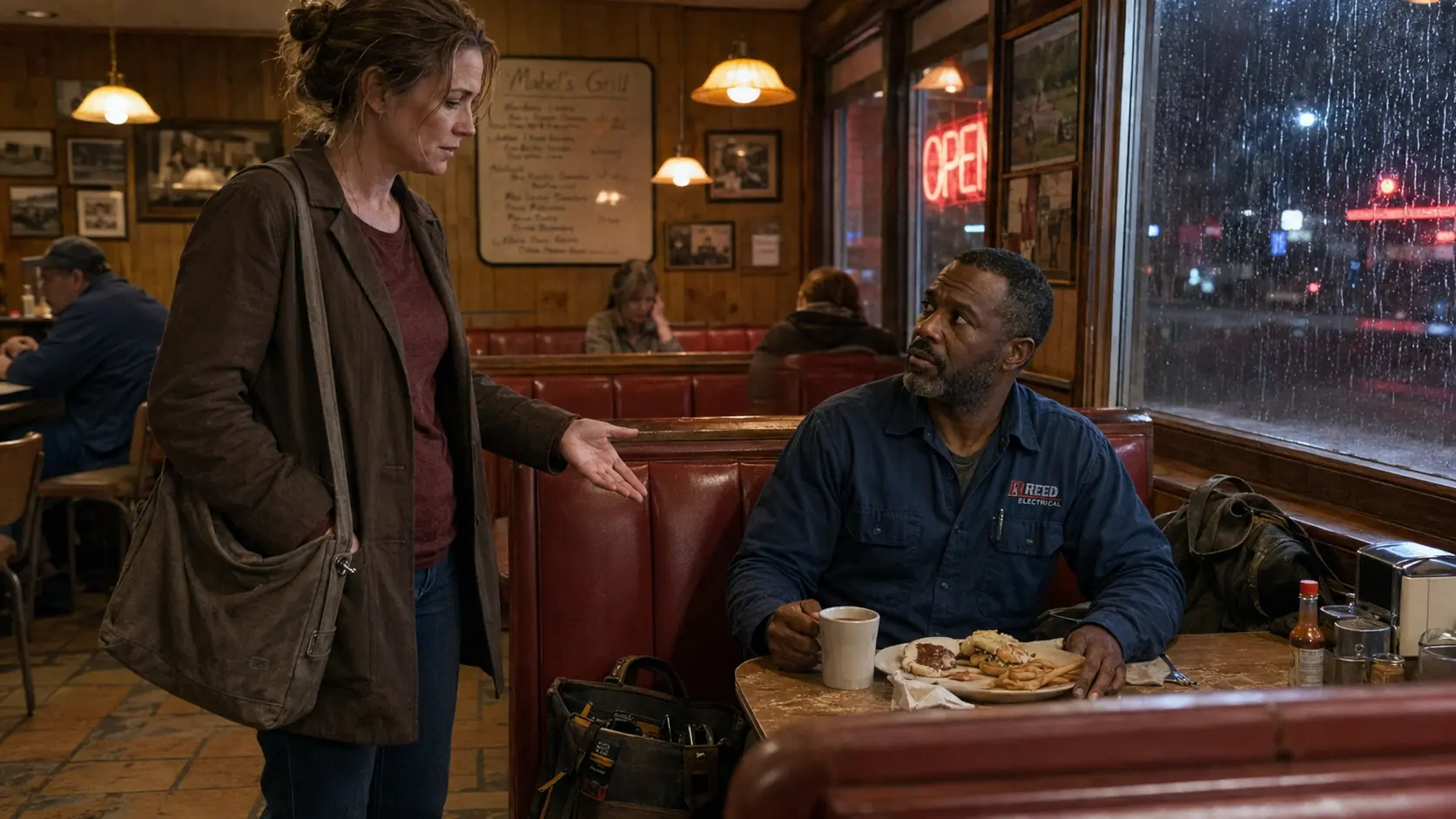
But then the woman standing beside his booth glanced down at the half-eaten bacon cheeseburger on his plate and asked again, "I'm sorry. I know this is strange. I just wondered if you were going to eat the rest." Tom stopped breathing. Not because she looked hungry.
Not because she wore a faded brown coat that was too thin for a cold October night in Charlotte, or because the cuffs were frayed enough to make her look like someone who had been sleeping in it for weeks. Not because her dark blonde hair had been pulled into a careless knot with loose strands damp from the rain. Tom froze because he knew that face. Four years had passed, but some faces stayed with a man. So did some names.
Serena Whitmore, chief executive officer of Whitmore Residential Group, the woman whose signature sat at the bottom of the letter that had ended his career. For a few seconds, Tom simply stared. Serena shifted uncomfortably. I shouldn't have asked. She started to step away.
Tom set his coffee down. Wait, she stopped. Tom looked at the food on his plate. Half a burger, a handful of fries going cold beside it. Nothing special.
He had ordered the same thing dozens of times after late jobs because Mabel's was open, the coffee was strong, and nobody expected conversation unless you wanted it. He could have handed her the plate. That would have been easy. He could also have said her name. That would have been easier.
Serena Whitmore. He could have spoken it loudly enough for the retired couple two booths over to hear. Loud enough for Mabel behind the counter to look up. Loud enough to watch the woman in front of him realize that whatever game she was playing had failed. A bitter part of him wanted that.
Four years ago, he had walked into Whitmore headquarters wearing a pressed shirt carrying a 27-page compliance report that showed Black applicants were being denied housing at rates that made no statistical sense. Three weeks later, security had escorted him out carrying his office belongings in a cardboard box. And at the bottom of his termination letter had been this woman's name, Serena Whitmore. Tom looked at her now. No makeup that he could see.
No diamond earrings, no tailored suit, no driver waiting at the curb, just an old coat, damp shoes, and the look of somebody forcing herself to ask for something she hated needing. Mabel, Tom called. A gray-haired waitress in her 60s glanced over from behind the counter. Yeah, sweetheart. Can I get another bacon cheeseburger?
Serena immediately shook her head. No, please. You don't have to buy me anything. Tom kept his eyes on her. Fries, too.
And coffee? He looked at Serena. She hesitated. Coffee would be nice. Mabel gave a short nod.
Coming up. Serena looked almost embarrassed. I really didn't mean for you to order me a meal. I only asked because you weren't finishing yours. Tom leaned back against the cracked vinyl booth.
At my table, nobody eats leftovers because somebody decided they were worth less. The words came out more sharply than he intended. Serena's expression changed. Not offended. Something closer to surprise.
She looked at him for several seconds, then glanced toward the empty seat across from him. May I? Tom nodded once. She sat. Up close, he could see that the disguise or whatever it was had been carefully done.
Her fingernails were clean but unpolished. No ring, no expensive watch. The canvas bag resting at her feet looked cheap enough to have come from a thrift store, but there were details money had difficulty hiding. The straightness of her posture, the way she listened to everything happening around her without appearing to. The calm, measured eye contact of someone who had spent decades sitting across tables from people who wanted something from her.
She was trying to look ordinary. Tom almost laughed. He took another drink of coffee instead. Serena rubbed her hands together for warmth. Thank you.
You already said that. I know. You don't have to keep saying it. She gave him the faintest smile. You always this friendly.
Depends who's asking. There was irony in that answer Serena could not possibly understand. She studied him. Tom was 52, broad-shouldered with close-cropped hair showing gray at the temples and hands roughened by electrical work. His Navy work shirt still carried the embroidered logo of the contractor he worked for, though his jacket covered most of it.
A small burn scar crossed the back of his left hand from a mistake he had made when he was 23 and still believed experience meant being fearless. Serena nodded toward the tool bag near his feet. Electrician mostly. You don't sound like you enjoy explaining yourself. I spent years doing it.
Didn't improve much. Mabel arrived with coffee first. She sat it down in front of Serena. Burgers coming. Thank you, Serena said.
Mabel gave Tom a quick look. She had known him for nine years, long enough to recognize when he was holding something back. Tom ignored the question in her eyes. Serena wrapped both hands around the mug. For a moment, neither of them spoke.
Outside, headlights moved through the rain. The wipers on parked cars clicked back and forth. Somewhere near the kitchen, an old country song played softly through a radio that had probably been there since before Tom first walked through the door. Serena lifted the coffee, took one sip, and tried not to make a face. Tom noticed that bad.
She swallowed. It's strong. That's polite. She smiled again, slightly more this time. I'm Serena.
Tom knew. Still, he said, Tom. No last name. Didn't hear you offer one. She glanced down at her coffee.
Fair. Mabel brought the burger and fries. Serena stared at the plate for a second longer than Tom expected. Then she picked up one fry. She ate carefully at first, almost too carefully, as if she were conscious of every movement.
Tom watched without appearing to. This wasn't hunger the way he had seen it in shelters or church kitchens. She wasn't starving. So why was Serena Whitmore sitting in a neighborhood diner dressed like a woman counting her last dollars? That question bothered him more than he wanted to admit.
Finally, Serena said, "Do you do this often? Eat? Buy dinner for strangers?" "No." "So, I'm special?"
Tom looked at her. "You're something." She laughed softly. It was not the polished laugh of a woman at a fundraiser. There was no audience for it.
For one second, Tom saw something beneath the name he hated, just a tired woman on a rainy night. That irritated him even more. He reminded himself of the cardboard box. His wife Denise sitting at the kitchen table four years ago trying to hide fear while medical bills gathered beside her. Lily only 12 then pretending not to hear them discussing which payment could wait.
The termination letter. Serena Whitmore's signature. Tom's jaw tightened. Serena noticed. Did I say something wrong?
No. You looked like you remembered something. I did. She waited, but Tom offered nothing else. By the time she finished half the burger, the rain had softened.
Serena wiped her hands with a napkin, then looked directly at him. Tom. Yeah. She hesitated. Have we met before?
For the first time that night, Tom allowed himself to look at her without hiding what was behind his eyes. Four years of anger, four years of questions, four years of a life rerouted by a decision she apparently did not even remember making. He raised his coffee and took a slow drink. Not in any way you'd remember. 3 days before Serena Whitmore sat across from Tom Reed at Mabel's Grill and asked if she could eat the food he had not finished.
She was standing 41 floors above Uptown Charlotte, looking down at a city she thought she understood. From the corner office of Whitmore Residential Group, the streets below looked almost orderly. Cars moved through intersections in clean streams. Office lights blinked on as the afternoon faded. Construction cranes stood against the October sky like thin steel crosses, marking new projects her company had helped finance, manage, or develop.
From up there, the city looked efficient, predictable, managed. Serena had spent most of her adult life believing that was the value of good leadership. You made systems work. You made decisions quickly. You hired capable people, trusted them to do their jobs, and accepted responsibility when something failed.
At 47, Serena had been CEO of Whitmore Residential for almost a decade. Her father, Charles Whitmore, had started the company with 12 rental properties and one secretary in a converted insurance office in Gastonia. By the time Serena inherited leadership, the company had grown into a regional housing and development firm with properties across North Carolina and parts of South Carolina. Her father had loved telling one particular story. Back in 1989, when the company was still small, a tenant named Mrs.
Jefferson had fallen two months behind on rent after her husband died. Charles had driven to the property personally, sat at her kitchen table, and worked out a payment plan instead of evicting her. Buildings are easy, he used to tell Serena, "People are the part you have to get right." Serena had believed she had preserved that philosophy. Whitmore Residential funded community programs.
It sponsored neighborhood cleanups. The annual report contained photographs of smiling families receiving keys to new apartments. Their website used phrases like equal opportunity, responsible development, and housing with dignity. Serena approved every word. That was why the email bothered her.
It arrived at 4:17 on a Tuesday afternoon. No name, no signature. The subject line read, "You don't know what happens after you sign the papers." Serena almost deleted it. Her inbox collected hundreds of messages every week, including complaints, unsolicited proposals, angry letters from former tenants, activist demands, and the occasional conspiracy theory from people who believed property developers secretly controlled city government.
But something made her open this one. There were no insults, no threats, just a short message. If you really want to know how Whitmore treats people, stop reading the reports prepared for you. Look at the raw applications. Compare who gets explanations and who gets rejected.
Then ask why. Attached was a spreadsheet. Serena opened it. At first, she saw nothing extraordinary. Applicant IDs, income bands, credit categories, employment history, rental history, approval decisions.
Then she noticed the highlighted rows. Two applicants, similar income, similar credit range. Both employed full-time, both with no eviction history. One approved, one denied. Then another pair and another.
The pattern repeated often enough that Serena stopped scrolling. A demographic column had been included in the attached file. The approved applicants were disproportionately white. The denied applicants were disproportionately black. Serena leaned closer to the screen.
Her first reaction was not guilt. It was disbelief. No, she said it aloud to an empty office. There had to be another explanation. Debt to income ratios, incomplete applications, rental gaps, property specific criteria, something the spreadsheet did not show.
Serena picked up the phone and called Graham Voss. He entered her office 12 minutes later without knocking. Graham had known Serena since she was 16. He had worked beside her father for years and had been one of the men standing nearest the grave when Charles Whitmore was buried. At 58, Graham carried himself with the easy confidence of someone who had spent most of his life in rooms where decisions were made before the public ever heard about them.
He looked at the spreadsheet on Serena's monitor, then at her. "Anonymous?" "Yes." "Then you already know how seriously I take it. Look at the numbers.
Graham leaned over her desk. He scanned the rows for perhaps 30 seconds, then straightened. "Manipulated." "That fast?" I decided someone selected examples designed to create a conclusion.
What if they didn't? Graham exhaled patiently. Serena, numbers are obedient. They'll tell whatever story the person arranging them once told. She disliked the line immediately.
What's the actual rejection rate by race? I don't know off the top of my head. Then let's pull it. Graham's expression changed only slightly. Not alarm, more like annoyance.
Compliance can review it. I asked for the raw data and I'm saying there's a reason we have departments. Serena looked at him. Since when do you object to me looking at my own company's data? I object to a CEO allowing an anonymous attachment to dictate her schedule.
He smiled. Then the familiar reassuring smile he had used for years whenever Serena pushed too hard on something he considered beneath her level. Let me handle it. For most of her career, that sentence had comforted her. That afternoon, it did not.
Serena requested the records herself. By 5:00, she had received three different responses. Information technology said portions of the tenant database were being migrated. Compliance said demographic reporting required privacy review. Property operations told her the requested records belong to separate regional divisions and would take several days to compile.
Serena stared at the messages. She was the CEO. Why did asking a simple question suddenly feel complicated? At 7:30 that evening, she was still in the office. Most of the executive floor had emptied.
What if she had not gotten the people right? The thought irritated her, then frightened her by morning. She had made a decision she would never have approved if one of her executives proposed it. She would go look herself. Not as Serena Whitmore, as someone nobody needed to impress.
She left her company phone in the office safe, removed her watch, took off the gold earrings she wore almost every day. From a thrift shop in Plaza Midwood, she bought a faded coat, two plain shirts, inexpensive jeans, and a canvas shoulder bag. At home, she studied herself in the bathroom mirror. She did not look poor. Not really.
She looked like a wealthy woman wearing cheap clothes, so she changed her posture. No straight shoulders, no executive stride. She tied her hair back without styling it and stopped wearing makeup. For a name, she chose Serena Mason using her mother's maiden name. She put $80 in cash into the canvas bag and left her credit cards at home.
She told herself this was not a game. She was not pretending to be homeless. She would not accept public aid or occupy resources meant for people who actually needed them. She only wanted to know what happened to a woman who walked into a Whitmore property without money, influence, or a recognizable name. The next morning, Serena rode a city bus for the first time in more years than she could remember.
No one looked at her twice. That unsettled her more than she expected. At the first Whitmore leasing office, she said she had recently lost her job and wanted information about lower-cost units. The employee was polite, not warm, but professional. Serena relaxed slightly.
Maybe the email was exaggerated. Then a white woman in her 20s came in with an incomplete application. The leasing agent spent nearly 15 minutes explaining what she could correct. You can bring the pay stub tomorrow. We can hold the unit until Friday.
Don't worry about that missing reference. We'll work around it. The woman left relieved. 10 minutes later, a Black man in his late 50s entered. He wore a clean work uniform and carried a folder.
Serena watched from a plastic chair near the wall. The man explained that he drove for a delivery company and wanted to move closer to his daughter. The leasing agent looked at his application. Less than 2 minutes. I'm not sure this property is going to work for you.
The man frowned. Why? Your profile. What about it? The agent lowered her voice.
Risk factors. The man opened his folder. I brought pay stubs and my landlord wrote a reference. I understand you haven't looked at them. The employee hesitated, then said the sentence Serena would remember all day.
You probably won't qualify. The man stood there quietly. There was no shouting, no accusation, only a change in his face. A familiar disappointment, as though this had happened before. Serena watched him put the papers back into his folder.
When he left, she approached the desk. What risk factors? The leasing agent looked confused. Excuse me? The gentleman before me, you said he had risk factors.
"That's just how the screening system scores things." "What things?" The agent shrugged. Employment type, rental history, neighborhood factors, a bunch of stuff. Did you actually run his application?
The woman looked at Serena differently now, suspiciously. I'm not allowed to discuss another applicant. Serena backed away. Outside, the afternoon air had turned colder. She stood at the bus stop for nearly 20 minutes, replaying the scene.
You probably won't qualify. The employee had not said anything explicitly racist. That was what bothered Serena. There was nothing obvious enough to point at, nothing ugly enough to condemn immediately, just a tone, a shortcut. A conclusion reached before the evidence had been examined.
By evening, Serena had visited three properties. She had eaten nothing since breakfast. Her feet hurt. Her bus was late. The cold had settled through the thin thrift store coat.
And for the first time, she understood just how quickly an ordinary day could become exhausting when every movement required waiting, walking, calculating, and trying not to spend money. She still had cash. She still owned a penthouse. She could stop whenever she wanted. That knowledge made the discomfort feel almost shameful.
When the rain started, she ducked beneath the awning of a diner she had never noticed before. Mabel's grill. Warm yellow light spilled through the windows. Inside, a man sat alone in a booth with a half-finished burger and a cup of coffee. Serena checked the money in her bag, then looked at the bus schedule, then back at the plate.
She stood outside for almost a minute, angry with herself for even considering it. Finally, she stepped inside. 3 minutes later, she was standing beside Tom Reed's table and asking the question that would change both of their lives. Serena did not expect to see Tom again. That was what she told herself all week.
The first dinner at Mabel's had felt too strange to repeat, too personal for two people who had supposedly just met. Tom had asked almost nothing about her, which was unusual in a way Serena had not been prepared for. Most people who met Serena Whitmore eventually wanted to know what she did, where she lived, who she knew, what decisions she could influence. Tom had seemed almost determined not to care. And yet, 7 days later, at 6:52 on a Thursday evening, Serena found herself stepping off a city bus three blocks from Mabel's Grill.
She was wearing the same thrift store coat, the same canvas bag hung from her shoulder. She had spent another day moving through Whitmore properties under the name Serena Mason, gathering impressions that were becoming harder to dismiss. Nothing she had seen was dramatic enough to make a headline. That was almost worse. No one had shouted a racial slur.
No employee had admitted to discriminating against anyone. Instead, there were shorter conversations, colder tones, unexplained rejections, and the phrase risk profile appearing again and again. By the time she pushed open the diner door, Serena was tired, hungry, and more unsettled than she wanted to admit. Tom was already there. Same booth, same black coffee, different meal.
Tonight, it was meatloaf, mashed potatoes, and green beans. He looked up as she approached. For half a second, Serena thought she saw surprise. Then his face settled into that maddening calm she remembered. Planning to steal my fries again?
Serena looked at his plate. You don't have fries. Tom nodded. Good. Then we're already making progress.
She smiled despite herself and slid into the booth across from him. Mabel appeared before Serena could ask for a menu. Coffee? Serena hesitated. The coffee was terrible.
Tom watched her. Serena Sil. Sure. Mabel poured. Tom lifted an eyebrow.
What? You made that face last week like the coffee had personally offended you. I'm adapting. That's one word for it. Mabel set down a menu.
Serena ordered chicken pot pie. When the waitress walked away, Tom looked at her canvas bag. Long day. You can tell you look tired. That is not a charming thing to say to a woman.
I wasn't trying to charm you. That somehow makes it worse. Tom almost smiled. Almost. Serena took a sip of coffee.
It was still too bitter. She drank it anyway. Outside, October had begun surrendering to November. The rain from the previous week was gone, but cold air pressed against the diner windows. Across the street, a mechanic was pulling down the metal door of an auto shop.
Farther down the block, a church sign advertised a Friday fish fry and a veteran's breakfast on Saturday morning. Serena noticed those things now. She had lived in Charlotte most of her adult life, yet large parts of the city had existed for her, only as roads between meetings. She knew development corridors, zoning districts, market projections. She knew which neighborhoods were appreciating fastest and where land values were expected to rise.
She did not know where people ate meatloaf after a 12-hour shift. Tom broke the silence. So, so what? You came back. You sound disappointed.
Curious? Serena leaned back. Maybe I liked the burger. Mabel's going to be thrilled. Or maybe I wanted to talk.
That sharpened his attention. About what? Serena looked toward the counter where Mabel was arguing good-naturedly with an older customer about whether the Carolina Panthers had any chance that season. Then Serena lowered her voice. Housing.
Tom's expression did not change, but something in him went still. Serena noticed. I've been looking at rental applications. For fun? No.
Good. I was worried rich people had developed a new hobby. Serena gave him a look. He took a drink of coffee. She continued, "I've noticed things that don't make sense."
Tom said nothing. At one office, a white applicant was given extra time to complete missing paperwork. A black applicant came in maybe 10 minutes later with documents already prepared, and they discouraged him before they even reviewed the file. Tom's jaw tightened slightly. Serena saw it.
They called it a risk profile. Tom stared at his coffee. You've heard that before. Everybody in housing has heard some version of it. That wasn't what I asked.
Tom looked up. Serena waited. Finally, he said. Risk profile can mean a hundred things. Such as income stability, credit, rental history, prior evictions, debt, employment, neighborhood factors.
Tom's gaze sharpened. Who said that? A leasing agent. And you asked, "Yes, what did she tell you? That the screening system calculates it?"
Tom sat back for several seconds. He looked past Serena toward the diner window. She recognized that expression. He knew something. Not suspicion, recognition.
What? Serena asked. Nothing. That's obviously not true. You always push people this hard.
When they avoid simple questions, Tom gave a dry laugh. You really don't know how to stop being in charge, do you? The sentence hit Serena harder than it should have. She almost replied defensively. Instead, she said, "Probably not."
Tom studied her. That answer seemed to surprise him. Mabel arrived with Serena's chicken pot pie. Steam rose from the golden crust. Serena thanked her.
Tom waited until Mabel moved away. What exactly are you looking for? I don't know yet. Then how do you know something's wrong? Serena broke the crust with her fork.
Because people keep telling me everything is fine. Tom's face changed. It was small, but Serena saw it. That means something to you. Tom cut into the meatloaf.
It means you're finally asking a useful question. Serena stopped. Finally, Tom realized the word had escaped. For the first time since she had met him, he looked irritated with himself. Serena leaned forward.
What did you used to do? Tom's fork paused. Different things. That isn't an answer. It's the one you're getting.
You understand tenant screening, compliance language, property management. You know more about this than an electrician should. Tom looked directly at her. And how much should an electrician know? Serena immediately heard the arrogance in her own sentence.
That came out wrong. It came out honest. I didn't mean I know what you meant. Tom returned to his food. The silence that followed felt different from their earlier ones.
Serena hated it. Not because Tom had embarrassed her, because he was right. She had reduced him to the job printed on his work shirt, then been surprised when he knew more. The irony made her uncomfortable. "I'm sorry," she said.
Tom looked up. Serena continued, "That was condescending. He watched her for a moment, then nodded once." ""Yeah. No graceful rescue."" ""No, it's fine. Just...
Yes."" Oddly, Serena respected him more for it. After a while, Tom said, "I used to work in corporate compliance." Serena kept her expression neutral. What industry? Housing.
His fork stopped. Property management among other things. For who? Tom wiped his mouth with a napkin. That part doesn't matter.
It might to you. Maybe. Tom's eyes held hers. There was something unsettling in the way he looked at her as though he knew the answer to a question she had not yet understood. Serena shifted.
What happened? Tom looked down at the table. For a moment. When he spoke, his voice had lost its dry humor. I used to believe companies wanted to know when something was wrong.
Serena waited. He continued. Turns out some of them only want to know when something is wrong if fixing it doesn't cost too much. And yours? Tom looked at her.
Mine decided I cost too much. Before Serena could ask more, the diner door opened. A teenage girl stepped inside carrying a large sketchbook under one arm. She was tall with Tom's eyes and a sweatshirt bearing the name of a local high school. She spotted him immediately.
Dad. Tom looked at the clock. You're early. Practice ended early. The girl approached the booth.
Tom introduced them. Serena, this is my daughter, Lily. Lily. Serena. Lily gave Serena a polite smile.
Hey. Hey. Lily glanced at the table. Are you eating with someone? Tom dead panned.
Apparently, Serena laughed. Lily rolled her eyes in the universal language of teenage daughters embarrassed by their fathers. While Tom paid the check, Lily set her sketchbook on the edge of the table. Serena caught a glimpse of a house drawn in pencil. Clean lines, wide porch, large windows.
No fence. That's good, Serena said. Lily looked down. Thanks. You want to be an architect?
Maybe. Serena pointed gently toward the drawing. No fence, Lily shrugged. Then, almost casually, she said enough people already spend their lives being told where they don't belong. Tom looked at his daughter.
Serena said nothing. The sentence settled somewhere deep. Lily closed the sketchbook. Tom put on his jacket. You getting home?
Okay, he asked. Serena. Yes, bus. She nodded. Tom seemed about to say something, then stopped himself.
Good night, Serena. Good night, Tom. She watched him leave with Lily. Through the window, she saw Tom take his daughter's sketchbook when she adjusted her backpack. A simple gesture, automatic, familiar.
Serena remained in the booth after they were gone. Mabel refilled her coffee without asking. This time, Serena drank it without making a face. She thought about risk profiles. She thought about Tom's sentence.
Mine decided I cost too much. And she thought about the way he had reacted when she mentioned neighborhood factors. He knew more than he was saying, much more. Serena looked toward the door through which he had disappeared. For the first time, she wondered whether meeting Tom had really been an accident.
Then a more uncomfortable question followed. What if the truth she was looking for had already been sitting across the table from her? Serena spent the next Thursday morning doing something she had not done in years, searching old personnel records herself. She had arrived at Whitmore Residential before 7, early enough that the executive floor was nearly silent. Charlotte was only beginning to wake beyond the glass walls of her office.
Traffic crawled along Interstate 277, lights still glowing beneath a pale November sky. On Serena's desks sat a paper cup of black coffee she had bought on the way in. She normally took coffee with cream, but somewhere between her second and third Thursday at Mabel's, she had stopped adding it. She had not noticed the change until that morning, Tom had become a problem she could not set aside. Not because of anything he had done, but because of what he knew.
Risk profiles, screening procedures, compliance language, neighborhood factors. Every time Serena mentioned something she had seen at one of Whitmore's properties, Tom reacted a fraction of a second before an ordinary person should have understood its significance. Then there was what he had said. I used to believe companies wanted to know when something was wrong. Serena had replayed those words on the ride home.
She opened Whitmore's archived employee database and typed the name she knew, Tom Reed. Nothing useful appeared. She tried Thomas Reed. One result, Serena stopped moving. Thomas E.
Reed, former compliance manager, Whitmore Residential Group. Her stomach tightened. No, she whispered. She opened the personnel file. Tom had worked for Whitmore for almost 9 years.
9 years. Serena stared at the dates. He had been inside her company while she was already serving as CEO. There were performance reviews describing him as meticulous, reliable, and unusually persistent. One supervisor had written that Reed asks difficult questions, but generally for the right reasons.
Serena almost smiled at that. It sounded exactly like him. Then she reached his final year. The language changed. Concerns about cooperation, concerns about alignment, concerns about communication with senior management.
Serena knew corporate language well enough to recognize when words were being used to avoid saying something directly. She opened another attachment 27 pages internal compliance review applicant screening disparities. Author: Thomas E. Reed. Serena leaned closer.
The report was four years old. Tom had compared rental applications across multiple Whitmore managed properties. He had controlled for income, credit categories, eviction history, and employment stability. Even after those factors were considered, Black applicants were being denied at substantially higher rates. Serena felt cold.
The anonymous spreadsheet she had received Three weeks ago was not revealing something new. Tom had found it four years earlier. He had documented it. He had reported it. Serena scrolled faster.
There were recommendations for an independent review of the screening model and warnings about proxy variables such as zip code, employment category, rental gaps, and neighborhood scoring. The same things Tom had been reluctant to discuss at Mabel's. Serena sat back. Why had she never seen this? She searched the executive records from that period.
There it was, a short summary prepared for senior leadership. The language bore almost no resemblance to Tom's report. Minor statistical inconsistencies, insufficient evidence of discriminatory impact, employee disagreement regarding established compliance methodology. Serena read it twice. She remembered the summary barely.
Four years earlier, Whitmore had been refinancing two major developments. Her father's health had been deteriorating, and Serena had been working 14-hour days. Graham had brought her a stack of documents between meetings. She remembered him standing beside her desk. Personnel matter.
Compliance disagreement. Management has handled it. She remembered signing. Serena returned to Tom's personnel file. The final document opened.
Notice of termination. Reason. Failure to align with executive compliance direction and repeated disruption of established internal review procedures. Effective immediately. She scrolled down and there it was her signature.
Serena Whitmore, chief executive officer. For several seconds, she simply stared at her own name. Her signature was unmistakable, a strong upward stroke on the S, the long line beneath Whitmore. She had practiced that signature when she was 28 because her father once joked that executives should sign their names like they intended to stand behind them. Serena touched the screen.
She could not remember signing Tom Reed's termination letter. Not the room, not the day, not his name, nothing. Yet Tom remembered. Of course he remembered. He had remembered her face the first night.
The realization landed with enough force that Serena stood and walked away from the desk. She looked out over Charlotte 4 years ago. She had probably signed that document between conference calls. Then she had gone home. Tom had gone home too, but not to the same life he had left that morning.
Serena suddenly pictured the man from Mabel's carrying his tool bag. Lily walking into the diner with her sketchbook. The house without a fence. She thought about Tom saying mine decided I cost too much. He had not been speaking metaphorically.
Her company had decided that and her name had made it official. At 9:15, Graham entered Serena's office. You wanted me? Serena turned from the window. Do you remember Thomas Reed?
Graham's face remained neutral, but there was a pause. Small. Serena would not have noticed it a month ago. Now she did. Should I?
Compliance manager. 4 years ago. Graham thought for a moment. Read. Yes.
Vaguely. Serena watched him. He raised concerns about tenant screening. That sounds familiar. He produced a 27-page report.
Graham shrugged. Compliance people produce reports. Then we fired him. Apparently, Serena's voice hardened. You don't remember?
Serena. We employ thousands of people. You were copied on his report. Another pause. Graham walked toward her desk.
What's this about? I've been reviewing old files. I thought we agreed compliance would handle the anonymous allegations. No, you told me compliance would handle them. Graham's expression cooled.
That distinction suddenly matters. It does to me. He studied her for a long moment. Then his familiar paternal tone returned. Serena, your father taught both of us something important.
Executives cannot personally retry every decision made below them. That's why companies have management structures. My signature is on Reed's termination. Then legal approved it. That wasn't my question.
What is your question? Serena looked directly at him. Why was the summary I received different from the report Reed actually wrote. For the first time, Graham did not have an immediate answer. Then he smiled faintly.
4 years is a long time. Context disappears. Serena felt something inside her shift. Not certainty, not yet. But trust had developed its first crack.
Find the context, she said. Graham's smile disappeared. Excuse me. Every email, every meeting note, every version of Reed's report, I want them. Graham studied her, then nodded.
Of course. As he reached the door, Serena spoke again. Graham. He turned. If there was nothing wrong with his report, why was he the one who had to leave?
Graham's expression revealed nothing. Sometimes being right about one thing doesn't make someone right for a company. Then he left. Serena remained still. That evening, she did not wear the thrift store coat.
For the first time since beginning her private investigation, Serena arrived at Mabel's as herself. A charcoal wool coat, dark trousers, leather shoes, her hair neatly styled, her watch back on her wrist. No, Serena Mason. No disguise. Tom was in the usual booth, drinking black coffee.
He looked up as she entered. His eyes moved over her clothes once, then back to her face. No surprise. That hurt more than Serena expected. She crossed the diner and sat opposite him without asking.
Tom looked at the sealed folder in her hand. Bad day. Serena placed the folder on the table. I found Thomas Reed. Tom said nothing.
She opened it and slid the termination letter toward him. His eyes dropped to the page. He did not touch it. Serena's voice was quiet. You knew who I was.
Tom looked up. Yes. The answer came without hesitation. Serena felt anger rise. Partly because anger was easier than shame.
How long before you sat down that first night? You let me lie to you. Tom's expression hardened. You put on old clothes, used another name, and walked through neighborhoods your company owns. Don't lecture me about pretending.
Serena recoiled as if he had slapped the table. I was trying to find out the truth. So was I. About what? Tom leaned forward.
You? Serena stared at him. Tom's voice remained low. I wanted to know what Serena Whitmore was like when she thought the man across from her had nothing she needed. The diner seemed suddenly quieter.
Serena looked down at the termination letter. Her own signature waited at the bottom. I don't remember signing this. Tom did not answer immediately. When he did, there was no anger in his voice.
That made it worse. I know. Serena looked up. Tom held her kaza. That's the part that hurt the most.
For several seconds after Tom spoke, Serena could not look away from the termination letter between them. That's the part that hurt the most. There was no accusation in his voice now. No bitterness sharpened for effect. Somehow that made the words heavier around them.
Mabel's grill continued as if nothing important had happened. Silverware clinkedked against plates. A truck driver near the counter laughed at something on television. The old ceiling fan turned lazily overhead. Serena had spent years in boardrooms where people raised their voices over matters worth millions of dollars.
Yet, she could not remember feeling as exposed as she did sitting across from Tom in that cracked vinyl booth. "I can reopen the case," she said. Tom leaned back. "What? Your termination?
I can have human resources review it independently this time." His expression did not change. "If you were wrongfully terminated, we can correct the record." Whitmore. Tom gave a humorless smile.
There it is. What? The CEO. Serena frowned. You find a broken thing and the first thing you reach for is the company toolbox.
I'm trying to make this right. You're trying to fix the part with my name on it. Isn't that where I should start? No. The answer came so quickly that Serena stopped.
Tom folded the termination letter once, then unfolded it along the same old crease. I have a job. I know. I pay my mortgage. My daughter has what she needs.
I don't want my old office back. I didn't say you had to return. Then what are you offering? Whatever is fair, Tom's eyes hardened. Careful with that word.
Serena inhaled slowly. If compensation is appropriate, Tom laughed once. There was no amusement in it. Money? That isn't what I meant.
It's exactly what you meant. I meant restitution. You think there's a check that turns 4 years backward? No. Then don't offer me one like there is.
Serena felt herself becoming defensive. In another room with another employee, she might have ended the conversation there. She might have reminded him that she was trying to help, but Tom was not asking for help. And perhaps that was the first thing she needed to understand. Then tell me, she said quietly.
What do you want? Tom looked at her for a long time. The truth. Serena waited. That's all.
That's not a small thing. What truth? The one your company decided was too expensive four years ago. Tom pushed the letter back toward her. I reported a pattern.
Graham told me the model was legal and the numbers were being misinterpreted. I asked for an outside review. Three weeks later, I was carrying my family photographs to the parking garage in a cardboard box. Serena thought of the 27-page report. You believe the same system is still being used.
I believe you wouldn't be sitting here dressed like Serena Whitmore again if you thought everything was fine. That landed. Serena lowered her voice. Help me investigate it. Tom stared at her.
No, you know the system better than I do. No, you recognize the same terminology immediately. Still no. He leaned forward. You disappeared into poor neighborhoods for a few weeks, rode the bus, wore an old coat, and now you think you're ready to dig up something people have spent years burying.
I never said I understood what people live through. No, but you still think you control what happens next. Serena fell silent. Tom stood. Good night, Serena.
Tom, he stopped. I'm going to investigate this with or without you. He looked back at her, then do it without me. The following week, Serena did exactly that. She requested tenant screening records from five Whitmore properties.
She compared rejection categories. She pulled old policy manuals and current scoring procedures. She discovered that the language had changed over the years, but the same vague categories kept appearing. Neighborhood stability, employment consistency, rental continuity, property risk. Whenever Serena asked what those categories actually measured, the answers became less precise.
Graham advised her again to stop digging. That made her dig harder. By Thursday, she returned to Mabel's carrying a folder. Tom was repairing a loose hinge on the diner's front door when she arrived. He saw the folder.
No, I haven't asked anything yet. You brought paperwork. You have an unreasonable prejudice against folders. I worked in compliance. Folders rarely brought good news.
Serena sat in their usual booth. Tom finished tightening the hinge and joined her reluctantly. She opened the folder. I found 12 applicants with comparable credit and income profiles. Tom did not look down.
Serena, nine Black applicants were denied. Two white applicants with weaker rental histories were approved. I told you I'm not doing this. One black applicant was rejected because of a rental gap after he spent 8 months caring for his mother. Tom's eyes moved to the page despite himself.
Serena noticed but said nothing. He read for perhaps 20 seconds, then pushed it away. Not enough. So there is something here. I said the sample isn't enough.
That means you looked. Tom said, you really are exhausting. I've been called worse. I'm sure. She almost smiled.
He did not. Why won't you help me? Tom's voice dropped. Because I already did this once. The words ended the argument.
Serena closed the folder. Tom continued, "I spent months checking numbers. I stayed late while my wife was sick because I believed if I made the evidence clear enough, decent people would have to listen. Serena saw his hand tighten around his coffee mug. They didn't.
I'm listening now. 4 years late. Yes. Tom looked at her. Serena did not defend herself.
4 years late, she repeated. Something in his face softened, but only slightly. The next Thursday, Serena came back again. This time, she brought no folder. She ordered meatloaf and black coffee.
Tom looked suspiciously at her empty hands. No documents? No. No questions? One, he sighed.
Of course. Serena waited until Mabel moved away. What would make you believe I'm serious? Tom's expression changed. I don't need to believe anything about you.
But if you did, I wouldn't, Tom. He looked toward the window. Serena said, "I can pull records you can't access. You understand patterns I don't recognize. Whatever happened four years ago, it didn't stop when you left.
Tom remained silent. And if I walk away now, Serena continued, then maybe the next person who finds it gets another termination letter with my name at the bottom. That finally made him look at her. Serena did not look away. I don't want forgiveness, she said.
I haven't earned it. I want to know what my company is doing. Tom studied her face as though searching for the executive beneath the woman sitting across from him. Then he asked if this leads to Graham. Serena hesitated.
Tom noticed there. That wasn't a no. It wasn't a yes either. Graham had known her father for decades. He had attended family Christmas dinners.
He had stood beside Serena at her father's funeral. The possibility that he had deliberately hidden something from her still felt like betrayal simply to consider. Serena answered carefully. If it leads to Graham, I follow it. And if it leads to the board, yes.
What if it leads to you? The question sat between them. Serena looked down at her coffee. Her signature flashed in her mind. Then she raised her eyes.
Then it leads to me. Tom said nothing for nearly a minute. Finally, he pulled the folder Serena had brought the previous week from the empty seat beside him. She had forgotten he had kept it. He opened it.
I have three conditions. Serena's heart quickened, but she kept her voice steady. I'm listening. No hiding evidence because it embarrasses Whitmore. Agreed.
No paying people to make problems disappear. Agreed. And if we find something with your fingerprints on it, you don't suddenly remember you're the CEO and decide the rules are different. Serena held his gaze. Agreed.
Tom extended his hand. It was the first time either of them had deliberately touched the other. Serena took it. His hand was rough, warm, and firm. This doesn't make us friends, he said.
I didn't think it did. It doesn't mean I trust you. I know. Tom released her hand. Tomorrow night after Mabel closes, Serena nodded.
Tom pulled the first application from the folder and turned it toward her. Then we start here. Serena looked at the page. Why this one? Tom tapped a line she had barely noticed.
Zip code. Because discrimination learned a long time ago not to introduce itself by name. Serena stared at the number. For the first time, she understood that they were no longer trying to determine whether something was wrong. They were trying to discover how carefully it had been designed to look right.
The next night, Serena arrived at Mabel's 10 minutes after closing. The neon open sign was dark. The chairs had been turned upside down on most of the tables, and the only light came from the counter and the booth where Tom sat surrounded by papers. Two cups of black coffee waited between them. "You're late," he said.
"10 minute." In electrical work, 10 minutes can be the difference between inconvenience and somebody sitting in the dark. Serena removed her coat. In corporate America, 10 minutes means the meeting before yours ran long. That explains a lot about corporate America.
She sat across from him and reached for the coffee. No cream, no sugar. She drank without complaint. Tom noticed. Look at you.
What? Three weeks ago, that coffee offended your ancestors. Maybe my standards are declining or improving. It was the closest thing to warmth either of them had allowed since their agreement. Then Tom turned his laptop toward her.
Let's ruin the evening. For the next 3 hours, he taught Serena how to read her own company's records differently. She had always viewed reports from the top down. Occupancy, revenue, delinquency, approval rates, quarterly trends. Tom taught her to move in the opposite direction.
Start with one applicant, one decision, one reason, then compare it with another person whose circumstances were almost identical. Companies love averages, Tom said. Averages make individual people disappear. He showed her two applications. Comparable income, similar credit, no evictions.
The white applicant had a six-month gap in rental history after moving back home following a divorce. Approved. The black applicant had a five-month gap after caring for his father following heart surgery. Denied. Reason.
Rental instability. Serena frowned. Same gap. Almost. Then why different decisions?
Tom tapped another field. Zip code. Serena looked at him. A zip code isn't race. No.
Employment category isn't race. No. Rental gaps aren't race. No. Then how can the system discriminate?
Tom leaned back. Because nobody designing a system like this has to type the word black into a box. He pointed to the screen. If certain neighborhoods are mostly black and you score those neighborhoods as higher risk, what happens? Serena said nothing.
If you penalize certain kinds of hourly employment more heavily, who gets caught more often? If you treat family caregiving as instability, who gets pushed down? You stack enough neutral-looking assumptions together and you can predict who ends up at the bottom. Serena stared at the applications. It never says race.
Tom's expression was grim. That's the point. The words stayed with her long after they left Mabel's. Over the following weeks, their investigation developed a rhythm. Serena used her executive access to retrieve records.
Tom examined them. Serena challenged his assumptions. Tom challenged hers harder. Some nights they argued until Mabel threatened to turn off the lights with them still inside. But something else was happening between them.
They began talking when they were not investigating. Not much at first, a football game, the ridiculous price of groceries, the fact that Tom still listened to Motown while working because his father had played Marvin Gaye and The Temptations every Saturday morning when Tom was a boy. Serena admitted that her father had preferred Johnny Cash, especially on long drives. You're telling me Charles Whitmore sang country music badly? I would have paid to hear that.
You couldn't afford it? Tom laughed. It was the first time Serena heard him laugh without bitterness. One January evening, Tom mentioned an old storage box containing compliance notes he had kept after his termination. He had never destroyed them, partly from anger and partly because some instinct told him the story was unfinished.
The box was at his house. Serena followed him there. Tom lived in a modest brick ranch in West Charlotte on a street lined with mature oaks and homes built decades before developers began giving neighborhoods names like communities in a brochure. Christmas lights still hung from one porch even though the holiday had passed. Inside the house was warm and orderly, not stylish, lived in.
A pair of Lily's sneakers sat near the door. Family photographs covered a shelf. On one wall was a picture of Tom, much younger, wearing a suit beside a smiling woman in a blue dress. Serena stopped. "That's Denise."
Tom followed her eyes. "Yeah, she was beautiful. She knew." Serena looked at him. Tom smiled faintly.
She would have corrected you if you said otherwise. "There was love in the sentence and pain." Serena turned back to the photograph. "How long were you married?" "17 years."
"I'm sorry." Tom nodded. He had heard those words many times. Serena did not ask how Denise died. She already knew from their earlier conversations that cancer had taken her and something about the quiet house told Serena not to pull at that wound simply because she was curious.
Tom went to a hallway closet. While waiting, Serena noticed an old metal toolbox beneath a side table. The red paint had been worn away along the corners. My father's, Tom said from behind her. You kept it.
He bought it when I was a teenager. Tom lifted it onto the table. He used to say a man should know the difference between something broken and something finished. Serena ran her eyes over the scratched metal. What's the difference?
Broken means you try to fix it. And finished. You have enough sense to stop pretending. Their eyes met. Neither of them mentioned Whitmore.
Tom opened a cabinet searching for the archived files. A stack of envelopes shifted and fell. Serena bent to help. Then she saw the hospital logo. Medical bills, some stamped past due, others four years old.
Tom immediately gathered them. You don't have to. I know. He stopped. Serena was holding another paper.
Not a bill. His termination letter. Her signature was visible at the bottom. Tom took it gently. For the first time, Serena understood why he had kept it.
Not because he enjoyed remembering. Because some wounds demanded evidence. "I'm sorry," she said. Tom placed the letter back in the drawer. Sorry doesn't pay old bills.
I know it doesn't give Lily those years back. I know it doesn't give Denise anything. Serena looked down. No. Tom closed the drawer.
His voice softened. Justice that arrives late can still matter, Serena. But people like to talk about it as if showing up eventually makes everything even. He shook his head. It doesn't.
Then more quietly. Sometimes by the time Justice gets there, you've already buried what it was supposed to save. Serena felt the words settle into the room. She wanted to tell him she would fix it. For once, she understood that would be the wrong thing to say, so she simply stood beside him.
After a moment, Tom found the storage box. They carried it to the kitchen table. Inside were handwritten notes, printed emails, old screening guidelines, and copies of reports Serena had never seen. They worked for another hour. Then Tom noticed Serena rubbing her eyes.
You're tired. I'm fine. You CEOs ever admit weakness? Only during earnings calls. He smiled.
She closed the file. Tom asked, "You ever regret not having a family?" The question surprised her. Serena looked toward Denise's photograph. "I was married once."
"I know. 11 years ago." "I know that, too." Serena raised an eyebrow. "You investigated me?
I knew who you were. Remember? She looked down at her hands. My marriage ended because there was always another quarter, another property, another crisis. After the divorce, I thought I'd rebuild the personal part later and later never showed up.
Something like that. She paused. I wanted children. Tom said nothing. I kept thinking I had more time.
The room became very quiet. Tom looked toward the photograph of Denise. When he answered, his voice was barely above a whisper. Tom's good at making promises. Nobody asked it to keep.
Serena looked at him. For a moment, there was no CEO and no former employee. Just two people old enough to understand that life did not always take things dramatically. Sometimes it simply waited while you were busy, then closed a door behind you. Tom broke eye contact first.
He pulled another folder from the box. You should see this. Serena moved beside him. Their shoulders nearly touched. Neither moved away.
Tom opened an old spreadsheet. Rows of tenant applications filled the page. Serena studied the numbers. Then she saw a notation beside several rejected applications. The same internal code repeated again and again.
What does that mean? Tom's face tightened. I don't know. You worked compliance. That code wasn't there when I wrote my original report.
Serena looked at him. So it came afterward. Looks that way. She stared at the page. Something cold moved through her.
They had spent weeks digging into a system Tom believed had survived his departure. Now they had found evidence that someone might have changed it after he left, not removed it. Changed it. Tom slowly closed the folder. Serena.
Yes. I think somebody learned from my report. Her heart lifted for one hopeful second. Then she saw his expression. Tom shook his head.
Not how to fix the system. He tapped the unfamiliar code. How to hide it better. Tom did not sleep much after Serena left his house. By 6:00 the next morning, the old compliance box was still open on his kitchen table, surrounded by files he had not touched in four years.
Winter sunlight pushed weakly through the blinds. His coffee had gone cold beside him, but Tom barely noticed. He kept returning to the unfamiliar code they had found beside dozens of rejected applications. Still, it had not existed when Tom worked at Whitmore. That bothered him.
By 8, he had compared every archived file he still possessed. The pattern was clear. Before his termination, applications had been evaluated through separate categories: credit, income, rental history, employment stability. After he submitted his report, a new composite designation began appearing in internal records. R17, someone had changed the system.
That evening, Serena arrived at Mabel's carrying her laptop and two thick folders. Tom was already in the booth. You look terrible, Serena said. You're getting more charming. You didn't sleep.
Neither did you, she sat. Mabel placed two black coffees on the table without asking. Serena opened her laptop. I found R17. Tom leaned forward.
It's not officially called that anymore. Internally, it became residential stability index. Sounds harmless. That may be the point. She turned the screen toward him.
The scoring model combined multiple factors. Zip code, employment classification, rental continuity, debt exposure, neighborhood turnover, and something called property compatibility. Tom stared at the last phrase. What the hell is property compatibility? I asked, and nobody gave me the same answer twice.
Tom scrolled through the data. Serena had run comparisons across several thousand applications. The result was worse than either of them expected. Black applicants with similar income and credit profiles were significantly more likely to receive elevated risk classifications. The model did not identify race directly.
It did not need to. Tom pointed at the screen. This is what I warned them about. I know. No.
Look. He opened his old report beside the current scoring model. 4 years earlier, Tom had warned that certain variables could create discriminatory outcomes even without race being explicitly included. Now those same variables had been bundled together. Serena stared at the two documents.
My God, they didn't ignore my report. Tom's voice was almost emotionless. They studied it. Serena looked at him. Tom continued.
I told them where the system was vulnerable. Someone used my report to make the discrimination harder to see. For Serena, that realization changed everything. Until then, some part of her had still hoped Whitmore suffered from institutional neglect rather than deliberate manipulation. Neglect would have been terrible, but understandable.
A company grew too quickly. Oversight failed. Bad practices survived because executives were careless. This was different. Someone had been worn.
Someone had adapted. What did the model accomplish financially? Tom asked. Serena hesitated. I'm working on that.
That means you found something. I found something I don't understand yet. She opened another spreadsheet. Several Whitmore properties using the highest R17 thresholds also showed unusually strong increases in valuation over the same period. Tom studied the screen.
Lower turnover partly higher rents. Yes. Serena scrolled. And there's language in internal strategy reports about maintaining demographic market stability. Tom looked at her.
Demographic. I know who approved that language. Graham's division. The name sat between them. Serena no longer defended him.
Tom noticed. They worked until nearly midnight. 2 days later, Serena called Tom while he was replacing a damaged breaker panel in an older house near Freedom Drive. I found another number. Tom balanced the phone against his shoulder.
What number? Serena did not answer immediately. $3.8 million. Tom stopped working. What? Can you meet me tonight?
Where? My office isn't safe. That sentence told him enough. Mabel's 8. When Tom arrived, Serena was already waiting.
No laptop this time, only printed records. Her face was pale. What happened? She slid the first page toward him. Whitmore had participated in several affordable housing initiatives, including emergency rental support connected to properties, receiving public incentives, and company funded assistance.
Over four years, approximately $3.8 million designated for affordable housing programs and emergency tenant assistance had been moved through consulting agreements and vendor contracts. Tom frowned. Moved where? That's the problem. Serena showed him another page.
Some of the vendors eventually connected to commercial redevelopment projects unrelated to tenant assistance who authorized the transfers. Serena placed the final document down at the bottom. Graham Voss, chief operating officer. Tom leaned back. Serena stared at her coffee.
I've known him since I was 16. Tom said nothing. He came to Thanksgiving at our house. He taught me how to drive a stick shift because my father had no patience. When dad was dying, Graham was at the hospital almost every day.
Her voice tightened. I trusted him. Tom looked at the papers. Trust is useful. Serena raised her eyes.
Until somebody realizes you've stopped checking. The words hurt because Serena knew they were true. They continued tracing transactions. Then Tom noticed a familiar address. He stopped.
"What?" Serena followed his eyes. Tom pulled the page closer. It was an archived emergency rental assistance record. Applicant Thomas E.
Reed. Serena looked at him. Tom had gone completely still. He remembered the application. Of course, he remembered.
It had been 11 months after Whitmore fired him. Denise was undergoing another round of cancer treatment. Tom had found electrical work, but the hours were inconsistent and medical expenses were swallowing everything they had saved. He had applied for temporary rental assistance. Not proudly, desperately, the rejection letter had arrived 2 weeks later.
Funds exhausted. Tom had believed it. He had blamed himself for needing help in the first place. Serena searched the corresponding financial period. Her breathing changed.
Tom. He did not answer. Tom, look at this. I'm looking. No.
The date. The assistance rejection had been issued on February 14. 6 days earlier. More than $400,000 had been transferred out of the same funding pool into a vendor account tied to a commercial redevelopment project. The money had not been exhausted.
It had been redirected. Tom stared at the page. For years, he had remembered that winter as the season he failed his family. He remembered Denise sitting at their kitchen table wearing a knit cap because chemotherapy had taken her hair. He remembered pretending the bills were manageable.
He remembered Lily asking why they could not turn the heat higher. He remembered lying thermostats acting up, baby. He remembered Denise reaching across the table after Lily went to bed. This isn't on you, Tom. But he had believed it was.
He had believed it every day since. Serena spoke softly. I'm sorry. Tom's head lifted. Something in his expression frightened her.
I didn't know. Tom pushed back from the table. Don't stop saying that. Several people turned toward them. Tom lowered his voice, but the anger remained.
Stop saying I didn't know. Like it changes what happened. I'm not saying it changes anything. You keep saying it because you need it to mean something. Serena went silent.
Tom pointed at the records. My wife was sick. I know. No, you know it now. His voice cracked.
I was working every job I could find. I was taking calls at 2:00 in the morning because I was scared the next bill would be the one that put us out of that house. Serena's eyes filled, but she did not interrupt. I asked for help one time. Tom held up one finger.
One. He looked at the rejection record. They told me there was nothing left. His jaw trembled. And there was.
Serena whispered. Yes, there was money. Yes, Tom stood. And while I was sitting at my kitchen table, thinking I had failed my wife, somebody was moving it somewhere else. Serena rose too.
Tom, please. He looked at her. For the first time since their investigation began, she saw the full weight of what her company's decisions had done to him. Not statistics, not compliance. A husband unable to protect the woman he loved.
A father terrified of losing the roof over his daughter's head. A proud man taught to blame himself for a failure that had never entirely been his. Serena reached toward him. Tom stepped back. That movement hurt more than any accusation.
I need to go. We can keep looking. You keep looking. Tom. I said, "I need to go."
He turned and walked out. Serena did not follow. Through the diner window, she watched him cross the parking lot alone beneath the yellow street lights. On the table remained the rejection letter. Funds exhausted.
Beside it lay the transfer record, proving the opposite. Serena slowly sat down. For weeks, she had believed she was investigating corruption inside Whitmore Residential. Now she understood something far worse. The damage was not buried in spreadsheets.
It had lived for years inside Tom Reed, and she was beginning to love the man who had been forced to carry it. Serena did not call Tom the next morning. She did not drive to his house, leave a message with Lily, or send the apology she wrote three times and deleted three times before sunrise. Everything in her wanted to explain herself, but somewhere between the empty booth at Mabel's and the long ride home, she finally understood that explanations were another privilege of power. People like Serena were accustomed to being heard.
They could call meetings, request 5 minutes, provide context, clarify intentions. Tom had spent four years living with consequences that had never asked for his side of the story. The least Serena could do now was give him the silence he had asked for. So, she went to work. At Whitmore headquarters, Graham had become increasingly attentive to her investigation.
He appeared in her office twice before noon with questions disguised as concern. You're spending a great deal of time on historical records. I am. Anything I should know about? If I find something, you'll know.
Graham stood near the door studying her. You sound like your father when you're suspicious. Serena kept her eyes on the computer. My father was usually suspicious for a reason. Graham smiled.
That wasn't always one of his better qualities. After he left, Serena locked the office door. She had stopped trusting the internal summaries prepared for her. Now she wanted source documents, archived emails, original attachments, server timestamps, approval chains. The deeper she searched, the more she discovered how easily truth could be altered without technically becoming a lie.
Tom's 27-page report had not vanished. It had been reduced. His warning about discriminatory outcomes became methodological disagreement. His recommendation for independent review became request for additional analysis. His concern about legal exposure disappeared entirely.
Serena compared file after file. Someone had not merely misunderstood Tom. Someone had translated him into harmless language. Late Tuesday afternoon, Serena found an archived email chain from four years earlier. The first message came from Tom to Graham.
The subject line read, "Urgent screening model compliance concerns." Tom's message was professional and direct. He requested suspension of several screening variables until an independent review could determine whether they were creating disparate racial outcomes. Graham's reply was short. We will discuss internally.
Do not circulate further until instructed. Serena kept reading. Two days later, Graham forwarded Tom's report to another senior executive. Serena opened the message. Her pulse slowed.
Reed is becoming a liability. He's pushing for outside review and may escalate if we delay. Prepare a personnel summary. Get Serena's signature before she starts asking questions. Serena read the sentence again, then a third time before she starts asking questions.
For several moments, she could hear nothing except the faint hum of the building's ventilation system. Graham had not simply failed to tell her. He had planned around her ignorance. He knew that if Serena saw Tom's complete report, she might ask questions, so he had made sure she signed first. Serena stood and walked toward the window.
41 floors below, Charlotte moved through another ordinary afternoon. She remembered Graham teaching her to drive a manual transmission in her father's old Jeep. She remembered him carrying boxes into her first apartment. She remembered the hospital corridor where he had sat beside her after her father's final stroke. She had mistaken history for loyalty.
That realization hurt in a way she had not expected. Then another truth followed. Graham had manipulated her, but manipulation did not erase her signature. He had counted on Serena being too busy to read closely, and he had been right. She printed the email.
That evening, she drove to Tom's house. She remained in the car for almost 5 minutes before walking to the front door. Tom answered wearing a gray sweatshirt and work pants. His expression tightened when he saw her. I didn't come to ask you to come back.
Then why are you here? Serena held out an envelope. Because you deserve to see this. Tom hesitated before taking it. He opened the envelope and read the email.
Serena watched his eyes stop at the sentence. Get Serena's signature before she starts asking questions. Tom read it twice. Then he looked at her. You found this where?
Archived executive correspondence. And Graham wrote it. Yes. Tom's jaw tightened. Serena could have said it then.
He lied to me. He used me. I was a victim, too. All of those things contained some truth. She chose none of them.
I didn't know when I signed your termination. Tom's face hardened slightly. Serena continued before he could answer. But I should have known. Silence.
I should have read the full report. I should have asked why a compliance manager with 9 years of good reviews suddenly became a problem Three weeks after raising a serious concern. I should have asked why Graham needed my signature so quickly. She looked directly at him. I didn't.
Tom lowered the email. For the first time since the night at Mabel's, some of the anger left his face. Not forgiveness, something quieter. Recognition. Serena took a step back.
That's all I came to say. She turned toward her car. Serena. He stopped. Tom stood in the doorway.
What else did you find? Two nights later, they were back at Mabel's. After closing, two black coffees, two laptops, too many papers. They did not discuss what had happened between them. They did not need to.
Tom simply returned to the investigation, and Serena understood that this was not forgiveness either. It was a decision to finish what they had started. Together, they reconstructed the timeline. Tom submitted his report. Graham ordered him not to circulate it.
Graham prepared the misleading summary. Serena signed the termination. Then within months, the screening system was modified into the residential stability index. What about the money? Tom asked.
Serena opened another file. I traced two of the vendors. Real companies. Yes, but one had a consulting agreement with a Whitmore commercial redevelopment partnership. So affordable housing money goes to the vendor.
Then the vendor gets paid by another Whitmore project. That's what it looks like. Tom rubbed his eyes. We need originals. I'm working on it.
You need to be careful. Serena looked at him. Is that concern? It's common sense. I'll take what I can get.
Tom shook his head, but she saw the corner of his mouth move. Near midnight, Serena was reading an expense report when the numbers began to blur. She rested her forehead against one hand just for a moment. When she opened her eyes again, the diner was quieter. Her cheek was against the back of the booth.
Something warm covered her shoulders. Tom's work jacket. He was sitting beside her now, reading from her laptop. Serena straightened slowly. How long was I asleep?
20 minutes. You should have woken me. You looked like you needed it. She pulled his jacket closer around herself. It smelled faintly of soap, coffee, and electrical dust.
Tom looked over. Their faces were closer than either expected. Neither moved. Serena could see the gray at his temples, the tiredness beneath his eyes, the man behind the anger. Tom, yeah.
Do you still hate me? He looked at her for a long moment. Some days the answer should have hurt. Instead, Serena smiled sadly, and the other days, Tom's eyes dropped briefly to her mouth, then returned to her eyes. Those are getting complicated.
For one suspended second, Serena thought he might kiss her. He did not, and she was grateful. Anything that happened between them deserved to happen after the truth, not in the middle of it. Then Tom's expression changed. He was looking past her at the laptop.
What? He reached around her and enlarged a document. It was a system access log. Serena followed the timestamps. Someone had opened several of the archived files she had requested yesterday, then copied them, then restricted executive access.
Serena's exhaustion vanished. I didn't do that. I know. Tom pointed to the authorization code. The account belonged to the chief operating officer's office.
Graham. Serena stared at the screen. He knew. Not 4 years ago. Not eventually.
Now. Graham knew she had found the files. Tom closed the laptop. You need to get everything important out of Whitmore's system tonight. Serena looked at him.
Why? Because the first time I started asking questions, they fired me. He glanced toward the dark windows of Mabel's. And this time, Graham knows exactly how much you've learned. By 8 the next morning, Serena had copied every document she could legally access through her executive account.
She preserved original emails, audit logs, screening model revisions, vendor contracts, approval records, and Tom's old compliance report. She kept careful notes showing where each file had come from and when she had accessed it. Tom had been clear about one thing. If this ever reached a courtroom or government investigator, evidence needed a clean history. Serena was still transferring the final records when her office phone rang.
Serena, Graham said. Boardroom 9:00. What's the meeting about? You. The line went dead.
At 8:57, Serena walked into the boardroom she had controlled for nearly 10 years. Graham sat near the far end instead of in his usual seat beside her. Several board members were already there along with outside counsel. Serena noticed the attorneys first. This was not a meeting.
It was an ambush wearing a necktie. Graham folded his hands. We have serious concerns about your recent conduct. My conduct? Unauthorized access to historical personnel files.
Independent investigation outside established compliance procedures. Removal of confidential company information. I'm the CEO, which makes your disregard for procedure more concerning, not less. Serena looked around the table. These records show potential discrimination and misuse of affordable housing funds.
Graham's expression barely changed. They show allegations you've interpreted without appropriate review. I found $3.8 million moved out of housing and emergency assistance programs allocated through approved vendor agreements to vendors connected to commercial projects. That is your interpretation. Serena leaned forward.
No, that is what the contracts say. A board member cleared his throat. Serena, we've also become concerned about your relationship with a former employee. She knew immediately. Tom Reed Graham watched her.
You've met with him repeatedly. He was the compliance manager who identified the screening problem four years ago. He was terminated for misconduct. He was terminated after reporting the problem. That is not what the personnel record says.
I know what the personnel record says. My signature is on it. The room went quiet. Graham's eyes hardened. Serena continued.
I also know you wrote an email saying to get my signature before I started asking questions. That changed him only for a second, but she saw it. Graham leaned back. This meeting is over. No, it isn't.
For you, it is. Outside counsel slid a document towards Serena. Pending an independent internal review. Her operational authority was being suspended. She would retain the title of CEO temporarily, but system access, contracting authority, personnel authority, and board privileges would be restricted.
Serena stared at the paper. For decades, Whitmore had been the most stable thing in her life. Now her own name sat at the top of a document, removing her from it. Again, a signature. Again, a life altered on paper.
She thought of Tom. For him, it was my life. Serena stood. Do whatever you think you have to do. Graham looked almost disappointed.
You're making this unnecessarily difficult. No, Serena said. I think difficult is just what truth feels like when it finally becomes expensive. By lunchtime, her executive access was gone. By evening, the story had leaked.
The first headline appeared on a Charlotte business website. Whitmore CEO secretly meeting fired employee during internal company dispute. Tom read it on his phone while sitting in his truck outside Lily's school. The article described him as a disgruntled former compliance employee with a long-standing grievance against Whitmore Residential. It mentioned Serena's private meetings with him and questioned whether her judgment had been compromised.
By dinner, social media had done what social media always did. Some people called Tom a liar. Others called him an opportunist. A few comments never mentioned his race directly, but did not need to. One suggested Serena had been played by a man who knew exactly what kind of rich woman to target.
Another asked why anyone would trust an angry former employee with an axe to grind. Tom had lived long enough to recognize coded language. He could handle it. Then Lily walked into the kitchen. Dad.
Tom put down his phone. What? She held out hers. Someone from school had sent her a screenshot. A photograph of Tom leaving Mabel's with Serena.
Under it, someone had written. Guess we know how Lily's dad plans to get rich. Tom felt something inside him go cold. Who sent this to you? It doesn't matter.
It matters to me. Dad. Lily. Who? She shook her head.
I'm fine. Tom knew that sentence. He had used it himself for years. It meant exactly the opposite. That evening, Serena was staying in a small hotel near South Park because reporters had gathered outside her building when Tom called.
"We're done." Serena sat upright. "What happened?" Lily got dragged into it. Her face tightened.
"How?" Tom explained. "I'm sorry. Don't." Serena closed her eyes.
Not because he was angry. Because she understood this is Graham probably. Then walking away gives him exactly what he wants. I know, Tom. No.
His voice was tired rather than angry. I lost my job once over this. I spent years wondering whether I should have kept my mouth shut and stayed home with Denise instead of fighting a company that didn't care. You did the right thing. Maybe you did.
Truth doesn't have to go home with my daughter tonight, Serena. I do. She had no answer. Tom continued. I can take people calling me bitter.
I can take them calling me a liar. But Lily didn't choose this. I understand. No, you respect it. That's what I need.
Serena swallowed. All right. The silence between them lasted several seconds. Then Tom said, "Be careful." The call ended.
The next morning, Serena entered Whitmore Tower under security escort. Her office had been sealed. A cardboard box waited outside the door. Inside were a framed photograph of her father, two books, a fountain pen, a coffee mug, and several personal items someone else had decided belonged to her. Serena stared at the box.
Four years earlier, Tom had carried one through the same building. The comparison was imperfect, and Serena knew it. She still had money, a home, lawyers, connections. Tom had walked out while his wife was sick and his daughter was 12. But humiliation had a recognizable shape.
Sometimes it looked like your life reduced to whatever fit inside cardboard. Serena picked up the box herself. Downstairs, Graham waited near the lobby. Let me stop this, he said. Serena turned.
How? Make a statement. Say Reed approached you. Say you were emotionally vulnerable after discovering his old termination. Say he manipulated your sense of guilt.
Serena stared at him. You want me to destroy him? I want you to save the company. My father's company. Your father's legacy.
Graham stepped closer. He already hated you once, Serena. Let him hate you again. For a moment, she saw Mabel's grill on that first rainy night. Tom recognizing her.
Tom remembering exactly what her signature had cost him. He could have humiliated her. Instead, he had bought her a fresh meal. At my table, nobody eats leftovers because somebody decided they were worth less. Serena tightened her grip on the cardboard box.
No. Graham's face changed. You're choosing him over your father. No, I'm choosing the truth over you. She walked out.
There was no company car waiting. Serena carried the box to the bus stop. For the first time, the old coat had not been necessary. There was no disguise left. That evening, she stood on Tom's porch.
When he opened the door, surprise crossed his face. I told you I'm out. I know. I meant it. I know that, too.
Serena did not step inside. I'm taking everything public tomorrow. Tom stared at her. The screening data, the money, Graham's email, my signature on your termination, all of it. Serena, if you do that, I know you could lose Whitmore.
She looked at him. Maybe I lost what Whitmore was supposed to mean years ago. I just didn't know it. Tom's eyes searched hers. You have enough evidence?
Enough to force questions. Maybe not enough to answer everyone. He was silent. Serena nodded. I didn't come to ask you back.
I only thought you deserve to know. She turned toward the steps. Behind her, Tom said, "Wait." Serena looked back. Tom disappeared into the house.
A minute later, he returned, carrying the battered storage box she had first seen beneath his kitchen table. His old compliance files, the originals. Tom held the box between them. "My conditions still stand." Serena looked at him.
No hiding, no buying silence, she said. And if it leads to you, Serena answered without hesitation. It leads to me. Tom handed her the box. Then he reached for his jacket.
"Where are you going?" "With you." "Tom, Lily—" Lily told me something after you called. What? Tom's expression softened.
She said, "Mom didn't raise us to let somebody else decide when the truth becomes inconvenient." Serena looked down for a moment. When she raised her eyes, Tom was already locking the door behind him. He picked up the box again. Come on.
Where? Mabel's. Tom looked at her. If we're going to finish this, we finish it where it started. For the first time in weeks, Serena felt something stronger than fear.
Not certainty, not victory, purpose. She walked beside Tom toward the car. Tomorrow, the truth would no longer belong to two people sitting across from each other in a diner. Tomorrow it would have an audience. By 9 the next morning, the story Serena had promised to make public was no longer private.
Copies of the screening records, vendor transactions, Tom's original compliance report, and Graham's archived email had been provided through counsel to investigators and officials reviewing Whitmore Residential's housing practices. Within days, the documents had triggered demands for an independent examination. By early June, Serena and Tom were walking side by side toward a public hearing chamber in Charlotte, where the questions Whitmore had avoided for 4 years would finally be asked in a room the company could not control. Reporters waited outside. Cameras turned the moment Serena stepped from the car.
Miss Whitmore, did you knowingly approve discriminatory screening policies? Mr. Reed, are you being paid for your testimony? Miss Whitmore, are you resigning? Mr.
Reed. Did you have a personal relationship with the CEO before these allegations became public? Tom kept walking. Serena did too. Inside, the hearing room was colder than either expected.
Fluorescent lights reflected off polished wood. Rows of chairs were packed with reporters, housing advocates, former tenants, attorneys, and ordinary residents who had come because they recognized something of their own lives in the allegations. Tom adjusted his tie. He had not worn one since Denise's funeral. Serena noticed his fingers at the knot.
Nervous? No. You're pulling your tie like it insulted you. Tom looked at her. I hate ties.
I remember. You never saw me wear one. I read nine years of personnel photographs. Tom stared at her. That's unsettling.
Despite everything, Serena smiled. Then the doors opened. Graham entered with three attorneys. He wore a dark navy suit and the expression of a man attending someone else's trial. His eyes found Serena first, then Tom.
He gave neither of them more than a second. The hearing began with records, approval rates, screening categories. Vendor vendor transfers. For nearly 2 hours, the story remained technical enough to make injustice sound almost bloodless. Percentages, models, thresholds, procedures.
Then Graham's attorney asked to question Tom. Tom moved to the witness table. Serena watched him take the oath. Mr. Reed, the attorney began.
You were terminated by Whitmore Residential 4 years ago, correct? Yes. And you were unhappy about that termination. Tom almost smiled. Would you have been happy?
A few people in the room shifted. The attorney did not. You were angry. Yes. You believed the company treated you unfairly.
I knew it did. Your opinion, my experience. The attorney walked several steps. After your termination, you struggled financially. Tom's face changed slightly.
Serena felt anger rise in her chest. Yes, you applied for financial assistance. Yes, you were denied. Yes, and now you are accusing the same company that terminated you of discrimination and financial misconduct. Tom waited.
I'm telling you what the records show. The attorney picked up a document. Isn't it true, Mr. Reed, that you had every personal reason to damage Whitmore Residential? There it was.
Not the evidence. The man. Tom looked toward the audience. He could feel the old story being built around him. Angry employee, financially struggling, black, resentful, vindictive, the attorney continued.
You maintained company documents for years after your termination. Copies of my own compliance work, documents you later shared with Miss Whitmore. Yes. After developing a personal relationship with her, Tom's jaw tightened. What are you asking?
I'm asking whether your relationship with Serena Whitmore influenced the accusations you are making today. No. Did you meet her privately? Yes. Repeatedly?
Yes. Did she visit your home? Serena looked toward the officials conducting the hearing. The implication was obvious. Tom answered anyway.
Yes. Did you discuss your financial hardship with her? Yes. Did she express guilt about your termination? Yes.
The attorney paused. Then, Mr. Reed, isn't it possible that you exploited that guilt? A murmur moved through the room. Tom stared at him.
For 4 years, he had imagined what it would feel like to finally tell the truth in a room where people were required to listen. He had imagined satisfaction. Instead, he felt tired. Tired of proving his anger did not make him dishonest. Tired of being expected to become emotionless before his evidence could be trusted.
Tired of watching powerful people turn pain into a character flaw. Tom leaned toward the microphone. Yes, the attorney blinked. Yes, yes, I'm angry. The room became still, Tom continued.
I was angry when I lost my job. I was angry when my wife was sick and I couldn't give my family the security I thought I was supposed to provide. I was angry when I learned money that could have helped families like mine had been moved somewhere else. He looked directly at Graham. And I'm angry now.
The attorney seemed almost pleased. So, you admit personal bias? Tom nodded slowly. If being harmed means I'm not allowed to talk about who harmed me, then I suppose nobody in this room who ever suffered anything should testify about it. The attorney's expression tightened.
Tom reached toward the box beside his chair. He removed a document. My anger didn't create this. He placed the first report on the table. This is my original compliance report.
He pointed to the date, September 8, 4 years ago. That's when I formally reported racial disparities in the screening system. He removed a second document. This email is dated September 11. He placed it beside the first.
That's when I was instructed not to circulate my findings outside the department. A third page. This personnel notice was prepared September 23. Then the final document. My termination became effective September 29.
He arranged all four pages in a straight line. Report. Warning. Termination. The room was silent.
The attorney stepped forward. Your interpretation of those events. Tom raised his eye. You don't have to believe my interpretation. The attorney stopped.
Tom looked toward the hearing officials, then toward the audience, then finally toward Serena. She saw something in his face she had never seen before. Not anger. Freedom. Tom turned back to the microphone.
You don't have to believe I'm a good man. His voice remained steady. You don't have to like me. You don't have to care that my wife was sick. You don't have to care that my daughter watched me leave for work every morning pretending I wasn't scared.
He touched the documents, but you can read. His finger moved from one date to the next. September 8. September 11. September 23.
September 29. Then Tom leaned back. You don't have to believe me. Just believe the dates. Nobody spoke.
For several seconds, the entire room seemed to understand that the argument had changed. Graham's attorney looked down at the documents. Tom had done something Serena's lawyers had spent weeks trying to accomplish. He had stripped the case of personality. No speculation, no sympathy, no romance, just sequence.
A man reported a problem. The company ordered him to stop. The company prepared to remove him. Then the company removed him. Graham leaned toward one of his attorneys and whispered something.
For the first time all morning, he looked worried. The questioning shifted toward the screening model. Tom explained the proxy variables without pretending every disparity automatically proved intent. He explained what his original report had warned. When zip codes, employment categories, rental gaps, and neighborhood scoring were combined, supposedly neutral criteria could repeatedly punish the same communities.
Then came the newer residential stability index. Tom placed his old warning beside the later model. The system changed after I left. How it became harder to see what each variable was doing. Are you saying your report was used to conceal discrimination?
I'm saying my report identified the places where discrimination could occur. The later model bundled many of those same places together. That distinction mattered. Tom was not guessing beyond the evidence. He did not need to.
The records were damaging enough. When he returned to his seat, Serena reached beneath the table and touched his hand once briefly. No one else noticed. "You okay?" She whispered.
Tom nodded. Then Graham stood. "I believe," he said. "We are spending an extraordinary amount of time examining the conduct of everyone except the person who actually authorized these decisions." Serena looked up.
Graham's attorney opened a thick binder. Inside were executive approvals, contracts, policy authorizations, personnel decision, page after page. At the bottom of each one was the same name, Serena Whitmore. Graham looked directly at her. If this hearing wants accountability, he said.
Perhaps we should begin with the person whose signature made these actions possible. The room erupted in whispers. Cameras turned. Serena looked at the first document placed before her. Her signature.
Then another her signature again. Then Tom's termination letter. There it was for the third time. The same confident stroke she had once believed represented leadership. Beside her, Tom said nothing.
Serena understood why this part belonged to her. Graham had spent years hiding behind her authority. Now he intended to bury her beneath it. Serena slowly stood. Her attorney reached for her arm.
Serena, don't. She gently pulled away. Across the room, Graham watched her. For the first time since this began, Serena knew exactly what he expected her to do. Deny, explain, deflect, blame him, blame the board, blame the people who prepared the papers.
Anything except except what her own name meant. Serena looked down at Tom's termination letter. Then she lifted her eyes toward the hearing panel. I'd like to answer that. And the room fell silent again.
I'd like to answer that. Serena's voice carried farther through the hearing room than she expected. Her attorney leaned toward her again and whispered, "You should not respond without discussing this with counsel." Serena understood the warning. For most of her career, attorneys had taught her that the safest answer was often the narrowest one.
Never volunteer, never accept a premise unnecessarily, never give an opponent words they could use against you. But across the room sat Tom Reed, a man who had just placed four dates on a table and trusted the truth to survive without decoration. Serena looked at the documents Graham's attorney had presented. Contracts, policy approvals, personnel authorizations, Tom's termination letter. Her name appeared again and again.
She moved toward the microphone. Those signatures are mine. The room went completely still. Graham's attorney seemed momentarily surprised. Serena continued, "I approved those documents.
Some were presented to me through executive summaries. Some were included in larger authorization packages. Some I reviewed too quickly, but none of that changes the name at the bottom." Her attorney closed his folder. There was nothing left to stop.
Graham leaned back in his chair, watching. The attorney approached Serena. "So, you acknowledge responsibility? I acknowledge my responsibility for Mr. Reed's termination.
My signature authorized it for the screening policies. I approved policies based on information presented to me by senior management. So you were either aware of what those policies were doing or you failed to understand the company you were running. A murmur moved through the room. Serena felt the trap.
Graham had constructed it carefully. Corrupt or incompetent? Choose one. 4 months earlier she would have fought the premise. Now she simply looked at the attorney.
I failed to understand part of the company I was running. The admission seemed to shock the room more than a denial would have. Serena glanced toward Tom. For years, I believed being a responsible CEO meant hiring experienced people and trusting them to manage what I delegated. I told myself I couldn't personally examine every application, every report, every personnel decision.
She paused. That is true then. But I used that truth as permission not to look closely enough. Graham shifted. Serena continued, "When Mr.
Reed raised concerns four years ago, I did not read his complete report. I read the summary given to me." She picked up Tom's termination letter. For me, this was one document in a stack of documents. Her voice softened.
For him, it was 4 years of his life. Tom lowered his eyes. Serena thought of Denise, Lily at 12, medical bills, a cold house, and a father pretending the thermostat was broken. I cannot return those years, Serena said. And saying I didn't know does not make them disappear.
Graham's attorney stepped forward. But you claim Mr. Voss deliberately concealed information from you. I don't claim it. Serena opened her folder.
I can prove it. She removed the archived email. Graham's face changed only slightly, but this time everyone close enough could see it. Serena read the relevant sentence. Reed is becoming a liability.
He's pushing for outside review and may escalate if we delay. Prepare a personnel summary. Get Serena's signature before she starts asking questions. The hearing room erupted. The presiding official called for order.
Graham leaned toward his attorneys, but Serena kept speaking. The email was sent from Mr. Voss's corporate account before my authorization of Tom Reed's termination. Graham finally interrupted. That message is being presented without context.
Serena turned toward him. Then give us the context. You know exactly how executive decisions worked at Whitmore. I know how I thought they worked. Your father trusted me.
Serena's expression tightened. So did I. Graham stood. Charles built that company from nothing. Everything I did was to protect what he built.
No. The word came quietly. Graham stopped. Serena faced him fully. Protecting his name is not the same thing as protecting what he believed in.
You think your father would approve of this? Graham demanded, gesturing toward the reporters and hearing officials, dragging his company through the mud, handing ammunition to every politician and lawyer who wants a headline. Serena remembered her father sitting at an old kitchen table with a grieving widow decades earlier. Buildings are easy. People are the part you have to get right.
My father would have asked who got hurt. Graham laughed bitterly. Your father understood business. He understood people before we got rich enough to forget them. That landed harder than Serena intended.
Graham's composure cracked. You have no idea what it took to keep Whitmore competitive. Then explain the $3.8 million. Silence Serena placed the financial records beside Graham's email. These funds were designated for affordable housing programs and emergency rental assistance.
They were transferred through vendor contracts connected to unrelated commercial projects. Graham's attorney rose. We dispute that characterization. Then an independent forensic audit can determine whether I'm wrong. Serena turned toward the hearing panel.
I am formally requesting one. She placed another document down. I am also requesting immediate suspension of the residential stability index pending independent review, re-examination of affected rental applications, and review of every emergency assistance denial issued during the period in question. The presiding official asked, "And the financial transfers? Refer the evidence to the appropriate state and federal authorities for review."
Graham stared at her. "You're destroying your own company." Serena looked at him. "No, I'm refusing to protect it from the consequences of what happened inside it." Then she took a breath.
"There's one more thing." Her attorney looked at her sharply. Serena knew what he feared. She said it anyway. If investigators determine that my negligence contributed to unlawful conduct, my name belongs in that investigation, too.
A wave of whispers swept through the room. Tom looked at her. This was the moment he understood that something fundamental had changed. Serena was no longer trying to prove she was innocent. She was trying to make sure the truth did not stop when it reached her.
For Tom, that mattered, not because it erased the past. Nothing could. Denise was still gone. Four years were still gone. Lily had still watched her father struggle, but Tom had spent years believing powerful people escaped accountability because they could always find someone below them to blame.
Serena had just been offered that escape. She had refused it. The hearing recessed shortly afterward. Reporters surged toward the doors. Graham was surrounded by attorneys.
Serena remained at the table, staring at her father's photograph on the identification card attached to one of the old corporate documents. Tom approached. You okay? Serena gave a tired laugh. I may have just ended my career.
Probably. She looked at him. You're terrible at comfort. I'm consistent. That earned a real smile.
Then Serena's expression grew serious. I meant what I said. I know. I should have known. Tom nodded.
Yes. Serena looked down. He could have softened it. He did not. After a moment, Tom added.
But you know now, she raised her eyes. And what you do after you know matters too. Serena swallowed. For months she had wanted something from Tom she had never been willing to name. Forgiveness.
He was not giving it to her. Not yet. What he was giving her was harder and more valuable. The possibility that a person could be accountable for yesterday without being condemned to repeat it tomorrow. Across the room.
Graham broke away from his lawyers. Serena. She turned. His face was red now. Years of polished restraint were gone.
You think this makes you righteous? No. You think Reed makes you one of the good people? Tom stiffened. Serena answered before he could.
This isn't about Tom making me anything. Then what is it about? Serena looked at the termination letter still lying on the table. Then at the financial records, then at Graham, making sure no one else has to lose 4 years before somebody decides to read the paperwork. Graham stared at her.
Security approached and asked him to leave the hearing area. For the first time in Serena's life, Graham Voss walked away from her without having the final word. Tom stood beside her. Outside, cameras were waiting. Investigations were beginning.
Whitmore Residential might survive. It might not. Serena's career might survive. It might not. None of that could be answered that day.
But when Serena and Tom stepped toward the doors together, she felt something she had not felt from the 41st floor of Whitmore Tower. The strange relief of no longer protecting a lie. Tom opened the door. Serena paused beside him. Ready?
He looked at the reporters waiting beyond it. No. Serena almost laughed. Me neither. Tom held the door open.
Then I guess we go anyway, and together they walked into the light. Justice did not arrive the morning after the hearing. It did not arrive with music, applause, or a single dramatic verdict that repaired everything Tom Reed had lost. It came the way justice often came in real life. Slowly, imperfectly through audits, interviews, subpoenas, revised policies, settlement meetings, and long days when nobody knew whether telling the truth had actually changed anything.
By August, the independent forensic audit had confirmed major irregularities inside Whitmore Residential Group. The residential stability index was suspended. Hundreds of rejected rental applications were flagged for review. The company agreed to outside oversight of its screening practices and the approximately $3.8 million moved through housing assistance and vendor accounts became part of a broader investigation. Graham Voss was removed from his position.
Further questions about the financial transfers were referred to the appropriate authorities. For Serena, there was no satisfaction in watching him leave. Graham had been part of her life for more than 30 years. Losing faith in him felt less like defeating an enemy than discovering that part of her own history had been built on something false. Tom understood that better than most.
He did not ask Serena to celebrate. By September, Whitmore publicly acknowledged that Tom's termination had followed legitimate compliance concerns and that the process used against him had been improper. His personnel record was corrected. The company offered a financial settlement. Then it offered him something Serena suspected he would reject before he ever saw the letter.
Senior vice president of compliance. Tom read the offer at his kitchen table. Lily sat across from him doing homework. Well, she asked. Tom placed the letter down.
Nice office. That means no. Good salary still means no. Tom smiled. Lily closed her textbook.
Why? Tom looked toward the old metal toolbox in the corner. Because I spent too many years needing them to tell me I belong there. He folded the letter. I don't anymore.
He declined the position the following morning. Serena made a similar decision two months later. After the board was restructured and independent oversight put in place, several directors approached her about returning as CEO. She met Tom at Mabel's that Thursday. By then, Thursday nights belonged to them again.
Not every Thursday. Life at their age had too many responsibilities for rituals to remain perfect, but often enough. Tom was halfway through a plate of pot roast when Serena placed the board's offer on the table. "They want you back," he said. "Yes."
"You going?" "No." Tom stopped chewing. "You spent half your life earning that chair." Serena looked toward the diner window.
"I spent half my life thinking the chair proved who I was. And now," she smiled faintly. "Losing it taught me more." Tom nodded. He understood.
December brought cold rain to Charlotte again. Almost 14 months had passed since Serena first walked into Mabel's wearing a thrift store coat. This time, she arrived in a simple navy sweater and winter coat. No disguise, no canvas bag. No Serena Mason, just Serena.
Tom sat in their booth with a bacon cheeseburger and fries. She stopped beside the table. He looked up. Serena pointed toward his plate. Are you going to finish that?
Tom stared at her, then slowly leaned back. I've heard that somewhere. Serena smiled. I can afford my own dinner this time. I know.
Tom pulled out the chair across from him. You can still sit down. Serena did. Mabel brought two coffees without asking. Black.
Serena wrapped her hands around the mug. For a while, they talked about ordinary things. Lily's college applications. Tom's work. Serena's plans to consult with nonprofit housing organizations.
Ordinary conversation had become precious after months when every meeting seemed to involve lawyers or evidence. Eventually, Tom grew quiet. What? Serena asked. I've been thinking about that first night.
That sounds dangerous. I knew who you were the second you walked over. I know. I looked at you and thought I was looking at the woman who destroyed my life. Serena lowered her eyes.
You were? Tom shook his head partly. She looked up. I hated you because it was easier to give everything that happened one face. He paused and your signature was there.
I wasn't imagining that. No, what changed wasn't the past. Tom reached across the table. For the first time, he took Serena's hand without anger, fear, exhaustion, or crisis standing between them. What changed was watching what you did after you finally saw it.
Serena looked at their hands. Does that mean you forgive me? Tom considered the question. I think forgiveness at our age ought to be more serious than pretending something didn't happen. Serena smiled through wet eyes.
That sounds like a no. It sounds like I'm still here. She laughed softly. Tom squeezed her hand. For two people who had already lost enough years to know their value.
That was declaration enough. The following summer, a renovated community building in West Charlotte opened its doors. Above the entrance were three simple words. The open table. Tom used part of his settlement to establish career retraining for adults trying to rebuild after layoffs, illness, incarceration, caregiving, or other disruptions that made employers see a gap instead of a person.
Serena helped build the housing navigation program. She contributed money, but more importantly, she contributed what she had learned about systems, how they worked, where they failed, and how easily good intentions became meaningless without accountability. The center also offered financial counseling and connections to legal resources. There was no Whitmore wing, no Serena Whitmore building, no bronze statue. Tom would have hated one.
Serena would have too. Lily, preparing to leave for college, designed the center's symbol. A simple house, wide windows, an open door, no fence. On opening day, folding tables filled the main room. Volunteers served barbecue chicken, macaroni and cheese, green beans, cornbread, and peach cobbler.
Tom stood near the serving line when he noticed an older woman hovering several feet away. Her coat was worn. Her hands remained tucked into the sleeves. She waited until most people had moved past before approaching. She pointed toward a tray where several portions remained.
"Sir," Tom turned. "Yes, ma'am." The woman looked embarrassed. "Would it be all right if I just took whatever's left?" Tom stopped.
Across the room, Serena heard the question. Their eyes met for a second. Mabel's grill returned. Cold October rain, a half-eaten burger, an old brown coat, a Black man carrying four years of anger. A white woman carrying power she did not yet understand.
Tom looked back at the woman. Then he reached for a clean plate. "No, ma'am." Her face fell. Tom smiled.
You get your own. He filled the plate. A full serving. Fresh food. No leftovers, the woman whispered.
Thank you. Tom handed it to her. At this table, everybody gets a place. Serena walked over after the woman left. You changed the line.
Tom glanced at her. Improved it. She slipped her hand into his. Outside, summer sunlight fell across the house without a fence symbol above the entrance. Serena Whitmore had once believed injustice belonged mostly to cruel people.
Tom Reed had taught her something harder. Sometimes injustice survived because decent people signed papers they did not read closely enough, trusted familiar faces for too long, protected comfortable institutions, and never stopped to ask who was paying the price. Tom never needed Serena to erase what had happened to him. He needed the truth to matter when telling it became inconvenient. And Serena never needed Tom to declare her innocent.
She needed the courage to stop asking whether she was innocent and start asking what she could make right. Their second chance did not begin with forgiveness. It began with a meal, a chair pulled away from a diner table, a stranger choosing dignity when humiliation would have been easier, and one quiet promise. Neither of them understood that rainy October night. No one should have to build a life from what the world leaves behind.