"Can I sit with you?" He'd already asked seven tables. Seven polite refusals.
A 72-year-old man with bruises around his wrists and a limp that turned every step into agony, rejected by every person in that diner.
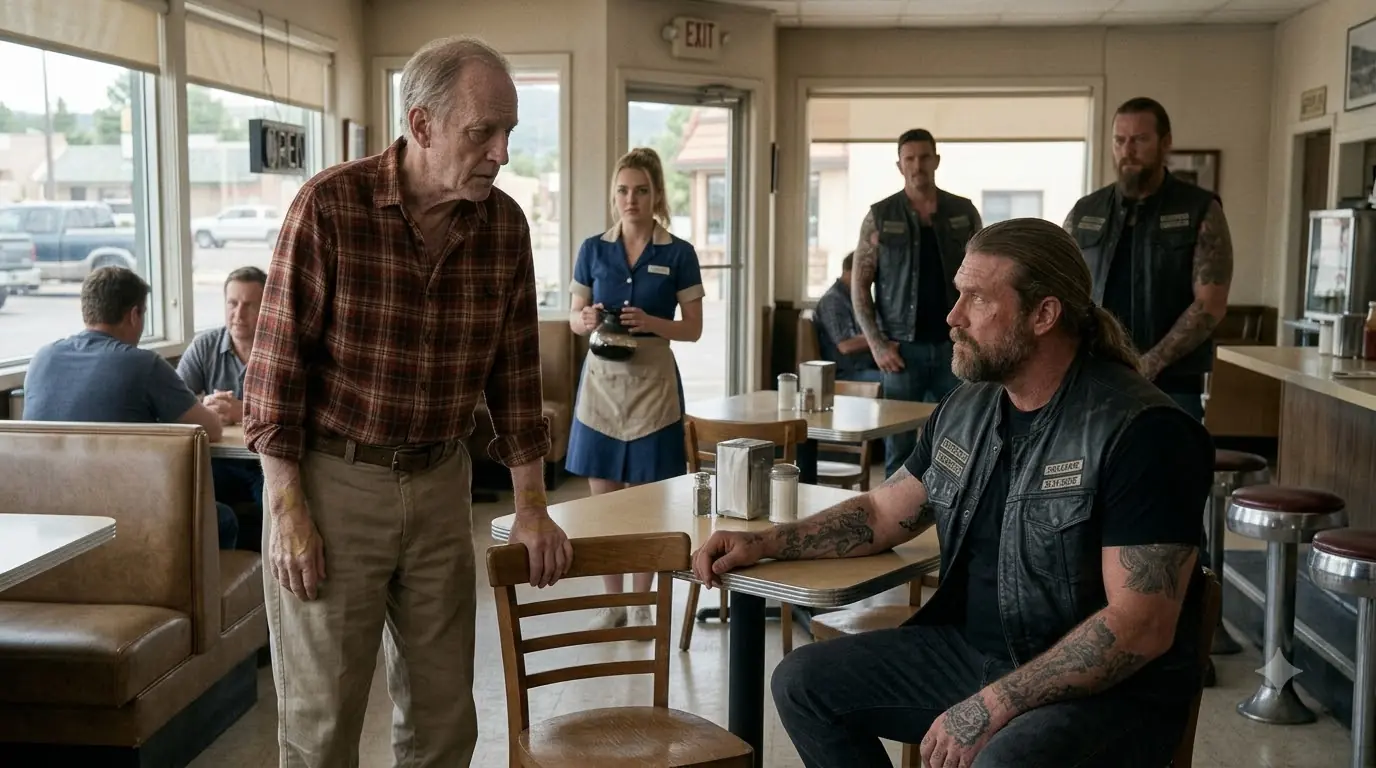
The last table belonged to a Hells Angels biker with fists like cinder blocks and eyes that missed nothing.
What Cole Mercer saw when Harold Bennett sat down, the grip marks, the flinching, the way he ate like someone who expected the plate to be taken away, set something in motion that would expose a crime so calculated, so quiet, so perfectly disguised behind Christmas cookies and a grandson's smile that an entire town refused to believe it until the lock was cut off the door.
Harold Bennett's hand was shaking when he pushed through the glass door of Mae's Diner. Not the kind of shaking that comes from cold weather. Not the kind that comes from age, either. This was something else. This was the trembling of a man who hadn't been outside in a long time.
A man who didn't know if he'd make it back before anyone noticed he was gone.
The lunch rush had already thinned out. A few truckers, a couple of locals nursing iced tea, a woman with two kids in the corner booth scrolling her phone while the younger one threw fries on the floor. Harold stood near the entrance for almost a full minute. Nobody looked up. He was 72 years old.
Thinning gray hair that hadn't been cut properly in months. A flannel shirt buttoned wrong, one side hanging lower than the other. Khaki pants too loose at the waist, cinched with a belt that had run out of holes. And a limp. A deep grinding limp on his left side that turned every step into a negotiation with pain.
But it was his eyes that told the real story. They moved too fast, scanning the room, checking the door, scanning again, like a man who expected someone to walk in and drag him back.
He spotted the first table. Two men, mid-50s, baseball caps, plates half cleared. Harold limped over. He stopped about 3 ft away, close enough to speak, far enough not to crowd. "Excuse me," he said.
His voice was quiet, careful, like he was testing whether it still worked. "Would it be all right if I sat with you?" The first man glanced at his buddy. The buddy didn't look up. "Sorry, pal."
"We're just finishing up." They weren't finishing up. Their coffee was still full. But Harold nodded like he understood, like he'd expected it.
He moved to the next table. A woman alone reading a paperback. "Ma'am, I'm sorry to bother you. Could I maybe sit here? I won't be any trouble."
She smiled. The kind of smile people give when they've already decided no. "I'm actually waiting for someone. Sorry." She wasn't waiting for anyone.
Her purse was on the opposite seat and she'd already settled her check. Harold nodded again. Third table. Fourth. Fifth.
Each time the same quiet request. Each time a polite deflection. Nobody was cruel about it. Nobody raised their voice or told him to get lost. They just didn't want to be involved.
Didn't want to sit across from an old man who looked like trouble had followed him through the door.
By the sixth table, Harold's limp had gotten worse. He was gripping the back of each chair now just to stay upright. His left knee buckled slightly every other step and he caught himself on the edge of a table hard enough to rattle the salt shaker. The seventh table said no before he even opened his mouth. "Sorry, buddy."
"Full up." There was one chair and one person sitting there. Harold stood in the middle of Mae's Diner and looked around. The room felt enormous. Every table occupied by people who'd already decided he wasn't their problem.
Except one. The last table. Back corner. Tucked against the wall where the overhead light had burned out months ago and nobody had bothered to replace it.
A man sat alone. Broad shoulders, mid-40s. Sunburned skin that said he'd been riding for days. Dark blonde hair pulled back and tied off. A jawline that looked like it had been set wrong after a fight and never corrected.
Arms that stretched the sleeves of a plain black T-shirt. And over that, a worn leather vest. The back patch was visible even from across the room. Hells Angels. The rocker underneath read Arizona.
Harold stared at that patch for a long time. Every instinct in his body told him to turn around. To limp back out the door and figure something else out. A man like that, a man wearing that patch, wasn't someone you approached. Not if you had any sense.
Not if you'd lived 72 years learning when to keep your head down. But Harold was out of tables. And he was out of time. He crossed the diner floor. Each step louder than the last.
Not because he was trying to be heard, but because his limp turned every footfall into a small collision with the ground.
The biker didn't look up when Harold stopped at his table. He was holding a coffee mug, black, no sugar, and staring at something on the far wall that probably wasn't there. His name was Cole Mercer. And Cole had learned a long time ago that you could tell more about a person by the way they approached you than by anything they actually said. He'd heard the old man circuit around the room.
Every polite refusal. Every shuffled step between tables. He tracked it the way he tracked everything. Without turning his head. Without changing his expression.
Without giving anyone a reason to think he was paying attention.
Cole had been riding with the club for 23 years. Vice president of the Flagstaff chapter. He'd buried friends. He'd sat in rooms where the wrong word got a man hurt. He'd stared down federal agents across interview tables and given them nothing but silence.
But he'd also sat with dying men in hospital rooms. He'd held a brother's kid during a funeral because nobody else would. He'd pulled over on a highway outside Tucson once because he saw a woman trying to change a tire in 112° heat with a baby in the backseat. The world saw the patch. Cole saw what was underneath it.
And right now, underneath the trembling and the bad limp and the shirt buttoned wrong, he saw something that made his chest tighten. Fear. Raw animal fear. The kind that doesn't come from being startled. The kind that builds over weeks, months.
The kind that rewires a person until they can't eat without checking over their shoulder. Harold cleared his throat. "Can I sit with you?"
Cole looked at him. Not through him. Not past him. At him. He studied the old man's face for exactly 3 seconds.
Then he did something that made the entire diner go quiet. He stood up. Not fast. Not aggressive. Slow and deliberate.
He reached across the table, pulled the empty chair back, and angled it so Harold wouldn't have to twist his bad leg to sit down. "Sit," Cole said. One word. No warmth in it. No hostility, either.
Just a statement of fact.
Harold sat. And for the first time in what looked like months, his shoulders dropped half an inch. The waitress came over. Young girl, maybe 22. Blonde ponytail.
Already nervous about approaching Cole's table. She set a menu in front of Harold. "What can I get you, sir?" Harold opened the menu and stared at it like he'd forgotten how to read. His fingers trembled on the laminated edges.
"Just some toast, please. And water." Cole watched him. "Get him eggs, too," Cole said without looking at the waitress. "Scrambled."
"And bacon. And more coffee." Harold looked up. "Oh, I can't. I don't have much on me."
"I didn't ask."
The waitress disappeared. Harold sat there with his hands in his lap, fingers interlocked, thumbs pressing against each other like he was trying to hold himself together from the inside out. "Thank you," he whispered. Cole said nothing. The food came.
Harold ate like a man who'd been rationing. Small bites. Chewing slowly. Swallowing carefully. Not the way someone eats when they're hungry.
The way someone eats when they're not sure the food won't be taken away.
Cole had seen that before. In men coming out of county. In people leaving situations they didn't have names for yet. He let Harold eat in silence. Didn't push.
Didn't ask questions. Just sat there with his coffee and let the old man have a meal in peace. It was Harold who spoke first. "I shouldn't be here." Cole set his mug down.
"Why is that?" "My grandson says I'm not safe to be on my own. Says I get confused, wander off." Harold paused. His jaw tightened.
"He tells people I don't know where I am half the time."
Cole listened. His eyes dropped to Harold's wrists. There it was. Yellow bruising. Circular.
Around both wrists, but worse on the left. The kind of bruising that comes from being grabbed, held, restrained. Not a fall, not an accident, not the normal wear of a 72-year-old body breaking down. Grip marks. Cole had seen those before, too.
"You get confused a lot?" Cole asked. His voice was flat, casual, but his eyes weren't casual at all.
Harold looked at him, and for the first time something shifted behind those eyes. A flicker of clarity so sharp it cut through every polite excuse he'd been trained to give. "I worked 31 years as a civil engineer," Harold said. "I can still calculate load-bearing tolerances in my head. I finished the crossword in the Flagstaff paper this morning in 11 minutes."
"I know exactly where I am, what day it is, and what I had for dinner three nights ago, which was half a can of soup because that's what was left." He paused. "I'm not confused. He tells people I'm confused. There's a difference."
The air between them changed. Cole felt it. That shift that happens when someone stops performing and starts telling the truth. When the weight of a lie they've been forced to carry gets too heavy and they set it down on the table between two cups of coffee and hope the other person doesn't walk away. "Who's he?"
Cole asked. "My grandson, Ryan." "Ryan got a last name?" "Caldwell. Ryan Caldwell."