The single father had only one bowl of stew for himself and his seven-year-old son. Yet every time Silas Thorne lifted the spoon, he gave the larger portion to the boy. 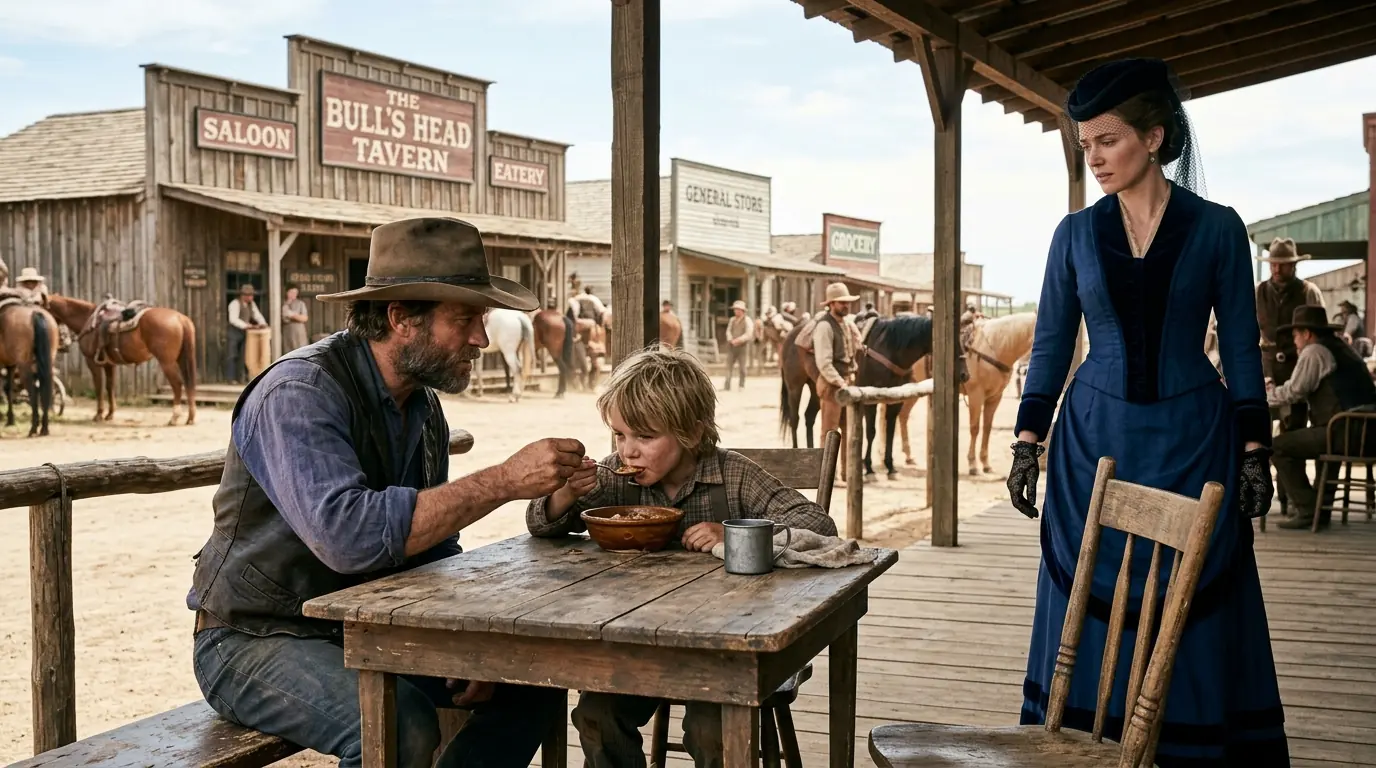
Eliza Montgomery watched from the wooden boardwalk of Abilene, Kansas in the summer of 1874. The sun was a white hammer beating against the dry plains. She had arrived in a deep blue morning dress that marked her as an outsider in this rough cattle town. She possessed enough wealth to buy half the town, yet none of it had filled the emptiness inside her. At that moment, she would have traded every dollar for the tenderness she saw at that poor man's table.
Silas wore a faded work shirt, his vest darkened by years at the forge. His hands were large and scarred, burned and stained with black grease that never quite washed away. Beside him sat Leo, a quiet boy with patched sleeves and tired eyes. There was only one bowl between them. Silas took a small, careful spoonful for himself, barely tasting the thin broth, and then he gave Leo a full, overflowing one.
The simple act stopped Eliza in her tracks. It reminded her of her own father, taking her back to the years before wealth and high society had shaped her life. Now she lived among grand rooms that never felt like home.
Around them, Abilene carried the fading scars of its cattle town years. Wagons rattled past on the dusty street, the dry wood of the buildings creaked in the wind, and railroad whistles echoed beyond the heat-warped rooftops. Dust drifted through the suffocating summer air, yet the small table felt untouched by the noise around it.
Eliza stepped closer, the silk of her dress whispering against the rough wood of the boardwalk. Silas tore the softer part from a piece of bread and placed it gently beside his son's bowl, keeping the hard crust for himself.
Then, Leo noticed her. His wide eyes moved from her fine blue dress to the empty chair beside them. Silas finally looked up. His gray eyes held no greed and no expectation; he looked at her as though she were simply another tired traveler searching for shade.
Eliza placed one gloved hand on the back of the empty chair. "Can I sit with you?" she asked, her voice soft, barely a murmur above the wind.
Silas studied her for a moment, his gaze steady and honest. He saw the sadness hidden behind her expensive veil. "It's a public table, ma'am," he said. "But you're welcome to the company."
For the first time in years, Eliza smiled without forcing herself. The tension in her chest eased. "No," she said softly. "I'm only a woman who would rather not eat alone."
Silas had seen many faces in Abilene. He had seen the faces of desperate gamblers and weary pioneers, the hard eyes of lawmen, and the hollow eyes of the hungry. But the woman before him was a mystery—a lady of high standing in a town of low spirits.
Silas moved the bowl slightly toward the center. "We don't have much," he said. "But what we have, we share."
From the careful way Silas measured every spoonful, Eliza suspected it was their only meal that day. The Panic of 1873 had emptied banks across the nation, closing businesses and leaving working families struggling across Kansas. At this table, the hardship had a face.
The heat shimmered off the street, making the distant cattle pens look like a mirage as the smell of manure and dry earth hung heavy. The silence between them was not awkward; it was a shared moment of rest.
"I am Silas Thorne," the man said, breaking the silence. "And this is Leo."
"I am Eliza," she replied. She did not offer her last name, not wanting the shadow of her late husband's shipping empire to fall on this humble table.
Silas watched his son eat for a moment. Leo was meticulous, making sure not to drop a single crumb of the precious bread. The boy's hands were small, but already calloused from helping his father.
"This town has seen plenty of men chasing easy money," Silas continued, looking directly at her, his eyes seeming to see through the layers of her fine blue silk. "Not many stop to notice what it costs them. But you don't look like you came here searching for money. You look like you lost something it couldn't buy back."
Eliza felt a sharp sting in her eyes. The truth of his words cut through her carefully built defenses. She looked down at the scarred wood of the table, its surface marred with knife marks and old stains. It reminded her of the Illinois farm where she had grown up. She remembered the smell of rain on dry soil and the sound of her father's laughter before the world grew complicated—before the great city swallowed the quiet countryside, and before the stress of wealth took the color from her mother's cheeks. She remembered a time when a single loaf of bread was a feast.
After the Great Chicago Fire destroyed her father's warehouses, her world had changed. The fire had been a monster of orange and black, swallowing everything they owned in a single, terrifying night and nearly ruining his entire business. The family had been forced to sell their precious land, but no ordinary buyer would touch it during the crisis. Speculators were circling like vultures, offering pennies for their heritage. They were days away from the street when an anonymous stranger paid twice what the property was worth.
That money kept her family from losing everything. The sale had kept her father from the cold, allowing him to rebuild from the ashes. In ways Eliza had never understood, that unknown buyer had made every later chapter of her life possible. Years later, Eliza married into wealth and moved into a house with twenty rooms, but comfort had never erased the memory of the stranger who saved them. She had spent thousands of dollars and hundreds of hours trying to find that man just to thank him, to know why he had been so kind.
"The past is a heavy pack to carry," Silas said quietly, seeming to read her thoughts without effort. "Sometimes you have to set it down just to keep walking."
Leo reached into his pocket and pulled out a small, hand-carved wooden horse that was smooth from years of use. He began to gallop it across the table toward Eliza's hand.
"He likes you," Silas said, a hint of a smile touching his eyes. "And the boy is a better judge of character than any lawman I know."
Suddenly, a shadow fell over the table. A man in a sharp, expensive suit stepped onto the porch. It was Mr. Sterling, whom Eliza knew from the predatory business circles of the city. He was a man who grew rich while others grew thin, smelling of imported tobacco and expensive cologne. He carried himself with the confidence of a man who believed money excused everything.
"Mrs. Montgomery!" Sterling exclaimed, his voice dripping with false concern. "What on earth are you doing at this sordid arrangement?" He looked at Silas with pure disgust, then at the bowl of stew as if it were a tray of poison.
Eliza felt her spine turn to cold steel, the weight of her family's history anchoring her. "I am having a meaningful conversation, Mr. Sterling," she said coldly. "A concept I am quite certain is foreign to your nature."
Sterling sneered, looking down his nose at Silas as he adjusted his silk tie with a manicured hand. "You there, blacksmith! She could buy your miserable little life and forget she owned it by dinnertime."
Silas didn't flinch. He didn't even stand up to meet the man's gaze, keeping his large hand on the table near his son. "I know she's a woman who asked for a seat at my table," Silas said. "In my world, that's all I need to know about a person."
Sterling laughed, a sharp, ugly sound that echoed off the dry, wooden walls of the store. "She's a benefactor, you fool. She throws crumbs to the poor to ease her own conscience."
Leo pressed closer to his father, unsettled by the man's harsh voice and looming presence. Silas's jaw tightened, his muscles, forged by years of striking iron, coiling like springs as his hand moved to the boy's shoulder to shield him.
"You have insulted a good man in front of his child," Eliza said, her voice low and dangerous—the voice of a woman who had survived the fire and the fallout. "Leave this porch, Mr. Sterling. If you speak to them that way again, every investor in St. Louis will learn exactly what kind of man you are. I will make sure your credit is as dry as this Kansas dust."
Sterling's smile faded. He knew the power Eliza held in the boardrooms. He tipped his hat stiffly and walked away, his boots clicking loudly on the boardwalk.
But the damage to the moment was done. The fragile peace of the table had been shattered. The heat seemed more intense now, the dust more invasive. Silas looked down at his rough, stained hands.
"Men like Sterling will use you to wound anyone standing beside you," Silas said quietly. "I can endure his contempt, but I won't let Leo grow up believing he deserves it."
He stood up slowly, his movements heavy and tired as the weight of the world seemed to settle back onto his shoulders. "Thank you for treating my boy with kindness," he said to Eliza. "He won't forget it."
Silas took Leo's hand and led him away. Eliza stood there alone, the Kansas sun burning her silk-covered shoulders as she watched them disappear into the swirling, dusty crowd. She felt a hollowness in her chest that no bank account could fill.
Reaching into her small, embroidered silk bag, she looked for a handkerchief to wipe the dust from her eyes. For years, she had carried a folded, yellowed receipt with her whenever she traveled—a reminder of the kindness that had saved her father. As she pulled out the handkerchief, the old document slipped to the floor. The wind caught it for a second before she stepped on it.
She picked it up and studied the faded, brittle brown writing. At the bottom were two initials she had traced a thousand times: *S.T.* Beneath them was a small mark she had never understood before—a tiny outline of a blacksmith's hammer.
Eliza's breath caught, her heart hammering against her ribs. Silas Thorne, a blacksmith. The initials were not absolute proof, but for the first time, they felt like a path toward the truth. It seemed impossible. The man she had just sat with was struggling to buy a single meal, barely able to afford one bowl of stew. How could a poor blacksmith have once paid enough to save her family? Where had that fortune gone? And why was he living in such poverty now?
Eliza needed more than initials; she needed the truth from him. She spent the night in the best hotel Abilene had to offer, but the velvet curtains and soft bed felt like a prison. She could only think of the man and the boy.
For three days, Eliza searched the roads beyond Abilene. She hired a small carriage and drove through the oppressive heat, questioning stable hands, wagon drivers, and anyone who knew the land outside town. She went to every blacksmith shop within ten miles, ignoring the dust that ruined her expensive dresses and the whispers of the townspeople who wondered why a rich widow was roaming the outskirts.
At last, a stable boy directed her toward a small forge beside the creek, tucked away behind a grove of thirsty cottonwood trees. Before she left the town limits, the sheriff gave her one quiet warning. "Silas doesn't speak much about his past," he said. "But when something in this town breaks, he's the man people trust to mend it. He's got a heart of gold, but a life of iron."
Eliza drove her carriage toward the edge of the wilderness, finding the forge near a winding creek where the water was low, barely a trickle over the stones. The sound of rhythmic, metallic clanging filled the air. *Clang. Clang.* It was the heartbeat of the frontier.
She walked toward the orange glow of the forge. The heat inside the small building was intense, smelling of sulfur, coal, and hot metal. She saw Silas through the wide door, his sleeves rolled above his elbows and his work shirt clinging to his back with sweat. His muscles rippled as he lifted the heavy hammer, bringing it down with steady, practiced precision, each strike sending a shower of sparks into the air.
Leo was sitting nearby on a pile of fresh hay, reading an old, tattered book. The boy looked up and saw her, his face lighting up with a recognition that warmed her soul. "Dad, the princess, she came back!"
Silas stopped his hammer mid-swing, wiped his brow with a grimy rag, and turned slowly around. He looked surprised, but his eyes remained calm.
Eliza held out the old, yellowed receipt with a shaking hand. She didn't speak; she couldn't.
Silas glanced at the faded initials, and his expression changed as the hardness of the blacksmith melted away. A shadow of memory crossed his face—a look of deep, ancient recognition. Then he looked directly into her eyes.
"I was a very young man then," he said softly, the roar of the forge seeming to fade into the background. "I had just returned from the silver mines in Nevada. I had struck a small vein of luck. I had money, but no family and no idea what to do with either my grief or my fortune."
Eliza moved closer, no longer caring about the soot on her blue silk dress. "Why my family, Silas?" she asked. "Why did you pay double for a failing farm? You didn't even know us."
Silas took a deep, shaky breath and set his hammer down on the anvil, the metal clinking softly. "Your father probably never remembered me," Silas said. "But I never forgot him. Years before that, I was ten years old and hungry on a Chicago street. My mother had passed and my father was gone. I tried to steal a loaf of bread from a shop on the corner, and the baker caught me and called for the police." Silas lowered his eyes. "I was terrified. I thought my life was over before it began. But your father was standing there. He paid for the bread, then he bought three more loaves and gave me a silver dollar."
Eliza covered her mouth with one gloved hand, seeing her father's face clearly in her mind.
"Before he walked away," Silas continued, "he told me, 'Don't let a hard world turn your heart to stone.' I built my life around those words. When I had that silver from the mines, I heard about the fire. I heard about the man who helped me losing everything, and I couldn't let that happen. I didn't want him to know it was me; I just wanted to pay the debt."
Eliza looked around the small, humble forge—a place of hard work and little profit. "What happened to the rest of the money?" she asked. "You should be a wealthy man, Silas."
Silas rested both hands on the edge of the anvil. "Most of it went into land, tools, and helping a few families who had nowhere else to turn," he said. "I didn't need much." His eyes moved toward Leo with a tenderness that was heartbreaking. "Then my wife, Clara, became ill. She was the light of this shop. I spent whatever remained trying to save her. I brought doctors from the East; I bought every medicine they suggested." He paused, the memory heavy. "After she died, I placed my last savings in a local bank. I wanted to make sure Leo would have a future. Then the Panic of 1873 closed its doors, and the bank vanished overnight. All I had left were my tools, this forge, and my son."
Eliza's voice softened, feeling a connection to this man that went far beyond gratitude. "And you never regretted helping my father, even when you were down to your last bowl of stew?"
"Not once," Silas said. "Losing money hurts. Losing the man you chose to be hurts more. Money is just metal, Eliza. Kindness is the only thing that doesn't rust."
Eliza felt the tears finally spill over. She had spent her life thinking her father's salvation was random luck, a stroke of fate, but her entire life was built on a simple act of kindness. It was a circle that had finally closed.
"I've spent so much time being the widow Montgomery," she said. "I've been a name on a bank account. I've been a guest at parties I hated. I think I forgot how to be just Eliza."
Silas walked over to her, stopping just inches away. He smelled of smoke and the forge. "You haven't forgotten, Eliza," he said. "You just needed a quiet place to sit and remember who you were. You found it at a table with a bowl of thin stew."
Over the next several weeks, Eliza returned to the forge again and again, leaving the town hotel behind. At first, the town called it curiosity, then people began calling it a scandal—the rich woman and the poor blacksmith. But Eliza didn't care about the whispers. On some mornings, she arrived with breakfast, bringing fresh eggs and thick bacon, staying only long enough to hear Leo read a page aloud from his book. On others, she sat quietly while Silas worked, watching the way he shaped the iron and fixed things that others threw away. The rhythm of the hammer became the heartbeat of her days. She made sure there was always enough food from the market for two bowls, and their affection grew through these shared meals and small kindnesses, grounded in the comfort of being understood without explanation. She told him about the riverboats of St. Louis, the whistles along the Mississippi, and the crowded streets she no longer missed.
One afternoon, a group of prominent ladies visited her hotel, led by a Mrs. Gable, who guarded social rules more fiercely than she guarded kindness. She wore a hat that looked like a bird's nest and a permanent frown.
"Eliza, darling," Mrs. Gable said, fanning herself. "The entire town is talking about your associations. You are seen at that dirty forge every day. It is causing irreparable damage to your reputation. Think of your late husband's name."
Eliza looked at these women with a sense of pity, seeing the judgment hiding beneath their polite smiles and the sheer boredom in their eyes. "My husband was a man of immense honor," Eliza said. "And if he were here today, he would be at that forge working right alongside Silas. Silas Thorne is a better man than any of the cowards I've met in your parlors. He knows what it means to give when he has nothing. If my reputation is damaged by associating with a man of character, then it wasn't a reputation worth having." She showed them the door and didn't look back.
For the first time, Eliza understood what her wealth was truly meant to do. It wasn't for silk dresses or fine hotels; it was for building something that lasted.
But life on the American frontier was never easy, and the wind could change in an instant. Near the end of summer, a heavy, lung-clogging fever spread through several homes along the creek. Leo woke one morning feverish and weak, his face flushed, exhausted by merely sitting upright. Silas was frantic. He could fight a fire and bend iron, but his strength was useless against an invisible enemy. The town doctor had more patients than beds and very little medicine left; the apothecary shelves were nearly empty.
Eliza didn't hesitate for a single second, using her wealth like a shield. She sent an urgent telegram to a physician in Junction City, paying the railroad to place him on the earliest westbound train. Then she moved Leo into the coolest room of her hotel suite, hired an experienced local nurse to help care for him, and bought every block of ice the town had to keep the boy's fever down.
For three long days, Eliza and Silas slept only in brief turns, holding Leo's small, burning hand. Silas sat in the plush hotel chairs looking completely out of place, his soot-stained clothes contrasting sharply with the white linens. He didn't care about the stares from the hotel staff; he only cared about the rise and fall of his son's chest.
"I should have given him a better home," Silas whispered one night in the dim room. "A room away from the heat. A bed that wasn't beside the forge. I failed him, Eliza."
Eliza put her hand on his broad shoulder. "You gave him your unconditional love, Silas. That is the only foundation that matters. You gave him a father he can be proud of. Now let me help you with the things that money actually can buy."
At dawn on the fourth day, Leo's fever broke. The sweat turned cool on his brow, and he opened his tired eyes, looking at the fancy ceiling and then at his father. He whispered, "Do we have any bread?"
Silas bowed his head against the bed and wept, the sound of his relief filling the quiet room. Eliza turned toward the window, unable to hide her own tears as she looked out at the rising sun. It was a new day for all of them.
When Leo was finally strong enough to walk, Silas came to Eliza on the high balcony of the hotel. Below them, Abilene was waking up, wagons moving as the town bustled with life.
"I can't stay in your world forever, Eliza," Silas said softly. "I am a man of the forge. I belong to the fire, the earth, and the hammer. I can't be the man who sits in parlors and talks about interest rates."
Eliza looked at him and saw that he meant every word. He was as solid as the iron he worked. "Then I will come to yours," she said.
Silas blinked, his voice failing him as he looked at her fine jewelry and soft hands. "You would give all of this up? The silk? The servants? The comfort of the city?"
Eliza smiled, and it was the most beautiful thing he had ever seen—a smile of true freedom. "I will use part of it to help build a school for Leo and the other children. I want to see books in every hand. And one day, I want Abilene to have a proper clinic—a place where no father has to feel helpless again. But I don't need the rest of it for myself. I just need my seat at your table, Silas, even if there is only one bowl."
Silas reached for her slowly, giving her time to step away if she chose, but Eliza moved straight into his arms. He smelled of charcoal, soap, and the open Kansas air, and his embrace was the first place that had felt like home in years.
"It's a rough life," he warned her. "The winters are bitter, and the dust never really goes away."
"But there will always be enough for those who knock at our door," Eliza said, "as long as we keep our hearts soft."
They were married a month later as the heat of summer began to fade into autumn. The air grew crisp and the leaves turned to gold. Not everyone accepted her choice; the socialites of St. Louis were horrified, two businessmen withdrew their offers to manage her investments, and several families stopped inviting her to their homes, calling her "the blacksmith's bride" with a sneer. Eliza signed each letter of rejection without a shred of regret. She didn't need their validation. Silas offered more than once to step away, not wanting her to lose her status, but each time she gave him the same answer: "A life that requires me to be ashamed of you is not a life I want."
They stood under the shade of a massive oak tree by the creek for the simple ceremony. Mr. Sterling did not attend, though neither Silas nor Eliza noticed his absence.
They built a life that eventually became a legend in Kansas. They built the Thorne house—not a mansion, but a home with a wide porch where the doors were never locked and a fire was always burning in the hearth. Anyone who was hungry could find a bowl of hot stew, and anyone who was lost could find a hand up. Eliza traded her fine silk for sturdy cotton, learning to garden and prepare simple remedies. She became the woman she was always meant to be, assisting the town doctor when families needed care and becoming a beacon of hope for the pioneers.
And Silas kept working at his forge, his hammer ringing out every morning. He was no longer the man who ate in silence; he was a man who helped build a community. Together, remembering the Panic of 1873, they helped many struggling families in Abilene keep their land by becoming secret, anonymous buyers. When a farm was on the verge of foreclosure, the debt would mysteriously vanish, passing the seed of kindness forward just as Eliza's father had once taught Silas.
Leo grew into a beloved teacher, a man of books and wisdom. In his classroom, he kept the small wooden horse on his desk as a reminder of the day he pushed it across a table toward a lonely woman in a blue dress. He taught his students that wealth could disappear in a single night and that fire could take everything you own, but that character remained.
Years later, Silas and Eliza still spent summer evenings on the wide porch. The sunsets in Kansas were still a marvel, and they shared simple meals while the sky turned purple and gold. Sometimes, Eliza would glance at the empty chair beside them and remember her very first question: *“Can I sit with you?”*
Silas would reach for her hand. His grip was still strong, though his skin had grown like parchment. She had once believed she was asking for a chair; in truth, she had been asking for a home. And beside a blacksmith who had kept his heart soft, she had finally found one.
Silence fell over the porch as the sun dipped below the horizon and the stars began to blink in the vast Kansas sky. Silas squeezed Eliza's hand. "Ready to go in?" he asked.
"Yes," she whispered. "I'm finally home."