An Airbus A320 is plunging through a violent storm at 37,000 ft. The captain slumped over the controls, his heart stopped. The co-pilot's hands are shaking too badly to grip the yoke.
174 passengers are screaming in absolute hysteria. And the only person stepping forward is a skinny 16-year-old black boy in a worn-out t-shirt.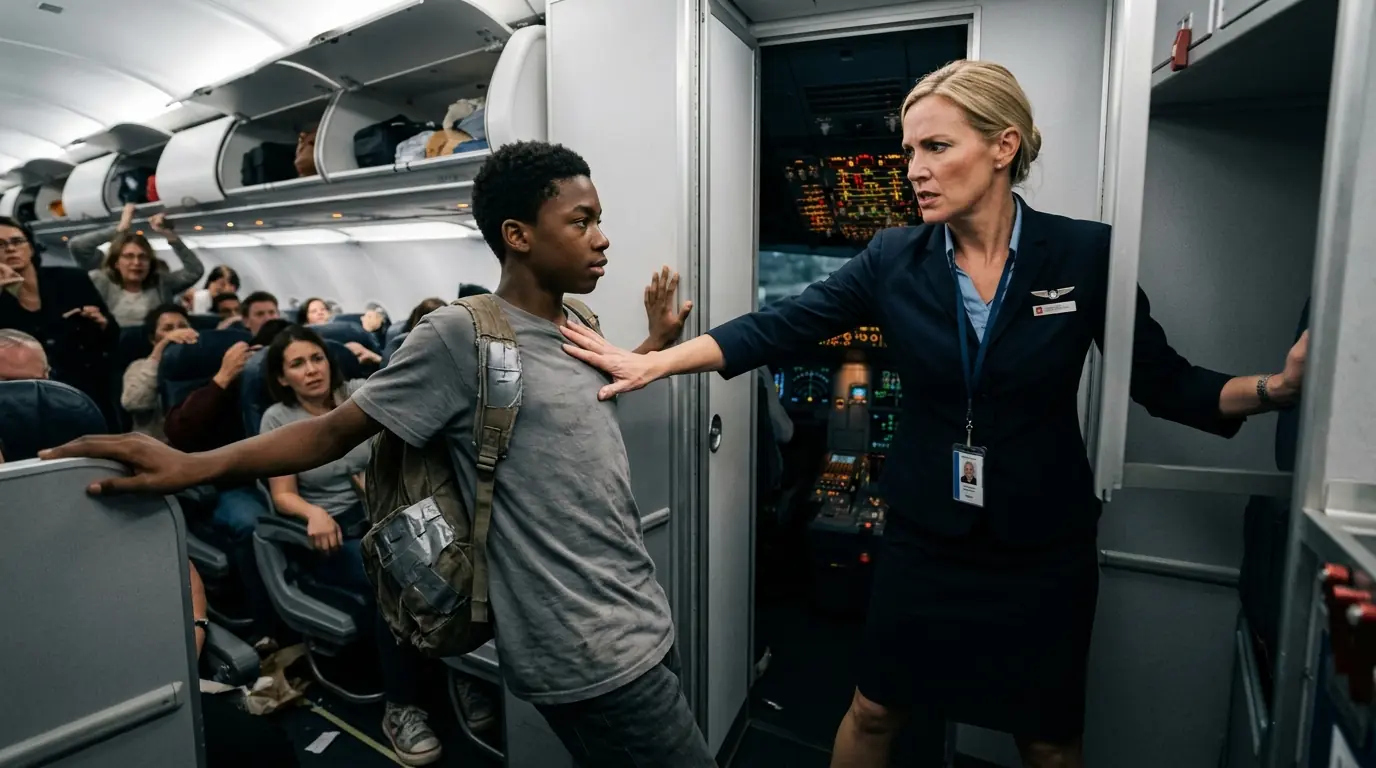
But before he can reach the cockpit door, a flight attendant shoves him backward and hisses, "Disgusting little rat. A filthy little brat like you dares to rush into the cockpit? You want to kill everyone faster? Is that it?"
He does not flinch. He just looks her straight in the eyes—calm, steady.
She has no idea who this boy really is. And when she finds out, she will collapse to her knees in tears.
How did a homeless black orphan become the last hope for flight 2136?
Miami, Florida: a city of sunlight, cruise ships, and million-dollar condos lining the coast. But 14 miles from those glittering beaches, tucked behind a row of check-cashing stores and a laundromat with a broken sign, sits the Overtown neighborhood, one of the oldest and poorest black communities in the American South.
This is where Benjamin Townsend grew up, if you can call it growing up.
Benjamin never knew his father. His mother, Lorraine Townsend, was a 20-year-old waitress who died of pneumonia when he was four. She could not afford the hospital bill, waited three days before going to the emergency room, and by then her lungs were already drowning.
Benjamin remembers only one thing about her: the smell of cocoa butter on her hands when she held his face and whispered, "Baby, you are going to fly someday."
He was too young to understand, but those words buried themselves deep in his chest and never left.
After Lorraine died, Benjamin entered the foster care system: 12 years, seven homes. Some were neglectful, some were cruel. In one, the foster father locked him in a garage for 2 days over a broken plate. In another, the foster mother collected the checks and fed him canned beans and stale bread.
By 13, Benjamin had learned one rule: nobody is coming to save you.
But he had something no foster home could take: an obsession with the sky.
It started at age six when a commercial jet flew low over Overtown. The roar shook his ribs. The silver belly reflected the sun like a second god passing overhead. He stared until his eyes burned. From that moment, something locked onto the sky like a compass finding north.
He spent every free hour at the Miami Public Library: aircraft manuals, aerodynamics textbooks, pilot memoirs. The librarian, an old Haitian woman named Mrs. Colette, once found him asleep at closing time with his face pressed against a copy of Stick and Rudder. She did not wake him, just draped her cardigan over his shoulders and let him sleep.
By 14, Benjamin could identify any commercial aircraft by silhouette. He knew the fuel capacity of a Boeing 787, the crosswind limit for an A320, the exact sequence for an emergency engine shutdown. He memorized cockpit recordings from YouTube—every callout, every checklist. His foster siblings thought he was insane. His teachers ignored him. Benjamin did not care. The sky was the only place he belonged.
Then at 15, everything changed.
A retired Air Force captain named Earl Davis walked into the Overtown Community Center. Captain Davis was 71, dark-skinned, silver-haired, back straight as a flagpole. He had landed a C-130 on a dirt strip in Afghanistan under enemy fire. Earned the Distinguished Flying Cross, 32 combat missions. Now he ran a tiny volunteer aviation club for underprivileged kids that no newspaper covered, no politician funded, and no donor noticed.
The first time Davis met Benjamin, he gave the boy 10 questions about flight instruments. Benjamin answered all 10 in under 2 minutes. Davis asked 10 more. Benjamin answered those, too.
Davis leaned back, folded his arms, and said, "Boy, who taught you all this?"
Benjamin replied, "Nobody, sir. I taught myself."
Davis was quiet for a long time. Then five words that changed everything: "I am going to teach you."
Over 14 months, Davis trained Benjamin on a full-motion A320 simulator donated to the community center: 212 hours, every weekend, every holiday. Davis taught him not just how to fly, but how to think. Stay calm when instruments scream. Trust your hands when eyes fail. Breathe when the world falls apart.
Before their final session, Davis gave Benjamin a hand-carved wooden model of an A320 with five words etched into the belly: The sky doesn't care what color you are.
Benjamin kept that model in his backpack every single day—the only thing he owned that meant anything.
Now at 16, Benjamin has won a STEM scholarship. The organization is flying him from Miami to Chicago for orientation at a prestigious aviation academy. His first time on a real airplane.
Gate B22, flight 2136, seat 34F, last row. Cheapest ticket, the seat nobody wants.
He walks through the gate in a faded gray t-shirt, secondhand sneakers, and a backpack held together with duct tape. He is smiling. He does not know that in less than 3 hours, everything about this flight and his life is about to change forever.
The moment Benjamin steps onto the jet bridge, he feels it: a shift in the air, a silent wall of judgment.
The businessman in front of him glances back, looks him up and down, then pulls his carry-on closer to his chest as if something might go missing. A mother nudges her daughter to the other side. No one says a word. No one has to.
Benjamin keeps his head down and walks to row 34.
Seat 34F is wedged against the window in the last row, right next to the lavatory. The seat does not recline. The overhead bin above it is already stuffed with someone else's luggage. Benjamin does not complain. He slides in, places his backpack on his lap, and presses his forehead against the cold window.
Outside, the ground crew is loading bags in the rain. He watches them and thinks about Captain Davis, about the simulator, about Chicago. For the first time in his life, something good is happening.
Then he hears a voice: "Excuse me."