She had $800 million and a legal team that billed by the hour. That night, she wore a borrowed coat and sat on a cold stone step with an empty paper cup. Not because she had to, but because she needed to know exactly who Owen Merritt was before she changed his life. He was a single father heading to his first date in three years.
He had no idea the woman shivering outside that restaurant door was the one person who could give him back everything that had been stolen from him. He stopped to buy her coffee. That single act undid everything. What happens when one small act of kindness destroys a 10-year plan and quietly builds something no one expected?
Three years had a way of making ordinary things feel monumental. Owen Merritt had not disappeared from the world. He had simply traded one version of it for another. He ran a small construction outfit now: four workers, modest contracts, nothing that made the business section of any newspaper.
He paid his bills on time. He picked Nate up in the afternoon and made dinner most nights from whatever was left in the refrigerator. The boy was thriving, or close enough to it that Owen told himself so on the hard evenings. There had been a different life before this one.
Owen had been 26 when he signed on with Vantage Design Group as a senior infrastructure architect. The kind of job that felt, at that age, like the beginning of something large. He was talented, and he knew it. But he wore the knowledge lightly, which was part of what made people want to work with him.
He had married Claire the following spring. She was a schoolteacher with a laugh that arrived without warning and stayed longer than the joke. When she was diagnosed during her second pregnancy, Owen threw himself into the Kessler project with the specific focus of a man who needs somewhere to put the parts of himself that can’t be useful at a hospital. He worked nights. He worked weekends.
He worked on a laptop Claire had bought him for his birthday at a desk in their apartment while she slept in the next room. The Kessler Riverfront proposal was the best thing Owen Merritt had ever built. He knew it the way a craftsman knows when a joint is true. Not from pride, but from the quiet certainty of something that fits the way it was designed to fit.
He submitted it to Dominic Ashford in the third week of November, 14 months after he started. Dominic had thanked him by email and said very little else. Three weeks later, Claire was gone. Six months after that, Owen sat in a conference room and watched Dominic Ashford accept an award for a project that bore no trace of his name.
His lawyer had read clause 7.4 aloud in a voice that carried no editorial opinion. Owen had nodded. He had a 4-year-old at home. He had no money for a legal fight he was told he could not win.
He had nothing left to spend on anger. So he folded it away: the design, the work, the 14 months, the laptop still sitting in a box in the closet, and he learned to build smaller things. Mrs. Ellison from next door sat with Nate when Owen had late jobs, and tonight she had arrived at 7:00 with a foil-wrapped plate of cookies she claimed were for herself but left on the kitchen counter. Owen had written her a thank-you note he knew she would find embarrassing.
That was the world he had built. Small, deliberate, held together with the kind of care that doesn’t ask for applause. Lucas Webb had spent three weeks working up to the ask. He was the last friend Owen had kept from the old life, the same easy, insistent Lucas who had once talked Owen into every questionable decision of his mid-20s and seemed to believe that continued qualification.
“Her name is Madison,” he’d said over the phone with the tone of a man presenting a business proposal. “Lifestyle blogger. Nice person. Just dinner.”
Owen had said no twice and yes once, and here he was. He stood in front of the bathroom mirror that morning and attempted a tie. The last time he’d worn one was at Claire’s funeral. He took it off.
He left the collar open. Nate approved with a single nod. The tie that didn’t happen and the open collar were still on Owen’s mind when he turned onto the block where Alderton sat behind its amber windows. The restaurant was not his kind of place.
Ninety dollars a plate. Cloth napkins folded into unlikely shapes. But Lucas had made the reservation and paid the deposit before Owen could protest. The city pressed in from every direction.
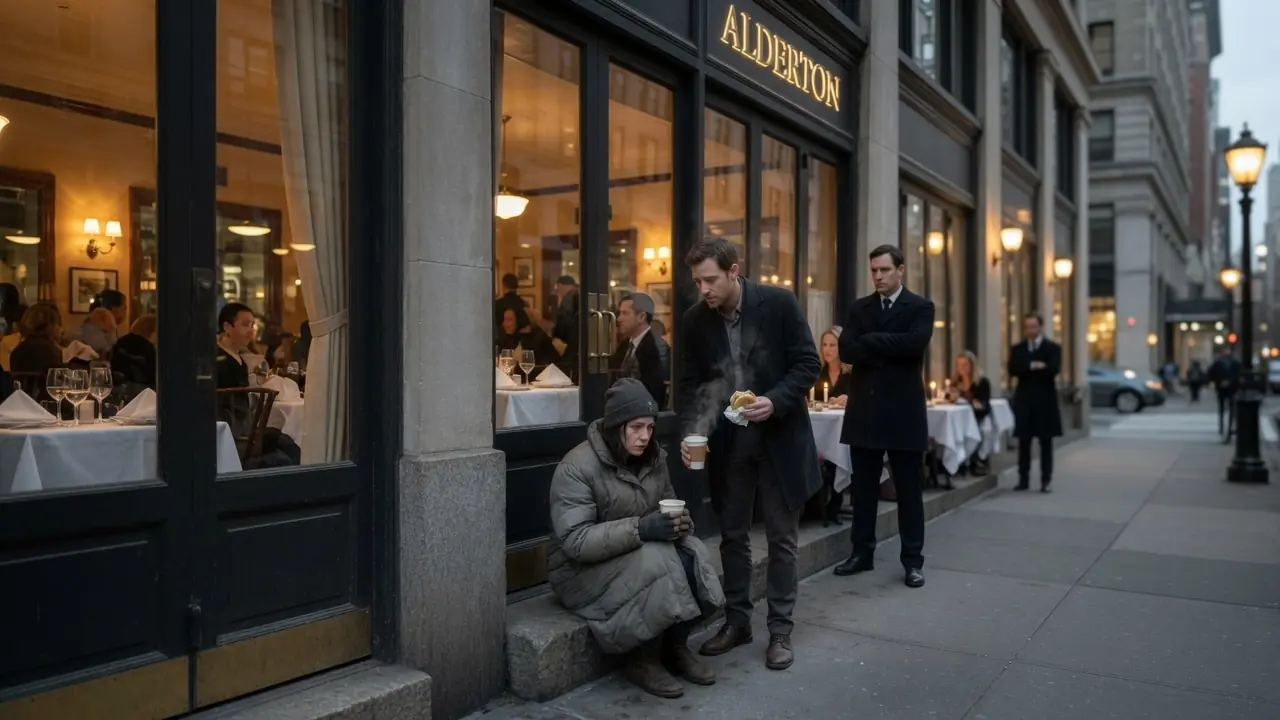
Halfway down the block, without thinking about it, Owen slowed. She was seated on the stone step outside the restaurant’s entrance, folded into a gray puffer coat that had seen too many winters, a knit hat pulled low, an empty paper cup balanced between her knees. The security guard by the door had positioned himself at an angle that suggested a third warning was already being composed. Owen watched for a moment.
Then he turned and walked 30 meters to a street cart, came back with a large coffee and a foil-wrapped sandwich, and set both down beside her without ceremony.
“Cold tonight,” he said. “More than the forecast.”
Then he straightened up and reached for the door. He did not ask her name. He did not wait to be thanked. He did not perform the gesture.
He simply did it and moved on, the way a person does when kindness is a reflex rather than a production. What he could not have known, standing there for those 15 seconds, was that the woman beneath the hat was watching him with the focused attention of someone whose job required her to see exactly what people did when they thought no one important was watching. Her name was Giselle Harmon. She was 28 years old and the chief executive of Harmon Capital Group, a real estate investment firm managing a portfolio worth $800 million.
The reason Giselle Harmon was sitting on a cold sidewalk outside a Manhattan restaurant in a borrowed coat was a name she had spent the better part of eight months building a legal case around: Dominic Ashford. Ashford was the chief executive of Vantage Design Group, a firm that had parlayed a single celebrated project into a decade of lucrative city contracts. That project, the Kessler Riverfront development, a 3.2-kilometer reimagining of the East River waterfront, had been presented to the city council by Dominic Ashford with his name on every page of the proposal. It had earned Vantage $120 million in initial contracts, with further consulting fees pushing the total considerably higher over the years that followed.
Dominic Ashford had accepted an urban design excellence award for it. His photograph appeared in architectural journals. His name was attached to the project in every public record. The name Owen Merritt appeared nowhere.
Giselle’s legal team had found the discrepancy eight months ago, buried in a backup server archive that Vantage had failed to properly wipe during a routine system migration. The metadata on the original design files was intact. The primary author field read O. Merritt. The timestamp predated Ashford’s presentation to the city council by 14 months.
Fourteen months of late nights and personal equipment and the particular obsessive focus of a man who genuinely believed in what he was building. She had tried twice to contact Owen through intermediaries. Both times, he had gone quiet, not hostile, just unreachable in the way of a person who has learned that certain doors lead nowhere and has stopped trying them. So she had done what her legal team had strongly advised her not to do, and she had come herself.
Not as Giselle Harmon, CEO. As a problem she needed to understand from the ground up. The problem tonight was Madison Clark. Two weeks earlier, Giselle’s investigators had traced Madison to Dominic Ashford through three layers of business connections that were not accidental.
Ashford had paid a lifestyle event coordinator $2,000 to introduce Madison to Lucas Webb at a networking event. Lucas, who meant well and understood very little of what was actually happening, had brought Madison to Owen as a favor. Inside Madison’s black leather bag, according to the same investigators, was a document Giselle’s team had identified as a termination of claims agreement. Owen would receive $15,000 in exchange for permanently waiving any intellectual property claims against Vantage Design Group related to the Kessler project.
Fifteen thousand dollars paid once to close a door that was worth, depending on how the litigation went, something between several hundred thousand and several million. Giselle shifted on the stone step. She held the coffee cup Owen had left her and felt the warmth travel up through her palms. She had been watching through the glass since he walked in.
The way he pulled Madison’s chair before sitting. The way he held his water glass when he listened. The way his shoulders had gone carefully still when Madison said something that landed wrong. She couldn’t hear the words.
She could read the posture. She had spent 15 years learning to read posture across boardroom tables. And what she saw in Owen Merritt’s body language was not a man who was naive. It was a man who was tired.
Tired was more dangerous than naive. Inside, the dinner had the surface texture of something pleasant. Madison Clark was good at her work. Owen would give her that, though he didn’t know yet that it was work.
She asked the right questions with the right timing, leaving just enough silence for Owen to fill if he chose to. She had ordered the duck. She had a story about a trip to Lisbon that was probably true. She was warm and attentive, and her dress was the color of a good Bordeaux.
And for approximately 45 minutes, Owen Merritt allowed himself to simply be a man having dinner with a woman who seemed to like him. Then she mentioned Kessler Riverfront, urban architecture. It was delivered as an aside, a casual pivot mid-sentence, the way a skilled angler changes lures without making a show of it.
“I read about the Kessler project once,” she said, reaching for her wine. “The riverfront one. That was Vantage Design, right? Incredible work.”
Owen set his glass down. He did not say anything immediately. He looked at Madison the way a man looks at a road he recognizes.
“That was Vantage’s project,” he said.
The words came out level, giving nothing.
“Right. Dominic Ashford. I saw him speak at a panel last week.” She turned her wine glass slowly. “Very impressive. Did you ever cross paths when you were there?”
“Briefly,” Owen said.
The word did not invite follow-up. Madison read it correctly and moved on back to Nate, back to the easy warmth, back to the practiced rhythm of the evening. Owen followed, or appeared to follow, but the stillness that had come into him at the mention of that name did not leave. It settled somewhere below his sternum like a stone dropped into still water.
He was still aware of it 20 minutes later when Madison reached into the bag on the chair beside her and set a Manila folder on the table between them with the casual ease of an afterthought.
“I almost forgot,” she said. “This is embarrassing to bring up at dinner, but Dominic asked me to pass this along. He said there was a consulting fee from years back that was never properly settled. He just wants to close the file.”
Owen looked at the folder. He did not touch it.
“I’m not sure what consulting work he’s referring to,” Owen said.
Madison smiled the smile of someone translating a no into a not yet. “It’s a pretty simple agreement. Just a formality, really. The amount is 15,000, which I thought might be helpful, given…”
“Madison.” Owen’s voice was quiet, not unkind, not particularly warm, either. “I read construction contracts for a living. I don’t sign anything I haven’t had reviewed.”
The smile held, but something behind it recalibrated. She reached for her phone under the table. The angle of her wrist was wrong, the small downward tilt of attention. Owen noticed it and said nothing.
He had spent three years building things with his hands, and before that he had spent 14 months designing something that was supposed to last generations. He had learned, somewhere in those years, the difference between a person who is present and a person who is performing presence. He picked up his water glass and waited.
Outside on the step, Giselle watched through the amber glass as Madison’s posture shifted and Owen went still. She had seen the folder go onto the table. She watched Owen not reach for it. Something unknotted slightly in her chest, not relief.
Not yet. She had read the metadata. She had built the case. But reading a file is not the same as knowing a person, and she had needed to know whether Owen Merritt was the kind of man who would sign something because he was tired and needed the money and had a 7-year-old at home.
Some people were. She could not judge them for it. She simply needed to know. He hadn’t signed.
He hadn’t even touched it. She stood up. The door of Alderton’s opened, and the security guard looked up, and then looked again at the woman walking through it because something in the angle of her chin and the direction of her eyes communicated, without ambiguity, that she knew exactly where she was going and had not come to be redirected. She walked to the table.
Madison saw her first. The color that left her face did not leave gradually. It was immediate, the way a screen goes dark. Owen turned in his chair, and what he saw was the woman from the step, same gray coat, same knit hat, now held in her hand.
Hair that had been under that hat all evening. No lipstick. No pretense of any kind.
“Madison,” Giselle said.
Her voice was even, pitched for the table and not the room.
“I think we need to talk.”
“I don’t know who you are,” Madison said.
The words were right, but the voice behind them was unsteady. Giselle took her phone from her pocket, the phone she had retrieved from her sock before standing up, because some preparations are worth the indignity, and held the screen toward Madison for three seconds. Not toward Owen. Toward Madison.
Whatever Madison read, there was enough. She pushed back from her chair.
“I need to make a call,” Madison said.
“The bag stays,” Giselle said. “And the phone.”
A pause lasted longer than it should have. The waiter two tables over had stopped moving. Then Madison set her phone on the table and walked toward the back of the restaurant and did not come back. Owen looked at Giselle.
Giselle looked at Owen. She pulled out the chair Madison had vacated and sat down in it as though it were a seat she had reserved. Owen watched this with the expression of a man who had stopped expecting the evening to resemble anything he prepared for.
“Who are you?” he asked.
“Giselle Harmon. Harmon Capital Group.”
Owen was quiet for a moment. Then, “How long were you sitting out there?”
“About two hours.”
“Why?”
She set her phone face up on the table between them and turned it so he could see the screen. It was a photograph of a document, a legal brief, internally watermarked. The title printed in clean serif type across the top read, “Kessler Riverfront Original Design Attribution Dispute.” Halfway down the page, highlighted in red, was a single line: “Primary Author: O. Merritt.”
Owen did not speak. He looked at the screen, and then he looked at the wall behind Giselle’s left shoulder, and then he looked back at the screen.
“They know,” Giselle said. “We know.”
“And the folder on this table,” she glanced at it without touching it, “is designed to make sure you can never prove it.”
He picked up the folder. He opened it to the first page and read the opening clause. His hand, holding the paper, tightened at the knuckles. She gave him the time to read.
When he set it down again, he looked at her with an expression she had not anticipated. Not anger, not relief, not the particular combination of vindication and grief that she had expected from someone who had been waiting years for a moment like this. What she saw was something quieter and harder to name. Something that had been folded up and stored away for a very long time and was only now, reluctantly, being unfolded.
“Tell me what you have,” he said.
She told him. She spoke without preamble because she respected him enough not to soften it into something easier to digest. Her legal team had recovered the original design files from a decommissioned backup server during Vantage’s financial audit, an audit Harmon Capital had initiated as part of a broader fraud investigation into the firm’s city contract history. The metadata on the files was unaltered.
Fourteen months of work, timestamped, attributed. The primary author field had never been changed because whoever managed the server migration had simply not thought to look that deep. Dominic Ashford had used clause 7.4 of Owen’s employment contract as a blanket claim of company ownership over anything produced during his tenure. But Giselle’s attorneys had identified a limitation in that clause that Vantage’s own lawyers appeared to have overlooked.
It applied only to work produced using company resources during company hours. If Owen could demonstrate that the foundational design work had been done at home, on personal equipment, during his own time, which the backup file timestamps strongly suggested, the clause was unenforceable.
“We have a neighbor,” Giselle said, “from your apartment on Crane Street, a man named Walter, retired, second floor. He says you had a light on in your home office most nights until 2:00 in the morning during the year before you left Vantage. He remembers because he had insomnia and used to see it from his window.”
Owen looked at her.
“We also have a former roommate from before you were married. And we have timestamp data from the backup server placing the initial design concepts on a Thursday evening, a holiday. Vantage was officially closed. The files were created on a personal laptop based on the hardware signature in the metadata.”
Owen was very still.
“The original drive,” he said, “I still have it.”
“We thought you might.”
“Claire bought it for me.” He said the name the way a person says a word in a language they no longer speak daily, with the specific care of someone who does not want to mispronounce it. “My wife. She got it the same week I started the Kessler work. Birthday present.”
Giselle did not fill the silence that followed. She had learned in 15 years of negotiation that the most important thing a person can do in certain moments is absolutely nothing.
“What is it that you want from me?” Owen asked finally.
“We need the original drive as evidence to complete our fraud case against Vantage. In return, Harmon Capital’s legal team will represent you at no cost in a separate intellectual property claim against Dominic Ashford personally and Vantage Design Group as a company. If we win, and based on what we have, I believe we will, you would be entitled to a percentage of the project revenue attributed to your design work. The Kessler project has generated approximately $180 million in total contract value over six years.”
Owen let that number sit in the air between them.
“They offered me $15,000,” he said, not with bitterness, with something closer to a man measuring the distance between two points on a map and finding it larger than he remembered.
“They offered you $15,000,” Giselle confirmed.
A couple at the next table was speaking in low voices about something unrelated to any of this. The candle between them bent slightly in a draft from the kitchen. Owen picked up the Manila folder and placed it in the center of the table, equidistant from both of them.
“You sat outside in the cold for two hours,” he said, “in a borrowed coat, I’m guessing. You could have sent a lawyer.”
“I sent lawyers twice. You didn’t respond.”
“I didn’t respond because I assumed it was another angle.”
“I know. That’s why I came myself in disguise, in a coat I borrowed from the prop department.”
“Yes.” Owen looked at her for a long moment. “And the coffee?”
“The coffee was not part of any strategy,” Giselle said. Her voice shifted just slightly, just enough. “That was just cold.”
Something moved across Owen’s face, not a smile exactly, more like the ghost of one that hadn’t decided whether to stay. He reached into his coat pocket. His hand closed around the small red truck, held it for a moment, then released it without taking it out.
“I need to call the woman watching my son,” he said. “And I need to call my lawyer.”
“Of course.”
“Her name is Claire,” he said, then stopped. He shook his head once, briefly, the correction arriving before the words did. “The woman watching him. Mrs. Ellison. Her name is Mrs. Ellison.”
Giselle said nothing. She simply waited, the way you wait for a person to find their footing.
In the back of the restaurant, Madison Clark stood in the narrow hallway near the service exit and made a phone call she did not want to make. Dominic Ashford picked up on the second ring. She told him what happened, her voice kept carefully flat. There was a silence on his end of the line that lasted long enough to become its own kind of answer.
Then he asked her a single question. She told him. Another silence. Then the call ended without a goodbye.
At 10 minutes past 10, a different call reached Dominic Ashford’s office on the 12th floor of the Vantage building. He had been sitting at his desk since 9:00, waiting. The number that appeared on his screen was unknown. The voice on the other end belonged to a senior attorney from Harmon Capital’s legal division, who identified himself by name and firm in the efficient tone of a man who made these calls frequently enough to have refined them to their essential components.
The attorney informed Dominic Ashford that Harmon Capital Group had that evening filed formal litigation against Vantage Design Group on charges of municipal contract fraud. A court order had been issued requiring the preservation of all internal documents, digital records, and communications related to the Kessler Riverfront project. Additionally, Harmon Capital’s legal team had accepted representation of Owen Merritt in a separate intellectual property claim.
“Mr. Merritt declined to sign the agreement presented to him this evening,” the attorney added. “His counsel will be in touch regarding next steps.”
There was a pause, then, “Good night, Mr. Ashford.”
Dominic Ashford sat at his desk for a long time after that. The lights of the city spread out below the 12th floor in their ordinary way, indifferent to what had just changed.
Madison did not return to the table. When Owen came back from his phone calls, Giselle was sitting alone with two glasses of water and the untouched Manila folder. They stayed for another 40 minutes, not celebrating, not performing anything for the room, talking through the practical sequence of what came next.
Owen had questions about the litigation timeline. He had questions about custody of the original drive and the chain of evidence. He asked twice whether the case was actually strong enough, not the way a nervous man asks, but the way a careful one does. The way a person who has been disappointed by certainty before now approaches it with both hands out to feel for the edges.
Giselle answered directly. She did not tell him it was guaranteed. She told him what the evidence showed and what her team believed and where the vulnerabilities were. Because she had found in her experience that people who have been lied to do not need reassurance.
They need information presented honestly. Owen Merritt, she had concluded somewhere in the middle of that two-hour wait on the cold step, was specifically that kind of person.
When they stepped outside, the wind from the river had settled into something that merely nipped rather than cut. Owen stood on the pavement and looked up at the Vantage building. He could see the 12th floor from here, the lights still on, as they always were.
“I never walked past that building without crossing to the other side,” he said. “For three years.”
Giselle stood beside him and looked at it. “You don’t have to do that anymore if you don’t want to. Or you can keep doing it. That’s also fine.”
Owen put his hands in his coat pockets. He felt the small hard weight of the red truck against his fingers and held it without taking it out.
“I need to get home to my son.”
“Of course.”
A pause that was not uncomfortable. The city moved around them the way cities do, continuous and unaware.
“The agreement,” Owen said, “send it through my lawyer. His name is Ray Kowalski. He does mostly property law, but he’ll know what to look at.”
Giselle nodded.
“And Giselle,” he used her name for the first time, and something in the way he said it acknowledged all the strangeness of the evening without cataloging it, “I’m sorry you sat out there in the cold. You should have brought a better coat.”
“It was enough,” she said. “The coffee was warm.”
He smiled then, not the ghost of one, but an actual, real smile, the kind that takes you slightly by surprise when it appears on someone who has been carrying weight for a long time. He nodded once. Then he turned and walked toward the parking garage three blocks north, hands in his pockets, footsteps unhurried.
Giselle watched him go. Then she looked up at the Vantage building for a moment longer than was necessary and thought about all the things that look like permanence until they don’t. She called her driver.
Three weeks later, the business press ran a two-paragraph item about Harmon Capital’s litigation against Vantage Design Group. It was buried in the financial section, not the front page. These things rarely made the front page, but it was there, plain and specific, citing municipal contract irregularities and pending disclosure of internal records.
Three days after that, the city council’s infrastructure committee announced it had requested a review of all Vantage contracts issued in the previous decade. Dominic Ashford did not give a statement. Lucas called Owen on a Thursday evening while Owen was making pasta.
“Did you have something to do with that?” he asked, meaning the news.
Owen said he might be peripherally involved.
Lucas was quiet for a while. Then, “I got paid $2,000 to set that dinner up. I didn’t know what it was.”
“I know you didn’t,” Owen said.
“I’m sorry.”
“Don’t be stupid.” Owen pulled the pasta from the stove. “Are you free Saturday? I’ve got a foundation pour that needs an extra pair of hands, and I’m not paying market rate.”
Lucas said yes before the sentence was finished.
Nate, for his part, had opinions. He had overheard exactly enough of the adult conversations happening around him to form a theory, which he presented to his father on a Saturday morning over pancakes with the air of a man presenting findings to a committee.
“The lady who helped you,” he said, “is she nice?”
“She’s complicated,” Owen said, which was honest.
“But nice?”
Owen thought about it. He thought about two hours on a cold stone step in a borrowed coat, about the way Giselle had told him the truth without softening it, about the small but definite shift in her voice when she said the coffee had been warm.
“Yeah,” he said. “I think she’s nice.”
Nate absorbed this. “Are you going to see her again?”
“Probably. We have legal things to work through.”
“That’s not what I mean.”
Owen looked at his son across the kitchen table. Seven years old, pancakes, syrup at the corner of his mouth, the red truck parked on the placemat next to his plate. There were days when the resemblance to Claire was a quiet ache and days when it was something else, something that felt more like continuity than loss, like a door left open instead of closed. This was one of the second kind of days.
“I don’t know yet,” Owen said.
Nate considered this the way he considered all things that required patience, which was with more patience than most adults managed.
“That’s okay,” he said. “Slow is okay.”
Owen reached over and ruffled his son’s hair. “When did you get so smart?”
“Mom,” Nate said simply, and picked up his fork.
Owen laughed. It came up from somewhere real, somewhere that had been quiet for a long time. Not the performance of a laugh, not the polite version, but the kind that arrives unexpectedly and feels, when it does, like remembering something you didn’t know you’d forgotten.
Three weeks after that, Owen arrived at the 34th floor of the Harmon Capital building with a worn external hard drive and a cardboard folder of printed design files, some pages yellowing at the edges. He wore the suit he had put away after the funeral, the charcoal one, the one Claire had picked out for a city planning gala they had attended together the year he started the Kessler work. It fit the same. He was thinner now, and the suit was slightly loose at the shoulders, but it fit.
Giselle met him in the conference room with three members of her legal team. She was wearing a navy blazer and her hair was up, and there was nothing about her that suggested the gray coat or the stone step or the borrowed hat. But Owen recognized her, not just her face, which he had spent the better part of three weeks thinking about more than he had intended to, but the specific quality of her attention. The way she listened without performing attentiveness.
It was the same quality he had seen through the restaurant window when he hadn’t known who she was, and it was the same quality in the boardroom now. And he found, sitting down across from her and the legal team, that this continuity mattered to him.
They worked for three hours. The hard drive’s contents were accessed, cataloged, and preserved. Owen walked the lawyers through the design timeline with the particular precision of a man who had spent several years telling himself none of this mattered, and now found, speaking it aloud, that he had retained every detail.
The initial concept sketches. The density algorithm he had built himself. The structural layering system. He explained each phase, and the lawyers documented, and the metadata confirmed what the metadata had always said, undisturbed, waiting.
When the formal session broke for lunch, the legal team stepped out into the corridor, and Owen and Giselle were briefly alone in the room with its floor-to-ceiling windows and the city spread out below.
“You memorized all of that,” Giselle said. “Every detail.”
“I didn’t need to memorize it,” Owen said. “I built it. You don’t forget the things you build.”
She looked at him with an expression that he was becoming slightly better at reading.
“No,” she said. “I suppose you don’t.”
“Giselle.”
He said it the same way he had said it outside the restaurant, with the acknowledgement of something unspoken carried in the two syllables. The night outside Alderton’s.
“You said you came yourself because you needed to know what kind of person I was before you approached me officially.”
“Yes.”
“What did you decide?”
She was quiet for a moment, in the way she was quiet when she was being careful, which was different from the way she was quiet when she had nothing to say.
“I decided,” she said, “that you were the kind of person who buys coffee for a stranger on the way to the first date he’s had in three years, and who doesn’t sign a document under pressure even when signing it would have made his life easier in the short term.”
“That’s a fairly low bar for a character reference.”
“It’s not a low bar,” Giselle said. “You’d be surprised how rare it is.”
The legal team came back. The afternoon continued. Owen drove home at 4:30 with the hard drive logged into evidence and a formal retainer agreement signed, and somewhere between the 34th floor and the street, he allowed himself to believe, carefully and without rushing, that the thing he had built, not just the design, but the three years after it, the small careful life, the pancakes on Saturday morning, the boy who gave him a red truck to carry when he was scared, that all of it had been worth something all along, even when it couldn’t be proved.
He picked Nate up from school at 5:00. The boy came running across the courtyard with his backpack bouncing and both shoes still tied, which was not always the case, and launched himself into his father’s arms with the full confidence of someone who has never once doubted the arms would be there.
“How’d it go?” Nate asked.
“Good,” Owen said.
“Really good?”
“Really good.”
Nate pulled back and looked at him with the assessing expression he had inherited from somewhere and applied to everything.
“You look different,” he said.
“Different how?”
The boy thought about it for a moment. “Like you’re not carrying something heavy anymore,” he said.
Then, before Owen could respond to this, he wriggled down and started toward the car. “Can we have tacos?”
Owen stood for a second on the sidewalk outside the school in the late afternoon light, in the suit that still fit, even if it was a little loose. He thought about the hard drive sitting in an evidence vault on the 34th floor. He thought about a woman who had sat in the cold for two hours, not because her lawyers told her to, but because she needed to see a thing for herself.
He thought about the way Nate had handed him the red truck and said, “Take it with you in case you get scared,” with the total certainty of a 7-year-old who has decided that his father is worth the gesture.
The thing about dignity, Owen had come to understand somewhere in those three years, was that it did not announce itself. It did not demand to be recognized. It simply remained underneath everything, the loss, the exhaustion, the years of letting a certain kind of anger go quiet because Nate needed him steady.
It remained the way a well-laid foundation remains, even when the structure above it shifts. You don’t know it’s there until someone tests the ground, and when they do, and it holds, you understand something you could not have understood any other way.
He caught up to his son and took his hand.
“Tacos,” he said. “Absolutely.”
They walked to the car in the ordinary light of a Thursday evening, and the city went on around them the way it always did, and neither of them looked back.