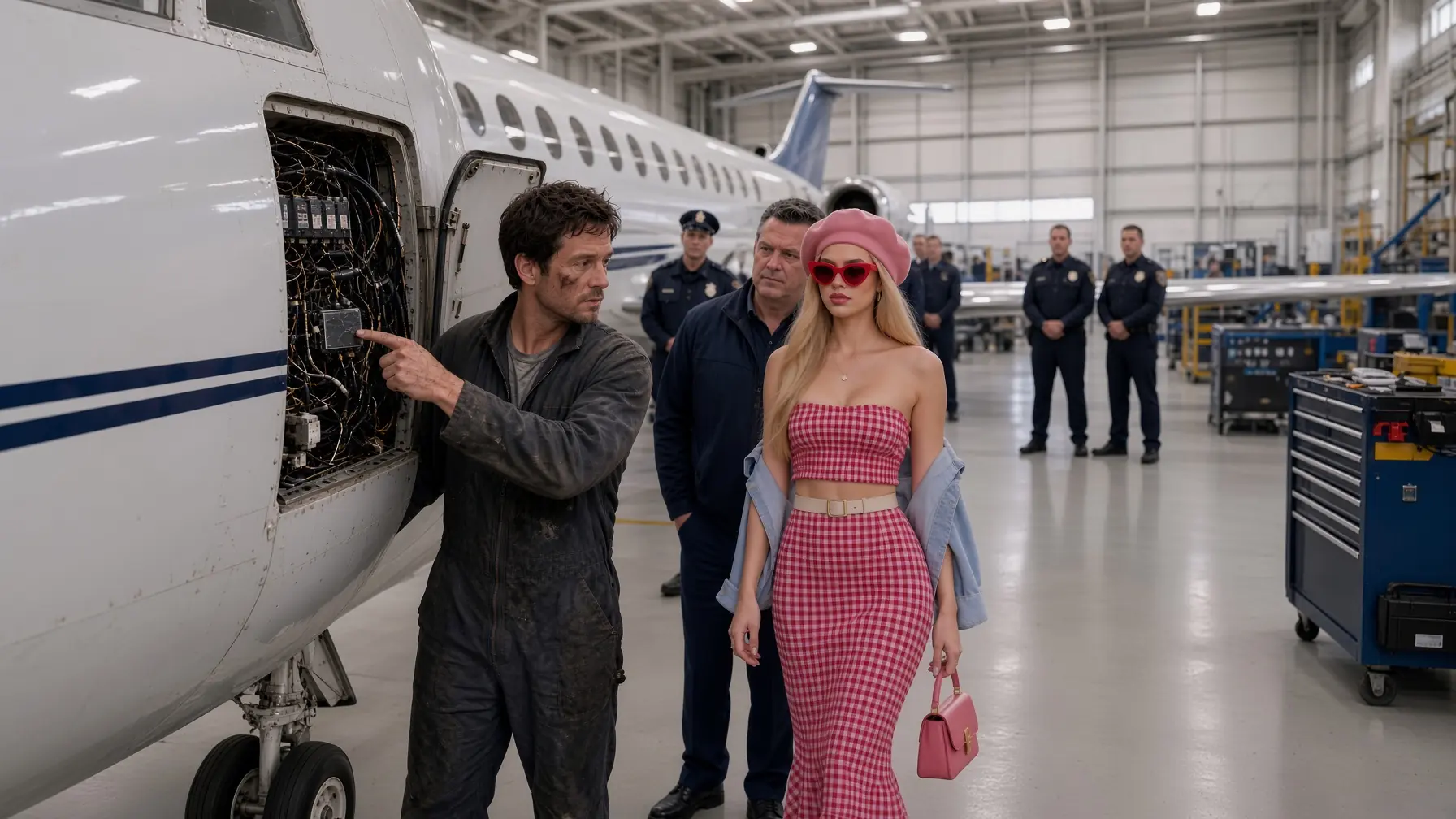
At 17 minutes past 2 in the morning, the $90 million jet belonging to billionaire CEO Saraphina Vale sat dead inside a private hanger on the edge of the city. Its engines silent and its cockpit flashing warnings that no engineer on her payroll could explain. The company had already spent millions of dollars trying to diagnose the failure. Flying in specialists from three continents, tearing apart wiring harnesses that had been replaced twice already, and still the aircraft refused to behave. It threw fault codes that contradicted one another, cleared them without explanation, then threw them again an hour later as though it were breathing on its own terms.
Into this silence walked a new hanger cleaner named Maddox Ror, a quiet man in a gray uniform who had been hired two weeks earlier to mop floors and empty trash bins. He walked past the aircraft the way he walked past everything else in that building without hurry until something made him stop. He tilted his head at one small panel near the leading edge of the left wing and said nothing for a long moment. Long enough that a technician noticed and called out to ask if he was lost. Saraphina turned from her conversation with the flight crew and saw a man in a cleaning uniform standing far too close to her aircraft.
"Who touched this? " Maddox asked before she could say a word. Saraphina laughed, sharp and short, the kind of laugh she reserved for people who wasted her time. "You're here to clean my hanger," she said. Maddox slowly peeled off his gloves, one finger at a time, and looked at her without blinking. "I know," he said.
Then he pointed toward the jet. But whoever repaired this nearly killed you. Saraphina's smile disappeared entirely and Maddox reached for the panel. Maddox Ror was 39 years old and almost nobody in that hanger knew what he had done with the first half of his life. He had spent more than a decade working in aviation systems maintenance at a level most of the men mocking him would never reach.
But for the last several years, he had taken only the jobs that asked nothing of his name. He wore the same gray uniform as the janitorial staff, carried a canvas bag with tools nobody had asked him to bring, and spoke so rarely that most of the crew had stopped trying to make conversation with him. He worked with a precision that unsettled people who did not understand it, wiping down surfaces in the same order every time, checking latches that were not on his list of duties, noticing things that were not his business to notice. The technicians on the Veil Aeronautics contract found him strange, and strange in their world was easy to dismiss as beneath them. One of them, a younger man named Pety Doss, liked to needle him whenever the mood struck.
That morning, watching Maddox linger by the wing longer than any mop bucket required, Pety called out from across the hanger, "You planning to fix it or polish it? " Maddox did not look up. I'm just looking, he said, and went back to work. Saraphina Vale was 37 years old and carried herself like a woman who had never once needed anyone's permission. She had built Veil Aeronautics from a single leasing contract into one of the most valuable private aviation companies on the continent. And the jet parked in that hanger was more than a machine to her.
It was proof, polished, and pressurized, that she had clawed her way to a place where nobody could tell her no anymore. She walked into rooms the way weather moved across open water, and everyone in the hangar adjusted their posture the moment her heels touched the concrete floor. When she passed close to Maddox that first afternoon, she did not slow down. "Don't touch my aircraft," she said, not even looking at him directly. The words tossed over her shoulder like a coin to a stranger.
Maddox said nothing back. He simply watched her go, then returned to the bucket and rag in his hands, moving with the same unhurried rhythm he brought to everything. It was near the end of his shift after the hanger had mostly emptied and the overhead lights had dimmed to their evening setting that Maddox heard it, a small click, barely audible, coming from somewhere deep inside the left engine housing. Most people would have missed it entirely, buried as it was beneath the hum of the ventilation system and the distant clatter of a toolbox being closed. Maddox did not miss it.
He stopped mid-motion, rag still in his hand, and turned his head slowly toward the sound. He knew that click. He had heard it before, years earlier, in a hanger very different from this one. And the memory of what it had meant back then settled into his chest like a stone dropping into still water. He did not move for a long moment.
Then he set down the rag, and he did not go home that night until he understood exactly what he had heard. The jet's problems had begun 3 weeks earlier. Though nobody in the company could agree on when the trouble had actually started, the aircraft would pass every ground inspection with perfect marks, only to throw an electrical fault the moment it was cleared for departure, forcing the crew to abort and taxi back to the hangar in front of clients who had paid enormous sums for punctuality. Engineers flown in from manufacturers overseas, spent days combing through the wiring, replacing sensors, running diagnostic loops that returned nothing but static contradictions. One specialist blamed a corroded ground wire.
Another insisted the fault lay in a software update pushed too quickly without proper testing. A third quietly suggested, only once and never again, that the problem might not be mechanical at all. Before Blaine Mercer shut the conversation down in front of the whole team, Blaine Mercer ran the technical division for Veil Aeronautics and had done so for 9 years. And his reputation was the only thing in that hanger he guarded more closely than the aircraft themselves. He was a broad-shouldered man with a habit of speaking in absolutes.
The kind of confidence that made junior staff nod along, even when they privately disagreed. When the third specialist raised the idea of interference, Blaine had laughed it off as the talk of a man trying to justify his consulting fee, and the conversation had died there. Saraphina, exhausted from weeks of delayed departures and mounting costs, wanted an answer more than she wanted the truth. And Blaine gave her the closest thing to certainty that anyone had offered in a month. "It's under control," he told her during a Tuesday briefing, tapping a folder of test results against the table for emphasis.
"We're close. A few more days. " The cost of those few more days was already staggering. An international flight to close a deal in another hemisphere had to be cancelled outright. The client rebooked on a commercial carrier with visible embarrassment on both sides and the financial fallout from that single cancellation ran into six figures before anyone even calculated the damage to the relationship itself. Saraphina absorbed each new failure with the same controlled expression she wore into every boardroom, giving nothing away.
Though those closest to her noticed the tightness building behind her eyes with every passing day, she did not have the luxury of panic. She had a company to run, investors to reassure, and a jet that behaved like it was haunted. Maddox watched all of this unfold from the edges of the hanger, saying nothing, doing his job. Noticing far more than anyone assumed a man with a mop could notice. Two nights after the cancellation, while running a routine diagnostic loop under Blaine's supervision, he saw something flicker across a secondary panel that nobody else in the room seemed to register, a pattern in the fault sequence that did not match the explanation being written into the report.
He filed the observation away without a word because he understood something the rest of them had not yet learned about him. He did not speak until he was certain, and he was not yet certain enough to be believed. Pety Doss caught him staring at the panel again the following afternoon and could not resist another jab, this time in front of two other technicians, eager for a laugh at the cleaner's expense. "You writing a report or something? " he asked, gesturing at the diagnostic screen with mock formality. "The other men chuckled, and Maddox straightened slowly, wiping his hands on a cloth before answering.