The Blackthorne Grand Hotel on Park Avenue had been rented out for a single evening, and every detail inside its ballroom whispered the same thing: "If you had to ask the price, you did not belong here." A line of Rolls-Royces, Bentleys, and matte black Maybach curled around the block, their drivers waiting in the November cold while their passengers drank champagne under chandeliers that had been polished twice that morning. The air smelled faintly of orchid, leather, and money. At the center of the ballroom, elevated on a circular platform of white marble, sat a single object inside a bulletproof glass case, the Veyron and Ashcroft Solstice number 19. Its case was rose gold, brushed rather than polished, so that it caught light the way a river catches morning.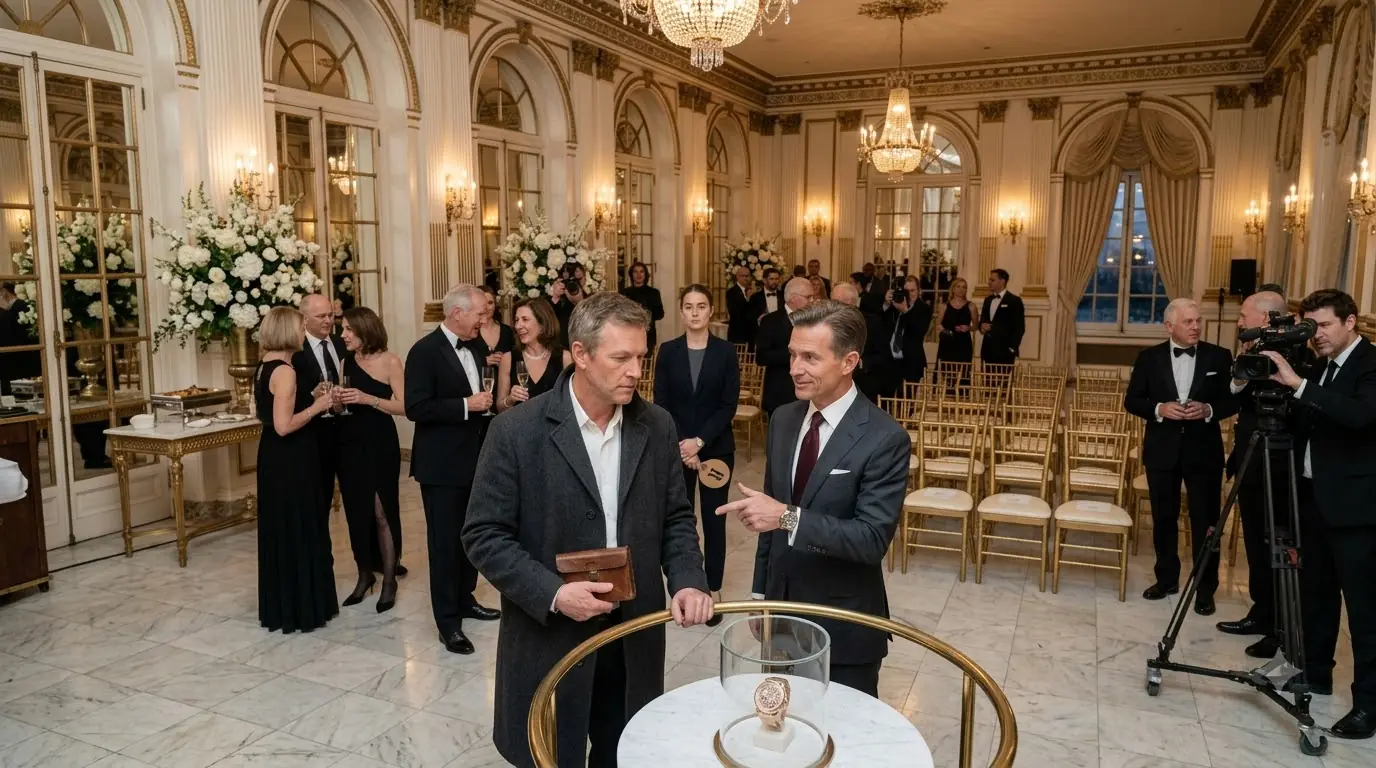
The dial was a pale silver-blue, the color of a winter sky at dawn, and beneath its sapphire crystal, the movement breathed in tiny, patient increments. Around it, collectors bent forward the way people do when they see something that might outlive them.
Ethan Mercer walked in through the revolving door at 6:47 p.m., three minutes late by design. He wore a dark wool coat that had been good ten years ago and honest ever since. His shoes were leather, well-kept, but worn thin at the heel. He carried a small brown case, the kind a country doctor might have carried a hundred years ago, and his wrist was bare. No watch, no ring, only a faint pale band where a wedding ring had lived for many years.
The hostess at the registration desk looked up, then looked at him again. "Sir," she said carefully, "is your name on the guest list?"
"Mercer," he said. "Ethan Mercer. My paddle should already be reserved." Her eyes flicked to her tablet. She blinked once, corrected her posture, and handed him a numbered paddle without another word.
Beside him, a woman in a charcoal suit, Clare Wittmann, though no one in the room yet knew her name, accepted her own paddle and said nothing. Ethan walked slowly toward the glass case. He did not stop to accept a glass of champagne. He did not look at the men whose watches cost more than most homes. He walked to the marble platform, placed one hand lightly on the brass rail around it, and stood very still.
Then he did something strange. He tilted his head slightly, as if listening. The Solstice made no audible sound through the glass. But Ethan closed his eyes for a moment, and when he opened them again, there was something in his face that had not been there a moment before. Not awe, recognition, the way a man might look at the sound of his own child's voice through a closed door.
He raised his hand slowly and let his fingertips hover an inch from the glass, tracing the shape of the case without touching it.
"Sir." The voice was smooth, amused, and loud enough to carry.
Julian Kesler crossed the ballroom in the unhurried way of a man who owned every floor he stepped on. His suit was Italian, his shoes were Italian, and the watch on his wrist was worth more than the car Ethan had driven there.
He was fifty-two years old, and he had spent thirty of those years learning exactly how to smile at people he intended to humiliate. "Sir," he said again as he drew closer, and the room began to turn toward the sound. "This is not a department-store counter. That watch costs more than everything a single father like you will ever own." A few people laughed.
A photographer near the wall lifted his camera and captured Julian in profile, one eyebrow raised in performed patience, and Ethan in a coat that predated the Solstice by five years, his hand still hovering near the glass. Ethan did not turn immediately. He kept his eyes on the dial. "It is running unevenly," Ethan said quietly.
Julian laughed, and this time the laugh was for the room. "A man who is not wearing a watch is now teaching us how time sounds." More laughter. A collector near the bar shook his head and smiled into his drink. Clare, standing three steps behind Ethan, did not move a single muscle in her face. She simply watched Julian the way a surgeon watches a patient who has just described his own symptoms in perfect detail.
Ethan lowered his hand. "Excuse me," he said, then walked past Julian without looking at him and set his brown leather case on the corner of the registration desk. He did not open it. He simply placed it there, the way a man might set down something he had carried for a very long time. Then he stepped away toward the tall windows at the far end of the ballroom because his phone was vibrating in his coat pocket.
There was a small pause on the other end.
Through the phone, he could hear her kitchen—the kettle and the soft scrape of a chair—and it steadied him more than any drink in the ballroom could have. "Dad," she said, "are you bringing Mom's watch home today?" Ethan closed his eyes.
Through the glass wall of the corridor, he could see the Solstice number 19 on its marble platform, tiny at this distance, catching the light like a coin at the bottom of a well. He thought for a moment about the winter Laura had spent finishing that dial. She had worked at the kitchen table when the workshop was too cold, a magnifier clipped to the edge of a lamp, her hands so steady that Ava, four years old at the time, had once asked why mommy's fingers didn't shake like other people's. "Because they are listening," Laura had told her. "You cannot shake if you are listening." "I cannot promise I will bring it home," Ethan said into the phone, his voice low and meant only for Ava. "But I can promise I will not let them sell her work as a lie."
Ava was quiet for a moment. Then, in the small, stern voice she had inherited from her mother without ever knowing it, she asked, "Did you eat?" Ethan laughed, surprised. "Not yet." "Dad." "I will. I promise." "There is food here."
"There is champagne there." "That is not food." "You sound like her. You know that?" The next pause was softer. "I know," Ava said. "You tell me every time." Ethan turned his back to the ballroom so no one inside could see his face. "Your mother had the most patient hands in that whole workshop," he said quietly. "Every person there was in a hurry except her. That is why they gave her number 19. They were saving the last one for the person who would not rush it."
"Dad, just come home safe. Watch or no watch." "I will."
He held the phone against his ear for another second after she hung up, listening to the small silence she had left behind. Then he slid it back into his coat pocket, straightened his cuffs, and turned toward the ballroom where Julian Kesler was already looking for him again.
He turned toward the ballroom, but before his hand touched the door, he paused. Something about the light inside, the cold white of the chandeliers falling across the Solstice's dial, reminded him of a different light in a different room a very long time ago. And for a moment, standing in that amber corridor with his daughter's voice still warm in his ear, Ethan Mercer let himself remember.
Twenty years earlier, the workshop of Veyron and Ashcroft had smelled of oil, brass, and old paper. It sat on the fourth floor of a narrow building in the watchmaking district, above a bakery, whose bread rose at 4:00 in the morning, and whose warmth climbed through the floorboards by 6. The kettle in the corner was always on. The window faced east, and the light came in slow. Ethan had been twenty-five years old the first time he walked through that door.
He was not the son of a watchmaker. He was not the son of anyone with money. He had grown up rebuilding lawnmowers for neighbors and studying vibration curves in a public library after his shift at a machine shop. And he had written to Veyron and Ashcroft seven times before someone finally answered. The man who answered was old Mr. Ashcroft himself.
And he had made Ethan sit at a bench for an entire day and take apart a broken movement no one else had been able to save. At the end of that day, Ashcroft had said only, "You listen to it. Good. Most people talk to it."
That was how Ethan came to design the caliber A19 Solstice. It took him four years, 311 components, a temperature compensation system that adjusted itself across a 40-degree range without the wearer feeling a stutter, and a third bridge, the small metal arch that held the escapement wheel, cut in a geometry no one had used before, with a tiny bevel along its inner edge that looked to any untrained eye like a mistake. It was not a mistake. It was the reason the movement could survive being wound to full tension in a hot room without deforming. Ethan had drawn that bevel by hand in pencil at the kitchen table of a small apartment on a Sunday afternoon.
At the next table that same afternoon, a young woman named Laura had been finishing a dial. She worked in the finishing department, one floor above the movement room, and she had walked down that morning to borrow a magnifier. She had stayed for coffee, then for lunch, then for the rest of her life. She had the most patient hands anyone in that building had ever seen.
When the Solstice line went into production, the master finisher walked past Laura's bench one afternoon, set a small silver disc in front of her, and said, "This one is yours. Take your time." That disc became the dial of Solstice number 19. Laura worked on it for almost a year. She layered the silver-blue lacquer in seven passes, each thinner than a sheet of paper, letting each dry for three days before the next. On the inside edge of the dial, in a place no wearer would ever see without dismantling the watch, she engraved a symbol so small it looked like a scratch.
It was a shape she and Ethan had used in the early years to sign notes they left for each other in the workshop. When Ava was born, they had drawn it on the top of her crib. Ethan had watched Laura finish that dial across many evenings, both of them staying past closing, the kettle on, the bakery below already dark. He had known even then that number 19 was unlike the others, not because of the movement, but because of the hands that had touched it last.
Then one autumn, the company died. It did not die the way workshops usually die, of exhaustion or obsolescence. It died because two men on the board had put company money into a currency speculation that collapsed in a single week. And to cover the loss, they had sold everything, the presses, the tools, the archives, the naming rights, the finished stock. The nineteen Solstice watches were scattered across four continents in ninety days. Some went to dealers, some to private collectors, and some into vaults where they were not seen again for a decade.
Ethan had tried to fight. He had spent his savings on a lawyer who told him gently that a movement architect's moral rights in a bankruptcy sale were worth exactly as much as the paper they were printed on. He had come home from that meeting to find Laura sitting at the kitchen table with a diagnosis in her hand. He stopped fighting the company that day. For eighteen months, he did nothing but drive her to appointments and hold her hand and read Ava bedtime stories in a voice that never once broke while Laura could hear it.
On Laura's last night, the room was very quiet, and the streetlight through the window fell across the small, unnumbered silver-blue test dial she had been allowed to take home. She reached for Ethan's hand and said the words he would carry for the rest of his life: "Do not let them turn our work into decoration for men who never listen to it." She died before morning. Ava was five.
For a year, Ethan did nothing but keep his daughter alive and fed and warm. He learned to braid hair. He learned which cereals had too much sugar. He learned to sit at parent teacher conferences and nod and not cry until he got back to the car.
And then in the second year, quietly, he began. He did not start a watch company. He started a company that made small, precise machined parts for medical devices and aerospace instruments. The kind of work that paid well, drew no attention, and used the same skills that had once cut a bevel into a third bridge. He called it Mercer Micro Systems.
It grew slowly, then quickly, then very quickly.
By the time Ava was 12, Ethan had enough money to begin buying back what had been scattered. He did it without announcement. Through intermediaries, auction houses in three countries, and private letters to collectors who did not know who he was, Ethan recovered one Solstice at a time. For some he paid full price; for others he traded precision components. He found one in a broken box in a Geneva dealer's back room and paid four times the asking price because the dealer did not know what he held. Twelve years. Eighteen watches. Only number 19 had eluded him.
It had passed through three private owners and then six weeks ago surfaced here at the Blackthorne Grand in the hands of a man named Julian Kesler. The corridor light flickered once as a waiter passed with a tray. Ethan opened his eyes. He straightened his coat. He pushed open the door and walked back into the ballroom.
Julian Kesler had spent the previous six weeks preparing for that night the way a director prepares an opening. Kesler Crown Horology, his flagship dealership on Fifth Avenue, was three months away from launching a global chain, Milan, Dubai, Singapore, Hong Kong. He had signed a memorandum with a luxury conglomerate that would put his face and his name on the cover of three magazines simultaneously. The centerpiece of the campaign, the single object around which every photograph would be composed, was the Veyron and Ashcroft Solstice, number 19. Julian had never wound a watch by hand.
He had never held a loop. He did not know what a balance wheel did. He knew what it cost, and he knew what it meant to be photographed beside it. And to him, those two things were the same thing.
He had told a journalist off the record that the Solstice was the perfect brand story. A dead workshop, a legendary movement, a silver-blue dial, nineteen pieces, scarcity you could hold in your hand.
Two weeks before the auction, his chief financial officer, Victor Sloan, had walked into his office with a folder and closed the door. "Julian, there is a name that keeps appearing in the provenance records," Victor Sloan had said. "A collector?" "A trust. Mercer Horology Trust, registered in Delaware. Quiet. It is on the paperwork for at least six of the other Solstice pieces I have been able to track. Maybe more." Julian had not looked up from his phone. "Victor," he said in the voice he used with children and junior staff, "a preservation trust is where old men put things nobody can sell. It does not affect us. Get me the shipping schedule for the launch."
Victor had stood there a moment longer, then set the folder on the desk and left. Julian had not opened the folder.
Now standing at the back of his own ballroom, glass of champagne in one hand, he saw Ethan Mercer step back through the door, coat unbuttoned, expression unreadable, and he smiled the small, tight smile of a man who had already decided how the evening was going to end. He set his glass down on a passing tray and began once more to walk toward him.
Ethan felt the shift in the air before he saw the man. It was the way a room quiets half a second before someone important—or someone about to embarrass himself—begins to speak. Julian arrived with two photographers already in orbit. "Mr. Mercer, is it?" He said the name as though tasting a wine he did not intend to buy. "I do not believe we have been properly introduced. Tell me, what do you do?" Ethan studied him for a long moment. "I work with small machines." Julian smiled at the room rather than at Ethan. "Small machines. How charming."
He turned a quarter step so the cameras had his better side. "There is a very nice kiosk at the Time Warner Center. They change watch batteries in under ten minutes. I am told the technicians are quite skilled, though I am not sure that qualifies a man to breathe on a Solstice." A ripple of laughter moved through the room, softer this time. A few of the older collectors did not join in.
Julian's eyes drifted casually to the registration desk to the guest card lying face up beside Ethan's brown case. His gaze caught on one line. He read it twice and then he smiled the way a man smiles when he thinks he has found a wound. He lowered his voice, but not enough. "Perhaps a single father should save his money for his daughter instead of pretending he belongs among collectors." The room stopped.
Not silence exactly. Champagne glasses still clinked. Someone coughed near the bar, but a kind of held breath that ran along the walls and came back. A woman in emerald green looked at the floor. A collector near the platform closed his eyes briefly as though he had heard something he did not want to have witnessed.
The photographers kept their cameras up but stopped clicking. Ethan did not raise his voice. He did not step closer. Ethan looked directly at Julian and said evenly, "My daughter knows exactly why I am here." Six words. That was all. Julian opened his mouth to answer, and for the first time that evening, he could not find the sentence he wanted.
He recovered with a laugh, but the laugh landed a halfbeat late, and a halfbeat late is the difference between a punchline and a mistake.
Near the far wall, an old man in a gray suit had turned to watch. Harold Bennett was 71 years old. He had been collecting mechanical watches since he was 19. He had known Mr. Ashcroft personally. He had heard decades ago a story about a young engineer who had drawn a bevel by hand and refused to let the foreman polish it out.
A story that had passed into workshop legend and then into rumor and then into nothing at all because the young engineer had disappeared after the bankruptcy and no one had spoken his name in a serious room since. Harold looked at Ethan. He looked at the coat, the worn shoes, the bare wrist. He looked at the way Ethan held his hands loosely at his sides, the fingers slightly curled, the way a man holds his hands when he is used to working with something delicate. Harold said nothing, but he began quietly to walk closer to the front row of chairs.
At the podium, Celeste Monroe tapped her microphone once. "Ladies and gentlemen, if I could ask you to take your seats."
The room reassembled itself around the marble platform in three neat crescents of gilded chairs. Ethan and Clare sat in the second row on the left, while Julian took a seat in the front row on the right, angled toward the cameras with one leg crossed over the other in the studied posture of a man who had rehearsed before a mirror.
Celeste was in her early forties, silver at her temples, her voice trained to the exact register that could hold a room of billionaires without ever asking for their attention.
"Lot 47: the Veyron and Ashcroft Solstice, number 19 of 19, caliber A19. Provenance verified. We will open at $4 million."
A paddle rose in the third row. A Swiss collector in a navy suit, unhurried. "$4.25 million to the gentleman on the aisle." $5 million. Julian raised his paddle without looking at it. $7 million. The room stirred. It was a $2 million jump made when the bidding did not require it, and everyone understood the message: Julian was not bidding on a watch; he was clearing the field.
Celeste accepted the number with a professional nod. "$7 million to Mr. Kesler." Ethan raised his paddle. "$7.2 million," Clare said quietly to Celeste's assistant, though Celeste had already caught the number from Ethan's paddle. "$7.2 million to the gentleman in the second row."
Julian turned in his seat. He looked at Ethan the way a man might look at a fly that had entered a room he had reserved for himself. Then Julian turned toward the nearest photographer and said loudly enough for two rows to hear, "Let him enjoy the room for a few more minutes." Someone laughed. Not many.
The bidding climbed: $8 million, $8.5 million, $9 million.
Ethan's paddle rose steadily, without hesitation or theater. Julian's rose in sharp bursts, each higher than necessary and accompanied by a small half-turn toward the cameras.
$10 million. $10.5 million. $11 million.
$12 million to Mr. Kesler.
Beside Julian, Victor Sloan leaned in and spoke into his ear. His voice was low, tight, the voice of a man trying to save his employer from himself. "Julian, that is above the ceiling, and we still do not have the originality certification finalized," Victor warned. "If anything is wrong with the provenance—" "Victor." "Julian, listen—"
"Sit back." Victor sat back. He did not look at the podium. He looked briefly at the brown leather case on the corner of the registration desk, and something moved behind his eyes that he did not let his face show.
Julian rose halfway from his seat. He turned so that the room could see him and the cameras could see him and the live stream cameras above the podium could see him. "I will pay whatever it takes," Julian declared, his voice carrying through the room, "to teach this man the difference between touching history and owning it." There was scattered applause. Not much.
The older collectors did not clap. Ethan did not react. He did not tighten his jaw. He did not look at Julian.
Ethan looked at the Solstice on its platform, at the small silver-blue dial catching the light. Beside him, Clare wrote a single line in her notebook and underlined it twice.
"$14 million," Celeste said. The room went quiet.
The overhead cameras mounted on articulated arms above the marble platform rotated silently into position.
On the enormous screen behind the podium, the face of Solstice number 19 appeared magnified thirty times, so large that the silver-blue dial filled the wall like a small moon.
The seconds hand swept forward in its steady, patient arc. Celeste drew breath to call the next number—and stopped.
On the screen behind her, the seconds hand had frozen mid-arc. For a moment, no one understood what they were seeing. The dial was still lit. The magnification was perfect, but the thin sliver of steel that should have been sweeping forward sat motionless against the silver-blue surface as if someone had pressed pause on the world. A collector in the front row leaned forward.
Celeste turned. The room registered it all at once in a slow ripple of murmurs that moved from the front rows to the back.
Julian rose from his seat. "A transport issue," Julian said quickly. Too quickly. "A minor shock during handling. My technicians will confirm."
A man in a white coat hurried up from the side of the platform carrying a microscope tray. He opened the case back with practiced hands, adjusted the lens, and bent over it. And then he stopped, his shoulders locked. He did not want to touch what he was looking at.
From the second row, without rising, Ethan spoke. "Do not touch the balance. The problem is under the third bridge."
Julian's head snapped toward him. "You do not get to diagnose a $14 million watch from across the room."
"I am not diagnosing it," Ethan replied, still not moving. "I am telling you where it stopped."
Harold Bennett, now standing in the aisle, drew a slow breath through his nose. He knew, the way a man knows a voice through a wall that only someone who had lived inside the caliber A19 could have heard the stop at that precise depth of the movement. Julian looked at his technician. The technician did not look back. The live stream light on the ceiling camera glowed red.
Somewhere in the world, 400,000 viewers were watching a frozen dial fill a wall. And behind it, a man in an Italian suit whose face was doing something it had not rehearsed.
Julian recovered, the only way he knew how, loudly. "Fine." Julian turned to the room, arms half-open and playing to the cameras. "Fine. If this single father thinks he knows the Solstice better than my experts, let him prove it." Ethan did not stand up. He looked at Clare.
Clare, who had been silent for the entire evening, opened her leather portfolio, removed a single sheet of paper, and walked it to the podium. Celeste read it. Her eyebrows rose one millimeter, which for Celeste was the equivalent of a gasp. She placed the sheet on the podium and turned it so the room could see. "A liability waiver," Celeste announced, her voice careful and clean. "Prepared by counsel for the interested party. It states that if the fault in lot 47 is determined to originate from a non-original component or a misrepresentation in the provenance record, Kesler Crown Horology will accept full liability before this auction house, the eventual buyer, and any media party present tonight."
The room did not move. Victor Sloan leaned forward so fast his chair scraped the floor. "Julian," Victor said, almost in a whisper. "Do not sign that. We have not audited the restoration. If there is anything in that movement that is not original—" "Victor." "Julian, listen to me."
"Sit down." "Julian—" "Sit down." Victor obeyed. He put one hand flat on his thigh and the hand was shaking and he closed it into a fist so no one would see.
Julian stood. He looked at the paper. He looked at the cameras. He looked at Ethan. Coat, worn shoes, bare wrist, the same terrible calm.
And he understood in some part of himself he did not want to hear that refusing to sign in front of 400,000 people would make him look afraid of a man in a ten-year-old coat. He walked to the podium. He picked up the pen. He signed his name in a fast, hard scroll, the way he signed everything. He set the pen down and turned to face Ethan across the marble platform.
Then, in a voice too loud for the room, Julian said, "Now embarrass yourself properly."
Ethan rose from his seat. He did not look at Julian. He did not look at the cameras. He walked unhurried to the technician's table beside the platform. From his coat pocket, he took a small worn leather sleeve.
From the sleeve, Ethan removed a brass loupe, dulled at the edges, its rim engraved with a faint logo that no factory had struck in twenty years: two interlocked V's and an A.
Harold Bennett saw it from the aisle, and Harold Bennett sat down slowly in the nearest empty chair because his knees had decided, without consulting him, that they needed to. Ethan clipped the loupe to his eye. He sat down at the table.
The room went so quiet you could hear the small mechanical whir of the camera above the platform, adjusting its focus down onto his hands. Ethan opened the case back. His hands moved the way Laura's had once moved across a dial. No hurry, no waste. He lifted the rotor.
He set it aside. He removed two screws so small they caught the light like grains of salt and placed them in a shallow tray. The overhead camera followed every motion onto the wall.
He stopped above the third bridge. His voice was quiet, but the microphone above the table carried it to every speaker in the room. "This bridge is too bright and too clean. The inner edge has been polished flat." Julian's technician stepped forward. "That is standard restoration finishing." "No." Ethan did not look up. "The original third bridge of the caliber A19 has a bevel along the inner edge. It looks like a flaw. It is not. It is a thermal-compensation cut."
He continued, "When the mainspring reaches full tension in a warm room, the bridge expands into that bevel instead of into the escapement wheel. Whoever restored this watch did not know that. They saw a rough edge and polished it out. That is why it stopped." At last he looked up at Julian. "The replacement is prettier. That is why it failed. The original was not made to look perfect. It was made to survive."
Julian's face had gone the color of paper. "And how," Julian asked, his voice no longer quite steady, "would you know what the original was made for?"
Ethan reached into his coat and set a folded sheet of drafting paper on the table. Clare stepped forward and unfolded it under the camera. Onto the wall bloomed a pencil drawing, old and yellowed at the corners. A cross-section of the caliber A19 drawn by hand at a kitchen table. The third bridge rendered in the center of the page with the bevel cut clearly marked and annotated in a neat engineer's hand at the bottom right corner in ink.
At the lower right, in a neat engineer's hand, was the inscription: Ethan Mercer, Lead Movement Architect, Veyron and Ashcroft, 2005.
The room did not gasp. It simply stopped breathing. Harold Bennett, seated in his chair, nodded once to himself, as if a story he had heard as a young man had just finished its final sentence in front of him. Julian tried to laugh. It did not come out right.
"An old engineer," Julian said, turning toward the cameras because he no longer trusted the room. "An old engineer with a drawing. That does not give you standing over the future of this piece. You are not on the paperwork. You are not in the provenance. You have one signature on a discontinued line."
Clare lifted the brown leather case from the corner of the registration desk. She walked to the podium. She opened it.
One by one, Clare placed documents on the podium's glass surface, and the overhead camera lifted each one onto the wall as it landed.
"Solstice number one," she said. "Ownership: Mercer Horology Trust. Number two: Mercer Horology Trust. Number three: Mercer Horology Trust."
Four. Five. Six. The list did not stop. Seven. Eight. Nine. Ten. Eleven.
The room made a sound—not a gasp, but something lower, the sound a crowd makes when it realizes the ground beneath it is not what it thought.
Twelve. Thirteen. Fourteen. Fifteen. Sixteen. Seventeen. Eighteen.
Clare placed the eighteenth certificate down and rested her hand on it for a moment. Then she straightened. "Over the past twelve years, Mercer Horology Trust has quietly recovered every Veyron and Ashcroft Solstice ever made, with the sole exception of lot 47: number 19, currently on the platform in this room." number 19, currently on the platform in this room. Julian's mouth opened. Nothing came out.
Clare lifted one more document. "There is a further matter. Clause 14 of the Veyron and Ashcroft bankruptcy dissolution, filed in 2007, states that no Solstice may be sold at auction under a certification of original movement architecture without the written verification of the lead designer or his legally recognized successor entity."
She placed the clause on the podium, and it filled the wall. "The legally recognized successor entity of Veyron and Ashcroft for the purposes of Solstice authentication is Mercer Horology Trust. Its founder, sole owner, and controlling signatory is Mr. Ethan Mercer."
She paused. "Mr. Mercer has not signed a verification for lot 47. He was never asked."
Julian turned very slowly toward Ethan, and Ethan finally stood. He did not raise his voice. He did not smile. He looked at Julian the way a man looks at someone who has just realized that the person he chose to humiliate before the world is the only person on earth who can decide whether the watch behind him is worth $14 million or nothing at all. Julian's mouth moved, but no sound came out.
Celeste broke the silence with the calm of a woman who had been trained for exactly this. "This house suspends lot 47," Celeste announced. "The piece can no longer be sold under its current certification of originality."
The Swiss collector rose without a word and left the room. A phone rang in Julian's pocket, his media partner, cancelling the launch campaign in real time. Victor Sloan was already on his feet, already dialing the board. The photographers turned. Every lens in the room swung away from the Solstice and onto Julian.
"Mr. Kesler, did you know the third bridge had been replaced?" "Mr. Kesler, who authorized the originality certification?" "Mr. Kesler, why was Mercer Horology Trust never contacted?"
Julian pushed past them. He crossed the platform and stopped in front of Ethan. "$500,000," Julian said in a low, hurried voice. "Sign the verification. Half a million tonight." Ethan did not answer. $2 million.
Nothing. $5 million. "Mr. Mercer, cash tonight."
Ethan studied him for a long moment, then said quietly enough that only the nearest microphone caught it, "You wanted to use my wife's work as a backdrop for your brand. I came here to make sure it survived you." Julian's face broke. Not dramatically, just a small private collapse behind the eyes of a man who had understood thirty seconds too late exactly what he had walked into.
Celeste cleared her throat. "Given the revised certification status," Celeste said, "the house recognizes the pre-existing successor rights of Mercer Horology Trust. Mr. Mercer, if you wish to exercise them, lot 47 can be transferred at a corrected valuation reflecting the restoration fault and verification costs." Clare nodded once. She had the figure ready. It was a fraction of $14 million.
Ethan signed the transfer at the podium. He did not look at Julian. He did not look at the cameras. When Celeste gently asked whether he wished to make a statement, Ethan shook his head. "No. Just pack it carefully. It has been away from home long enough."
Harold Bennett walked up the aisle then. He did not speak. He placed one hand on Ethan's shoulder for exactly one second, the way one generation acknowledges another and walked back down the aisle and out of the room.
Outside, the November air was cold and clean. Ethan stood on the curb with the small padded case in his hand, heavier than he expected and lighter than he had feared. He took out his phone. Ava picked up on the first ring. "Dad?" "I am bringing her home, sweetheart."
There was a very small sound on the other end—the sound of a seventeen-year-old girl trying not to cry into a phone. "Okay," she said. "Okay. Drive safely." He put the phone back in his pocket. Behind him, through the glass doors of the Blackthorne Grand, he could see Julian Kesler still standing on the marble platform, alone now in a room that had already begun to empty around him.
The story broke before Ethan's car reached the bridge. By morning, the footage of the frozen dial and the pencil drawing was on every horology forum in the world. By the end of the week, three financial reporters had opened Kesler Crown's provenance records and begun pulling threads. What they found was not only Solstice number 19, it was a decade of pieces sold under certifications that had been at best generous and at worst invented. The board suspended Julian within ten days.
Victor Sloan was appointed interim chief executive and immediately opened a full audit. The Swiss distributor canceled the exclusive partnership. The luxury conglomerate that had signed the launch memorandum walked away and asked in a lawyer's letter for its logo to be scrubbed from every photograph in which Julian Kesler appeared. Julian had believed the cameras would remember him standing beside the last Solstice. Instead, they remembered him beside a frozen dial in a room that had stopped laughing.
One year later, on a quiet street in the old watchmaking district, a small brass plate went up beside a heavy oak door. Mercer Horology Archive. The building had once been a satellite workshop of Veyron and Ashcroft. Ethan had bought it two years earlier and spent a year restoring the floors and the east-facing windows. Inside, the light came in slow, the way it used to.
There was no marble platform. There were no chandeliers.
There was a long, low display along the main wall, lit softly from above, holding nineteen watches in the order they had been made. Solstice number one at the near end. Solstice number 19 at the far end, alone in a case of its own, resting on a small pad of dark blue linen. Behind the display was a working restoration bench. Behind that, a room of original drawings under glass.
Upstairs was a classroom where students of precision engineering attended without charge twice a week. On the landing was a small framed board announcing the Laura Mercer Scholarship, awarded annually to a student in dial finishing. Beside it, in a modest wooden case, a magnifier, two pencils worn to the length of a fingernail, and a folded sketch of a silver-blue dial, unsigned, in a woman's careful hand.
Ava had designed the lighting. She had refused to let number 19 sit under the hard museum spots the contractor recommended. Instead, she had built a soft, warm halo around the case, the color and angle of an autumn evening in an old workshop above a bakery.
On the opening day, a visitor stopped in front of number 19 for a long time. She was young, in her twenties, with a notebook in her hand. She turned to Ava, who stood quietly by the display, and asked the question everyone eventually asked. "Why is this one different from the others?" Ava did not answer immediately. She looked at the small silver-blue dial, at the halo of light Laura would have recognized, and at the serial number engraved on the crown. "My father built the movement," she said. "My mother finished the dial. I think that means it kept both of their time."
The visitor wrote it down and did not thank her because she understood that it was not the sort of sentence you thanked someone for.
Outside, the November light was already beginning to turn. Near the end of the day, when most of the visitors had gone, a reporter lingered by the far case. He had been waiting patiently for the room to empty. When Ethan walked past, the reporter stepped forward with a small recorder. "Mr. Mercer, one question, if I may." Ethan stopped.
"You now own the only complete Solstice collection in the world—nineteen pieces, every one of them—and yet you still do not wear one. Why?" Ethan looked for a long moment at Ava across the room, standing beside the soft halo of light she had built for her mother's dial. Then Ethan looked at number 19, at the small silver-blue face that had traveled through three continents, four owners, and twenty years to return to the room where it had been made. "Because I did not build them to prove I own time," he said. "I built them to honor the people who gave theirs." The reporter lowered his recorder.
He did not ask another question.
Outside the tall east-facing windows, the last of the afternoon light moved slowly across the floor of the old workshop, the same way it had moved twenty years ago, above a bakery that no longer existed, over a bench where a young man had once drawn a small bevel by hand on a Sunday afternoon, and a young woman at the next table had looked up and smiled. Julian Kesler had walked into that auction, believing luxury belonged to whoever could afford it. Ethan Mercer had walked in knowing that some things belong only to the person who understands every heartbeat inside them.