The hallway on the 14th floor smelled like fresh paint and new carpet. Clare Marsh walked through it the way she walked through every room she owned. Straight back, measured steps, the kind of pace that told people to move or get left behind. She saw him before he saw her. He was standing on a 6-ft ladder near the far wall, roller in hand, wearing a white t-shirt that had probably been white sometime in the previous decade. work pants, boots with dried paint on the steel toe, the kind of clothes that had no business being inside a building with her name on the lease.
She stopped. Her two assistants stopped behind her, who let him in through the front. The man came down from the ladder slowly. He reached into the chest pocket of his shirt, pulled out a folded piece of paper, and held it out to her. She didn't take it.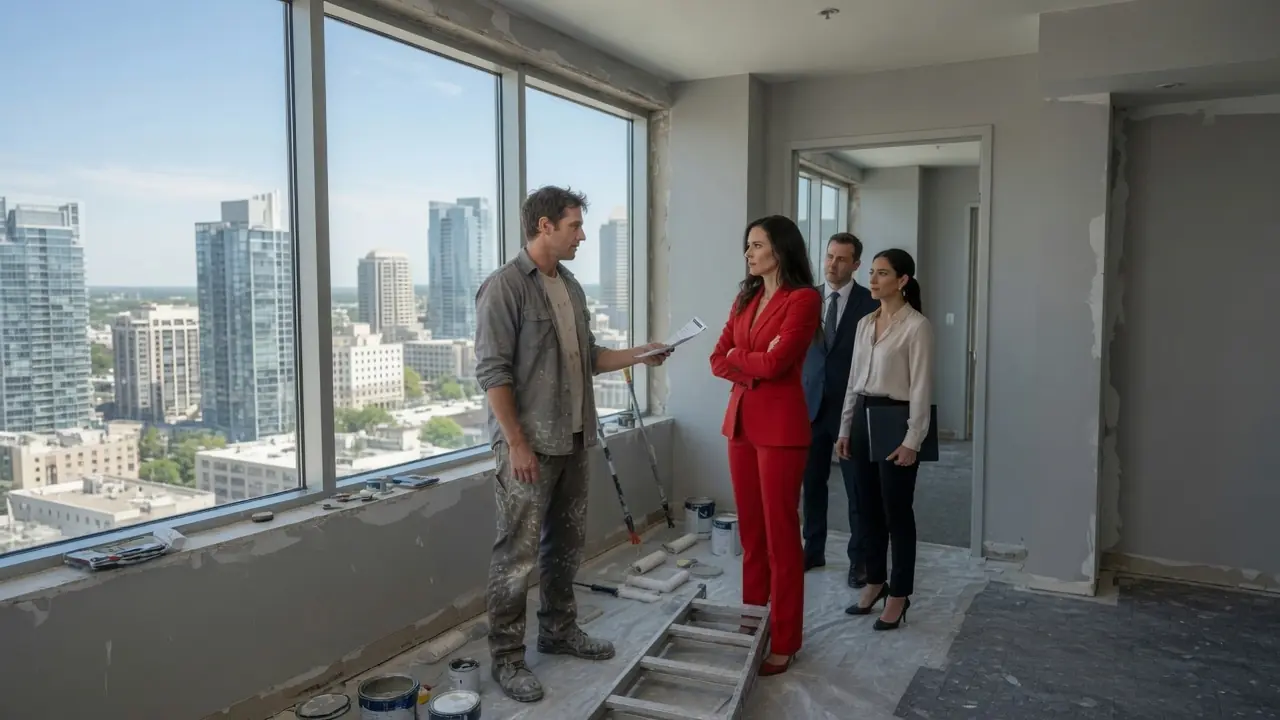
He set it on the edge of the nearest table, picked up his roller, and went back up the ladder. Tom Hail had been up since 5:30. That was how it worked on school days. He got up, made coffee, started eggs, and by the time Lily wandered out of her room with her hair half out of its braid and her left sock on inside out, breakfast was already on the table. He didn't make a production of it.
He just did it. She was nine. She liked her eggs scrambled with a little too much cheese, which he'd started doing without thinking about it sometime around her 7th birthday. She sat down across from him at the kitchen table, a table with a scar down one side from a moving truck incident 3 years ago, and ate without talking much. That was fine.
Tom didn't need conversation in the morning. Neither did she. He fixed her braid while she was still chewing, checked her backpack, made sure she had her lunch. she said bye at the door and meant it, which was all he'd ever asked for from any morning. The house was small, a two-bedroom in Clintonville, north side of Columbus, the kind of neighborhood where people had lived for 30 years, and knew each other's dogs by name. He'd bought it in 2021, the same year he'd opened Hail Painting and Renovation.
It wasn't the kind of house he'd lived in before, but it was the kind of house he'd needed. He dropped Lily at school, drove south on High Street, and pulled into the parking structure next to the Courtland Group's new downtown office building a few minutes before 7:00. He sat in the truck for a moment before getting out. The building was 12 stories of glass and steel on Broad Street, completed in 2012, and Tom knew it the way you know a place you've spent years inside. Not from the outside, but from the way it sat in your chest.
He'd stood in this spot before, back when the parking lot was still a dirt construction zone, and the building was a set of drawings on a conference table. He and Edward Marsh had walked the site every Tuesday morning for 18 months, arguing about loadbearing specifications and window placement, and whether the 14th floor atrium needed that second column or if they were just being cautious. They'd been cautious. They'd kept the column. He got out of the truck, grabbed his toolbox, and went inside.
The job was a three-floor interior renovation, painting, finishing, some trim work on the upper levels. 6 weeks, standard commercial spec, subcontracted through a midsize Columbus firm that had won the primary bid. Tom's company had won the sub. He'd read the address on the contract twice before signing. He met the site foreman in the lobby, got briefed on the scope, and spent the first hour walking the floors alone.
14th, 13th, 12th. He moved slowly, running a hand along the wall near the window bank on 12, the same stretch of wall where he and Edward had spent an entire afternoon arguing about whether to go with textured plaster or smooth coat. Edward had wanted smooth. Tom had said textured held repairs better. Edward had laughed and said, "You always want to build in the forgiveness." They'd gone with smooth in the end.
Edward usually won those. He stood at the south window on 14 for a while. Columbus looked the same from up here as it always had, broad and flat and going on in every direction. He and Edward had stood in this exact spot in the winter of 2011 before the windows were even installed, wind cutting through the open frame. Both of them in construction jackets with coffee cups that had gone cold and talked about what kind of company they were building.
Not the numbers, the kind. Tom picked up his roller and got to work. That afternoon, Clare Marsh came down from the executive floor. He'd seen her in the lobby that morning when he walked in. She was the one who'd said what she'd said.
Now she stood in the hallway near the site foreman with her arms crossed and the expression of someone who tolerated inconveniences efficiently. The foreman pointed her toward Tom. She walked over and asked about the timeline. Tom told her 3 weeks for the upper two floors, another two for 12, one week for punch list. She asked if the fumes on 13 would be a problem for the East Wing offices.
He said he'd schedule the oilbased work for Fridays and leave the weekend for ventilation. She nodded, taking the information the way you take what you already expected to be given. She turned to leave, then stopped, looked back at him for a half second. The way you look at something that doesn't fit where you placed it. Then she went upstairs.
An hour before end of day, Greg Dunn came down. Greg was the executive vice president. 45 years old, silver hair kept short, the kind of man who wore his authority without being obvious about it, which Tom had learned was actually the more dangerous kind. He introduced himself, shook Tom's hand, and asked questions that sounded like small talk, but were structured like intake forms. Name of the company, how long in business, how the contract had come about.
Tom answered each one and went back to work. Greg stood there a few seconds longer than he needed to. His eyes moved to the logo on Tom's jacket. White letters on navy above the left breast pocket. Hail Painting and Renovation.
Then they moved to the sign bolted to the hallway wall. Courtland Group established 2010. He left without saying anything else. But he was thinking about something when he left. Tom could tell the difference between a man who was done with a conversation and a man who just started one in his own head.
Tom sat on the top step of the ladder at the end of the day and looked at the Courtland Group logo through the glass wall of the conference room across the hall. Office lights were still on behind it. Shadows moving around in there. People finishing their afternoon doing the ordinary things people do at 5:00 in a building they've never thought twice about. Tom had thought about it.
He just hadn't said so. He packed up and went home. The crack in the wall on the 12th floor wasn't visible until Tom pulled the outlet cover plate near the southeast corner on the third day. What he found behind it wasn't a surface fracture. It ran vertically along the mortar joint for about 14 in and the edges had that spread to them wider at the top than the bottom.
Tom said he'd like it passed up today. Clare was in a budget meeting when the message came through. She was out in 4 minutes. She came onto the 12th floor with the particular energy of someone who runs meetings and knows how long 4 minutes is. She found Tom standing next to the flagged section with his phone and a level.
She was skeptical. That was fine. He'd have been skeptical, too, if someone who painted walls for a living had just halted a 6 week project. He showed her the photographs on his phone, pointed out the spread pattern, the angle of the crack relative to the mortar joint, what it indicated versus what a standard settling crack would look like. She listened without interrupting, which told him she was actually thinking about it rather than waiting to respond.
You're saying it's the foundation? She said, "I'm saying it's worth finding out." She called a structural engineer. The man arrived 2 hours later, inspected the wall, checked the adjacent floor plate, and went down to look at the exterior footing from the parking level below. He came back up and gave them his assessment. Differential settlement at a secondary footing, minor, but present, requiring remediation before any finish work proceeded.
He said it was fortunate someone had caught it before the painting went over it. After the engineer left, Clare stood in the empty conference room with Tom. Late afternoon, light came through the south-facing windows in long flat rectangles across the floor. She was looking at the wall section. He was looking at the window view.
Did you study engineering? She said, "No, architecture. No." He looked at her. I just know buildings. She held that for a moment.
There was a version of that sentence that was a deflection and a version that was just the truth. and she seemed to be working out which one this was. She turned toward the door. That afternoon, Paul Greer was walking the hallway on 12 toward the supply room when he saw the man crouching near the flagged wall section packing up his equipment for the day. Paul was 61 years old and had been Courtland Group's chief financial officer since 2011. He had been there when the framing went up, when the first lease was signed, when the company hit its first bad quarter, and came back from it.
He had been present for all of it and had made his peace with most of it. Most. He stopped. The man looked up. Neither of them moved for a moment.
It wasn't the look of strangers. Paul walked over and lowered his voice. Tom. Tom stood. Paul, you shouldn't be here.
I have a valid subcontract. Paul looked down the hallway in both directions. Turned back. She doesn't know anything. I'm asking you.
Please don't let her hear it from you. Tom looked at him. Paul's hands had a slight tremor that hadn't been there 5 years ago. The lines around his eyes were deeper. A man who had been carrying something for a long time looks different than a man who hasn't.
And Paul looked exactly like that. I'm not here to tell her anything, Tom said. I have a job to finish. Paul gave a nod that wasn't quite relief and wasn't quite gratitude, but lived somewhere close to both. He turned and walked back down the hall without looking back.
Tom stood where he was for a while after Paul turned the corner. He looked into the conference room through the glass wall, the long table, the leather chairs, the view of Columbus that he and Edward had spent 20 minutes one afternoon just standing and looking at because for a few minutes there wasn't anything pressing and the city looked good from up here. They'd called this room the argument room. Never officially, just between themselves. Tom picked up his toolbox and went home.
The next morning, Greg Dunn arrived 40 minutes before the rest of the office. He took the stairs to the basement level where the building's physical archives were kept in a climate controlled room behind the maintenance corridor. He'd gotten the access code from the facility's manager's files the night before, told the man it was a compliance pull, and the man had given it without question. People usually did when you sounded certain enough. The archive was organized by year and by document type. metal shelving, brown banker boxes, each one labeled with a strip of adhesive tape and a marker.
He pulled the 2010 through 12 construction file and worked through it systematically. Site permits, structural signoffs, certificate of occupancy paperwork until he found the original schematic drawings for the 12th floor. Standard architectural drawings. Contractor signatures in the lower margins. Site notes in pencil on the overlay.
In the lower right corner of the primary sheet, two signatures in blue ink. Edward R. Marsh. And below it, Thomas J. Hail, co-owner.
Greg stood there with the drawing in his hands for close to a minute. He thought about the 5 years he'd spent in this building in a role that existed because of how that transition had been managed. He thought about the press release from 2019 that had described Edward Marsh as the sole visionary founder of Courtland Group and the way Greg had reviewed the language before it went out and the way he'd felt at the time which was satisfied because it was cleaner that way. He thought about the framed company timeline in the reception area on the executive floor which he had also reviewed and which also said nothing about a Thomas J. Hail.
He thought about the fact that someone with that name was currently on the 11th floor with a roller and a six-week contract and that Linda Carr had called him Mr. Hail in a hallway and that Clare had seen it. He thought about the way Clare had watched him come out of Paul's office. He put the drawing back, closed the box, and walked upstairs. That morning, Tom arrived early, and stepped into the elevator at the same time as Clare.
She was carrying a coffee and a folder of presentation materials thick enough to suggest a significant afternoon meeting. She was reading something clipped to the top of the folder when she stepped in. The elevator stopped between the seventh and eighth floors. A small electrical fault. The maintenance team would later determine a relay switch in the shaft control panel.
The car didn't drop. The lights stayed on. It simply stopped. Clare exhaled and looked at the ceiling. Tom leaned against the back wall of the car and waited.
After a moment, she looked at him. "You're not worried. It'll start again." "You don't know that for certain." "No," he said. "But elevators in buildings like this don't fail catastrophically. They stall.
It'll start again in a few minutes." She looked at him with the expression of a person who finds an unreasonably calm response annoying and somehow reassuring at the same time. She looked back at her folder. On the top page circled twice in red pen was a projection figure she needed three investors from Cleveland to accept by end of day. She'd been running the scenarios since before breakfast. The number was defensible.
She just needed the room to believe she believed it. Tom didn't ask what she was looking at. He stood against the back wall with his hands in his jacket pockets and waited. He wasn't on his phone. He wasn't looking at his watch.
He was just there present in the simple way that some people are. the kind that doesn't require acknowledgement and doesn't generate noise. She'd been in rooms all week with people who needed her to notice them. This was different. The elevator started again 8 and 1/2 minutes later. She stepped out first, walked three paces down the hall, stopped.
The 12th floor, she said without turning around. You were right. She kept walking. Tom stepped off the elevator and watched the hallway empty in front of him. Then he went up to the 14th floor and got to work.
That afternoon, Lily called on his cell while he was cleaning brushes at the end of the day. She asked where he was. He told her the building name. She thought about it, then asked if he'd be home for dinner. He said yes.
She said okay and hung up. He dried the brushes, packed the kit, and drove north through the Columbus rush hour with the radio on low. By the second week, the building had adjusted to Tom's presence the way large offices do, not by announcement, but by accumulation. The maintenance crew nodded to him in the mornings. A junior associate on 11 had started propping the side door open so he didn't have to buzz.
One of the paralegals asked whether the smell on nine was paint or primer, and he'd said paint, and she'd said she actually liked it, which was not something he heard often. He moved through the space without needing to belong to it, which was its own kind of belonging. On a Tuesday morning, Linda Carr passed him in the hallway on 12th. She was 58 years old and had worked in the Courtland Group's accounting department since 2011, which made her one of the few people remaining in the building who had been there from the beginning. She knew every filing system, every quarter in process, and every version of every internal form that had existed in that office since the second year of operation.
She was also the kind of person who doesn't say much unless she has something to say, which Tom had always respected about her. She stopped when she saw him. Mr. Hail. He looked up from the trim.
He was cutting. She was smiling. Not the polite closed smile people give contractors when they're being civil. The kind of smile that comes from genuine recognition, seeing someone you hadn't expected to see again. Linda, he said, doing all right.
Better now that nine looks like a real office again. She paused. It's been a long time. It has. They exchanged a few more words, general things, nothing specific, and she went on her way.
Clare had come out of the conference room behind her. She'd caught the tail end of the exchange. She saw the way Linda had said his name. Mr. Hail, not hay or the painter or nothing at all.
And the ease of the exchange beneath it, not small talk, something with a longer route to it, something between people who had known each other in a specific context, a real one, not just from passing in a hall. She went the other direction and didn't say anything. That afternoon, she stopped at Linda's desk on her way to the copier, asked about a quarterly reconciliation, and then said because she'd been thinking about it for 4 hours. the painter working on 12. You know him? Linda looked up from her screen.
I met him here years ago when the building was new. What was he doing then? A pause, small, clean. Honestly, I don't remember exactly. It was a long time ago.
She turned back to her screen. Clare walked to the copier and stood there with her papers in hand, running the sentence back. It was a complete sentence, but it had the shape of something left unfinished. Late in the afternoon, Tom was working in the hallway outside the main conference room on 14. The door was pulled almost shut.
A meeting in progress. Three men from Cleveland in dark suits. A projector on. Clare at the head of the table. He could hear her voice through the gap.
Not words exactly, but the cadence of a person who knows their material and has decided not to be nervous about it. She paused in the right places. She didn't rush the numbers. She didn't overexlain. The thing about listening to someone you don't know well is that you can sometimes hear more clearly than people who do.
You don't fill in what you expect. You hear what's actually there. He rested his roller on the edge of the tray and stood still for a moment he hadn't planned to take. Then he picked up the roller and kept working. After the Cleveland men left and the floor had quieted down, Clare stopped in the hallway on her way to the elevator.
Tom was finishing the last stretch of wall near the elevator bank. She didn't stop to talk, but she paused for just long enough, two steps past him that he looked up. She gave a small nod in his direction, the kind that closes something and opened something else in the same motion. He went back to the wall. That evening, Greg Dunn sat in his car in the parking garage, and read the investigator's second report on his phone.
Thomas J. Hail, born 1987, Columbus. Business registered 2021. Prior to 2021, no public records of professional activity, no corporate filings, no property under that name, no litigation, no professional licenses filed in any state, no social media presence going back further than 2020, 11 years empty. Greg sat there for a long time.
He'd seen gaps like this before in due diligence work on acquisitions. A clean gap, one where everything that should exist doesn't, is not natural. It's the result of decisions. Either a man had lived entirely off the grid for a decade, which happened but was rare, or someone had made choices about what could and couldn't be found. Given the name on those founding documents, Greg knew which kind this was.
He started the car and drove home. Already composing the list of questions he needed answered before the week was out. Starting with a call to Paul Greer. The rain came in fast on a Wednesday afternoon in mid-October. the kind Columbus does without warning. Heavy drops and wind off the open plains, sky gone gray in less than 20 minutes.
Tom's truck wouldn't start. He'd known the battery was due, but hadn't gotten to it. He called roadside assistance and was told 45 minutes, give or take. He settled into one of the chairs in the building's main lobby, toolbox at his feet, jacket across his lap. Most of the staff filtered out by 6:30.
The lobby went quiet. Rain beat against the glass doors. The security desk at the far end was empty. The overnight guard didn't come in until 8. Clare came down at 7:10.
She saw him when the elevator opened. Stopped for half a second. He nodded. She crossed to the vending machine in the far corner of the lobby, the one nobody used because the office had a proper coffee setup three floors up and fed a $1.50 into it. She came back and held out a cup without asking if he wanted one.
She sat down two chairs away. Neither of them said anything for a while. Outside, rain sheeted across Broad Street. A bus went by, its headlights blurred through the wet glass doors. Battery, she said finally.
Yep. On the truck from this morning. The very same. She almost smiled. The quiet stretched out and wasn't uncomfortable.
She had her coat folded in her lap and her phone face down on the armrest. She wasn't looking at it, which for someone in her position at 7:00 in the evening was either unusual or deliberate. She asked if he had kids. He said, "One, a daughter 9 years old." She asked the name, "Lily," he said. She looked at the rain on the door glass.
"My father died when I was 19, first year of college. I drove back from Pittsburgh on a Tuesday and he was gone by Thursday." Tom didn't say he was sorry and immediately pivot somewhere else. He said, "I'm sorry." And that was the full sentence. She nodded and didn't have to explain why it mattered that he'd left it there. After a moment, she said, and it came out sounding more like thinking out loud than like something she'd planned to say.
I took over the company 2 years ago. And some days, I still can't tell if I was given a trust or handed a debt. She stopped, looked at the table between them as though she'd left something on it that she hadn't meant to. Tom turned his cup in his hands. The lobby was quiet except for the rain.
Which does it feel like most days? He said. She thought about it. He waited. Depends on the day, she said.
That sounds right. She looked at him. Most people say it's clearly a trust that I should be proud of what he built. She paused. The people who say that are either being kind or they don't know what they're talking about.
Probably both, he said. She almost smiled at that. Yeah. She turned the coffee cup in her hands. He built something real.
I've known that since I was a teenager. But there's a difference between knowing something is real and understanding what it actually took to make it that way. And I'm still figuring out the second part. She stopped. Sorry, that's more than you asked for.
You didn't volunteer it unprompted, Tom said. She looked at him. He had a plain, unhurried way of saying things that she couldn't quite categorize. Not reassurance, not deflection, just the accurate response. She looked at the lobby doors, rain still sheeting down the glass.
She looked at him with an expression he couldn't quite place. Not suspicion and not warmth. Something between recognition and caution. The look of a person who has been in enough conversations to know when one has gone somewhere real and isn't sure yet what to do about that. The roadside truck pulled up outside at 7:42.
Tom stood, put on his jacket, and picked up his toolbox. Good luck with the battery," she said. "It's a new one from here on out," he said. He pushed through the lobby doors and went out into the rain without hurrying. She watched him through the glass, the jacket, the toolbox, the unhurried walk.
The rain was coming down hard, and he didn't jog. He just went. She sat in the lobby chair for a few minutes after the truck left. Then she got up, went out to her own car, and drove home. On the way, she realized she hadn't thought about the Cleveland numbers once in the past hour.
Meanwhile, upstairs in the dark, Greg Dunn was at his desk with a folder open in front of him. Inside it, a copy of the articles of incorporation for the Courtland Group, filed March of 2010, pulled from Franklin County Records that afternoon by his assistant. Two names at the bottom of the document. He looked at the second one for a long time. Then he picked up the phone and called Paul Greer.
Greg closed the door to Paul's office the next morning. He put the incorporation document on the desk between them. Thomas J. Hail circled in red. Greg's hands were flat on the desk.
His voice was steady. The voice of a man who'd had the night to prepare what he wanted to say and had used it well. You've known about this since the beginning, Greg said. I need you to make sure that name is out of this building before she sees it. The subcontract can be cancelled on a technical basis.
I'll handle the documentation on my end. I need you to make sure it goes quietly. Paul looked at the document. He'd seen it before. He'd signed the one beside it 14 years ago.
He was thinking about a morning in March of 2019. A conference room on the third floor with no windows. The small one nobody liked because it smelled like old carpet and the HVAC ran loud. Tom had sat across the table from him with a transfer agreement and a pin and a stillness that Paul had found remarkable at the time. Given what was on the paper, Paul had asked, "Are you sure?" Tom had looked at the pen for a moment.
Edward built this for his family. "I'm not his family." He would have wanted you to have something. He would have wanted the company to stay whole. Paul had watched him sign it, had watched him cap the pin, and set it down on top of the document with the careful deliberateness of a man who does not want to be talked back from a decision. Tom had shaken his hand, said thank you to Paul, not to the room, not to the process, to Paul specifically, and walked out.
Paul had sat in that room for a long time after the door closed. He stood up now. He opened the lower filing cabinet behind his desk, the one with the lock that he had not opened in 5 years, and removed a thick brown envelope, its corners worn soft from handling in 2019, and then from not being handled at all after that. He set it on the desk in front of Greg. That envelope contains the original cooperation agreement from 2017, Paul said.
Edward and Tom signed it. I witnessed it. There's also the full meeting minutes from March of 2019, including the record of Tom declining all forms of compensation, both sets of originals. Greg looked at the envelope. He didn't touch it.
I've kept quiet for 5 years. Paul said, "The NDA hasn't expired, and I'm aware of the terms, but I'm not going to help you bury what's left of it. Do what you need to do." He walked out and closed the door behind him. Not hard, just shut. Greg stood alone in Paul's office.
He picked up the envelope, turned it over in his hands. He knew what was inside it. He knew what it meant for the version of Courtland Group history that had been circulating on the website, in the anniversary publications, in the frame timeline in the reception area on the executive floor that listed Edward Marsh as the sole visionary behind the company that bore his name. He slid the envelope into the inside pocket of his jacket and walked out to the elevator. Clare was passing the doorway of Paul's office when she saw Greg come out.
He had the particular look of a man who had just absorbed something he hadn't wanted to know. She'd seen it before in boardrooms. The moment a person realizes the number they'd counted on is different from what's on the page. Greg, everything okay? He looked up for a half second, he was visibly recalibrating.
Budget question. Nothing urgent. He went past her toward the elevator. She stood in the doorway of Paul's empty office. The lower filing cabinet was slightly open.
Paul's chair was pushed back from the desk at an angle that suggested he'd gotten up quickly. She turned and went back to her floor. That evening, Tom was heading toward the elevator at end of day and passed Paul's open office. Paul was standing at the window facing the Columbus skyline, not reading, not working, just standing there in the way of a man who has made a decision he can't take back and is working out what to do with the weight of it. Tom stopped in the doorway.
Paul turned. They looked at each other. Paul gave a small nod. It was different from the one in the hallway 3 days ago. That one had been a warning.
This one was the acknowledgement of a man who has finally stopped doing the thing that has been costing him. Tom nodded back, got on the elevator. Clare came in before 7 the next morning. She set her bag down, unlocked her computer, and saw the brown envelope on her desk. No name on it, no return address, just the envelope set square in the center of the desk.
She opened it. The first document was the 2017 cooperation agreement. Two signatures on the final page, Edward R. Marsh and Thomas J. Hail.
The agreement described in plain language that in the event of the death of either party, the deceased equity stake would transfer without condition to the surviving partner's family trust. Paul Greer's signature appeared as witness. She read it once, then again more slowly. The second document was a set of meeting minutes dated March 19th, 2019. Tom Hail appeared as the primary attendee alongside the legal team and Paul Greer.
The minutes noted that Mr. Hail had formally declined all proposed forms of compensated separation, cash settlement, retained equity position, advisory retainer, and deferred payment structure. The decline was recorded as final and unconditional. Paul's initials appeared at the bottom of each page. The third item was a handwritten letter.
One page, both sides. Paul's handwriting. Careful. Slightly cramped. The hand of a man who'd done most of his work on paper before everything went digital.
Claire, I've been quiet for 5 years because I was afraid. At my age, you calculate what losing a job means in a way that younger people don't. That calculation turned out to be the wrong one. Your father trusted Tom with everything he had professionally and personally, and Tom gave it all back without asking for anything in return. What happened in 2019 wasn't a clean transaction.
It was one man walking away from what he'd built because he believed it belonged to someone else's family. The least I can do is make sure that's on record somewhere. I should have done it sooner. I'm sorry I didn't. She set the letter on the desk.
She looked at the logo on the wall behind her, the one her father had sketched on a napkin in 2009 before the company had an address or a lease or a name, just the shape of the letters. He'd showed it to her when she was in high school and said it wasn't finished yet. She'd always assumed he meant the logo. She stood up, put the documents back in the envelope, took the elevator to 12. Tom was alone on the 12th floor.
Early crew hadn't arrived yet. Daylight was just starting through the south windows. pale and flat, and the sound of his roller moving across the wall was the only sound in the building at that hour. Clare stopped in the doorway. He looked up. He saw her face and the envelope in her hand.
He came down from the ladder without being asked. "You're Thomas Hail," she said. "It wasn't a question." "Yes." She looked at the papers in her hand, then back at him. "You built this company with my father. He had the vision," Tom said.
"I knew how to build." She looked at him. The paint stained shirt, the worn boots, the level expression of a man who is not going to look away from this and is not going to dramatize it either. A man standing in a building he'd spent years of his life on. You gave everything back, she said. You didn't keep anything.
It was his company. He built it for his family. You built it, too. He didn't answer that. The sound of footsteps from the stairwell.
Greg Dunn came through the fire door at the far end of the hall, moving quickly, his eyes tracking between them as he crossed the distance. "Claire, there's context here, I think. My office," she said. "15 minutes." Greg stopped, looked from her to Tom, turned, and walked back toward the elevator. "The hallway was quiet again." Clare stood with the documents, and looked at Tom, a man she'd told to use the service entrance 11 days ago.
A man who'd found the fault in her building's wall and said nothing about what it revealed that he knew how to read it. A man who'd sat in her lobby in the rain and listened without offering her anything she hadn't asked for. "Why did you take the contract?" she said of everything in Columbus. Why this building? He thought about it for a moment.
Not a long moment. Because it was the job, he said. She looked at him. That's it. That's it.
She didn't have anything to say to that. Not yet. She turned and went back to the elevator. The doors opened. She stepped in and they closed.
Tom stood in the conference room alone. Morning light was filling the floor now. He looked at the south-facing windows. The view of Columbus that he and Edward had stood at 14 years ago in the winter with cold coffee. Then he picked up his roller and went back to the wall.
Greg sat across from Clare in her office with the door closed. He began with Patricia Marsha's name. Clare's mother had made the decision during a difficult transition period. It had been about protecting the company's stability and providing continuity of leadership during a time when the organization needed clarity. The legal team had reviewed the communications framework.
He had followed the directive he'd been given by the person who held authority at the time. He said all of this in a measured, organized way. The way a man says things he has rehearsed. Clare, let him finish. You hired a private investigator, she said.
Within 48 hours of his name appearing in this building, Greg didn't deny it. You went to the building archive alone before 6:00 in the morning and pulled the founding documents. He was quiet. You went to Paul Greer's office and pressured him to keep quiet and help you remove Tom from the project. More quiet.
You found Tom Hail's name and made a calculation about what it would mean for your position if it became visible. She set the documents on the desk between them. Not for the company, for you. That's what every piece of this was. Greg looked at the documents on the desk.
He had a response somewhere. Something about institutional stability, something about the complexity of transitions, but it had the quality of a thing he no longer believed quite enough to say out loud. You have until Friday to submit your resignation. He looked up. He started to form a sentence and didn't finish it.
He stood, straightened his jacket, and walked out. She sat at the desk for a moment after he left. The office was quiet. Through the south-facing window, Columbus went about its afternoon. Then she got up and went out to the terrace.
She sat at her desk for a moment. Then she got up and went out to the terrace on the south side of the building. Her mother picked up on the second ring. She was in Palm Beach, had been there since September. She answered with the easy tone of someone in a different climate doing comfortable things.
The tone lasted about 40 seconds. Mom, I need you to tell me about Tom Hail. A long silence. Sweetheart, please don't start there. Another pause.
Her mother took a breath. Your father didn't want Tom to feel obligated. Tom had made his decision. Your father respected it, and we followed his lead. Tom's name has been erased from every public record of this company, the anniversary publication, the website, the framed timeline and reception.
That was Greg handled the communications. I wasn't involved in the specific. You signed off on the anniversary publication, Mom. A longer silence. Tell me about the settlement offer, Clare said.
The longest silence yet. Our legal team put forward a separation payment. Patricia said finally. $2 million standard for a situation like that. Tom declined it. He said she stopped, started again.
He said the company was Edward's family's and he didn't want money from it. He wanted it to go to the people it was built for. Clare stood at the terrace railing with the phone against her ear. October wind off the Sciota River. $2 million declined. No conditions, no counter, no argument.
She said she'd call again soon and ended the call. Back inside, Paul was standing in the hall outside her office. He looked like a man who had made his decision and was now waiting to find out what it cost. "I know what I did," he said. "I'll clear out if that's where this goes." She shook her head.
"I need you to stay. You were there. You're the only one left in this building who actually was." He nodded. Something in the set of his shoulders changed. That evening, Paul called Tom.
Tom was in the truck two blocks from the building. Hadn't started the engine yet. Paul told him everything. The resignation, the call to Patricia, the board vote scheduled for tomorrow morning. She's okay, Paul said.
I thought you'd want to know. Tom looked out at the street. The lights along Columbus's downtown grid were coming on one at a time. You didn't have to do what you did, Tom said. Yeah, Paul said.
I did. Tom sat in the truck for a while after hanging up. He thought about March of 2019. He thought about the decision and how straightforward it had felt at the time. Not easy, but clear.
He thought about whether clarity and correctness are the same thing and whether it mattered now either way. He started the engine, drove home. The next morning, he was back at 7, jacket on, toolbox in hand. The project still had 2 weeks left on the contract. No one had told him to stop.
He went through the lobby, nodded to the security guard by name, and got on the elevator. Clare found him on the 12th floor 2 days later. She came in the afternoon alone. No assistant following, no folder, no meeting to get back to. She was wearing a dark green sweater and had her hair pulled back.
And she walked onto the floor the way someone walks into a place when they've decided to go there rather than been told to. Tom was finishing the last section in the east corner, the final piece of the whole three-floor project. As it happened, he was cutting in along the baseboard with a small brush, the kind of work that takes focus and goes slowly. She asked if she could talk to him when he was done. He said yes.
They ended up outside on the rear service steps overlooking the building's back lot. Concrete steps, a commercial dumpster off to the left, a narrow view of the Columbus skyline above the roof line of the adjacent parking structure. The city looked fine from there. Neither of them commented on it. Tom had a coffee he'd brought down from the breakroom.
Clare had her hands in the pockets of her sweater. The afternoon light was going amber. She asked about her father. Not the company, not the founding documents, not the transfer or the settlement or the board resolution that had passed that morning. She asked what Edward Marsh was like to work with.
Tom looked at the skyline for a moment. He got here first, he said. Every morning, no matter what, he'd have a full pot of coffee made before anyone else came through the door. He didn't announce it or make you feel like you owed him anything for it. He just did it.
Clare didn't say anything. He had a limit on meetings. if we passed 45 minutes, he'd stand up and say, "Let's come back to this tomorrow when we know more." Which was usually true. You usually did no more the next day. But the lawyers hated it. She was almost smiling.
He had this habit of going to the window when he needed to think something through. Just stood there and looked out for a minute, then turned back around with wherever he'd landed. She looked down at the step below her feet. I always thought he was worried about something when he did that. He wasn't worried.
He just needed a minute of quiet. Those look the same from outside. She nodded slowly. He talked about you, Tom said. When you were in school, when you graduated, he said you were smarter than both of us put together and had the good sense not to say so out loud.
She didn't respond. She looked at the parking lot at the line of cars and the chainlink fence and the brick of the building across the alley. Her jaw had a slight set to it that wasn't quite tight, but was working at something. Tom turned his coffee cup in his hands. He thought about what else he knew.
The stories that had no function here, the small things that weren't anyone's business. He held back most of them. He brought food home from catered meetings, he said, wrapped it in napkins from the buffet table, and brought it home. She made a sound that was close to a laugh. He said it was a waste to throw it out.
That's what he always said. My mother called it embarrassing. She paused. He kept doing it. They sat there for a while.
The light dropped further. Somewhere in the building above them, an HVAC unit cycled on. I've been running this company for 2 years, she said. And I've been trying to understand who built it, what kind of place it was supposed to be. She stopped, looked at the fence line.
I was asking the wrong question. Tom waited. The question wasn't just who built it, she said. It was who was there for it. He looked at her.
She wasn't looking at him. She was looking at the skyline above the parking structure. the low orange light on the glass of the buildings going up further downtown, but she'd said the thing clearly. He didn't respond to it. After a while, she stood, brushed the back of her sweater off, and picked up the empty cup she'd set on the step. "Thank you," she said, "for keeping your word to him." She went inside.
The door closed behind her. Tom sat on the concrete steps in the October air and listened to the city for a few minutes. traffic, wind, the low mechanical hum of everything running that doesn't announce itself. Then he went in and locked his toolbox for the night. Tom arrived on the last day of the project at 7:15 and found Paul Greer already in the rear parking lot, standing by the service entrance with his hands in his coat pockets and a small box under one arm. Tom got out of the truck.
Paul handed him the box. Plain brown paper, the kind you wrap things in when you want them to travel safely. Edward left it for you. Paul said 2019. He wrote a note with it.
Said to give it to you when it made sense. I held it a long time. Tom looked at the box. What changed? She knows now.
Paul lifted one shoulder. And you're done keeping things in the dark. I wasn't hiding. No, Paul said. But you weren't all the way here either.
He put his hand briefly on Tom's shoulder. A solid, quiet gesture. Take care of yourself. He turned and went inside. Tom put the box on the passenger seat of the truck.
He finished the morning's final items. Two touch-ups on 13, a trim section on 14, cleanup on 12. The kind of work that closes a project out properly. He moved through it methodically, the way he moved through all of it. At noon, he sat in the cab, broke the tape on the box, and opened it.
Inside was a watch. Stainless steel case, clean dial, simple hands, not expensive. the kind of watch you buy because you like watches, not because you want anyone to notice you're wearing one. He turned it over on the case back, engraved in small, clean letters. T, for what you built and what you gave. E.
Tom sat with the watch in his hand for a while. He looked out through the windshield at the parking lot at the back face of the Courtland Group building, the service entrance, the loading dock, the steel door with the push bar. He'd come through a hundred times over 6 weeks. He put the watch in the breast pocket of his jacket, closed the box, and went inside to sign the completion paperwork. He was in the lobby with his toolbox and the signed forms when he heard the elevator open and saw Clare come out.
She had a brown envelope in her hand, a clean one. New? She stopped when she saw him. I wasn't sure you'd still be here, she said. Finishing up.
She held the envelope out. I know you don't need it, but you should have the original. He took it. didn't open it. The 2017 agreement, she said in a board resolution from this morning. The company's historical record is being corrected.
Your name goes back in. He looked at the envelope for a moment. I know that doesn't make it even, she said. I'm not trying to make it even. I know, he said.
Outside the lobby's glass front, a city bus pulled to the curb and its doors opened. A girl jumped down, backpack on, hair in a braid that had survived most of the school day. one sock up and one folded down. She walked straight toward the parking lot with the confidence of a person who knows where she's going. Tom watched her. Something shifted in his face that he didn't do anything about.
Your daughter, Clare said. She rides the bus to meet me on last days of a job. Lily had spotted the truck in the lot and climbed up on the hood. She pulled a homework folder from her backpack, opened it, and started reading. She hadn't seen them inside yet.
Then she looked up through the lobby glass and found her father. She waved. Tom raised a hand. Then Lily looked at the woman standing next to him and with the directness that nine-year-olds have not yet learned to soften. Is that your friend?
Clare looked at Tom. Colleague, he said. Lily thought this over with visible seriousness. You don't have colleagues. You work by yourself.
Lily, I'm just saying. Clare pressed her lips together. She was not entirely succeeding at keeping her expression where she'd put it. "You'd better go," she said. Tom picked up his toolbox and the envelope and stepped through the lobby door.
He got Lily settled in the back seat with her homework. Started the engine. He was pulling out of the space when he heard her voice behind him. Close, which meant she'd come out of the building. He stopped and rolled the window down.
She was standing on the sidewalk in her green sweater, hands in her pockets, the October wind moving through her hair. She was looking at him the way someone looks at a question they've decided to ask. Hail Renovation, she said. Do you take commercial office work? He looked at her.
She wasn't offering him this out of obligation. He knew what obligation looked like. He'd turned down $2 million of it. This was something else. Depends on the project, he said.
I'll send you the file. He held her gaze for a moment. Then he put the truck in drive. Okay. He said.
He pulled out onto Broad Street. in the rear view mirror. She was still standing on the sidewalk outside the lobby, not going back in, watching the truck move down the block. "She's nice, Dad," Lily said from the back seat. Tom didn't answer. The drive home went north on High Street, past Schiller Park, past the old movie house on the corner, past the bakery he and Dana used to stop at on Sunday mornings in winter, back when Lily was small enough to carry, and the world was the shape it was then.
The city went by in its ordinary way. The brown envelope was on the passenger seat. Beside it, the small box and the watch with eight letters on the back of the case. He thought about a Tuesday morning in March of 2019. The third floor conference room with no windows, a pen, a transfer agreement, and a decision that had felt simple and had turned out to be one of the more complicated things he'd ever done.
He thought about a woman standing on a sidewalk who had asked a real question and waited for a real answer. He thought about Lily in the back seat working through her homework the way she worked through everything steadily without making a production of it. The light at Fifth Avenue went red and he stopped. He didn't know what came next. That was the honest answer.
He had an envelope, a watch, and a file he hadn't received yet from someone who'd said she'd send it. None of that was a plan. None of it was a promise. But for the first time in a long time, the not knowing didn't feel like something missing.
It felt like something open. The light changed. He drove home.