The Asheville Grand, Monday, 7:00 in the morning. The hotel manager steered Claire Whitfield toward the desk. Ms. Whitfield, this is Mr. Cross. He came in overnight for the fault on three.
The whole wing would have been dark. Daniel Cross stood by the service door in a gray work uniform, toolbox at his feet. He extended his hand. Claire’s eyes dropped to it, grease caught in the crease of his knuckle, and then she looked away and kept walking.
Not a word. Daniel lowered his hand slowly, his face held nothing. He didn’t know the woman who just walked past him held 60% of his firm. Asheville in 2024 was a city in the middle of becoming something.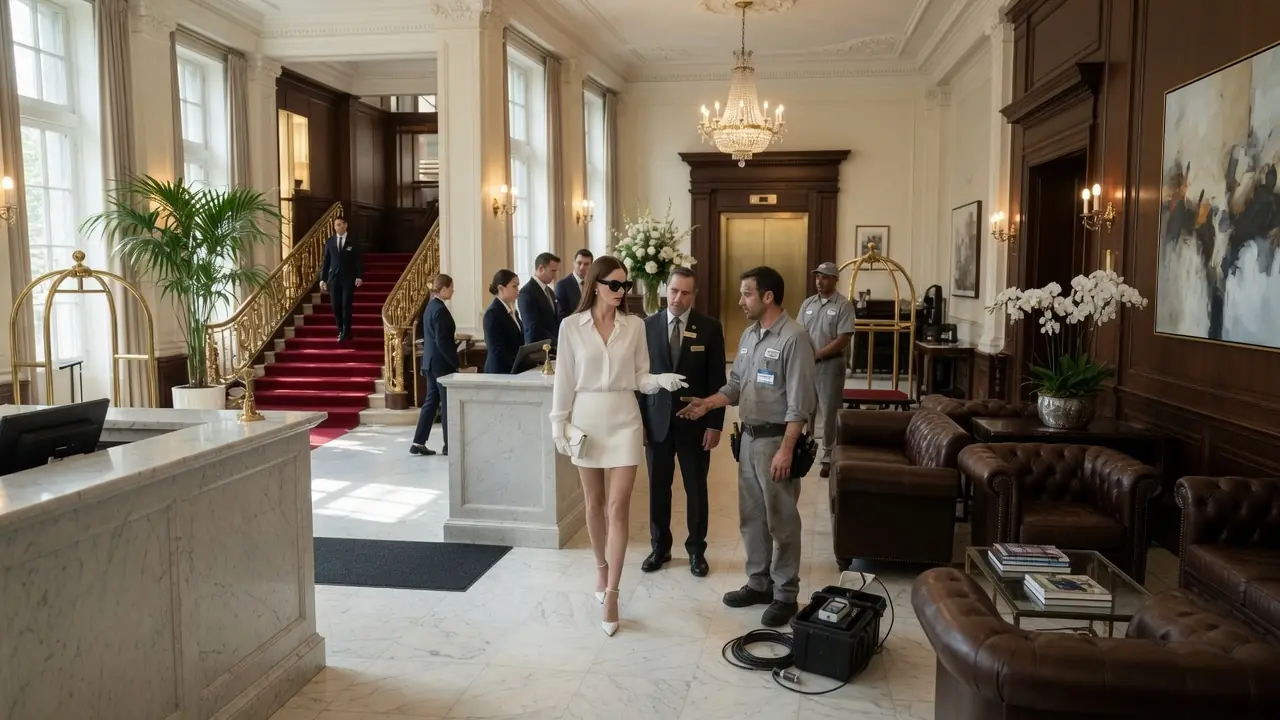
The old neighborhoods held on to Craftsman bungalows, independent hardware stores, diners with handwritten menus, while new money crept in from the edges, converting warehouses into creative offices, planting coffee shops with no signs on the door. It was the kind of city where a man in a work uniform and a woman running a seven-figure consulting firm could live within two miles of each other and never once occupy the same room. Claire Whitfield had built Whitfield and Voss Consulting over five years out of a single rented office on Lexington Avenue and a willingness to outwork everyone in the room. The firm was good, genuinely good at turning struggling mid-market companies into acquisition targets or turnaround stories.
She had 12 employees, three anchor clients, and a reputation that had finally grown large enough to reach the kind of investors who didn’t return cold calls. Meridian Capital was the largest she had ever approached. $$18 million. The number sat in her head every morning before she was fully awake. Garrett Voss, co-founder, COO, the man whose name came second on the letterhead, had his own ideas about how to approach Meridian.
In the conference room that Monday afternoon, he laid out a presentation restructured to center his operational role. Claire listened without interrupting. When he finished, she asked one question. Which sections did you move?
Garrett smiled the way people smile when they think the other person is missing the bigger picture. The ones that needed context, he said. Claire nodded once and said nothing more. She had learned that some arguments were worth having in writing.
Daniel left the Asheville Grand at 8:15, drove across town in his F-150, and was parked outside Asheville Elementary by 3:00. He watched the double doors until Lily came through them at 3:10, backpack bouncing, a folded piece of construction paper clutched in both hands like a document of some importance. I drew our house, she said, handing it to him before he could ask. He unfolded it carefully.
A square house in green crayon, one window, a tree that was taller than the house, and two figures out front, one tall, one small. He folded it back along her original crease and tucked it into his shirt pocket. It’s good, he said. I know, she said.
He had been doing this for four years. Wake at 5:30, take the first job call, be done before 2:30 when possible, pick up Lily by 3:15 at the latest, dinner by 6:00, dishes by 7:00, Lily in bed by 8:30, then the quiet part of the evening, the part where he would scroll through the emails from Marcus without opening most of them, read the ones that needed a response, type two lines, and close the laptop. Marcus ran Meridian Capital. Daniel let him.
It had been the arrangement since Sarah died, and it worked well enough that neither of them had felt the need to revisit it. That evening, Claire received a text from Lily’s teacher about a parent volunteer meeting for the third-grade science project. Daniel received the same message 4 minutes later. Claire read the sign-up sheet attached.
Her daughter Emma was paired with a student named Lily Cross. She typed a confirmation, set her phone face down on her desk, and went back to the pitch deck. Daniel read the message while standing over the stove. He scrolled to the parent contact listed alongside his: Whitfield, Claire.
He stopped, then he put his phone on the counter and turned down the heat under the soup. The parent meeting was held on a Tuesday evening in the school library. Folding chairs arranged in a rough circle. The smell of dry-erase markers and old carpet.
Daniel arrived at 6:50 and took a seat near the back. He had his jacket on, which was unusual for him. He wasn’t sure why he had put it on. Claire arrived at 7:04.
She moved to the front without looking around. She did not see Daniel until 20 minutes later when the teacher, Ms. Fowler, a small woman with reading glasses pushed up into her hair, began organizing parents into pairs to support the project. Claire was assigned to the same table as Daniel. She sat down across from him, looked at his face, placed him: the lobby, the extended hand, the moment she had kept walking.
He would help with the structural materials. She would coordinate the research component. It took 9 minutes. They did not discuss anything outside the project.
Across the room, Lily was showing Emma something on a piece of paper, a sky she had painted in art class. Blue layered over blue with white pressed in at the center. You can’t just use one color. Lily was saying.
You have to blend it. Otherwise, it looks fake. Emma studied the painting with the seriousness of someone being taught something she suspected she should already know. Claire watched them for a moment.
She looked away before Daniel could notice her looking. That night, after Lily was asleep, Marcus called. Daniel was sitting on the back porch with his phone on the armrest, watching the lights of the neighborhood through the maple branches. I need to tell you something, Marcus said.
He didn’t use that phrasing lightly. Meridian is moving forward on a deal. The firm is called Whitfield and Voss Consulting. Does that name mean anything to you?
Daniel was quiet for a moment. I’ve met her. When? Twice. Once at the Grand, once tonight at Lily’s school. A pause.
Then you need to know the Lily Cross Trust holds 60% of Meridian’s voting shares. Every deal above $10 million requires your signature. You’re the controlling stakeholder, Daniel. You’ve always been.
I know what I am, Daniel said. Process it the normal way. I can’t. Marcus’ voice dropped. Garrett Voss, the co-founder, is pushing a term structure that would dilute Claire Whitfield’s equity to below 30% within 18 months of closing.
She wouldn’t have enough shares left to block a buyout. He’s planning to acquire her position at a distressed valuation once the dilution triggers kick in. If you sign the deal as currently written, you’re signing her out of her own company. Daniel said nothing.
Rain had started light, barely audible, just enough to make the leaves move. Send me the full term sheet, he said. Tonight. Daniel. Tonight, Marcus. He sat there after the call ended. After a while, he opened the laptop he kept on the kitchen table for Lily’s homework.
He typed the name into the search bar, Whitfield and Voss Consulting. The website loaded clean, professional, a photograph of the executive team. Claire Whitfield was in the center. He recognized her immediately.
The lobby, the hand he had offered, the direction she had walked. He closed the laptop halfway, then opened it again. There was work to do. He read through the documents until 2:00 in the morning, working the way he worked a complicated electrical fault, not from the end backward, but from the source forward, tracing each line until he understood where the current was meant to go and where it was actually going.
The term sheet was 41 pages. The dilution mechanism was on page 11, inside a subclause under the definition of conversion event. It was written in the grammar of standard legal language, in the kind of phrasing designed to be ignored because it resembled everything around it. But the math it described was exact.
If Claire signed this deal as written, she would own less of her company with every month that passed, and there would be nothing in the agreement that technically prevented it. At 2:17 in the morning, Daniel sent Marcus an email. I need to know who drafted Section 4B on Garrett Voss’s side, and I need the full internal correspondence between Garrett and the Meridian board members going back 60 days. He did not go to sleep after that.
He sat in the kitchen and thought about the kind of person who would architect something this careful over this long a period of time. At the office the next morning, Claire stood at the whiteboard running through the pitch sequence with her team. She had divided the presentation into three sections, market context, operational track record, and growth roadmap. She was presenting the operational section herself.
Garrett had the financial model. She paused at one point and asked, without making it a larger moment than it was, Who’s the actual decision maker at Meridian? Not the committee. Who moves first?
Garrett looked up from his laptop. It’s a committee structure, standard for a firm their size. No single person holds veto power on the investment side. That’s not what I asked, Claire said.
Garrett set his pen down. The committee acts on consensus. There’s no individual with unilateral authority. He said it the way a person says something true in a way designed to leave out something important.
Claire turned back to the whiteboard. That evening, she picked up Emma from the after-school program and asked on the drive home, How’s the science project coming? Good, Emma said. Lily figured out how to make the rings on Saturn look right.
You have to use two different colors of orange. How do you know which colors to use? She just knows, Emma said, as if this required no further explanation. Claire looked at the road.
That night, Marcus’s reply arrived in Daniel’s inbox. Attached were 62 pages of email correspondence. Garrett had been in contact with two Meridian board members for six weeks before the official pitch process began. The emails were careful, nothing explicit, nothing that named the dilution play directly, but the pattern was legible to anyone paying attention.
Garrett had been building relationships on the inside of the deal, while presenting himself to Claire as focused entirely on the outside. Daniel printed the relevant pages, folded them into an envelope, and put the envelope in the inside pocket of his jacket. Then, he went to bed, because tomorrow he had a job in West Asheville that started at 7:00, and the homeowner had already called twice to reschedule. The Meridian Capital offices occupied the top two floors of a glass building on College Street that reflected the Blue Ridge in the mornings when the light was right.
On the 14th floor, the conference room had windows on three sides. The mountains to the west looked close enough to touch. Claire arrived at 9:45 with her team. Garrett was already set up, laptop connected to the display, printed materials at every seat, a yellow legal pad at his own place covered in handwriting Claire hadn’t seen before the meeting.
He had been here earlier than she had. She noted this and said nothing. The presentation ran an hour and 20 minutes. Claire handled the opening and the strategy sections without hesitation.
She had given versions of this talk dozens of times and had stopped needing notes for it 2 years ago. Garrett took the financial model and ran long on it, drifting twice into territory that belonged to her section. Each time she waited for a natural pause and then redirected with a question that brought the room back to the framework she had established. The board members asked good questions.
The session ended with handshakes in the polished neutrality of people who make decisions on other people’s timelines. While the pitch was in progress, Daniel was sitting in the fourth-floor waiting area with a paper cup of water and his jacket folded over one knee. The receptionist had asked him twice if he needed anything else. He had said no both times.
Marcus came down at 11:15. They stood in the corridor near the stairwell door. You could have told me you were coming, Marcus said. I’m telling you now.
Marcus looked at him, the work jacket, the paper cup, the complete absence of performance. You haven’t been in a board meeting since Sarah died. I’m not going to a board meeting. I’m sitting in a hallway.
Daniel, who in that room knows my name? Marcus thought about it. No one. The board members know the trust exists. They don’t know who the trustee is.
Good, Daniel said. Keep it that way. The pitch team came out at 12:05. Garrett moved immediately to shake hands with the board members, positioning himself between Claire and the people she needed to talk to.
Claire stepped around him without making it visible. Then she came around the corner of the hallway and stopped. Daniel was standing by the window at the end of the corridor, hands in his pockets, looking out at the mountains. He turned when he heard footsteps.
It took her a moment to assemble at the lobby, the school library, this hallway on the 14th floor of the firm that was about to write her company an $$18 million check. Three different rooms, one face. You work here? she said. Not exactly. Marcus stepped out from the stairwell door.
Ms. Whitfield, he said, extending his hand. Marcus Cross, and this is my brother, Daniel Cross. The hallway was quiet. Somewhere below them, a door closed.
Claire looked at Daniel Cross and Daniel Cross looked back at her, and neither of them said the thing that was sitting in the air between them. Marcus walked Claire to a small conference room off the main corridor, glass walls, four chairs, a table the size of a kitchen island. He closed the door. Garrett was not in the room.
Through the glass, she could see the hallway, but Daniel was around the corner and out of view. He explained it without embellishment. The Lily Cross Trust had been established in 2010. It held 60% of Meridian Capital’s voting equity.
The trust’s sole trustee was Daniel Cross. Any investment decision exceeding $$10 million required his written approval. Without his signature, the deal did not close. It was that simple and had always been that simple. Claire listened.
Her hands were flat on the table. She asked no questions while Marcus spoke. And when he finished, she was quiet for a moment before she said, how long has this structure been in place? Since we founded the firm, Marcus said.
Daniel stepped back from operations four years ago. His wife passed. He needed distance, and I gave it to him, and neither of us revisited the equity structure afterward. Why not?
Marcus considered the question. Because he didn’t want to, and because Meridian kept running. You don’t fix what functions. She nodded once.
Then she stood up and said, thank you, Marcus, and walked out. Daniel was in the hallway where she had left him, standing at the window, watching the city below. A truck was idling at the intersection. A woman was walking a dog in the square.
He heard her steps and didn’t turn immediately. She stopped beside him. They both looked down at the street. When did you know? she said.
Know about the deal? A few days ago. Know you were Claire Whitfield? He paused. The school meeting.
And you didn’t say anything. You didn’t either. It wasn’t an accusation, but it settled between them like something that had weight. Her phone buzzed.
She looked at the screen. Garrett had a message about a dinner reservation, a place on Broadway, the kind of evening that implied celebration. She put the phone back in her pocket without responding. I need more time before I sign, Daniel said.
He was still looking at the street. Seven days. The deal will cool. A good deal doesn’t cool in Seven days. She turned her head to look at him.
He was still watching the street. The truck at the intersection had moved on. Seven days. she said. She drove back to her office. She opened the term sheet on her screen, the same document she had read four times in the last 2 weeks.
She started at page one and read differently now, the way you read something when someone has told you, without telling you, that you missed something. By page 11, she had found it, buried under the definition of conversion event, inside a subclause that required three readings to parse. The dilution trigger was not hypothetical. It was structural.
If the deal closed as written, her equity position would begin eroding in month seven. By month 18, she would no longer have enough shares to block a majority vote. She sat in her chair and looked at the wall for a long time. On Wednesday morning, Claire closed her office door and called Garrett in.
She sat behind her desk. He sat across from it, which was already different from their usual arrangement. Section 4B, she said. The conversion event clause.
Walk me through the intent. Garrett didn’t hesitate. Investor protection. Standard structure for a deal this size. Meridian needs to know their position is secure.
If the growth targets aren’t hit— the dilution threshold isn’t tied to performance targets. It’s time-based, month seven, regardless of revenue. That’s how conversion triggers work in most term sheets at this level. I’ve read 20 term sheets at this level, Claire said.
This isn’t standard. Garrett shifted in his chair. Just barely. Claire, I think you’re reading adversarial intent into language that’s designed to be protective. We’re about to close the most significant round of our careers.
This isn’t the moment to get into the weeds on— This is exactly the moment, she said. He changed approaches then talking about vision, about the long game, about the way great partnerships required some give on both sides. He was good at it. He had always been good at it.
She listened to the whole thing and then told him she needed the rest of the afternoon to think. After he left, she sat with the document and her instincts and the certainty that something was wrong and she could not yet prove the shape of it. The proof came that evening, delivered by someone neither of them had thought about. Sandra Osay had worked as Garrett’s executive assistant for three years before leaving to freelance.
Six weeks before the pitch, she had sat outside a glass-walled conference room while Garrett met privately with two of Meridian’s board members. She had not been in the room, but she had been close enough to the door. She had recorded 11 minutes and 40 seconds on her phone and kept the file while she decided what to do with it. On Wednesday evening, she sent it to Marcus Cross, the general counsel contact on Meridian’s public disclosure filing, the only address that wasn’t Garrett Voss.
Marcus listened to the recording at his desk at 8:00 in the evening. Then he called Daniel. Daniel was in the kitchen. Lily had been asleep for an hour.
The house was the particular quiet it got after 9:00. The refrigerator hum, the settling of the walls, the feeling of all the day’s motion finally coming to rest. He listened to the file on speakerphone with the volume low. Garrett’s voice was recognizable even at that register.
Clear enough, he said, Once the conversion triggers activate and her position falls below 30, she won’t have the votes to block anything. I’ll make her an offer on her remaining shares. She’ll take it because she won’t have a better option. And then we restructure the cap table the way we should have from the beginning.
Daniel set the phone face down on the counter. He looked at the window above the sink. The backyard was dark. He could hear the maple moving in the wind.
He picked the phone back up and called Claire. She answered on the second ring. He could tell from the quality of the silence behind her voice that she was still at her desk. I need to meet with you, he said, tomorrow morning without Garrett.
What time? 7:00. Mill Street Coffee. Do you know it? I’ll find it, she said.
They hung up. In her apartment, Claire turned off her desk lamp and sat in the dark for a while. In his house, Daniel turned off the kitchen light and stood in the hallway for a moment before going upstairs to check on Lily. She was asleep on her side, one arm wrapped around a stuffed rabbit that was missing one eye.
He stood in the doorway for a moment. Then he went to bed. Neither of them slept well. Mill Street Coffee was the kind of place that had been there long enough to stop trying to look like anything other than what it was: six tables, mismatched chairs, and a chalkboard menu that had the same 12 items it always had.
The music was jazz from a small speaker on the shelf behind the counter. The front window let in gray morning light and the slow movement of the street outside. Daniel arrived at 6:45. He ordered two black coffees without deliberating.
He sat at the table near the window and waited. Claire came in at 7:02. She saw the two cups and sat down across from him. You ordered for me.
I don’t know what you drink, he said, but it’s early and you came from across town. This seemed right. She looked at him for a moment, then wrapped her hands around the cup. He slid his phone across the table.
The recording app was open. Listen to this first, he said. All of it. She put in the earbud he offered and listened.
Daniel watched the street. A man unlocked the bakery across the road and propped the door open. A dog tied to a parking meter lifted its head, then settled again. Inside the coffee shop, the jazz moved through a bridge and came back around.
Claire set the earbud down. She did not look up immediately. When she did, her eyes were steady. He planned this before the pitch, she said.
It was not a question. He was in contact with two Meridian board members six weeks before you went in, Daniel said. He was building the inside of the deal while he was running the outside with you. How long have you known something was wrong?
I knew there was a structural problem in the term sheet when Marcus sent it to me. I didn’t have proof of intent until last night. You could have let it close, Claire said. Deal goes through as written.
I lose control of the company in 18 months. Garrett buys my position at a discount. You still hold 60% of Meridian. Nothing changes for you.
Daniel looked out the window. The bakery across the street had its lights on now, orange and warm against the gray morning. I built Meridian so that the money it moved would do something worth doing, he said. Not so it could be used to take something from someone who built it herself.
The coffee was good. Neither of them rushed it. They spent the next hour working through the restructure, which clauses to remove, what replacement language would protect Meridian’s legitimate interests without the concealed dilution mechanism, and what the timeline would need to be to get a revised term sheet in front of the board before Garrett could maneuver around them. Daniel had done enough of this in a different life to move quickly.
Claire was faster with the details than he expected. They worked in the practical register of two people who are past the part where they have to establish credibility with each other. At some point in the space between one subject and the next, Claire said, What’s your daughter’s name? Lily. Emma talks about her.
Daniel looked down at his coffee cup. Something moved at the corner of his mouth, not quite a smile, not performing as one, just a small involuntary thing. Claire saw it and looked back at her own cup. When they stood to leave, Daniel held out his hand the same way he had in the lobby of the Asheville Grand, except that nothing about this moment resembled that one.
Claire looked at his hand. She thought of the lobby. She thought of herself walking away. She took his hand and shook it the way you shake the hand of someone you’re glad is on your side.
Thank you, Daniel, she said. It was the first time she had used his name. The emergency board meeting convened at 9:00 on Friday morning on the 14th floor. Eight people around the conference table, six board members, Marcus and Daniel.
The mountains were visible through the west window, clear this morning, closer seeming than usual in the October light. Daniel sat to Marcus’s right. He had a navy shirt on, dark slacks, no tie. He set a folder on the table in front of him and left it closed.
He didn’t introduce himself. No one asked him to. Garrett arrived at 9:04. He came through the door at his usual pace and stopped when he saw Daniel, a pause of a quarter second, no more, and then his face reassembled and he moved to his seat at the far end of the table.
Marcus noticed Daniel had already looked down at his folder. Marcus presented first. The recording, the emails, the pattern of contact between Garrett and the two board members whose names appeared most frequently, once in week two, twice in week four, three times in the final 10 days before the pitch. He laid it out the way a contractor lays out a job estimate.
Everything itemized, nothing inflated. The room was very quiet in the way that rooms become quiet when everyone in them is processing information they could not unknow and cannot quite believe they didn’t know sooner. Garrett’s first response was the most defensible one available to him. That conversation was taken out of context.
Those were exploratory discussions, standard pre-deal relationship building with two sitting board members. Marcus said, Six weeks before a pitch, you had material non-public information. His second was more tactical. Garrett turned slightly in his chair and addressed not Marcus, but the room.
Daniel Cross has not participated in Meridian’s operations in four years. The question is his standing in a governance matter of this kind. Daniel opened the folder. He took out a single page and placed it on the table.
The Lily Cross Trust, original, notarized. The equity structure set out in the specific language of legal instruments, 60% of voting shares, sole trustee, no expiration. He laid it flat. I don’t need standing, he said.
I need my signature. And I haven’t signed. Garrett did not speak again after that. The vote took 11 minutes.
Garrett’s role in the transaction was suspended pending formal review. The deal was tabled in its current form pending restructure. Two board members who had met privately with Garrett recused themselves from the vote on the question of their own conduct review. Neither of them argued the point.
Claire sat in the room as the receiving party, present, attentive, saying very little. When Marcus turned to her near the end and asked whether she would accept a revised term structure, she said, Yes. Then she looked at Daniel for 1 second before she looked back at the papers in front of her. The meeting adjourned at 10:55.
Claire was standing in the hallway when Daniel came out. He saw her and slowed his pace without stopping. It’s done, he said. It’s done, she said.
The hallway was quiet. Somewhere below them, an elevator opened. Neither of them reached for the next sentence, not because they didn’t have one, but because the silence was doing something that words would have interrupted. Daniel nodded once, then he walked to the elevator.
Claire watched the corridor until he turned the corner, and then she looked at the place where he had been for a moment before she turned the other direction. three weeks passed. Asheville moved through the first cool days of October, the maples beginning their slow shift from green to something warmer. Daniel spent most of the week rewiring the first floor of a craftsman in West Asheville old knob-and-tube wiring that had been patched so many times it had become its own system, a record of every owner who had tried to fix something without fixing the original problem.
He worked steadily and didn’t think about much else. Marcus handled the revised deal documents. The new structure came together without incident. Claire signed the final closing papers on a Tuesday.
$$18 million, clean terms, no hidden triggers. She read the full document before signing all 43 pages. Garrett’s departure from the firm was handled through a letter from the company’s legal counsel. On Monday morning, his office was empty.
His name no longer on the conference room booking system. The office held his absence the way rooms hold the shape of furniture that’s been moved. On a Friday afternoon, the third grade class at Asheville Elementary held its science project exhibition in the gymnasium. Folding tables were covered in poster boards and models, and the concentrated effort of children who had worked on something for several weeks and were now prepared to explain it to adults.
Daniel arrived and took a seat in the third row. He had his jacket on again. Claire came in 6 minutes after him and sat in the same row, one chair between them. Lily and Emma stood at their table with a scale model of the solar system built from papier-mâché and wire and careful amounts of paint.
Lily handled the explanatory portion. She pointed to Saturn’s rings and said, You can’t just use yellow. You have to put orange in the outer band and blend it at the edges or it won’t look like the photographs. Emma nodded with the authority of someone who had watched this process and understood its importance. Daniel clapped. Claire clapped.
They both looked at the table and nodded at each other. Afterward, Lily came running across the gymnasium floor and took hold of Daniel’s wrist with both hands. Dad, Emma invited me to her house this weekend. Can I go?
Daniel looked up. Claire was standing five feet away. The question Lily had asked was technically about a weekend visit, but it was also about something else and all three of them understood this, though only two of them could have said so. Is that all right?
Daniel said to Claire. It’s all right, Claire said, if Emma’s dad agrees. Lily swung toward Daniel. Dad, do you agree?
He looked at Claire for a moment. I agree, he said. Lily released his wrist and ran back to Emma to deliver the verdict. The two of them disappeared into the crowd of children and parents and poster boards.
Daniel and Claire stood in the gymnasium surrounded by noise with nothing requiring them to stay there and nothing requiring them to leave. The weekend came. Claire pulled into the driveway of a small house on the edge of the city on a Saturday afternoon. Wood-frame, a covered porch, a garden at its autumn version of itself, a maple burning orange.
Before she could knock, the door opened. Daniel had an apron on over a dark shirt. Behind him, the house smelled of onions and butter. Come in, he said.
I’m in the middle of something. No greeting beyond that. No performance. Just the door opened and the warm kitchen smell and the assumption that she would come inside, which she did. Emma and Lily were audible before they were visible.
A moment later they were gone into Lily’s room and the house settled into its quieter register. Two adults, a kitchen, something on the stove. Claire sat at the kitchen table. Daniel stirred the pot without looking over.
They talked the way people talk when they are comfortable enough not to need a reason about the neighborhood, about a coffee shop on Merrimon Avenue that had changed owners, about the time Daniel had tried to teach Lily to read a wiring diagram and she had decided it was a treasure map and searched the house for three days. At some point Claire stood up and moved beside him at the stove. She hadn’t been invited. She just stood there and said, It needs more salt.
He handed her the salt without asking how she knew. She added a small amount, tasted it, set the spoon down. The kitchen was not large. The distance between them was less than it had ever been and neither of them had engineered it and neither stepped back.
Dinner was the four of them at a table too small for four, which meant the bread basket had to be passed rather than reached. Lily talked. Emma continued. Daniel and Claire ate and occasionally looked at each other across the table in the way of people who are beginning to understand something they’re not yet ready to name. After dinner, Claire and Emma stood in the driveway in the early dark. The porch light was on.
Daniel stood on the step. Lily stood beside him. Emma waved from the car. Lily waved back.
Claire reached the car door and stopped. She turned back. Daniel was still on the step, one hand on the railing. She looked at him.
He looked at her. There was nothing that needed saying. She nodded once. He nodded back.
From the porch, Lily watched the tail lights disappear around the corner. Then she looked up at her father. Dad, she said, is Emma’s mom nice? Daniel looked at the empty street.
The maple was dark now, just a shape against the sky. The porch light made a small warm circle around the two of them. Yeah, he said, do you like her? He put his hand on her shoulder and turned her toward the door.
Let’s go see if there’s any soup left. Lily went inside. Daniel stood in the open doorway for a moment, the quiet street, the empty driveway, the smell of the kitchen coming through behind him. He reached for the light switch and then didn’t, just stood there between the inside and the outside, in no hurry to close anything.
Neither of them had been looking for this. That was probably the reason it had found them.