"Did you just touch me with those black hands?"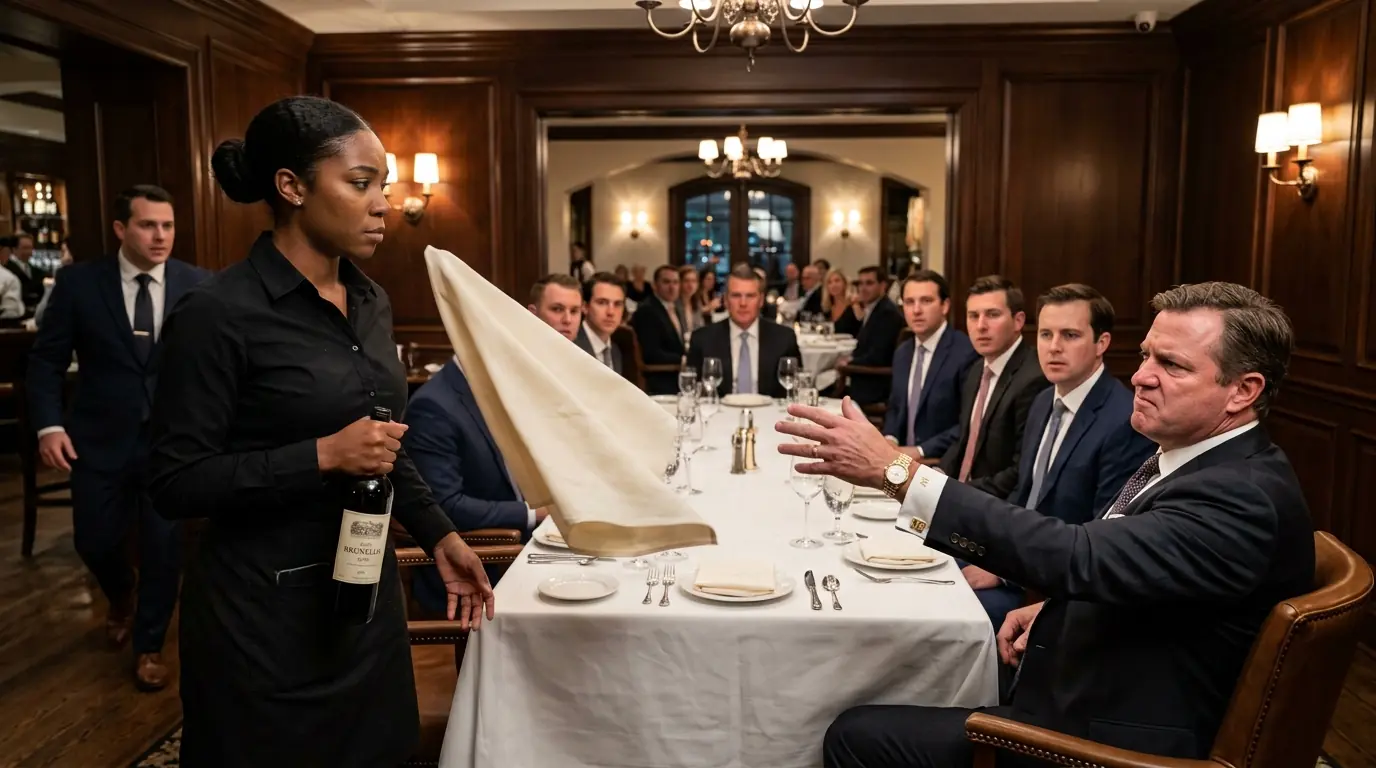
Forty guests at the Sterling went dead silent. Grant Hollister grabbed his linen napkin and threw it straight at the waitress's face.
"Sir, I was only pouring your—"
"Shut your mouth! Get this animal away from my table before she ruins my appetite."
The floor manager rushed over, apologized to Hollister—not to her. She bent down, picked up the napkin, folded it perfectly, placed it back on his table, leaned close, and whispered three words.
He waved her off, laughed, turned to his executives: "Relax. She's nobody."
He threw a napkin at a Black waitress and never thought about it again. Why would he? She was just a girl in an apron. But those three words she whispered, they were already ticking. And Monday morning, they exploded.
Six days before that napkin hit Amara Williams' face, she was sitting in her car outside the Sterling at 5:47 p.m. on a Tuesday evening. A Wharton MBA hung on her apartment wall back in Charlotte. A signed offer letter from Hollister Ventures glowed on her laptop at home: VP of People and Culture. Start date: Monday.
The board had voted four to one to hire her. The lone dissent: Grant Hollister himself. He hadn't met her, hadn't seen her photo, hadn't read her file. All he'd said in the meeting was, "We don't need another diversity hire making PowerPoints nobody reads." Board Chairman Victor Bellingham overruled him.
Now Amara sat in her car wearing a plain black shirt and black pants—a server uniform she'd bought that morning at a thrift store on King Street. Her professional clothes were folded in the back seat. On the passenger seat, a leather notebook. She opened it, wrote two words: Day One.
She had one week before Monday. One week to answer a single question: Who is Grant Hollister when he thinks no one that matters is watching?
She picked up her phone, made one call. A man's voice answered, older, steady.
"I'm going in," she said.
"Be careful, Amara. And don't get caught."
She hung up, stepped out of the car, walked through the Sterling service entrance.
The first person she met was Ruthie Simmons, fifty-four, Black, elbows deep in a tray of polished silverware. Eleven years at the Sterling, the longest-serving employee on the floor. Ruthie looked her up and down the way someone reads a resume without words.
"You don't look like someone who needs this job."
Amara tied her apron. "Everybody needs something."
Ruthie held her gaze a beat too long, then shrugged. "Patio's this way."
The staff hallway told Amara everything she needed to know within thirty seconds. A whiteboard hung beside the breakroom door: the weekly section assignment sheet, handwritten in blue marker. Amara slowed as she passed it. Didn't stop, didn't stare, just read:
-
Section one (indoor): Trent Moore
-
Section two (indoor): Kyle Bennett
-
Section three (indoor): Colton Brady
-
Section four (patio): Ruthie Simmons
-
Section five (patio): Janelle Dixon
-
Section six (patio): Marcus Perry
-
Section seven (patio): Amara Williams
-
Section eight (patio): Darnell Okafor
Every indoor section: white. Every patio section: Black. No exceptions. No asterisks.
Amara pulled out her phone as if checking a text, snapped a photo of the board, kept walking.
Beside the whiteboard hung the Employee of the Month display: two rows of framed photos stretching back twenty-four months. Amara counted without breaking stride. Twenty-four months, twenty-four faces, all white. She noted it in her leather notebook during her first bathroom break. Wrote: 24/24. Not one.
Derek Lawson found her three minutes later. The floor manager was forty-four, sharp-jawed, quick-stepping, the kind of man who confused efficiency with authority. He didn't shake her hand, didn't ask about her experience, didn't look at the application she'd filled out that morning, which listed a hospitality management degree she actually held.
"You're Section 7, patio. You shadow Ruthie tonight. She'll show you the tables."
"Any chance of an indoor section? I have fine dining experience—"
He was already walking away. "That's where we need people."
People. Not you. Not even new hires. People.
Amara tied her apron tighter and followed Ruthie outside. The patio was beautiful for guests: string lights, magnolia trees, candlelit tables overlooking a courtyard. For servers, it was a different story: farthest from the kitchen, no air conditioning. August in Charleston meant 96° on a slow night. And the tips—half of what indoor sections averaged, because the big spenders always sat inside.
During the last hour of her first shift, Ruthie handed her a coffee in the breakroom. They sat in silence for a moment. Then Ruthie spoke quietly, the way people talk when they've given up on being heard.
"Don't bother asking about indoor sections. I asked for six years." She nodded toward the hallway. "Trent Moore. You see his name on the board? Three weeks. Three weeks he's been here. He's already inside." She sipped her coffee. "They say it's seniority. Funny how seniority only works one direction."
Amara said nothing, but she reached for the stack of linen napkins on the breakroom table—the same heavy cream-colored linen the Sterling used in the dining room. She pulled one off the top, took out a pen, and began writing notes along the edge: times, sections, names.
The napkin as a weapon hadn't happened yet. For now, it was something else: a quiet tool of intelligence hiding in plain sight. Ruthie watched her write, said nothing, but her eyes lingered on the leather notebook poking out of Amara's apron pocket. You write a lot for a waitress. She didn't say it. She didn't have to.
Three days passed. Three days of patio heat, polished glasses, and notes filling the margins of Amara's leather notebook. She logged everything: the section assignments unchanged every single day; the tip gaps—she calculated them on a napkin during her break. Indoor servers averaged $380 a night; patio servers, $120.
She watched Colton Brady, twenty-one years old, former car wash attendant, fumble a tray of champagne flutes on his second day in Section 3. Nobody moved him. She watched Ruthie handle a twelve-top alone on the patio without a busser, while two indoor servers shared a four-top with full support. None of it was accidental. All of it was architecture.
Then Friday came. At 6:15 p.m., Derek Lawson's radio crackled. He lifted it to his ear, listened, and his posture changed: shoulders back, chin up—a different man. He found Amara restocking napkins in the service corridor.