The auctioneer never even used Darius Flournoy's name. He pointed at him with a rolled-up brochure, the way you point at a dog that has wandered onto a golf course, and he said to the crowd, "Well, somebody wants the tetanus farm. Sold to the young man who doesn't read the fine print."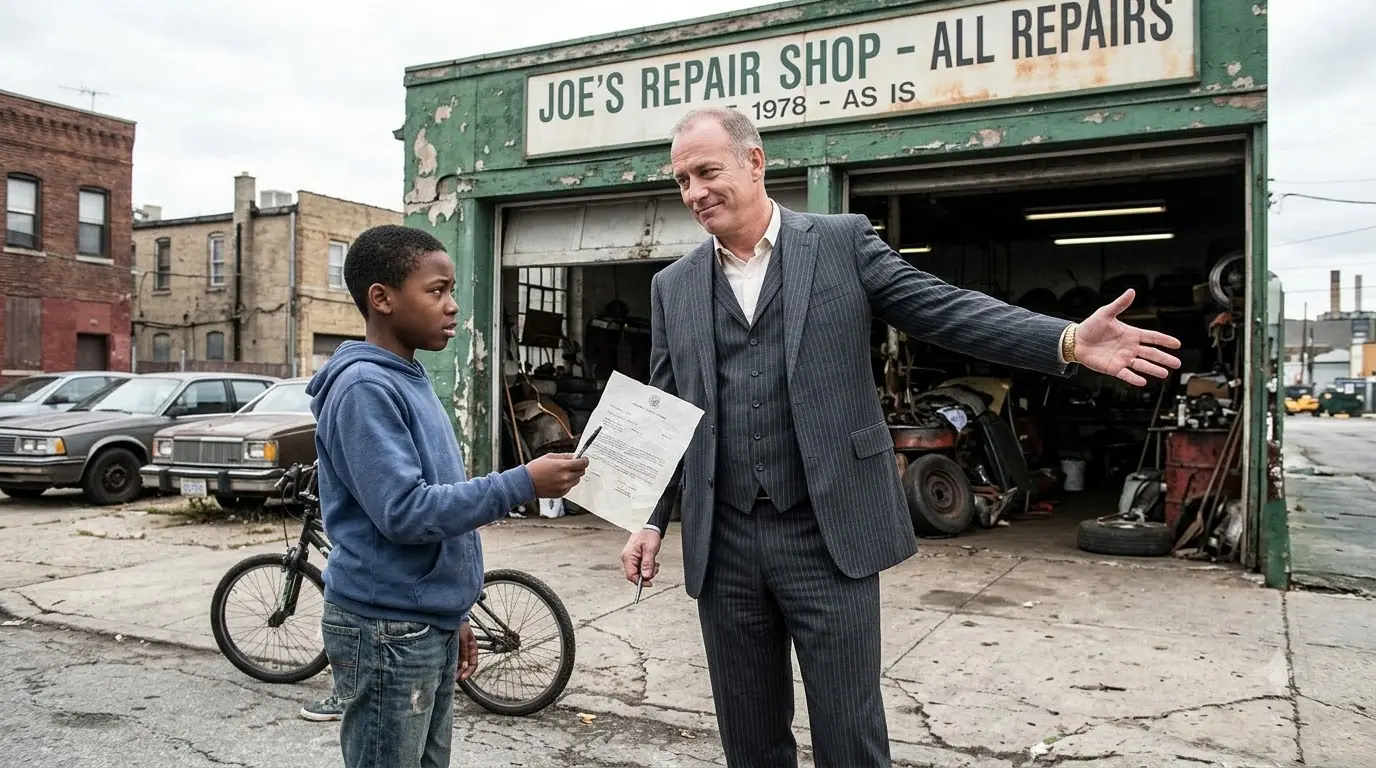
They laughed. All of them. The men in blue suits with their phones already up and filming. The woman in beige who covered her mouth like the laugh was a hiccup she was too polite to release. And the tall one near the front, Chase Brewer, who did not cover anything, who let his laugh roll out across the cracked asphalt of the old Route 90 lot, so it bounced off the tin walls of the garage Darius had just bought for $1,000.
Darius folded the receipt in half and put it in his shirt pocket. He did not smile back. He did not need them to stop. He had spent three weeks reading the fine print they were so sure he had not read. And the fine print was the whole reason he was standing there in the July heat, letting a rich man call his new property a tetanus farm.
But that comes later. Start where Darius started, which was under a car.
He had a life before the laughing men. That is the thing they never understand about the people they film. There was a whole person there before they arrived to make him a clip. His shop was not really a shop; it was a bay he rented at Cornell Boone's place on the edge of town—a lift, a bench, and a rolling stool with one wheel that turned sideways when it felt like it.
Darius was 23. He had hands that knew engines the way some people know music: by feel, by the small wrongness of a note before it becomes a broken thing. He could stand next to a running motor with his eyes closed and tell you which cylinder was tired. He learned it from a man named Rufus who was dead now, and from 10,000 hours of listening, and from a stubbornness his grandmother used to call a gift and a curse in the same breath.
Cornell Boone was 60 and had run the place since before Darius was born. He smelled like pipe tobacco—he had quit smoking 11 years ago, the smell just living in his clothes now. And he called every customer "sir" or "ma'am," even the ones who did not deserve it.
On the morning this story really begins, Cornell was leaning in the doorway with a cup of gas station coffee going cold in his hand, watching Darius torque a set of lug nuts by memory.
And he said, "You still going out to that auction Saturday?"
"I am."
"For the Route 90 lot?"
"For the Route 90 lot."
Cornell made a sound in his chest that was not quite a laugh. "Son, that lot has been dead 30 years. Marbury's people have been buying up everything from the interstate to the river, and they skipped it. You know why they skipped it?"
"'Cuz it's junk," Darius said.
"Because it's junk."
Darius rolled out from under the car and looked up at him. There was grease on his forearm in the shape of a wing where he had brushed the tie rod. "Or because whoever priced it didn't walk the back fence," he said, and rolled back under before Cornell could ask what that meant.
He had walked the back fence. That was the seed of the whole thing, and nobody at the auction knew he had done it.
Three weeks earlier, on a Sunday when the county office was closed and the lot was just a padlocked ghost, Darius had parked on the shoulder, climbed the sagging gate, and walked the property line with a printout of the plat map he had pulled from the county records office for $4.30 in copy fees. He had walked it because his grandmother, Ada, had once told him something he never forgot. She cleaned houses out on the ridge for 30 years, houses owned by people who owned other things, and she used to say, "The rich do not check the corners. They buy the middle of a thing. The pretty part. The part in the photograph. And they let a man in an office draw the lines. And the man in the office is bored and underpaid, and he rounds."
She said it like a warning, and Darius had heard it like an instruction.
So, he walked the corners. And what he found at the back corner, where the plat map showed the boundary running arrow-straight along the tree line, was that the boundary did not run along the tree line at all. It ran 40 yards past it, down a shallow draw, across a dry creek bed, to a rusted iron pin sunk in concrete that some surveyor had driven into the ground in 1961, and that no one had looked at since.
The lot was more than three times the size the auction brochure said it was. And that back 40 yards of scrub and creek bed sat directly across the only flat buildable gap in the ridge for 11 miles in either direction.
Darius knew that gap. Everybody in the county knew that gap. It was the gap the new water and rail corridor was supposed to run through—the corridor Preston Marbury had been announcing and unannouncing in the paper for two years, the one that was going to make somebody very rich.
He did not tell Cornell. He did not tell anybody. He put the plat map in a drawer under his socks, went to work every day, and saved $1,100.
And on Saturday, he drove out to the auction in a truck that idled rough because he had not bothered to fix his own truck. And he stood in the sun and let Preston Marbury's people laugh at him and hand him a receipt.
Preston Marbury himself was not supposed to be there. A man like Marbury did not attend a $1,000 auction. He sent Chase Brewer and a handful of associates to sweep up the last scraps of the corridor route, and it should have been a formality, a morning's paperwork. But Marbury came anyway, because Marbury liked to be photographed winning.
He had brought a videographer, and the plan was to film him buying the last worthless piece of the puzzle for pocket change and post it with a caption about vision and grit.
The problem was that Darius bid $1,200.