The chandeliers sparkled as if nothing ugly had ever happened beneath them.
Dozens of crystal branches hung from the ceiling of the Grand Plaza Hotel, scattering soft light across polished marble floors, gold-trimmed columns, and arrangements of imported white orchids that changed every morning before the first guests arrived.
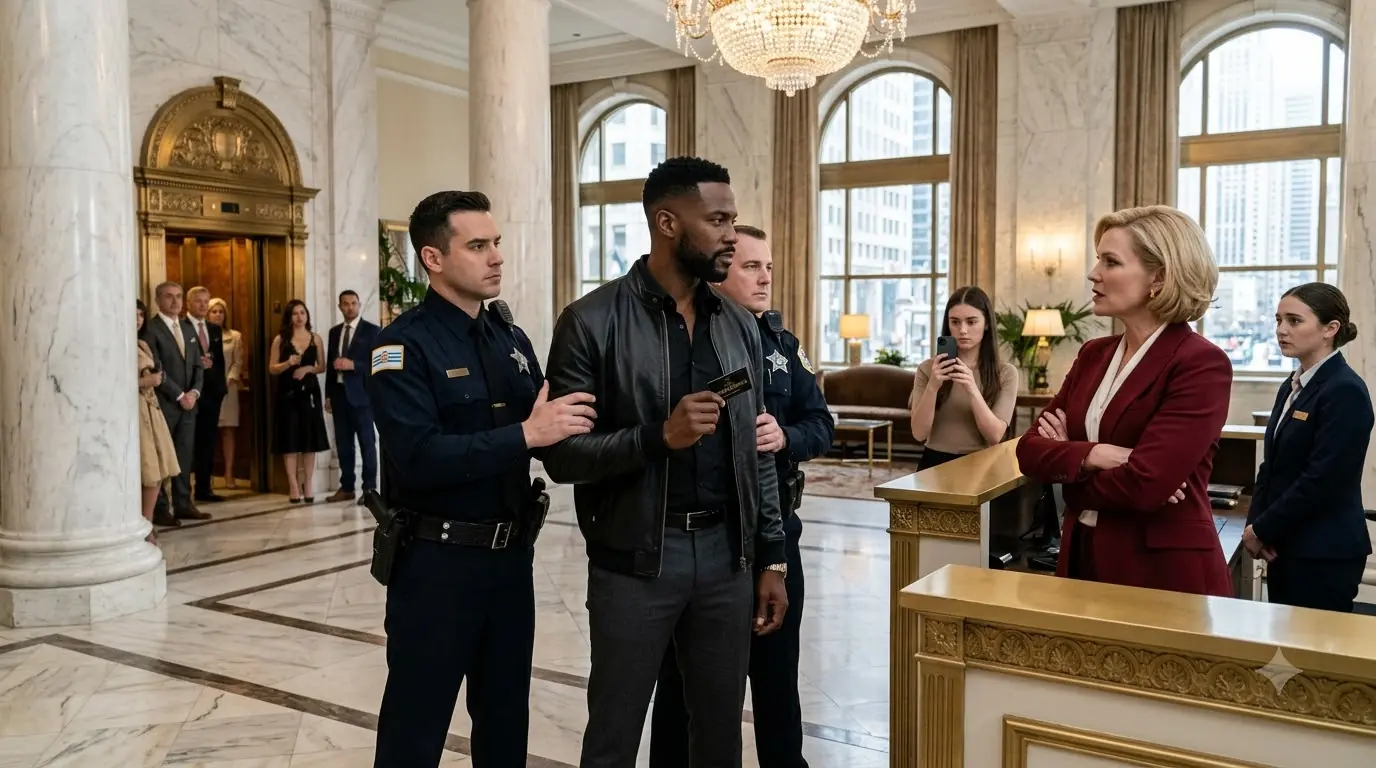
Every surface reflected wealth. Every employee uniform had been pressed until the seams looked sharp enough to cut paper.
Even the air seemed expensive, carrying faint traces of cedar, citrus, and whatever fragrance the hotel paid consultants to select for its lobby.
For nearly seventy years, the Grand Plaza had built its reputation on making certain people feel important.
Presidents had stayed there.
Actors had hidden from photographers there.
European royalty had occupied the upper floors during diplomatic visits.
Corporate mergers worth billions had been negotiated over breakfast in its private dining rooms.
The hotel called itself timeless.
That night, however, beneath the brightest chandelier in the lobby, something timeless was exposed for what it really was.
A Black man in a fitted black leather jacket stood near the center of the marble floor with two uniformed officers holding his arms.
He was not shouting.
He was not resisting.
He was not threatening anyone.
His expression was controlled, though humiliation tightened every muscle in his jaw.
Around him, guests slowed their steps.
A couple near the elevators whispered.
Three businessmen near the bar turned their chairs slightly to watch.
A woman in a silver evening dress raised her phone.
Behind the gold-trimmed front desk, General Manager Vanessa Whitmore stood with her arms folded, outwardly composed.
She believed she had the situation under control.
What she did not know was that the man being restrained had signed the documents transferring ownership of the Grand Plaza Hotel to his company three months earlier.
She did not know that his signature appeared on the final acquisition agreement.
She did not know that the board she still believed she answered to had already transferred operational authority.
And she certainly did not know that within thirty minutes, she would be standing beneath the same chandelier explaining why she had ordered security to remove the man who owned the building.
His name was Marcus Ellington.
He was thirty-eight years old.
And he had spent most of his life learning what happened when people decided who you were before allowing you to speak.
Marcus had grown up forty minutes south of downtown Chicago in a narrow two-bedroom apartment above a laundromat.
His mother, Denise Ellington, raised him alone.
She worked double shifts as a certified nursing assistant in a long-term care facility, often leaving home before sunrise and returning after Marcus had finished his homework.
Some nights she smelled like antiseptic and hospital soap when she kissed his forehead.
Some nights her feet were swollen so badly she sat on the edge of the bathtub and soaked them in hot water before she could sleep.
Marcus remembered asking her once why she worked so much.
She had smiled tiredly and said, “Because I want you to have choices.”
That sentence stayed with him.
Denise never had many choices herself.
She had left community college when she became pregnant.
She drove used cars until they could no longer be repaired.
She clipped coupons.
She knew which grocery stores marked down meat after seven in the evening.
Yet she carried herself with quiet dignity.
She taught Marcus that poverty was not shameful, but surrender was.
More importantly, she taught him that people would sometimes look at him and decide what he deserved before knowing anything about him.
“You cannot control what they assume,” she told him when he was fourteen after a store employee followed him through three aisles. “You can control what you become.”
Marcus took those words seriously.
He became the student who arrived early.
The employee who stayed late.
The young executive who read contracts twice before meetings because he knew mistakes that were forgiven in others might define him permanently.
He earned scholarships.
Finished business school.
Worked briefly for a major hotel investment group where he learned that hospitality was less about rooms and more about systems.
The front desk mattered.
Housekeeping mattered.
Security mattered.
The person answering a room service call at midnight mattered.
A luxury hotel could spend millions on marble and still fail because of one human interaction.
Marcus eventually left corporate life and founded Ellington Hospitality Holdings with two employees, a borrowed office, and more confidence than capital.
The first property he bought was not glamorous.
It was a struggling seventy-room hotel near an interstate outside Milwaukee.
The carpets smelled faintly of cigarettes even though smoking had been banned years earlier.
Half the televisions were outdated.
Online reviews mentioned stained towels and rude employees.
Most investors considered the building a lost cause.
Marcus saw opportunity.
He replaced management.
Raised wages before changing the lobby furniture.
Started eating breakfast anonymously in the hotel restaurant to hear what guests experienced.
Within eighteen months, occupancy rose dramatically.
Then came another property.
Then three.
Then twelve.
Marcus developed a reputation for buying hotels with strong locations but weak cultures.
He was not interested in cosmetic improvement alone.
He studied complaints.
Employee turnover.
Security reports.
Guest surveys.
He believed bad service was usually not an isolated problem. It was evidence of what leadership tolerated.
By thirty-eight, Ellington Hospitality Holdings controlled luxury and business properties in nine states.
Yet Marcus remained deliberately low-profile.
He rarely appeared in glossy magazines.
He disliked ceremonial introductions.
He had seen too many executives become insulated from the companies they supposedly ran.
That was one reason he had insisted on personally visiting the Grand Plaza before the acquisition became public.
The deal had taken eleven months.
The Grand Plaza's previous ownership group had accumulated significant debt despite the hotel's prestigious reputation.
Publicly, the property looked flawless.
Privately, occupancy among repeat customers had begun slipping.
Employee turnover was increasing.
Complaints were growing.
Nothing catastrophic.
Just enough warning signs to interest Marcus.
His company purchased the hotel quietly through a holding structure.
The transition agreement allowed the current executive staff to remain temporarily until Ellington Hospitality completed its internal review.
The public announcement was scheduled for the following week.
Most hotel employees had no idea.
Vanessa Whitmore knew a sale was being discussed, but she believed the current investors remained in control.
She had been general manager for almost seven years.
Vanessa was fifty-one, immaculately dressed, relentlessly punctual, and skilled at making powerful guests feel recognized.
She remembered names.
Preferred suites.
Favorite wines.
Anniversaries.
She could spot a repeat guest walking through the revolving door from fifty feet away.
Owners loved that about her.
So did wealthy clients.
What appeared less frequently in official reports was how Vanessa defined the word “guest.”
She had spent years cultivating what she called “standards.”
Employees understood what that meant even if she rarely said it directly.
Certain people were welcomed immediately.
Others were watched.
Some reservations were double-checked.
Some forms of clothing triggered questions.
Some accents were treated as suspicious.
Some guests were required to explain themselves in ways others were not.
Vanessa never used openly discriminatory language in emails.
She was too careful for that.
Instead, she used phrases.
“Profile inconsistency.”
“Billing verification.”
“Guest suitability.”
“Brand alignment.”
“Security awareness.”
Her language was polished enough to protect her.
Her assumptions were not.
Marcus had received hints of those issues during the acquisition.
Several online complaints described unequal treatment.
One former employee had anonymously written that management trained staff to distinguish between “luxury clients and problem guests” based partly on appearance.
Nothing had been substantiated.
Marcus wanted firsthand experience before making accusations.
So he booked the hotel like anyone else.
No assistant.
No corporate account connected publicly to Ellington Hospitality.
No executive alert.
He used his personal identification and reserved a presidential suite for two nights.
The room was prepaid.
At 6:42 p.m. on Friday evening, Marcus stepped from a black sedan beneath the Grand Plaza awning.
A valet opened his door.
“Good evening, sir. Welcome to the Grand Plaza.”
“Thank you.”
Marcus carried one slim leather briefcase and a garment bag.
The valet offered to take both.
“I've got them.”
The lobby doors opened automatically.
Marcus paused for half a second.
The Grand Plaza was beautiful.
He understood immediately why investors had fought over it.
The marble staircase curved upward like something from an old European estate.
Tall windows reflected the city.
A pianist played softly near the lounge.
If guests judged only appearances, the hotel deserved every star beside its name.
Marcus approached reception.
Three employees stood behind the counter.
Vanessa happened to be there reviewing something with a supervisor.
Marcus waited.
A white couple stepped to the neighboring station and were immediately greeted.
“Welcome back, Mr. and Mrs. Patterson.”
The clerk smiled broadly.
Marcus noticed the detail.
Repeat guests.
Fine.
His turn came.
Vanessa looked up.
“Good evening.”
“Good evening. Checking in. Marcus Ellington.”
Her eyes moved quickly over him.
Black leather jacket.
Dark trousers.
No tie.
No visible luggage beyond the briefcase and garment bag.
The inspection lasted less than a second.
But Marcus had spent a lifetime recognizing that second.
“Identification and credit card.”
He provided both.
Vanessa entered his name.
Her expression changed slightly when the reservation appeared.
“Presidential suite?”
“Yes.”
She looked at the screen again.
Then at Marcus.
“Yes.”
A pause.
“Was this reservation made by you personally?”
Marcus smiled faintly.
“Yes.”
“Interesting.”
He waited.
Vanessa examined his driver's license longer than necessary.
Then she placed it beneath a verification light.
Marcus said nothing.
He noticed the couple beside him had already received keys.
Their identification had never left the clerk's hand for more than a few seconds.
Vanessa turned toward another employee.
“Could you confirm this reservation with central booking?”
The employee looked confused.
“It shows confirmed.”
“I'd like another confirmation.”
Marcus finally spoke.
“Is there a problem?”
Vanessa smiled.
“Routine procedure, sir.”
Marcus knew it was not.
Still, he remained calm.
“What exactly are you verifying?”
“Nothing concerning.”
“Then why is additional verification necessary?”
Vanessa's smile tightened.
“Luxury properties have certain fraud-prevention protocols.”
Marcus nodded slowly.
“Was there something about my card?”
“No.”
“My identification?”
“Not specifically.”
“My reservation?”
“It is a high-value room.”
“So presumably all presidential-suite guests receive this verification.”
Another pause.
Vanessa's eyes shifted briefly toward the other guests.
“We evaluate situations individually.”
There it was.
Marcus filed the phrase away.
Eventually, his reservation was confirmed for the third time.
Vanessa returned his card.
“Enjoy your stay.”
Marcus received no apology for the delay.