My name is Marcus, and for fifteen years I thought I had the perfect marriage.
Rebecca and I met at a church social in Springfield, Illinois, back when we were both twenty-two. She had this radiant smile and a voice that could make angels weep. I was working at the local bank then, just starting out as a loan officer, dreaming of eventually managing my own branch.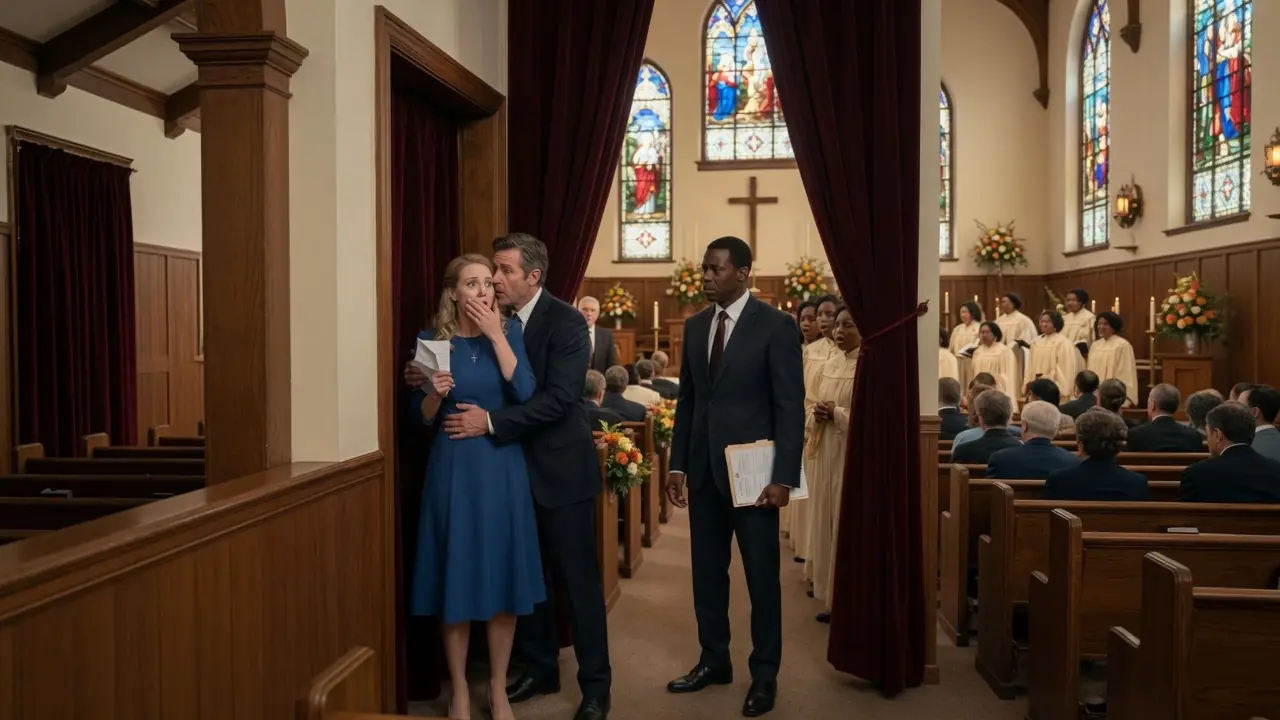
Our wedding was everything a young couple could hope for. Rebecca wore her grandmother’s dress, I wore my father’s tie, and the whole congregation sang as we walked down the aisle. We bought a modest two-story house on Maple Street, painted it yellow with white shutters, and settled into what I believed was domestic bliss.
Rebecca joined the church choir almost immediately. She had this pure soprano voice that became the centerpiece of every Sunday service. Pastor Williams always said she was gifted by God Himself. I’d sit in the third pew every Sunday, watching her face light up as she sang, feeling proud that this incredible woman had chosen me.
For years, everything seemed perfect. Rebecca would come home from choir practice on Thursday evenings glowing with excitement, telling me about the new songs they were learning, the upcoming Christmas cantata, or the Easter special. She’d hum melodies while cooking dinner, practice scales in the shower, and sometimes sing me to sleep with old hymns.
I was promoted to assistant manager at First National Bank when I turned thirty. The extra money meant we could finally think about starting a family. We’d been trying for a couple of years with no luck, but the doctor said everything looked fine, to just keep trying and stay relaxed. Rebecca threw herself even deeper into choir activities, saying music was her way of staying positive.
That’s when Jacob Patterson joined the choir.
Jacob was new to Springfield, having moved from Chicago after what he called a difficult divorce. He was a tenor with a rich, warm voice that complemented Rebecca’s soprano beautifully. Pastor Williams paired them for several duets throughout the year. Jacob was handsome in that rugged, artistic way, tall with graying temples and calloused hands from his work as a contractor.
At first, I was genuinely happy that Rebecca had found such a good musical partner. Their voices blended perfectly during Sunday services, and the congregation always erupted in applause after their performances. Rebecca would beam with pride, and I’d beam right along with her.
Thursday evening choir practices started running later. Rebecca would come home at ten, sometimes ten-thirty, apologizing and explaining that they’d been working on particularly challenging pieces. She’d be energized, talking rapidly about harmonies, breath control, and the upcoming performances. I didn’t think much of it. Rebecca had always been passionate about music.
The first thing that should have worried me was the phone calls. Rebecca’s cell would ring at odd hours, and she’d step outside to answer, claiming it was Jacob calling about choir arrangements. When I’d ask what was so urgent that it couldn’t wait until Thursday practice, she’d wave her hand dismissively and say I wouldn’t understand the technical aspects.
Summer arrived, and the choir planned an ambitious project. They would perform at the regional gospel competition in Chicago. Rebecca was beside herself with excitement. She and Jacob would perform a particularly difficult duet that required extra practice sessions.
Suddenly, Thursday evenings weren’t enough. They needed Tuesday evenings, too. Sometimes Saturday afternoons. I started working longer hours at the bank, partly because we were understaffed, but partly because Rebecca seemed so busy with her music that I felt like I was in the way at home.
When I’d get back from work at seven or eight, she’d already begun to practice. I’d heat up leftovers and watch television alone, falling asleep on the couch more nights than I cared to count.
The weekend of the Chicago competition, I couldn’t attend because of a banking conference in St. Louis. Rebecca assured me she understood, kissed me goodbye, and promised to call with results. The choir won second place, and Rebecca was over the moon when she called that Saturday night. She and Jacob’s duet had been specifically praised by the judges.
When she returned Sunday evening, she seemed different somehow. Not bad, just distant. She’d sit at the kitchen table, staring out the window, humming melodies I didn’t recognize. When I’d ask what she was thinking about, she’d snap back to attention and smile that radiant smile, but it felt forced.
August brought a new development. The choir had been invited to perform at a wedding in Decatur, about an hour’s drive away. It was a Saturday evening ceremony, and they wouldn’t return until late. Rebecca was apologetic about missing our usual Saturday movie night, but she said the opportunity was too good to pass up.
“Wedding?” The secretary sounded confused. “We don’t have any wedding scheduled today. Are you sure you have the right church?”
I called three more churches in Decatur. None had weddings that day. None had heard of any choir from Springfield performing. My hands were shaking as I hung up the phone.
There had to be some explanation. Maybe Rebecca had gotten the town wrong. Maybe it was a private ceremony at someone’s home. Maybe the secretary was new and didn’t know the schedule.
I spent that Saturday walking around our house like a caged animal. Every rational explanation I invented seemed flimsy. By evening, I was sitting in my car outside our house, watching for Rebecca’s headlights, rehearsing the conversation in my head.
She came home just after midnight looking flushed and happy. Her hair was slightly messed, her lipstick gone. She had that same distant, dreamy expression I’d been noticing more often.
“How was the wedding?” I asked, trying to keep my voice casual.
“Oh, it was beautiful,” she said, not meeting my eyes. “The bride wore this vintage lace dress, and the flowers were everywhere. Yellow roses and baby’s breath. The whole church just glowed.”
She was lying. I could tell because Rebecca always looked directly at people when she spoke. It was one of the things I’d first loved about her. Now she was staring at the wall behind my head, her hands fidgeting with her purse strap.
I didn’t sleep that night. I lay in bed listening to Rebecca’s steady breathing, wondering how long this had been going on. Was I losing my mind? Was I paranoid and jealous over nothing? But the evidence was piling up. The late practices, the mysterious phone calls, the fake wedding in Decatur.
The next morning was Sunday, and we sat in our usual pew for service. I watched Rebecca in the choir loft. Watched the way she looked at Jacob during their duet. There was something intimate in their glances, a private communication that excluded everyone else in the room.
When they hit the final note together, holding it in perfect harmony, Rebecca’s face showed pure joy, the kind of expression I hadn’t seen her direct at me in months.
After service, we were standing in the church fellowship hall, drinking coffee and eating homemade cookies. Rebecca was across the room talking to Pastor Williams about the upcoming fall concert series. Jacob was near the dessert table, and I found myself walking over to him.
“Great performance today,” I said, extending my hand.
“Thank you, Marcus,” Jacob replied, shaking firmly. “Rebecca brings out the best in my voice.”
There was something in the way he said her name. Too familiar. Too warm.
“I hear you two have been putting in a lot of extra practice time,” I said, watching his reaction carefully.
Jacob’s smile faltered just slightly. “Well, you know how it is. Perfect harmony doesn’t happen overnight.”
The double meaning hung in the air between us like incense.
That week, I did something I never thought I’d do. I started paying attention to Rebecca’s schedule in a way that felt like surveillance. I noted when she left for practice and when she returned. I listened to her phone conversations from the next room.
I even drove by the church on Thursday evening to see if the lights were on in the choir room.
The church was dark.
I sat in my car in the parking lot, feeling sick to my stomach. If choir practice wasn’t at the church, where was it? I drove around Springfield for an hour, looking for Rebecca’s car, feeling like the worst kind of husband, but unable to stop myself.
I found her car parked outside Jacob’s apartment complex on the edge of town.
The next Thursday, I followed the same routine. Same result. Rebecca’s car was at Jacob’s apartment for three hours while I sat in my bank parking lot pretending to work late, and she was supposedly at choir practice.
I wanted to confront her immediately, but something held me back. Maybe it was cowardice. Maybe it was hope that I was misunderstanding the situation. Maybe they really were practicing music. Maybe Jacob’s apartment had better acoustics than the church. Maybe I was the paranoid husband letting jealousy destroy his marriage over nothing.
But deep down, I knew better.
The breaking point came in early September. Rebecca announced that she and Jacob had been selected to perform a special duet for the upcoming Harvest Festival, the church’s biggest event of the year. They would need intensive rehearsals leading up to the performance.
“How intensive?” I asked.
“Well, Pastor Williams suggested we might even want to do a weekend retreat to really focus. Just the two of us, to work on our musical partnership without distractions.”
She said it so casually, as if she was suggesting we pick up milk on the way home.
“A weekend retreat. Just you and Jacob.”
“For the music, Marcus. This is really important to me.”
“More important than our marriage?”
The words came out harsher than I’d intended. Rebecca’s eyes widened with what looked like genuine surprise.
“What does our marriage have to do with choir practice?”
“You tell me, Rebecca.”
We stared at each other across the kitchen table. I could see her calculating, trying to figure out how much I knew, what I suspected. For just a moment, her mask slipped, and I saw something I’d never seen in my wife’s face before.
Guilt.
“I don’t know what you’re implying,” she said finally, but her voice was shaky.
“I’m not implying anything. I’m asking directly. Are you having an affair with Jacob Patterson?”
The question hung between us like a physical thing.
Rebecca’s face went through several expressions. Surprise. Indignation. Fear. And finally, something that looked almost like relief.
“Yes,” she said quietly. “Yes, I am.”
I felt like I’d been punched in the stomach. Even though I’d suspected, even though I’d seen the evidence, hearing her say it made it real in a way that nothing else could.
“How long?” I asked.
“Since the spring. Since the Chicago competition.”
Four months.
Four months of lies.
Fake practices.
Imaginary weddings in Decatur.
Four months of coming home to my excited wife telling me about her day while she was actually telling me about her time with another man.
“Why?” I asked, though I wasn’t sure I wanted to hear the answer.
Rebecca was crying now, tears streaming down her cheeks.
“I didn’t plan it, Marcus. I never meant for this to happen, but when Jacob and I sing together, I feel alive. More alive than I’ve felt in years. He understands music the way I do. He listens when I talk about phrasing and breath control and the way certain notes make me feel. You just nod and smile, but he really hears me.”
“So you decided to have an affair.”
“I decided to feel like myself again.”
We talked for hours that night. Rebecca told me about feeling lost in our marriage, feeling like she’d become just Marcus’s wife instead of Rebecca the person. She talked about our failed attempts to get pregnant, how she’d started to feel broken, like her body was failing at its most basic purpose.
She talked about Jacob’s divorce, how he understood what it meant to feel trapped in a life that wasn’t working.
None of it made me feel better. If anything, it made me feel worse because I could understand some of what she was saying. I had gotten comfortable in our marriage, maybe too comfortable. I’d stopped really listening when she talked about music because it wasn’t my passion. I’d assumed that as long as we were happy on the surface, everything was fine underneath.
But understanding didn’t equal forgiveness.
“What do you want to do now?” I asked as dawn was breaking through our kitchen windows.
“I don’t know,” Rebecca said. “I love you, Marcus. I really do. But I can’t give up Jacob. Not yet.”
“Then I guess you’ve made your choice.”
I moved into the guest bedroom that day. Rebecca continued going to choir practice on Thursdays, but now she was honest about where she was going. The pretense was over, but somehow that made everything worse. Now I knew exactly when my wife was with her lover, and I had to sit in our house thinking about it.
Two weeks later was the Harvest Festival. Rebecca and Jacob were scheduled to perform their duet during the main service. I knew I couldn’t sit in that pew and watch them sing together knowing what I knew. But I also couldn’t stay home. It would look strange, and people would ask questions.
So I made a decision that would change everything.
The Saturday night before the Harvest Festival, I printed out copies of every photo I’d taken of Rebecca’s car parked outside Jacob’s apartment. I’d been documenting their meetings without really planning to do anything with the evidence. But now I had a purpose.
I also printed bank records showing withdrawals from our joint account on days when Rebecca claimed to be at church events that didn’t exist.
Sunday morning, I dressed in my best suit and drove to church early. I found Pastor Williams in his office going over his sermon notes.
“Pastor,” I said, “I need to talk to you about something important.”
I showed him the photographs and the bank records. I told him about the fake wedding in Decatur, the false choir practices, everything. Pastor Williams’s face grew graver with each revelation.
“Marcus, I’m so sorry,” he said finally. “I had no idea.”
“I want to handle this publicly,” I told him. “Today, after their performance.”
Pastor Williams looked uncomfortable. “Are you sure? This kind of confrontation could be very damaging to everyone involved.”
“More damaging than letting it continue?”
We agreed on a plan. After Rebecca and Jacob’s duet, Pastor Williams would ask them to remain on the platform for a special announcement. That’s when I would present the evidence to the entire congregation.
The service proceeded normally until it came time for the special music. Rebecca looked beautiful in her blue dress, her hair perfectly styled. Jacob wore a dark suit and stood close enough to her that their shoulders almost touched.
When they began to sing a hymn about faithfulness and eternal love, their voices blended in perfect harmony.
The congregation was mesmerized. I watched faces in the pews, saw the way people smiled and nodded appreciatively. Mrs. Henderson in the front row had tears in her eyes. The Johnson family was swaying slightly to the music.
Everyone could hear the beauty, the connection between the two voices.
When the song ended, applause filled the sanctuary. Rebecca and Jacob smiled at each other, and I saw that intimate look pass between them again.
Before Rebecca and Jacob returned to their seats, Pastor Williams stood up and said, “Marcus has something he’d like to share with the congregation.”
I walked to the front of the church on unsteady legs. Rebecca’s face showed confusion, then growing alarm as she saw me approaching with a manila folder in my hands.
“Many of you know that Rebecca and Jacob have been working very hard on their music together,” I began, my voice carrying clearly through the sanctuary. “What you don’t know is that their partnership has extended beyond the church walls.”
The sanctuary grew very quiet. I could hear the ventilation system humming.
I opened the folder and pulled out the first photograph.
“This is a picture of my wife’s car parked outside Jacob Patterson’s apartment last Thursday evening, when she told me she was at choir practice here at the church.”
Gasps and murmurs rippled through the congregation. Rebecca’s face had gone white.
“This is another picture from the Thursday before that. And this one is from three weeks ago.”
I held up photograph after photograph.
“While you’ve all been admiring their beautiful harmony on Sunday mornings, Rebecca and Jacob have been meeting secretly twice a week for the past four months.”
The sanctuary erupted. People were standing up, looking back and forth between me, Rebecca, and Jacob. I heard Mrs. Henderson gasp, “Oh my word,” and saw the Johnson family staring in shock.
“Furthermore,” I continued, raising my voice above the murmurs, “Rebecca lied to me about performing at a wedding in Decatur two weeks ago. No such wedding existed. She spent that Saturday evening with Jacob while I sat at home trusting my wife.”
Jacob tried to step forward.
“Marcus, let me explain.”
“Explain what? That you’ve been having an affair with a married woman? That you’ve been making a mockery of this church and this congregation?”
Pastor Williams intervened. “Perhaps we should discuss this privately.”
“No,” I said firmly. “This has been happening in plain sight. All of you have been watching them perform together, praising their connection, their chemistry. You had a right to know what that connection really was.”
Rebecca was crying openly now.
“Marcus, please. Not like this.”
“Like what? Honestly? Publicly? The same way you’ve been performing your fake marriage every Sunday while carrying on with him?”
The congregation was in chaos now. People were standing, talking, some heading for the exits. I could see phones coming out as people started texting and calling others who weren’t present.
I turned to face Rebecca directly.
“I want a divorce.”
Those four words cut through the noise like a knife.
The sanctuary fell silent again.
“I’ve already filed the papers. They’ll be served tomorrow. I’m keeping the house since I can prove adultery. You’re free to be with Jacob without having to lie about it anymore.”
Rebecca sank into one of the platform chairs, sobbing. Jacob looked like he wanted to run. Pastor Williams stood frozen between us all, clearly wishing he was anywhere else.
I walked back down the aisle through the stunned congregation. People I’d known for fifteen years stared at me with mixtures of sympathy, shock, and curiosity.
When I reached our usual pew, I stopped and turned back.
“Oh, and Rebecca, that beautiful song you just sang about faithfulness and eternal love? You might want to learn the words.”
I left the church and never went back.
The fallout was swift and brutal, exactly as I’d planned. By Monday morning, the story was all over Springfield. Rebecca’s reputation in the community was destroyed. Women she’d known for years crossed the street to avoid her.
Her job at the elementary school became uncomfortable as parents whispered in the hallways. Jacob, being newer to the community and already divorced, faced less immediate social consequences, but he found his contracting business drying up as church members and their friends decided to hire other companies.
The divorce proceedings moved quickly once adultery was established. Rebecca got very little. Some personal belongings, her car, and a small cash settlement. I kept the house, the joint accounts, and most importantly, the moral high ground.
But the victory felt emptier than I’d expected.
Six months later, I was living alone in our yellow house on Maple Street. Rebecca had moved to Chicago, supposedly to live with her sister while she got back on her feet. Jacob had left town entirely. I heard he’d gone back to Chicago as well, though I didn’t know if he and Rebecca were still together.
The house felt enormous and quiet.
I’d gotten a promotion at work. Apparently, my colleagues viewed me as a tragic figure deserving of sympathy and advancement. I was now managing my own branch, the dream I’d had for years finally achieved.
But I came home every evening to silence. No humming in the shower. No excited chatter about choir practice. No off-key singing while cooking dinner.
I’d gained everything I’d wanted professionally and lost everything that had made home feel like home.
Sometimes I wondered if I’d handled it right. Could we have worked through it privately? Could counseling have saved our marriage? But then I’d remember the lies, the fake wedding in Decatur, the way Rebecca had looked at Jacob during their performances, and I’d know that the marriage had been over long before I exposed it publicly.
The hardest part wasn’t the loneliness or the quiet house. It was the realization that Rebecca had been right about one thing. I hadn’t really been listening to her. Not for years. I’d been content with surface-level happiness while she’d been suffocating underneath.
But that didn’t excuse the affair. It didn’t excuse the lies. And it didn’t change the fact that when she’d been given the choice between working on our marriage and continuing with Jacob, she’d chosen Jacob.
A year later, I sold the yellow house on Maple Street and moved to Indianapolis. I got a job at a larger bank, bought a downtown condo, and started what I suppose you’d call a new life. I dated occasionally, but found it hard to trust.
Every time a woman mentioned working late or having plans with friends, I’d find myself wondering if she was telling the truth.
I never remarried. I threw myself into work, got promoted twice more, and eventually became regional manager for a chain of banks across Indiana. I made good money, lived comfortably, and by all external measures, I was successful.
But I never sang again.
I’d never had a particularly good voice, but I used to enjoy humming along to the radio or singing in the shower. After Rebecca, music felt like a betrayal, a reminder of what I’d lost and how I’d lost it.
Five years after the divorce, I got a wedding invitation in the mail.
Rebecca Patterson Collins was marrying someone new, not Jacob, but a man named Richard Collins I’d never heard of. The wedding was in Chicago, at a small church I didn’t recognize. She must have found a new community, rebuilt her reputation, started over.
I was happy for her, I realized. Not completely happy. There was still some bitterness, some resentment. But mostly, I was glad that she’d found a way forward.
We’d both paid the price for the choices she’d made, but apparently she’d found redemption.
I didn’t attend the wedding, but I sent a card. Just a simple congratulations, signed with my name. No message, no explanation. I hoped she understood that it represented my final letting go of the anger I’d carried.
Looking back now, I understand that there were no real winners in our story. Rebecca lost her community, her reputation, and her marriage. I lost my wife, my faith community, and my ability to trust completely. Jacob lost his business and had to start over somewhere new.
The congregation lost their beautiful music and gained a story they’d be talking about for years. Pastor Williams retired earlier than planned, saying the incident had taught him that shepherding souls was more complicated than he’d thought.
But maybe that’s the way these stories have to end. Maybe when trust is broken that completely, when lies pile up that high, there isn’t a path back to happiness for anyone involved. Maybe the best you can hope for is that everyone eventually finds a way to move forward.
Sometimes I still wonder what would have happened if I’d handled it differently. If I’d confronted Rebecca privately, demanded counseling, given her an ultimatum away from the public eye. Maybe we could have worked through it. Maybe she would have chosen our marriage over Jacob.
But I also know that the public confrontation wasn’t really about punishment or humiliation, though it served both purposes. It was about truth. For months, I’d been living a lie without knowing it. Our friends, our pastor, our entire community had been unknowingly complicit in Rebecca and Jacob’s deception.
Everyone deserved to know the truth, even if it was ugly.
Especially because it was ugly.
I’m fifty-two now, settled into my life in Indianapolis. I have a few close friends, a job I’m good at, and enough money to live comfortably. I volunteer at a literacy program downtown and take long weekend drives through the Indiana countryside.
It’s not the life I planned when I married Rebecca all those years ago. It’s not the yellow house on Maple Street with children’s voices echoing through the rooms and a wife who sings while she cooks.
But it’s honest.
It’s built on truth instead of lies, on reality instead of performance.
And after everything that happened, that feels like enough.