“Take those ridiculous boots off my field.”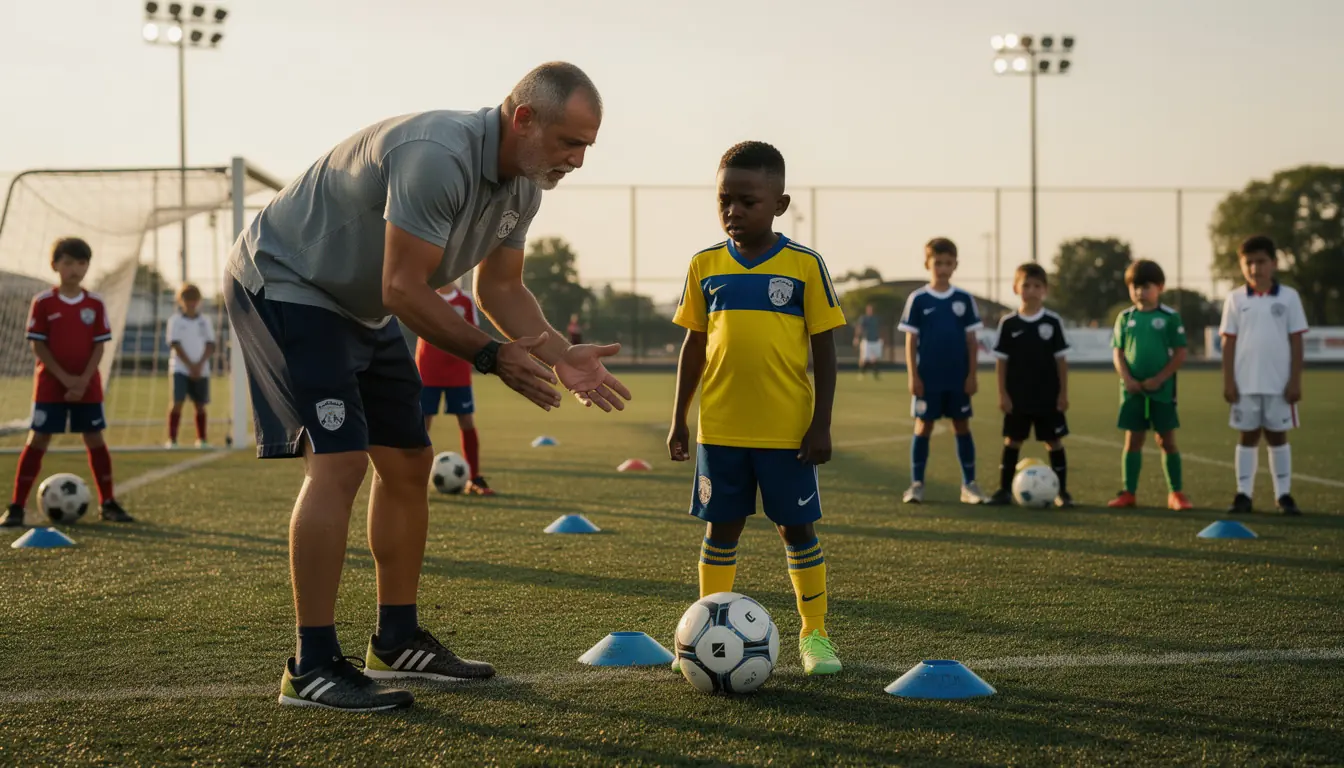
The coach shouted so loudly that the whistle hanging around his neck bounced against his chest. Every ball stopped moving at the Cedar Ridge Soccer Academy, and twenty-three teenagers turned to look at the tall Black boy standing beside the sideline.
The boy was seventeen, wearing a faded gray sweatshirt, black training shorts, and soccer cleats whose once-white leather had turned the color of old pavement. He held a mesh bag of practice balls in one hand and his younger brother’s water bottle in the other.
Coach Grant Mercer walked toward him with the impatient confidence of a man accustomed to having the final word. “I said you’re not dressed for this class. We teach proper football here, not whatever tricks you learned in a parking lot.”
A few boys laughed. One lifted his phone as if the embarrassment might be worth recording.
The teenager looked down at his shoes. The right one had a neat line of blue stitching near the toe, a repair his grandfather had made by hand.
“They’re safe to play in, sir,” he said. “I checked the studs.”
“I didn’t ask for a safety report,” Mercer replied. “I asked you to get off my pitch.”
Behind the teenager, his fourteen-year-old brother, Eli, took a step forward. “Coach, that’s Malik. He’s here because—”
“Because he thinks every kid with a ball is a coach?” Mercer interrupted. “Eli, I already told you to stop asking for special treatment.”
Malik Carter touched his brother’s shoulder. He could feel Eli trembling through the thin fabric of his jersey.
“It's all right,” Malik said quietly. “Go finish the drill.”
Mercer heard him and gave a theatrical sigh. “See? He’s already giving instructions.”
Laughter rolled across the artificial turf. Malik’s mother, Angela, was at work that Saturday morning, driving a city bus across Durham, North Carolina, and had trusted her sons to spend a useful day at the academy.
She did not know that the older one was about to become the morning’s entertainment.
“Since you’re such an expert,” Mercer continued, raising his voice for the parents in the bleachers, “why don’t you tell us where you learned to play?”
Malik hesitated. “From my grandfather, mostly.”
“Backyard training,” Mercer announced. “Ladies and gentlemen, we have a backyard expert.”
Someone laughed again, louder this time. Eli lowered his eyes, and Malik knew that the humiliation was spreading beyond him to the only reason he had come.
He could have ended the conversation in one sentence. He could have told Mercer where he played professionally, how many first-team matches he had completed, and why the academy director had invited him that morning.
But the younger players were watching. Malik had learned that showing people you were important was not the same as teaching them how to treat someone who appeared unimportant.
“I’m only here to help my brother,” he said.
Mercer pointed toward a pyramid of orange cones. “Then be useful. You can pick those up after the paying students finish.”
That was the moment Malik understood this wasn’t simply a misunderstanding about who belonged on the field.
Three boys from private schools wore matching academy training suits, and Mercer greeted their fathers by name. Five scholarship students stood off to the side waiting for equipment that had not arrived, although the grant funding their places had already been approved.