"We all know why you're really here, Desiree." Coach Phillips's voice cuts through the natatorium, deliberately loud enough for everyone to hear. "Diversity scholarships might get you through the door, but they don't make you a swimmer."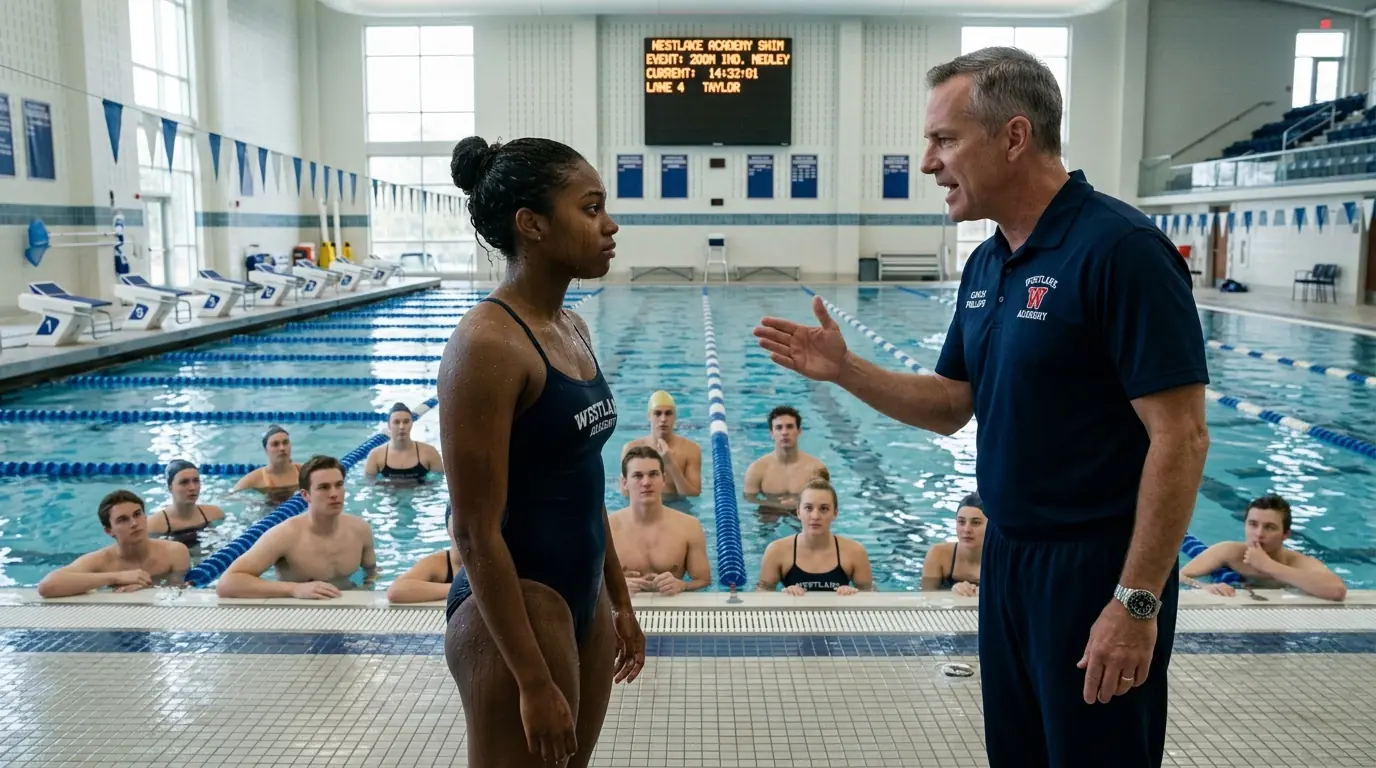
The words slam into Desiree Taylor like a physical blow. She stands dripping at the edge of the Olympic-sized pool, the chlorine scent mixing with the metallic taste of humiliation rising in her throat. 16 white faces stare from the water: some shocked, most smirking. No one speaks up.
"But my times were better than half the—" Desiree starts, her voice betraying her with a slight tremble.
"Times?" Coach Phillips laughs, the sound echoing off the water. "You think this is just about hitting a clock?" He gestures dismissively at the electronic scoreboard, where just yesterday Desiree's name had appeared in the top three. "This is about technique, precision, understanding the culture of the sport."
The last phrase hangs in the air, its meaning unmistakable. Heather Griffin, team captain with her perfect blonde ponytail, doesn't even try to hide her satisfied smile. Blake Peterson, whose father chairs the school board, actually whispers, "Finally," loud enough for Desiree to hear.
"The reality is," Coach continues, checking his expensive Rolex—a gift everyone knows came after the Griffins' substantial pool renovation donation last season—"some people just don't fit our program, no matter how hard they try."
A single droplet of pool water trails down Desiree's face, indistinguishable from what might be a tear. The fluorescent lights seem to intensify, spotlighting her as the only dark face in the blindingly white space.
"You can leave your team suit before you go," Coach adds, already turning away. "We wouldn't want to waste resources."
Desiree stands frozen, feeling 16 pairs of eyes burning into her skin. Someone snickers. Another whispers something that sounds like "quota kid." The words swirl around her like the chemically treated water: toxic and suffocating.
With every ounce of dignity she possesses, Desiree forces her chin up. Her spine straightens as she turns and walks—never runs—toward the locker room, each footstep leaving wet prints on the tiles like evidence of a crime. Only behind the sanctuary of the bathroom stall does she allow her hands to shake as she texts her grandfather.
It happened worse than we thought.
She stares at her reflection—at the girl who was fast enough to qualify, but somehow not "right" enough to stay. This isn't about swimming anymore. This was never just about swimming. And they're about to learn exactly what they've done.
The city bus squeaks to a halt at the corner of Maple and 43rd, its brakes protesting like everything else in this part of town. Desiree steps down onto cracked concrete, a world away from Westlake Academy's manicured grounds. The contrast never fails to hit her: 20 minutes by bus separates gleaming luxury cars from rusted chain-link fences, verdant lawns from concrete patches where weeds fight to breathe.
She walks three blocks to the Park View Apartments, a name that mocks the total absence of any park or view. The elevator's out again, so she climbs five flights, her swim bag heavy on her shoulder. Not that she'll need it anymore.
"That you, butterfly?" her grandfather's voice greets her before she's fully through the door. Elton Taylor sits at their small kitchen table, dinner already waiting. At 68, he moves slower these days, but his eyes miss nothing.
"Hey, Pops." She drops her bag, forces a smile that doesn't reach her eyes.
"You're home early." His voice is steady, but the lines around his mouth deepen. He already knows.
Desiree takes a seat, pokes at the food he's prepared. "Coach Phillips cut me today. Said my technique wasn't precise enough."
Elton nods slowly, his face a careful mask. But Desiree sees it: the quick flash of pain, then resignation, then something harder settling in his eyes. She's seen that look before in old photographs from 1972, when he stood beside an empty Olympic pool in Munich, qualification times in hand, but no chance to compete.
"Did you tell him about your morning times?" he asks finally.
Desiree stares at her plate. "No."
"Why not?"
The question hangs between them, heavier than it should be. Desiree pushes rice around with her fork, listening to the rhythmic ticking of her grandfather's old kitchen timer. 1-2-3, 1-2-3. The same rhythm he'd count when teaching her strokes as a child.
"I didn't want to stand out more than I already do," she finally admits, the words painful to voice. "I'm already the only Black girl on the team, the only scholarship kid, the only one who takes the bus instead of driving Daddy's BMW." Her voice catches. "If they knew how fast I really am..."
Elton rises slowly, disappears into his bedroom, and returns with a worn leather notebook. He places it on the table between them. The cover reads simply: The Perfect Stroke.
"When they wouldn't let me swim in '72, I decided to understand water better than anyone else," he says quietly. "Before there were computers analyzing technique, before sports medicine caught up, I was documenting every angle, every resistance point, every way the human body could move through water."
He opens the book, revealing pages of meticulous diagrams, calculations, notes in faded ink. "Nobody wanted to hear from a Black janitor who claimed to understand fluid dynamics better than coaches. So I taught you instead."
Desiree remembers those early mornings at the community pool, age seven, her grandfather's patient voice counting strokes while other kids slept. How the water felt different when she followed his instructions—like it parted for her, welcomed her.
From his wrist, Elton removes his everyday watch. An ordinary-looking digital timepiece that Desiree knows is anything but ordinary: professional-grade, waterproof to extreme depths, capable of recording split-second intervals with precision most Olympic timers would envy.
"You've been holding back," he says, not a question.
Desiree nods. "At team practices, I go full speed. Only during my 5:00 a.m. sessions at the community pool when nobody's watching."
"Why?"
She looks away. "You know why, Pops. The last time a Black girl outswam everyone at Westlake, they—"
"That was 20 years ago," he interrupts, though they both know nothing's really changed.
The phone rings, breaking the moment. Desiree answers, her face darkening as she listens. She hangs up, hands trembling slightly. "That was Ms. Abernathy, the guidance counselor. My academic scholarship requires an extracurricular activity. I have three weeks to find a replacement for swim team, or they'll review my status."
Elton's jaw tightens as he glances at the stack of medical bills partially hidden under a cookbook—bills for medication he pretends isn't as expensive as they both know it is.
"Three weeks," he repeats, his voice low. His fingers tap the edge of the notebook. 1-2-3, 1-2-3. The rhythm of perfection.